Watch a language model think: next-word predictions and live attention, visualized as a galaxy — runs 100% in your browser.
See the codeWatch a language model predict the next word — and see which earlier words it paid attention to.
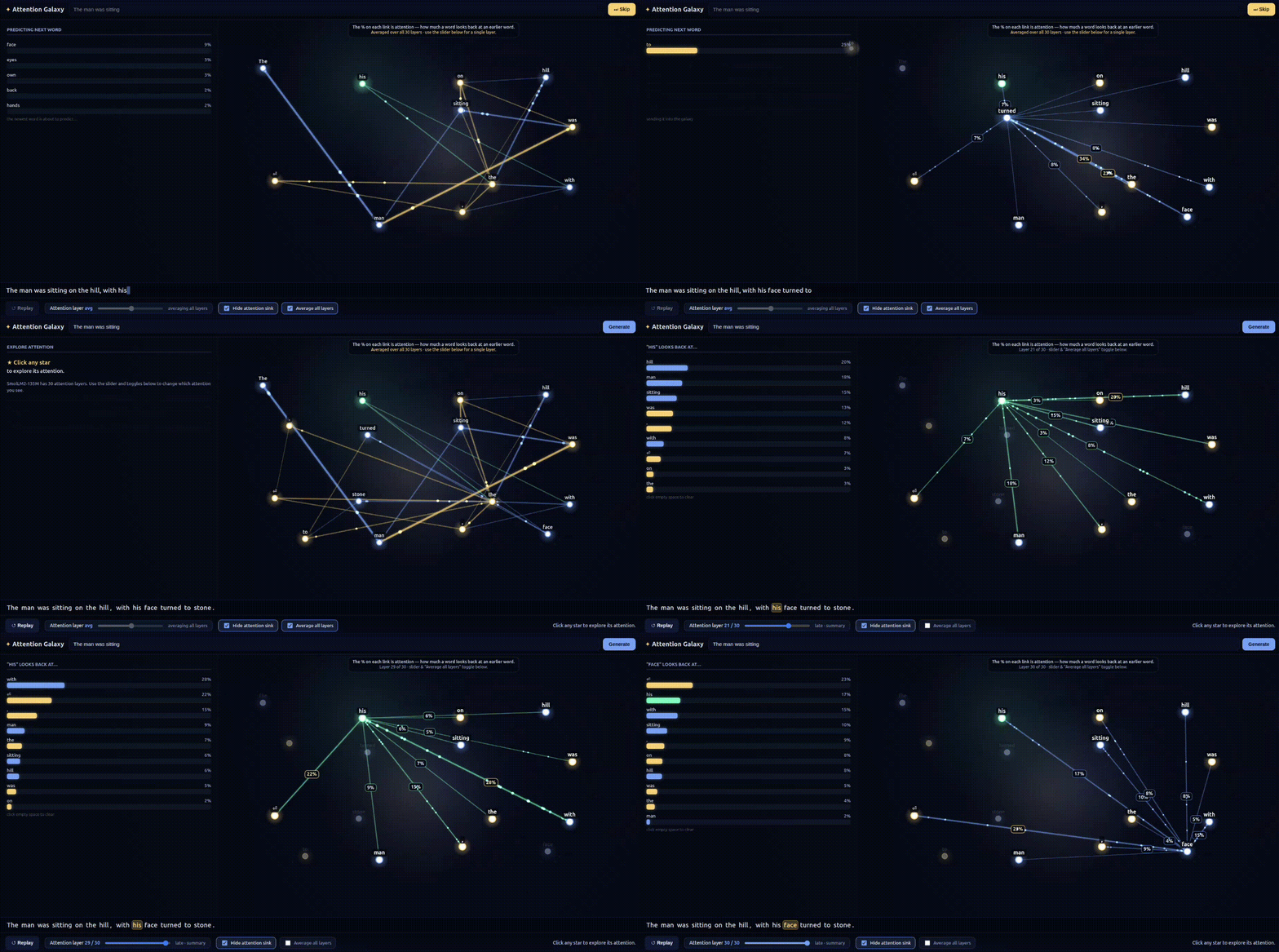
Attention Galaxy turns a transformer's inner workings into something you can watch. Type a prompt and the model continues it one word at a time. For every word it predicts, you see the candidate words it considered and their probabilities — and, in the galaxy, exactly which earlier words it attended to to make that choice, each connection labelled with a clear percentage.
A small 135M-parameter model runs right in your browser — no install, no sign-up.
Useful for learning how transformers work, teaching attention, or just poking at a real model's reasoning. The attention shown is the model's own — it faithfully reflects which earlier words it used, not an approximation.
Browser only
  Transformers.js tokenizer ──▶ onnxruntime-web  (SmolLM2-135M · int8 · WASM-CPU)
                                   │ logits → candidate words + probabilities
                                   │ attn   → per-layer attention (averaged heads)
                                   │ emb    → k-means star colours
                                   ▼
                              Canvas 2D galaxy + prediction panel
| Model | Runtime | Tokenizer | Rendering |
|---|---|---|---|
| SmolLM2-135M (2024, 135M params, 30 layers), int8-quantized ONNX (~158 MB) | onnxruntime-web on WASM-CPU — works on laptops and phones, no special headers | the model's own tokenizer via Transformers.js | a single HTML5 Canvas with one requestAnimationFrame loop |
Decoding is greedy with a repetition penalty and no-repeat-ngram constraint, so the output stays coherent rather than looping. The model is downloaded once (on an explicit click) and cached by the browser thereafter.
Standard ONNX exports don't expose attention weights — which is the one thing
this app is built around. backend/scripts/export_onnx.py wraps the model so it
outputs logits + token embeddings + per-layer attention (using eager
attention so the weights are real), exports to ONNX, quantizes to int8, and
bundles the tokenizer. The wrapper is architecture-agnostic, so GPT-2, Llama /
SmolLM2, Qwen and others all export the same way. You only need this to rebuild
or swap the model — the deployed app already includes everything it needs.
cd frontend
npm install
npm run dev          # http://localhost:5173
The galaxy starts empty. Click Download model, then type a prompt and press
Generate. In development the weights load from frontend/public/model/, so
no internet is needed after npm install.
cd frontend
npm run build        # outputs ./dist
npm run preview
cd backend
python -m venv .venv && source .venv/bin/activate
pip install -r requirements.txt
python scripts/export_onnx.py                    # default: SmolLM2-135M
EXPORT_MODEL=gpt2 python scripts/export_onnx.py  # or any HF causal LM
This writes *-int8.onnx + tokenizer/ + model.json into
frontend/public/model/.
The site is deployed to GitHub Pages by the included GitHub Actions workflow
(.github/workflows/deploy.yml), which builds frontend/ and publishes it on
every push to main. Because the model file exceeds GitHub's 100 MB limit, the
weights are hosted separately on the Hugging Face Hub (CDN-backed and
CORS-enabled) and fetched at runtime — the model URL lives in src/infer.js. The
published site itself is only a few MB, so it stays well within Pages' limits.
attention-galaxy/
├── frontend/                   # the app (static, no runtime server)
│   ├── index.html
│   ├── src/
│   │   ├── main.js             # UI wiring, model download, controls
│   │   ├── infer.js            # in-browser generation (onnxruntime-web)
│   │   ├── galaxy.js           # canvas render loop, physics, links, panels
│   │   └── style.css
│   └── public/model/           # model.json + tokenizer (weights hosted on HF Hub)
├── backend/                    # build-time only: produces the ONNX model
│   ├── requirements.txt
│   └── scripts/export_onnx.py
└── .github/workflows/deploy.yml
Watch a language model think: next-word predictions and live attention, visualized as a galaxy — runs 100% in your browser.
See the codeWatch a language model predict the next word — and see which earlier words it paid attention to.
Attention Galaxy turns a transformer's inner workings into something you can watch. Type a prompt and the model continues it one word at a time. For every word it predicts, you see the candidate words it considered and their probabilities — and, in the galaxy, exactly which earlier words it attended to to make that choice, each connection labelled with a clear percentage.
A small 135M-parameter model runs right in your browser — no install, no sign-up.
Useful for learning how transformers work, teaching attention, or just poking at a real model's reasoning. The attention shown is the model's own — it faithfully reflects which earlier words it used, not an approximation.
Browser only
  Transformers.js tokenizer ──▶ onnxruntime-web  (SmolLM2-135M · int8 · WASM-CPU)
                                   │ logits → candidate words + probabilities
                                   │ attn   → per-layer attention (averaged heads)
                                   │ emb    → k-means star colours
                                   ▼
                              Canvas 2D galaxy + prediction panel
| Model | Runtime | Tokenizer | Rendering |
|---|---|---|---|
| SmolLM2-135M (2024, 135M params, 30 layers), int8-quantized ONNX (~158 MB) | onnxruntime-web on WASM-CPU — works on laptops and phones, no special headers | the model's own tokenizer via Transformers.js | a single HTML5 Canvas with one requestAnimationFrame loop |
Decoding is greedy with a repetition penalty and no-repeat-ngram constraint, so the output stays coherent rather than looping. The model is downloaded once (on an explicit click) and cached by the browser thereafter.
Standard ONNX exports don't expose attention weights — which is the one thing
this app is built around. backend/scripts/export_onnx.py wraps the model so it
outputs logits + token embeddings + per-layer attention (using eager
attention so the weights are real), exports to ONNX, quantizes to int8, and
bundles the tokenizer. The wrapper is architecture-agnostic, so GPT-2, Llama /
SmolLM2, Qwen and others all export the same way. You only need this to rebuild
or swap the model — the deployed app already includes everything it needs.
cd frontend
npm install
npm run dev          # http://localhost:5173
The galaxy starts empty. Click Download model, then type a prompt and press
Generate. In development the weights load from frontend/public/model/, so
no internet is needed after npm install.
cd frontend
npm run build        # outputs ./dist
npm run preview
cd backend
python -m venv .venv && source .venv/bin/activate
pip install -r requirements.txt
python scripts/export_onnx.py                    # default: SmolLM2-135M
EXPORT_MODEL=gpt2 python scripts/export_onnx.py  # or any HF causal LM
This writes *-int8.onnx + tokenizer/ + model.json into
frontend/public/model/.
The site is deployed to GitHub Pages by the included GitHub Actions workflow
(.github/workflows/deploy.yml), which builds frontend/ and publishes it on
every push to main. Because the model file exceeds GitHub's 100 MB limit, the
weights are hosted separately on the Hugging Face Hub (CDN-backed and
CORS-enabled) and fetched at runtime — the model URL lives in src/infer.js. The
published site itself is only a few MB, so it stays well within Pages' limits.
attention-galaxy/
├── frontend/                   # the app (static, no runtime server)
│   ├── index.html
│   ├── src/
│   │   ├── main.js             # UI wiring, model download, controls
│   │   ├── infer.js            # in-browser generation (onnxruntime-web)
│   │   ├── galaxy.js           # canvas render loop, physics, links, panels
│   │   └── style.css
│   └── public/model/           # model.json + tokenizer (weights hosted on HF Hub)
├── backend/                    # build-time only: produces the ONNX model
│   ├── requirements.txt
│   └── scripts/export_onnx.py
└── .github/workflows/deploy.yml



