LensLapse: An In-Browser Logit Lens for Interactive Exploration of Language Model Training Dynamics
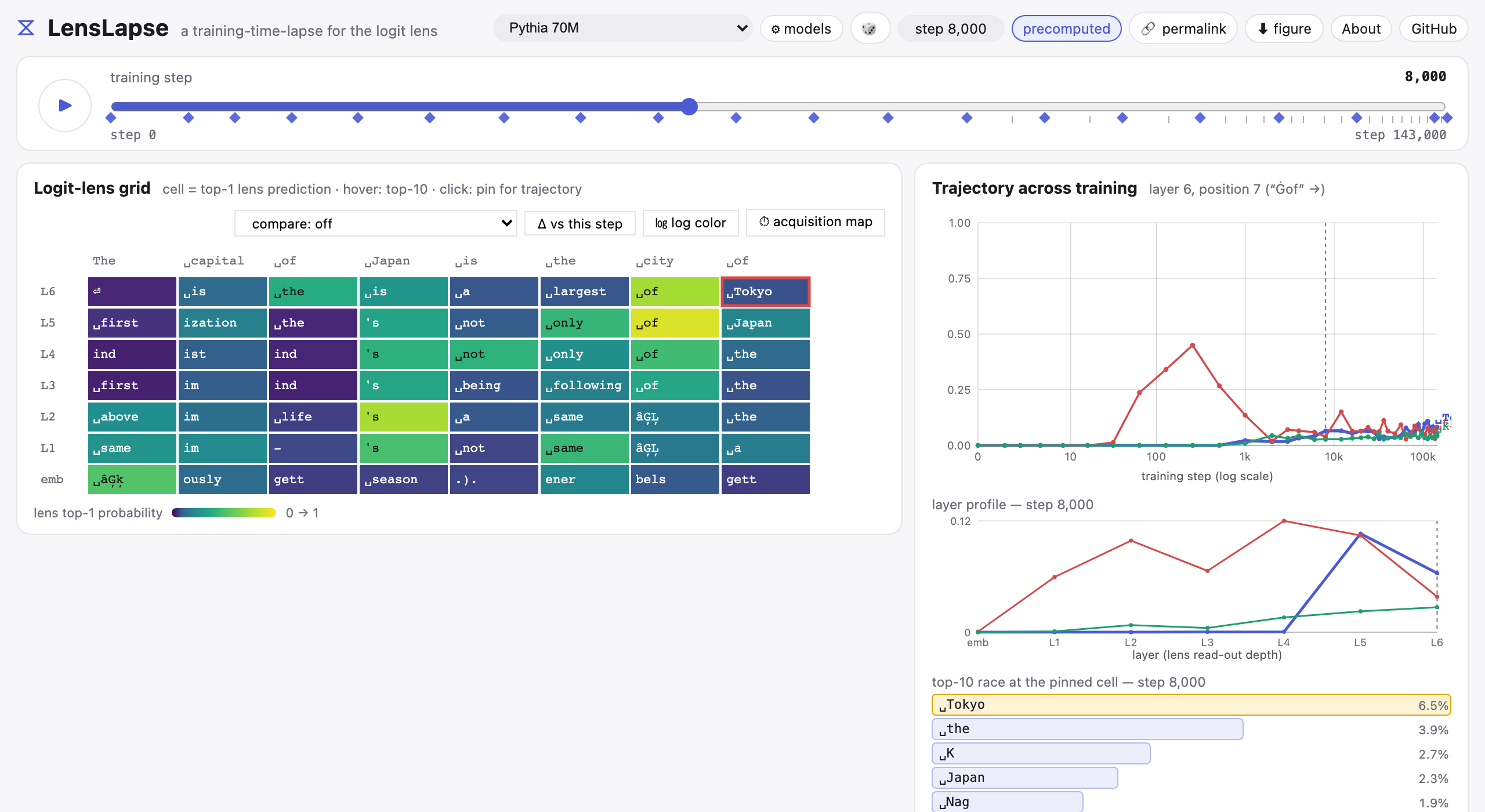
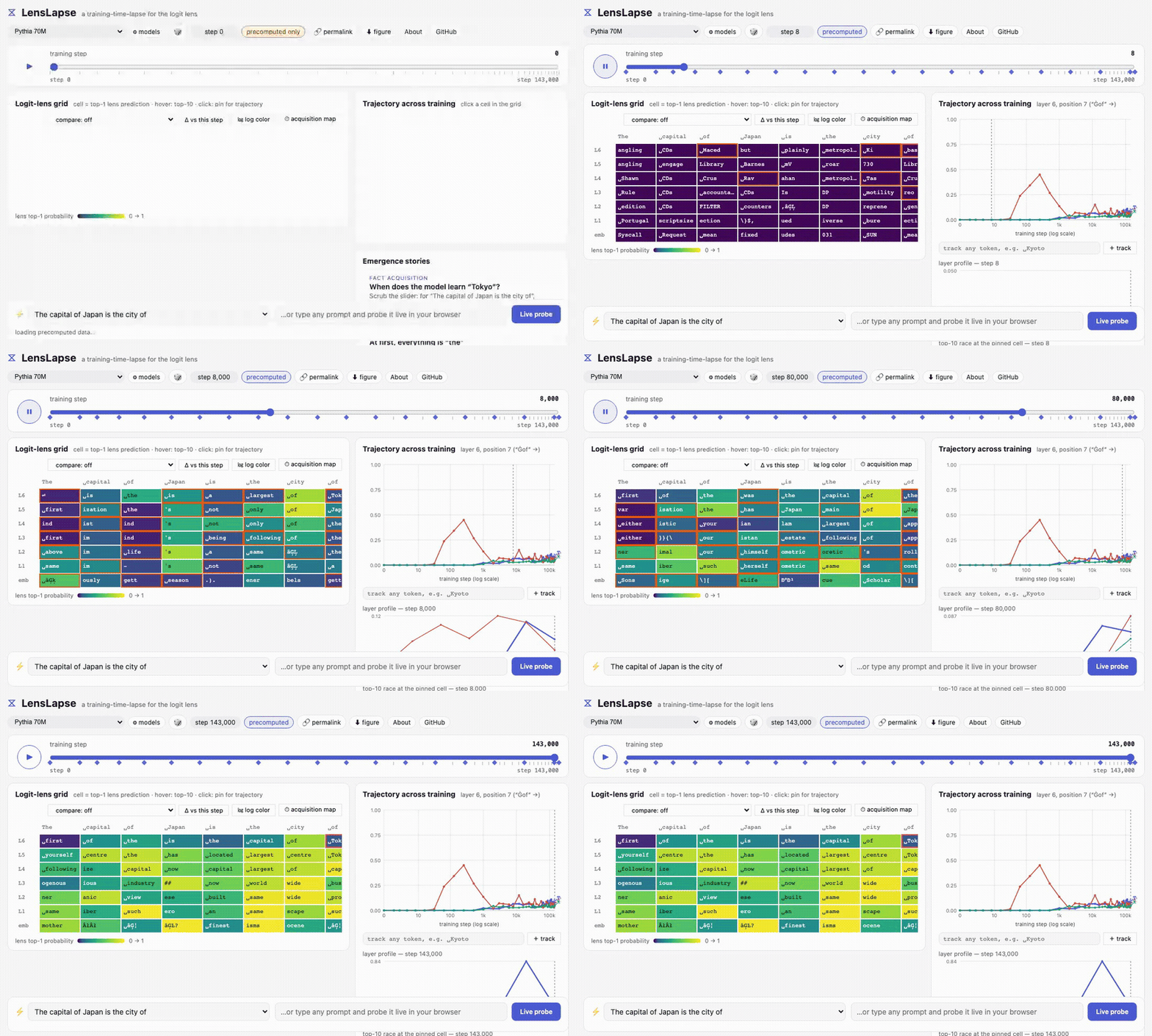
See the codeA fully in-browser time-lapse for the logit lens: scrub across Pythia's public training checkpoints and watch next-token predictions crystallize from noise into knowledge — layer by layer, with zero backend.
| Model | Params | Checkpoints | Languages |
|---|---|---|---|
| Pythia 14M / 70M / 160M | 14M–160M | 20 training steps each | English |
| GPT-2 | 124M | final checkpoint | English |
| MAP-Neo | 250M | 8 training steps (Hub subfolders) | Chinese/English |
| BAAI Aquila | 135M | 6 training steps (Hub subfolders) | Chinese/English |
| BLOOM | 560M | 8 training steps (global_step{N} revisions) | Multilingual (46 languages) |
| SmolLM2 | 135M | final checkpoint | English |
| Qwen3 | 0.6B | final checkpoint | Multilingual |
| OPT | 125M | final checkpoint | English |
| Gemma 3 | 270M | final checkpoint | Multilingual |
Switchable in the header, each labeled by its documented language support ("Multilingual", "Chinese/English", or untagged for English-only) and offering only the curated prompts it can actually handle. The recipe itself is architecture-generic (GPT-NeoX, GPT-2, Llama-style RMSNorm, Mistral-style RMSNorm, and Gemma-style plus-one-weight RMSNorm models all pass the parity check — see src/lenslapse/check_arch_parity.py); a layout the generic heuristic can't reach registers an explicit override in one line via register_architecture() (src/lenslapse/arch.py), without touching the resolver itself. opt-125m and gemma3-270m carry non-Apache-2.0/MIT licenses — see docs/model-card.md before redistributing or deploying them.
pip install lenslapse
lenslapse server        # serves the web app AND the probe API on one local port, then opens it
Everything runs on http://localhost:8017/ — the UI is bundled into the package, so this works
fully offline once models are downloaded, with no CORS or browser permission prompts.
Click ⚙ models in the header, pick a Hugging Face id or press 📁 Browse… to choose a
checkpoint folder with your OS's file dialog, and probe it live — no ONNX conversion, no config
files. (In a checkout, uv run lenslapse server serves your own web/dist build instead;
run scripts/bundle_webapp.sh after changing web/ to refresh the packaged shell.)
Pythia checkpoint (HF Hub, revision step{N})
   └─ src/lenslapse/export_checkpoints.py
        ├─ backbone.f16.onnx   input_ids → hidden states [L+1, T, H]   (pre-ln, uniform; via forward hooks)
        └─ lens.f16.onnx       hidden [N, H] → logits [N, V]           (final_layer_norm + unembedding)
   └─ src/lenslapse/precompute_lens.py → static JSON shards (top-10 per cell + exact target trajectories)

web/ (Vite, TypeScript)
   ├─ precomputed mode: fetch JSON shard → canvas grid + SVG trajectories (no model download)
   └─ live mode: onnxruntime-web (WebGPU→WASM fallback) + @huggingface/transformers tokenizer
Key property: lens(hidden[-1]) == model logits exactly (validated per checkpoint at export). Weights are stored fp16 and cast to fp32 at session load; dynamic int8 was rejected because its final-layer top-1 agreement with fp32 drops to 52% (per-tensor; 71% per-channel) at late checkpoints (see src/lenslapse/fidelity_eval.py).
See docs/advanced-usage.md for: local development setup, converting
checkpoints & precomputing lens data, adding your own model (Hub or local), running the local
probe server for heavy models, scripting every feature from the CLI, probe reproducibility, and
benchmarking. The same guides plus a full API reference are rendered at
https://iamtatsuki05.github.io/lenslapse/docs/.
HF_DEFAULT in web/src/live.ts.npm run build, publish web/dist/ to GitHub Pages (workflow in .github/workflows/deploy-pages.yml).docs/deployment.md.MIT. Pythia checkpoints are © EleutherAI, Apache-2.0; GPT-2 weights are © OpenAI, MIT (Modified);
MAP-Neo and BAAI Aquila checkpoints are Apache-2.0. BLOOM checkpoints are © BigScience Workshop,
licensed under the BigScience RAIL License v1.0 — not a plain permissive license like the others
here; it attaches use-based behavioral restrictions to downstream recipients. opt-125m (Meta's
OPT-175B License Agreement) is non-commercial-research-only — no commercial use is permitted at
all. gemma3-270m (Google's Gemma Terms of Use) permits commercial use but requires passing its
Prohibited Use Policy on to downstream recipients and remains subject to Google's unilateral right
to restrict or terminate use. See docs/model-card.md for the full attribution and license text
for every model.
LensLapse: An In-Browser Logit Lens for Interactive Exploration of Language Model Training Dynamics
See the codeA fully in-browser time-lapse for the logit lens: scrub across Pythia's public training checkpoints and watch next-token predictions crystallize from noise into knowledge — layer by layer, with zero backend.
| Model | Params | Checkpoints | Languages |
|---|---|---|---|
| Pythia 14M / 70M / 160M | 14M–160M | 20 training steps each | English |
| GPT-2 | 124M | final checkpoint | English |
| MAP-Neo | 250M | 8 training steps (Hub subfolders) | Chinese/English |
| BAAI Aquila | 135M | 6 training steps (Hub subfolders) | Chinese/English |
| BLOOM | 560M | 8 training steps (global_step{N} revisions) | Multilingual (46 languages) |
| SmolLM2 | 135M | final checkpoint | English |
| Qwen3 | 0.6B | final checkpoint | Multilingual |
| OPT | 125M | final checkpoint | English |
| Gemma 3 | 270M | final checkpoint | Multilingual |
Switchable in the header, each labeled by its documented language support ("Multilingual", "Chinese/English", or untagged for English-only) and offering only the curated prompts it can actually handle. The recipe itself is architecture-generic (GPT-NeoX, GPT-2, Llama-style RMSNorm, Mistral-style RMSNorm, and Gemma-style plus-one-weight RMSNorm models all pass the parity check — see src/lenslapse/check_arch_parity.py); a layout the generic heuristic can't reach registers an explicit override in one line via register_architecture() (src/lenslapse/arch.py), without touching the resolver itself. opt-125m and gemma3-270m carry non-Apache-2.0/MIT licenses — see docs/model-card.md before redistributing or deploying them.
pip install lenslapse
lenslapse server        # serves the web app AND the probe API on one local port, then opens it
Everything runs on http://localhost:8017/ — the UI is bundled into the package, so this works
fully offline once models are downloaded, with no CORS or browser permission prompts.
Click ⚙ models in the header, pick a Hugging Face id or press 📁 Browse… to choose a
checkpoint folder with your OS's file dialog, and probe it live — no ONNX conversion, no config
files. (In a checkout, uv run lenslapse server serves your own web/dist build instead;
run scripts/bundle_webapp.sh after changing web/ to refresh the packaged shell.)
Pythia checkpoint (HF Hub, revision step{N})
   └─ src/lenslapse/export_checkpoints.py
        ├─ backbone.f16.onnx   input_ids → hidden states [L+1, T, H]   (pre-ln, uniform; via forward hooks)
        └─ lens.f16.onnx       hidden [N, H] → logits [N, V]           (final_layer_norm + unembedding)
   └─ src/lenslapse/precompute_lens.py → static JSON shards (top-10 per cell + exact target trajectories)

web/ (Vite, TypeScript)
   ├─ precomputed mode: fetch JSON shard → canvas grid + SVG trajectories (no model download)
   └─ live mode: onnxruntime-web (WebGPU→WASM fallback) + @huggingface/transformers tokenizer
Key property: lens(hidden[-1]) == model logits exactly (validated per checkpoint at export). Weights are stored fp16 and cast to fp32 at session load; dynamic int8 was rejected because its final-layer top-1 agreement with fp32 drops to 52% (per-tensor; 71% per-channel) at late checkpoints (see src/lenslapse/fidelity_eval.py).
See docs/advanced-usage.md for: local development setup, converting
checkpoints & precomputing lens data, adding your own model (Hub or local), running the local
probe server for heavy models, scripting every feature from the CLI, probe reproducibility, and
benchmarking. The same guides plus a full API reference are rendered at
https://iamtatsuki05.github.io/lenslapse/docs/.
HF_DEFAULT in web/src/live.ts.npm run build, publish web/dist/ to GitHub Pages (workflow in .github/workflows/deploy-pages.yml).docs/deployment.md.MIT. Pythia checkpoints are © EleutherAI, Apache-2.0; GPT-2 weights are © OpenAI, MIT (Modified);
MAP-Neo and BAAI Aquila checkpoints are Apache-2.0. BLOOM checkpoints are © BigScience Workshop,
licensed under the BigScience RAIL License v1.0 — not a plain permissive license like the others
here; it attaches use-based behavioral restrictions to downstream recipients. opt-125m (Meta's
OPT-175B License Agreement) is non-commercial-research-only — no commercial use is permitted at
all. gemma3-270m (Google's Gemma Terms of Use) permits commercial use but requires passing its
Prohibited Use Policy on to downstream recipients and remains subject to Google's unilateral right
to restrict or terminate use. See docs/model-card.md for the full attribution and license text
for every model.