Live J-space / Jacobian-lens visualizer for open-weights language models — interactive layer-by-position workspace readouts from 'Verbalizable Representations Form a Global Workspace in LMs' (2026)
Python
15
0 commits
updated Jul 10, 2026
Live J-space / Jacobian-lens visualizer for open-weights language models.
▶ Try the demo — serverless demo of deepseek-coder-1.3b (40-prompt lens fit on a laptop; GPT-2 comparison page linked in its header) with precomputed example prompts — full UI: lens toggle, workspace panel, click-to-trace ranks, model continuations. Run locally to type your own prompts at any model.
Type a prompt, watch what every layer of the model is disposed to say at every token position — the "verbalizable workspace" from Anthropic's Verbalizable Representations Form a Global Workspace in Language Models (Gurnee et al., 2026) — rendered as an interactive layer × position heatmap, with one-click comparison against the vanilla logit lens and live plots of the paper's workspace-band signatures.
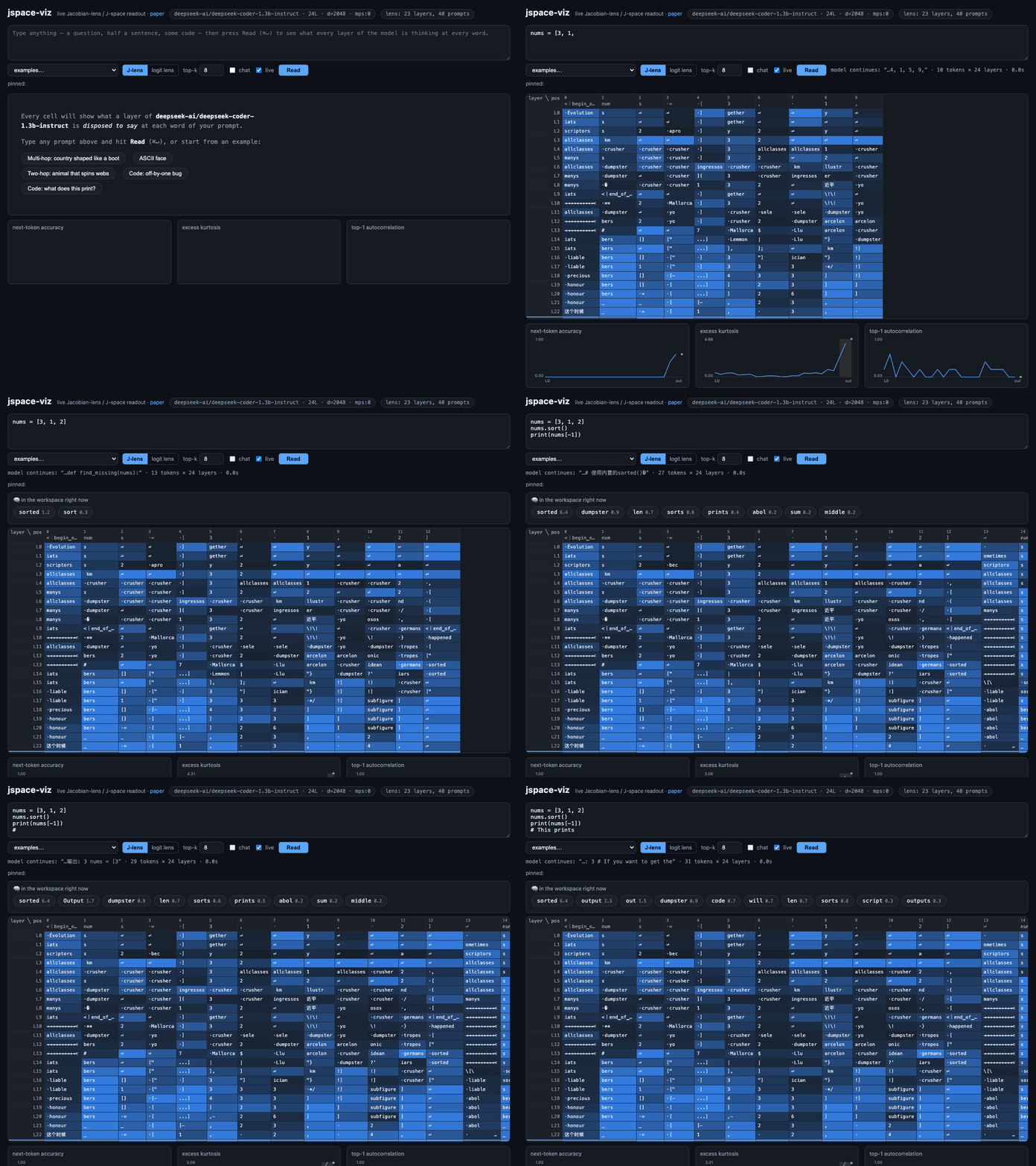
Every frame above is a real render: the app reading a growing prefix of the
prompt, exactly what live-typing mode looks like. Regenerate with
scripts/make_demo_gif.py.
Paste a fresh question — say, code whose answer requires doing something:
nums = [3, 1, 2]
nums.sort()
print(nums[-1])
# This prints
What comes back (deepseek-coder-1.3b):
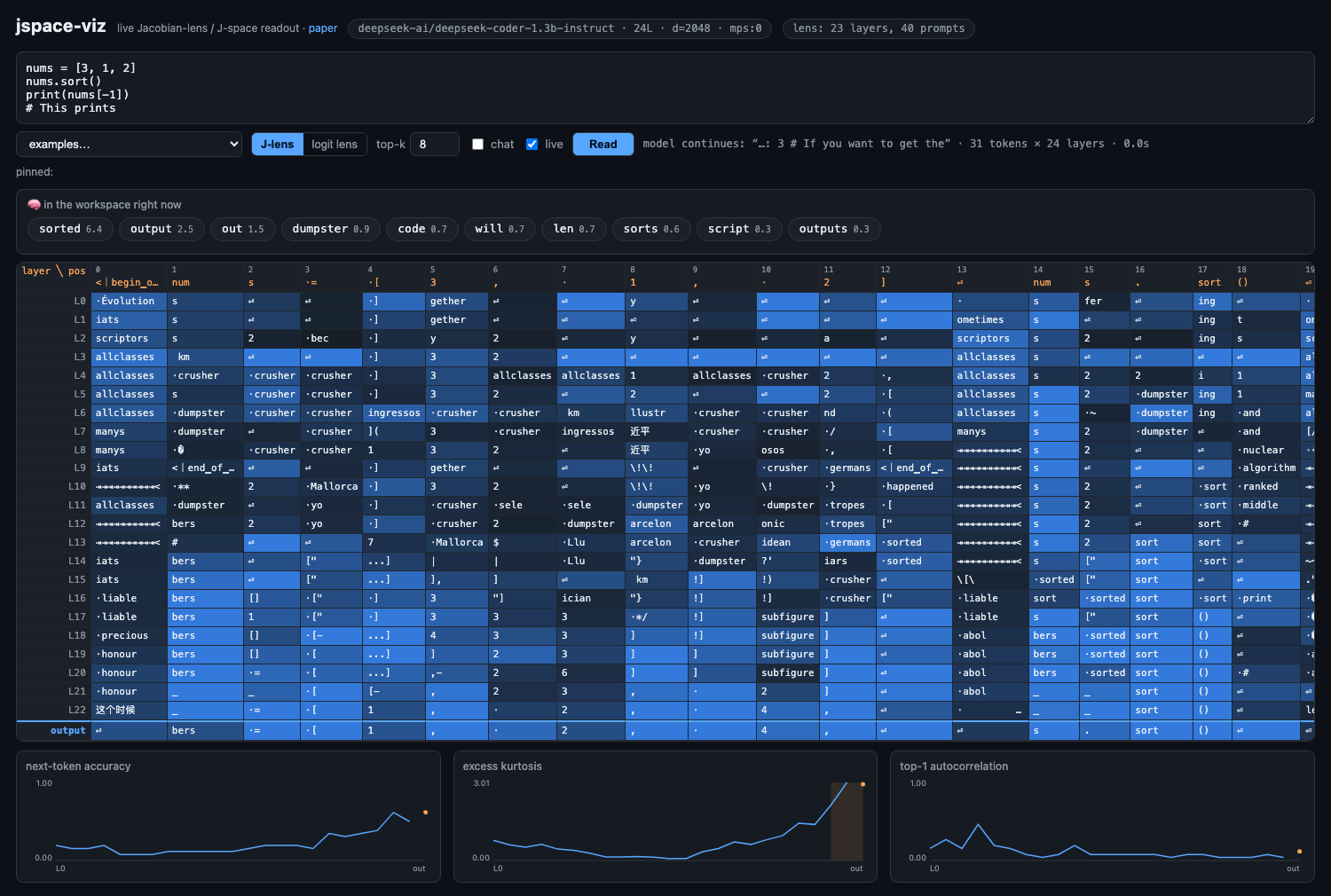
model continues: "…: 3". Correct: the model sorted
[3, 1, 2] in its head and indexed the result.sorted, ahead of output,
len, sorts: while reading unsorted code, the model is holding the
concept of sortedness — the intermediate state its answer depends on,
visible before anything is said.sort column and read downward: early layers
see syntax, mid layers ignite the sorting/output concepts (watch the
excess kurtosis chart hump — that's the workspace band), late layers
converge on phrasing. Click any cell to trace that token's rank everywhere.↳ model says) — the model's own generated
words, workspace included: what it was thinking while it spoke. This is
the readout the paper's alignment-monitoring pitch is about.Then flip on live and edit the code — change sort() to reverse() and
watch the workspace swap sorted out. Every read is computed fresh; nothing
is canned.
The residual stream at layer l lives in a different basis than the final
layer, so decoding it directly with the unembedding (the classic logit lens)
breaks down in early and middle layers. The Jacobian lens first transports the
activation into the final-layer basis using the average input–output
Jacobian over a text corpus:
lens_l(h) = unembed( J_l @ h ), J_l = E[ ∂h_final / ∂h_l ]
The expectation runs over prompts, source positions, and all current-and-later
target positions. The rows of W_U · J_l are the J-lens vectors — one
direction per vocabulary token — and the set of sparse non-negative
combinations of them is the J-space, the paper's candidate for a global
workspace: the small, verbalizable, causally load-bearing slice of the model's
state.
This repo is an independent implementation of the estimator described in the paper and its official reference code (Anthropic PBC, Apache-2.0). The on-disk lens format is byte-compatible in both directions, so the prebaked community lenses that Neuronpedia publishes on the Hub load directly, and lenses fit here load in the official tooling.
Validation — scripts/validate_lens.py fits Pythia-70m on 8 WikiText
prompts and compares against Neuronpedia's 1000-prompt lens (fit with the
official code, on a B200):
| layer | 0 | 1 | 2 | 3 | 4 |
|---|---|---|---|---|---|
| cos(J_ours, J_ref) | 0.66 | 0.76 | 0.89 | 0.94 | 0.98 |
Rising toward 1.0 with layer is the expected convergence pattern (early-layer Jacobians have the highest per-prompt variance), confirming the estimators match.
git clone https://github.com/Festyve/jspace-viz && cd jspace-viz
uv venv && uv pip install -e '.[fit]'

# DeepSeek + this repo's published lens (both auto-download, ~3 GB total)
.venv/bin/jspace-viz --preset deepseek-coder-1.3b
# → open http://127.0.0.1:8321 and type any prompt

# or the featherweight instant version (GPT-2 + Neuronpedia lens, ~600 MB)
.venv/bin/jspace-viz --preset gpt2
Type any prompt — anything at all — and hit Read. The grid is the model's processing unrolled:
· marks a leading space,
⏎ a newline). Each row is one layer, shallow at the top; the
blue-bordered bottom row is what the model actually says next.★0 = the #1 thing on the model's mind at that (layer, position); 30000 =
not a thought at all. Watch a concept ignite mid-stack — the paper's
rank-tracking charts, live.Caveat: GPT-2 is a small 2019 model — its workspace is genuinely murky (you will see word-fragments among the readouts). It's the instant demo. The DeepSeek preset (and anything ≥1B, e.g. the prebaked Gemma/Llama lenses) reads far cleaner.
No public DeepSeek lens existed, so this repo fits its own. On an Apple-Silicon
laptop (16 GB is enough for a ~1.3B model — fitting backprops through the model
d_model times per prompt):
# checkpointed + resumable; writes a usable partial lens after every prompt
.venv/bin/python scripts/fit_lens.py --preset deepseek-coder-1.3b --n-prompts 40 --dim-batch 16
.venv/bin/jspace-viz --preset deepseek-coder-1.3b
Presets (see jspace_viz/presets.py — any HF causal LM with a Llama-style,
GPT-2, or NeoX layout works via --model-id + --lens):
| preset | model | lens | runs on |
|---|---|---|---|
gpt2 | gpt2 (124M) | prebaked (Neuronpedia) | anything |
pythia-70m | Pythia-70m | prebaked (Neuronpedia) | anything |
deepseek-coder-1.3b | deepseek-coder-1.3b-instruct | prebaked (Festyve/jspace-lenses) or refit locally | 16 GB laptop |
gemma-3-1b-it | Gemma-3-1B-it (gated) | prebaked (Neuronpedia) | 16 GB laptop |
llama-3.1-8b-it | Llama-3.1-8B-it (gated) | prebaked (Neuronpedia) | 24 GB+ GPU |
deepseek-r1-distill-llama-8b | R1-Distill-Llama-8B | fit yourself | A100-class GPU |
Corpus follows the Neuronpedia convention (WikiText-103 stream, ≤128 tokens,
first 16 positions skipped as attention sinks). Quality saturates fast: the
paper reports ~10 prompts already beats the logit lens, ~100 is solid, 1000 is
what they ship. Empirically even the 1-prompt partial lens already beats
the logit lens on deepseek-coder-1.3b: on "The capital of France is" it reads
Paris top-1 from layer 16 of 24, while the logit lens still reads generic
filler ( usually, either) at the same depths.
Two options:
python scripts/export_static.py --preset gpt2
precomputes the grids (with full rank tables, so pin/trace works without a
backend) for the example prompts into docs/, ready for GitHub Pages or any
static host. That's what the live demo
is. Visitors can't type new prompts — everything else works.Dockerfile deploys anywhere Docker runs; on Hugging Face, Docker Spaces
require a PRO subscription as of mid-2026.J_l matrices, so the free static site no longer needs precomputed
promptspresets.py are adapted
from its examples.Code: Apache-2.0 (see LICENSE).
Live J-space / Jacobian-lens visualizer for open-weights language models — interactive layer-by-position workspace readouts from 'Verbalizable Representations Form a Global Workspace in LMs' (2026)
Python
15
0 commits
updated Jul 10, 2026
Live J-space / Jacobian-lens visualizer for open-weights language models.
▶ Try the demo — serverless demo of deepseek-coder-1.3b (40-prompt lens fit on a laptop; GPT-2 comparison page linked in its header) with precomputed example prompts — full UI: lens toggle, workspace panel, click-to-trace ranks, model continuations. Run locally to type your own prompts at any model.
Type a prompt, watch what every layer of the model is disposed to say at every token position — the "verbalizable workspace" from Anthropic's Verbalizable Representations Form a Global Workspace in Language Models (Gurnee et al., 2026) — rendered as an interactive layer × position heatmap, with one-click comparison against the vanilla logit lens and live plots of the paper's workspace-band signatures.
Every frame above is a real render: the app reading a growing prefix of the
prompt, exactly what live-typing mode looks like. Regenerate with
scripts/make_demo_gif.py.
Paste a fresh question — say, code whose answer requires doing something:
nums = [3, 1, 2]
nums.sort()
print(nums[-1])
# This prints
What comes back (deepseek-coder-1.3b):
model continues: "…: 3". Correct: the model sorted
[3, 1, 2] in its head and indexed the result.sorted, ahead of output,
len, sorts: while reading unsorted code, the model is holding the
concept of sortedness — the intermediate state its answer depends on,
visible before anything is said.sort column and read downward: early layers
see syntax, mid layers ignite the sorting/output concepts (watch the
excess kurtosis chart hump — that's the workspace band), late layers
converge on phrasing. Click any cell to trace that token's rank everywhere.↳ model says) — the model's own generated
words, workspace included: what it was thinking while it spoke. This is
the readout the paper's alignment-monitoring pitch is about.Then flip on live and edit the code — change sort() to reverse() and
watch the workspace swap sorted out. Every read is computed fresh; nothing
is canned.
The residual stream at layer l lives in a different basis than the final
layer, so decoding it directly with the unembedding (the classic logit lens)
breaks down in early and middle layers. The Jacobian lens first transports the
activation into the final-layer basis using the average input–output
Jacobian over a text corpus:
lens_l(h) = unembed( J_l @ h ), J_l = E[ ∂h_final / ∂h_l ]
The expectation runs over prompts, source positions, and all current-and-later
target positions. The rows of W_U · J_l are the J-lens vectors — one
direction per vocabulary token — and the set of sparse non-negative
combinations of them is the J-space, the paper's candidate for a global
workspace: the small, verbalizable, causally load-bearing slice of the model's
state.
This repo is an independent implementation of the estimator described in the paper and its official reference code (Anthropic PBC, Apache-2.0). The on-disk lens format is byte-compatible in both directions, so the prebaked community lenses that Neuronpedia publishes on the Hub load directly, and lenses fit here load in the official tooling.
Validation — scripts/validate_lens.py fits Pythia-70m on 8 WikiText
prompts and compares against Neuronpedia's 1000-prompt lens (fit with the
official code, on a B200):
| layer | 0 | 1 | 2 | 3 | 4 |
|---|---|---|---|---|---|
| cos(J_ours, J_ref) | 0.66 | 0.76 | 0.89 | 0.94 | 0.98 |
Rising toward 1.0 with layer is the expected convergence pattern (early-layer Jacobians have the highest per-prompt variance), confirming the estimators match.
git clone https://github.com/Festyve/jspace-viz && cd jspace-viz
uv venv && uv pip install -e '.[fit]'

# DeepSeek + this repo's published lens (both auto-download, ~3 GB total)
.venv/bin/jspace-viz --preset deepseek-coder-1.3b
# → open http://127.0.0.1:8321 and type any prompt

# or the featherweight instant version (GPT-2 + Neuronpedia lens, ~600 MB)
.venv/bin/jspace-viz --preset gpt2
Type any prompt — anything at all — and hit Read. The grid is the model's processing unrolled:
· marks a leading space,
⏎ a newline). Each row is one layer, shallow at the top; the
blue-bordered bottom row is what the model actually says next.★0 = the #1 thing on the model's mind at that (layer, position); 30000 =
not a thought at all. Watch a concept ignite mid-stack — the paper's
rank-tracking charts, live.Caveat: GPT-2 is a small 2019 model — its workspace is genuinely murky (you will see word-fragments among the readouts). It's the instant demo. The DeepSeek preset (and anything ≥1B, e.g. the prebaked Gemma/Llama lenses) reads far cleaner.
No public DeepSeek lens existed, so this repo fits its own. On an Apple-Silicon
laptop (16 GB is enough for a ~1.3B model — fitting backprops through the model
d_model times per prompt):
# checkpointed + resumable; writes a usable partial lens after every prompt
.venv/bin/python scripts/fit_lens.py --preset deepseek-coder-1.3b --n-prompts 40 --dim-batch 16
.venv/bin/jspace-viz --preset deepseek-coder-1.3b
Presets (see jspace_viz/presets.py — any HF causal LM with a Llama-style,
GPT-2, or NeoX layout works via --model-id + --lens):
| preset | model | lens | runs on |
|---|---|---|---|
gpt2 | gpt2 (124M) | prebaked (Neuronpedia) | anything |
pythia-70m | Pythia-70m | prebaked (Neuronpedia) | anything |
deepseek-coder-1.3b | deepseek-coder-1.3b-instruct | prebaked (Festyve/jspace-lenses) or refit locally | 16 GB laptop |
gemma-3-1b-it | Gemma-3-1B-it (gated) | prebaked (Neuronpedia) | 16 GB laptop |
llama-3.1-8b-it | Llama-3.1-8B-it (gated) | prebaked (Neuronpedia) | 24 GB+ GPU |
deepseek-r1-distill-llama-8b | R1-Distill-Llama-8B | fit yourself | A100-class GPU |
Corpus follows the Neuronpedia convention (WikiText-103 stream, ≤128 tokens,
first 16 positions skipped as attention sinks). Quality saturates fast: the
paper reports ~10 prompts already beats the logit lens, ~100 is solid, 1000 is
what they ship. Empirically even the 1-prompt partial lens already beats
the logit lens on deepseek-coder-1.3b: on "The capital of France is" it reads
Paris top-1 from layer 16 of 24, while the logit lens still reads generic
filler ( usually, either) at the same depths.
Two options:
python scripts/export_static.py --preset gpt2
precomputes the grids (with full rank tables, so pin/trace works without a
backend) for the example prompts into docs/, ready for GitHub Pages or any
static host. That's what the live demo
is. Visitors can't type new prompts — everything else works.Dockerfile deploys anywhere Docker runs; on Hugging Face, Docker Spaces
require a PRO subscription as of mid-2026.J_l matrices, so the free static site no longer needs precomputed
promptspresets.py are adapted
from its examples.Code: Apache-2.0 (see LICENSE).