Local inference engine for Qwen3.8-Flash-Next on NVIDIA Blackwell
C++
73
1,297 commits
updated Oct 18, 2026

Basalt is a local inference engine for the Qwen3.8-Flash-Next mixture-of-experts model. It targets one thing:
Linux with an NVIDIA Blackwell GPU (sm_120). The experts that do not fit in VRAM live in system RAM (and optionally on
a second GPU used as a peer expert tier), so a large MoE model runs on a single workstation.
Ready-to-run .basalt packs are on Hugging Face.
It is a fork of Strata (MIT), stripped down to that one target. See THIRD_PARTY_LICENSES.
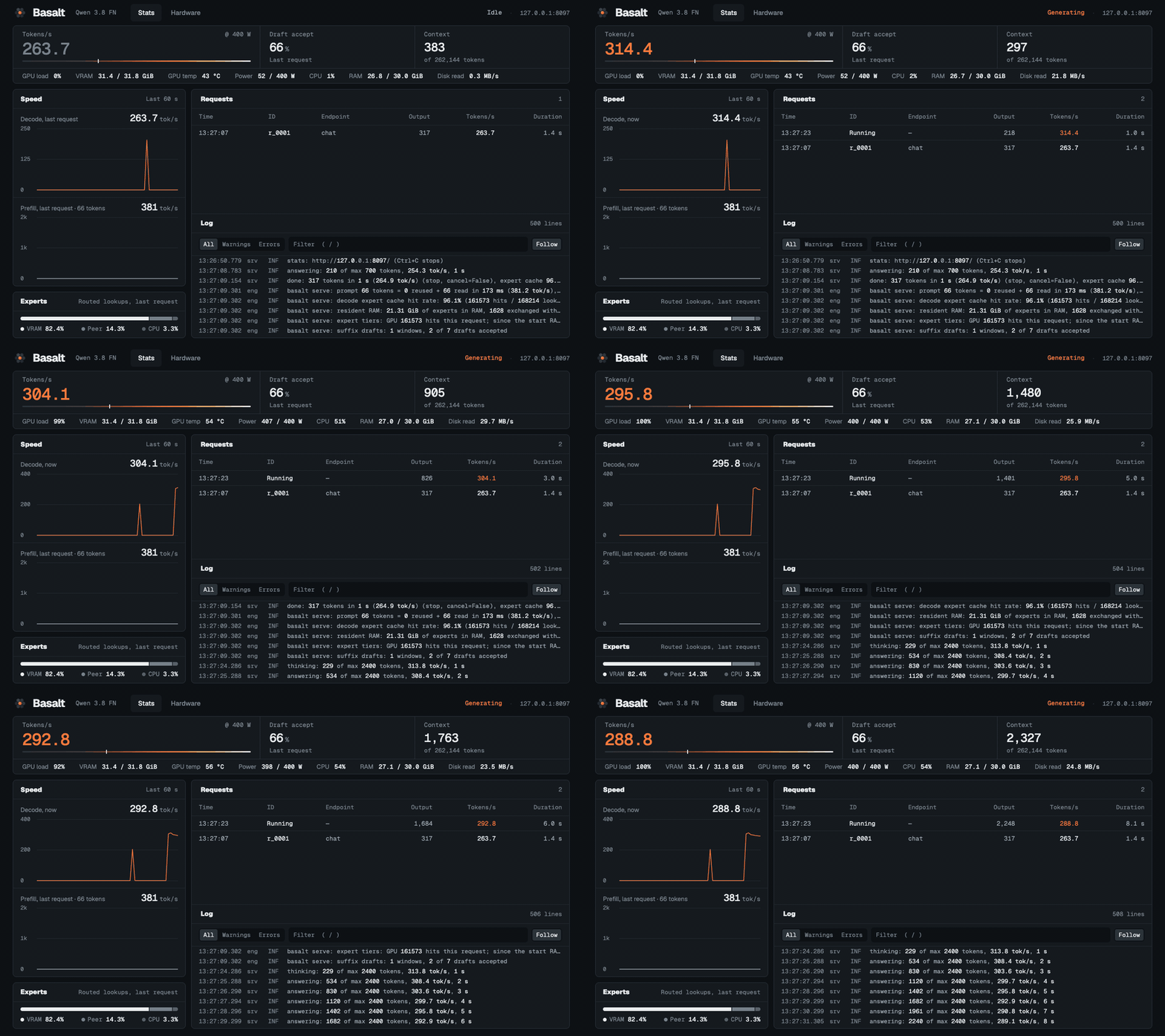
The web UI at / while a reply streams: live decode speed, draft accept rate, context, GPU load and the request log.
src/, include/: the C++/CUDA engine (one binary, basalt).serve/: a Python server with an OpenAI- and Anthropic-compatible API, and a stats page.tools/convert/: the model-file converter (convert.py), its section builders and the drafter fetcher (mtp_fetch.py).tools/: the .basalt reader and writer (model_file.py), the PPL/KLD quality gate (ppl_gate.py), the greedy-identity
check and the tokenizer.tests/: parity and unit tests.pip install -r requirements.txt.cmake -S . -B build -DCMAKE_BUILD_TYPE=Release
cmake --build build -j # bin/basalt, bin/basalt-bench, bin/basalt-vision
The tests are off by default. Configure with -DBUILD_TESTING=ON, build, then run ctest:
cmake -S . -B build -DCMAKE_BUILD_TYPE=Release -DBUILD_TESTING=ON
cmake --build build -j
ctest --test-dir build
The kernel parity tests need the GPU; the file-format, cache and memory unit tests do not. expert_parity and pool_test
need local expert data (experts.bin in the source directory, not shipped), and platform_memory_test needs a locked-memory
limit raised first (ulimit -l); without that, those three fail.
basalt-bench reads its pre-tokenized prompts from data/bench (token ids for the Qwen3.8-Flash-Next tokenizer: the
three decode prompts and a prefill filler); run it from the repository root or pass --fixtures DIR. basalt-bench --help says how the files are made.
The build needs nothing outside this repository and fetches nothing. The parts of ggml and llama.cpp that Basalt uses
(quantization formats, CPU dot products, the prompt path's MMQ kernels) are extracted into src/ and include/basalt/ggml/,
with their MIT licence in THIRD_PARTY_LICENSES.
bin/basalt serve --model /path/to/model.basalt --host 127.0.0.1 --port 8080 [--alias NAME]
The server listens on 127.0.0.1 by default; do not expose it beyond that without --api-key.
--configThe engine's built-in defaults are untuned (4096 context, fp16 KV, no speculation, no expert cache), and the model
file carries no engine flags. Put every setting in one basalt_config.json and pass --config:
{
  "server": {
    "model": "model.basalt",
    "alias": "Qwen 3.8 FN",
    "gpu": "0,1",
    "host": "127.0.0.1",
    "port": 8080
  },
  "engine": {
    "expert-cache": "auto",
    "prefill": "auto",
    "spec": 7,
    "spec-min-p": 0.5,
    "max-context": 262144,
    "kv": "int8",
    "resident-experts": true,
    "vram-reserve-mib": 700
  }
}
bin/basalt serve --config basalt_config.json                     # everything from the file
bin/basalt serve --config basalt_config.json --max-context 32768  # the command line wins
--parallel N--parallel N (1..8, also "parallel" in the config's server section) serves N requests at once in the
engine's batch slots; the default 1 is the single-stream path. Further requests wait in arrival order (a later one
may go first only to resume a slot that holds its conversation, a few times at most). A slot is freed when its
request finishes, is cancelled or its client leaves. /metrics reports live.slots (total, active,
queue_depth). As in llama.cpp, --max-context is shared: each slot holds --max-context / N tokens (--parallel 4 --max-context 262144 gives four slots of 65536; ask for --max-context 1048576 for four of 262144). The solo
path, used while one request runs alone, has the same length, so a request that fits a slot never outgrows it, and
one that does not is refused with a 400 naming that length. /slots, /props and /v1/models report the context
each slot has. --slot-full-context (also "slot-full-context" in the config's server section) gives every slot
the whole --max-context instead, at N times the KV cache; the startup line says so. The slots' KV cache, and one
solo session of the same length, come out of the expert cache.
While other slots are decoding, a new prompt is read beside them: the prompt path runs on its own thread, the slots' decode windows keep running (their kernels take the higher stream priority), and the few steps that touch the draft layer or the output run between two windows. A long prompt therefore does not stop the other requests. A prompt that arrives while no other slot is decoding is read as in the single-stream path.
At startup the server prints one [server] kv cache: line per device with all the session state placed there, for
example 12.5 GiB on cuda2 (solo 262144 tokens + 2 slots x 262144 tokens + draft K/V 0.5 GiB). Because that memory is
taken from the expert cache, the engine warns (basalt warning: the N batch slots' sessions ... take X GiB of CUDA0 ...) when it leaves the cache short of the expert set, or at under half of what it would hold without the slots, and
names the remedies: a smaller --max-context, no --slot-full-context, fewer --parallel slots. If a slot's session
does not fit at all, the engine says which slot (WARNING: --batch N: slot K's session does not fit) and starts with
the slots that did fit; if fewer than two fit, --batch is off and the server runs one request at a time.
server holds the server's options (python -m serve.server --help), named as the flags without the dashes:
strings or numbers, true/false for a switch (lazy, ...), a list for the repeatable ones
(allowed-host, cors-origin). model and tokenizer paths are relative to the file.engine holds engine flags (bin/basalt --help), the same way: a string or number, true for a switch, false
to leave it off. Any flag the engine accepts works, on the command line as well (--kv int8, --resident-experts).
A name the engine does not accept stops the server at startup, as does one in the wrong section.spec, spec-min-p, mtp-max-t, peer-exclusive and
max-context are engine flags; they are also server flags on the command line.--api-key); a config file that sets it is refused.[server] engine: ... lists the settings that came from the file or the command line; without
--config it says the built-in defaults apply.--prefillA prompt is read in chunks. --prefill auto (the usual setting) takes the largest chunk whose buffers the expert cache
can lend: the buffers are carved from the cache's last slots for the length of the prompt and the experts in those slots
are copied back afterwards, so a short prompt lends only what it needs. A bare auto reads a prompt in the fewest equal chunks of at most 12288 tokens (16384 with --peer-exclusive), because
a chunk's cost per token stops falling past a few thousand tokens; it is still limited to what the lend can fund, which with
--resident-experts is the lent slots whose experts the RAM copy holds plus a fixed amount of file reading, and without
--resident-experts is 8192. --prefill auto:N (N = 8192, 16384 or 32768) sets the ceiling yourself; a number sets a
fixed chunk. A prompt longer than one chunk is split into equal chunks (a short tail chunk costs nearly a whole pass over
the streamed experts). The startup line prompt chunk auto: N tokens says what was
chosen.
Basalt refuses settings that would leave the machine without memory, and never shrinks what you asked for:
--vram-reserve-mib below 256 is refused at startup: with less VRAM free once everything is loaded, a later
allocation can make the driver page GPU memory and requests stall.RAM floor ... gives the figures.
When every expert has a place, only the margin is kept, as before.--resident-budget-gib that would leave less than that floor free is refused at startup; the error
states the RAM available and the largest safe value.basalt error: RAM ran low while generating ..., also returned to the client); the server keeps running and takes the next request.--visionImage input is one server option, --vision off | on | peer | dynamic | cpu (config: "vision": "peer" in the
server section). It is off by default. The encoder is Basalt's own and shares its kernels in every mode, so all
five give bitwise identical embeddings.
| mode | where the encoder runs | VRAM cost | fresh-image latency (IQ3_S, 400 W) |
|---|---|---|---|
off | no image input | none | |
on | sidecar bin/basalt-vision on the main GPU, always loaded | about 2.2 GiB of the main card's expert cache | TTFT 0.77 s at 1k image tokens, 1.4 s at 3k, 1.8 s at 4k |
peer | the same sidecar on the second --gpu card | about 1.8 GiB of the peer card's cache, none on the main card | 0.86 s, 2.1 s, 2.9 s |
dynamic | inside the engine, on the main GPU | none at rest (0.87 GiB of pinned RAM) | 0.77 s, 1.45 s, 1.8 s |
cpu | sidecar on the CPU | none | about 6 s at 1k, 40 s at 3k, 70 s at 4k |
dynamic borrows up to 1.55 GiB of expert-cache slots per image (the prompt path's lend), uploads the weights from the
pinned copy (about 30 ms), encodes on a side stream, and refills the same slots from RAM (about 60 ms), so the cache is
identical afterwards. Other --parallel slots pause for the encode. An image already seen is served from the
encoder cache in tens of milliseconds in every mode. peer on a single GPU warns and loads the encoder on that GPU;
with two cards, on says so at startup and names peer as the way to put it on the second card.
{ "server": { "gpu": "0,1", "vision": "peer" } }
on and peer use the sidecar, which the main build also produces (tools/vision also builds on its own); the
server looks for it next to bin/basalt. dynamic needs no sidecar.
The image encoder is Basalt's own, written for this model's vision tower (no llama.cpp or ggml): bf16 tensor-core products and flash attention with fp32 accumulation on the GPU, AVX-512/AVX2 on the CPU. It replaces llama.cpp's mtmd encoder as a drop-in, is faster than it at every image size, and stays closer to an fp32 reference: mtmd's fp16 attention drifts on large images, ours does not.
.basalt model fileA model is one file. It holds everything the engine, the server and the vision sidecar load: the weights, the
tokenizer and chat template, the MTP drafter, the expert profile, the 8-bit hyper-connection copies, the vision
projector, and the default sampling. It carries no engine flags: those come from --config or the command line.
BASALTMF, version, a table of up to 511 named sections, each with its offset,
size and SHA-256), then the sections, each aligned to 2 MiB so it can be memory-mapped or read with O_DIRECT.meta (JSON: geometry, the source GGUF metadata, every tensor's type, shape and offset,
sampling, provenance and license), tokenizer/*, dense, experts and experts.layout (the routed
experts, laid out per layer), gguf (every non-expert source tensor), mtp/* (the drafter), profile, hc8 and
vision/*. The authoritative description is include/basalt/core/model_format.hpp.--compat-bf16, for GGUFs that store the small projections the engine reads as BF16 in another type; it converts
them and records that in meta.Build one from the source GGUF shards (give shard 1; the others are found beside it):
python3 tools/convert/convert.py --gguf MODEL-00001-of-0000N.gguf --mmproj MMPROJ.gguf --out MODEL.basalt \
    [--mtp-source DIR [--mtp-dense FILE]] [--draft-vocab FILE] [--profile FILE] [--hc8 FILE] [--compat-bf16] [--name NAME]
python3 tools/convert/convert.py --help describes every input.
Quality measured with basalt-bench --quality: 20 chunks of wikitext-2 (512 tokens each), scored through the decode
path against the Q8_0 reference. Lower KLD and higher top-1 agreement are closer to Q8_0. How precision is handled and how quality is measured:
docs/precision.md.
| model | source | file | experts | PPL | KLD mean | same top-1 |
|---|---|---|---|---|---|---|
| GSQ-RCO-Coder IQ1_M (256 experts) | ISTA-DASLab | 57.4 GiB | 23.4 GiB | 1.03 | 69% | |
| GSQ-RCO Q2_0 | ISTA-DASLab | 64.9 GiB | 31.6 GiB | 2.971 | 0.486 | 80.6% |
| GSQ-RCO IQ3_XXS | ISTA-DASLab | 74.4 GiB | 40.0 GiB | 2.535 | 0.277 | 86.8% |
| UD-Q2_K_XL | Unsloth | 76.5 GiB | 42.9 GiB | 2.755 | 0.323 | 84.3% |
| UD-IQ3_XXS | Unsloth | 79.4 GiB | 45.3 GiB | 2.564 | 0.244 | 87.0% |
| GSQ-RCO IQ3_S | ISTA-DASLab | 81.0 GiB | 46.8 GiB | 2.387 | 0.177 | 89.4% |
| UD-Q3_K_XL | Unsloth | 86.8 GiB | 52.0 GiB | 2.457 | 0.160 | 89.3% |
| UD-Q4_K_XL | Unsloth | 106.7 GiB | 71.7 GiB | 2.321 | 0.068 | 93.0% |
| Q8_0 | Unsloth | 178.3 GiB | 119.5 GiB | 2.282 | reference |
The IQ3_S, IQ3_XXS and Q2_0 packs carry an MTP layer fine-tuned on the model's own output (self-distillation), which
raises draft acceptance. Output is unchanged, because verify decides every token. Q4_K_XL and Q8_0 keep the original
MTP layer. --mtp-dense FILE embeds that tuned layer (the mtp/dense section's raw bytes, checked against the
source layout) and records it as self-distilled, with its SHA-256, in meta.mtp. The tuned layer ships with the
packs, inside the model file; the converter input is only needed to build a pack yourself.
The model files are derived from Qwen3.8-Flash-Next and are distributed under the Qwen Community License 1.0, not Basalt's MIT license. The GSQ-RCO quants come from IST Austria's Deep Algorithms and Systems Lab; please cite the GSQ and RCO papers if you use them.
See CONTRIBUTING.md.
MIT, see LICENSE.
64 followers · starred Oct 2026
948 followers · starred Oct 2026
39 followers · starred Oct 2026
Local inference engine for Qwen3.8-Flash-Next on NVIDIA Blackwell
C++
73
1,297 commits
updated Oct 18, 2026
Basalt is a local inference engine for the Qwen3.8-Flash-Next mixture-of-experts model. It targets one thing:
Linux with an NVIDIA Blackwell GPU (sm_120). The experts that do not fit in VRAM live in system RAM (and optionally on
a second GPU used as a peer expert tier), so a large MoE model runs on a single workstation.
Ready-to-run .basalt packs are on Hugging Face.
It is a fork of Strata (MIT), stripped down to that one target. See THIRD_PARTY_LICENSES.
The web UI at / while a reply streams: live decode speed, draft accept rate, context, GPU load and the request log.
src/, include/: the C++/CUDA engine (one binary, basalt).serve/: a Python server with an OpenAI- and Anthropic-compatible API, and a stats page.tools/convert/: the model-file converter (convert.py), its section builders and the drafter fetcher (mtp_fetch.py).tools/: the .basalt reader and writer (model_file.py), the PPL/KLD quality gate (ppl_gate.py), the greedy-identity
check and the tokenizer.tests/: parity and unit tests.pip install -r requirements.txt.cmake -S . -B build -DCMAKE_BUILD_TYPE=Release
cmake --build build -j # bin/basalt, bin/basalt-bench, bin/basalt-vision
The tests are off by default. Configure with -DBUILD_TESTING=ON, build, then run ctest:
cmake -S . -B build -DCMAKE_BUILD_TYPE=Release -DBUILD_TESTING=ON
cmake --build build -j
ctest --test-dir build
The kernel parity tests need the GPU; the file-format, cache and memory unit tests do not. expert_parity and pool_test
need local expert data (experts.bin in the source directory, not shipped), and platform_memory_test needs a locked-memory
limit raised first (ulimit -l); without that, those three fail.
basalt-bench reads its pre-tokenized prompts from data/bench (token ids for the Qwen3.8-Flash-Next tokenizer: the
three decode prompts and a prefill filler); run it from the repository root or pass --fixtures DIR. basalt-bench --help says how the files are made.
The build needs nothing outside this repository and fetches nothing. The parts of ggml and llama.cpp that Basalt uses
(quantization formats, CPU dot products, the prompt path's MMQ kernels) are extracted into src/ and include/basalt/ggml/,
with their MIT licence in THIRD_PARTY_LICENSES.
bin/basalt serve --model /path/to/model.basalt --host 127.0.0.1 --port 8080 [--alias NAME]
The server listens on 127.0.0.1 by default; do not expose it beyond that without --api-key.
--configThe engine's built-in defaults are untuned (4096 context, fp16 KV, no speculation, no expert cache), and the model
file carries no engine flags. Put every setting in one basalt_config.json and pass --config:
{
  "server": {
    "model": "model.basalt",
    "alias": "Qwen 3.8 FN",
    "gpu": "0,1",
    "host": "127.0.0.1",
    "port": 8080
  },
  "engine": {
    "expert-cache": "auto",
    "prefill": "auto",
    "spec": 7,
    "spec-min-p": 0.5,
    "max-context": 262144,
    "kv": "int8",
    "resident-experts": true,
    "vram-reserve-mib": 700
  }
}
bin/basalt serve --config basalt_config.json                     # everything from the file
bin/basalt serve --config basalt_config.json --max-context 32768  # the command line wins
--parallel N--parallel N (1..8, also "parallel" in the config's server section) serves N requests at once in the
engine's batch slots; the default 1 is the single-stream path. Further requests wait in arrival order (a later one
may go first only to resume a slot that holds its conversation, a few times at most). A slot is freed when its
request finishes, is cancelled or its client leaves. /metrics reports live.slots (total, active,
queue_depth). As in llama.cpp, --max-context is shared: each slot holds --max-context / N tokens (--parallel 4 --max-context 262144 gives four slots of 65536; ask for --max-context 1048576 for four of 262144). The solo
path, used while one request runs alone, has the same length, so a request that fits a slot never outgrows it, and
one that does not is refused with a 400 naming that length. /slots, /props and /v1/models report the context
each slot has. --slot-full-context (also "slot-full-context" in the config's server section) gives every slot
the whole --max-context instead, at N times the KV cache; the startup line says so. The slots' KV cache, and one
solo session of the same length, come out of the expert cache.
While other slots are decoding, a new prompt is read beside them: the prompt path runs on its own thread, the slots' decode windows keep running (their kernels take the higher stream priority), and the few steps that touch the draft layer or the output run between two windows. A long prompt therefore does not stop the other requests. A prompt that arrives while no other slot is decoding is read as in the single-stream path.
At startup the server prints one [server] kv cache: line per device with all the session state placed there, for
example 12.5 GiB on cuda2 (solo 262144 tokens + 2 slots x 262144 tokens + draft K/V 0.5 GiB). Because that memory is
taken from the expert cache, the engine warns (basalt warning: the N batch slots' sessions ... take X GiB of CUDA0 ...) when it leaves the cache short of the expert set, or at under half of what it would hold without the slots, and
names the remedies: a smaller --max-context, no --slot-full-context, fewer --parallel slots. If a slot's session
does not fit at all, the engine says which slot (WARNING: --batch N: slot K's session does not fit) and starts with
the slots that did fit; if fewer than two fit, --batch is off and the server runs one request at a time.
server holds the server's options (python -m serve.server --help), named as the flags without the dashes:
strings or numbers, true/false for a switch (lazy, ...), a list for the repeatable ones
(allowed-host, cors-origin). model and tokenizer paths are relative to the file.engine holds engine flags (bin/basalt --help), the same way: a string or number, true for a switch, false
to leave it off. Any flag the engine accepts works, on the command line as well (--kv int8, --resident-experts).
A name the engine does not accept stops the server at startup, as does one in the wrong section.spec, spec-min-p, mtp-max-t, peer-exclusive and
max-context are engine flags; they are also server flags on the command line.--api-key); a config file that sets it is refused.[server] engine: ... lists the settings that came from the file or the command line; without
--config it says the built-in defaults apply.--prefillA prompt is read in chunks. --prefill auto (the usual setting) takes the largest chunk whose buffers the expert cache
can lend: the buffers are carved from the cache's last slots for the length of the prompt and the experts in those slots
are copied back afterwards, so a short prompt lends only what it needs. A bare auto reads a prompt in the fewest equal chunks of at most 12288 tokens (16384 with --peer-exclusive), because
a chunk's cost per token stops falling past a few thousand tokens; it is still limited to what the lend can fund, which with
--resident-experts is the lent slots whose experts the RAM copy holds plus a fixed amount of file reading, and without
--resident-experts is 8192. --prefill auto:N (N = 8192, 16384 or 32768) sets the ceiling yourself; a number sets a
fixed chunk. A prompt longer than one chunk is split into equal chunks (a short tail chunk costs nearly a whole pass over
the streamed experts). The startup line prompt chunk auto: N tokens says what was
chosen.
Basalt refuses settings that would leave the machine without memory, and never shrinks what you asked for:
--vram-reserve-mib below 256 is refused at startup: with less VRAM free once everything is loaded, a later
allocation can make the driver page GPU memory and requests stall.RAM floor ... gives the figures.
When every expert has a place, only the margin is kept, as before.--resident-budget-gib that would leave less than that floor free is refused at startup; the error
states the RAM available and the largest safe value.basalt error: RAM ran low while generating ..., also returned to the client); the server keeps running and takes the next request.--visionImage input is one server option, --vision off | on | peer | dynamic | cpu (config: "vision": "peer" in the
server section). It is off by default. The encoder is Basalt's own and shares its kernels in every mode, so all
five give bitwise identical embeddings.
| mode | where the encoder runs | VRAM cost | fresh-image latency (IQ3_S, 400 W) |
|---|---|---|---|
off | no image input | none | |
on | sidecar bin/basalt-vision on the main GPU, always loaded | about 2.2 GiB of the main card's expert cache | TTFT 0.77 s at 1k image tokens, 1.4 s at 3k, 1.8 s at 4k |
peer | the same sidecar on the second --gpu card | about 1.8 GiB of the peer card's cache, none on the main card | 0.86 s, 2.1 s, 2.9 s |
dynamic | inside the engine, on the main GPU | none at rest (0.87 GiB of pinned RAM) | 0.77 s, 1.45 s, 1.8 s |
cpu | sidecar on the CPU | none | about 6 s at 1k, 40 s at 3k, 70 s at 4k |
dynamic borrows up to 1.55 GiB of expert-cache slots per image (the prompt path's lend), uploads the weights from the
pinned copy (about 30 ms), encodes on a side stream, and refills the same slots from RAM (about 60 ms), so the cache is
identical afterwards. Other --parallel slots pause for the encode. An image already seen is served from the
encoder cache in tens of milliseconds in every mode. peer on a single GPU warns and loads the encoder on that GPU;
with two cards, on says so at startup and names peer as the way to put it on the second card.
{ "server": { "gpu": "0,1", "vision": "peer" } }
on and peer use the sidecar, which the main build also produces (tools/vision also builds on its own); the
server looks for it next to bin/basalt. dynamic needs no sidecar.
The image encoder is Basalt's own, written for this model's vision tower (no llama.cpp or ggml): bf16 tensor-core products and flash attention with fp32 accumulation on the GPU, AVX-512/AVX2 on the CPU. It replaces llama.cpp's mtmd encoder as a drop-in, is faster than it at every image size, and stays closer to an fp32 reference: mtmd's fp16 attention drifts on large images, ours does not.
.basalt model fileA model is one file. It holds everything the engine, the server and the vision sidecar load: the weights, the
tokenizer and chat template, the MTP drafter, the expert profile, the 8-bit hyper-connection copies, the vision
projector, and the default sampling. It carries no engine flags: those come from --config or the command line.
BASALTMF, version, a table of up to 511 named sections, each with its offset,
size and SHA-256), then the sections, each aligned to 2 MiB so it can be memory-mapped or read with O_DIRECT.meta (JSON: geometry, the source GGUF metadata, every tensor's type, shape and offset,
sampling, provenance and license), tokenizer/*, dense, experts and experts.layout (the routed
experts, laid out per layer), gguf (every non-expert source tensor), mtp/* (the drafter), profile, hc8 and
vision/*. The authoritative description is include/basalt/core/model_format.hpp.--compat-bf16, for GGUFs that store the small projections the engine reads as BF16 in another type; it converts
them and records that in meta.Build one from the source GGUF shards (give shard 1; the others are found beside it):
python3 tools/convert/convert.py --gguf MODEL-00001-of-0000N.gguf --mmproj MMPROJ.gguf --out MODEL.basalt \
    [--mtp-source DIR [--mtp-dense FILE]] [--draft-vocab FILE] [--profile FILE] [--hc8 FILE] [--compat-bf16] [--name NAME]
python3 tools/convert/convert.py --help describes every input.
Quality measured with basalt-bench --quality: 20 chunks of wikitext-2 (512 tokens each), scored through the decode
path against the Q8_0 reference. Lower KLD and higher top-1 agreement are closer to Q8_0. How precision is handled and how quality is measured:
docs/precision.md.
| model | source | file | experts | PPL | KLD mean | same top-1 |
|---|---|---|---|---|---|---|
| GSQ-RCO-Coder IQ1_M (256 experts) | ISTA-DASLab | 57.4 GiB | 23.4 GiB | 1.03 | 69% | |
| GSQ-RCO Q2_0 | ISTA-DASLab | 64.9 GiB | 31.6 GiB | 2.971 | 0.486 | 80.6% |
| GSQ-RCO IQ3_XXS | ISTA-DASLab | 74.4 GiB | 40.0 GiB | 2.535 | 0.277 | 86.8% |
| UD-Q2_K_XL | Unsloth | 76.5 GiB | 42.9 GiB | 2.755 | 0.323 | 84.3% |
| UD-IQ3_XXS | Unsloth | 79.4 GiB | 45.3 GiB | 2.564 | 0.244 | 87.0% |
| GSQ-RCO IQ3_S | ISTA-DASLab | 81.0 GiB | 46.8 GiB | 2.387 | 0.177 | 89.4% |
| UD-Q3_K_XL | Unsloth | 86.8 GiB | 52.0 GiB | 2.457 | 0.160 | 89.3% |
| UD-Q4_K_XL | Unsloth | 106.7 GiB | 71.7 GiB | 2.321 | 0.068 | 93.0% |
| Q8_0 | Unsloth | 178.3 GiB | 119.5 GiB | 2.282 | reference |
The IQ3_S, IQ3_XXS and Q2_0 packs carry an MTP layer fine-tuned on the model's own output (self-distillation), which
raises draft acceptance. Output is unchanged, because verify decides every token. Q4_K_XL and Q8_0 keep the original
MTP layer. --mtp-dense FILE embeds that tuned layer (the mtp/dense section's raw bytes, checked against the
source layout) and records it as self-distilled, with its SHA-256, in meta.mtp. The tuned layer ships with the
packs, inside the model file; the converter input is only needed to build a pack yourself.
The model files are derived from Qwen3.8-Flash-Next and are distributed under the Qwen Community License 1.0, not Basalt's MIT license. The GSQ-RCO quants come from IST Austria's Deep Algorithms and Systems Lab; please cite the GSQ and RCO papers if you use them.
See CONTRIBUTING.md.
MIT, see LICENSE.
64 followers · starred Oct 2026
948 followers · starred Oct 2026
39 followers · starred Oct 2026



