
README
QW3 + KVMem
CUDA-native inference and tiered KV memory for long-running Qwen agents.
QW3 is a purpose-built inference runtime for Qwen qwen35 hybrid models. It
owns model loading, tokenization, CUDA execution, and device memory instead of
delegating generation to another inference engine. Development currently
focuses on Qwen3.6 and Qwen3.8 27B text generation plus a native
Qwen3.8 image-input path.
Its main feature, KVMem, turns previously computed attention KV state into reusable agent memory. KVMem keeps a bounded working set on the GPU, stages colder blocks through host RAM and optional NVMe, and selects relevant blocks for each new query. The goal is to reduce repeated full-history prefill and text compaction in long-lived agent sessions.
Paper link: https://arxiv.org/abs/2609.04852
Why QW3?
- Native CUDA runtime: QW3 owns the loader, tokenizer, executor, CUDA kernels, KV cache, and memory lifecycle.
- KV memory for agents: retain contextualized KV blocks across GPU, host RAM, and NVMe, then retrieve a bounded working set for the current query.
- Hybrid-model specialization: kernels and execution paths are designed for
Qwen's DeltaNet-plus-attention
qwen35architecture. - Local API serving: expose OpenAI-compatible completions and an Anthropic-compatible Messages subset from the same native runtime.
- Optional native vision: run the Qwen3.8 visual tower on CPU or CUDA and reuse unchanged per-image embeddings across full-transcript requests.
- Optional performance paths: MTP speculative decoding, paged KV, continuous batching, FP8 KV, and NVFP4 weights can be enabled independently.
How KVMem works
KVMem treats an agent’s accumulated KV cache as virtual memory. When the workspace exceeds GPU capacity or the model’s context window, it stores completed KV blocks in host memory or NVMe instead of discarding or summarizing them. At each agent step, KVMem uses the current query to select relevant historical blocks and materializes them, in chronological order, into a bounded GPU-resident execution view. By reusing previously computed KV states and loading only the blocks needed for the current step, KVMem supports large persistent workspaces while keeping GPU memory usage bounded.
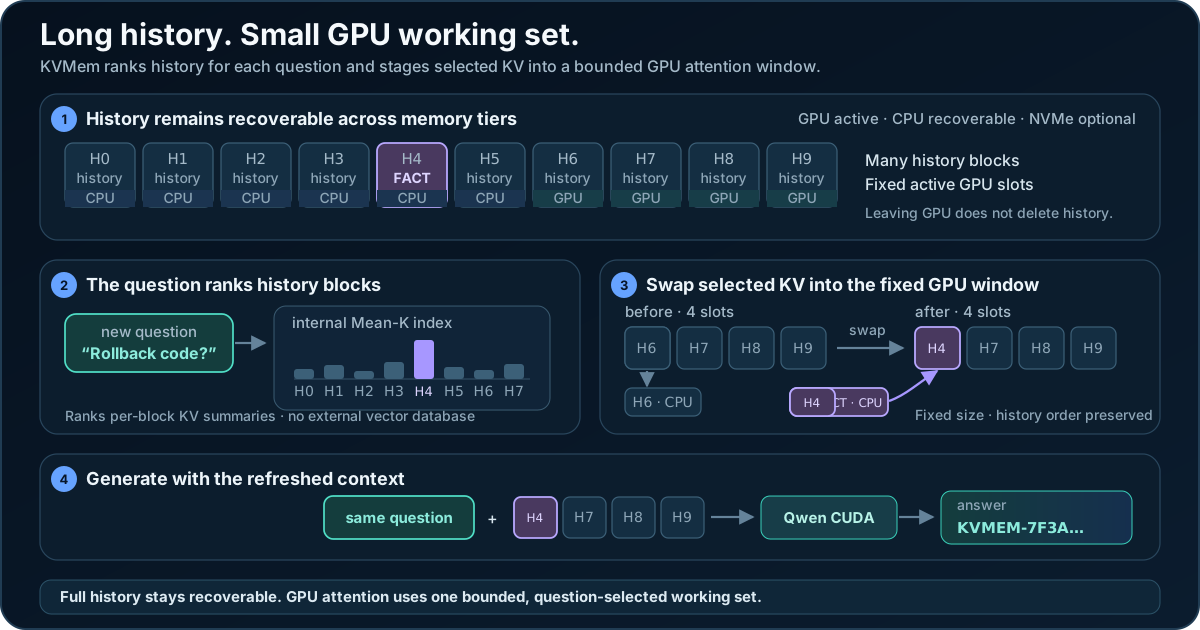
The following three parameters control KVMem’s capacity:
--ctxsets the maximum logical size of the accumulated request or agent workspace, including history stored outside GPU memory.--kvmem-budgetlimits the number of historical tokens selected and materialized into the active working set at each agent step.--kvmem-gen-budgetreserves space in the active context for newly generated response tokens, preventing retrieved history from occupying the entire context window.
The active working set, current-step context, and generation reserve must
together fit within the model’s context window and the available GPU KV
capacity. When the accumulated history exceeds --kvmem-budget, KVMem uses
query-conditioned retrieval to select the most relevant historical blocks for
the current step. The retrieval method, block size, query construction, and
working-set budget provide flexible controls for balancing context coverage and
execution efficiency. KVMem is designed for long-running agents, with its
benefits becoming increasingly pronounced as the accumulated workspace grows
beyond practical GPU KV capacity.
Requirements
- Linux; current development and validation use x86-64.
- An Ampere-or-newer NVIDIA GPU and a matching CUDA toolkit. A dedicated GPU with at least 48 GiB of memory is recommended for the 27B Q8_0 quick start.
- CMake 3.16 or newer for the host build, CMake 3.18 or newer for the CUDA quick start, and a C++17 compiler. SM120 builds require CUDA 12.8 or newer.
- A compatible language checkpoint for the Qwen
qwen35architecture. Image input additionally requires the matching Hugging Face model directory withmodel.visual.*weights and the Python preprocessing dependencies. - Python 3 and the Hugging Face CLI are needed only for the download commands;
install the latter with
python3 -m pip install --upgrade huggingface_hub. - Additional host RAM and fast local NVMe for large KVMem configurations.
- FlashInfer headers for KVMem, FP8 KV, continuous batching, native CUDA vision, or NVFP4; see the FlashInfer build.
QW3 generation is CUDA-only. A host-only build supports model inspection and unit tests, but it does not provide a CPU generation runtime. AMD/ROCm, Metal, and other non-NVIDIA device backends are not implemented.
Quick start: Q8_0 GGUF
This is the smallest QW3 runtime path: in-tree CUDA kernels, FP16 KV, no MTP,
and one request at a time. FlashInfer and Python packages are not required for
the runtime. If a compatible Q8_0 GGUF is already available, set QW3_MODEL
to it and skip the optional download block below.
The native GGUF loader currently supports GGUF v3 files whose model tensors are Q8_0 with F32 metadata/scalar tensors. Generic Q4/IQ GGUF files are not supported.
1. Clone and select the model
git clone https://github.com/Di-Chai/qw3.git
cd qw3

export QW3_MODEL=/absolute/path/to/Qwen3.6-or-Qwen3.8-27B-Q8_0.gguf
# Example for RTX PRO 6000 Blackwell; replace this for the target GPU.
export QW3_CUDA_ARCH=120a-real
For a reproducible public Qwen3.6 Q8 candidate, download the pinned revision and verify its checksum:
export QW3_MODEL_ROOT="${PWD}/../qw3-models"
export QW3_Q8_REVISION=82d411acf4a06cfb8d9b073a5211bf410bfc29bf
export QW3_Q8_DIR="${QW3_MODEL_ROOT}/qwen36-q8"
mkdir -p "${QW3_Q8_DIR}"

hf download unsloth/Qwen3.6-27B-GGUF \
  Qwen3.6-27B-Q8_0.gguf \
  --revision "${QW3_Q8_REVISION}" \
  --local-dir "${QW3_Q8_DIR}"

export QW3_MODEL="${QW3_Q8_DIR}/Qwen3.6-27B-Q8_0.gguf"
export QW3_Q8_SHA256=f93f517f38e696d35a1a7df2c0e3155a64f4c4dcd662107a146ae263f7fb14ce
printf '%s  %s\n' "${QW3_Q8_SHA256}" "${QW3_MODEL}" | sha256sum -c -
Set QW3_CUDA_ARCH to the deployment GPU instead of copying 120a-real
unchanged: use 80 for A100, 86 for A40/A6000/RTX 30, 89 for Ada, 90
for Hopper, and 120a-real for SM120 Blackwell.
2. Build the CUDA runtime
cmake -S . -B build \
  -DCMAKE_BUILD_TYPE=Release \
  -DQW3_ENABLE_CUDA=ON \
  -DQW3_ENABLE_FLASHINFER=OFF \
  -DCMAKE_CUDA_ARCHITECTURES="${QW3_CUDA_ARCH}"

cmake --build build -j
If CMake cannot find nvcc, add the CUDA bin directory to PATH or set
CUDACXX before configuring, for example
export CUDACXX=/usr/local/cuda/bin/nvcc (adjust for your toolkit location).
The explicit OFF keeps this a native-only build even when reusing a CMake
cache. Use the separate build-flashinfer directory below for FlashInfer;
omitting the option does not reset a previously cached value.
3. Inspect the GGUF
./build/qw3-inspect "${QW3_MODEL}"
qw3-inspect is a GGUF inspection tool; it does not inspect Hugging Face model
directories.
4. Run one prompt
./build/qw3 \
  --model "${QW3_MODEL}" \
  --ctx 8192 \
  --kv-dtype fp16 \
  --prefill-chunk 1024 \
  --temp 0 --top-p 1 --top-k 1 \
  -p "Explain virtual memory in one paragraph." \
  -n 256
5. Start the HTTP server
./build/qw3 serve \
  --model "${QW3_MODEL}" \
  --host 127.0.0.1 \
  --port 8080 \
  --ctx 32768 \
  --kv-dtype fp16 \
  --mtp-chain 0 \
  --no-continuous-batching
The server defaults are deliberately conservative: serialized requests, FP16 KV, and no MTP, paged KV, or continuous batching.
In another terminal:
curl -sS http://127.0.0.1:8080/health

curl -sS http://127.0.0.1:8080/v1/chat/completions \
  -H 'Content-Type: application/json' \
  -d '{
    "model": "qw3",
    "messages": [
      {"role": "user", "content": "Explain virtual memory in one paragraph."}
    ],
    "temperature": 0,
    "max_tokens": 256
  }'
The commands above have been checked with the pinned Qwen3.6 Q8_0 file. See the hardware compatibility notes for details about other configurations.
Optional FlashInfer build
FlashInfer is optional for ordinary Q8_0 + FP16 KV generation. It is required
for FP8 KV and the current device-paged attention paths used by KVMem and
continuous batching, as well as native CUDA vision and SM120a NVFP4 weights.
The native-only build/qw3 above does not include these paths.
Keep QW3_MODEL and QW3_CUDA_ARCH from the quick start: use 89 for RTX 4090
or 120a-real for SM120 Blackwell. Set FLASHINFER_DATA to an installed
FlashInfer package's data directory containing include/, cutlass/include/,
and cutlass/tools/util/include/. The SM89/SM120 regression campaign used
FlashInfer 0.6.11.post2 with CUDA 13.0.88; this is the tested combination,
not a claim that every FlashInfer or CUDA version is interchangeable.
export FLASHINFER_DATA=/absolute/path/to/flashinfer/data

cmake -S . -B build-flashinfer \
  -DCMAKE_BUILD_TYPE=Release \
  -DQW3_BUILD_TESTS=OFF \
  -DQW3_ENABLE_CUDA=ON \
  -DCMAKE_CUDA_ARCHITECTURES="${QW3_CUDA_ARCH}" \
  -DQW3_ENABLE_FLASHINFER=ON \
  -DQW3_FLASHINFER_INCLUDE_DIR="${FLASHINFER_DATA}/include" \
  -DQW3_FLASHINFER_CUTLASS_INCLUDE_DIR="${FLASHINFER_DATA}/cutlass/include"

cmake --build build-flashinfer -j4
CMake applies the scalar-output synchronization fix in a build-private header overlay; do not edit installed FlashInfer headers. Rebuild after updating QW3 to include both this fix and the plan-cache/host-metadata fixes. An unrecognized dependency layout stops configuration and requires compatibility review.
FlashInfer attention and its plan cache are enabled by default in this build. If an earlier workaround forced native attention or disabled the plan cache, remove those overrides from the launching shell or service configuration:
unset QW3_PREFILL_ATTN QW3_DECODE_ATTN QW3_FLASHINFER_PLAN_CACHE

./build-flashinfer/qw3 serve \
  --model "${QW3_MODEL}" \
  --host 127.0.0.1 --port 8080 \
  --ctx 32768 \
  --kv-dtype fp16 \
  --prefill-chunk 2048 \
  --mtp-chain 0 \
  --no-continuous-batching
The service CLI/API is unchanged. 2048 makes the server's existing default
prefill chunk explicit; 1024 is also valid. Use --kv-dtype fp8 for FP8 KV
with the same Q8_0 weights. Stop an existing server on port 8080 before starting
another example, or choose a different port.
The latest regression covered serialized Qwen3.8-27B-Q8_0 generation with FP16/FP8 KV on an RTX 4090 48 GB configuration (SM89) and RTX PRO 6000 Blackwell (SM120a). It does not establish that the model fits a stock 24 GB 4090, or validate KVMem, concurrent serving, MTP, vision, or NVFP4 weights. See the SM89/SM120 FlashInfer results for correctness checks, throughput by chunk size, and test coverage limits.
Optional Qwen3.8 image input
QW3 can accept base64 data: image URLs on the OpenAI-compatible chat endpoint
when a matching Qwen3.8 Hugging Face model directory supplies the visual
weights. First prepare the Python worker used for image decoding and
preprocessing:
python3 -m venv .venv
.venv/bin/python -m pip install --upgrade pip
.venv/bin/python -m pip install \
  torch pillow safetensors 'transformers>=5.10,<6'

export QW3_VISION_MODEL=/absolute/path/to/Qwen3.8-27B-BF16
export QW3_VISION_CPU_PYTHON="${PWD}/.venv/bin/python"
The CPU visual frontend works with the basic Q8 build from the quick start. Only the visual tower runs on CPU; the language model remains on GPU:
./build/qw3 serve \
  --model "${QW3_MODEL}" \
  --vision-model "${QW3_VISION_MODEL}" \
  --vision-device cpu \
  --host 127.0.0.1 --port 8080 \
  --ctx 32768 \
  --kv-dtype fp16 \
  --mtp-chain 0 \
  --no-continuous-batching
Native CUDA vision requires the FlashInfer build
above; the basic build binary does not contain that path:
./build-flashinfer/qw3 serve \
  --model "${QW3_MODEL}" \
  --vision-model "${QW3_VISION_MODEL}" \
  --vision-device cuda \
  --host 127.0.0.1 --port 8080 \
  --ctx 32768 \
  --kv-dtype fp16 \
  --mtp-chain 0 \
  --no-continuous-batching
Both servers accept the same OpenAI content-block request:
export IMAGE_FILE=/absolute/path/to/image.png
export IMAGE_BASE64="$(base64 -w0 "${IMAGE_FILE}")"

curl -sS http://127.0.0.1:8080/v1/chat/completions \
  -H 'Content-Type: application/json' \
  -d "{
    \"model\": \"qw3\",
    \"messages\": [{
      \"role\": \"user\",
      \"content\": [
        {\"type\": \"text\", \"text\": \"Describe this image.\"},
        {\"type\": \"image_url\", \"image_url\": {
          \"url\": \"data:image/png;base64,${IMAGE_BASE64}\"
        }}
      ]
    }],
    \"temperature\": 0,
    \"max_tokens\": 256
  }"
--vision-device cuda keeps the BF16 visual tower and projected embeddings on
the GPU; --vision-device cpu runs the visual model in the worker process and
copies its projected embeddings into the language model. Both paths cache
results per image, so an accumulated request such as [A,B,C] -> [A,B,C,D]
only reruns the visual tower for D. The default CPU and GPU cache limits are
512 MiB and can be changed with QW3_VISION_CPU_CACHE_MIB and
QW3_VISION_GPU_CACHE_MIB.
KVMem keeps each visual token span atomic and preserves its M-RoPE coordinates.
With --kvmem-prefix-cache, full-transcript serving validates visual identity
at each projected row before a candidate checkpoint. An accumulated request
such as [A,B,C] -> [A,B,C,D] can therefore reuse the language-model KV prefix
for A,B,C, while a changed or reordered historical image forces a safe miss
at its first visual token. Video input and multimodal continuous batching are
not implemented. See the
native CUDA vision notes for validation details.
Try KVMem
First complete the FlashInfer build, including
removing any old native-attention overrides. KVMem requires FlashInfer's
FP16/FP8 device-paged attention even with serialized serving and
--kvmem-index-placement cpu; the index placement does not move attention to
the CPU. Do not use the native-only quick-start binary for this example.
Prepare a directory on a fast local NVMe filesystem:
export QW3_KVMEM_DIR=/absolute/path/on/local/nvme/qw3-kvmem
mkdir -p "${QW3_KVMEM_DIR}"
Start a serialized KVMem service with a 32K selected working set inside a 128K logical capacity:
./build-flashinfer/qw3 serve \
  --model "${QW3_MODEL}" \
  --host 127.0.0.1 \
  --port 8080 \
  --ctx 131072 \
  --kv-dtype fp16 \
  --mtp-chain 0 \
  --no-continuous-batching \
  --kvmem \
  --kvmem-block-tokens 128 \
  --kvmem-budget 32768 \
  --kvmem-gen-budget 8192 \
  --kvmem-method retrieval \
  --kvmem-retrieval-method mean-k \
  --kvmem-query-conditioned \
  --kvmem-update-mode step \
  --kvmem-index-placement cpu \
  --kvmem-gpu-memory-ratio 0.90 \
  --kvmem-cpu-gb 16 \
  --kvmem-nvme-dir "${QW3_KVMEM_DIR}" \
  --kvmem-nvme-gb 64 \
  --kvmem-query-replay
OpenAI clients should send the accumulated messages history on each turn.
The command above deliberately leaves warm prefix caching off so that the
first smoke test validates the stateless full-transcript path without relying
on checkpoint reuse. The final user message drives query-conditioned retrieval.
--kvmem-prefix-cache is an optional serialized, single-trajectory
optimization that reuses an exact prompt-and-response prefix and prefills only
the appended suffix. Before adding it to a deployment, run
scripts/kvmem_prefix_cache_above_budget_canary.py against the exact build and
configuration; it has stricter prompt-continuation and checkpoint invariants
than the base KVMem path.
The public retrieval scorer values are:
mean-k.per-token(GPU index only).sub-block-mean-k.key-direction-fixed4.key-direction-adaptive.
The older names mean_attention and content_mean are not accepted by the
current CLI. CPU index placement requires query-conditioned retrieval and does
not support per-token.
--kvmem-gpu-memory-ratio bounds total QW3 process memory on the GPU, including
model weights and scratch space; it is not a KV-only percentage. The 0.90
template assumes a dedicated GPU. Lower it only if the resulting ceiling can
still contain the resident model, scratch reserve, selected KV window, and
generation reserve.
Enable QW3_KVMEM_TRACE=1 and QW3_KVMEM_TIER_TRACE=1 when validating a new
installation. An above-budget request should show query replay, a non-fallback
retrieval scorer, and tier movement. A successful short chat request proves
HTTP and generation health, but does not prove that sparse KVMem retrieval ran.
Optional NVFP4 profile
NVFP4 is the memory-efficient weight path for NVIDIA SM120a. It loads a Hugging
Face compressed-tensors directory and uses FlashInfer/CUTLASS-backed NVFP4
kernels; it is not a generic Q4 GGUF path.
export QW3_MODEL_ROOT="${QW3_MODEL_ROOT:-${PWD}/../qw3-models}"
export QW3_NVFP4_REVISION=ccdaab7e68af2409599b8949a8f2685703c9bae5
export QW3_NVFP4_MODEL="${QW3_MODEL_ROOT}/qwen36-nvfp4"
mkdir -p "${QW3_NVFP4_MODEL}"

hf download unsloth/Qwen3.6-27B-NVFP4 \
  --revision "${QW3_NVFP4_REVISION}" \
  --local-dir "${QW3_NVFP4_MODEL}"
Set FLASHINFER_DATA to a FlashInfer package-data directory containing
include/ and cutlass/include/:
export FLASHINFER_DATA=/absolute/path/to/compatible/flashinfer/data

cmake -S . -B build-nvfp4 \
  -DCMAKE_BUILD_TYPE=Release \
  -DQW3_BUILD_TESTS=OFF \
  -DQW3_ENABLE_CUDA=ON \
  -DCMAKE_CUDA_ARCHITECTURES=120a-real \
  -DQW3_ENABLE_FLASHINFER=ON \
  -DQW3_FLASHINFER_INCLUDE_DIR="${FLASHINFER_DATA}/include" \
  -DQW3_FLASHINFER_CUTLASS_INCLUDE_DIR="${FLASHINFER_DATA}/cutlass/include"

cmake --build build-nvfp4 -j

# Loader and tensor-binding smoke test.
./build-nvfp4/qw3 --model "${QW3_NVFP4_MODEL}" --native-plan

# Short generation smoke test; FP8 is the KV-cache dtype, not the weight dtype.
./build-nvfp4/qw3 \
  --model "${QW3_NVFP4_MODEL}" \
  --ctx 8192 \
  --kv-dtype fp8 \
  --prefill-chunk 1024 \
  --temp 0 --top-p 1 --top-k 1 \
  -p "Explain virtual memory in one paragraph." \
  -n 256
Do not run qw3-inspect on this Hugging Face directory; that tool accepts GGUF
files only.
APIs
The serialized server exposes:
GET /health.GET /v1/models.POST /v1/completions.POST /v1/chat/completions.POST /v1/messagesandPOST /v1/messages/count_tokensfor the supported Anthropic-compatible subset.POST /tokenizeandPOST /v1/tokenize.
The built-in server does not provide authentication or TLS. Keep it bound to
127.0.0.1; if it must be reachable beyond localhost, place it behind an
authenticated TLS reverse proxy and apply normal network access controls.
Model format notes
The language-model Hugging Face loader accepts qwen3_5_text directories using
the compressed-tensors format. A generic official FP8 or BF16 directory is
not a drop-in replacement for that language path. The optional visual frontend
separately reads matching model.visual.* weights from a Hugging Face model
directory; it currently accepts images but not video.
Optional runtime paths
The following are intentionally outside the first quick start:
- FlashInfer: optional build-time headers for optimized prefill/decode, required by FP8 KV, KVMem/device-paged attention, continuous batching, native CUDA vision, and NVFP4. Use the FlashInfer build.
- NVFP4: 4-bit
compressed-tensorsweights on SM120a, not generic Q4 GGUF. - MTP speculative decode: enable with
--mtp-chain N. - Image input: enable with
--vision-model DIR --vision-device cpu|cuda; image requests currently use serialized serving. - Continuous batching: use a FlashInfer-enabled binary and enable with
--continuous-batching; it also enables the required paged-KV serving pool and body-batch executor by default. - Frozen archives:
qw3 archive build|query|infoprovides an immutable long-context workflow with stricter FP8 and serving constraints.
Run ./build/qw3 --help for the complete current CLI.
Documentation
- Release status and support matrix
- FlashInfer SM89/SM120 fixes, regression results, and throughput
- Architecture
- Harness compatibility
- Claude Code integration
- Incremental KVMem sessions
- Semantic-group retrieval
- Native CUDA vision frontend
- Third-party notices
Host build and unit tests
The host build is useful for contributors working on parsing, policies, protocol handling, and storage logic. It does not provide generation:
cmake -S . -B build-host -DCMAKE_BUILD_TYPE=Release
cmake --build build-host -j
ctest --test-dir build-host --output-on-failure
Project layout
include/qw3/   Public C++ headers and model/storage interfaces
src/           Runtime, server, model loading, and CUDA kernels
tests/         Host and CUDA component tests
scripts/       Regression, benchmark, and research tooling
docs/          Architecture, integration, and research documentation
third_party/   Vendored source headers covered by third-party notices
License
QW3 source is licensed under the Apache License 2.0. Third-party components retain their respective licenses; see THIRD_PARTY_NOTICES.md. Model checkpoints are distributed separately and may use different license terms.


Similar repos


Languages
C++
37.4%
Python
35.7%
Cuda
21.7%
Shell
4.9%
README
QW3 + KVMem
CUDA-native inference and tiered KV memory for long-running Qwen agents.
QW3 is a purpose-built inference runtime for Qwen qwen35 hybrid models. It
owns model loading, tokenization, CUDA execution, and device memory instead of
delegating generation to another inference engine. Development currently
focuses on Qwen3.6 and Qwen3.8 27B text generation plus a native
Qwen3.8 image-input path.
Its main feature, KVMem, turns previously computed attention KV state into reusable agent memory. KVMem keeps a bounded working set on the GPU, stages colder blocks through host RAM and optional NVMe, and selects relevant blocks for each new query. The goal is to reduce repeated full-history prefill and text compaction in long-lived agent sessions.
Paper link: https://arxiv.org/abs/2609.04852
Why QW3?
- Native CUDA runtime: QW3 owns the loader, tokenizer, executor, CUDA kernels, KV cache, and memory lifecycle.
- KV memory for agents: retain contextualized KV blocks across GPU, host RAM, and NVMe, then retrieve a bounded working set for the current query.
- Hybrid-model specialization: kernels and execution paths are designed for
Qwen's DeltaNet-plus-attention
qwen35architecture. - Local API serving: expose OpenAI-compatible completions and an Anthropic-compatible Messages subset from the same native runtime.
- Optional native vision: run the Qwen3.8 visual tower on CPU or CUDA and reuse unchanged per-image embeddings across full-transcript requests.
- Optional performance paths: MTP speculative decoding, paged KV, continuous batching, FP8 KV, and NVFP4 weights can be enabled independently.
How KVMem works
KVMem treats an agent’s accumulated KV cache as virtual memory. When the workspace exceeds GPU capacity or the model’s context window, it stores completed KV blocks in host memory or NVMe instead of discarding or summarizing them. At each agent step, KVMem uses the current query to select relevant historical blocks and materializes them, in chronological order, into a bounded GPU-resident execution view. By reusing previously computed KV states and loading only the blocks needed for the current step, KVMem supports large persistent workspaces while keeping GPU memory usage bounded.
The following three parameters control KVMem’s capacity:
--ctxsets the maximum logical size of the accumulated request or agent workspace, including history stored outside GPU memory.--kvmem-budgetlimits the number of historical tokens selected and materialized into the active working set at each agent step.--kvmem-gen-budgetreserves space in the active context for newly generated response tokens, preventing retrieved history from occupying the entire context window.
The active working set, current-step context, and generation reserve must
together fit within the model’s context window and the available GPU KV
capacity. When the accumulated history exceeds --kvmem-budget, KVMem uses
query-conditioned retrieval to select the most relevant historical blocks for
the current step. The retrieval method, block size, query construction, and
working-set budget provide flexible controls for balancing context coverage and
execution efficiency. KVMem is designed for long-running agents, with its
benefits becoming increasingly pronounced as the accumulated workspace grows
beyond practical GPU KV capacity.
Requirements
- Linux; current development and validation use x86-64.
- An Ampere-or-newer NVIDIA GPU and a matching CUDA toolkit. A dedicated GPU with at least 48 GiB of memory is recommended for the 27B Q8_0 quick start.
- CMake 3.16 or newer for the host build, CMake 3.18 or newer for the CUDA quick start, and a C++17 compiler. SM120 builds require CUDA 12.8 or newer.
- A compatible language checkpoint for the Qwen
qwen35architecture. Image input additionally requires the matching Hugging Face model directory withmodel.visual.*weights and the Python preprocessing dependencies. - Python 3 and the Hugging Face CLI are needed only for the download commands;
install the latter with
python3 -m pip install --upgrade huggingface_hub. - Additional host RAM and fast local NVMe for large KVMem configurations.
- FlashInfer headers for KVMem, FP8 KV, continuous batching, native CUDA vision, or NVFP4; see the FlashInfer build.
QW3 generation is CUDA-only. A host-only build supports model inspection and unit tests, but it does not provide a CPU generation runtime. AMD/ROCm, Metal, and other non-NVIDIA device backends are not implemented.
Quick start: Q8_0 GGUF
This is the smallest QW3 runtime path: in-tree CUDA kernels, FP16 KV, no MTP,
and one request at a time. FlashInfer and Python packages are not required for
the runtime. If a compatible Q8_0 GGUF is already available, set QW3_MODEL
to it and skip the optional download block below.
The native GGUF loader currently supports GGUF v3 files whose model tensors are Q8_0 with F32 metadata/scalar tensors. Generic Q4/IQ GGUF files are not supported.
1. Clone and select the model
git clone https://github.com/Di-Chai/qw3.git
cd qw3

export QW3_MODEL=/absolute/path/to/Qwen3.6-or-Qwen3.8-27B-Q8_0.gguf
# Example for RTX PRO 6000 Blackwell; replace this for the target GPU.
export QW3_CUDA_ARCH=120a-real
For a reproducible public Qwen3.6 Q8 candidate, download the pinned revision and verify its checksum:
export QW3_MODEL_ROOT="${PWD}/../qw3-models"
export QW3_Q8_REVISION=82d411acf4a06cfb8d9b073a5211bf410bfc29bf
export QW3_Q8_DIR="${QW3_MODEL_ROOT}/qwen36-q8"
mkdir -p "${QW3_Q8_DIR}"

hf download unsloth/Qwen3.6-27B-GGUF \
  Qwen3.6-27B-Q8_0.gguf \
  --revision "${QW3_Q8_REVISION}" \
  --local-dir "${QW3_Q8_DIR}"

export QW3_MODEL="${QW3_Q8_DIR}/Qwen3.6-27B-Q8_0.gguf"
export QW3_Q8_SHA256=f93f517f38e696d35a1a7df2c0e3155a64f4c4dcd662107a146ae263f7fb14ce
printf '%s  %s\n' "${QW3_Q8_SHA256}" "${QW3_MODEL}" | sha256sum -c -
Set QW3_CUDA_ARCH to the deployment GPU instead of copying 120a-real
unchanged: use 80 for A100, 86 for A40/A6000/RTX 30, 89 for Ada, 90
for Hopper, and 120a-real for SM120 Blackwell.
2. Build the CUDA runtime
cmake -S . -B build \
  -DCMAKE_BUILD_TYPE=Release \
  -DQW3_ENABLE_CUDA=ON \
  -DQW3_ENABLE_FLASHINFER=OFF \
  -DCMAKE_CUDA_ARCHITECTURES="${QW3_CUDA_ARCH}"

cmake --build build -j
If CMake cannot find nvcc, add the CUDA bin directory to PATH or set
CUDACXX before configuring, for example
export CUDACXX=/usr/local/cuda/bin/nvcc (adjust for your toolkit location).
The explicit OFF keeps this a native-only build even when reusing a CMake
cache. Use the separate build-flashinfer directory below for FlashInfer;
omitting the option does not reset a previously cached value.
3. Inspect the GGUF
./build/qw3-inspect "${QW3_MODEL}"
qw3-inspect is a GGUF inspection tool; it does not inspect Hugging Face model
directories.
4. Run one prompt
./build/qw3 \
  --model "${QW3_MODEL}" \
  --ctx 8192 \
  --kv-dtype fp16 \
  --prefill-chunk 1024 \
  --temp 0 --top-p 1 --top-k 1 \
  -p "Explain virtual memory in one paragraph." \
  -n 256
5. Start the HTTP server
./build/qw3 serve \
  --model "${QW3_MODEL}" \
  --host 127.0.0.1 \
  --port 8080 \
  --ctx 32768 \
  --kv-dtype fp16 \
  --mtp-chain 0 \
  --no-continuous-batching
The server defaults are deliberately conservative: serialized requests, FP16 KV, and no MTP, paged KV, or continuous batching.
In another terminal:
curl -sS http://127.0.0.1:8080/health

curl -sS http://127.0.0.1:8080/v1/chat/completions \
  -H 'Content-Type: application/json' \
  -d '{
    "model": "qw3",
    "messages": [
      {"role": "user", "content": "Explain virtual memory in one paragraph."}
    ],
    "temperature": 0,
    "max_tokens": 256
  }'
The commands above have been checked with the pinned Qwen3.6 Q8_0 file. See the hardware compatibility notes for details about other configurations.
Optional FlashInfer build
FlashInfer is optional for ordinary Q8_0 + FP16 KV generation. It is required
for FP8 KV and the current device-paged attention paths used by KVMem and
continuous batching, as well as native CUDA vision and SM120a NVFP4 weights.
The native-only build/qw3 above does not include these paths.
Keep QW3_MODEL and QW3_CUDA_ARCH from the quick start: use 89 for RTX 4090
or 120a-real for SM120 Blackwell. Set FLASHINFER_DATA to an installed
FlashInfer package's data directory containing include/, cutlass/include/,
and cutlass/tools/util/include/. The SM89/SM120 regression campaign used
FlashInfer 0.6.11.post2 with CUDA 13.0.88; this is the tested combination,
not a claim that every FlashInfer or CUDA version is interchangeable.
export FLASHINFER_DATA=/absolute/path/to/flashinfer/data

cmake -S . -B build-flashinfer \
  -DCMAKE_BUILD_TYPE=Release \
  -DQW3_BUILD_TESTS=OFF \
  -DQW3_ENABLE_CUDA=ON \
  -DCMAKE_CUDA_ARCHITECTURES="${QW3_CUDA_ARCH}" \
  -DQW3_ENABLE_FLASHINFER=ON \
  -DQW3_FLASHINFER_INCLUDE_DIR="${FLASHINFER_DATA}/include" \
  -DQW3_FLASHINFER_CUTLASS_INCLUDE_DIR="${FLASHINFER_DATA}/cutlass/include"

cmake --build build-flashinfer -j4
CMake applies the scalar-output synchronization fix in a build-private header overlay; do not edit installed FlashInfer headers. Rebuild after updating QW3 to include both this fix and the plan-cache/host-metadata fixes. An unrecognized dependency layout stops configuration and requires compatibility review.
FlashInfer attention and its plan cache are enabled by default in this build. If an earlier workaround forced native attention or disabled the plan cache, remove those overrides from the launching shell or service configuration:
unset QW3_PREFILL_ATTN QW3_DECODE_ATTN QW3_FLASHINFER_PLAN_CACHE

./build-flashinfer/qw3 serve \
  --model "${QW3_MODEL}" \
  --host 127.0.0.1 --port 8080 \
  --ctx 32768 \
  --kv-dtype fp16 \
  --prefill-chunk 2048 \
  --mtp-chain 0 \
  --no-continuous-batching
The service CLI/API is unchanged. 2048 makes the server's existing default
prefill chunk explicit; 1024 is also valid. Use --kv-dtype fp8 for FP8 KV
with the same Q8_0 weights. Stop an existing server on port 8080 before starting
another example, or choose a different port.
The latest regression covered serialized Qwen3.8-27B-Q8_0 generation with FP16/FP8 KV on an RTX 4090 48 GB configuration (SM89) and RTX PRO 6000 Blackwell (SM120a). It does not establish that the model fits a stock 24 GB 4090, or validate KVMem, concurrent serving, MTP, vision, or NVFP4 weights. See the SM89/SM120 FlashInfer results for correctness checks, throughput by chunk size, and test coverage limits.
Optional Qwen3.8 image input
QW3 can accept base64 data: image URLs on the OpenAI-compatible chat endpoint
when a matching Qwen3.8 Hugging Face model directory supplies the visual
weights. First prepare the Python worker used for image decoding and
preprocessing:
python3 -m venv .venv
.venv/bin/python -m pip install --upgrade pip
.venv/bin/python -m pip install \
  torch pillow safetensors 'transformers>=5.10,<6'

export QW3_VISION_MODEL=/absolute/path/to/Qwen3.8-27B-BF16
export QW3_VISION_CPU_PYTHON="${PWD}/.venv/bin/python"
The CPU visual frontend works with the basic Q8 build from the quick start. Only the visual tower runs on CPU; the language model remains on GPU:
./build/qw3 serve \
  --model "${QW3_MODEL}" \
  --vision-model "${QW3_VISION_MODEL}" \
  --vision-device cpu \
  --host 127.0.0.1 --port 8080 \
  --ctx 32768 \
  --kv-dtype fp16 \
  --mtp-chain 0 \
  --no-continuous-batching
Native CUDA vision requires the FlashInfer build
above; the basic build binary does not contain that path:
./build-flashinfer/qw3 serve \
  --model "${QW3_MODEL}" \
  --vision-model "${QW3_VISION_MODEL}" \
  --vision-device cuda \
  --host 127.0.0.1 --port 8080 \
  --ctx 32768 \
  --kv-dtype fp16 \
  --mtp-chain 0 \
  --no-continuous-batching
Both servers accept the same OpenAI content-block request:
export IMAGE_FILE=/absolute/path/to/image.png
export IMAGE_BASE64="$(base64 -w0 "${IMAGE_FILE}")"

curl -sS http://127.0.0.1:8080/v1/chat/completions \
  -H 'Content-Type: application/json' \
  -d "{
    \"model\": \"qw3\",
    \"messages\": [{
      \"role\": \"user\",
      \"content\": [
        {\"type\": \"text\", \"text\": \"Describe this image.\"},
        {\"type\": \"image_url\", \"image_url\": {
          \"url\": \"data:image/png;base64,${IMAGE_BASE64}\"
        }}
      ]
    }],
    \"temperature\": 0,
    \"max_tokens\": 256
  }"
--vision-device cuda keeps the BF16 visual tower and projected embeddings on
the GPU; --vision-device cpu runs the visual model in the worker process and
copies its projected embeddings into the language model. Both paths cache
results per image, so an accumulated request such as [A,B,C] -> [A,B,C,D]
only reruns the visual tower for D. The default CPU and GPU cache limits are
512 MiB and can be changed with QW3_VISION_CPU_CACHE_MIB and
QW3_VISION_GPU_CACHE_MIB.
KVMem keeps each visual token span atomic and preserves its M-RoPE coordinates.
With --kvmem-prefix-cache, full-transcript serving validates visual identity
at each projected row before a candidate checkpoint. An accumulated request
such as [A,B,C] -> [A,B,C,D] can therefore reuse the language-model KV prefix
for A,B,C, while a changed or reordered historical image forces a safe miss
at its first visual token. Video input and multimodal continuous batching are
not implemented. See the
native CUDA vision notes for validation details.
Try KVMem
First complete the FlashInfer build, including
removing any old native-attention overrides. KVMem requires FlashInfer's
FP16/FP8 device-paged attention even with serialized serving and
--kvmem-index-placement cpu; the index placement does not move attention to
the CPU. Do not use the native-only quick-start binary for this example.
Prepare a directory on a fast local NVMe filesystem:
export QW3_KVMEM_DIR=/absolute/path/on/local/nvme/qw3-kvmem
mkdir -p "${QW3_KVMEM_DIR}"
Start a serialized KVMem service with a 32K selected working set inside a 128K logical capacity:
./build-flashinfer/qw3 serve \
  --model "${QW3_MODEL}" \
  --host 127.0.0.1 \
  --port 8080 \
  --ctx 131072 \
  --kv-dtype fp16 \
  --mtp-chain 0 \
  --no-continuous-batching \
  --kvmem \
  --kvmem-block-tokens 128 \
  --kvmem-budget 32768 \
  --kvmem-gen-budget 8192 \
  --kvmem-method retrieval \
  --kvmem-retrieval-method mean-k \
  --kvmem-query-conditioned \
  --kvmem-update-mode step \
  --kvmem-index-placement cpu \
  --kvmem-gpu-memory-ratio 0.90 \
  --kvmem-cpu-gb 16 \
  --kvmem-nvme-dir "${QW3_KVMEM_DIR}" \
  --kvmem-nvme-gb 64 \
  --kvmem-query-replay
OpenAI clients should send the accumulated messages history on each turn.
The command above deliberately leaves warm prefix caching off so that the
first smoke test validates the stateless full-transcript path without relying
on checkpoint reuse. The final user message drives query-conditioned retrieval.
--kvmem-prefix-cache is an optional serialized, single-trajectory
optimization that reuses an exact prompt-and-response prefix and prefills only
the appended suffix. Before adding it to a deployment, run
scripts/kvmem_prefix_cache_above_budget_canary.py against the exact build and
configuration; it has stricter prompt-continuation and checkpoint invariants
than the base KVMem path.
The public retrieval scorer values are:
mean-k.per-token(GPU index only).sub-block-mean-k.key-direction-fixed4.key-direction-adaptive.
The older names mean_attention and content_mean are not accepted by the
current CLI. CPU index placement requires query-conditioned retrieval and does
not support per-token.
--kvmem-gpu-memory-ratio bounds total QW3 process memory on the GPU, including
model weights and scratch space; it is not a KV-only percentage. The 0.90
template assumes a dedicated GPU. Lower it only if the resulting ceiling can
still contain the resident model, scratch reserve, selected KV window, and
generation reserve.
Enable QW3_KVMEM_TRACE=1 and QW3_KVMEM_TIER_TRACE=1 when validating a new
installation. An above-budget request should show query replay, a non-fallback
retrieval scorer, and tier movement. A successful short chat request proves
HTTP and generation health, but does not prove that sparse KVMem retrieval ran.
Optional NVFP4 profile
NVFP4 is the memory-efficient weight path for NVIDIA SM120a. It loads a Hugging
Face compressed-tensors directory and uses FlashInfer/CUTLASS-backed NVFP4
kernels; it is not a generic Q4 GGUF path.
export QW3_MODEL_ROOT="${QW3_MODEL_ROOT:-${PWD}/../qw3-models}"
export QW3_NVFP4_REVISION=ccdaab7e68af2409599b8949a8f2685703c9bae5
export QW3_NVFP4_MODEL="${QW3_MODEL_ROOT}/qwen36-nvfp4"
mkdir -p "${QW3_NVFP4_MODEL}"

hf download unsloth/Qwen3.6-27B-NVFP4 \
  --revision "${QW3_NVFP4_REVISION}" \
  --local-dir "${QW3_NVFP4_MODEL}"
Set FLASHINFER_DATA to a FlashInfer package-data directory containing
include/ and cutlass/include/:
export FLASHINFER_DATA=/absolute/path/to/compatible/flashinfer/data

cmake -S . -B build-nvfp4 \
  -DCMAKE_BUILD_TYPE=Release \
  -DQW3_BUILD_TESTS=OFF \
  -DQW3_ENABLE_CUDA=ON \
  -DCMAKE_CUDA_ARCHITECTURES=120a-real \
  -DQW3_ENABLE_FLASHINFER=ON \
  -DQW3_FLASHINFER_INCLUDE_DIR="${FLASHINFER_DATA}/include" \
  -DQW3_FLASHINFER_CUTLASS_INCLUDE_DIR="${FLASHINFER_DATA}/cutlass/include"

cmake --build build-nvfp4 -j

# Loader and tensor-binding smoke test.
./build-nvfp4/qw3 --model "${QW3_NVFP4_MODEL}" --native-plan

# Short generation smoke test; FP8 is the KV-cache dtype, not the weight dtype.
./build-nvfp4/qw3 \
  --model "${QW3_NVFP4_MODEL}" \
  --ctx 8192 \
  --kv-dtype fp8 \
  --prefill-chunk 1024 \
  --temp 0 --top-p 1 --top-k 1 \
  -p "Explain virtual memory in one paragraph." \
  -n 256
Do not run qw3-inspect on this Hugging Face directory; that tool accepts GGUF
files only.
APIs
The serialized server exposes:
GET /health.GET /v1/models.POST /v1/completions.POST /v1/chat/completions.POST /v1/messagesandPOST /v1/messages/count_tokensfor the supported Anthropic-compatible subset.POST /tokenizeandPOST /v1/tokenize.
The built-in server does not provide authentication or TLS. Keep it bound to
127.0.0.1; if it must be reachable beyond localhost, place it behind an
authenticated TLS reverse proxy and apply normal network access controls.
Model format notes
The language-model Hugging Face loader accepts qwen3_5_text directories using
the compressed-tensors format. A generic official FP8 or BF16 directory is
not a drop-in replacement for that language path. The optional visual frontend
separately reads matching model.visual.* weights from a Hugging Face model
directory; it currently accepts images but not video.
Optional runtime paths
The following are intentionally outside the first quick start:
- FlashInfer: optional build-time headers for optimized prefill/decode, required by FP8 KV, KVMem/device-paged attention, continuous batching, native CUDA vision, and NVFP4. Use the FlashInfer build.
- NVFP4: 4-bit
compressed-tensorsweights on SM120a, not generic Q4 GGUF. - MTP speculative decode: enable with
--mtp-chain N. - Image input: enable with
--vision-model DIR --vision-device cpu|cuda; image requests currently use serialized serving. - Continuous batching: use a FlashInfer-enabled binary and enable with
--continuous-batching; it also enables the required paged-KV serving pool and body-batch executor by default. - Frozen archives:
qw3 archive build|query|infoprovides an immutable long-context workflow with stricter FP8 and serving constraints.
Run ./build/qw3 --help for the complete current CLI.
Documentation
- Release status and support matrix
- FlashInfer SM89/SM120 fixes, regression results, and throughput
- Architecture
- Harness compatibility
- Claude Code integration
- Incremental KVMem sessions
- Semantic-group retrieval
- Native CUDA vision frontend
- Third-party notices
Host build and unit tests
The host build is useful for contributors working on parsing, policies, protocol handling, and storage logic. It does not provide generation:
cmake -S . -B build-host -DCMAKE_BUILD_TYPE=Release
cmake --build build-host -j
ctest --test-dir build-host --output-on-failure
Project layout
include/qw3/   Public C++ headers and model/storage interfaces
src/           Runtime, server, model loading, and CUDA kernels
tests/         Host and CUDA component tests
scripts/       Regression, benchmark, and research tooling
docs/          Architecture, integration, and research documentation
third_party/   Vendored source headers covered by third-party notices
License
QW3 source is licensed under the Apache License 2.0. Third-party components retain their respective licenses; see THIRD_PARTY_NOTICES.md. Model checkpoints are distributed separately and may use different license terms.
Similar repos
Languages
C++
37.4%
Python
35.7%
Cuda
21.7%
Shell
4.9%