VendorBench-100: a unified cross-paradigm benchmark evaluating 36 deepfake/AI-image detectors (5 commercial APIs, 7 vision LLMs, 24 open-source) on one adversarial 100-image corpus.
Python
1
6 commits
updated Jul 30, 2026
📄 Paper: arXiv:2607.06254
VendorBench-100 evaluates 36 detectors across three paradigms — 5 commercial APIs, 7 zero-shot vision LLMs, and 24 open-source detectors — on one shared adversarial image corpus under a single output schema and a single metrics engine. Models are ranked by the Matthews Correlation Coefficient (MCC), with ROC-AUC as a threshold-free tiebreak.
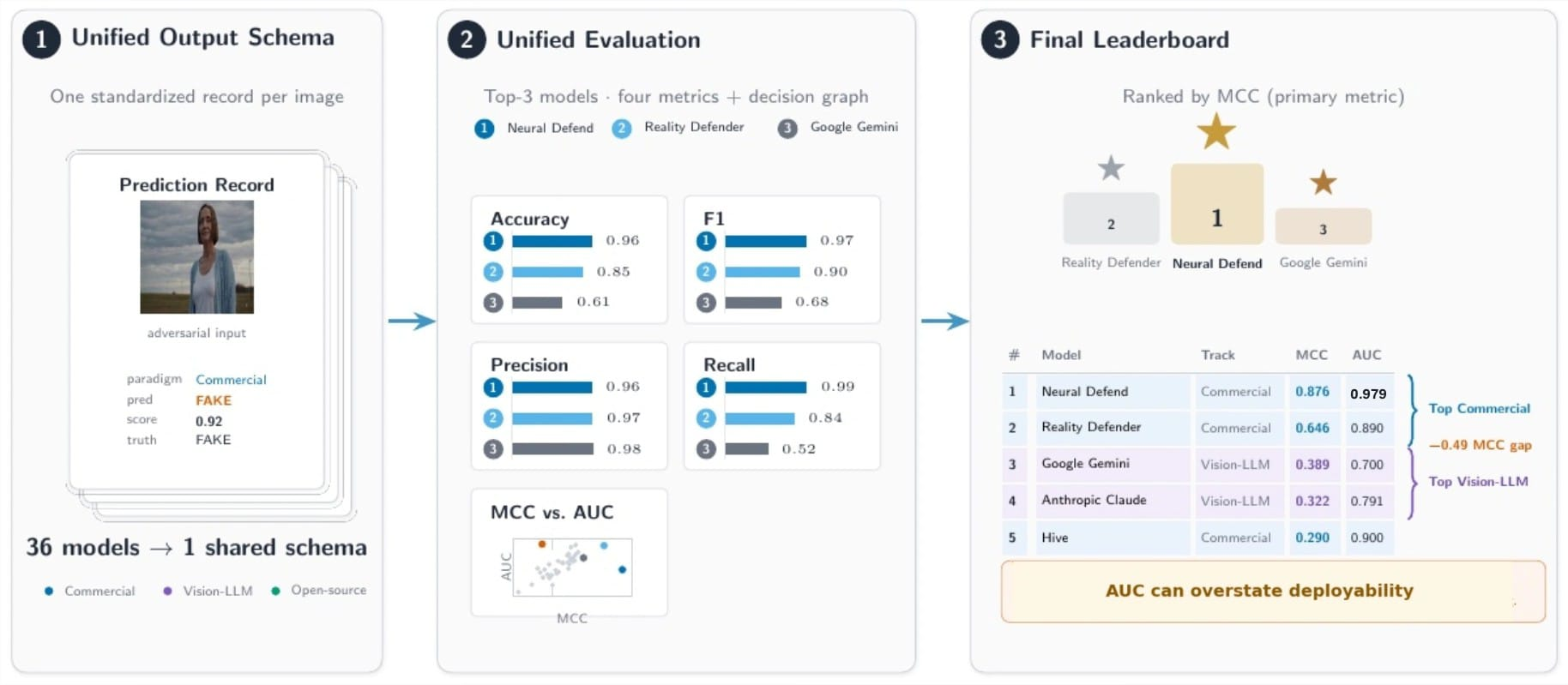
Commercial detection APIs, general-purpose vision LLMs, and open-source detectors are almost never
measured on common ground. VendorBench-100 places all three on one fixed, deliberately hard corpus,
normalizes every model's output into the same (label, P(fake), success) record, and scores them with
the same metrics. Across all 36 models MCC and ROC-AUC are strongly correlated (Pearson r ≈ 0.86),
so the two metrics mostly agree; the more consequential, one-directional finding is that a subset of
otherwise strong rankers are mis-calibrated at their shipped 0.5 threshold, so a high ROC-AUC can
overstate real-world deployability.
The image corpus is not distributed in this repository. It is hosted separately as a gated Hugging Face dataset (access by request): https://huggingface.co/datasets/SharayuD/vendorbench-100
Status: the Hugging Face repository is live and gated (access is granted after manual review of a short request form).
Design. A compact, hand-picked adversarial corpus (fake images + real negative controls) built
for difficulty rather than scale, spanning 8 edge-case failure families across 21 provenance source
groups, with a strict anti-leakage protocol (models are served neutral numeric filenames; the
descriptive fake_<GROUP>_NNN labels are post-hoc join keys only) and a per-image provenance registry.
The eight failure families: live / virtual face-swap smear · near-duplicate face-swap selfies · letterboxed text-to-video stills (Sora/Veo) · AI-avatar compositing seams (HeyGen) · fully synthetic text-to-image · on-device AI photo-edits of real scenes · opaque / unknown provenance · compressed research-dataset frames (DF40, FaceForensics++).
Ranked by MCC (primary), ROC-AUC (tiebreak); positive class = FAKE. Full 36-model leaderboard:
docs/RESULTS.md.
| Track | Models | Best MCC | Median MCC | Best ROC-AUC | Median ROC-AUC |
|---|---|---|---|---|---|
| Commercial API | 5 | 0.876 (neural_defend) | 0.322 | 0.979 (neural_defend) | 0.900 |
| Vision LLM | 7 | 0.389 (gemini) | 0.199 | 0.791 (claude_opus48) | 0.632 |
| Open-source | 24 | 0.289 (ntire2026) | 0.062 | 0.866 (drct) | 0.566 |
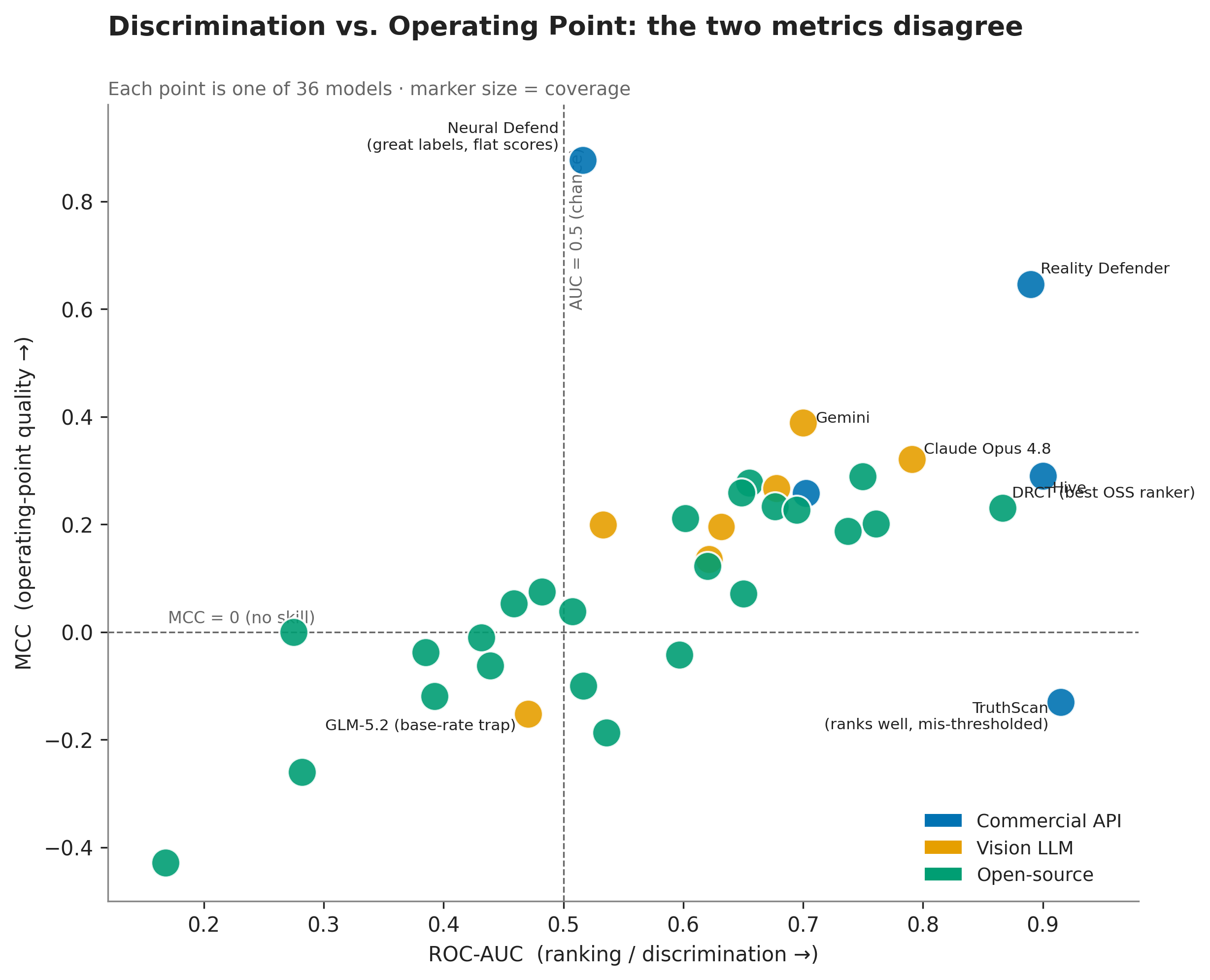
Key findings. neural_defend leads on both metrics (MCC 0.876, ROC-AUC 0.979). MCC and ROC-AUC
correlate strongly (r ≈ 0.86), but a few strong rankers are mis-calibrated at 0.5 — truthscan
(AUC 0.923, MCC 0.322), hive (0.900, 0.290) and drct (0.866, 0.230) — so ROC-AUC alone can
overstate deployability. drct (AUC 0.866) still beats every vision LLM. Paradigm order by median
MCC: Commercial > LLM > Open-source. Base-rate trap: zai_glm52, dima806_ai_vs_real and
ateeqq_siglip2 post high accuracy with near-zero specificity.
benchmark_nd/
├── benchmark/            Core package: runner, metrics, shared schema, per-track adapters
│   ├── commercial_apis/  5 vendor HTTP clients
│   ├── llms/             7 vision-LLM adapters + shared verdict normalization
│   └── opensource_models/ 24 detector loaders (Tier A/B/C) + registry
├── scripts/             Track drivers + aggregation (run, import, export, compare)
│                        (dataset hosted separately — gated Hugging Face, link above)
├── results/             Aggregated summary.json + per-image.csv per track
├── images/              Architecture + MCC-vs-AUC figures
├── docs/                RESULTS.md (full leaderboard), MODELS.md, LLMS.md
├── requirements.txt     Commercial-API + reporting deps
└── requirements-research.txt  Open-source + LLM deps (torch, transformers)
# Base env (commercial-API track + reporting)
python -m venv .venv && .venv/bin/pip install -r requirements.txt

# Research env (open-source + LLM tracks; needs a CUDA GPU)
python -m venv .venv-research && .venv-research/bin/pip install -r requirements-research.txt

cp config.env.example config.env   # then add commercial-API keys (gitignored)
# Commercial APIs — call each vendor over Source/, then report
python -m benchmark.main run
python -m benchmark.main report

# Open-source detectors — download weights, run on GPU, report
.venv-research/bin/python scripts/download_models.py
.venv-research/bin/python scripts/run_research.py
.venv-research/bin/python scripts/report_research.py

# Vision LLMs — import pre-collected dumps and report
.venv-research/bin/python scripts/import_llms.py
.venv-research/bin/python scripts/report_llms.py

# Aggregate all tracks and build the cross-paradigm comparison
.venv-research/bin/python scripts/export_results.py
.venv-research/bin/python scripts/report_compare.py
results/*/summary.json, per-image.csv) are in this repo.scripts/download_models.py.@misc{deshmukh2026vendorbench100,
author = {Deshmukh, Sharayu N. and Deshmukh, Nilesh K.},
title = {VendorBench-100: A Unified Cross-Paradigm Benchmark for Deepfake Image Detection},
year = {2026},
eprint = {2607.06254},
archivePrefix = {arXiv},
primaryClass = {cs.CV},
url = {https://arxiv.org/abs/2607.06254}
}
Code is released under the MIT License. The image corpus is provided for research and benchmarking use only; third-party generator outputs and any images of external origin remain the property of their respective owners.
VendorBench-100: a unified cross-paradigm benchmark evaluating 36 deepfake/AI-image detectors (5 commercial APIs, 7 vision LLMs, 24 open-source) on one adversarial 100-image corpus.
Python
1
6 commits
updated Jul 30, 2026
📄 Paper: arXiv:2607.06254
VendorBench-100 evaluates 36 detectors across three paradigms — 5 commercial APIs, 7 zero-shot vision LLMs, and 24 open-source detectors — on one shared adversarial image corpus under a single output schema and a single metrics engine. Models are ranked by the Matthews Correlation Coefficient (MCC), with ROC-AUC as a threshold-free tiebreak.
Commercial detection APIs, general-purpose vision LLMs, and open-source detectors are almost never
measured on common ground. VendorBench-100 places all three on one fixed, deliberately hard corpus,
normalizes every model's output into the same (label, P(fake), success) record, and scores them with
the same metrics. Across all 36 models MCC and ROC-AUC are strongly correlated (Pearson r ≈ 0.86),
so the two metrics mostly agree; the more consequential, one-directional finding is that a subset of
otherwise strong rankers are mis-calibrated at their shipped 0.5 threshold, so a high ROC-AUC can
overstate real-world deployability.
The image corpus is not distributed in this repository. It is hosted separately as a gated Hugging Face dataset (access by request): https://huggingface.co/datasets/SharayuD/vendorbench-100
Status: the Hugging Face repository is live and gated (access is granted after manual review of a short request form).
Design. A compact, hand-picked adversarial corpus (fake images + real negative controls) built
for difficulty rather than scale, spanning 8 edge-case failure families across 21 provenance source
groups, with a strict anti-leakage protocol (models are served neutral numeric filenames; the
descriptive fake_<GROUP>_NNN labels are post-hoc join keys only) and a per-image provenance registry.
The eight failure families: live / virtual face-swap smear · near-duplicate face-swap selfies · letterboxed text-to-video stills (Sora/Veo) · AI-avatar compositing seams (HeyGen) · fully synthetic text-to-image · on-device AI photo-edits of real scenes · opaque / unknown provenance · compressed research-dataset frames (DF40, FaceForensics++).
Ranked by MCC (primary), ROC-AUC (tiebreak); positive class = FAKE. Full 36-model leaderboard:
docs/RESULTS.md.
| Track | Models | Best MCC | Median MCC | Best ROC-AUC | Median ROC-AUC |
|---|---|---|---|---|---|
| Commercial API | 5 | 0.876 (neural_defend) | 0.322 | 0.979 (neural_defend) | 0.900 |
| Vision LLM | 7 | 0.389 (gemini) | 0.199 | 0.791 (claude_opus48) | 0.632 |
| Open-source | 24 | 0.289 (ntire2026) | 0.062 | 0.866 (drct) | 0.566 |
Key findings. neural_defend leads on both metrics (MCC 0.876, ROC-AUC 0.979). MCC and ROC-AUC
correlate strongly (r ≈ 0.86), but a few strong rankers are mis-calibrated at 0.5 — truthscan
(AUC 0.923, MCC 0.322), hive (0.900, 0.290) and drct (0.866, 0.230) — so ROC-AUC alone can
overstate deployability. drct (AUC 0.866) still beats every vision LLM. Paradigm order by median
MCC: Commercial > LLM > Open-source. Base-rate trap: zai_glm52, dima806_ai_vs_real and
ateeqq_siglip2 post high accuracy with near-zero specificity.
benchmark_nd/
├── benchmark/            Core package: runner, metrics, shared schema, per-track adapters
│   ├── commercial_apis/  5 vendor HTTP clients
│   ├── llms/             7 vision-LLM adapters + shared verdict normalization
│   └── opensource_models/ 24 detector loaders (Tier A/B/C) + registry
├── scripts/             Track drivers + aggregation (run, import, export, compare)
│                        (dataset hosted separately — gated Hugging Face, link above)
├── results/             Aggregated summary.json + per-image.csv per track
├── images/              Architecture + MCC-vs-AUC figures
├── docs/                RESULTS.md (full leaderboard), MODELS.md, LLMS.md
├── requirements.txt     Commercial-API + reporting deps
└── requirements-research.txt  Open-source + LLM deps (torch, transformers)
# Base env (commercial-API track + reporting)
python -m venv .venv && .venv/bin/pip install -r requirements.txt

# Research env (open-source + LLM tracks; needs a CUDA GPU)
python -m venv .venv-research && .venv-research/bin/pip install -r requirements-research.txt

cp config.env.example config.env   # then add commercial-API keys (gitignored)
# Commercial APIs — call each vendor over Source/, then report
python -m benchmark.main run
python -m benchmark.main report

# Open-source detectors — download weights, run on GPU, report
.venv-research/bin/python scripts/download_models.py
.venv-research/bin/python scripts/run_research.py
.venv-research/bin/python scripts/report_research.py

# Vision LLMs — import pre-collected dumps and report
.venv-research/bin/python scripts/import_llms.py
.venv-research/bin/python scripts/report_llms.py

# Aggregate all tracks and build the cross-paradigm comparison
.venv-research/bin/python scripts/export_results.py
.venv-research/bin/python scripts/report_compare.py
results/*/summary.json, per-image.csv) are in this repo.scripts/download_models.py.@misc{deshmukh2026vendorbench100,
author = {Deshmukh, Sharayu N. and Deshmukh, Nilesh K.},
title = {VendorBench-100: A Unified Cross-Paradigm Benchmark for Deepfake Image Detection},
year = {2026},
eprint = {2607.06254},
archivePrefix = {arXiv},
primaryClass = {cs.CV},
url = {https://arxiv.org/abs/2607.06254}
}
Code is released under the MIT License. The image corpus is provided for research and benchmarking use only; third-party generator outputs and any images of external origin remain the property of their respective owners.



