Code for 'Certification of Real Images through Calibrated Content Authentication' (Hashmi et al., 2026): detector benchmark, PGD robustness, and the calibrated resynthesis / Authenticity-Index certifier.
Python
3
70 commits
updated Oct 6, 2026
Sarim Hashmi, Abdelrahman Elsayed, Mohammed Talha Alam, Samuele Poppi, Nils Lukas
Mohamed bin Zayed University of Artificial Intelligence (MBZUAI)
Project Page · Paper · PDF · Installation · Reproduction · Citation
Code, benchmarks, and analysis for calibrated content authentication: a method that certifies an image as authentic relative to a tested set of generators, with a calibrated false-certification rate, and abstains when a generator can faithfully reconstruct it.
The repository includes an evaluation of 20 deepfake detectors against 10 generators released between December 2022 and May 2026, white-box adversarial attacks, and the inversion-based certification pipeline.
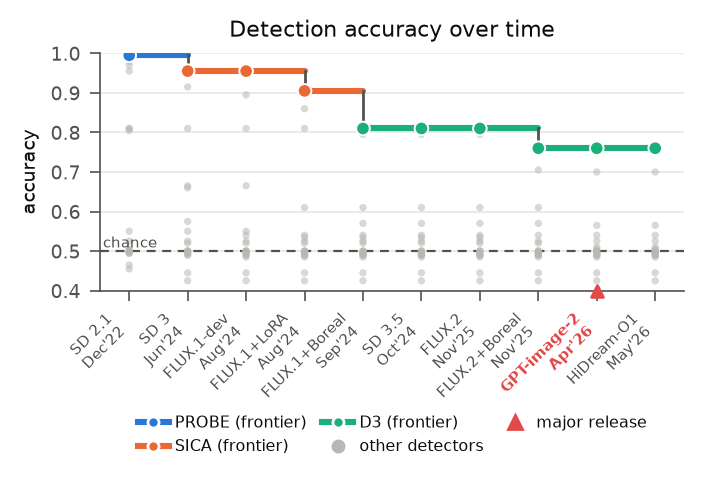
A generator can reproduce authentic content, including through memorization. When authentic and generated images can be identical, image content alone cannot uniquely establish provenance.
Our method asks a narrower question: can a known generator faithfully reconstruct the query image?
Calibration controls how often generated images are incorrectly certified as authentic. Attack-aware calibration uses a stricter threshold for the evaluated bounded-perturbation setting.
Certification is relative to the tested generators and calibration setting. Abstention does not mean an image is fake, and certification is not an unconditional proof of provenance.
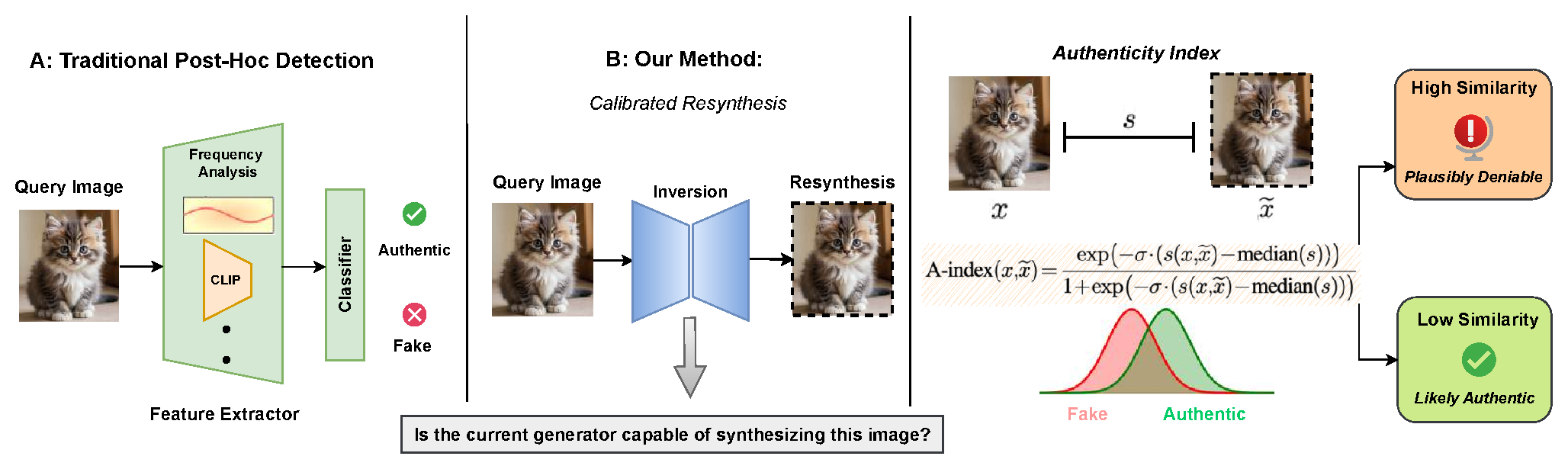
For each generator $G$ in the tested set, use RF-Inversion to reconstruct the query image $x$, producing $\tilde{x}_G$.
Compare the image and its reconstruction using pixel fidelity (PSNR), structural similarity (SSIM), perceptual similarity ($1 - \mathrm{LPIPS}$), and semantic similarity (CLIP). Combine these measurements into the Authenticity Index (A-index):
$$ s(x, \tilde{x}_G) = \alpha_1,\mathrm{PSNR} + \alpha_2,\mathrm{SSIM} + \alpha_3,(1 - \mathrm{LPIPS}) + \alpha_4,\mathrm{CLIP} $$
$$ A(x, \tilde{x}_G) = \frac{\exp(-\sigma s)}{1 + \exp(-\sigma s)} $$
The fitted weights are $\alpha_1 = -0.0181$, $\alpha_2 = 1.380$, $\alpha_3 = -4.058$, and $\alpha_4 = 8.066$, with $\sigma = 0.9$. The metric is implemented in inversion/metric.py.
The A-index lies in $[0, 1]$. Faithful reconstructions receive low scores, making authenticity plausibly deniable.
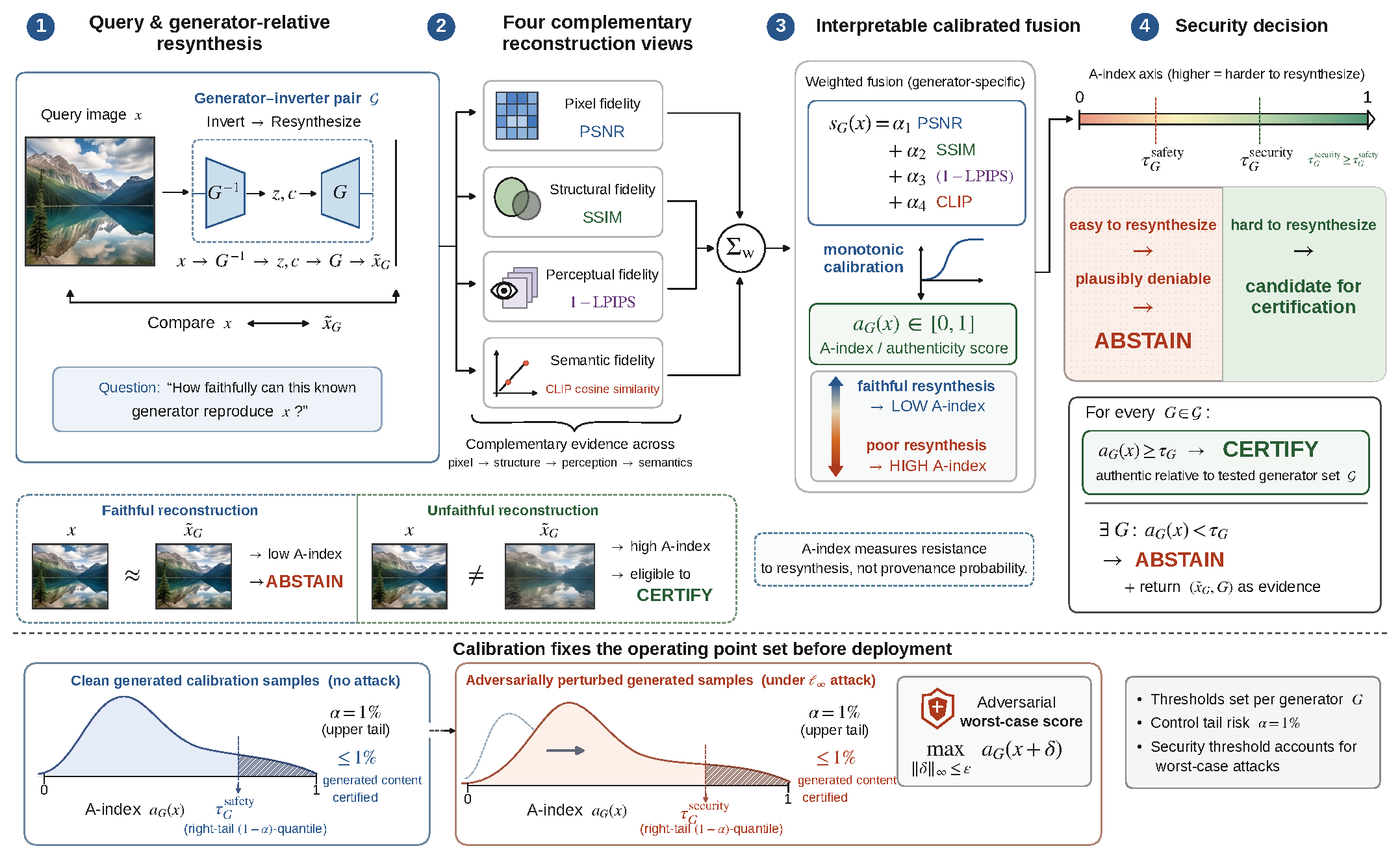
For each generator, set the safety threshold to the $(1 - \alpha)$-quantile of A-index scores on held-out generated samples, with a target false-certification rate of $\alpha = 0.01$. The security threshold uses the same quantile after attacking the calibration samples with ℓ∞-bounded PGD.
Certify a query only when its A-index meets or exceeds the corresponding threshold for every tested generator. Otherwise, abstain and return the reconstruction as evidence.
| Generator configuration | Safety threshold |
|---|---|
| SD2.1 | 0.015 |
| SD3 Medium | 0.0365 |
| SD3.5 Medium | 0.0365 |
| FLUX.1 Dev | 0.035 |
| FLUX.1 Dev + Realism LoRA | 0.038 |
Certification takes 11.67 seconds per image per generator on one NVIDIA RTX 5000 Ada.
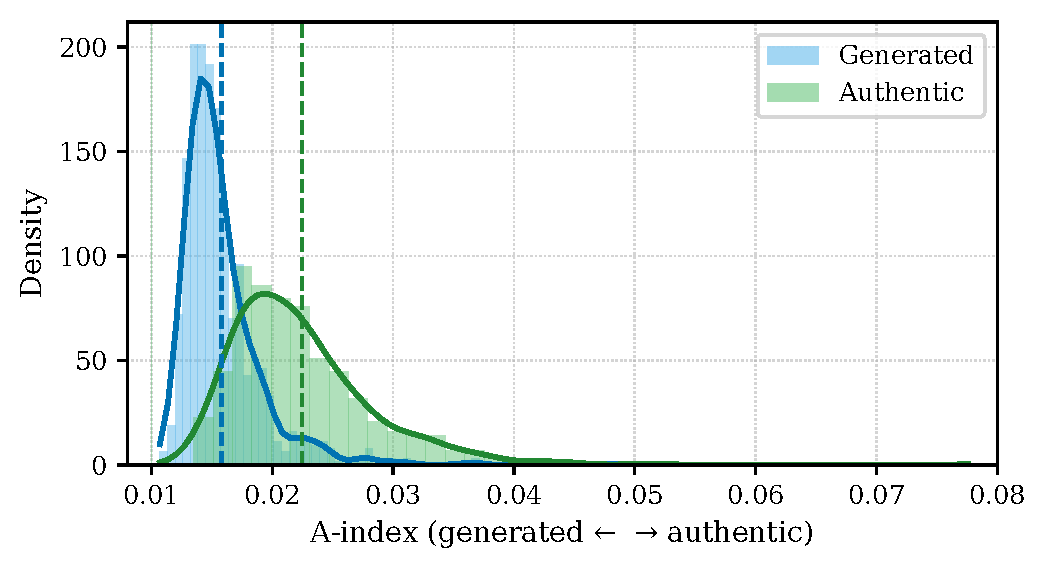
For SD3 Medium, reconstruction fidelity separates authentic and generated images:
PGD with ε = 8/255 on 2,000 images (1,000 fake, 1,000 real, 512×512). Only samples classified correctly before the attack are perturbed. † marks threshold-degenerate detectors; "–" means no sample of that class was correct before the attack.
| Model | Correct fake (before) | Correct real (before) | Acc. before (%) | Correct fake (after) | Correct real (after) | Acc. after (%) | Attack success on fake (%) | Attack success on real (%) |
|---|---|---|---|---|---|---|---|---|
| UFD | 1 | 974 | 48.75 | 0 | 0 | 0.00 | 100.0 | 100.0 |
| FreqNet | 53 | 995 | 52.40 | 0 | 0 | 0.00 | 100.0 | 100.0 |
| NPR | 86 | 653 | 36.95 | 0 | 0 | 0.00 | 100.0 | 100.0 |
| FatFormer | 1 | 987 | 49.40 | 0 | 0 | 0.00 | 100.0 | 100.0 |
| AEROBLADE† | 778 | 778 | 77.80 | 0 | 30 | 1.50 | 100.0 | 96.1 |
| C2PClip | 51 | 949 | 50.00 | 0 | 2 | 0.10 | 100.0 | 99.8 |
| D3 | 736 | 942 | 83.90 | 24 | 11 | 1.75 | 96.7 | 98.8 |
| FIRE† | 998 | 0 | 49.90 | 1 | 0 | 0.05 | 99.9 | – |
| DDA | 576 | 975 | 77.55 | 0 | 4 | 0.20 | 100.0 | 99.6 |
| FerretNet | 40 | 962 | 50.10 | 0 | 0 | 0.00 | 100.0 | 100.0 |
| WaRPAD† | 689 | 689 | 68.90 | 15 | 0 | 0.75 | 97.8 | 100.0 |
| APM | 34 | 987 | 51.05 | 0 | 0 | 0.00 | 100.0 | 100.0 |
| OmniAID | 917 | 948 | 93.25 | 0 | 0 | 0.00 | 100.0 | 100.0 |
| PGC | 304 | 951 | 62.75 | 0 | 0 | 0.00 | 100.0 | 100.0 |
| PROBE | 539 | 990 | 76.45 | 0 | 1 | 0.05 | 100.0 | 99.9 |
| DEAR | 417 | 993 | 70.50 | 0 | 0 | 0.00 | 100.0 | 100.0 |
| DGS-Net | 10 | 847 | 42.85 | 0 | 0 | 0.00 | 100.0 | 100.0 |
| SICA | 716 | 924 | 82.00 | 0 | 0 | 0.00 | 100.0 | 100.0 |
| IAPL | 14 | 980 | 49.70 | 0 | 0 | 0.00 | 100.0 | 100.0 |
| ForensicCpt | 55 | 982 | 51.85 | 0 | 2 | 0.10 | 100.0 | 99.8 |
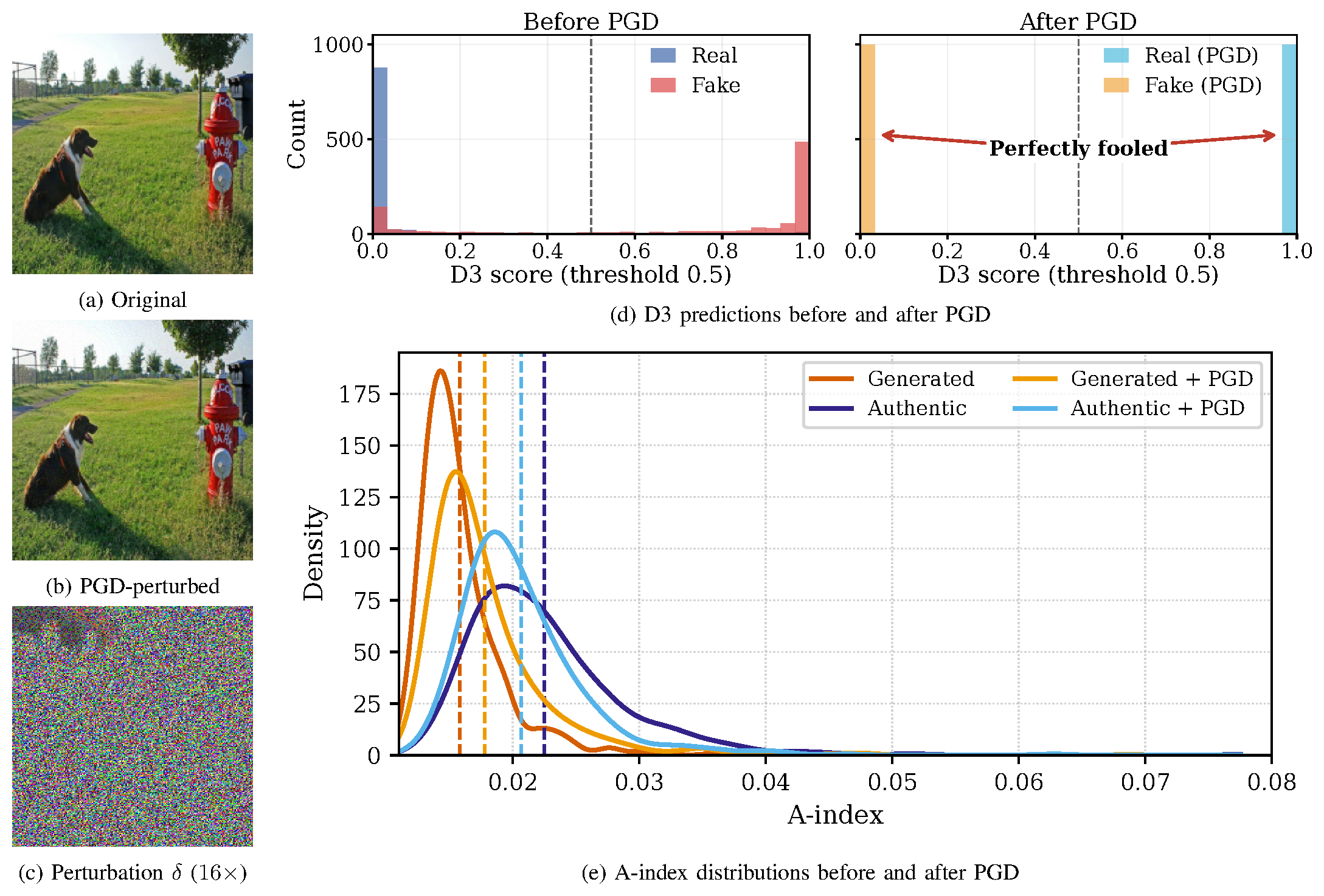
In the evaluated setting, PGD reduces binary-detector accuracy to below 2%, while the A-index distributions remain separated:
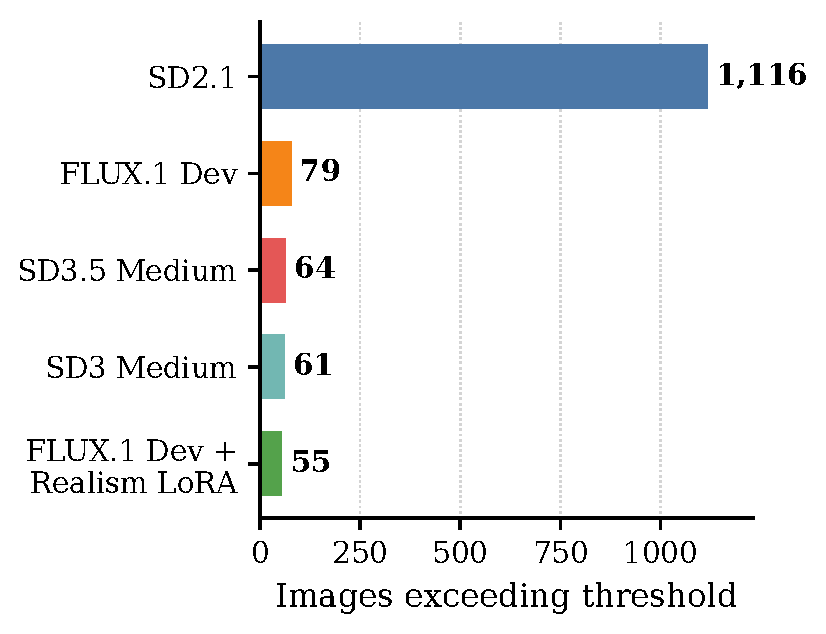
We apply five generator-specific thresholds to the same SD3 inversion scores of 3,000 unverified Reddit images: 1,116 images exceed the SD2.1 threshold, against 55 to 79 for the four newer configurations. These images are unverified; threshold exceedance does not establish their true provenance.
On 100 videos from Deepfake-Eval-2024 (50 authentic, 50 generated), video detectors transfer poorly, while frame-aggregated A-index scores preserve the image-level ordering.
| Model | AUC | Prec. | Rec. | F1 |
|---|---|---|---|---|
| GenConViT | 0.615 | 0.59 | 0.49 | 0.53 |
| FTCN | 0.483 | 0.50 | 0.64 | 0.40 |
| StyleFlow | 0.509 | 0.53 | 0.42 | 0.47 |
| Path | Purpose |
|---|---|
benchmark/ | Detector benchmarking, normalization, analysis, and attack aggregation |
benchmark/adapters/ | Detector wrappers with a common inference interface |
benchmark/attacks/ | Per-detector white-box PGD harnesses and shared attack engine |
benchmark/docs/ | Adapter and PGD attack contracts |
benchmark/plots/ | Benchmark figures |
inversion/ | Conditioned and unconditioned RF-Inversion through SD2, SD3, and SD3.5 |
inversion/metric.py | Reconstruction metrics and A-index computation |
assets/ | Figures from the paper |
A GPU is required for detector inference, inversion, and PGD attacks. Run the following commands from the repository root:
python -m venv venv
source venv/bin/activate
pip install -r requirements.txt
Detector checkpoints and generator weights are not included because they are large or access-gated. Obtain the required weights before running the experiments. Detector adapters load checkpoints from the local detector zoo:
detectors/<year>/<Name>/weights/
See the adapter contract for the expected checkpoint layout and inference interface.
The file benchmark/manifest.csv contains one image per row with these columns:
generator,gen_year,label,path
Run from the repository root:
# Normalize images to 512 × 512 to remove the real/fake resolution confound.
# Output: benchmark/manifest_normalized.csv
python benchmark/normalize_images.py

# Evaluate all detectors on the normalized manifest.
# Output: benchmark/scores/<Detector>.csv
python benchmark/run_all.py \
    --device cuda \
    --manifest benchmark/manifest_normalized.csv \
    --scores-dir benchmark/scores

# Generate accuracy and AUROC tables and figures.
# Outputs: benchmark/results.csv and benchmark/plots/
python benchmark/analyze.py
The reported white-box PGD evaluation uses ε = 8/255 and 10 steps. Replace <Detector> with the name used by the corresponding attack script and <manifest.csv> with your manifest path, resolved from benchmark/.
cd benchmark

# Run the per-detector attack harness.
python attacks/attack_<Detector>.py \
    --manifest <manifest.csv> \
    --out attacks_out/<Detector>.csv \
    --device cuda

# Aggregate the per-detector attack results.
# Outputs: results_attack.json and results_attack.md
python aggregate_attacks.py
Each detector adapter accepts --manifest, --out, --device, and optional --limit arguments. Its output contains:
generator,gen_year,label,path,score
Higher detector scores indicate a greater likelihood of generated content. See the adapter contract and PGD attack contract for details.
Run from the repository root. Replace the placeholders with your image and reconstruction directories.
# Reconstruct query images with a known generator (SD3.5 example).
python inversion/sd3.5_all_in.py \
    --input_dir <query_images> \
    --output_dir <reconstructions>

# Compute PSNR, SSIM, LPIPS, CLIP similarity, and the A-index.
python inversion/metric.py \
    --source_dir <query_images> \
    --recon_dir <reconstructions> \
    --out metrics.jsonl
Use the per-image scores in metrics.jsonl to calibrate generator-specific thresholds on generated calibration samples. Evaluate certification on separate held-out content. For the security setting, calibrate on attacked generated samples under the intended perturbation budget.
Repeat the reconstruction and scoring procedure for each generator in the certification set. A query is certified only if it meets every generator-specific threshold.
UFD, FreqNet, NPR, FatFormer, AEROBLADE, C2P-CLIP, D3, FIRE, DDA, FerretNet, WaRPAD, AllPatchesMatter, OmniAID, PGC, PROBE, DEAR, DGS-Net, SICA, IAPL, and ForensicConcept.
Each detector has an inference adapter and a PGD attack harness. In the results table, AllPatchesMatter is abbreviated as APM, ForensicConcept as ForensicCpt, and C2P-CLIP as C2PClip.
The benchmark covers ten generator configurations spanning December 2022 to May 2026, including SD2.1, SD3, SD3.5, FLUX.1 with LoRA and Boreal adapters, FLUX.2, GPT Image-2, and HiDream-O1.
Certification is calibrated for five configurations: SD2.1, SD3 Medium, SD3.5 Medium, FLUX.1 Dev, and FLUX.1 Dev with Realism LoRA.
For questions, implementation issues, or reproducibility discussions, please open an issue in this repository or contact the authors at MBZUAI.
If you use this code, benchmark, or method in your research, please cite:
Sarim Hashmi, Abdelrahman Elsayed, Mohammed Talha Alam, Samuele Poppi, and Nils Lukas. Certification of Real Images through Calibrated Content Authentication. arXiv:2610.05870, 2026. Paper · PDF.
@article{hashmi2026certification,
  title         = {Certification of Real Images through Calibrated Content Authentication},
  author        = {Hashmi, Sarim and Elsayed, Abdelrahman and Alam, Mohammed Talha and Poppi, Samuele and Lukas, Nils},
  journal       = {arXiv preprint arXiv:2610.05870},
  year          = {2026},
  eprint        = {2610.05870},
  archivePrefix = {arXiv},
  url           = {https://arxiv.org/abs/2610.05870}
}
Code for 'Certification of Real Images through Calibrated Content Authentication' (Hashmi et al., 2026): detector benchmark, PGD robustness, and the calibrated resynthesis / Authenticity-Index certifier.
Python
3
70 commits
updated Oct 6, 2026
Sarim Hashmi, Abdelrahman Elsayed, Mohammed Talha Alam, Samuele Poppi, Nils Lukas
Mohamed bin Zayed University of Artificial Intelligence (MBZUAI)
Project Page · Paper · PDF · Installation · Reproduction · Citation
Code, benchmarks, and analysis for calibrated content authentication: a method that certifies an image as authentic relative to a tested set of generators, with a calibrated false-certification rate, and abstains when a generator can faithfully reconstruct it.
The repository includes an evaluation of 20 deepfake detectors against 10 generators released between December 2022 and May 2026, white-box adversarial attacks, and the inversion-based certification pipeline.
A generator can reproduce authentic content, including through memorization. When authentic and generated images can be identical, image content alone cannot uniquely establish provenance.
Our method asks a narrower question: can a known generator faithfully reconstruct the query image?
Calibration controls how often generated images are incorrectly certified as authentic. Attack-aware calibration uses a stricter threshold for the evaluated bounded-perturbation setting.
Certification is relative to the tested generators and calibration setting. Abstention does not mean an image is fake, and certification is not an unconditional proof of provenance.
For each generator $G$ in the tested set, use RF-Inversion to reconstruct the query image $x$, producing $\tilde{x}_G$.
Compare the image and its reconstruction using pixel fidelity (PSNR), structural similarity (SSIM), perceptual similarity ($1 - \mathrm{LPIPS}$), and semantic similarity (CLIP). Combine these measurements into the Authenticity Index (A-index):
$$ s(x, \tilde{x}_G) = \alpha_1,\mathrm{PSNR} + \alpha_2,\mathrm{SSIM} + \alpha_3,(1 - \mathrm{LPIPS}) + \alpha_4,\mathrm{CLIP} $$
$$ A(x, \tilde{x}_G) = \frac{\exp(-\sigma s)}{1 + \exp(-\sigma s)} $$
The fitted weights are $\alpha_1 = -0.0181$, $\alpha_2 = 1.380$, $\alpha_3 = -4.058$, and $\alpha_4 = 8.066$, with $\sigma = 0.9$. The metric is implemented in inversion/metric.py.
The A-index lies in $[0, 1]$. Faithful reconstructions receive low scores, making authenticity plausibly deniable.
For each generator, set the safety threshold to the $(1 - \alpha)$-quantile of A-index scores on held-out generated samples, with a target false-certification rate of $\alpha = 0.01$. The security threshold uses the same quantile after attacking the calibration samples with ℓ∞-bounded PGD.
Certify a query only when its A-index meets or exceeds the corresponding threshold for every tested generator. Otherwise, abstain and return the reconstruction as evidence.
| Generator configuration | Safety threshold |
|---|---|
| SD2.1 | 0.015 |
| SD3 Medium | 0.0365 |
| SD3.5 Medium | 0.0365 |
| FLUX.1 Dev | 0.035 |
| FLUX.1 Dev + Realism LoRA | 0.038 |
Certification takes 11.67 seconds per image per generator on one NVIDIA RTX 5000 Ada.
For SD3 Medium, reconstruction fidelity separates authentic and generated images:
PGD with ε = 8/255 on 2,000 images (1,000 fake, 1,000 real, 512×512). Only samples classified correctly before the attack are perturbed. † marks threshold-degenerate detectors; "–" means no sample of that class was correct before the attack.
| Model | Correct fake (before) | Correct real (before) | Acc. before (%) | Correct fake (after) | Correct real (after) | Acc. after (%) | Attack success on fake (%) | Attack success on real (%) |
|---|---|---|---|---|---|---|---|---|
| UFD | 1 | 974 | 48.75 | 0 | 0 | 0.00 | 100.0 | 100.0 |
| FreqNet | 53 | 995 | 52.40 | 0 | 0 | 0.00 | 100.0 | 100.0 |
| NPR | 86 | 653 | 36.95 | 0 | 0 | 0.00 | 100.0 | 100.0 |
| FatFormer | 1 | 987 | 49.40 | 0 | 0 | 0.00 | 100.0 | 100.0 |
| AEROBLADE† | 778 | 778 | 77.80 | 0 | 30 | 1.50 | 100.0 | 96.1 |
| C2PClip | 51 | 949 | 50.00 | 0 | 2 | 0.10 | 100.0 | 99.8 |
| D3 | 736 | 942 | 83.90 | 24 | 11 | 1.75 | 96.7 | 98.8 |
| FIRE† | 998 | 0 | 49.90 | 1 | 0 | 0.05 | 99.9 | – |
| DDA | 576 | 975 | 77.55 | 0 | 4 | 0.20 | 100.0 | 99.6 |
| FerretNet | 40 | 962 | 50.10 | 0 | 0 | 0.00 | 100.0 | 100.0 |
| WaRPAD† | 689 | 689 | 68.90 | 15 | 0 | 0.75 | 97.8 | 100.0 |
| APM | 34 | 987 | 51.05 | 0 | 0 | 0.00 | 100.0 | 100.0 |
| OmniAID | 917 | 948 | 93.25 | 0 | 0 | 0.00 | 100.0 | 100.0 |
| PGC | 304 | 951 | 62.75 | 0 | 0 | 0.00 | 100.0 | 100.0 |
| PROBE | 539 | 990 | 76.45 | 0 | 1 | 0.05 | 100.0 | 99.9 |
| DEAR | 417 | 993 | 70.50 | 0 | 0 | 0.00 | 100.0 | 100.0 |
| DGS-Net | 10 | 847 | 42.85 | 0 | 0 | 0.00 | 100.0 | 100.0 |
| SICA | 716 | 924 | 82.00 | 0 | 0 | 0.00 | 100.0 | 100.0 |
| IAPL | 14 | 980 | 49.70 | 0 | 0 | 0.00 | 100.0 | 100.0 |
| ForensicCpt | 55 | 982 | 51.85 | 0 | 2 | 0.10 | 100.0 | 99.8 |
In the evaluated setting, PGD reduces binary-detector accuracy to below 2%, while the A-index distributions remain separated:
We apply five generator-specific thresholds to the same SD3 inversion scores of 3,000 unverified Reddit images: 1,116 images exceed the SD2.1 threshold, against 55 to 79 for the four newer configurations. These images are unverified; threshold exceedance does not establish their true provenance.
On 100 videos from Deepfake-Eval-2024 (50 authentic, 50 generated), video detectors transfer poorly, while frame-aggregated A-index scores preserve the image-level ordering.
| Model | AUC | Prec. | Rec. | F1 |
|---|---|---|---|---|
| GenConViT | 0.615 | 0.59 | 0.49 | 0.53 |
| FTCN | 0.483 | 0.50 | 0.64 | 0.40 |
| StyleFlow | 0.509 | 0.53 | 0.42 | 0.47 |
| Path | Purpose |
|---|---|
benchmark/ | Detector benchmarking, normalization, analysis, and attack aggregation |
benchmark/adapters/ | Detector wrappers with a common inference interface |
benchmark/attacks/ | Per-detector white-box PGD harnesses and shared attack engine |
benchmark/docs/ | Adapter and PGD attack contracts |
benchmark/plots/ | Benchmark figures |
inversion/ | Conditioned and unconditioned RF-Inversion through SD2, SD3, and SD3.5 |
inversion/metric.py | Reconstruction metrics and A-index computation |
assets/ | Figures from the paper |
A GPU is required for detector inference, inversion, and PGD attacks. Run the following commands from the repository root:
python -m venv venv
source venv/bin/activate
pip install -r requirements.txt
Detector checkpoints and generator weights are not included because they are large or access-gated. Obtain the required weights before running the experiments. Detector adapters load checkpoints from the local detector zoo:
detectors/<year>/<Name>/weights/
See the adapter contract for the expected checkpoint layout and inference interface.
The file benchmark/manifest.csv contains one image per row with these columns:
generator,gen_year,label,path
Run from the repository root:
# Normalize images to 512 × 512 to remove the real/fake resolution confound.
# Output: benchmark/manifest_normalized.csv
python benchmark/normalize_images.py

# Evaluate all detectors on the normalized manifest.
# Output: benchmark/scores/<Detector>.csv
python benchmark/run_all.py \
    --device cuda \
    --manifest benchmark/manifest_normalized.csv \
    --scores-dir benchmark/scores

# Generate accuracy and AUROC tables and figures.
# Outputs: benchmark/results.csv and benchmark/plots/
python benchmark/analyze.py
The reported white-box PGD evaluation uses ε = 8/255 and 10 steps. Replace <Detector> with the name used by the corresponding attack script and <manifest.csv> with your manifest path, resolved from benchmark/.
cd benchmark

# Run the per-detector attack harness.
python attacks/attack_<Detector>.py \
    --manifest <manifest.csv> \
    --out attacks_out/<Detector>.csv \
    --device cuda

# Aggregate the per-detector attack results.
# Outputs: results_attack.json and results_attack.md
python aggregate_attacks.py
Each detector adapter accepts --manifest, --out, --device, and optional --limit arguments. Its output contains:
generator,gen_year,label,path,score
Higher detector scores indicate a greater likelihood of generated content. See the adapter contract and PGD attack contract for details.
Run from the repository root. Replace the placeholders with your image and reconstruction directories.
# Reconstruct query images with a known generator (SD3.5 example).
python inversion/sd3.5_all_in.py \
    --input_dir <query_images> \
    --output_dir <reconstructions>

# Compute PSNR, SSIM, LPIPS, CLIP similarity, and the A-index.
python inversion/metric.py \
    --source_dir <query_images> \
    --recon_dir <reconstructions> \
    --out metrics.jsonl
Use the per-image scores in metrics.jsonl to calibrate generator-specific thresholds on generated calibration samples. Evaluate certification on separate held-out content. For the security setting, calibrate on attacked generated samples under the intended perturbation budget.
Repeat the reconstruction and scoring procedure for each generator in the certification set. A query is certified only if it meets every generator-specific threshold.
UFD, FreqNet, NPR, FatFormer, AEROBLADE, C2P-CLIP, D3, FIRE, DDA, FerretNet, WaRPAD, AllPatchesMatter, OmniAID, PGC, PROBE, DEAR, DGS-Net, SICA, IAPL, and ForensicConcept.
Each detector has an inference adapter and a PGD attack harness. In the results table, AllPatchesMatter is abbreviated as APM, ForensicConcept as ForensicCpt, and C2P-CLIP as C2PClip.
The benchmark covers ten generator configurations spanning December 2022 to May 2026, including SD2.1, SD3, SD3.5, FLUX.1 with LoRA and Boreal adapters, FLUX.2, GPT Image-2, and HiDream-O1.
Certification is calibrated for five configurations: SD2.1, SD3 Medium, SD3.5 Medium, FLUX.1 Dev, and FLUX.1 Dev with Realism LoRA.
For questions, implementation issues, or reproducibility discussions, please open an issue in this repository or contact the authors at MBZUAI.
If you use this code, benchmark, or method in your research, please cite:
Sarim Hashmi, Abdelrahman Elsayed, Mohammed Talha Alam, Samuele Poppi, and Nils Lukas. Certification of Real Images through Calibrated Content Authentication. arXiv:2610.05870, 2026. Paper · PDF.
@article{hashmi2026certification,
  title         = {Certification of Real Images through Calibrated Content Authentication},
  author        = {Hashmi, Sarim and Elsayed, Abdelrahman and Alam, Mohammed Talha and Poppi, Samuele and Lukas, Nils},
  journal       = {arXiv preprint arXiv:2610.05870},
  year          = {2026},
  eprint        = {2610.05870},
  archivePrefix = {arXiv},
  url           = {https://arxiv.org/abs/2610.05870}
}



