[EACL 2026] The official GitHub repo for the paper "DebateQA: Evaluating Question Answering on Debatable Knowledge"
See the codeThis repo consists of the dataset and evaluation scripts for the EACL 2026 paper "DebateQA: Evaluating Question Answering on Debatable Knowledge".
Rongwu Xu, Xuan Qi, Zehan Qi, Wei Xu and Zhijiang Guo
Tsinghua Universty, University of Cambridge and Fangcun AI
If you have any questions or issues with the code, please send us an issue directly.
In our work, we present the DebateQA dataset tailored for evaluating debatable questions, which includes a collection of debatable questions and their plausible partial answers. Each partial answer respond the original question in one unique perspective. Additionally, we introduce two metrics for evaluating these answers: Perspective Diversity (P.D.) and Dispute Awareness (D.A.).
Our dataset, DebateQA, comprises 2,941 debatable questions, each paired with multiple partial answers annotated by humans. These partial answers capture a variety of perspectives, ensuring a comprehensive representation of the debate surrounding each question. The dataset is fully annotated by human.
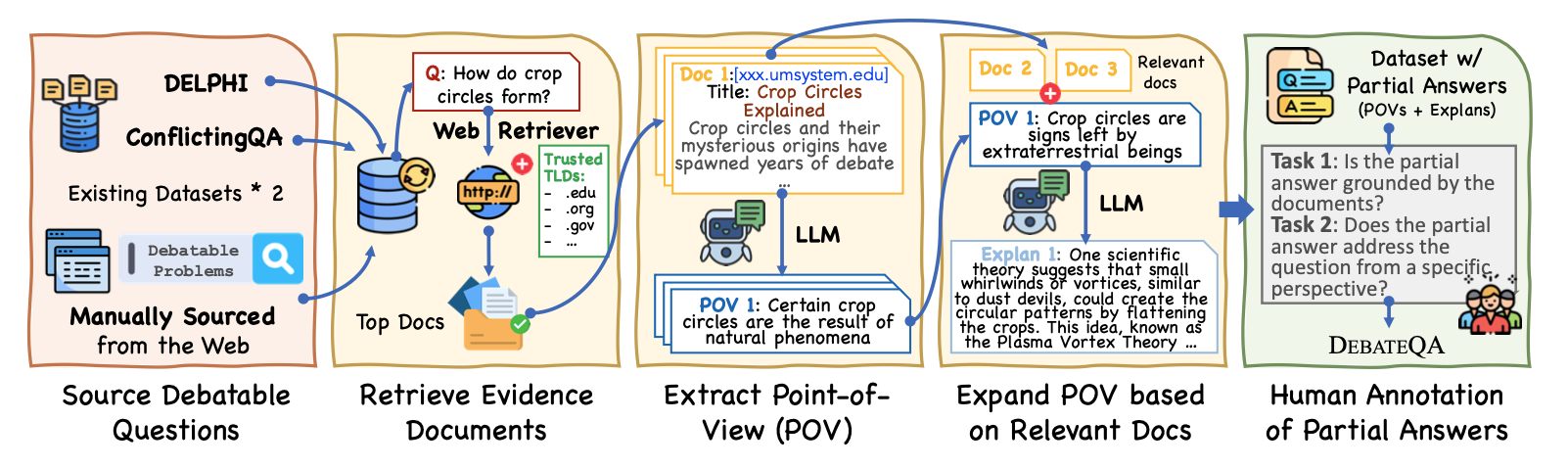
Pipeline for curating DebateQA. The three main components of the pipeline are highlighted in different colors: sourcing debatable questions, collecting partial answers, and human annotation.
The P.D. metric evaluates the comprehensiveness of the perspectives provided in the answers. This metric measures how well the answers encompass multiple viewpoints, reflecting the complexity and diversity of opinions on debatable issues.
$$P.D. := \sum^n_i PPL(\text{PA}^i \mid \texttt{chatTemplate}(\texttt{Concat}(A, , "Please restate."))),$$
where
$$ PPL(Y \mid X) = \exp \left(\frac{1}{N} \sum_{i=1}^{N} \log P(y_i \mid X, y_{< i})\right) $$
The D.A. metric assesses whether the model acknowledges the debatable nature of the question. This metric is crucial for ensuring that the model does not present a debatable question as a fixed fact, but rather recognizes and conveys its controversial aspects.
Our experiments with 12 popular LLMs demonstrate varying levels of proficiency in recognizing and addressing debatable issues. While most models excel at identifying debatable questions, their ability to provide comprehensive answers encompassing diverse perspectives varies significantly.
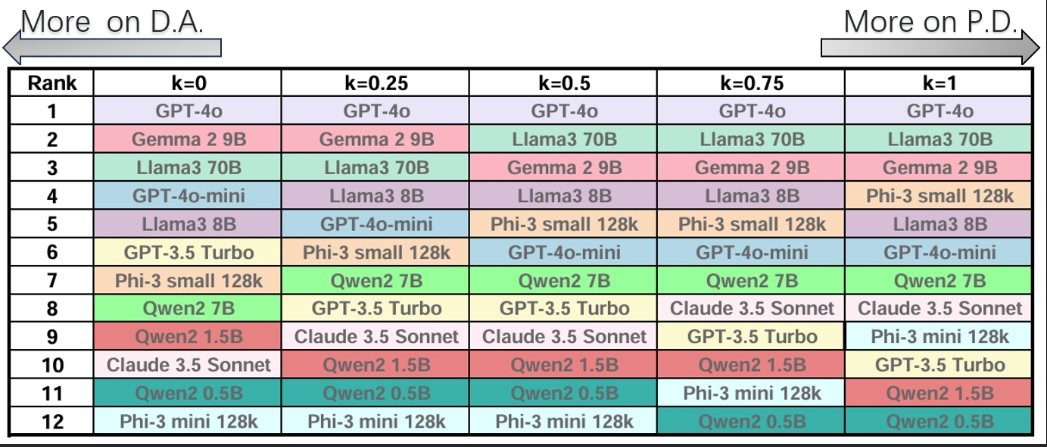
Ranks of tested LLMs on P.D. and D.A. metrics.
For detailed results, analysis, and case studies, refer to our Paper.
Quick install the environment:
cd DebateQA
conda create -n DebateQA python=3.9 cudatoolkit=11.3
conda activate DebateQA
pip install torch==1.11.0+cu113 torchvision==0.12.0+cu113 torchaudio==0.11.0 --extra-index-url https://download.pytorch.org/whl/cu113
pip install -r requirements.txt
scriptsFolder - Contain bash scripts for testing P.D. and D.A. discribed in our paper.
datasetFolder - Contain our whole dataset.
raw_dataFolder - Contain the original articles used to generate the POVs as well as the index corresponding to each POV in the documents. Theranked_retrieve_docsis used to fetch the original documents and web links for the POVs, while thepartial_answerscontains the source index corresponding to the document passage extracted for each POV.
Befor evaluation, the model answers to questions in DebateQA should be ready
You should provide a .jsonl file with each line being the following format:
{"generation": {your model's answer to question id}; "id": {the original question id}}
You can evaluate the P.D. metric with run_PD.sh :
There are 3 parameters that need to be specified:
scripts/input_file_demo. jsonl for the exact structure.Then run
./run_PD.sh --input_file <your_input_file>
Your can get the P.D. score of the input file on corresponding dataset.
If you use the input_file_demo.jsonl, the output should be
File: input_file_demo.jsonl, Average P.D. score: 3.9867007732391357
You can evaluate the D.A. metric with run_DA.sh :
There are 3 parameters that need to be specified:
scripts/input_file_demo. jsonl for the exact structure.Then run
./run_DA.sh --input_file <your_input_file>
Your can get the D.A. score of the input file on corresponding dataset.
If you find our evaluation useful, please consider citing:
@article{xu2024debateqa,
  title={Debateqa: Evaluating question answering on debatable knowledge},
  author={Xu, Rongwu and Qi, Xuan and Qi, Zehan and Xu, Wei and Guo, Zhijiang},
  journal={arXiv preprint arXiv:2408.01419},
  year={2024}
}
[EACL 2026] The official GitHub repo for the paper "DebateQA: Evaluating Question Answering on Debatable Knowledge"
See the codeThis repo consists of the dataset and evaluation scripts for the EACL 2026 paper "DebateQA: Evaluating Question Answering on Debatable Knowledge".
Rongwu Xu, Xuan Qi, Zehan Qi, Wei Xu and Zhijiang Guo
Tsinghua Universty, University of Cambridge and Fangcun AI
If you have any questions or issues with the code, please send us an issue directly.
In our work, we present the DebateQA dataset tailored for evaluating debatable questions, which includes a collection of debatable questions and their plausible partial answers. Each partial answer respond the original question in one unique perspective. Additionally, we introduce two metrics for evaluating these answers: Perspective Diversity (P.D.) and Dispute Awareness (D.A.).
Our dataset, DebateQA, comprises 2,941 debatable questions, each paired with multiple partial answers annotated by humans. These partial answers capture a variety of perspectives, ensuring a comprehensive representation of the debate surrounding each question. The dataset is fully annotated by human.
Pipeline for curating DebateQA. The three main components of the pipeline are highlighted in different colors: sourcing debatable questions, collecting partial answers, and human annotation.
The P.D. metric evaluates the comprehensiveness of the perspectives provided in the answers. This metric measures how well the answers encompass multiple viewpoints, reflecting the complexity and diversity of opinions on debatable issues.
$$P.D. := \sum^n_i PPL(\text{PA}^i \mid \texttt{chatTemplate}(\texttt{Concat}(A, , "Please restate."))),$$
where
$$ PPL(Y \mid X) = \exp \left(\frac{1}{N} \sum_{i=1}^{N} \log P(y_i \mid X, y_{< i})\right) $$
The D.A. metric assesses whether the model acknowledges the debatable nature of the question. This metric is crucial for ensuring that the model does not present a debatable question as a fixed fact, but rather recognizes and conveys its controversial aspects.
Our experiments with 12 popular LLMs demonstrate varying levels of proficiency in recognizing and addressing debatable issues. While most models excel at identifying debatable questions, their ability to provide comprehensive answers encompassing diverse perspectives varies significantly.
Ranks of tested LLMs on P.D. and D.A. metrics.
For detailed results, analysis, and case studies, refer to our Paper.
Quick install the environment:
cd DebateQA
conda create -n DebateQA python=3.9 cudatoolkit=11.3
conda activate DebateQA
pip install torch==1.11.0+cu113 torchvision==0.12.0+cu113 torchaudio==0.11.0 --extra-index-url https://download.pytorch.org/whl/cu113
pip install -r requirements.txt
scriptsFolder - Contain bash scripts for testing P.D. and D.A. discribed in our paper.
datasetFolder - Contain our whole dataset.
raw_dataFolder - Contain the original articles used to generate the POVs as well as the index corresponding to each POV in the documents. Theranked_retrieve_docsis used to fetch the original documents and web links for the POVs, while thepartial_answerscontains the source index corresponding to the document passage extracted for each POV.
Befor evaluation, the model answers to questions in DebateQA should be ready
You should provide a .jsonl file with each line being the following format:
{"generation": {your model's answer to question id}; "id": {the original question id}}
You can evaluate the P.D. metric with run_PD.sh :
There are 3 parameters that need to be specified:
scripts/input_file_demo. jsonl for the exact structure.Then run
./run_PD.sh --input_file <your_input_file>
Your can get the P.D. score of the input file on corresponding dataset.
If you use the input_file_demo.jsonl, the output should be
File: input_file_demo.jsonl, Average P.D. score: 3.9867007732391357
You can evaluate the D.A. metric with run_DA.sh :
There are 3 parameters that need to be specified:
scripts/input_file_demo. jsonl for the exact structure.Then run
./run_DA.sh --input_file <your_input_file>
Your can get the D.A. score of the input file on corresponding dataset.
If you find our evaluation useful, please consider citing:
@article{xu2024debateqa,
  title={Debateqa: Evaluating question answering on debatable knowledge},
  author={Xu, Rongwu and Qi, Xuan and Qi, Zehan and Xu, Wei and Guo, Zhijiang},
  journal={arXiv preprint arXiv:2408.01419},
  year={2024}
}