Browser decision playground and reproducible experiments on memory, uncertainty, and Doom control
See the codeContext → questions and candidate answers → probabilities → your application's next step.
OpenJev is a local decision interface and a collection of controlled learning experiments. Score choices with stable IDs, try text decisions in your browser, or explore recorded chess, Doom and robot policies.
Text demo · Chess replay · API · Setup · Experiment archive
Supply English context, your questions, and candidate IDs with descriptions. OpenJev returns each chosen ID and the relative probability of every supplied answer. Your application decides what to do next; the API itself executes no external action.
The local scorer uses a pinned Qwen model, maps candidates to single-token labels, and scores those labels without generating an explanation. Questions are independent. Stable IDs constrain the response format, not whether the choice is correct.
Architecture and calibration notes explain what public Jev-inspired implementations establish and which claims still need evidence.
Use POST /api/decide with the X-OpenJev: 1 header, or openjev decide request.json. The complete example and API reference cover request limits, errors, model metadata and execution boundaries.
Apple Silicon macOS, Python 3.11-3.13:
git clone https://github.com/kw2828/OpenJev.git
cd OpenJev
uv sync --frozen --extra language
uv run --extra language openjev setup
uv run --extra language openjev serve
Open http://127.0.0.1:8000. Setup downloads the pinned Qwen3-4B weights; inference then uses the local cache. No paid API key is needed.
The free browser demo runs Qwen3-0.6B through WebGPU. Its scores are not interchangeable with the local 4B model. Browser requirements · Linux, Docker and hosting.
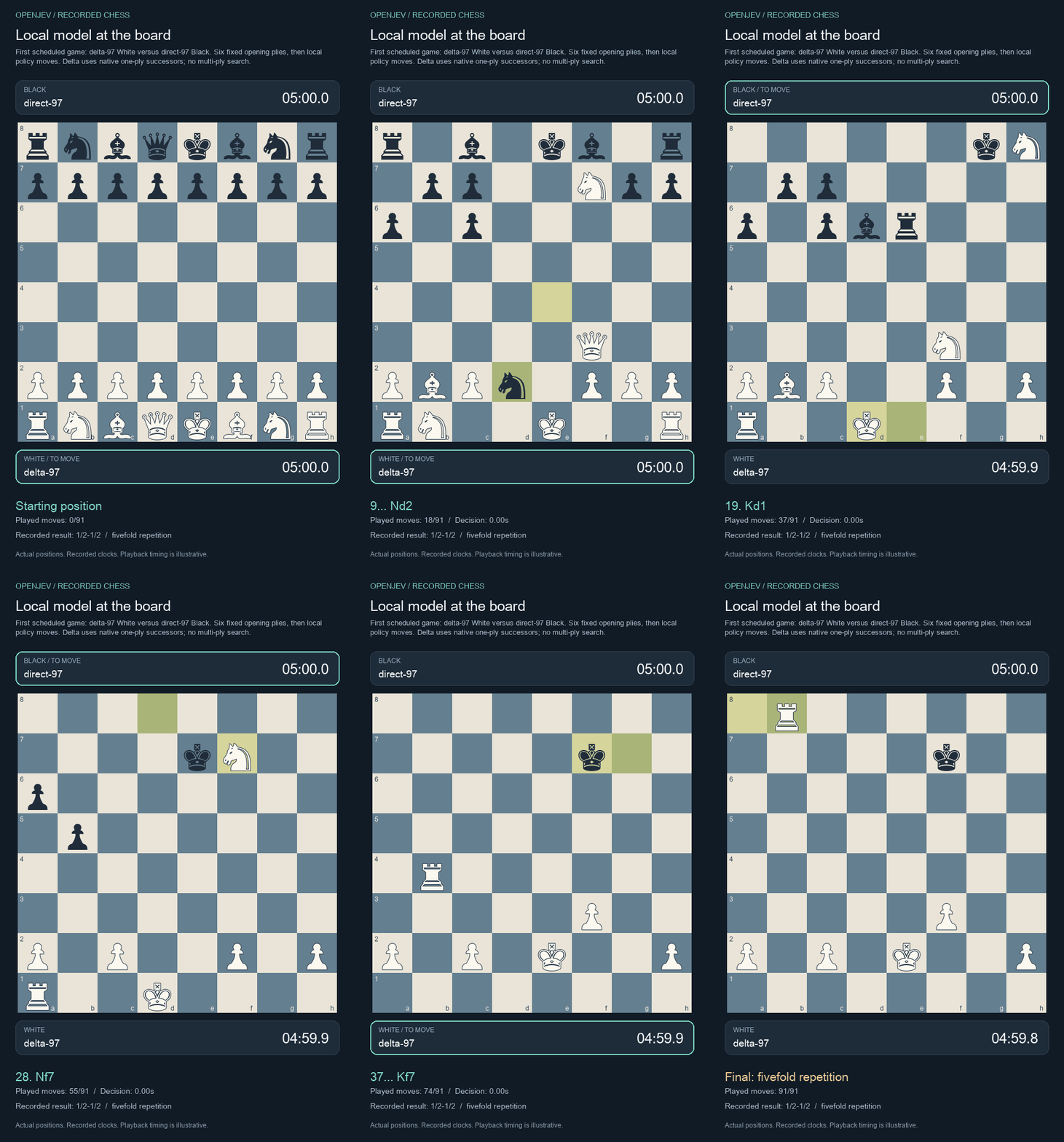
Four small policies score legal moves across twelve fits and 288 games. Exact next-board differences raise ordinary move agreement from 31.75% to 33.15%, but cost more computation and fail the engine-loss and game-score criteria. The GIF is the first scheduled game, not a selected win. No learned world model or Elo rating is established.
Open chess GIF · Results, all checkpoints and controls · ChessBench transfer · Connectome comparison · Graph-quality comparison.

13 kills in 19.26 game seconds, from the first fit and first evaluation seed. JEPA supplies training rewards; a small policy plays this recording. The full nine-method comparison did not establish a reliable JEPA advantage. This is one illustrative episode, not an inference-speed benchmark.
Open Doom GIF · Results and limits · Recording receipt · Other Doom controllers.
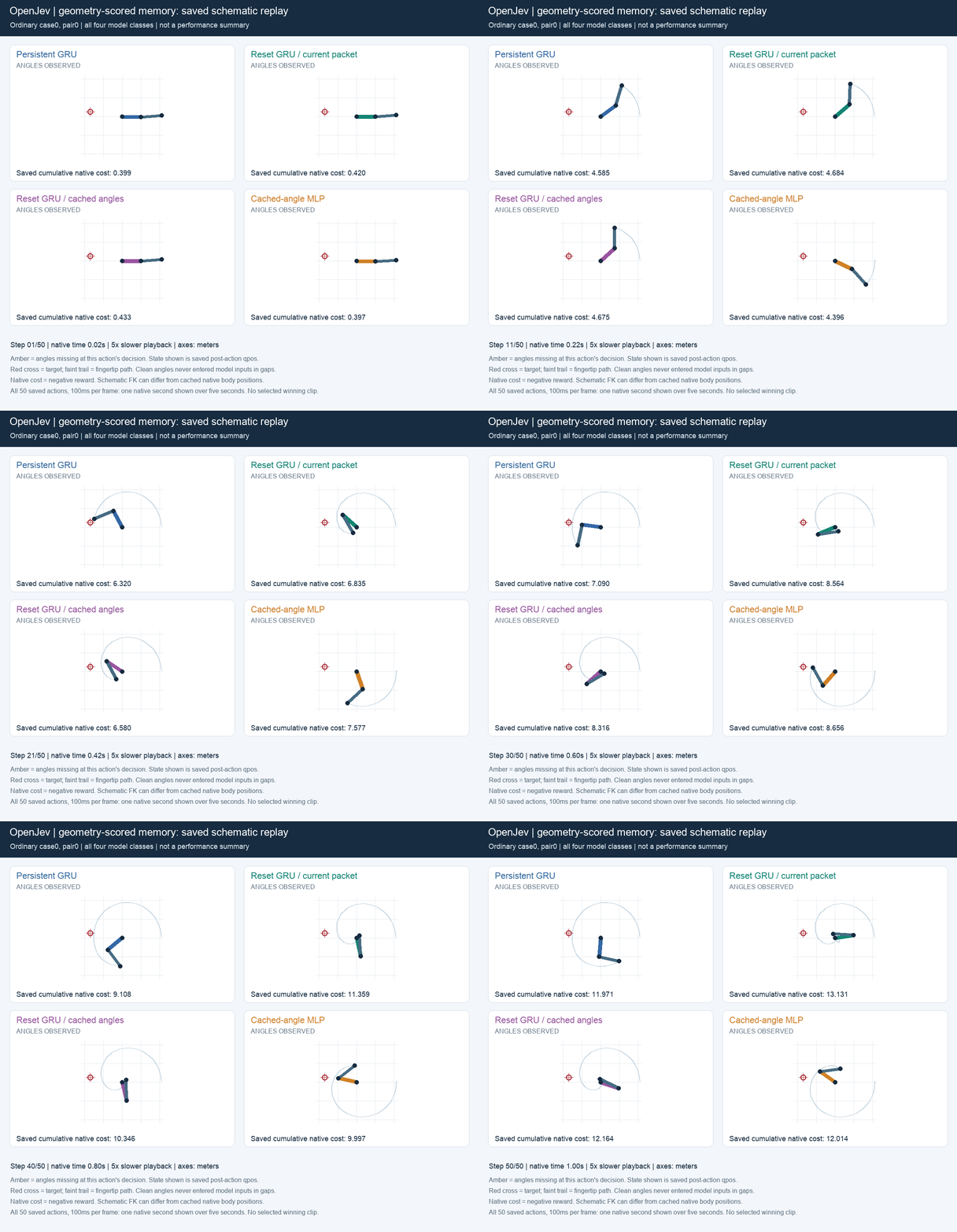
The stronger memory comparison failed its rule: 24/25 checks passed. Persistent GRU lowers control cost by 4.44% / 2.94% versus a separately trained two-observation controller; the rule requires at least 3% on both sensing-gap panels. Supplied-physics controllers still perform better.
The GIF is from the earlier, weaker-control study. The stronger comparison retains all nine models, five references and complete costs. Neither establishes a new architecture or biological-wiring advantage.
The completed nonlinear reference check passes all 4/4 development continuation checks. Our unchanged recurrent residual model keeps 22.31% lower forecast error than the strongest eligible completed control. All 1,536 forecasts replay correctly in the independent audit.
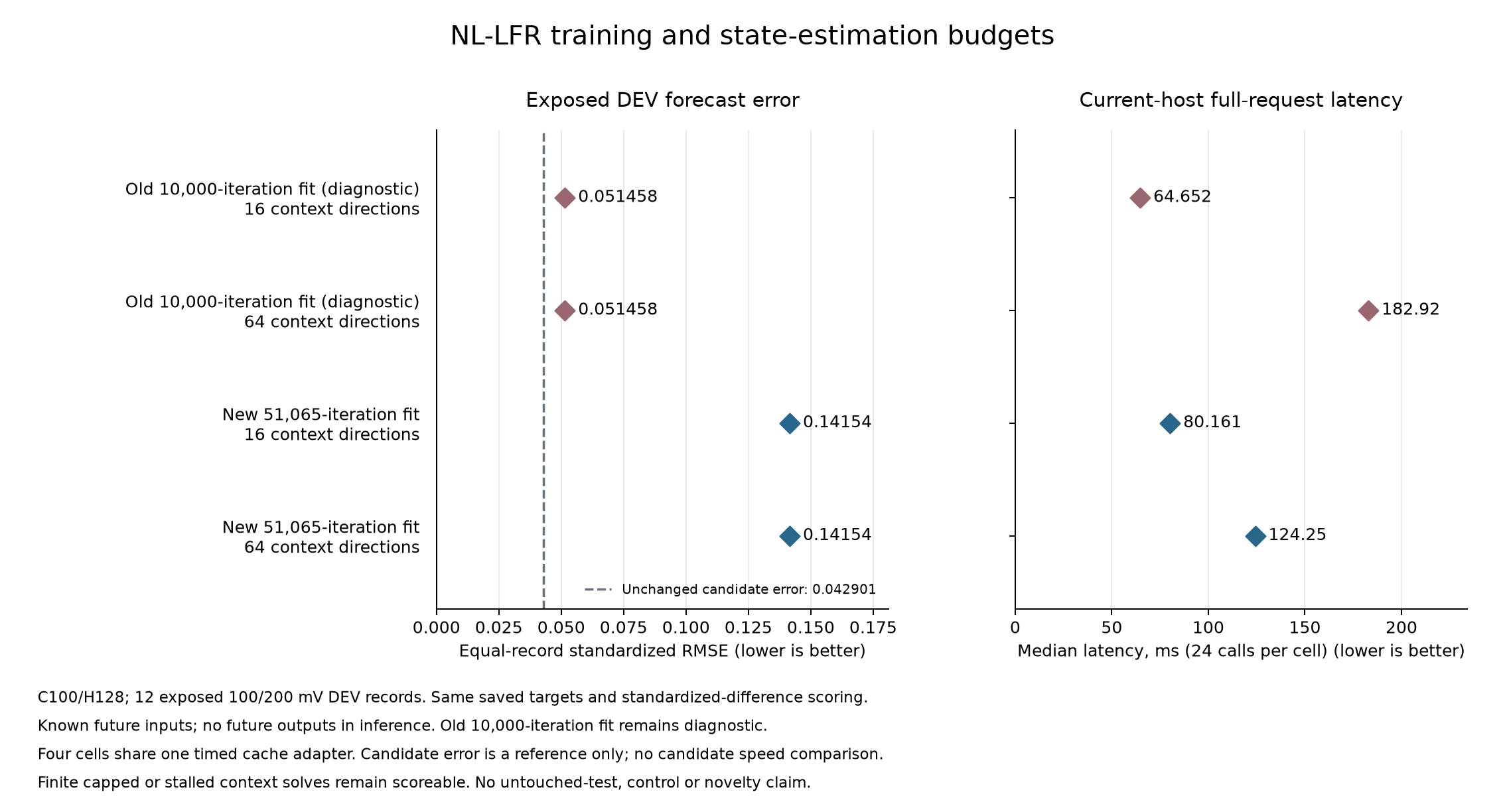
More training did not help the reference: its training loss fell, but forecast error rose about 175%. Extra state-estimation steps barely changed accuracy and increased latency. The older capped checkpoint remains a diagnostic result.
Results, chart and checkpoints · All control scores · Proposed scenario-shift check · All experiments.
These checks use exposed development data. Scenario-shift confirmation, a second measured system and architectural novelty remain unresolved. The next priority is evaluating frozen models at 300 mV before adding more learning techniques; that comparison is not yet registered or run. The publication correction remains available, as do earlier negative experiments.
The Rust inference path passes 110 synthetic checks, but its trained-model comparison stops at physical-output parity before timing. No Rust speedup is established.
Separate engineering studies measured 1.20-1.35x training throughput from shared computation and 2.08x scoring speed on four-question synthetic workloads. Neither reproduces proprietary RLCD. Public Qwen RLCD review · Jev architecture claims.
Candidate probabilities are uncalibrated and relative to the supplied choices. Rewording or changing the choices can change the scores.
These demos use different models and protocols. Replays illustrate preserved episodes; they do not replace complete comparisons. The research has not established a novel architecture, a biological-wiring advantage or a new RL algorithm.
OpenJev is independent of TypeSafe Jev, zhihz/openjev and openjev.com. It does not reproduce proprietary Jev architecture or weights.
The root MIT license applies except where component notices specify other terms, including GPL-3.0-only chess research files and the GPL-3.0-or-later author-baseline adapter. Third-party data and model licenses apply separately.
Browser decision playground and reproducible experiments on memory, uncertainty, and Doom control
See the codeContext → questions and candidate answers → probabilities → your application's next step.
OpenJev is a local decision interface and a collection of controlled learning experiments. Score choices with stable IDs, try text decisions in your browser, or explore recorded chess, Doom and robot policies.
Text demo · Chess replay · API · Setup · Experiment archive
Supply English context, your questions, and candidate IDs with descriptions. OpenJev returns each chosen ID and the relative probability of every supplied answer. Your application decides what to do next; the API itself executes no external action.
The local scorer uses a pinned Qwen model, maps candidates to single-token labels, and scores those labels without generating an explanation. Questions are independent. Stable IDs constrain the response format, not whether the choice is correct.
Architecture and calibration notes explain what public Jev-inspired implementations establish and which claims still need evidence.
Use POST /api/decide with the X-OpenJev: 1 header, or openjev decide request.json. The complete example and API reference cover request limits, errors, model metadata and execution boundaries.
Apple Silicon macOS, Python 3.11-3.13:
git clone https://github.com/kw2828/OpenJev.git
cd OpenJev
uv sync --frozen --extra language
uv run --extra language openjev setup
uv run --extra language openjev serve
Open http://127.0.0.1:8000. Setup downloads the pinned Qwen3-4B weights; inference then uses the local cache. No paid API key is needed.
The free browser demo runs Qwen3-0.6B through WebGPU. Its scores are not interchangeable with the local 4B model. Browser requirements · Linux, Docker and hosting.
Four small policies score legal moves across twelve fits and 288 games. Exact next-board differences raise ordinary move agreement from 31.75% to 33.15%, but cost more computation and fail the engine-loss and game-score criteria. The GIF is the first scheduled game, not a selected win. No learned world model or Elo rating is established.
Open chess GIF · Results, all checkpoints and controls · ChessBench transfer · Connectome comparison · Graph-quality comparison.
13 kills in 19.26 game seconds, from the first fit and first evaluation seed. JEPA supplies training rewards; a small policy plays this recording. The full nine-method comparison did not establish a reliable JEPA advantage. This is one illustrative episode, not an inference-speed benchmark.
Open Doom GIF · Results and limits · Recording receipt · Other Doom controllers.
The stronger memory comparison failed its rule: 24/25 checks passed. Persistent GRU lowers control cost by 4.44% / 2.94% versus a separately trained two-observation controller; the rule requires at least 3% on both sensing-gap panels. Supplied-physics controllers still perform better.
The GIF is from the earlier, weaker-control study. The stronger comparison retains all nine models, five references and complete costs. Neither establishes a new architecture or biological-wiring advantage.
The completed nonlinear reference check passes all 4/4 development continuation checks. Our unchanged recurrent residual model keeps 22.31% lower forecast error than the strongest eligible completed control. All 1,536 forecasts replay correctly in the independent audit.
More training did not help the reference: its training loss fell, but forecast error rose about 175%. Extra state-estimation steps barely changed accuracy and increased latency. The older capped checkpoint remains a diagnostic result.
Results, chart and checkpoints · All control scores · Proposed scenario-shift check · All experiments.
These checks use exposed development data. Scenario-shift confirmation, a second measured system and architectural novelty remain unresolved. The next priority is evaluating frozen models at 300 mV before adding more learning techniques; that comparison is not yet registered or run. The publication correction remains available, as do earlier negative experiments.
The Rust inference path passes 110 synthetic checks, but its trained-model comparison stops at physical-output parity before timing. No Rust speedup is established.
Separate engineering studies measured 1.20-1.35x training throughput from shared computation and 2.08x scoring speed on four-question synthetic workloads. Neither reproduces proprietary RLCD. Public Qwen RLCD review · Jev architecture claims.
Candidate probabilities are uncalibrated and relative to the supplied choices. Rewording or changing the choices can change the scores.
These demos use different models and protocols. Replays illustrate preserved episodes; they do not replace complete comparisons. The research has not established a novel architecture, a biological-wiring advantage or a new RL algorithm.
OpenJev is independent of TypeSafe Jev, zhihz/openjev and openjev.com. It does not reproduce proprietary Jev architecture or weights.
The root MIT license applies except where component notices specify other terms, including GPL-3.0-only chess research files and the GPL-3.0-or-later author-baseline adapter. Third-party data and model licenses apply separately.



