
A nano replica of Jev: parallel decisions, dynamic candidates, and an end-to-end training pipeline.
Python
317
13 commits
updated Sep 17, 2026
See what people are saying (1)
README
NanoJev — A nano replica of Jev
English | 简体中文
A 0.6B parallel decision model. States and questions in, complete probability distributions out—with zero output-token decoding.
Open the live side-by-side demo →
Three models, one game
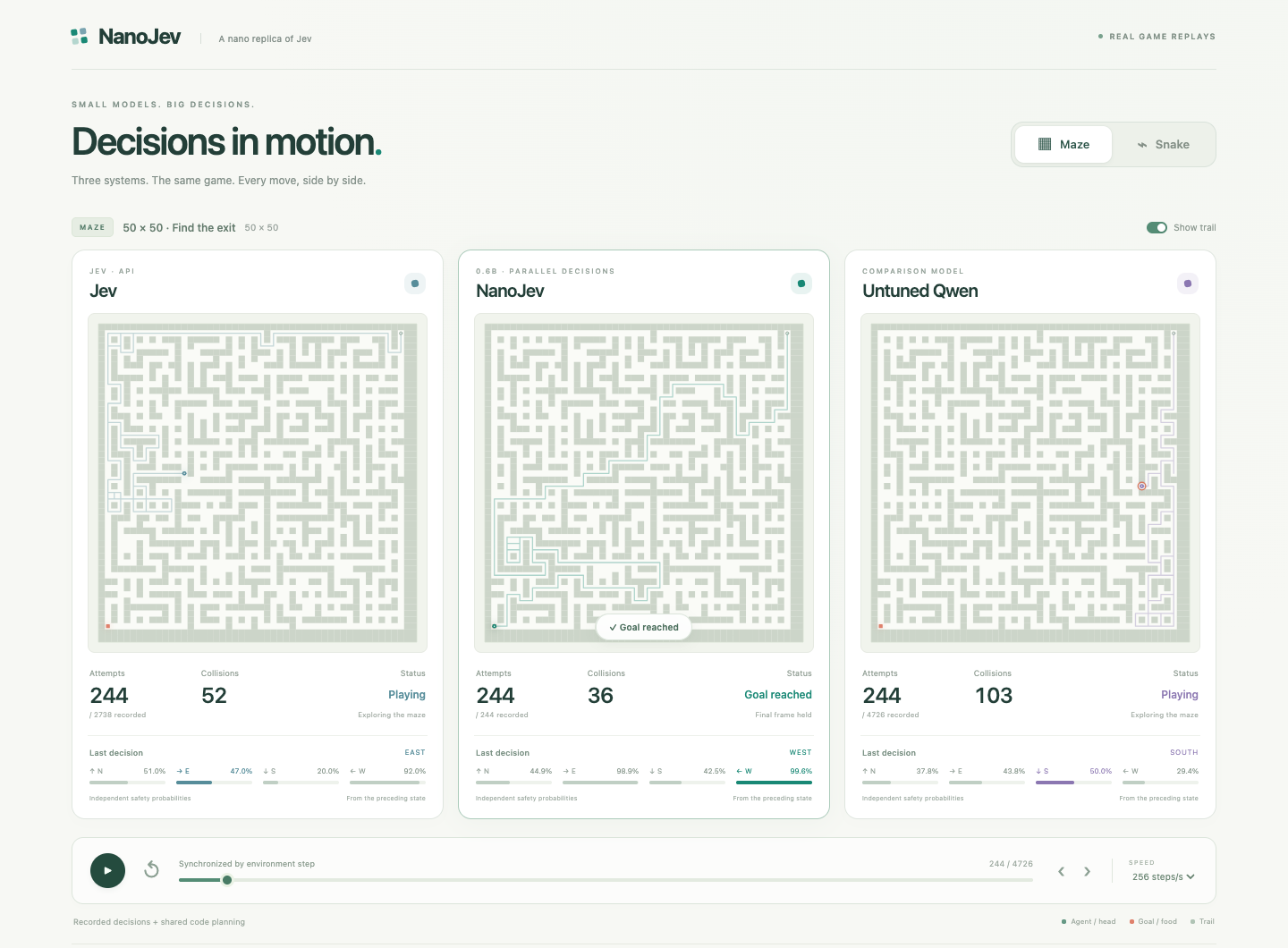
Download the maze video (MP4) · 27 seconds · 1440 × 1120 · 30 fps
Play Snake · Explore the 50×50 maze · Recorded sources and replay checks
The standalone ChatGPT Sites demo presents Jev, NanoJev, and Untuned Qwen in three light panels. Playback advances by the same environment step across panels; completed runs freeze at their actual final state. Probability bars show the last decision that produced the displayed state. Shared code planning remains part of each system.
The new maze baseline is the original Qwen3-0.6B: 4,726 attempts, 2,044 collisions, goal reached. The older maze video below keeps its original Starting NanoJev comparison and recorded results.
Recorded showcase runs
Watch model judgments and shared code planning work together. Each game uses the same controller code across its three systems; the recordings preserve the actual actions, probabilities, and final outcomes.
Find the exit: 50×50 maze
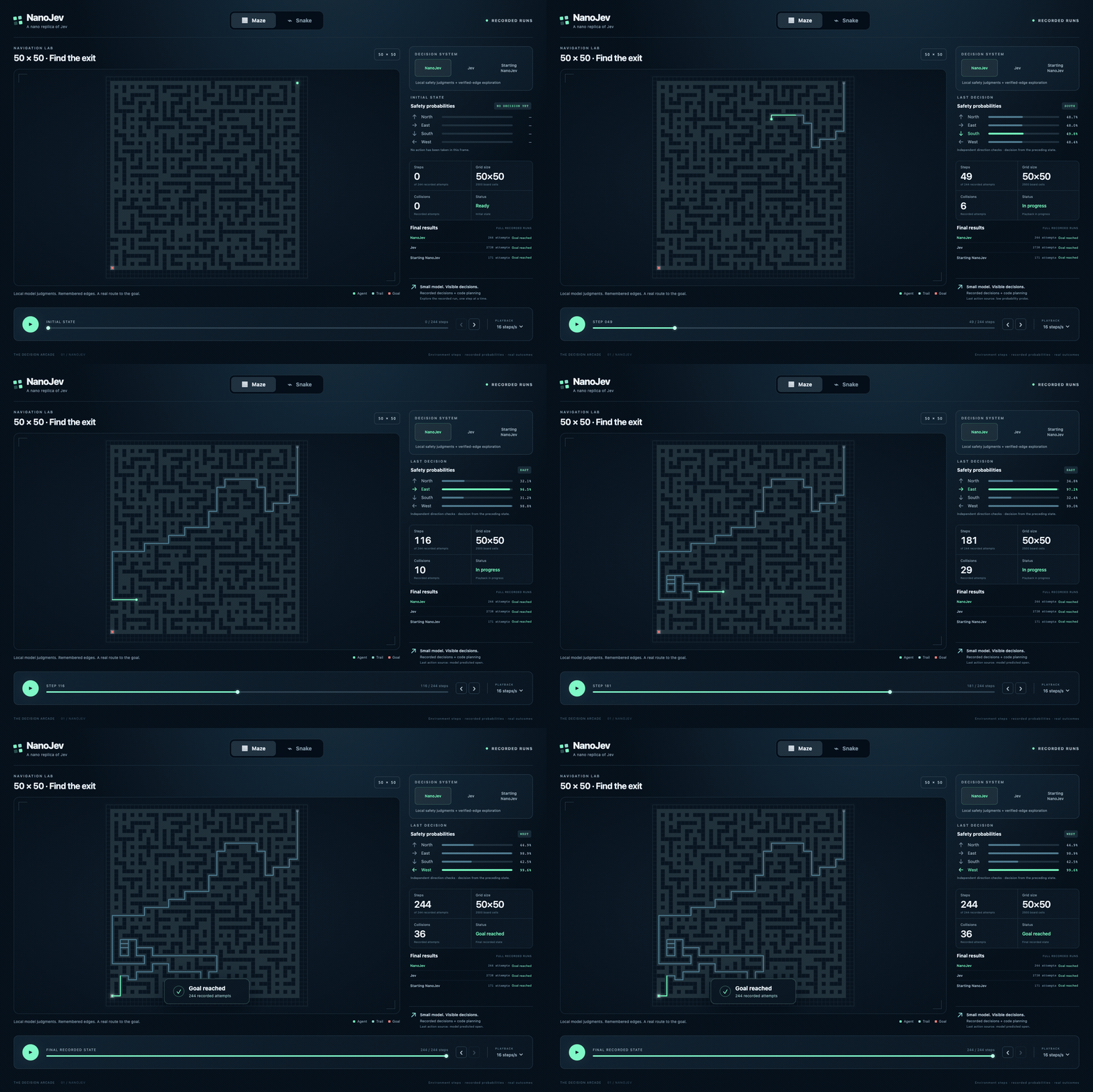
Watch the MP4 · Interactive replay
The model judges four local directions. Code remembers collisions, explores untried edges, and repositions through verified open paths.
| System | Attempts | Collisions | Outcome |
|---|---|---|---|
| NanoJev | 244 | 36 | Goal reached |
| Jev | 2,738 | 1,044 | Goal reached |
| Starting NanoJev | 171 | 43 | Goal reached |
Starting NanoJev is the earlier trained NanoJev checkpoint. The new NanoJev model uses matched local safety training.
Keep growing: 12×12 Snake
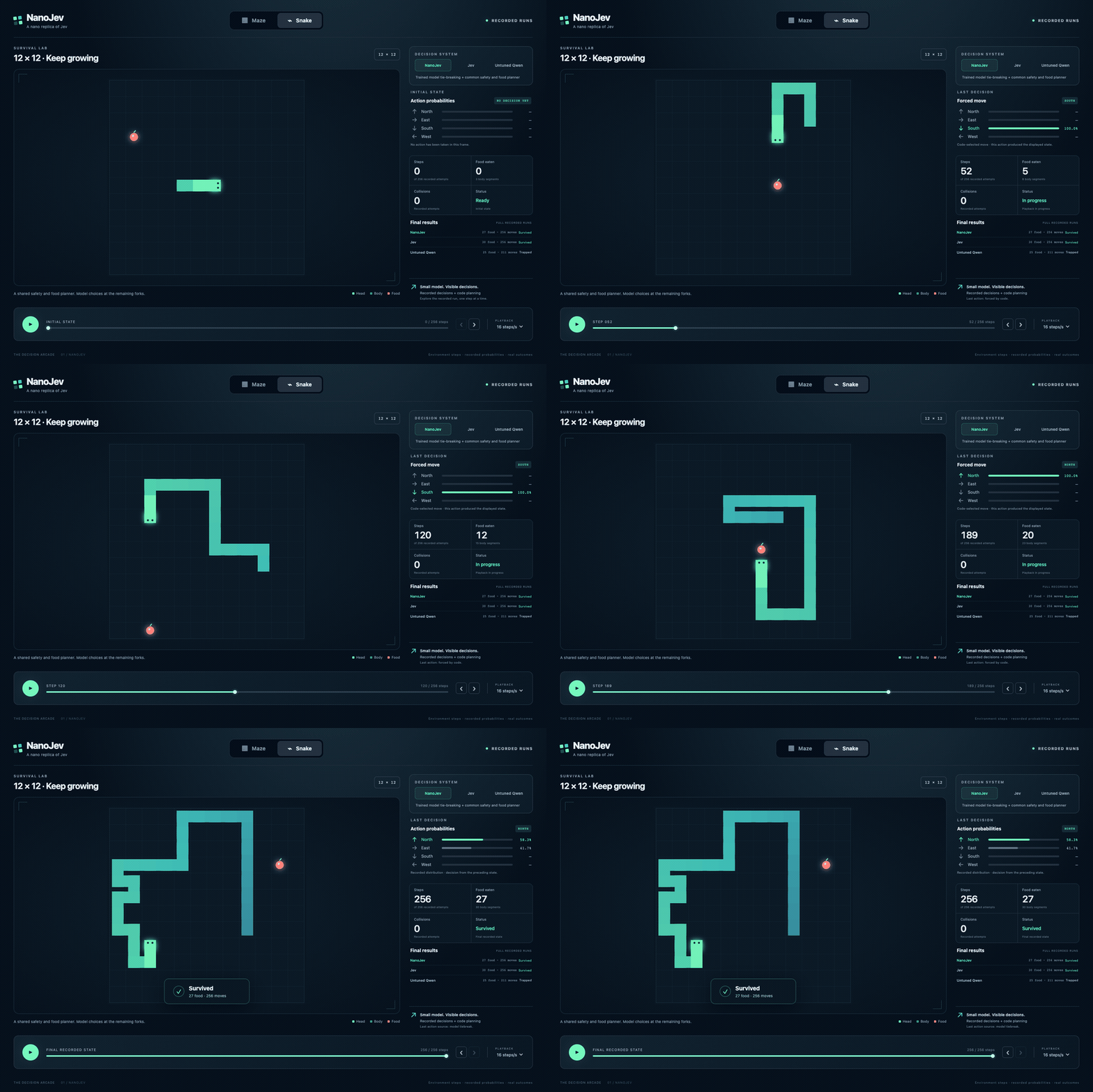
Watch the MP4 · Interactive replay
The common planner filters immediate collisions and finds static paths toward the visible food. The model breaks ties between the remaining actions; a single remaining action is a code-forced move. Seed: 61005. Controller: greedy.
| System | Food collected | Steps | Outcome |
|---|---|---|---|
| NanoJev | 27 | 256 | Alive at horizon |
| Jev | 30 | 256 | Alive at horizon |
| Untuned Qwen3-0.6B | 25 | 211 | Trapped |
Untuned Qwen uses its original pretrained weights and native language-model head, conditioned on the offered A–D answer tokens.
Recorded cases and replay verification · Eight-case controller comparison
Features
- 0.6B LLM backbone. Qwen3-0.6B with decision heads for structured outputs.
- Multiple states and questions in one forward. Batch independent decisions together.
- Dynamic Choice. Supply 2–255 candidates and receive a probability for every candidate.
- Boolean decisions. Receive the probability that a complete proposition is true.
- Ordered Score. Supply 2–10 levels and receive the level distribution and expected score.
- Complete distributions. Use the same output for ranking, greedy selection, or probability sampling.
- Zero output decoding. Read decisions directly from a forward pass.
- Persistent serving. Load a checkpoint once and reuse it across requests.
Measured in the running service: 6 states · 18 questions · 44 candidate paths · 1 backbone forward.
Larger games and calibrated decisions
- Full-size environments: 8×8, 16×16, 32×32, and 50×50 mazes, four topologies, multiple positions per map, and configurable larger sizes.
- Local judgments + code planning: matched 5×5 observations, four parallel safety judgments, movement memory, and model-guided exploration.
- Snake dynamics: reproducible food generation, body growth, collision rules, tail movement, dynamic action candidates, and safety questions.
- Probability learning: observed-event datasets, CE/Brier training, paired proper-reward learning, exact gradient checks, and completed Qwen3-0.6B runs.
- Verified evaluation: map-separated data, frozen game cohorts, real model execution, and independent trajectory replay.
The local safety model reaches 77.84% accuracy on test questions and 76.56% on 50×50 OOD questions. The probability-learning pilot's paired proper-reward arm reaches 0.11844 test / 0.06202 OOD distribution error, measured as the sum of squared differences from the simulator's event probabilities.
Atomic planning · Scaled-game pipeline · RLCD implementation and results · Input contract · Game results
Earlier 40-map navigation benchmark
Controller: T=1 probability sampling. The full benchmark contains 20 test maps and 20 OOD maps.
| System | 4×4 test | 6×6 OOD |
|---|---|---|
| NanoJev | 19/20 — 95% | 18/20 — 90% |
| Jev | 20/20 — 100% | 19/20 — 95% |
| Untuned Qwen3-0.6B | 7/20 — 35% | 3/20 — 15% |
Earlier comparison viewer · Complete benchmark results
How it works
Each decision is defined by a state, a question, and its candidate set. Every candidate path carries the relevant input into the backbone. Shared decision heads return a distribution over the candidates supplied for that question.
Choice uses a shared scalar head and set attention. Boolean uses a single-path sigmoid. Score evaluates its ordered level descriptions and returns their probability-weighted expectation.
- Build queries. Generate states, questions, candidate descriptions, and target distributions.
- Organize data. Keep related maps, rules, and their variations in the same split.
- Train. Initialize Qwen3-0.6B, warm up the decision heads, and train with complete-question distribution losses.
- Evaluate. Measure probability quality and execute game controllers with recorded actions.
- Serve and visualize. Reuse a persistent model endpoint and replay complete trajectories in the browser.
Quick start: side-by-side replay
The interactive replay runs with Python's built-in HTTP server:
git clone https://github.com/TianyuCodings/NanoJev.git
cd NanoJev
python3 -m http.server 8080 --bind 127.0.0.1 --directory web
Open http://127.0.0.1:8080/side-by-side.html for the three-panel Snake and maze comparison. The dark arcade remains at http://127.0.0.1:8080/arcade.html, and the earlier benchmark viewer at http://127.0.0.1:8080/comparison.html.
Download the showcase models
| Use | Checkpoint in C-Tianyu/NanoJev |
|---|---|
| 50×50 maze demo | variants/local_atomic_seed17 |
| Snake demo | variants/games_gold_seed17 |
| Full-map comparison | variants/games_api_seed17 |
| Calibrated-decision experiments | variants/events_ce_seed17, variants/events_brier_seed17, variants/events_paired_seed17 |
from pathlib import Path
from huggingface_hub import snapshot_download

variant = "local_atomic_seed17"  # Select "games_gold_seed17" for Snake.
snapshot = snapshot_download(
    repo_id="C-Tianyu/NanoJev",
    allow_patterns=[f"variants/{variant}/*"],
)
checkpoint_dir = Path(snapshot) / "variants" / variant
The game data package contains the matching training splits, frozen evaluation inputs, and all six Snake controller recordings. Download, verify, and reproduce the games.
Download and run the model
The model and dataset are public. Prepare a CUDA environment with the recorded Python dependencies:
python -m pip install -r requirements-toy.txt
Download the base release checkpoint and dataset. The root checkpoint is the initialization model and the earlier navigation baseline:
from huggingface_hub import snapshot_download

snapshot_download(
    repo_id="C-Tianyu/NanoJev", local_dir="checkpoints/NanoJev",
    allow_patterns=["best.safetensors", "config.json", "tokenizer/*", "backbone_config/*"],
)
snapshot_download(
    repo_id="C-Tianyu/NanoJev-Data", repo_type="dataset", local_dir="data/NanoJev",
)
Start the persistent service:
python scripts/serve_decisions.py \
  --checkpoint-dir checkpoints/NanoJev \
  --web-root web --port 8765
Open http://127.0.0.1:8765. The service loads the model once and accepts repeated batches through POST /api/evaluate.
The pipeline runbook covers data generation, training, evaluation, checkpoint creation, and continuing from the downloaded model and data.
Roadmap
- Scale up data — Add larger mazes, Snake, atomic questions, and observed-event datasets.
- Calibrated reward prototype — Implement and test paired proper-reward learning with CE/Brier controls.
- RLCD expansion — Add broader semantic tasks, stochastic long-horizon events, and additional model seeds.
- Structured input support — Version the encoder for structured instructions, criteria, and the native Noul interface.
Contributors

13 commits
Similar repos




Languages
Python
81.0%
JavaScript
17.1%
HTML
1.9%
A nano replica of Jev: parallel decisions, dynamic candidates, and an end-to-end training pipeline.
Python
317
13 commits
updated Sep 17, 2026
See what people are saying (1)
README
NanoJev — A nano replica of Jev
English | 简体中文
A 0.6B parallel decision model. States and questions in, complete probability distributions out—with zero output-token decoding.
Open the live side-by-side demo →
Three models, one game
Download the maze video (MP4) · 27 seconds · 1440 × 1120 · 30 fps
Play Snake · Explore the 50×50 maze · Recorded sources and replay checks
The standalone ChatGPT Sites demo presents Jev, NanoJev, and Untuned Qwen in three light panels. Playback advances by the same environment step across panels; completed runs freeze at their actual final state. Probability bars show the last decision that produced the displayed state. Shared code planning remains part of each system.
The new maze baseline is the original Qwen3-0.6B: 4,726 attempts, 2,044 collisions, goal reached. The older maze video below keeps its original Starting NanoJev comparison and recorded results.
Recorded showcase runs
Watch model judgments and shared code planning work together. Each game uses the same controller code across its three systems; the recordings preserve the actual actions, probabilities, and final outcomes.
Find the exit: 50×50 maze
Watch the MP4 · Interactive replay
The model judges four local directions. Code remembers collisions, explores untried edges, and repositions through verified open paths.
| System | Attempts | Collisions | Outcome |
|---|---|---|---|
| NanoJev | 244 | 36 | Goal reached |
| Jev | 2,738 | 1,044 | Goal reached |
| Starting NanoJev | 171 | 43 | Goal reached |
Starting NanoJev is the earlier trained NanoJev checkpoint. The new NanoJev model uses matched local safety training.
Keep growing: 12×12 Snake
Watch the MP4 · Interactive replay
The common planner filters immediate collisions and finds static paths toward the visible food. The model breaks ties between the remaining actions; a single remaining action is a code-forced move. Seed: 61005. Controller: greedy.
| System | Food collected | Steps | Outcome |
|---|---|---|---|
| NanoJev | 27 | 256 | Alive at horizon |
| Jev | 30 | 256 | Alive at horizon |
| Untuned Qwen3-0.6B | 25 | 211 | Trapped |
Untuned Qwen uses its original pretrained weights and native language-model head, conditioned on the offered A–D answer tokens.
Recorded cases and replay verification · Eight-case controller comparison
Features
- 0.6B LLM backbone. Qwen3-0.6B with decision heads for structured outputs.
- Multiple states and questions in one forward. Batch independent decisions together.
- Dynamic Choice. Supply 2–255 candidates and receive a probability for every candidate.
- Boolean decisions. Receive the probability that a complete proposition is true.
- Ordered Score. Supply 2–10 levels and receive the level distribution and expected score.
- Complete distributions. Use the same output for ranking, greedy selection, or probability sampling.
- Zero output decoding. Read decisions directly from a forward pass.
- Persistent serving. Load a checkpoint once and reuse it across requests.
Measured in the running service: 6 states · 18 questions · 44 candidate paths · 1 backbone forward.
Larger games and calibrated decisions
- Full-size environments: 8×8, 16×16, 32×32, and 50×50 mazes, four topologies, multiple positions per map, and configurable larger sizes.
- Local judgments + code planning: matched 5×5 observations, four parallel safety judgments, movement memory, and model-guided exploration.
- Snake dynamics: reproducible food generation, body growth, collision rules, tail movement, dynamic action candidates, and safety questions.
- Probability learning: observed-event datasets, CE/Brier training, paired proper-reward learning, exact gradient checks, and completed Qwen3-0.6B runs.
- Verified evaluation: map-separated data, frozen game cohorts, real model execution, and independent trajectory replay.
The local safety model reaches 77.84% accuracy on test questions and 76.56% on 50×50 OOD questions. The probability-learning pilot's paired proper-reward arm reaches 0.11844 test / 0.06202 OOD distribution error, measured as the sum of squared differences from the simulator's event probabilities.
Atomic planning · Scaled-game pipeline · RLCD implementation and results · Input contract · Game results
Earlier 40-map navigation benchmark
Controller: T=1 probability sampling. The full benchmark contains 20 test maps and 20 OOD maps.
| System | 4×4 test | 6×6 OOD |
|---|---|---|
| NanoJev | 19/20 — 95% | 18/20 — 90% |
| Jev | 20/20 — 100% | 19/20 — 95% |
| Untuned Qwen3-0.6B | 7/20 — 35% | 3/20 — 15% |
Earlier comparison viewer · Complete benchmark results
How it works
Each decision is defined by a state, a question, and its candidate set. Every candidate path carries the relevant input into the backbone. Shared decision heads return a distribution over the candidates supplied for that question.
Choice uses a shared scalar head and set attention. Boolean uses a single-path sigmoid. Score evaluates its ordered level descriptions and returns their probability-weighted expectation.
- Build queries. Generate states, questions, candidate descriptions, and target distributions.
- Organize data. Keep related maps, rules, and their variations in the same split.
- Train. Initialize Qwen3-0.6B, warm up the decision heads, and train with complete-question distribution losses.
- Evaluate. Measure probability quality and execute game controllers with recorded actions.
- Serve and visualize. Reuse a persistent model endpoint and replay complete trajectories in the browser.
Quick start: side-by-side replay
The interactive replay runs with Python's built-in HTTP server:
git clone https://github.com/TianyuCodings/NanoJev.git
cd NanoJev
python3 -m http.server 8080 --bind 127.0.0.1 --directory web
Open http://127.0.0.1:8080/side-by-side.html for the three-panel Snake and maze comparison. The dark arcade remains at http://127.0.0.1:8080/arcade.html, and the earlier benchmark viewer at http://127.0.0.1:8080/comparison.html.
Download the showcase models
| Use | Checkpoint in C-Tianyu/NanoJev |
|---|---|
| 50×50 maze demo | variants/local_atomic_seed17 |
| Snake demo | variants/games_gold_seed17 |
| Full-map comparison | variants/games_api_seed17 |
| Calibrated-decision experiments | variants/events_ce_seed17, variants/events_brier_seed17, variants/events_paired_seed17 |
from pathlib import Path
from huggingface_hub import snapshot_download

variant = "local_atomic_seed17"  # Select "games_gold_seed17" for Snake.
snapshot = snapshot_download(
    repo_id="C-Tianyu/NanoJev",
    allow_patterns=[f"variants/{variant}/*"],
)
checkpoint_dir = Path(snapshot) / "variants" / variant
The game data package contains the matching training splits, frozen evaluation inputs, and all six Snake controller recordings. Download, verify, and reproduce the games.
Download and run the model
The model and dataset are public. Prepare a CUDA environment with the recorded Python dependencies:
python -m pip install -r requirements-toy.txt
Download the base release checkpoint and dataset. The root checkpoint is the initialization model and the earlier navigation baseline:
from huggingface_hub import snapshot_download

snapshot_download(
    repo_id="C-Tianyu/NanoJev", local_dir="checkpoints/NanoJev",
    allow_patterns=["best.safetensors", "config.json", "tokenizer/*", "backbone_config/*"],
)
snapshot_download(
    repo_id="C-Tianyu/NanoJev-Data", repo_type="dataset", local_dir="data/NanoJev",
)
Start the persistent service:
python scripts/serve_decisions.py \
  --checkpoint-dir checkpoints/NanoJev \
  --web-root web --port 8765
Open http://127.0.0.1:8765. The service loads the model once and accepts repeated batches through POST /api/evaluate.
The pipeline runbook covers data generation, training, evaluation, checkpoint creation, and continuing from the downloaded model and data.
Roadmap
- Scale up data — Add larger mazes, Snake, atomic questions, and observed-event datasets.
- Calibrated reward prototype — Implement and test paired proper-reward learning with CE/Brier controls.
- RLCD expansion — Add broader semantic tasks, stochastic long-horizon events, and additional model seeds.
- Structured input support — Version the encoder for structured instructions, criteria, and the native Noul interface.
Similar repos
Contributors
13 commits
Languages
Python
81.0%
JavaScript
17.1%
HTML
1.9%