
Open alternative to Jev: typed, calibrated decisions from any open-weights LLM in one forward pass (HF + vLLM), with benchmarks
Python
0
5 commits
updated Sep 18, 2026
See what people are saying (1)
README
Open Alternative to Jev
Open-source System One models: typed, calibrated decisions from any open-weights LLM, in one forward pass.
An open alternative to the idea behind TypeSafe's Jev, running on your own GPU with models you already have.
Python package open-alternative-jev, import name so1 ("System One"). No text is generated: the model reads the state once and every question is answered from the next-token distribution at its own position, restricted to the options you give.
Results
Qwen3.6-27B (bitsandbytes 8-bit), one H200 MIG slice with 35 GB, Hugging Face Transformers. Every number
below comes from benchmarks/results/, produced by the scripts in benchmarks/scripts/.
RACE-H, 250 passages x 4 questions (n = 1000). One passage, four multiple-choice questions. This is the shared-state case the library is built for.
| Mode | Accuracy | Questions / s | Tokens processed |
|---|---|---|---|
| A: one question per forward | 92.6 % | 1.66 | 468,583 |
| B: batch of 4 (padding) | 92.8 % | 2.00 | 481,924 |
| Open Alternative to Jev (packed, state written once) | 92.9 % | 4.55 | 186,898 |
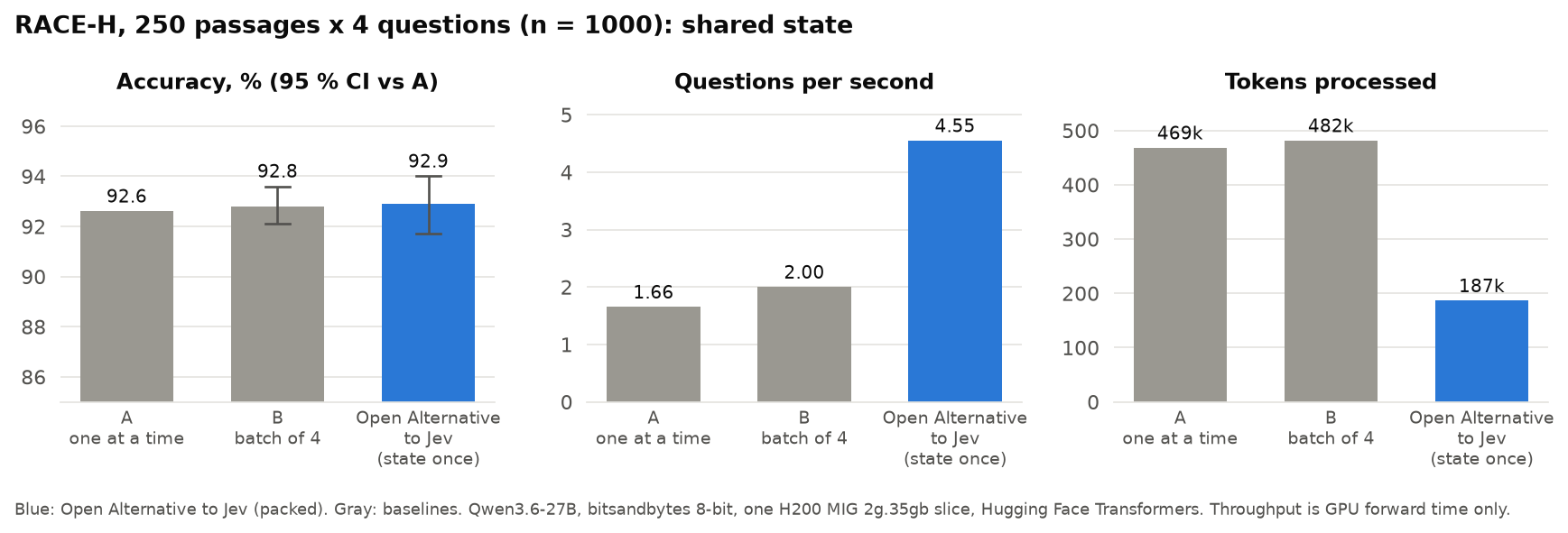
Packing writes the passage once instead of four times: 2.5x fewer tokens, 2.3x the throughput of batching, same accuracy (Open Alternative to Jev minus A = +0.3 points, 95 % CI -0.9 to +1.4, bootstrap over passages).
MMLU, 1200 questions, no shared state. Accuracy holds up to 12 questions per sequence.
| Mode | Accuracy | Questions / s | Tokens processed |
|---|---|---|---|
| A: one question per forward | 84.2 % | 3.10 | 163,032 |
| B: batch of 3 (padding) | 83.8 % | 3.88 | 253,638 |
| Open Alternative to Jev, 3 packed | 84.0 % | 5.44 | 165,432 |
| Open Alternative to Jev, 6 packed | 84.9 % | 6.21 | 166,032 |
| Open Alternative to Jev, 12 packed | 84.2 % | 6.71 | 166,332 |
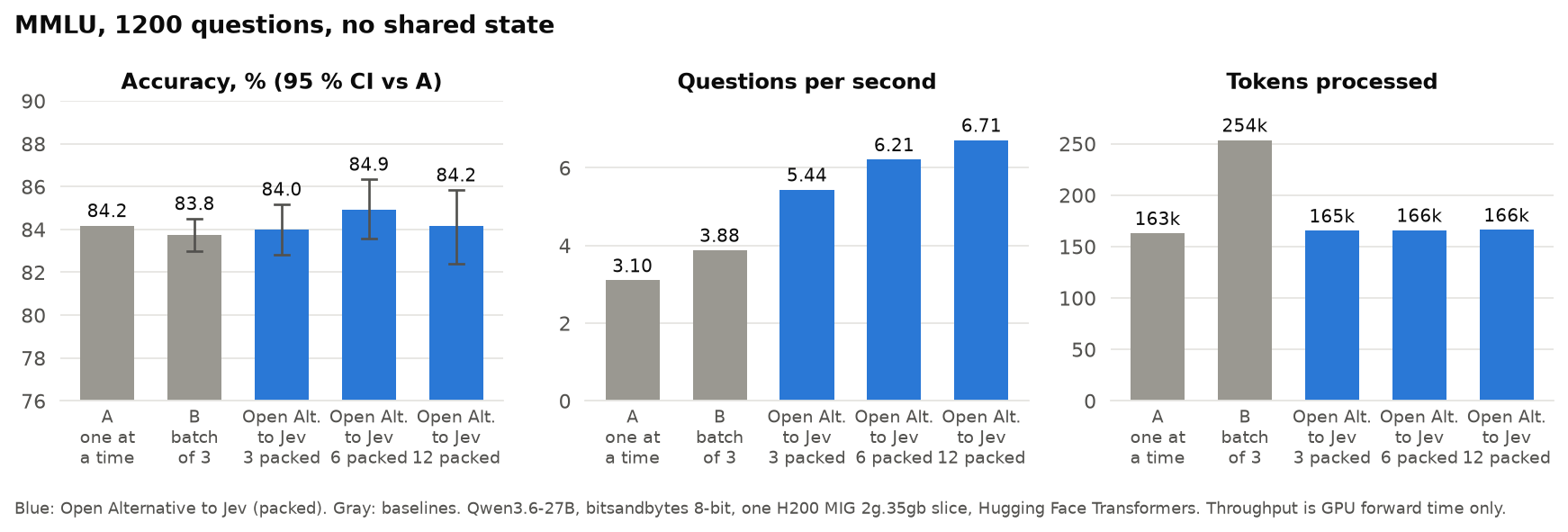
Read the MMLU speed column carefully: without a shared state, packing does not reduce compute per token. It is faster here because batch B wastes 36 % of its tokens on padding and because each forward call has a fixed cost that packing amortizes. A serving engine with continuous batching and no padding would close most of that gap. The RACE-H gain is structural and survives any engine.
The correction that made this README honest. Our first pilot reported "1.4x faster than batching" on MMLU. Regressing forward time on token counts showed that B and C cost exactly the same per token (0.96 vs 0.97 ms) and that the whole difference was padding waste in the batch. We kept the pilot and the analysis in
benchmarks/docs/RESULTS.md(Spanish) so you can check the reasoning, and we designed the RACE-H run so that the baseline had almost no padding (2.8 %).
Interference: accuracy holds, individual answers move
Later questions in a packed sequence can attend to earlier questions and to the placeholders between them.
We measured the effect against a clean noise floor: the same prompt, one at a time, but right-padded to a
fixed length (A_pad) changes 2.7 % of answers purely through kernel numerics. Packing changes 6-9 %.
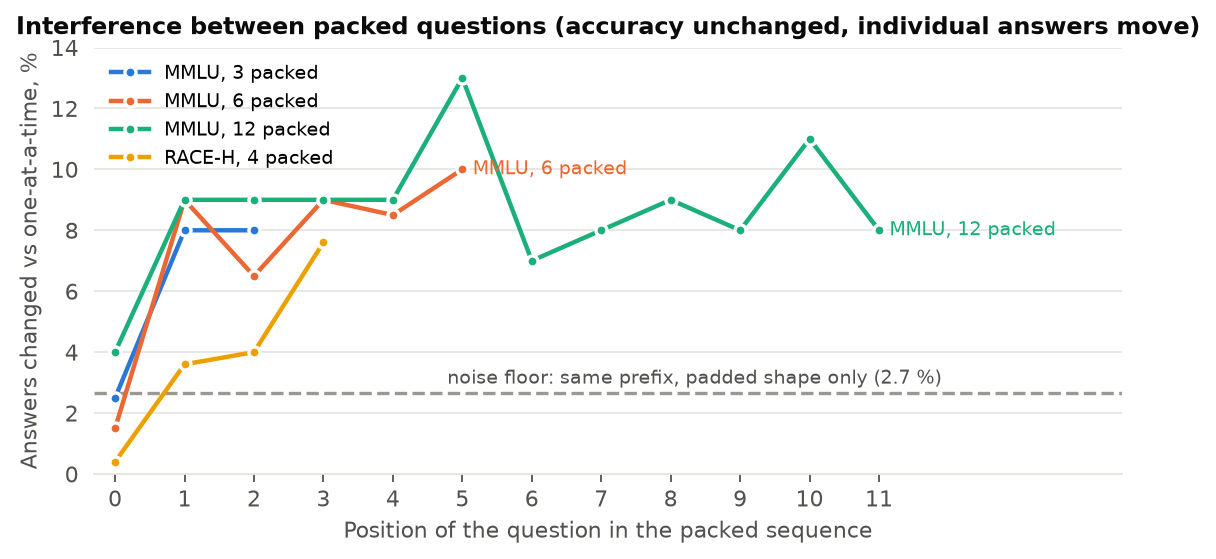
The changes are symmetric, so aggregate accuracy does not drop, but a given decision can differ depending
on which questions accompany it, and on their order (rotating the order changes 8 % of MMLU answers,
2.4 % of RACE-H answers). If you need answer-level stability, use mode="separate".
Calibration: one scalar, fitted on held-out labels
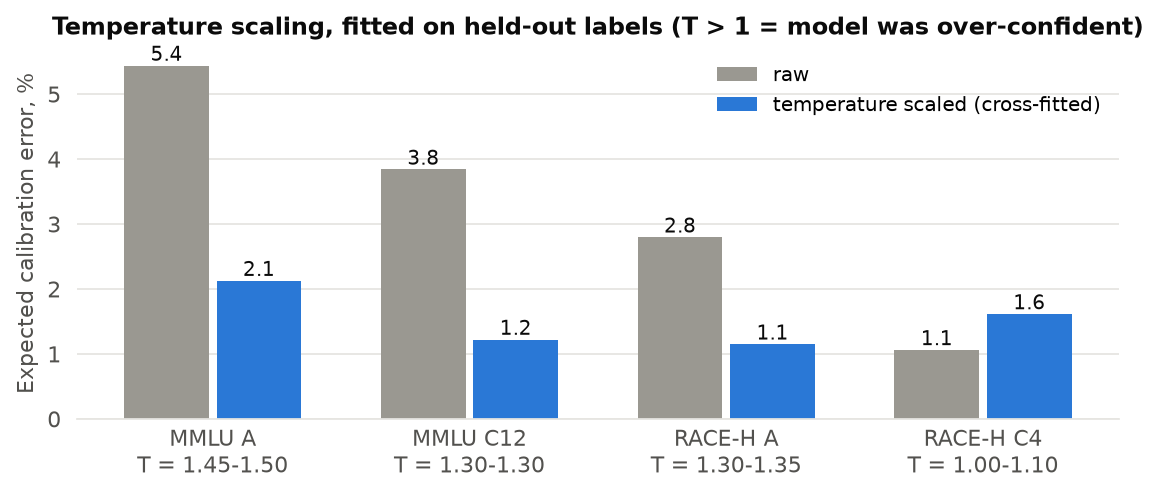
Raw confidence is about 5 points too high (mean confidence 0.90, accuracy 0.84 on MMLU). Temperature scaling with a single scalar, fitted on one half and evaluated on the other, brings the expected calibration error from 5.4 % to 2.1 % on MMLU and from 2.8 % to 1.1 % on RACE-H. Packed modes come out less over-confident than one-at-a-time scoring; RACE-H packed was already close to calibrated (T = 1.0-1.1) and scaling does not help it.
from so1 import TemperatureScaler
scaler = TemperatureScaler().fit(probabilities, correct_indices)   # a few hundred labelled decisions
calibrated = [scaler.apply(d) for d in decisions]
Quickstart
from so1 import Decider, Choice, yes_no

decider = Decider.from_pretrained("Qwen/Qwen3.6-27B", backend="hf", load_in_8bit=True)
decisions = decider.decide(
    state="Ticket #8813: 'Since yesterday's release the export button does nothing. Board meeting Monday.'",
    questions=[
        Choice("Ticket category", ["bug", "feature request", "billing", "question"]),
        Choice("Urgency", ["low", "medium", "high"]),
        yes_no("Escalate to an engineer?"),
    ],
)
for d in decisions:
    print(d.choice, round(d.confidence, 2))   # bug 0.83 / high 0.71 / yes 0.77
The answer is always one of your options, and it comes with a probability.
Install
pip install open-alternative-jev            # Hugging Face backend
pip install "open-alternative-jev[vllm]"    # + vLLM backend
pip install "open-alternative-jev[quant]"   # + bitsandbytes 8-bit / 4-bit loading
Python 3.10+. Works on CPU for small models (the test suite runs on Qwen2.5-0.5B on a laptop).
How it works
<|im_start|>user
Choose the correct option. Reply with only its letter.

Context:
<your state>

Question: <question 1>
A. option   B. option   C. option<|im_end|>
<|im_start|>assistant
<think></think>            <- readout 1: next-token distribution over A/B/C
_<|im_end|>                <- fixed placeholder, never the model's own answer
<|im_start|>user
Answer the following question about the same context. Reply with only the letter.

Question: <question 2> ...<|im_end|>
<|im_start|>assistant
                           <- readout 2
- Each question is rendered as a normal chat turn, so the model sees a format it was trained on.
- The turns are concatenated into one token sequence with a fixed placeholder answer between them.
- One forward pass; logits are read only at the readout positions (
logits_to_keepon Transformers,prompt_logprobson vLLM). - The logits of the option letters are normalized with a softmax. Nothing outside your options can win.
- Optionally, a fitted temperature turns the raw probabilities into calibrated ones.
Two modes:
mode="packed"(default): one sequence per state, all its questions inside. Fastest with a shared state.mode="separate": one sequence per question, each with the full state. No interference between questions. On vLLM this uses constrained generation withallowed_token_idsand shares the state through the prefix cache, which is the conventional baseline.
Backends
| Hugging Face Transformers | vLLM | |
|---|---|---|
| Load | Decider.from_pretrained(id, backend="hf", load_in_8bit=True) | Decider.from_pretrained(id, backend="vllm", gpu_memory_utilization=0.85) |
| Packed readout | exact logits at each position | top-k prompt_logprobs (k = 20); labels outside top-k get a floor, counted in backend.missing_labels |
| Separate readout | exact | exact (allowed_token_ids + processed logprobs) |
| Best for | measurement, quantized checkpoints, small GPUs | serving, throughput, long shared states |
Any model with a ChatML template (Qwen, and many fine-tunes) works out of the box. Other templates need a
ChatFormat with the strings that start a user turn and end an assistant turn.
What this is not
- Not a reproduction of Jev. TypeSafe describes a dedicated architecture, sampler and training method. This library packages a capability that ordinary open models already have and that chat APIs hide. We make no claim about how Jev works or how it compares; the numbers above compare our own modes against each other on the same model.
- Not calibrated out of the box. Raw probabilities are over-confident. Fit a temperature on your data.
- Not immune to context. Packed answers depend, in 6-9 % of cases, on their neighbours. Use
mode="separate"when a decision must not change with the batch it arrived in. - Not a speed record. The absolute numbers come from an 8-bit model with the hybrid linear-attention layers running on PyTorch fallback kernels. The ratios between modes are the result; the absolute throughput is not.
Reproduce
pip install -e ".[dev]"
pytest                                            # CPU, Qwen2.5-0.5B, ~10 s after download
python benchmarks/scripts/make_figures.py         # regenerate the figures from benchmarks/results
python benchmarks/scripts/prepare_v2.py           # rebuild the MMLU and RACE-H samples (pinned revisions)
python benchmarks/scripts/benchmark_v2.py --data race1000.jsonl --group-size 4 --modes A,B4,C4,C4_rot --out results/race
python benchmarks/scripts/library_compare.py --model Qwen/Qwen3.5-4B --backends hf,vllm --out results/lib
benchmarks/docs/RESULTS.md has the full write-up, including the pilot and its correction.
License
Apache-2.0.
Contributors

5 commits
Similar repos


Languages
Python
95.3%
Shell
4.7%
Open alternative to Jev: typed, calibrated decisions from any open-weights LLM in one forward pass (HF + vLLM), with benchmarks
Python
0
5 commits
updated Sep 18, 2026
See what people are saying (1)
README
Open Alternative to Jev
Open-source System One models: typed, calibrated decisions from any open-weights LLM, in one forward pass.
An open alternative to the idea behind TypeSafe's Jev, running on your own GPU with models you already have.
Python package open-alternative-jev, import name so1 ("System One"). No text is generated: the model reads the state once and every question is answered from the next-token distribution at its own position, restricted to the options you give.
Results
Qwen3.6-27B (bitsandbytes 8-bit), one H200 MIG slice with 35 GB, Hugging Face Transformers. Every number
below comes from benchmarks/results/, produced by the scripts in benchmarks/scripts/.
RACE-H, 250 passages x 4 questions (n = 1000). One passage, four multiple-choice questions. This is the shared-state case the library is built for.
| Mode | Accuracy | Questions / s | Tokens processed |
|---|---|---|---|
| A: one question per forward | 92.6 % | 1.66 | 468,583 |
| B: batch of 4 (padding) | 92.8 % | 2.00 | 481,924 |
| Open Alternative to Jev (packed, state written once) | 92.9 % | 4.55 | 186,898 |
Packing writes the passage once instead of four times: 2.5x fewer tokens, 2.3x the throughput of batching, same accuracy (Open Alternative to Jev minus A = +0.3 points, 95 % CI -0.9 to +1.4, bootstrap over passages).
MMLU, 1200 questions, no shared state. Accuracy holds up to 12 questions per sequence.
| Mode | Accuracy | Questions / s | Tokens processed |
|---|---|---|---|
| A: one question per forward | 84.2 % | 3.10 | 163,032 |
| B: batch of 3 (padding) | 83.8 % | 3.88 | 253,638 |
| Open Alternative to Jev, 3 packed | 84.0 % | 5.44 | 165,432 |
| Open Alternative to Jev, 6 packed | 84.9 % | 6.21 | 166,032 |
| Open Alternative to Jev, 12 packed | 84.2 % | 6.71 | 166,332 |
Read the MMLU speed column carefully: without a shared state, packing does not reduce compute per token. It is faster here because batch B wastes 36 % of its tokens on padding and because each forward call has a fixed cost that packing amortizes. A serving engine with continuous batching and no padding would close most of that gap. The RACE-H gain is structural and survives any engine.
The correction that made this README honest. Our first pilot reported "1.4x faster than batching" on MMLU. Regressing forward time on token counts showed that B and C cost exactly the same per token (0.96 vs 0.97 ms) and that the whole difference was padding waste in the batch. We kept the pilot and the analysis in
benchmarks/docs/RESULTS.md(Spanish) so you can check the reasoning, and we designed the RACE-H run so that the baseline had almost no padding (2.8 %).
Interference: accuracy holds, individual answers move
Later questions in a packed sequence can attend to earlier questions and to the placeholders between them.
We measured the effect against a clean noise floor: the same prompt, one at a time, but right-padded to a
fixed length (A_pad) changes 2.7 % of answers purely through kernel numerics. Packing changes 6-9 %.
The changes are symmetric, so aggregate accuracy does not drop, but a given decision can differ depending
on which questions accompany it, and on their order (rotating the order changes 8 % of MMLU answers,
2.4 % of RACE-H answers). If you need answer-level stability, use mode="separate".
Calibration: one scalar, fitted on held-out labels
Raw confidence is about 5 points too high (mean confidence 0.90, accuracy 0.84 on MMLU). Temperature scaling with a single scalar, fitted on one half and evaluated on the other, brings the expected calibration error from 5.4 % to 2.1 % on MMLU and from 2.8 % to 1.1 % on RACE-H. Packed modes come out less over-confident than one-at-a-time scoring; RACE-H packed was already close to calibrated (T = 1.0-1.1) and scaling does not help it.
from so1 import TemperatureScaler
scaler = TemperatureScaler().fit(probabilities, correct_indices)   # a few hundred labelled decisions
calibrated = [scaler.apply(d) for d in decisions]
Quickstart
from so1 import Decider, Choice, yes_no

decider = Decider.from_pretrained("Qwen/Qwen3.6-27B", backend="hf", load_in_8bit=True)
decisions = decider.decide(
    state="Ticket #8813: 'Since yesterday's release the export button does nothing. Board meeting Monday.'",
    questions=[
        Choice("Ticket category", ["bug", "feature request", "billing", "question"]),
        Choice("Urgency", ["low", "medium", "high"]),
        yes_no("Escalate to an engineer?"),
    ],
)
for d in decisions:
    print(d.choice, round(d.confidence, 2))   # bug 0.83 / high 0.71 / yes 0.77
The answer is always one of your options, and it comes with a probability.
Install
pip install open-alternative-jev            # Hugging Face backend
pip install "open-alternative-jev[vllm]"    # + vLLM backend
pip install "open-alternative-jev[quant]"   # + bitsandbytes 8-bit / 4-bit loading
Python 3.10+. Works on CPU for small models (the test suite runs on Qwen2.5-0.5B on a laptop).
How it works
<|im_start|>user
Choose the correct option. Reply with only its letter.

Context:
<your state>

Question: <question 1>
A. option   B. option   C. option<|im_end|>
<|im_start|>assistant
<think></think>            <- readout 1: next-token distribution over A/B/C
_<|im_end|>                <- fixed placeholder, never the model's own answer
<|im_start|>user
Answer the following question about the same context. Reply with only the letter.

Question: <question 2> ...<|im_end|>
<|im_start|>assistant
                           <- readout 2
- Each question is rendered as a normal chat turn, so the model sees a format it was trained on.
- The turns are concatenated into one token sequence with a fixed placeholder answer between them.
- One forward pass; logits are read only at the readout positions (
logits_to_keepon Transformers,prompt_logprobson vLLM). - The logits of the option letters are normalized with a softmax. Nothing outside your options can win.
- Optionally, a fitted temperature turns the raw probabilities into calibrated ones.
Two modes:
mode="packed"(default): one sequence per state, all its questions inside. Fastest with a shared state.mode="separate": one sequence per question, each with the full state. No interference between questions. On vLLM this uses constrained generation withallowed_token_idsand shares the state through the prefix cache, which is the conventional baseline.
Backends
| Hugging Face Transformers | vLLM | |
|---|---|---|
| Load | Decider.from_pretrained(id, backend="hf", load_in_8bit=True) | Decider.from_pretrained(id, backend="vllm", gpu_memory_utilization=0.85) |
| Packed readout | exact logits at each position | top-k prompt_logprobs (k = 20); labels outside top-k get a floor, counted in backend.missing_labels |
| Separate readout | exact | exact (allowed_token_ids + processed logprobs) |
| Best for | measurement, quantized checkpoints, small GPUs | serving, throughput, long shared states |
Any model with a ChatML template (Qwen, and many fine-tunes) works out of the box. Other templates need a
ChatFormat with the strings that start a user turn and end an assistant turn.
What this is not
- Not a reproduction of Jev. TypeSafe describes a dedicated architecture, sampler and training method. This library packages a capability that ordinary open models already have and that chat APIs hide. We make no claim about how Jev works or how it compares; the numbers above compare our own modes against each other on the same model.
- Not calibrated out of the box. Raw probabilities are over-confident. Fit a temperature on your data.
- Not immune to context. Packed answers depend, in 6-9 % of cases, on their neighbours. Use
mode="separate"when a decision must not change with the batch it arrived in. - Not a speed record. The absolute numbers come from an 8-bit model with the hybrid linear-attention layers running on PyTorch fallback kernels. The ratios between modes are the result; the absolute throughput is not.
Reproduce
pip install -e ".[dev]"
pytest                                            # CPU, Qwen2.5-0.5B, ~10 s after download
python benchmarks/scripts/make_figures.py         # regenerate the figures from benchmarks/results
python benchmarks/scripts/prepare_v2.py           # rebuild the MMLU and RACE-H samples (pinned revisions)
python benchmarks/scripts/benchmark_v2.py --data race1000.jsonl --group-size 4 --modes A,B4,C4,C4_rot --out results/race
python benchmarks/scripts/library_compare.py --model Qwen/Qwen3.5-4B --backends hf,vllm --out results/lib
benchmarks/docs/RESULTS.md has the full write-up, including the pilot and its correction.
License
Apache-2.0.
Similar repos
Contributors
5 commits
Languages
Python
95.3%
Shell
4.7%