
mini-Jev: what a Jev-style typed-decision interface looks like on a frozen Qwen3-4B — read the option letter's logits instead of generating JSON. Preregistered experiment, results, teaching bench.
Python
4
5 commits
updated Sep 17, 2026
See what people are saying (1)
README
mini-Jev · read the letter
What a Jev-style interface looks like on a frozen model: classify against a schema that arrives with the request by reading next-token logits, not by generating JSON. Measured on Qwen3-4B.
TypeSafe's Jev is trained for typed decisions without open generation. mini-Jev asks how much of that interface an ordinary frozen model already provides, and measures it against today's path, grammar-constrained JSON.
A JSON schema arrives with the request. Today the model writes a JSON object under a grammar, token by token. This project measures the alternative for closed-choice fields: turn each field into a lettered multiple-choice question, run one forward pass, and read the model's scores for the option letters at the answer position. No token is generated. Strings and numbers are still generated.
Everything here runs on Qwen/Qwen3-4B-Instruct-2507 (bf16, greedy) with xgrammar for constrained generation and CLINC150 as the task. The experiment was preregistered (PREREG.md, amendments v1.1–v1.3) and every number below is recomputed from the stored run records.
Results in one table
| question | answer | evidence |
|---|---|---|
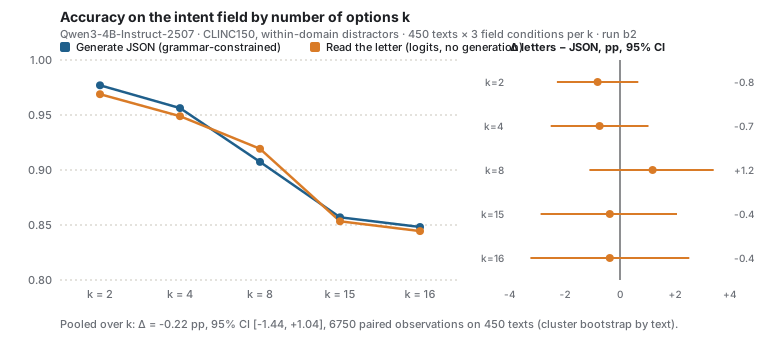
| Does reading the letter lose accuracy vs generating JSON under a grammar? | No. Intent field, 6750 paired observations on 450 texts: JSON 0.909, letters 0.907, Δ −0.22 pp, 95 % CI [−1.44, +1.04]. Every k from 2 to 16 has a CI covering zero. | run b2, figure |
| Is the mechanism really reading the answer? | Yes. The most likely next token is an option letter in 13 600 / 13 600 questions; the letters carry the whole distribution (candidate mass min 0.99999624); position prior is flat; the unconstrained model writes the same letter we read in 199 / 200 prompt-identical controls. | run b2 |
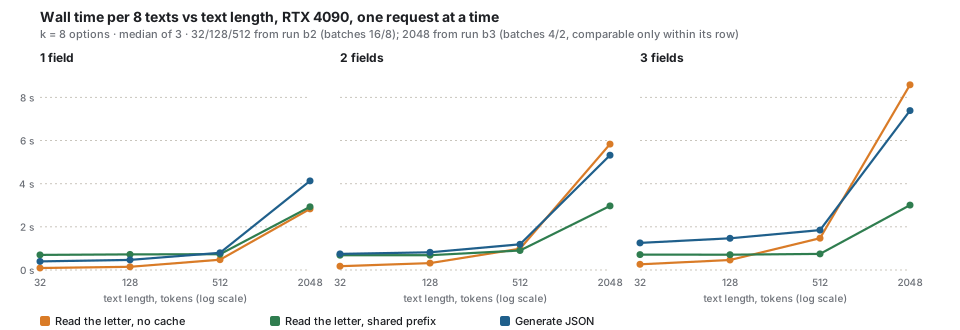
| Is it faster? | 4× faster than JSON on short texts (32 tokens: 0.24× the time). On 2048-token texts 1.4× / 1.8× / 2.4× faster for 1 / 2 / 3 fields with the shared-prefix cache (the text's KV cache reused across the questions; 0.71 / 0.56 / 0.41× the time). The naive form that re-reads the text per field loses there (1.10–1.16×). | runs b2/b3, figure |
| Is a letter better than writing the option's name? | Yes: +10.0 pp [+8.3, +11.7] for the letter on intent, +13.2 pp on domain, +1.2 pp (CI covers 0) on a boolean whose names are already single tokens. | run b1, figure |
| Where does reading lose? | Out-of-scope texts: JSON picks "none of the above" on 47 / 50, letters on 41 / 50 (both 1 / 50 on in-scope texts). Dependent fields: a boolean that follows from an earlier field gains 5 pp when written after it in one JSON. | run b2, figure |
| Should the model write probabilities instead (the TypeSafe adapter shape)? | No. With a bounded enum grid and a 640-token cap the form finishes but scores 0.346 on intent vs 0.896 for letters on the same units; 62 % of its "choices" are the first option. | run b3 |
| Does a shared KV cache change the answers? | Same accuracy (0.8484 vs 0.8483); 59 / 13 500 answers flip, all near ties, consistent with a different arithmetic path. The same code on two different RTX 4090s is bit-identical (607 / 607). | run b2 |
What to do with each kind of field
| field type | recommended | why | watch out |
|---|---|---|---|
| enum, 2–26 options | ask a lettered question, read the letter scores (or generate one letter under a grammar; it is the same decision) | same accuracy as JSON, no decode cost, a ranking over options plus a confidence gap for free | the shares are normalized candidate scores, not calibrated probabilities; use the gap for abstention, do not read the percentage as P(correct) |
| boolean | letter read (A = true, B = false) when independent; keep it inside one JSON, or put the earlier answer into the question, when it depends on another field | independent booleans read fine (0.95); a dependent one lost 5 pp when read alone | the length advantage of letters is nil here: true/false are already single tokens |
| "none of the above" / abstention | keep JSON generation, or read letters and add an explicit abstention rule on the gap | reading picked "none" less often on out-of-scope texts (41 vs 47 of 50) | 50 texts: a direction, not a measured size |
| enum with > 26 options | two-level codes (A1…) or hierarchical questions | not measured here | out of scope of this study |
| string copied from the text (phone, date, name, quote) | first try to make it a choice: enumerate the candidates found in the text (regex or a tagger for phones, dates, numbers, names; numbered sentences for quotes) and ask "which one?" with letters; the model then cannot alter the copied span. Generate under a single-field grammar with maxLength only when candidates cannot be enumerated | a closed set of spans reads like any enum; a copied span is never corrupted | extraction-as-choice is a recommendation from the design, not measured in this study |
| integer / number | generate under a grammar with a bounded type (integer, or an enum grid of allowed decimals) | an unbounded number accepts an endless digit string | never ask the model to write probabilities as numbers: 0.35 accuracy |
| free text | generate | nothing to read | — |
| many fields on one long text | read letters with a shared prefix (server-side prefix caching does this for you) | re-reading a 2048-token text per field costs more than one JSON; the cache brings it back to 0.4–0.7× | the shared part must be byte-identical: put the question after the text |
In TypeSafe's own vocabulary (agent skill): their Choice and Noul primitives are what this study measures on a frozen model, as the letter read and the boolean; Score (an ordered scale) was not measured; their pattern select over generate is the extraction-as-choice recommendation above, also not measured here. This is a correspondence of terms, not a reproduction of their model.
Rule of thumb from the whole study: on this model, quality is the same either way for closed choices; the single lever that changed accuracy was giving the model a one-token identifier to answer with. Reading the logits then removes the decode cost and hands you a distribution.
Try it: the teaching bench
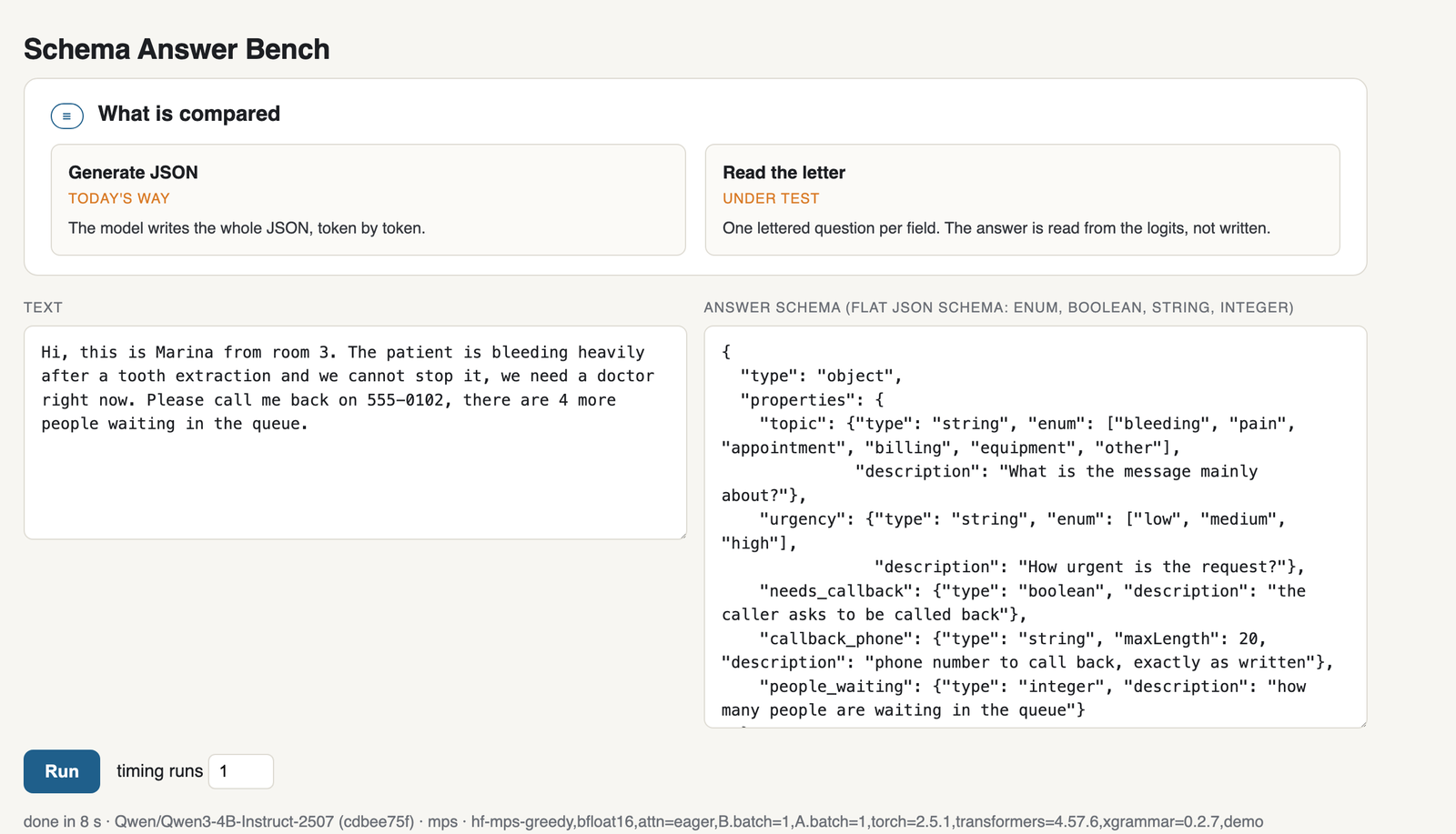
demo/ is a local page that takes a text and a flat JSON schema, answers it with both methods on one model, and shows every step with the model's own numbers: the exact prompt and constraint, the top next tokens at the answer position, the letter scores, what the grammar allowed and overrode at each written token, and the timing.
Requirements: Python 3.11, uv, ~9 GB of disk for the weights, and either Apple Silicon (MPS) or an NVIDIA GPU (CUDA). The 4B model needs about 8.5 GB of memory.
git clone https://github.com/r-ms/mini-jev.git && cd mini-jev
uv sync                                   # torch 2.5.1, transformers 4.57.6, xgrammar 0.2.7, pinned
MINIJEV_DEVICE=mps uv run python demo/server.py    # or MINIJEV_DEVICE=cuda
# first start downloads Qwen/Qwen3-4B-Instruct-2507 (revision pinned) and warms up, then:
open http://127.0.0.1:8765/
Edit the text or the schema in the page and press Run. Supported field types: string with enum, boolean, string (with maxLength), integer, number. Nested objects and arrays are refused on purpose.
What you will see, on the default example:
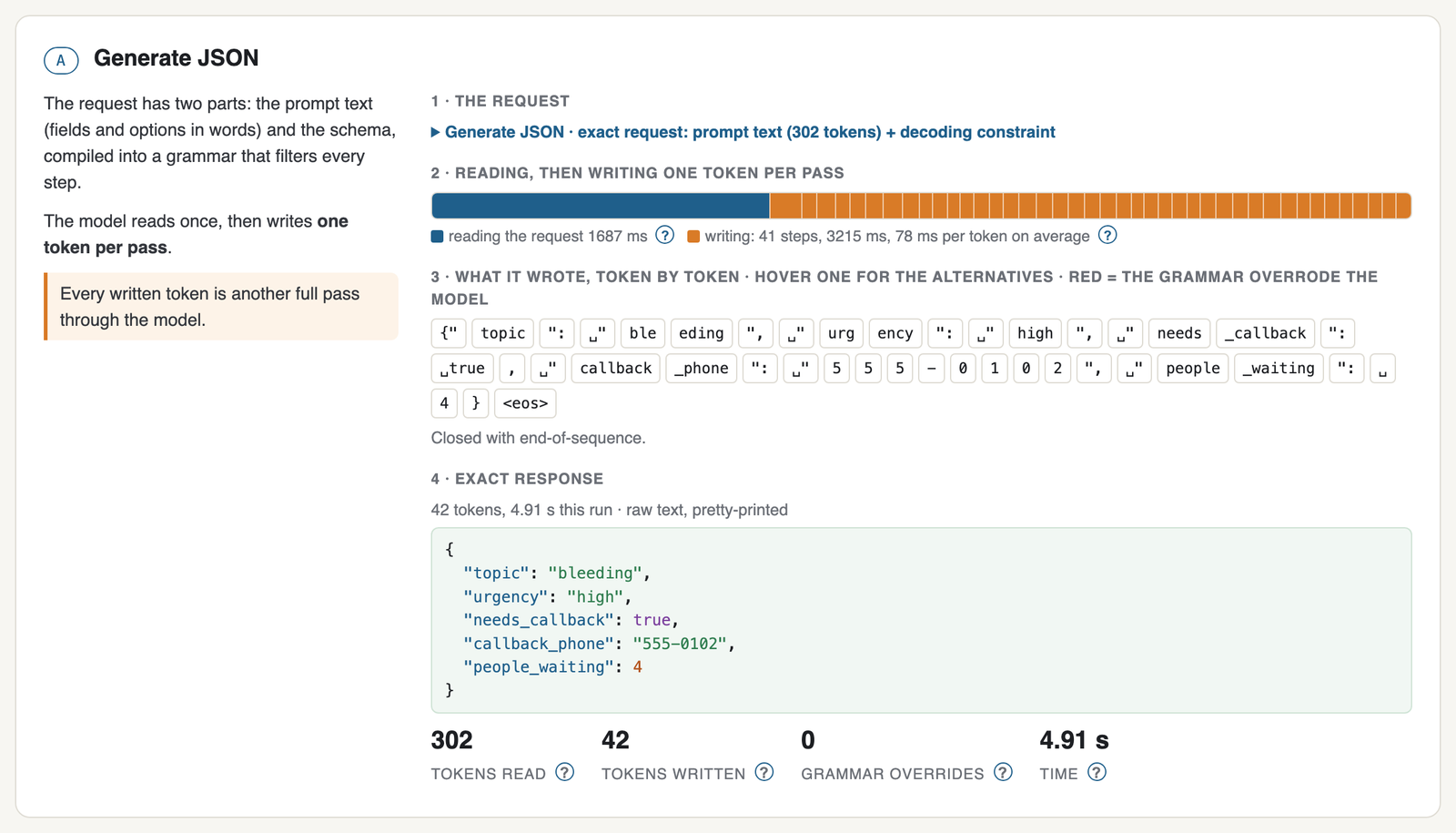
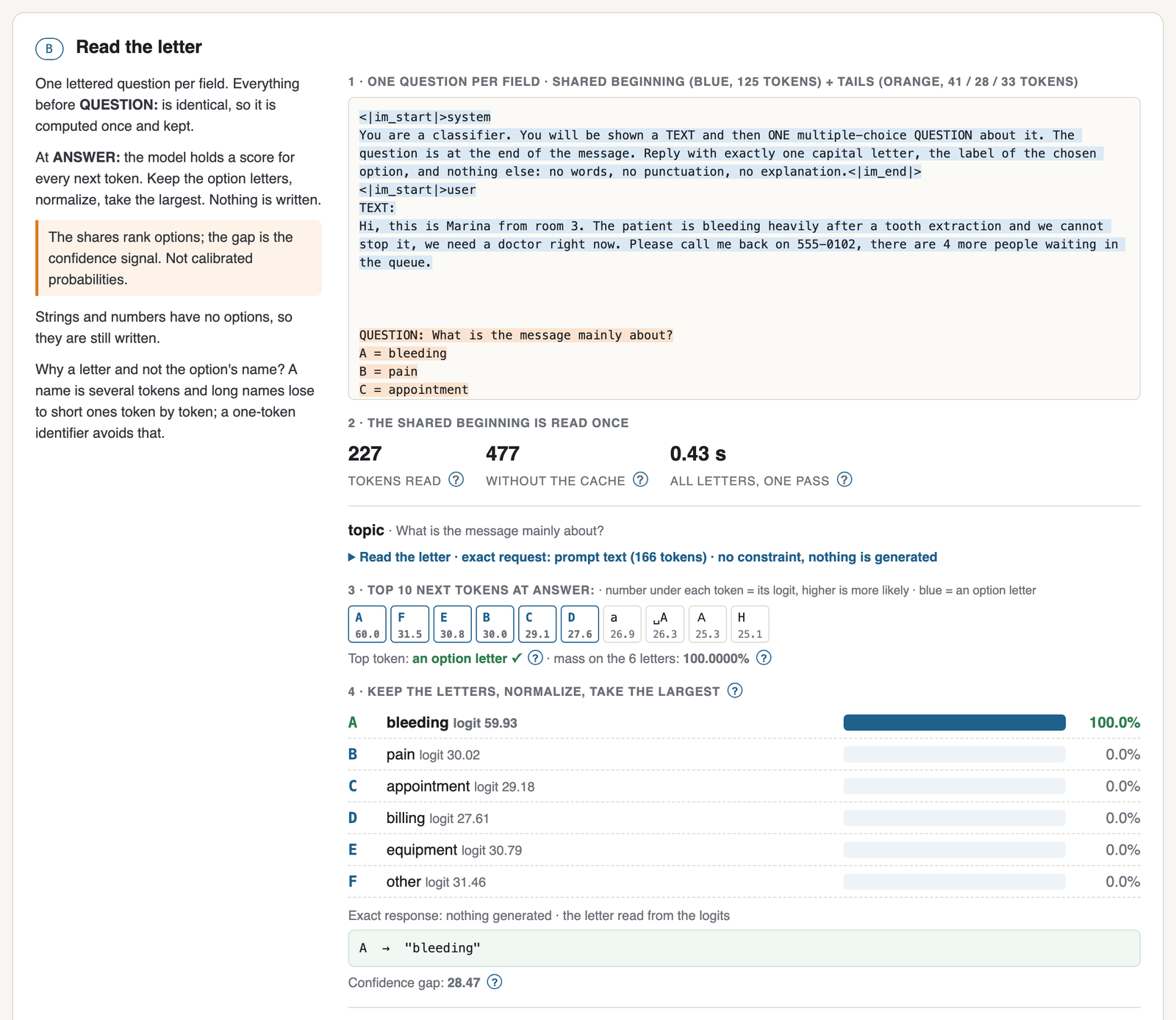
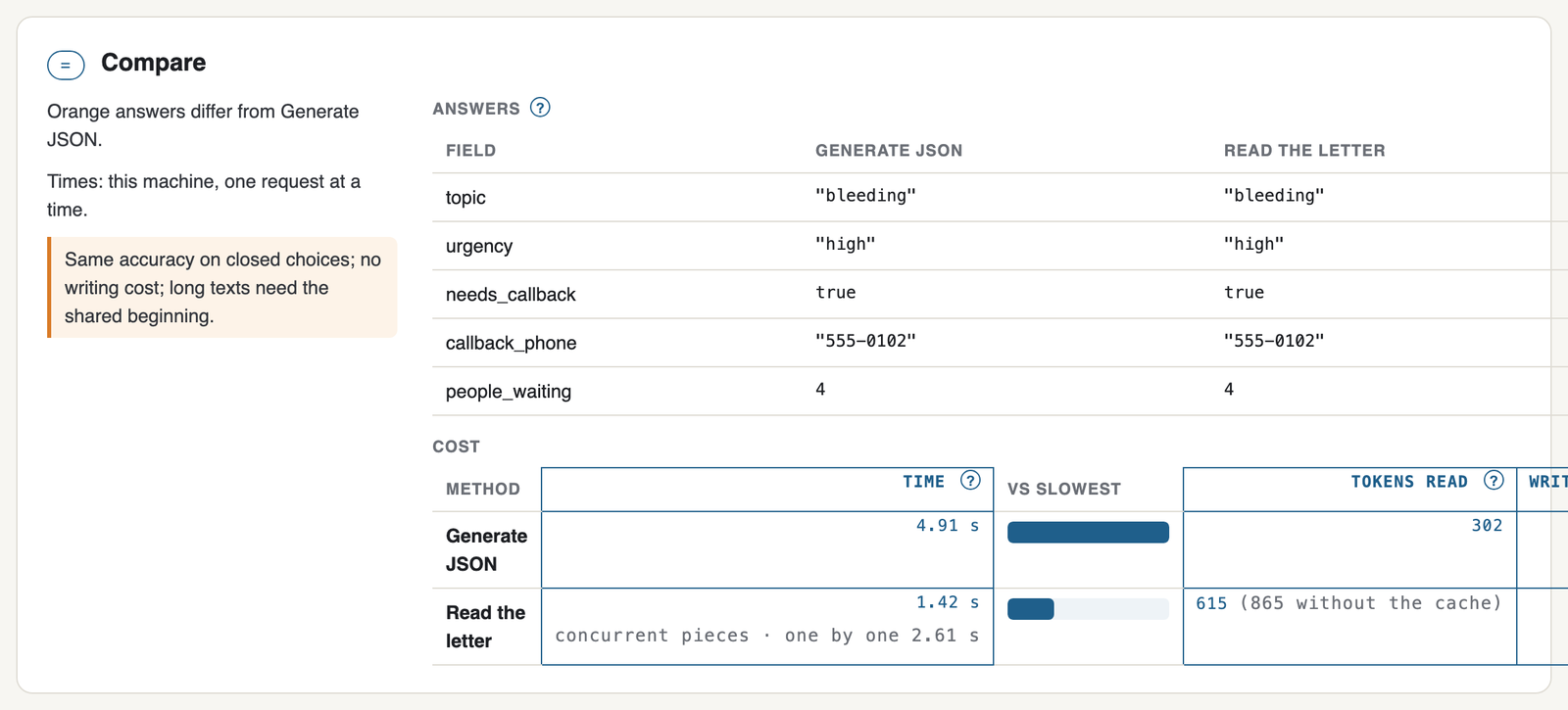
Hover any written token in the page to see the five tokens the model considered at that step, which of them the grammar blocked, and the best tokens it allowed.
Reproduce the experiment
uv run python scripts/build_data.py                    # CLINC150 sample, pinned revision, manifest with hashes
MINIJEV_DEVICE=cuda uv run python scripts/smoke_positions.py      # two-sided guard for the generation path
MINIJEV_DEVICE=cuda uv run python scripts/run.py --arm B1      --subset main --run-id r1
MINIJEV_DEVICE=cuda uv run python scripts/run.py --arm A1joint --subset main --run-id r1
uv run python scripts/report.py runs/r1                # mechanism counters first, then accuracies
uv run python scripts/run_cost.py --run-id r1 --lengths 32,128,512
uv run python analysis/figures.py                      # redraws docs/figures from runs/
uv run pytest -q tests/                                # 29 harness guards (each has a placebo)
Arms: B1 (read letters), B1cache (read letters on a shared prefix), A1joint (one JSON, all fields), A1split (one JSON per field), A1letter (one letter under a grammar), A1label (option name under a grammar), A1prob (model writes probabilities), A0 (no grammar), B1free (unconstrained text control), B1perm (option-order rotation), plus scripts/run_score.py for sequence likelihood of the names. Every record carries the raw response, candidate logits, prompt and schema hashes, the gold position and a run-mode string; a run refuses to resume if the mode changed.
Repository layout
README.md            this file
docs/ARTICLE.md      the write-up, with figures
PREREG.md            preregistration and its four amendments (v1 … v1.3)
DEFERRED.md          what was deliberately not done (second model, calibration)
minijev/             engine, prompts, schema and grammar builders, scoring, report
scripts/             run.py (all arms), run_cost.py, run_score.py, smoke_*.py, report.py, build_data.py
analysis/            follow-up analyses (dependent fields, controls) and figures.py
demo/                the teaching bench: server.py + index.html
tests/               29 guards for the harness
runs/                run records (not committed; regenerate or ask)
Caveats, stated plainly
One model (Qwen3-4B-Instruct), one dataset (CLINC150, English, short utterances). Bench times are one request at a time on one GPU. The letter shares are a ranking with a confidence gap, not calibrated probabilities.
License
MIT. CLINC150 is © its authors under CC BY 3.0; Qwen3 weights are under the Apache-2.0 license of their release.
Contributors

5 commits
Similar repos


Languages
Python
100.0%
mini-Jev: what a Jev-style typed-decision interface looks like on a frozen Qwen3-4B — read the option letter's logits instead of generating JSON. Preregistered experiment, results, teaching bench.
Python
4
5 commits
updated Sep 17, 2026
See what people are saying (1)
README
mini-Jev · read the letter
What a Jev-style interface looks like on a frozen model: classify against a schema that arrives with the request by reading next-token logits, not by generating JSON. Measured on Qwen3-4B.
TypeSafe's Jev is trained for typed decisions without open generation. mini-Jev asks how much of that interface an ordinary frozen model already provides, and measures it against today's path, grammar-constrained JSON.
A JSON schema arrives with the request. Today the model writes a JSON object under a grammar, token by token. This project measures the alternative for closed-choice fields: turn each field into a lettered multiple-choice question, run one forward pass, and read the model's scores for the option letters at the answer position. No token is generated. Strings and numbers are still generated.
Everything here runs on Qwen/Qwen3-4B-Instruct-2507 (bf16, greedy) with xgrammar for constrained generation and CLINC150 as the task. The experiment was preregistered (PREREG.md, amendments v1.1–v1.3) and every number below is recomputed from the stored run records.
Results in one table
| question | answer | evidence |
|---|---|---|
| Does reading the letter lose accuracy vs generating JSON under a grammar? | No. Intent field, 6750 paired observations on 450 texts: JSON 0.909, letters 0.907, Δ −0.22 pp, 95 % CI [−1.44, +1.04]. Every k from 2 to 16 has a CI covering zero. | run b2, figure |
| Is the mechanism really reading the answer? | Yes. The most likely next token is an option letter in 13 600 / 13 600 questions; the letters carry the whole distribution (candidate mass min 0.99999624); position prior is flat; the unconstrained model writes the same letter we read in 199 / 200 prompt-identical controls. | run b2 |
| Is it faster? | 4× faster than JSON on short texts (32 tokens: 0.24× the time). On 2048-token texts 1.4× / 1.8× / 2.4× faster for 1 / 2 / 3 fields with the shared-prefix cache (the text's KV cache reused across the questions; 0.71 / 0.56 / 0.41× the time). The naive form that re-reads the text per field loses there (1.10–1.16×). | runs b2/b3, figure |
| Is a letter better than writing the option's name? | Yes: +10.0 pp [+8.3, +11.7] for the letter on intent, +13.2 pp on domain, +1.2 pp (CI covers 0) on a boolean whose names are already single tokens. | run b1, figure |
| Where does reading lose? | Out-of-scope texts: JSON picks "none of the above" on 47 / 50, letters on 41 / 50 (both 1 / 50 on in-scope texts). Dependent fields: a boolean that follows from an earlier field gains 5 pp when written after it in one JSON. | run b2, figure |
| Should the model write probabilities instead (the TypeSafe adapter shape)? | No. With a bounded enum grid and a 640-token cap the form finishes but scores 0.346 on intent vs 0.896 for letters on the same units; 62 % of its "choices" are the first option. | run b3 |
| Does a shared KV cache change the answers? | Same accuracy (0.8484 vs 0.8483); 59 / 13 500 answers flip, all near ties, consistent with a different arithmetic path. The same code on two different RTX 4090s is bit-identical (607 / 607). | run b2 |
What to do with each kind of field
| field type | recommended | why | watch out |
|---|---|---|---|
| enum, 2–26 options | ask a lettered question, read the letter scores (or generate one letter under a grammar; it is the same decision) | same accuracy as JSON, no decode cost, a ranking over options plus a confidence gap for free | the shares are normalized candidate scores, not calibrated probabilities; use the gap for abstention, do not read the percentage as P(correct) |
| boolean | letter read (A = true, B = false) when independent; keep it inside one JSON, or put the earlier answer into the question, when it depends on another field | independent booleans read fine (0.95); a dependent one lost 5 pp when read alone | the length advantage of letters is nil here: true/false are already single tokens |
| "none of the above" / abstention | keep JSON generation, or read letters and add an explicit abstention rule on the gap | reading picked "none" less often on out-of-scope texts (41 vs 47 of 50) | 50 texts: a direction, not a measured size |
| enum with > 26 options | two-level codes (A1…) or hierarchical questions | not measured here | out of scope of this study |
| string copied from the text (phone, date, name, quote) | first try to make it a choice: enumerate the candidates found in the text (regex or a tagger for phones, dates, numbers, names; numbered sentences for quotes) and ask "which one?" with letters; the model then cannot alter the copied span. Generate under a single-field grammar with maxLength only when candidates cannot be enumerated | a closed set of spans reads like any enum; a copied span is never corrupted | extraction-as-choice is a recommendation from the design, not measured in this study |
| integer / number | generate under a grammar with a bounded type (integer, or an enum grid of allowed decimals) | an unbounded number accepts an endless digit string | never ask the model to write probabilities as numbers: 0.35 accuracy |
| free text | generate | nothing to read | — |
| many fields on one long text | read letters with a shared prefix (server-side prefix caching does this for you) | re-reading a 2048-token text per field costs more than one JSON; the cache brings it back to 0.4–0.7× | the shared part must be byte-identical: put the question after the text |
In TypeSafe's own vocabulary (agent skill): their Choice and Noul primitives are what this study measures on a frozen model, as the letter read and the boolean; Score (an ordered scale) was not measured; their pattern select over generate is the extraction-as-choice recommendation above, also not measured here. This is a correspondence of terms, not a reproduction of their model.
Rule of thumb from the whole study: on this model, quality is the same either way for closed choices; the single lever that changed accuracy was giving the model a one-token identifier to answer with. Reading the logits then removes the decode cost and hands you a distribution.
Try it: the teaching bench
demo/ is a local page that takes a text and a flat JSON schema, answers it with both methods on one model, and shows every step with the model's own numbers: the exact prompt and constraint, the top next tokens at the answer position, the letter scores, what the grammar allowed and overrode at each written token, and the timing.
Requirements: Python 3.11, uv, ~9 GB of disk for the weights, and either Apple Silicon (MPS) or an NVIDIA GPU (CUDA). The 4B model needs about 8.5 GB of memory.
git clone https://github.com/r-ms/mini-jev.git && cd mini-jev
uv sync                                   # torch 2.5.1, transformers 4.57.6, xgrammar 0.2.7, pinned
MINIJEV_DEVICE=mps uv run python demo/server.py    # or MINIJEV_DEVICE=cuda
# first start downloads Qwen/Qwen3-4B-Instruct-2507 (revision pinned) and warms up, then:
open http://127.0.0.1:8765/
Edit the text or the schema in the page and press Run. Supported field types: string with enum, boolean, string (with maxLength), integer, number. Nested objects and arrays are refused on purpose.
What you will see, on the default example:
Hover any written token in the page to see the five tokens the model considered at that step, which of them the grammar blocked, and the best tokens it allowed.
Reproduce the experiment
uv run python scripts/build_data.py                    # CLINC150 sample, pinned revision, manifest with hashes
MINIJEV_DEVICE=cuda uv run python scripts/smoke_positions.py      # two-sided guard for the generation path
MINIJEV_DEVICE=cuda uv run python scripts/run.py --arm B1      --subset main --run-id r1
MINIJEV_DEVICE=cuda uv run python scripts/run.py --arm A1joint --subset main --run-id r1
uv run python scripts/report.py runs/r1                # mechanism counters first, then accuracies
uv run python scripts/run_cost.py --run-id r1 --lengths 32,128,512
uv run python analysis/figures.py                      # redraws docs/figures from runs/
uv run pytest -q tests/                                # 29 harness guards (each has a placebo)
Arms: B1 (read letters), B1cache (read letters on a shared prefix), A1joint (one JSON, all fields), A1split (one JSON per field), A1letter (one letter under a grammar), A1label (option name under a grammar), A1prob (model writes probabilities), A0 (no grammar), B1free (unconstrained text control), B1perm (option-order rotation), plus scripts/run_score.py for sequence likelihood of the names. Every record carries the raw response, candidate logits, prompt and schema hashes, the gold position and a run-mode string; a run refuses to resume if the mode changed.
Repository layout
README.md            this file
docs/ARTICLE.md      the write-up, with figures
PREREG.md            preregistration and its four amendments (v1 … v1.3)
DEFERRED.md          what was deliberately not done (second model, calibration)
minijev/             engine, prompts, schema and grammar builders, scoring, report
scripts/             run.py (all arms), run_cost.py, run_score.py, smoke_*.py, report.py, build_data.py
analysis/            follow-up analyses (dependent fields, controls) and figures.py
demo/                the teaching bench: server.py + index.html
tests/               29 guards for the harness
runs/                run records (not committed; regenerate or ask)
Caveats, stated plainly
One model (Qwen3-4B-Instruct), one dataset (CLINC150, English, short utterances). Bench times are one request at a time on one GPU. The letter shares are a ranking with a confidence gap, not calibrated probabilities.
License
MIT. CLINC150 is © its authors under CC BY 3.0; Qwen3 weights are under the Apache-2.0 license of their release.
Similar repos
Contributors
5 commits
Languages
Python
100.0%