
tiny Jev-like model built on top of Qwen2.5-0.5B you can train and run on your MacBook
Python
327
43 commits
updated Sep 19, 2026
See what people are saying (1)
README
kev
Jev-inspired decision model. Typed questions in, calibrated probabilities out, one forward pass.




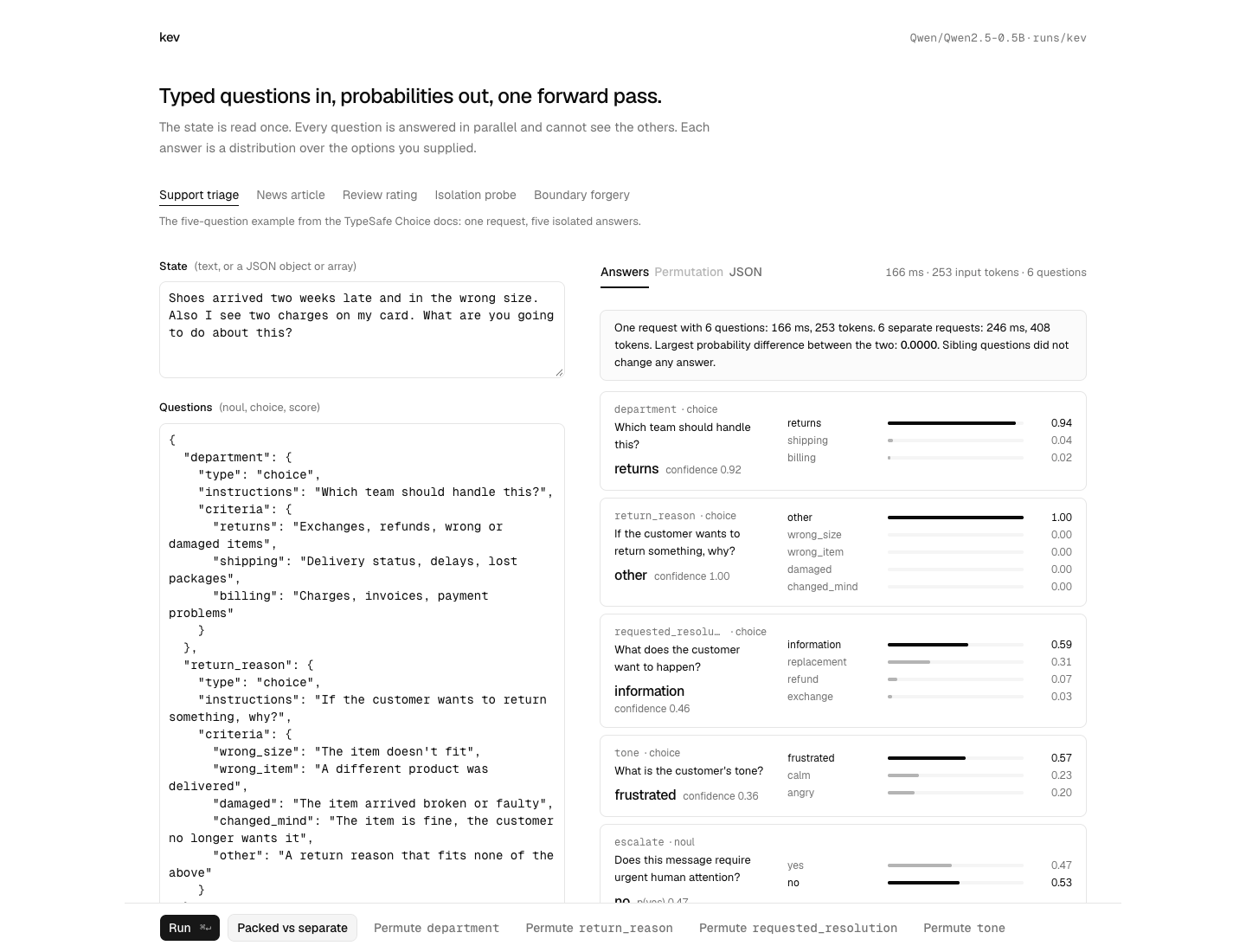
kev is a LoRA adapter and a small readout head on top of Qwen2.5-0.5B. It reads a document once and answers many typed questions about it in parallel, in a single prefill pass with no decoding. The document and every question are packed into one sequence; a block-causal mask lets each question see the document but never another question. A pointer head then scores each question's options against its decision token and applies softmax. Those probabilities are the output. The head is trained with cross-entropy against labelled outcomes, so the probabilities are learned rather than generated as text.
The architecture follows the reconstruction of TypeSafe's Jev in Jev's Architecture Unmasked. The API follows TypeSafe's System One contract, so the official typesafe-sdk works against a local kev server with a base_url change.
Highlights
- Three question types.
noul(yes/no),choice(2–255 options),score(ordered levels). One shared readout. - One pass, many answers. The state is encoded once. Questions run as isolated branches under a block-causal mask.
- Isolation is exact. A question cannot see a sibling question. Packed and separate requests agree to
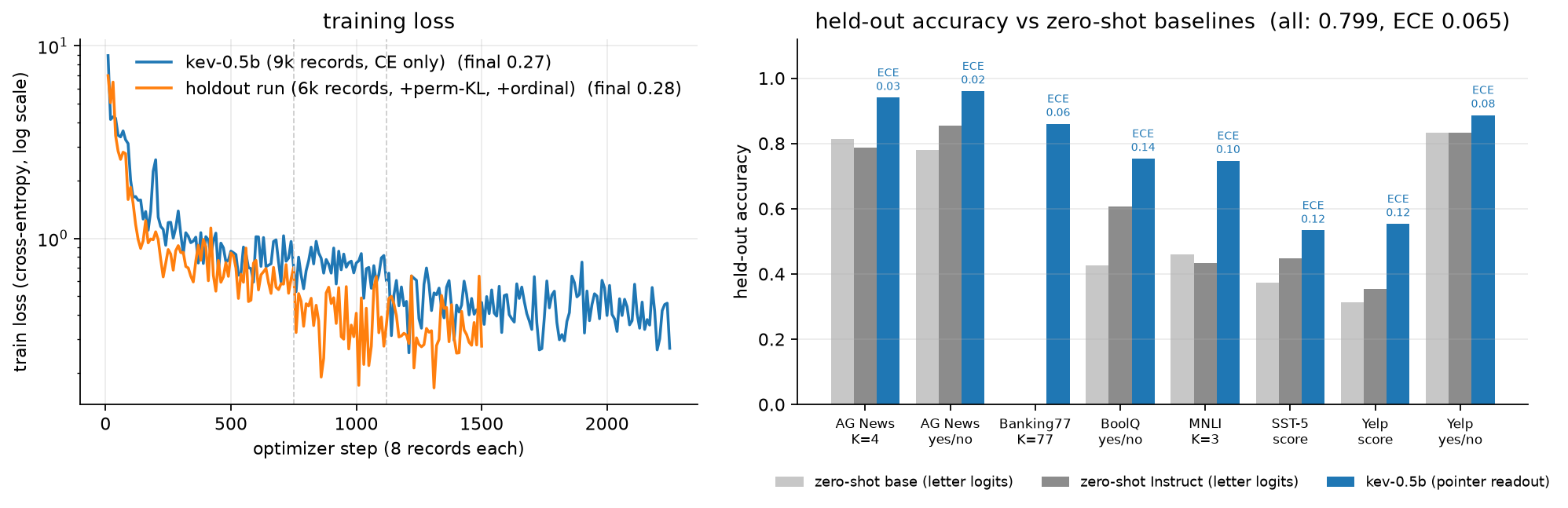
4e-6. - Probabilities, not prose. Trained with cross-entropy. Held-out ECE 0.065, 0.031 after one-parameter temperature scaling.
- Drop-in API.
POST /v1/systemonewith TypeSafe's request and response shapes. Their SDK's quickstart runs unmodified. - Runs on a laptop.
kev-0.5btrains in about 1h45m on an Apple M5 and serves a six-question request in ~160 ms.
Installation
Requires Python 3.12+, uv, and Node 20+ for the playground. Tested on Apple Silicon (MPS). CUDA is untested.
git clone https://github.com/jaredpalmer/kev.git && cd kev
uv sync --extra serve
cd playground && npm install && cd ..
Download the weights
The trained adapter is on the Hugging Face Hub as jaredpalmer/kev-0.5b (base Qwen2.5-0.5B, tag v0.1; the checkpoint in this README). --run accepts a Hub id directly; the base model downloads on first load.
uv run --extra serve python -m kev.serve --run jaredpalmer/kev-0.5b --port 8009
The same files are attached to the GitHub release as kev-0.5b.tar.gz.
Research previews (no version tags; each fails our predeclared release screen on held-out policy reasoning and is published for comparison, with one exploratory locked-test read recorded in its card):
| base | in-distribution (dev / locked test) | out-of-domain (dev / locked test) | card | |
|---|---|---|---|---|
| kev-0.5b (released) | Qwen2.5-0.5B | 0.712 / – | 0.575 / – | MODEL_CARD.md |
kev-0.6b | Qwen3-0.6B-Base | 0.805 / 0.819 | 0.598 / 0.631 | card |
kev-4b | Qwen3-4B-Base | 0.843 / 0.852 | 0.759 / 0.794 | card |
kev-8b | Qwen3-8B-Base | 0.869 / 0.869 | 0.774 / 0.799 | card |
| Jev (reference) | – | 0.845 / – | 0.855 / – |
Same frozen items for every row (evals/v4). KEV_DTYPE=bf16 serves the 4B/8B checkpoints on a 32 GB Mac.
Quick Start
Start the server:
uv run --extra serve python -m kev.serve --run runs/kev --port 8009
Ask it something:
curl -s localhost:8009/v1/systemone -H 'content-type: application/json' -d '{
  "state": "Shoes arrived two weeks late and in the wrong size. Also I see two charges on my card.",
  "model": "kev-latest",
  "questions": {
    "department":  {"type": "choice", "instructions": "Which team should handle this?",
                    "criteria": {"returns": "Exchanges, refunds, wrong or damaged items",
                                 "shipping": "Delivery status, delays, lost packages",
                                 "billing": "Charges, invoices, payment problems"}},
    "escalate":    {"type": "noul",  "instructions": "Does this need urgent human attention?"},
    "frustration": {"type": "score", "instructions": "How frustrated is the customer?",
                    "criteria": ["Calm", "Frustrated", "Very angry"]}
  }}'
{
  "model": "kev-latest",
  "answers": {
    "department":  { "type": "choice", "choice": "returns", "confidence": 0.92,
                     "probabilities": { "returns": 0.94, "shipping": 0.04, "billing": 0.02 } },
    "escalate":    { "type": "noul", "noul": 0.47 },
    "frustration": { "type": "score", "score": 0.67, "confidence": 0.74,
                     "legend": { "0": "Calm", "1": "Frustrated", "2": "Very angry" },
                     "probabilities": { "0": 0.43, "1": 0.47, "2": 0.10 } }
  },
  "usage": { "input_tokens": 253, "output_tokens": 156 },
  "latency_ms": 162
}
Or use the TypeSafe SDK:
from typesafe_sdk import TypeSafeClient, Choice, Noul, Score

client = TypeSafeClient(api_key="local", base_url="http://127.0.0.1:8009", model="kev-latest")
r = client.system_one(
    state="I was charged twice. Please fix this ASAP.",
    questions={
        "billing": Noul(instructions="Is this ticket about billing?"),
        "tone": Choice(instructions="What is the customer's tone?", criteria={"calm": None, "frustrated": None, "angry": None}),
        "urgency": Score(instructions="How urgent is this ticket?", criteria=["can wait", "this week", "today"]),
    },
)
r.nouls["billing"].noul, r.choices["tone"].choice, r.scores["urgency"].score
Playground
cd playground && npm run dev -- -p 3001
Open localhost:3001. Load a preset, edit the state and questions, press ⌘↵. Packed vs separate compares one N-question request with N single-question requests. Permute re-asks a Choice under six option orders. The Isolation probe and Boundary forgery presets reproduce the two experiments from the blog post.
Chess at localhost:3001/chess: the legal moves are the options of one Choice question, the board is the state, and a Score rates the position in the same request. Play the model or watch it play itself; games are kept in localStorage.
API
POST /v1/systemone
{
  "state": "…",                          // string | object | array — the content to evaluate
  "model": "kev-latest",
  "questions": {
    "<id>": {                            // you choose the id; the model never sees it
      "type": "noul" | "choice" | "score",
      "instructions": "…",               // string | object | array
      "criteria": …                      // noul: {true?, false?}  choice: {option: description|null}  score: [level, …]
    }
  }
}
| Answer type | Fields | Derived from the distribution p |
|---|---|---|
noul | noul | p[yes] |
choice | choice, probabilities, confidence | argmax, p by option key, (p_max − 1/K) / (1 − 1/K) |
score | score, legend, probabilities, confidence | Σ k·p[k], level index → text, p by level index |
Structured instructions, criteria and state are flattened to labelled text. Option and branch delimiters cannot be forged from user text. Validation errors return 422.
Other endpoints
| Method | Path | Purpose |
|---|---|---|
GET | /v1/models | Model, base and run info |
POST | /v1/systemone/permute | One Choice question under N option orders |
POST | /v1/systemone/separate | Each question in its own pass, for comparison |
There is no authentication. The server is intended for local use.
How It Works
flowchart LR
    A[API request<br/>state + typed questions] --> B[render to text<br/>api.to_record]
    B --> C[pack into one sequence<br/>model.encode]
    C --> D[block-causal mask +<br/>branch position ids]
    D --> E[causal LM backbone<br/>Qwen2.5-0.5B + LoRA<br/>prefill only]
    E --> F[pointer readout<br/>decide token · option tokens]
    F --> G[softmax per question]
    G --> H[API response<br/>choice · confidence · score]
Packing. The state and every question go into one token sequence. Reserved tokens mark the structure.
<state> …state…
<q> instructions <opt> option 1 </opt> <opt> option 2 </opt> … <decide>    ← question 1
<q> instructions <opt> option 1 </opt> <opt> option 2 </opt> … <decide>    ← question 2
Mask. Position i attends to j when j ≤ i and j is in the state or in the same question as i. State tokens are computed once. Question branches never see each other.
flowchart TB
    subgraph S[state prefix — computed once]
        s1[t1] --> s2[t2] --> s3[t3]
    end
    subgraph Q1[question 1 branch]
        q1a[q] --> q1b[opt] --> q1c[opt] --> q1d[decide]
    end
    subgraph Q2[question 2 branch]
        q2a[q] --> q2b[opt] --> q2c[opt] --> q2d[decide]
    end
    S --> Q1
    S --> Q2
    Q1 -. no attention .- Q2
Positions. Each branch restarts its position ids after the state. Every question sees "state, then one question". Question order does not matter.
Readout. A pointer head scores each option's </opt> hidden state against the <decide> hidden state and applies softmax. K is whatever the request sends. <decide> follows all options, so the model reads the full list before scoring; this is what makes "none of the above" work.
Training. LoRA (r=16) on the backbone, head from scratch, cross-entropy on the option distribution. Training data and live requests go through the same renderer, so the model never meets a format at inference that it did not see in training.
Training
kev-0.5b is trained on six public datasets converted to TypeSafe-shaped requests: Banking77 (77-way Choice), AG News (Choice + yes/no), MNLI (3-way Choice), BoolQ (Noul), SST-5 and Yelp (5-level Score). 9,000 records, 13,500 questions, two epochs.
# sanity run, ~1 minute
uv run python -m kev.train --n_per_source 40 --accum 4 --out runs/smoke

# kev-0.5b, ~1h45m on an M5
uv run python -m kev.train --n_per_source 1500 --epochs 2 --perm_kl 0 --ord_w 0 --out runs/kev
| Flag | Default | Purpose |
|---|---|---|
--base | Qwen/Qwen2.5-0.5B | Causal LM backbone |
--n_per_source | 1000 | Records sampled per dataset |
--holdout | – | Sources to exclude, e.g. mnli,sst5, for out-of-source evaluation |
--perm_kl | 0 | Optional symmetric KL between predictions under two option orders |
--ord_w | 0 | Optional ranked probability score for ordered levels |
--suite | – | Train on a frozen suite's training partition |
--batch, --dtype | 1, fp32 | Padded batch size; bf16 autocast on CUDA (fp32 master weights) |
--device | auto | cuda, mps, or cpu |
The released kev-0.5b used cross-entropy without either extra loss. The current data conversion and sampling have changed, so rerunning this command does not reproduce its weights exactly. The optional ordinal loss now compares cumulative probabilities, a proper scoring rule, rather than absolute error of the expected level. Full historical recipe in the model card.
On a Mac, run one training job at a time; two jobs on the same Apple GPU slow each other by about 10×. The MBP path is kept working, but anything longer than a smoke run goes to Modal.
Modal
Studies run as one H100 container per trial, in parallel, with results pulled back into runs/ and ranked by the same code that runs locally.
uv run modal token new                                    # once; opens the browser
KEV_GPU=T4 uv run modal run modal_app.py::smoke           # end-to-end check, ~1 minute of GPU

uv run modal run modal_app.py::study \
    --suite evals/decision-v2 --plan experiments/data-ablation-v2.json \
    --name ablation-v2 --transfer evals/transfer-v2 \
    --existing jaredpalmer/kev-0.5b                       # legacy checkpoints scored alongside

uv run modal run modal_app.py::evaluate --run jaredpalmer/kev-0.5b --suite evals/transfer-v2 --name transfer-kev
A plan is a JSON list of 1–8 trials over an allowlisted set of training parameters (kev/experiment.py). Each trial records the local git commit, the suite hash, and the hashes of the shipped kev/*.py; the container refuses to run if they differ from what the launcher hashed. Training uses TF32 and optional bf16; evaluation is fp32-exact (TF32 alone moves probabilities by ~1e-3, enough to trip the isolation gate). Measured: 0.019 s/record for Qwen2.5-0.5B at batch 8 on an H100 vs 0.34 s/record on an M5, ~$0.15–0.30 per 0.5B trial.
Evaluation
uv run python -m kev.evaluate --run runs/kev --n_per_source 150 \
    --baseline --baseline_instruct Qwen/Qwen2.5-0.5B-Instruct
Writes runs/kev/eval.json. Baselines use the same rendered text and read next-token logits over option letters.
| Zero-shot base | Zero-shot Instruct | kev-0.5b | |
|---|---|---|---|
| Choice, 4-way (AG News) | 0.813 / 0.069 | 0.787 / 0.160 | 0.940 / 0.028 |
| Choice, 3-way (MNLI) | 0.460 / 0.225 | 0.433 / 0.390 | 0.747 / 0.100 |
| Choice, 77-way (Banking77) | – | – | 0.860 / 0.057 |
| Noul (BoolQ) | 0.427 / 0.274 | 0.607 / 0.084 | 0.753 / 0.136 |
| Score, 5 levels (Yelp) | 0.313 / 0.043 | 0.353 / 0.078 | 0.553 / 0.118 |
| All (1,350 held-out questions) | 0.799 / 0.065 |
Cells are accuracy / ECE (10 bins). These are in-distribution numbers; the test splits come from the training datasets.
Frozen research suite
evals/decision-v1 is a frozen, checksummed suite: separate training, calibration, development, and locked test partitions; pinned dataset and base-model revisions; and per-record provenance. Development runs are used for model selection. The locked test is only for promoted candidates and requires --allow-test.
uv run python -m kev.benchmark --run runs/kev --suite evals/decision-v1 --out runs/research-kev-v01
uv run python -m kev.experiment --suite evals/decision-v1 --plan experiments/mbp-comparison.json --out runs/mbp-comparison-v1
Trials are configuration-only: kev.experiment refuses configs outside a bounded allowlist, records code, suite, and git hashes, checks complete coverage, isolation, and packing, and never reads the locked test.
Comparison with Jev
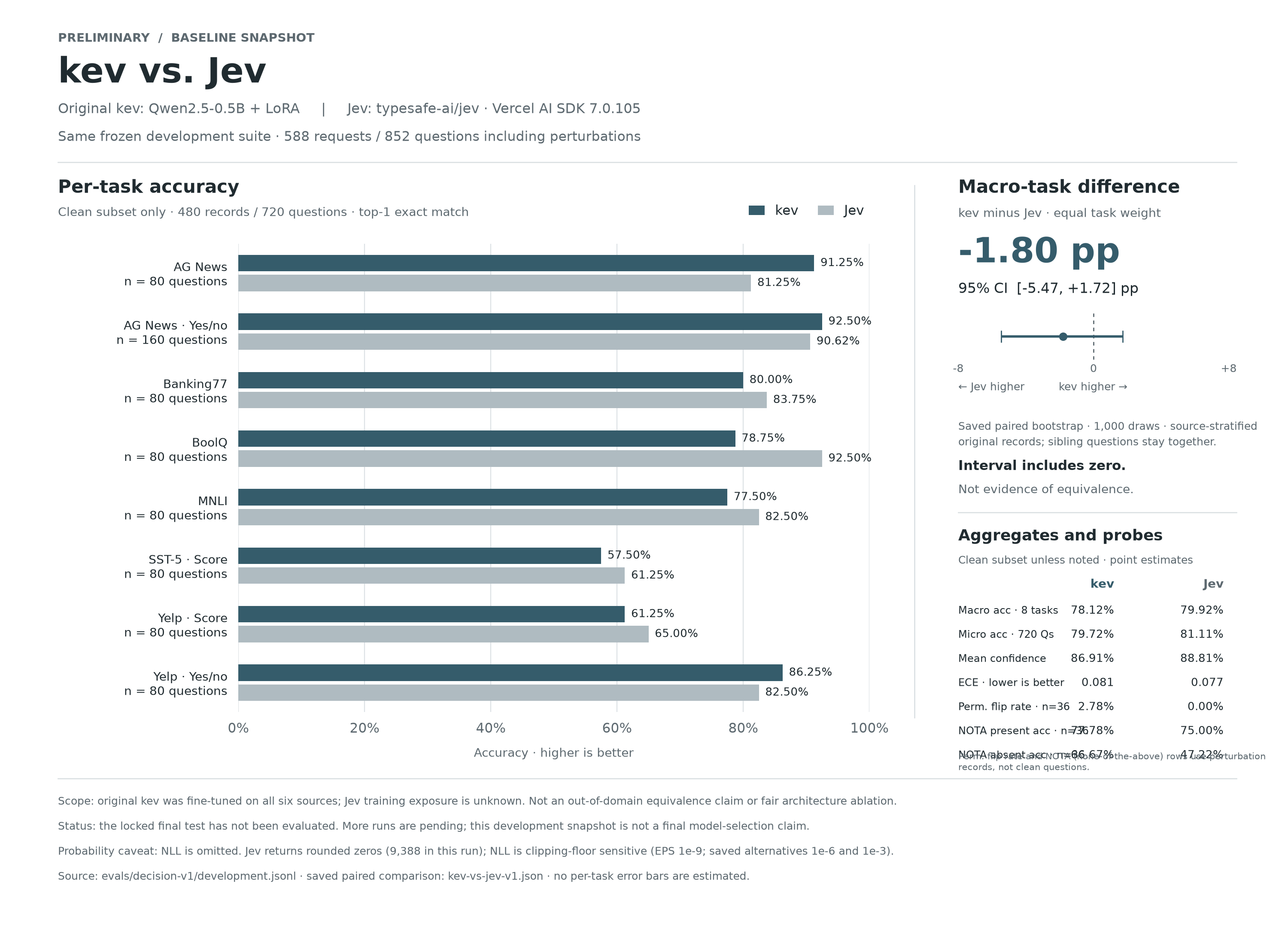
kev.jev scores the same frozen development suite against the real typesafe-ai/jev through Vercel AI Gateway (AI SDK 7 experimental_evaluate, cost-capped). Jev is the hosted reference product; kev was fine-tuned on these six datasets, so this is a shared-task baseline, not a controlled ablation. On 720 clean development questions the released kev-0.5b had 79.7% micro accuracy and Jev 81.1%; the record-clustered macro accuracy difference was −1.8 points with 95% CI [−5.5, +1.7]. Jev rounds some probabilities to zero, so log-loss depends on the clipping floor. Results and caveats: runs/kev-vs-jev-v1.json; regenerate the figure with uv run python scripts/plot_eval_comparison.py.
Controlled studies (v3/v4 suites, Modal H100s). With the public examples and the synthetic budget held equal, backbone capacity dominates out-of-domain accuracy: Qwen3-0.6B → 4B is +14–19 pp on transfer-v3, 4B → 8B is +1–7 pp; programmatic compositional policy data adds +4–5 pp at 4B (CI touching zero at one seed) and nothing measurable at 0.6B; tripling the public training data at 4B lowers transfer by ~3 pp while raising in-distribution accuracy. Jev on the same sets: 0.845 in-distribution, 0.855 out-of-domain; best 8B trial 0.843 / 0.765. Every trial, with hashes and a paired bootstrap, is in runs/leaderboard.md; the research log is PLAN.md.
Outside kev's training data (evals/transfer-v1: TREC, DBpedia-14, Emotion, IMDB, Amazon, QNLI, TweetEval offensive, MMLU; zero exact-match overlap with any kev training state): kev-0.5b 63.3% vs Jev 82.3% on 640 clean questions, macro difference −19.1 pp, 95% CI [−23.1, −15.0]. kev is the better-calibrated of the two out of domain (ECE 0.052 vs 0.075) and Jev's option-order flip rate is 0.000 (kev 0.208). The in-distribution parity above does not transfer. Details: runs/kev-vs-jev-transfer-v1.json; plan for closing the gap: PLAN.md.
| Mechanism test | Result |
|---|---|
| Isolation — secret in sibling question / absent / in state | p = 0.03 / 0.03 / 0.99 |
| Packed vs separate — max probability difference | 3.7e-6, packed 2.0× faster |
| Permutation — argmax flips under 4 option orders | 7.4% |
| IIA — log-odds shift from one irrelevant option | 0.13 mean, 0.34 p90 |
| Boundary forgery — fake delimiters in option text | option count unchanged, forged option p ≤ 0.09 |
Limitations
- Knowledge. The backbone is 0.5B parameters. On the TypeSafe docs' structured-criteria example kev picks
return_policywhere Jev picksreturn_status. - Breadth. Six datasets, about ten instruction templates. Tasks far from passage classification are untrained.
- Calibration is in-distribution. ECE on the training datasets says nothing about a new workflow. Real calibration needs outcome-labelled data from that workflow.
- Context. Trained at 384 state / 1,024 branch tokens; serving caps at 8,192. Jev allows ~32k per branch.
- Serving. fp32 on MPS, one request at a time, no cross-request KV cache, dense per-sample mask.
- Score confidence uses a stand-in formula. TypeSafe has not published theirs.
Development
uv run python -m pytest tests/test_unit.py -q                                      # no weights, no server; runs in CI
KEV_BASE_URL=http://127.0.0.1:8009 uv run --extra serve python -m pytest tests/test_api.py -q   # against a running server
cd playground && npm run lint && npx tsc --noEmit -p .
tests/test_api.py runs the TypeSafe docs' example requests and the official SDK against the local server.
Troubleshooting
MPS backend out of memorywhile training. Do not enableoutput_hidden_states; readlast_hidden_statefrom the bare backbone. Do not add tokens with pefttrainable_token_indices. Lower--n_per_sourceon small machines.- Playground shows
connecting…and buttons do nothing. Next.js 16 dev only trusts the hostname it started with. Uselocalhost:3001or add your host toallowedDevOriginsinnext.config.ts. Nothing is logged; verify hydration with a browser, notcurl. Dataset scripts are no longer supported. Uselegacy-datasets/banking77; already wired indata.py.
Authors
- Jared Palmer (@jaredpalmer)
Built with Devin. Architecture claims from Archer Hume. API contract from TypeSafe. Backbone: Qwen2.5-0.5B. Related work: Hydragen, DeFT, FIRST.
License
Apache-2.0. The base model is distributed under the Qwen license. Datasets carry their own licenses; see the model card.
Contributors

42 commits

1 commits
Similar repos




Languages
Python
77.2%
TypeScript
20.0%
CSS
1.7%
tiny Jev-like model built on top of Qwen2.5-0.5B you can train and run on your MacBook
Python
327
43 commits
updated Sep 19, 2026
See what people are saying (1)
README
kev
Jev-inspired decision model. Typed questions in, calibrated probabilities out, one forward pass.
kev is a LoRA adapter and a small readout head on top of Qwen2.5-0.5B. It reads a document once and answers many typed questions about it in parallel, in a single prefill pass with no decoding. The document and every question are packed into one sequence; a block-causal mask lets each question see the document but never another question. A pointer head then scores each question's options against its decision token and applies softmax. Those probabilities are the output. The head is trained with cross-entropy against labelled outcomes, so the probabilities are learned rather than generated as text.
The architecture follows the reconstruction of TypeSafe's Jev in Jev's Architecture Unmasked. The API follows TypeSafe's System One contract, so the official typesafe-sdk works against a local kev server with a base_url change.
Highlights
- Three question types.
noul(yes/no),choice(2–255 options),score(ordered levels). One shared readout. - One pass, many answers. The state is encoded once. Questions run as isolated branches under a block-causal mask.
- Isolation is exact. A question cannot see a sibling question. Packed and separate requests agree to
4e-6. - Probabilities, not prose. Trained with cross-entropy. Held-out ECE 0.065, 0.031 after one-parameter temperature scaling.
- Drop-in API.
POST /v1/systemonewith TypeSafe's request and response shapes. Their SDK's quickstart runs unmodified. - Runs on a laptop.
kev-0.5btrains in about 1h45m on an Apple M5 and serves a six-question request in ~160 ms.
Installation
Requires Python 3.12+, uv, and Node 20+ for the playground. Tested on Apple Silicon (MPS). CUDA is untested.
git clone https://github.com/jaredpalmer/kev.git && cd kev
uv sync --extra serve
cd playground && npm install && cd ..
Download the weights
The trained adapter is on the Hugging Face Hub as jaredpalmer/kev-0.5b (base Qwen2.5-0.5B, tag v0.1; the checkpoint in this README). --run accepts a Hub id directly; the base model downloads on first load.
uv run --extra serve python -m kev.serve --run jaredpalmer/kev-0.5b --port 8009
The same files are attached to the GitHub release as kev-0.5b.tar.gz.
Research previews (no version tags; each fails our predeclared release screen on held-out policy reasoning and is published for comparison, with one exploratory locked-test read recorded in its card):
| base | in-distribution (dev / locked test) | out-of-domain (dev / locked test) | card | |
|---|---|---|---|---|
| kev-0.5b (released) | Qwen2.5-0.5B | 0.712 / – | 0.575 / – | MODEL_CARD.md |
kev-0.6b | Qwen3-0.6B-Base | 0.805 / 0.819 | 0.598 / 0.631 | card |
kev-4b | Qwen3-4B-Base | 0.843 / 0.852 | 0.759 / 0.794 | card |
kev-8b | Qwen3-8B-Base | 0.869 / 0.869 | 0.774 / 0.799 | card |
| Jev (reference) | – | 0.845 / – | 0.855 / – |
Same frozen items for every row (evals/v4). KEV_DTYPE=bf16 serves the 4B/8B checkpoints on a 32 GB Mac.
Quick Start
Start the server:
uv run --extra serve python -m kev.serve --run runs/kev --port 8009
Ask it something:
curl -s localhost:8009/v1/systemone -H 'content-type: application/json' -d '{
  "state": "Shoes arrived two weeks late and in the wrong size. Also I see two charges on my card.",
  "model": "kev-latest",
  "questions": {
    "department":  {"type": "choice", "instructions": "Which team should handle this?",
                    "criteria": {"returns": "Exchanges, refunds, wrong or damaged items",
                                 "shipping": "Delivery status, delays, lost packages",
                                 "billing": "Charges, invoices, payment problems"}},
    "escalate":    {"type": "noul",  "instructions": "Does this need urgent human attention?"},
    "frustration": {"type": "score", "instructions": "How frustrated is the customer?",
                    "criteria": ["Calm", "Frustrated", "Very angry"]}
  }}'
{
  "model": "kev-latest",
  "answers": {
    "department":  { "type": "choice", "choice": "returns", "confidence": 0.92,
                     "probabilities": { "returns": 0.94, "shipping": 0.04, "billing": 0.02 } },
    "escalate":    { "type": "noul", "noul": 0.47 },
    "frustration": { "type": "score", "score": 0.67, "confidence": 0.74,
                     "legend": { "0": "Calm", "1": "Frustrated", "2": "Very angry" },
                     "probabilities": { "0": 0.43, "1": 0.47, "2": 0.10 } }
  },
  "usage": { "input_tokens": 253, "output_tokens": 156 },
  "latency_ms": 162
}
Or use the TypeSafe SDK:
from typesafe_sdk import TypeSafeClient, Choice, Noul, Score

client = TypeSafeClient(api_key="local", base_url="http://127.0.0.1:8009", model="kev-latest")
r = client.system_one(
    state="I was charged twice. Please fix this ASAP.",
    questions={
        "billing": Noul(instructions="Is this ticket about billing?"),
        "tone": Choice(instructions="What is the customer's tone?", criteria={"calm": None, "frustrated": None, "angry": None}),
        "urgency": Score(instructions="How urgent is this ticket?", criteria=["can wait", "this week", "today"]),
    },
)
r.nouls["billing"].noul, r.choices["tone"].choice, r.scores["urgency"].score
Playground
cd playground && npm run dev -- -p 3001
Open localhost:3001. Load a preset, edit the state and questions, press ⌘↵. Packed vs separate compares one N-question request with N single-question requests. Permute re-asks a Choice under six option orders. The Isolation probe and Boundary forgery presets reproduce the two experiments from the blog post.
Chess at localhost:3001/chess: the legal moves are the options of one Choice question, the board is the state, and a Score rates the position in the same request. Play the model or watch it play itself; games are kept in localStorage.
API
POST /v1/systemone
{
  "state": "…",                          // string | object | array — the content to evaluate
  "model": "kev-latest",
  "questions": {
    "<id>": {                            // you choose the id; the model never sees it
      "type": "noul" | "choice" | "score",
      "instructions": "…",               // string | object | array
      "criteria": …                      // noul: {true?, false?}  choice: {option: description|null}  score: [level, …]
    }
  }
}
| Answer type | Fields | Derived from the distribution p |
|---|---|---|
noul | noul | p[yes] |
choice | choice, probabilities, confidence | argmax, p by option key, (p_max − 1/K) / (1 − 1/K) |
score | score, legend, probabilities, confidence | Σ k·p[k], level index → text, p by level index |
Structured instructions, criteria and state are flattened to labelled text. Option and branch delimiters cannot be forged from user text. Validation errors return 422.
Other endpoints
| Method | Path | Purpose |
|---|---|---|
GET | /v1/models | Model, base and run info |
POST | /v1/systemone/permute | One Choice question under N option orders |
POST | /v1/systemone/separate | Each question in its own pass, for comparison |
There is no authentication. The server is intended for local use.
How It Works
flowchart LR
    A[API request<br/>state + typed questions] --> B[render to text<br/>api.to_record]
    B --> C[pack into one sequence<br/>model.encode]
    C --> D[block-causal mask +<br/>branch position ids]
    D --> E[causal LM backbone<br/>Qwen2.5-0.5B + LoRA<br/>prefill only]
    E --> F[pointer readout<br/>decide token · option tokens]
    F --> G[softmax per question]
    G --> H[API response<br/>choice · confidence · score]
Packing. The state and every question go into one token sequence. Reserved tokens mark the structure.
<state> …state…
<q> instructions <opt> option 1 </opt> <opt> option 2 </opt> … <decide>    ← question 1
<q> instructions <opt> option 1 </opt> <opt> option 2 </opt> … <decide>    ← question 2
Mask. Position i attends to j when j ≤ i and j is in the state or in the same question as i. State tokens are computed once. Question branches never see each other.
flowchart TB
    subgraph S[state prefix — computed once]
        s1[t1] --> s2[t2] --> s3[t3]
    end
    subgraph Q1[question 1 branch]
        q1a[q] --> q1b[opt] --> q1c[opt] --> q1d[decide]
    end
    subgraph Q2[question 2 branch]
        q2a[q] --> q2b[opt] --> q2c[opt] --> q2d[decide]
    end
    S --> Q1
    S --> Q2
    Q1 -. no attention .- Q2
Positions. Each branch restarts its position ids after the state. Every question sees "state, then one question". Question order does not matter.
Readout. A pointer head scores each option's </opt> hidden state against the <decide> hidden state and applies softmax. K is whatever the request sends. <decide> follows all options, so the model reads the full list before scoring; this is what makes "none of the above" work.
Training. LoRA (r=16) on the backbone, head from scratch, cross-entropy on the option distribution. Training data and live requests go through the same renderer, so the model never meets a format at inference that it did not see in training.
Training
kev-0.5b is trained on six public datasets converted to TypeSafe-shaped requests: Banking77 (77-way Choice), AG News (Choice + yes/no), MNLI (3-way Choice), BoolQ (Noul), SST-5 and Yelp (5-level Score). 9,000 records, 13,500 questions, two epochs.
# sanity run, ~1 minute
uv run python -m kev.train --n_per_source 40 --accum 4 --out runs/smoke

# kev-0.5b, ~1h45m on an M5
uv run python -m kev.train --n_per_source 1500 --epochs 2 --perm_kl 0 --ord_w 0 --out runs/kev
| Flag | Default | Purpose |
|---|---|---|
--base | Qwen/Qwen2.5-0.5B | Causal LM backbone |
--n_per_source | 1000 | Records sampled per dataset |
--holdout | – | Sources to exclude, e.g. mnli,sst5, for out-of-source evaluation |
--perm_kl | 0 | Optional symmetric KL between predictions under two option orders |
--ord_w | 0 | Optional ranked probability score for ordered levels |
--suite | – | Train on a frozen suite's training partition |
--batch, --dtype | 1, fp32 | Padded batch size; bf16 autocast on CUDA (fp32 master weights) |
--device | auto | cuda, mps, or cpu |
The released kev-0.5b used cross-entropy without either extra loss. The current data conversion and sampling have changed, so rerunning this command does not reproduce its weights exactly. The optional ordinal loss now compares cumulative probabilities, a proper scoring rule, rather than absolute error of the expected level. Full historical recipe in the model card.
On a Mac, run one training job at a time; two jobs on the same Apple GPU slow each other by about 10×. The MBP path is kept working, but anything longer than a smoke run goes to Modal.
Modal
Studies run as one H100 container per trial, in parallel, with results pulled back into runs/ and ranked by the same code that runs locally.
uv run modal token new                                    # once; opens the browser
KEV_GPU=T4 uv run modal run modal_app.py::smoke           # end-to-end check, ~1 minute of GPU

uv run modal run modal_app.py::study \
    --suite evals/decision-v2 --plan experiments/data-ablation-v2.json \
    --name ablation-v2 --transfer evals/transfer-v2 \
    --existing jaredpalmer/kev-0.5b                       # legacy checkpoints scored alongside

uv run modal run modal_app.py::evaluate --run jaredpalmer/kev-0.5b --suite evals/transfer-v2 --name transfer-kev
A plan is a JSON list of 1–8 trials over an allowlisted set of training parameters (kev/experiment.py). Each trial records the local git commit, the suite hash, and the hashes of the shipped kev/*.py; the container refuses to run if they differ from what the launcher hashed. Training uses TF32 and optional bf16; evaluation is fp32-exact (TF32 alone moves probabilities by ~1e-3, enough to trip the isolation gate). Measured: 0.019 s/record for Qwen2.5-0.5B at batch 8 on an H100 vs 0.34 s/record on an M5, ~$0.15–0.30 per 0.5B trial.
Evaluation
uv run python -m kev.evaluate --run runs/kev --n_per_source 150 \
    --baseline --baseline_instruct Qwen/Qwen2.5-0.5B-Instruct
Writes runs/kev/eval.json. Baselines use the same rendered text and read next-token logits over option letters.
| Zero-shot base | Zero-shot Instruct | kev-0.5b | |
|---|---|---|---|
| Choice, 4-way (AG News) | 0.813 / 0.069 | 0.787 / 0.160 | 0.940 / 0.028 |
| Choice, 3-way (MNLI) | 0.460 / 0.225 | 0.433 / 0.390 | 0.747 / 0.100 |
| Choice, 77-way (Banking77) | – | – | 0.860 / 0.057 |
| Noul (BoolQ) | 0.427 / 0.274 | 0.607 / 0.084 | 0.753 / 0.136 |
| Score, 5 levels (Yelp) | 0.313 / 0.043 | 0.353 / 0.078 | 0.553 / 0.118 |
| All (1,350 held-out questions) | 0.799 / 0.065 |
Cells are accuracy / ECE (10 bins). These are in-distribution numbers; the test splits come from the training datasets.
Frozen research suite
evals/decision-v1 is a frozen, checksummed suite: separate training, calibration, development, and locked test partitions; pinned dataset and base-model revisions; and per-record provenance. Development runs are used for model selection. The locked test is only for promoted candidates and requires --allow-test.
uv run python -m kev.benchmark --run runs/kev --suite evals/decision-v1 --out runs/research-kev-v01
uv run python -m kev.experiment --suite evals/decision-v1 --plan experiments/mbp-comparison.json --out runs/mbp-comparison-v1
Trials are configuration-only: kev.experiment refuses configs outside a bounded allowlist, records code, suite, and git hashes, checks complete coverage, isolation, and packing, and never reads the locked test.
Comparison with Jev
kev.jev scores the same frozen development suite against the real typesafe-ai/jev through Vercel AI Gateway (AI SDK 7 experimental_evaluate, cost-capped). Jev is the hosted reference product; kev was fine-tuned on these six datasets, so this is a shared-task baseline, not a controlled ablation. On 720 clean development questions the released kev-0.5b had 79.7% micro accuracy and Jev 81.1%; the record-clustered macro accuracy difference was −1.8 points with 95% CI [−5.5, +1.7]. Jev rounds some probabilities to zero, so log-loss depends on the clipping floor. Results and caveats: runs/kev-vs-jev-v1.json; regenerate the figure with uv run python scripts/plot_eval_comparison.py.
Controlled studies (v3/v4 suites, Modal H100s). With the public examples and the synthetic budget held equal, backbone capacity dominates out-of-domain accuracy: Qwen3-0.6B → 4B is +14–19 pp on transfer-v3, 4B → 8B is +1–7 pp; programmatic compositional policy data adds +4–5 pp at 4B (CI touching zero at one seed) and nothing measurable at 0.6B; tripling the public training data at 4B lowers transfer by ~3 pp while raising in-distribution accuracy. Jev on the same sets: 0.845 in-distribution, 0.855 out-of-domain; best 8B trial 0.843 / 0.765. Every trial, with hashes and a paired bootstrap, is in runs/leaderboard.md; the research log is PLAN.md.
Outside kev's training data (evals/transfer-v1: TREC, DBpedia-14, Emotion, IMDB, Amazon, QNLI, TweetEval offensive, MMLU; zero exact-match overlap with any kev training state): kev-0.5b 63.3% vs Jev 82.3% on 640 clean questions, macro difference −19.1 pp, 95% CI [−23.1, −15.0]. kev is the better-calibrated of the two out of domain (ECE 0.052 vs 0.075) and Jev's option-order flip rate is 0.000 (kev 0.208). The in-distribution parity above does not transfer. Details: runs/kev-vs-jev-transfer-v1.json; plan for closing the gap: PLAN.md.
| Mechanism test | Result |
|---|---|
| Isolation — secret in sibling question / absent / in state | p = 0.03 / 0.03 / 0.99 |
| Packed vs separate — max probability difference | 3.7e-6, packed 2.0× faster |
| Permutation — argmax flips under 4 option orders | 7.4% |
| IIA — log-odds shift from one irrelevant option | 0.13 mean, 0.34 p90 |
| Boundary forgery — fake delimiters in option text | option count unchanged, forged option p ≤ 0.09 |
Limitations
- Knowledge. The backbone is 0.5B parameters. On the TypeSafe docs' structured-criteria example kev picks
return_policywhere Jev picksreturn_status. - Breadth. Six datasets, about ten instruction templates. Tasks far from passage classification are untrained.
- Calibration is in-distribution. ECE on the training datasets says nothing about a new workflow. Real calibration needs outcome-labelled data from that workflow.
- Context. Trained at 384 state / 1,024 branch tokens; serving caps at 8,192. Jev allows ~32k per branch.
- Serving. fp32 on MPS, one request at a time, no cross-request KV cache, dense per-sample mask.
- Score confidence uses a stand-in formula. TypeSafe has not published theirs.
Development
uv run python -m pytest tests/test_unit.py -q                                      # no weights, no server; runs in CI
KEV_BASE_URL=http://127.0.0.1:8009 uv run --extra serve python -m pytest tests/test_api.py -q   # against a running server
cd playground && npm run lint && npx tsc --noEmit -p .
tests/test_api.py runs the TypeSafe docs' example requests and the official SDK against the local server.
Troubleshooting
MPS backend out of memorywhile training. Do not enableoutput_hidden_states; readlast_hidden_statefrom the bare backbone. Do not add tokens with pefttrainable_token_indices. Lower--n_per_sourceon small machines.- Playground shows
connecting…and buttons do nothing. Next.js 16 dev only trusts the hostname it started with. Uselocalhost:3001or add your host toallowedDevOriginsinnext.config.ts. Nothing is logged; verify hydration with a browser, notcurl. Dataset scripts are no longer supported. Uselegacy-datasets/banking77; already wired indata.py.
Authors
- Jared Palmer (@jaredpalmer)
Built with Devin. Architecture claims from Archer Hume. API contract from TypeSafe. Backbone: Qwen2.5-0.5B. Related work: Hydragen, DeFT, FIRST.
License
Apache-2.0. The base model is distributed under the Qwen license. Datasets carry their own licenses; see the model card.
Similar repos
Contributors
42 commits
1 commits
Languages
Python
77.2%
TypeScript
20.0%
CSS
1.7%