
See what people are saying
README
OpenJev
An open-source, Jev-compatible System One decision engine with a Claude Code style REPL.
Typed decisions (Choice · Score · Noul) from open models in one forward pass. No JSON parsing, no hallucinated shapes, every answer comes with a probability.
English · 简体中文



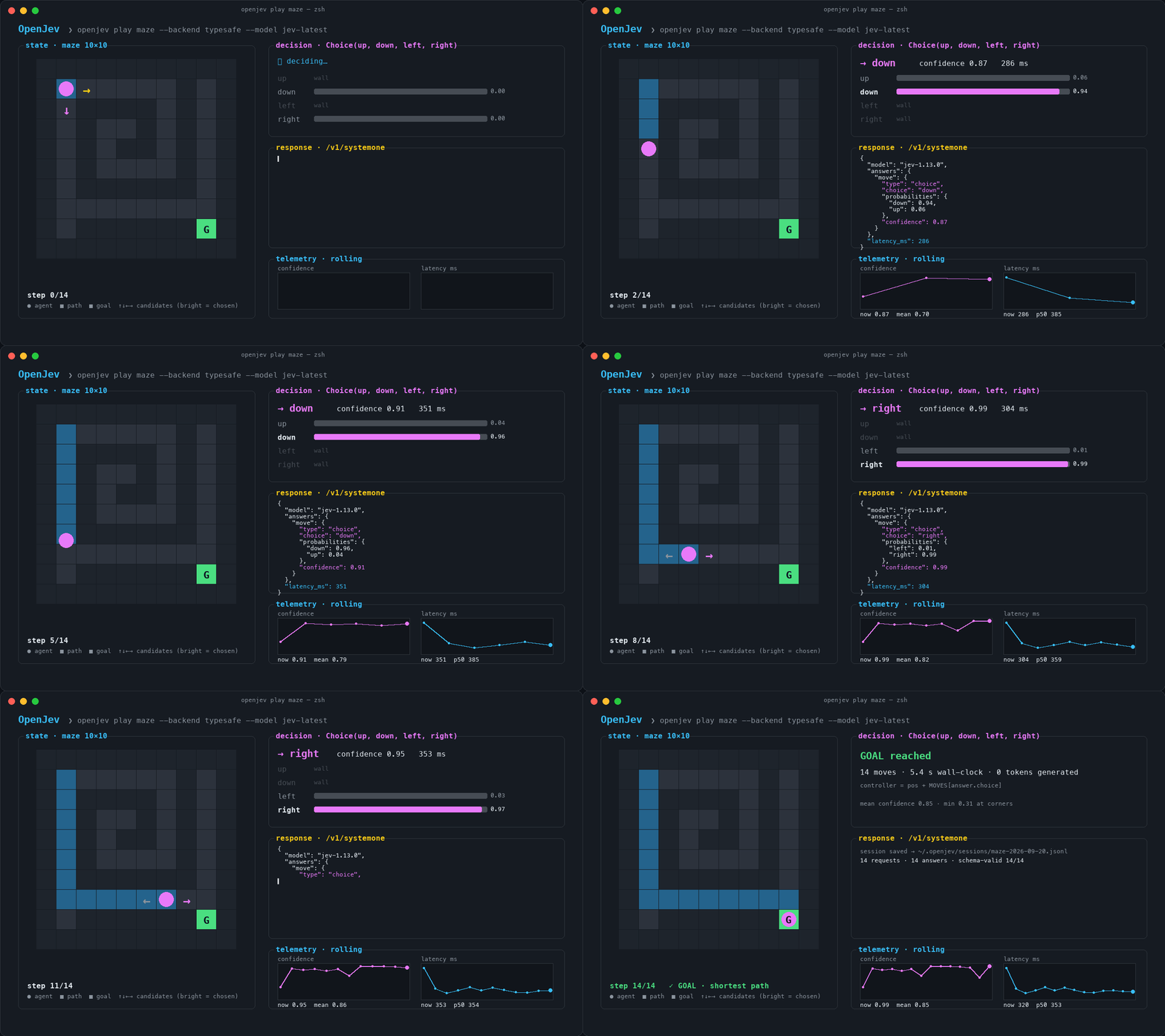
openjev play maze · left: live state · right: streaming /v1/systemone response, option probabilities, rolling confidence & latency. Replays real Jev decisions (14 moves, shortest path, 0 tokens generated).
Independent project. OpenJev reproduces the interface pattern of TypeSafe's Jev with open-weight models. It does not reproduce Jev's undisclosed model or training, and it is not affiliated with or endorsed by TypeSafe. Jev and TypeSafe are trademarks of their respective owners.
Why
Most decisions inside an agent are small: route this, retry that, is this tool call dangerous, which option wins? A chat model can answer them, but it spends hundreds of tokens generating text that your code immediately parses back into an if.
Jev showed that a System One model can answer typed questions in ~100 ms with calibrated probabilities. OpenJev brings that experience to open models, and adds the thing the ecosystem is missing: a terminal you can actually watch decisions happen in, the same way Clawd-Code gives you a Claude Code style REPL in Python.
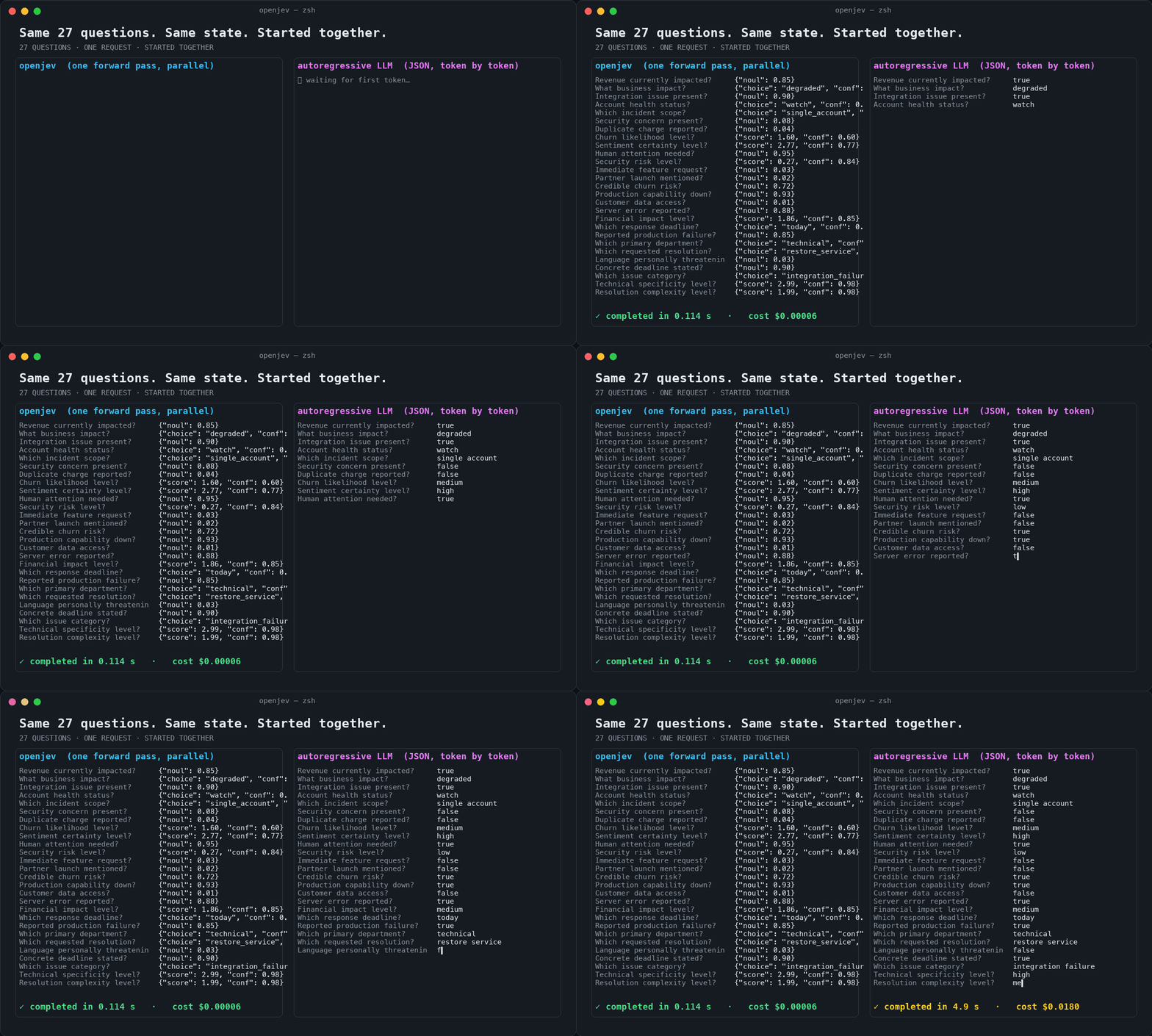
Same 27 questions, same state, started together. One forward pass per question vs. autoregressive JSON. (Illustrative animation; measured numbers below.)
What you can run today
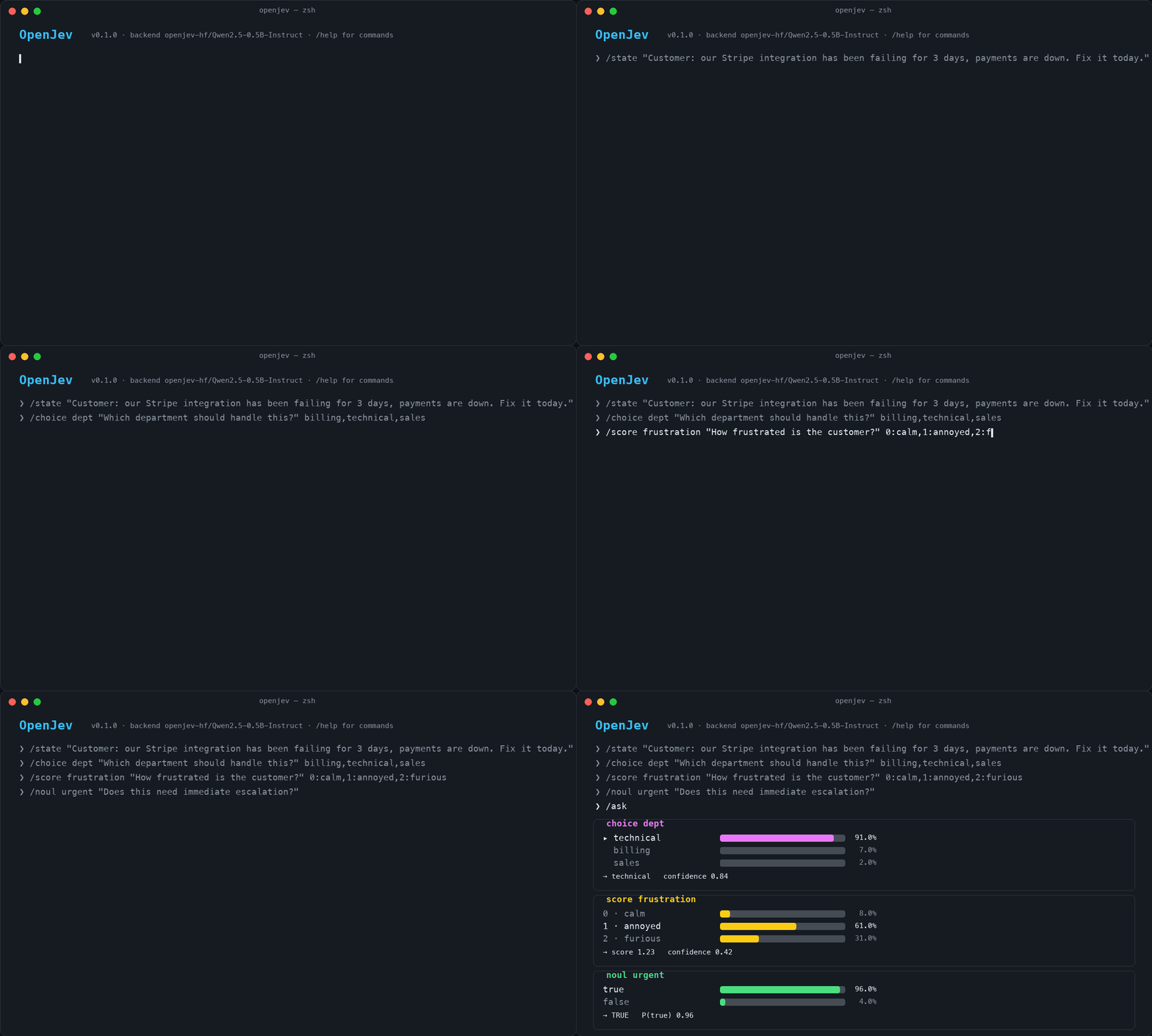
The concept above is the Phase 1-2 target UI. The REPL that ships now already renders the same probability bars, confidence and latency for every decision:
Live experiments against the real Jev
OpenJev ships a reference harness that runs real experiments against the official API, so every claim in this README can be re-measured with one command. Full write-up in docs/EXPERIMENTS.md.
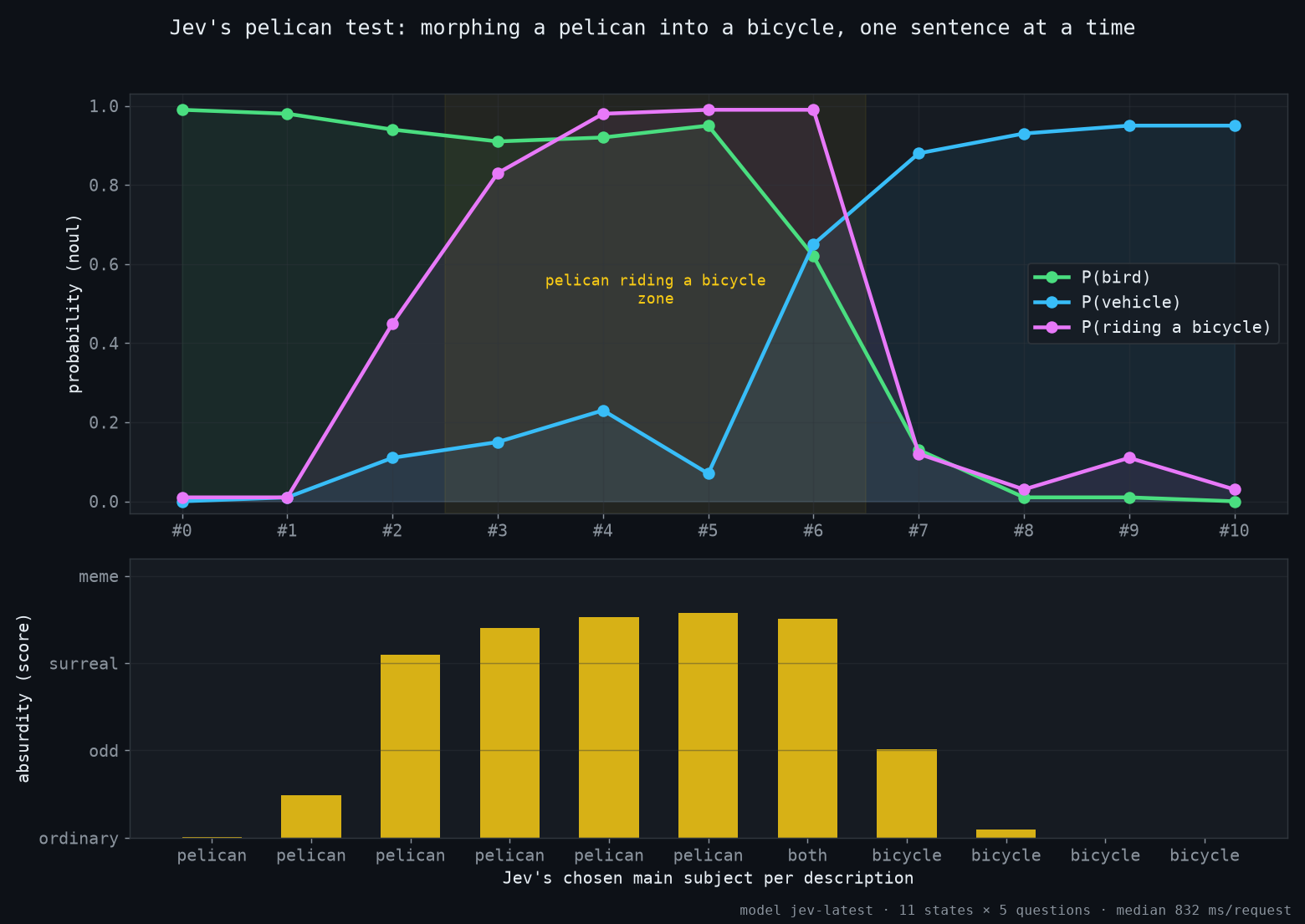
The pelican test. Morph a pelican into a bicycle one sentence at a time. P(bird) and P(vehicle) cross exactly where Jev says the subject is both; absurdity peaks while the pelican is riding.
|
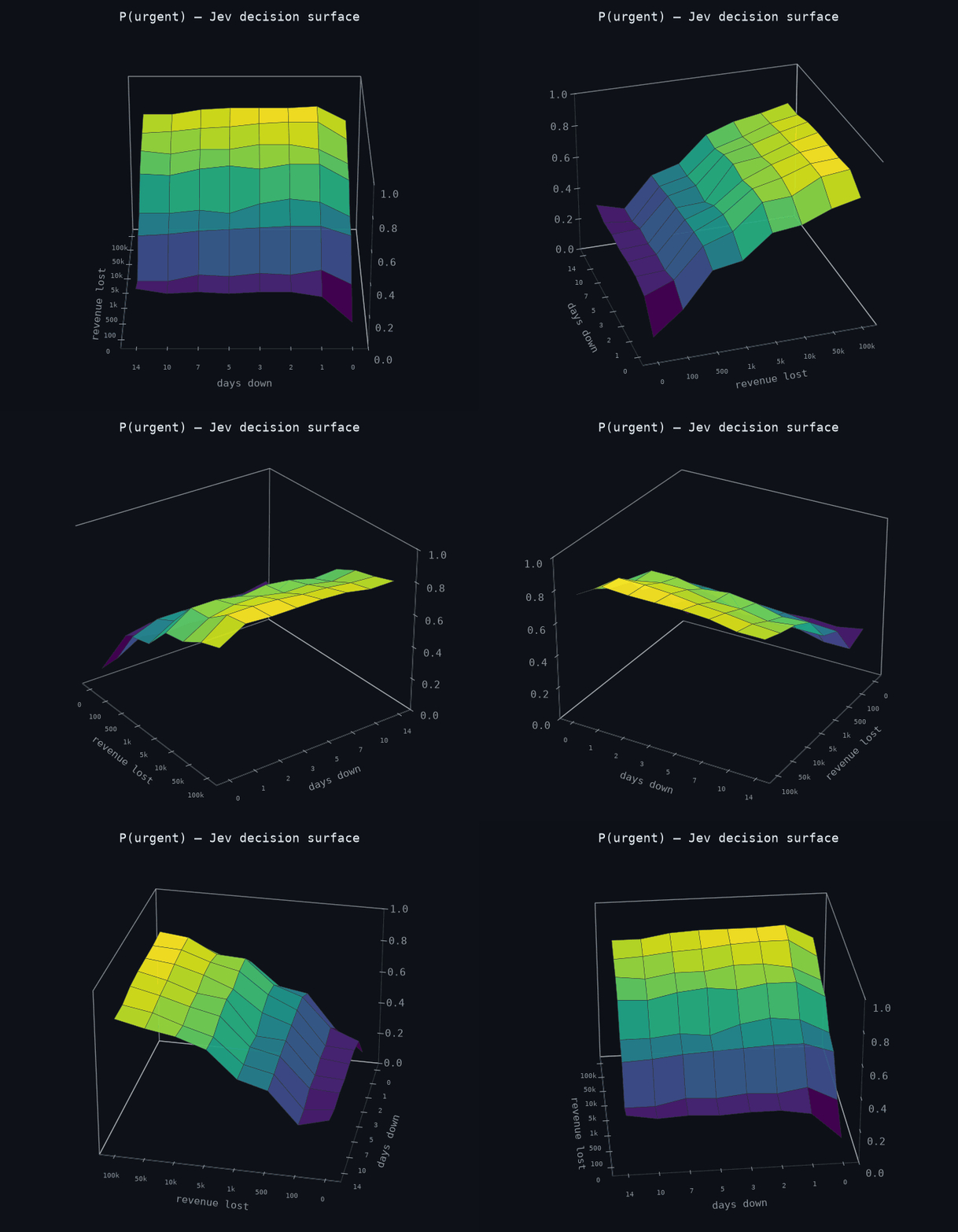
Decision landscape. 64 tickets on a days-down × revenue-lost grid, one call each. P(urgent) rises monotonically from 0.11 to 0.85; priority flips P3 → P1 with a cliff around day 3-5. |
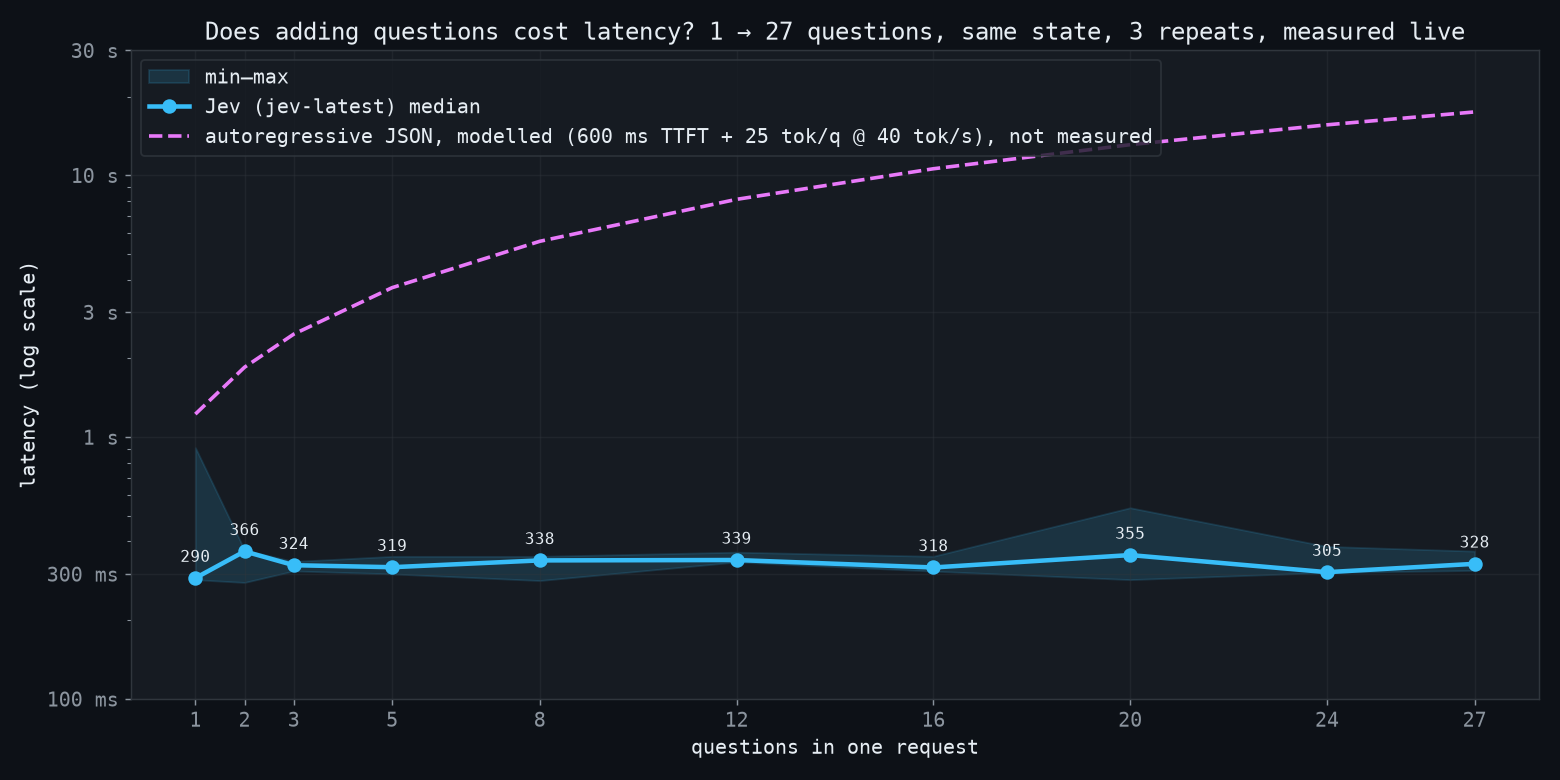
Adding questions is nearly free. Measured live: 290 ms for 1 question, 328 ms for 27 (output tokens 23 → 594). Dashed line is a modelled autoregressive baseline. |
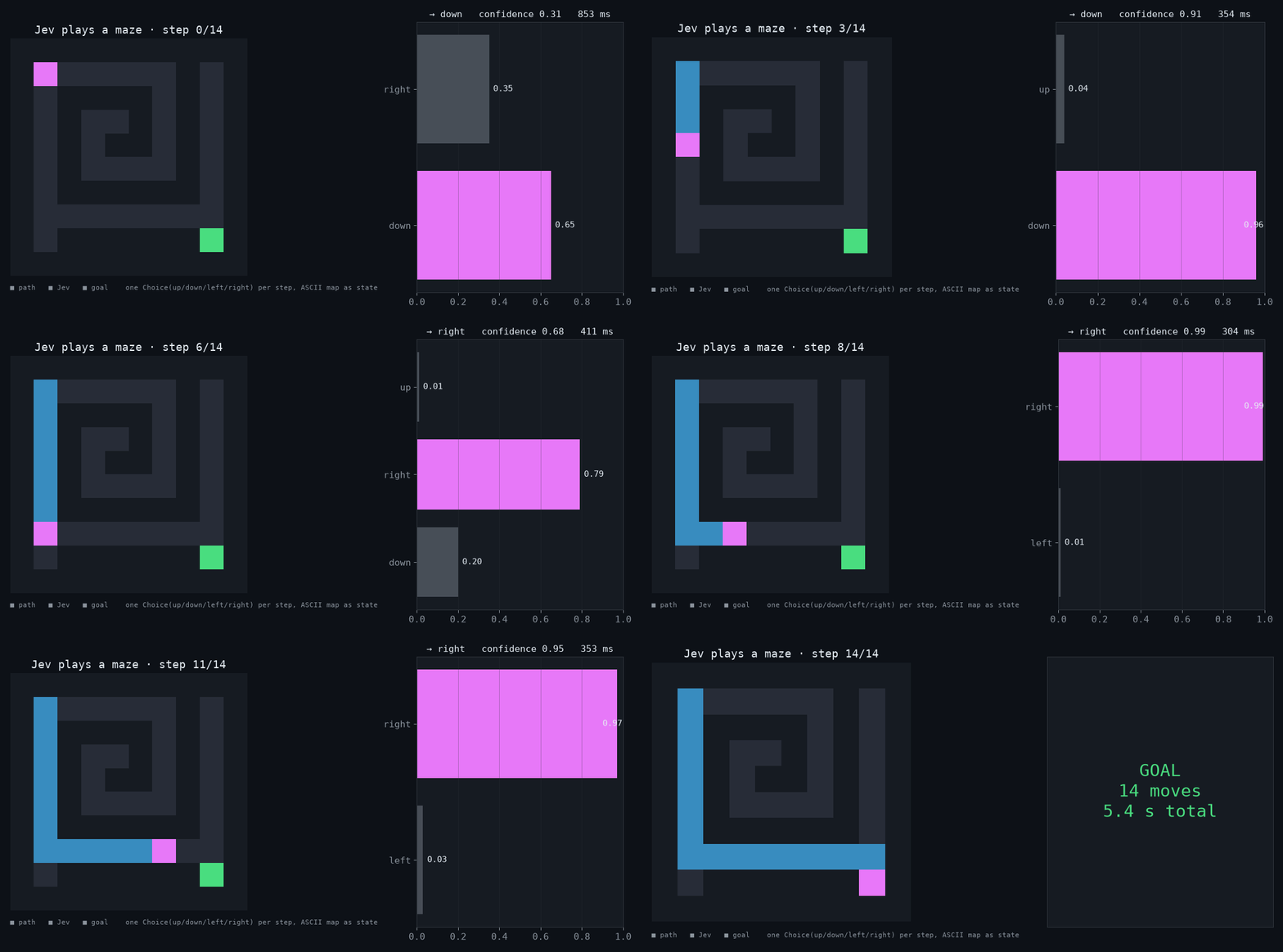
Jev plays a maze. One Choice per step, ASCII map as state. Shortest path (14 moves) in 5.4 s. Confidence drops to 0.6 exactly at the corners and sits at 0.99 in corridors.
|
echo 'TYPESAFE_API_KEY=...' > .env
uv pip install -e ".[experiments]"
python scripts/experiments.py all      # pelican · surface · latency · maze, ~130 calls
What you get
- Three primitives, Jev-compatible schema.
Choice(pick one of up to 255 options),Score(probability-weighted grade on an ordered legend),Noul(P(true) for a yes/no judgement). Same request/response shape asPOST /v1/systemone. - Claude Code style REPL. Paste a state, add questions with slash commands, hit
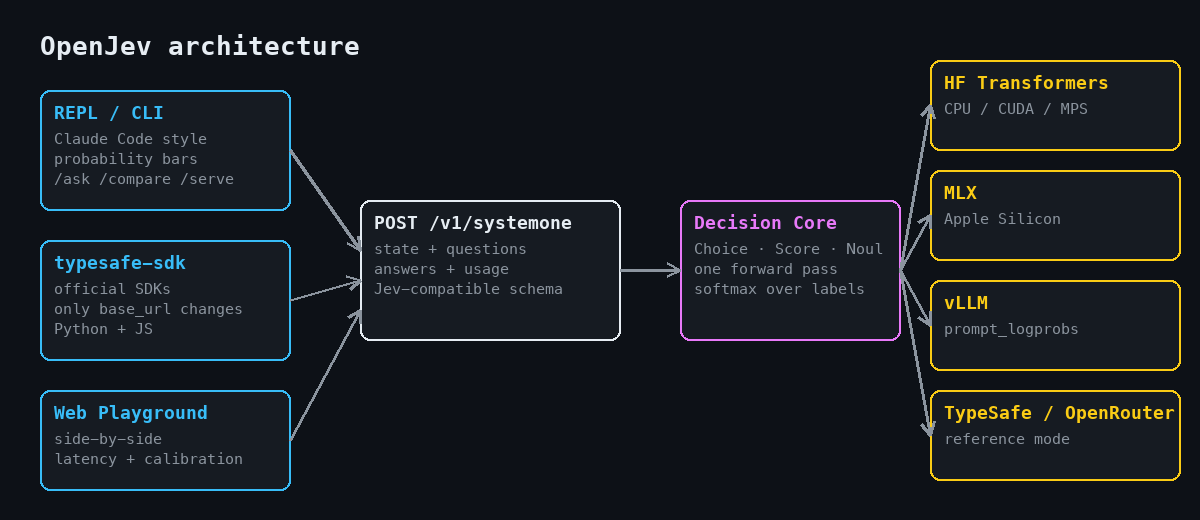
/ask, watch probability bars stream in with confidence and latency. - One forward pass. Logits are read at the answer position and softmaxed over your labels only. Nothing outside the option set can win. No decoding loop.
- Pluggable backends. Hugging Face Transformers today (CPU / CUDA / MPS). MLX, vLLM and a TypeSafe/OpenRouter reference mode on the roadmap.
- Drop-in for the official SDKs (Phase 1). Point
typesafe-sdkor@typesafe-ai/sdkathttp://localhost:8000and keep your code.
Quick start
git clone https://github.com/GPT-AGI/OpenJev.git && cd OpenJev
uv venv --python 3.11 && source .venv/bin/activate
uv pip install -e ".[dev]"          # core + REPL, runs anywhere with the mock backend
uv pip install -e ".[hf]"           # + real models via Transformers

openjev                              # mock backend, instant, no download
openjev --backend hf --model Qwen/Qwen2.5-0.5B-Instruct
Inside the REPL:
❯ /state "Customer: our Stripe integration has been failing for 3 days, payments are down. Fix it today."
❯ /choice dept "Which department should handle this?" billing,technical,sales
❯ /score frustration "How frustrated is the customer?" 0:calm,1:annoyed,2:furious
❯ /noul urgent "Does this need immediate escalation?"
❯ /ask
Or use it as a library:
from openjev import Choice, Noul, Score, SystemOneRequest
from openjev.backends import get_backend

backend = get_backend("hf", model_id="Qwen/Qwen2.5-0.5B-Instruct")
resp = backend.decide(SystemOneRequest(
    state={"ticket": "Stripe integration failed for 3 days, payments down"},
    questions={
        "dept": Choice(instructions="Which department?", options=["billing", "technical", "sales"]),
        "urgent": Noul(instructions="Does this need immediate escalation?"),
        "frustration": Score(instructions="Customer frustration?", legend={"0": "calm", "1": "annoyed", "2": "furious"}),
    },
))
print(resp.answers["dept"].choice, resp.answers["dept"].confidence)   # technical 0.84
print(resp.answers["urgent"].noul)                                     # 0.96
print(resp.answers["frustration"].score)                               # 1.23
print(resp.latency_ms)
Response shape (identical to the Jev docs):
{
  "model": "openjev-hf/Qwen2.5-0.5B-Instruct",
  "answers": {
    "dept":        {"type": "choice", "choice": "technical", "probabilities": {"technical": 0.91, "billing": 0.07, "sales": 0.02}, "confidence": 0.84},
    "urgent":      {"type": "noul",   "noul": 0.96},
    "frustration": {"type": "score",  "score": 1.23, "legend": {"0": "calm", "1": "annoyed", "2": "furious"}, "probabilities": {"0": 0.08, "1": 0.61, "2": 0.31}, "confidence": 0.42}
  },
  "usage": {"input_tokens": 312, "output_tokens": 8}
}
How it works
flowchart LR
    S[state] --> P[prompt template]
    Q[question + labels] --> P
    P --> M[open causal LM<br/>one forward pass]
    M -- logits at answer position --> R[read only label tokens]
    R --> SM[softmax over labels]
    SM --> C{Choice / Score / Noul}
    C --> A["typed answer<br/>+ probabilities<br/>+ confidence"]
confidence is 1 - normalized entropy of the label distribution (TypeSafe does not publish its formula; this is a transparent approximation). Raw probabilities from zero-shot models are over-confident, so Phase 2 adds temperature calibration against your own labelled data.
Roadmap
| Phase | Goal | Status |
|---|---|---|
| 0 | Core primitives, HF backend, Claude Code style REPL, demo GIFs | ✅ this release |
| 1 | openjev serve: FastAPI POST /v1/systemone, official SDKs work by changing base_url; shared-state prefill with KV-cache reuse; session save/load | 🔜 |
| 2 | Web Playground: side-by-side OpenJev vs Jev vs LLM-JSON with probability bars, latency and cost; openjev eval with accuracy + ECE on public sets; temperature calibration | ⏳ |
| 3 | Backends: MLX (Apple Silicon), vLLM (prompt_logprobs), TypeSafe / OpenRouter reference mode; agent middlewares (tool-call guardrail, model router, RAG reranker); SKILL.md for Claude Code / Clawd-Code | ⏳ |
| 4 | Train a lightweight decision head (NanoJev / jevlike style) with calibration losses; publish weights; Docker + one-click deploy | ⏳ |
Full design notes in docs/DESIGN.md.
Related work
The Jev launch triggered a wave of open reproductions. OpenJev builds on what they learned and focuses on the developer-facing experience.
- TheoLeeCJ/SemIf (formerly OpenJev) — single-token logits, WebGPU browser demo
- daseinlabs/open-jev — multi-token option scoring with KV-cache reuse, MLX, Doom demo
- ikermoel/open-alternative-jev — HF + vLLM, packed vs separate modes, honest benchmarks
- TianyuCodings/NanoJev — actually trains a decision head on Qwen3-0.6B
- vinnylarouge/jevlike — option-attention scorer trained from scratch
- vLLM PR #57250 — DiffusionGemma as a Jev-like via one denoising step
Contributing
PRs welcome. uv pip install -e ".[dev]" && pytest && ruff check src tests. See CONTRIBUTING.md.
License
MIT. See LICENSE.
Similar repos


Languages
Python
98.5%
Shell
1.5%
See what people are saying
README
OpenJev
An open-source, Jev-compatible System One decision engine with a Claude Code style REPL.
Typed decisions (Choice · Score · Noul) from open models in one forward pass. No JSON parsing, no hallucinated shapes, every answer comes with a probability.
English · 简体中文
openjev play maze · left: live state · right: streaming /v1/systemone response, option probabilities, rolling confidence & latency. Replays real Jev decisions (14 moves, shortest path, 0 tokens generated).
Independent project. OpenJev reproduces the interface pattern of TypeSafe's Jev with open-weight models. It does not reproduce Jev's undisclosed model or training, and it is not affiliated with or endorsed by TypeSafe. Jev and TypeSafe are trademarks of their respective owners.
Why
Most decisions inside an agent are small: route this, retry that, is this tool call dangerous, which option wins? A chat model can answer them, but it spends hundreds of tokens generating text that your code immediately parses back into an if.
Jev showed that a System One model can answer typed questions in ~100 ms with calibrated probabilities. OpenJev brings that experience to open models, and adds the thing the ecosystem is missing: a terminal you can actually watch decisions happen in, the same way Clawd-Code gives you a Claude Code style REPL in Python.
Same 27 questions, same state, started together. One forward pass per question vs. autoregressive JSON. (Illustrative animation; measured numbers below.)
What you can run today
The concept above is the Phase 1-2 target UI. The REPL that ships now already renders the same probability bars, confidence and latency for every decision:
Live experiments against the real Jev
OpenJev ships a reference harness that runs real experiments against the official API, so every claim in this README can be re-measured with one command. Full write-up in docs/EXPERIMENTS.md.
|
The pelican test. Morph a pelican into a bicycle one sentence at a time. P(bird) and P(vehicle) cross exactly where Jev says the subject is both; absurdity peaks while the pelican is riding.
|
Decision landscape. 64 tickets on a days-down × revenue-lost grid, one call each. P(urgent) rises monotonically from 0.11 to 0.85; priority flips P3 → P1 with a cliff around day 3-5. |
|
Adding questions is nearly free. Measured live: 290 ms for 1 question, 328 ms for 27 (output tokens 23 → 594). Dashed line is a modelled autoregressive baseline. |
Jev plays a maze. One Choice per step, ASCII map as state. Shortest path (14 moves) in 5.4 s. Confidence drops to 0.6 exactly at the corners and sits at 0.99 in corridors.
|
echo 'TYPESAFE_API_KEY=...' > .env
uv pip install -e ".[experiments]"
python scripts/experiments.py all      # pelican · surface · latency · maze, ~130 calls
What you get
- Three primitives, Jev-compatible schema.
Choice(pick one of up to 255 options),Score(probability-weighted grade on an ordered legend),Noul(P(true) for a yes/no judgement). Same request/response shape asPOST /v1/systemone. - Claude Code style REPL. Paste a state, add questions with slash commands, hit
/ask, watch probability bars stream in with confidence and latency. - One forward pass. Logits are read at the answer position and softmaxed over your labels only. Nothing outside the option set can win. No decoding loop.
- Pluggable backends. Hugging Face Transformers today (CPU / CUDA / MPS). MLX, vLLM and a TypeSafe/OpenRouter reference mode on the roadmap.
- Drop-in for the official SDKs (Phase 1). Point
typesafe-sdkor@typesafe-ai/sdkathttp://localhost:8000and keep your code.
Quick start
git clone https://github.com/GPT-AGI/OpenJev.git && cd OpenJev
uv venv --python 3.11 && source .venv/bin/activate
uv pip install -e ".[dev]"          # core + REPL, runs anywhere with the mock backend
uv pip install -e ".[hf]"           # + real models via Transformers

openjev                              # mock backend, instant, no download
openjev --backend hf --model Qwen/Qwen2.5-0.5B-Instruct
Inside the REPL:
❯ /state "Customer: our Stripe integration has been failing for 3 days, payments are down. Fix it today."
❯ /choice dept "Which department should handle this?" billing,technical,sales
❯ /score frustration "How frustrated is the customer?" 0:calm,1:annoyed,2:furious
❯ /noul urgent "Does this need immediate escalation?"
❯ /ask
Or use it as a library:
from openjev import Choice, Noul, Score, SystemOneRequest
from openjev.backends import get_backend

backend = get_backend("hf", model_id="Qwen/Qwen2.5-0.5B-Instruct")
resp = backend.decide(SystemOneRequest(
    state={"ticket": "Stripe integration failed for 3 days, payments down"},
    questions={
        "dept": Choice(instructions="Which department?", options=["billing", "technical", "sales"]),
        "urgent": Noul(instructions="Does this need immediate escalation?"),
        "frustration": Score(instructions="Customer frustration?", legend={"0": "calm", "1": "annoyed", "2": "furious"}),
    },
))
print(resp.answers["dept"].choice, resp.answers["dept"].confidence)   # technical 0.84
print(resp.answers["urgent"].noul)                                     # 0.96
print(resp.answers["frustration"].score)                               # 1.23
print(resp.latency_ms)
Response shape (identical to the Jev docs):
{
  "model": "openjev-hf/Qwen2.5-0.5B-Instruct",
  "answers": {
    "dept":        {"type": "choice", "choice": "technical", "probabilities": {"technical": 0.91, "billing": 0.07, "sales": 0.02}, "confidence": 0.84},
    "urgent":      {"type": "noul",   "noul": 0.96},
    "frustration": {"type": "score",  "score": 1.23, "legend": {"0": "calm", "1": "annoyed", "2": "furious"}, "probabilities": {"0": 0.08, "1": 0.61, "2": 0.31}, "confidence": 0.42}
  },
  "usage": {"input_tokens": 312, "output_tokens": 8}
}
How it works
flowchart LR
    S[state] --> P[prompt template]
    Q[question + labels] --> P
    P --> M[open causal LM<br/>one forward pass]
    M -- logits at answer position --> R[read only label tokens]
    R --> SM[softmax over labels]
    SM --> C{Choice / Score / Noul}
    C --> A["typed answer<br/>+ probabilities<br/>+ confidence"]
confidence is 1 - normalized entropy of the label distribution (TypeSafe does not publish its formula; this is a transparent approximation). Raw probabilities from zero-shot models are over-confident, so Phase 2 adds temperature calibration against your own labelled data.
Roadmap
| Phase | Goal | Status |
|---|---|---|
| 0 | Core primitives, HF backend, Claude Code style REPL, demo GIFs | ✅ this release |
| 1 | openjev serve: FastAPI POST /v1/systemone, official SDKs work by changing base_url; shared-state prefill with KV-cache reuse; session save/load | 🔜 |
| 2 | Web Playground: side-by-side OpenJev vs Jev vs LLM-JSON with probability bars, latency and cost; openjev eval with accuracy + ECE on public sets; temperature calibration | ⏳ |
| 3 | Backends: MLX (Apple Silicon), vLLM (prompt_logprobs), TypeSafe / OpenRouter reference mode; agent middlewares (tool-call guardrail, model router, RAG reranker); SKILL.md for Claude Code / Clawd-Code | ⏳ |
| 4 | Train a lightweight decision head (NanoJev / jevlike style) with calibration losses; publish weights; Docker + one-click deploy | ⏳ |
Full design notes in docs/DESIGN.md.
Related work
The Jev launch triggered a wave of open reproductions. OpenJev builds on what they learned and focuses on the developer-facing experience.
- TheoLeeCJ/SemIf (formerly OpenJev) — single-token logits, WebGPU browser demo
- daseinlabs/open-jev — multi-token option scoring with KV-cache reuse, MLX, Doom demo
- ikermoel/open-alternative-jev — HF + vLLM, packed vs separate modes, honest benchmarks
- TianyuCodings/NanoJev — actually trains a decision head on Qwen3-0.6B
- vinnylarouge/jevlike — option-attention scorer trained from scratch
- vLLM PR #57250 — DiffusionGemma as a Jev-like via one denoising step
Contributing
PRs welcome. uv pip install -e ".[dev]" && pytest && ruff check src tests. See CONTRIBUTING.md.
License
MIT. See LICENSE.
Similar repos
Languages
Python
98.5%
Shell
1.5%