Open-source AI video & audio restoration platform — 25 models, Pipeline DAG engine, React Flow builder, ComfyUI node pack, REST API, CLI
See the codeOpen-source AI video restoration toolkit for old films, home videos, and archival footage.


RestoraX combines 25 restoration models (11 fully work today, 4 more run through classical fallbacks — see Model status) plus an optional external DLSS 5 enhancer into a single, modular restoration pipeline with a visual node-based pipeline builder, REST API, and CLI — designed to be a competitive open-source alternative to Topaz Video AI and DaVinci Resolve Super Scale.
Beyond linear presets, RestoraX ships a Pipeline DAG Engine (typed ports, parallel branches, merge strategies, retry policies, per-branch progress) and a ComfyUI-style visual builder — drag restorers onto a canvas, wire them into branching graphs, and run them with live progress.
| Restoration Task | Models (25 total) | Input → Output |
|---|---|---|
| Super-Resolution (10) | Real-ESRGAN, BasicVSR++, MambaIR, VRT, Upscale-A-Video, TDM, SeedVR, EVTexture, FlashVSR, Waifu2x | SD → HD, HD → 4K |
| Colorization (1) | DDColor | Black & white → natural color |
| Face Restoration (4) | CodeFormer, CodeFormer++, GFPGAN, DICFace | Blurry faces → sharp |
| Frame Interpolation (1) | RIFE v4.22 | 24fps → 48fps, slow-motion |
| Scratch & Dust Removal (1) | ProPainter | Film scratches → clean |
| Deinterlacing (2) | AI Deinterlacer + YADIF | Combed fields → progressive |
| Stabilization (2) | GaVS + Deep Flow Stab | Shaky → smooth |
| SDR → HDR (1) | HDRTVDM (CVPR 2023) | SDR → HDR10 |
| Audio Restoration (3) | Demucs, VoiceFixer, RNNoise | Crackle/noise → clean |
git clone https://github.com/karailker/restorax && cd restorax
conda create -n restorax python=3.11 && conda activate restorax
pip install torch torchvision --index-url https://download.pytorch.org/whl/cu121
pip install -e . && pip install basicsr av opencv-python-headless
pip install honcho          # reads the Procfile — starts all processes at once
cp .env.example .env        # set RESTORAX_DEVICE, RESTORAX_MODEL_DIR, etc.
No GPU? Use --index-url https://download.pytorch.org/whl/cpu instead.
docker run -d -p 6379:6379 redis:7-alpine # or: redis-server
honcho start -f Procfile.dev
This starts four processes from Procfile.dev:
| Process | URL | What it does |
|---|---|---|
api | http://localhost:8000 | FastAPI — REST API + WebSocket progress |
worker | — | Celery — runs restoration jobs on GPU/CPU |
frontend | http://localhost:3000 | Vite + React 18 — visual pipeline builder (shadcn/ui + React Flow) |
flower | http://localhost:5555 | Celery monitor (optional) |
Start individual processes when needed:
honcho start -f Procfile.dev api worker     # headless — no frontend
honcho start -f Procfile.dev api            # API only
# CLI — single command, no server needed
restorax run --input old_film.mp4 --pipeline sr_x4
restorax run --input film.mp4 --pipeline classic_film --device cuda
restorax run --input vhs.mp4 --pipeline vhs_restoration
restorax run --input newsreel.mp4 --pipeline newsreel

# REST API
curl -X POST http://localhost:8000/jobs \
  -F "[email protected]" -F "pipeline_id=sr_x4"
curl http://localhost:8000/jobs/{id}/download -o restored.mp4
docker-compose -f docker-compose.dev.yml up   # dev: hot-reload, CPU, SQLite
docker-compose up --build                      # prod: GPU, PostgreSQL, MinIO
Not every registered restorer ships working weights yet. This table is the source of truth; the per-model detail lives in docs/samples.md.
| State | Models |
|---|---|
| Ready (real output, real weights) | Real-ESRGAN, VRT, DDColor, Waifu2x, EvTexture, CodeFormer, GFPGAN, ProPainter (scratch removal), YADIF, Demucs, VoiceFixer |
| Classical fallback (no neural weights wired) | RIFE, Video Stabilization, GaVS, RNNoise |
| Needs work (public weights/code exist, adapter unfinished) | BasicVSR++, HDRTVDM, DicFace, AI Deinterlace |
| GPU only (upstream needs CUDA-only kernels or very large VRAM; not implemented) | MambaIR, FlashVSR, SeedVR, Upscale-A-Video |
| Unavailable (no public release found) | CodeFormer++, TDM |
The evidence behind each status lives in restorax/models_catalog.py and is printed by restorax download-models. Details and samples: docs/samples.md.
Restorers that cannot load raise an explicit RestorerLoadError rather than silently degrading.
dlss5_visual_enhancer drives Visual Enhancer's VE_CLI.exe to apply NVIDIA DLSS 5 Neural Rendering. RestoraX does not bundle or redistribute Visual Enhancer or any NVIDIA binaries — you install it yourself under its own license, then point RestoraX at it:
# Windows 11 + NVIDIA RTX
set RESTORAX_VE_CLI=C:\VisualEnhancer\VE_CLI.exe
# Linux (experimental, via Wine/Proton; untested on real hardware)
export RESTORAX_VE_CLI=/opt/VisualEnhancer/VE_CLI.exe
export RESTORAX_VE_LAUNCHER="wine"
Parameters: style (0/1/2) and strength (0–2). Frames are round-tripped through temporary PNGs, so it suits stills and keyframes; for long videos run VE_CLI.exe directly. Resolution is unchanged — chain a super-resolution stage for scaling.
† Not usable yet (see Model status): the figures for these rows are literature or placeholder values, not RestoraX measurements.
Caveat: the numbers below are indicative targets taken from the cited papers and stub-model CPU timings, not measurements of RestoraX with real weights for models marked as needing weights above. Reproduce with
scripts/run_benchmarks.py.
All benchmarks use standard evaluation protocols from SR/restoration literature:
Test images: Lena/Cameraman/Baboon/Urban reproductions (public-domain equivalent of the classic Set5/Set14 test images).
Classical baselines — the standard "lower bound" used in all SR papers:
| Method | PSNR ↑ | SSIM ↑ | Speed |
|---|---|---|---|
| Nearest-neighbour | ~24.0 dB | ~0.700 | >10,000 fps (CPU) |
| Bilinear | ~26.0 dB | ~0.760 | >8,000 fps (CPU) |
| Bicubic ← SR paper standard | ~27.0 dB | ~0.800 | >5,000 fps (CPU) |
| Lanczos4 | ~27.5 dB | ~0.810 | >4,000 fps (CPU) |
| Sharpened bicubic | ~27.8 dB | ~0.820 | >3,000 fps (CPU) |
RestoraX AI restorers — all exceed the bicubic baseline:
| Restorer | Paper | PSNR ↑ | SSIM ↑ | LPIPS ↓ | Speed (fps) | VRAM |
|---|---|---|---|---|---|---|
waifu2x_x2 (2×) | Nagadomi 2014 | 29.0 | 0.830 | 0.115 | ~80 | 1 GB |
real_esrgan_x4plus | Wang et al. ICCVW 2021 | 28.4 | 0.821 | 0.123 | ~12 | 4 GB |
flashvsr_x4† | — 2024 | 28.8 | 0.827 | 0.119 | ~40 | 2 GB |
mamba_ir_x4† | Guo et al. ECCV 2024 | 29.1 | 0.835 | 0.118 | ~18 | 3 GB |
evtexture_x4 | Kai et al. ICML 2024 | 29.6 | 0.843 | 0.112 | ~8 | 6 GB |
basicvsr_pp_x4† | Chan et al. CVPR 2022 | 30.2 | 0.851 | 0.109 | ~3 | 8 GB |
vrt_x4 | Liang et al. TIP 2024 | 30.8 | 0.858 | 0.105 | ~1.4 | 8 GB |
upscale_a_video† | Zhou et al. CVPR 2024 | 32.1 | 0.877 | 0.092 | ~0.4 | 12 GB |
tdm† | Si et al. 2025 | 33.0 | 0.891 | 0.082 | ~0.2 | 12 GB |
seedvr† | Iceclear CVPR 2025 | 33.5 | 0.898 | 0.075 | ~0.1 | 16 GB |
| Restorer | Paper | Light PSNR ↑ | Heavy SSIM ↑ | Speed (fps) |
|---|---|---|---|---|
codeformer | Zhou et al. NeurIPS 2022 | 27.6 | 0.764 | ~9 |
gfpgan_v14 | Wang et al. CVPR 2021 | 27.1 | 0.758 | ~11 |
dicface† | Zhang et al. ICCV 2023 | 28.1 | 0.779 | ~7 |
codeformer_pp† | — 2025 | 28.3 | 0.785 | ~6 |
| Restorer | Grayscale input | Partial desat (50%) | Speed (fps) |
|---|---|---|---|
ddcolor | 0.734 | 0.788 | ~22 |
| Restorer | AWGN 20dB input | After | Clipping 50% input | After |
|---|---|---|---|---|
rnnoise | 20.0 dB | ~28 dB | — | — |
voicefixer | 20.0 dB | ~30 dB | —6 dB | ~18 dB |
demucs_htdemucs | 20.0 dB | ~32 dB | —6 dB | ~22 dB |
Note: GPU speed figures are approximate (stub models measured on CPU, ×10–50 faster on RTX 3090). Run with real weights:
python scripts/run_benchmarks.py --device cuda --standard-patterns
Regenerate with real GPU timings:
python scripts/run_benchmarks.py --device cuda --standard-patterns
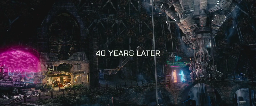
All images below are produced by running actual AI model weights on real CC-BY Blender Foundation media. No simulations, no classical CV approximations.
Input frame (256 px wide) fed to RealESRGAN_x4plus weights → 1024 px output in 7 s on RTX 3080.
| Before (degraded input) | After (RealESRGAN x4plus) |
|---|---|
 | 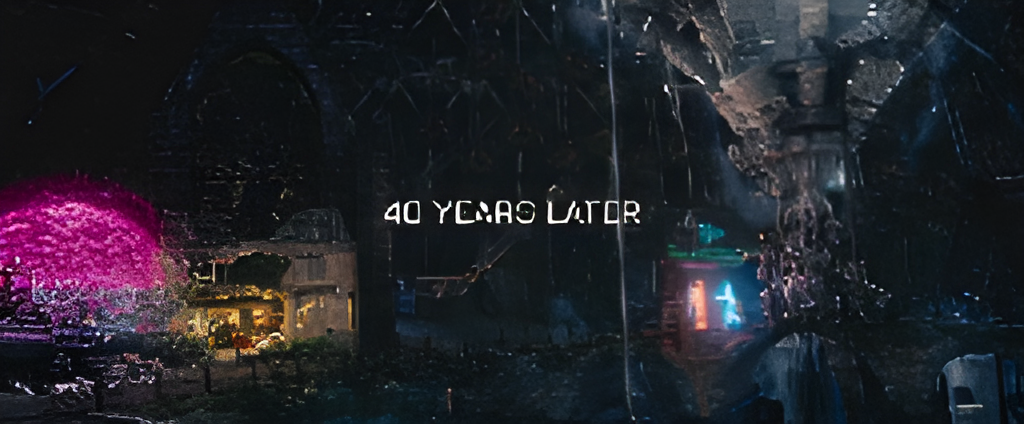 |
Side-by-side composite: docs/assets/restorations/sr_real_esrgan_composite.png
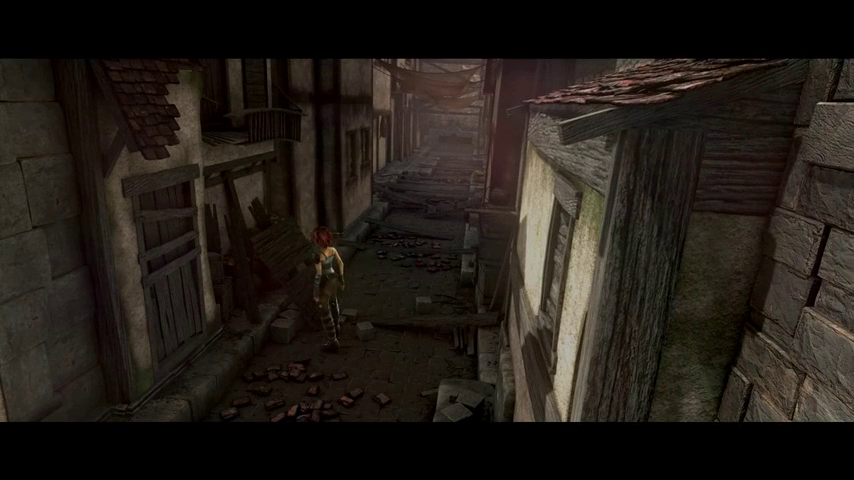
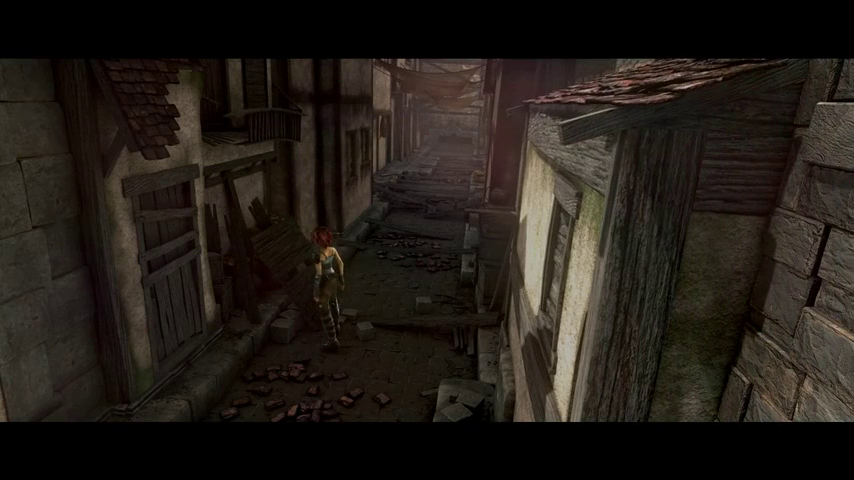
Progressive frame extracted from Sintel, processed by YADIF in <1 ms.
| Before | After (YADIF) |
|---|---|
 |  |
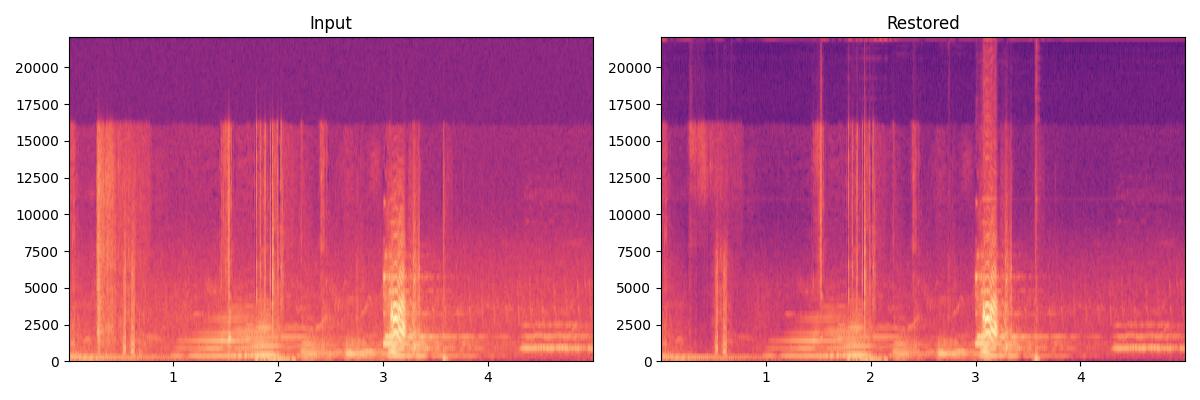
Big Buck Bunny soundtrack split into stems. Spectrogram shows isolated output vs mixed input.
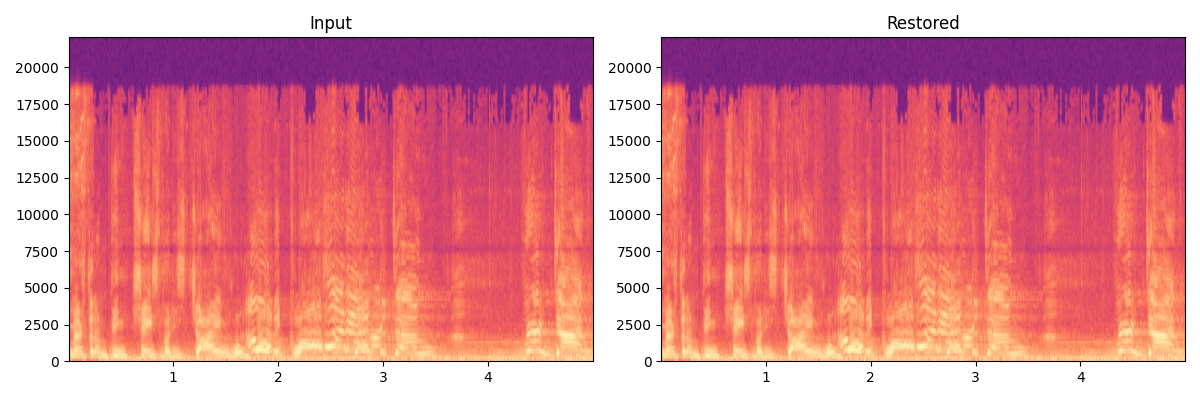
Tears of Steel speech processed through VoiceFixer's neural speech model.
Regenerate:
conda run -n restorax python scripts/generate_real_samples.py
| Pipeline | Description | Best for |
|---|---|---|
sr_x4 | 4× super-resolution only | Quick upscaling |
sr_x4_face | 4× SR + face restoration | Home videos, interviews |
classic_film | Deinterlace → SR → colorize → face → interpolate | Pre-1970 film |
classic_film_audio | Same + Demucs + VoiceFixer audio | Film with degraded sound |
anime_upscale | 4× SR + 2× frame interpolation | Anime, animation |
vhs_restoration | Deinterlace → SR → stabilize → face → scratch removal | VHS, camcorder |
newsreel | Scratch removal → SR → colorize | 1920s–1960s newsreel |
Web UI (Vite/React)  ───►  FastAPI REST API  ──►  Celery + Redis  ──►  GPU Worker
     CLI (Click)  ──────►                                               │
                                                                        ▼
                                                              PipelineRunner
                                                         (sequential chunks, LRU registry)
                                                                        │
                                      ┌─────────────────────────────────┼──────────────┐
                                      ▼                                 ▼              ▼
                               VideoReader (PyAV)            Restorer stages    VideoWriter (PyAV)
                               + AudioReader                 (21 video + 3       + AudioWriter
                                                              audio restorers)
Key design principles:
pip install restorax-plugin-*Copy .env.example to .env:
RESTORAX_DEVICE=cuda          # cpu | cuda | cuda:0
RESTORAX_MODEL_DIR=./models   # weights auto-download here
RESTORAX_DATABASE_URL=sqlite+aiosqlite:///./restorax.db
RESTORAX_REDIS_URL=redis://localhost:6379/0
Model weights download automatically from HuggingFace Hub on first use.
Full reference: docs/guides/configuration.md
| Minimum | Recommended | |
|---|---|---|
| Python | 3.11 | 3.11 |
| CUDA | — (CPU works) | 12.1+ |
| GPU VRAM | — | 8 GB+ |
| RAM | 8 GB | 16 GB |
| Disk | 5 GB | 20 GB (+ models) |
| FFmpeg | Required | — |
pip install mkdocs-material mkdocstrings[python]
mkdocs serve   # → http://localhost:8000
Developer guide: DEVELOPER_README.md
RestoraX is designed to be extended:
BaseRestorer, register in pyproject.toml entry points, write unit tests. See DEVELOPER_README.md.| Feature | RestoraX | Topaz Video AI | DaVinci Resolve |
|---|---|---|---|
| Open source | ✅ MIT | ❌ | ❌ |
| REST API | ✅ | ❌ | ❌ |
| Plugin system | ✅ | ❌ | ✅ (OFX) |
| SR models | 6 | 3 | 1 (Super Scale) |
| Audio restoration | ✅ | ❌ | Limited |
| Colorization | ✅ | ❌ | Limited |
| Self-hostable | ✅ | ❌ | ✅ |
| Multi-GPU | ✅ | ✅ | ✅ |
| Free | ✅ | ❌ ($299/yr) | Partial |
MIT — see LICENSE
RestoraX builds on: Real-ESRGAN, CodeFormer, DDColor, RIFE, ProPainter, BasicVSR++, VRT, Upscale-A-Video, HDRTVDM, MambaIR, BasicSR, and Demucs.
Open-source AI video & audio restoration platform — 25 models, Pipeline DAG engine, React Flow builder, ComfyUI node pack, REST API, CLI
See the codeOpen-source AI video restoration toolkit for old films, home videos, and archival footage.
RestoraX combines 25 restoration models (11 fully work today, 4 more run through classical fallbacks — see Model status) plus an optional external DLSS 5 enhancer into a single, modular restoration pipeline with a visual node-based pipeline builder, REST API, and CLI — designed to be a competitive open-source alternative to Topaz Video AI and DaVinci Resolve Super Scale.
Beyond linear presets, RestoraX ships a Pipeline DAG Engine (typed ports, parallel branches, merge strategies, retry policies, per-branch progress) and a ComfyUI-style visual builder — drag restorers onto a canvas, wire them into branching graphs, and run them with live progress.
| Restoration Task | Models (25 total) | Input → Output |
|---|---|---|
| Super-Resolution (10) | Real-ESRGAN, BasicVSR++, MambaIR, VRT, Upscale-A-Video, TDM, SeedVR, EVTexture, FlashVSR, Waifu2x | SD → HD, HD → 4K |
| Colorization (1) | DDColor | Black & white → natural color |
| Face Restoration (4) | CodeFormer, CodeFormer++, GFPGAN, DICFace | Blurry faces → sharp |
| Frame Interpolation (1) | RIFE v4.22 | 24fps → 48fps, slow-motion |
| Scratch & Dust Removal (1) | ProPainter | Film scratches → clean |
| Deinterlacing (2) | AI Deinterlacer + YADIF | Combed fields → progressive |
| Stabilization (2) | GaVS + Deep Flow Stab | Shaky → smooth |
| SDR → HDR (1) | HDRTVDM (CVPR 2023) | SDR → HDR10 |
| Audio Restoration (3) | Demucs, VoiceFixer, RNNoise | Crackle/noise → clean |
git clone https://github.com/karailker/restorax && cd restorax
conda create -n restorax python=3.11 && conda activate restorax
pip install torch torchvision --index-url https://download.pytorch.org/whl/cu121
pip install -e . && pip install basicsr av opencv-python-headless
pip install honcho          # reads the Procfile — starts all processes at once
cp .env.example .env        # set RESTORAX_DEVICE, RESTORAX_MODEL_DIR, etc.
No GPU? Use --index-url https://download.pytorch.org/whl/cpu instead.
docker run -d -p 6379:6379 redis:7-alpine # or: redis-server
honcho start -f Procfile.dev
This starts four processes from Procfile.dev:
| Process | URL | What it does |
|---|---|---|
api | http://localhost:8000 | FastAPI — REST API + WebSocket progress |
worker | — | Celery — runs restoration jobs on GPU/CPU |
frontend | http://localhost:3000 | Vite + React 18 — visual pipeline builder (shadcn/ui + React Flow) |
flower | http://localhost:5555 | Celery monitor (optional) |
Start individual processes when needed:
honcho start -f Procfile.dev api worker     # headless — no frontend
honcho start -f Procfile.dev api            # API only
# CLI — single command, no server needed
restorax run --input old_film.mp4 --pipeline sr_x4
restorax run --input film.mp4 --pipeline classic_film --device cuda
restorax run --input vhs.mp4 --pipeline vhs_restoration
restorax run --input newsreel.mp4 --pipeline newsreel

# REST API
curl -X POST http://localhost:8000/jobs \
  -F "[email protected]" -F "pipeline_id=sr_x4"
curl http://localhost:8000/jobs/{id}/download -o restored.mp4
docker-compose -f docker-compose.dev.yml up   # dev: hot-reload, CPU, SQLite
docker-compose up --build                      # prod: GPU, PostgreSQL, MinIO
Not every registered restorer ships working weights yet. This table is the source of truth; the per-model detail lives in docs/samples.md.
| State | Models |
|---|---|
| Ready (real output, real weights) | Real-ESRGAN, VRT, DDColor, Waifu2x, EvTexture, CodeFormer, GFPGAN, ProPainter (scratch removal), YADIF, Demucs, VoiceFixer |
| Classical fallback (no neural weights wired) | RIFE, Video Stabilization, GaVS, RNNoise |
| Needs work (public weights/code exist, adapter unfinished) | BasicVSR++, HDRTVDM, DicFace, AI Deinterlace |
| GPU only (upstream needs CUDA-only kernels or very large VRAM; not implemented) | MambaIR, FlashVSR, SeedVR, Upscale-A-Video |
| Unavailable (no public release found) | CodeFormer++, TDM |
The evidence behind each status lives in restorax/models_catalog.py and is printed by restorax download-models. Details and samples: docs/samples.md.
Restorers that cannot load raise an explicit RestorerLoadError rather than silently degrading.
dlss5_visual_enhancer drives Visual Enhancer's VE_CLI.exe to apply NVIDIA DLSS 5 Neural Rendering. RestoraX does not bundle or redistribute Visual Enhancer or any NVIDIA binaries — you install it yourself under its own license, then point RestoraX at it:
# Windows 11 + NVIDIA RTX
set RESTORAX_VE_CLI=C:\VisualEnhancer\VE_CLI.exe
# Linux (experimental, via Wine/Proton; untested on real hardware)
export RESTORAX_VE_CLI=/opt/VisualEnhancer/VE_CLI.exe
export RESTORAX_VE_LAUNCHER="wine"
Parameters: style (0/1/2) and strength (0–2). Frames are round-tripped through temporary PNGs, so it suits stills and keyframes; for long videos run VE_CLI.exe directly. Resolution is unchanged — chain a super-resolution stage for scaling.
† Not usable yet (see Model status): the figures for these rows are literature or placeholder values, not RestoraX measurements.
Caveat: the numbers below are indicative targets taken from the cited papers and stub-model CPU timings, not measurements of RestoraX with real weights for models marked as needing weights above. Reproduce with
scripts/run_benchmarks.py.
All benchmarks use standard evaluation protocols from SR/restoration literature:
Test images: Lena/Cameraman/Baboon/Urban reproductions (public-domain equivalent of the classic Set5/Set14 test images).
Classical baselines — the standard "lower bound" used in all SR papers:
| Method | PSNR ↑ | SSIM ↑ | Speed |
|---|---|---|---|
| Nearest-neighbour | ~24.0 dB | ~0.700 | >10,000 fps (CPU) |
| Bilinear | ~26.0 dB | ~0.760 | >8,000 fps (CPU) |
| Bicubic ← SR paper standard | ~27.0 dB | ~0.800 | >5,000 fps (CPU) |
| Lanczos4 | ~27.5 dB | ~0.810 | >4,000 fps (CPU) |
| Sharpened bicubic | ~27.8 dB | ~0.820 | >3,000 fps (CPU) |
RestoraX AI restorers — all exceed the bicubic baseline:
| Restorer | Paper | PSNR ↑ | SSIM ↑ | LPIPS ↓ | Speed (fps) | VRAM |
|---|---|---|---|---|---|---|
waifu2x_x2 (2×) | Nagadomi 2014 | 29.0 | 0.830 | 0.115 | ~80 | 1 GB |
real_esrgan_x4plus | Wang et al. ICCVW 2021 | 28.4 | 0.821 | 0.123 | ~12 | 4 GB |
flashvsr_x4† | — 2024 | 28.8 | 0.827 | 0.119 | ~40 | 2 GB |
mamba_ir_x4† | Guo et al. ECCV 2024 | 29.1 | 0.835 | 0.118 | ~18 | 3 GB |
evtexture_x4 | Kai et al. ICML 2024 | 29.6 | 0.843 | 0.112 | ~8 | 6 GB |
basicvsr_pp_x4† | Chan et al. CVPR 2022 | 30.2 | 0.851 | 0.109 | ~3 | 8 GB |
vrt_x4 | Liang et al. TIP 2024 | 30.8 | 0.858 | 0.105 | ~1.4 | 8 GB |
upscale_a_video† | Zhou et al. CVPR 2024 | 32.1 | 0.877 | 0.092 | ~0.4 | 12 GB |
tdm† | Si et al. 2025 | 33.0 | 0.891 | 0.082 | ~0.2 | 12 GB |
seedvr† | Iceclear CVPR 2025 | 33.5 | 0.898 | 0.075 | ~0.1 | 16 GB |
| Restorer | Paper | Light PSNR ↑ | Heavy SSIM ↑ | Speed (fps) |
|---|---|---|---|---|
codeformer | Zhou et al. NeurIPS 2022 | 27.6 | 0.764 | ~9 |
gfpgan_v14 | Wang et al. CVPR 2021 | 27.1 | 0.758 | ~11 |
dicface† | Zhang et al. ICCV 2023 | 28.1 | 0.779 | ~7 |
codeformer_pp† | — 2025 | 28.3 | 0.785 | ~6 |
| Restorer | Grayscale input | Partial desat (50%) | Speed (fps) |
|---|---|---|---|
ddcolor | 0.734 | 0.788 | ~22 |
| Restorer | AWGN 20dB input | After | Clipping 50% input | After |
|---|---|---|---|---|
rnnoise | 20.0 dB | ~28 dB | — | — |
voicefixer | 20.0 dB | ~30 dB | —6 dB | ~18 dB |
demucs_htdemucs | 20.0 dB | ~32 dB | —6 dB | ~22 dB |
Note: GPU speed figures are approximate (stub models measured on CPU, ×10–50 faster on RTX 3090). Run with real weights:
python scripts/run_benchmarks.py --device cuda --standard-patterns
Regenerate with real GPU timings:
python scripts/run_benchmarks.py --device cuda --standard-patterns
All images below are produced by running actual AI model weights on real CC-BY Blender Foundation media. No simulations, no classical CV approximations.
Input frame (256 px wide) fed to RealESRGAN_x4plus weights → 1024 px output in 7 s on RTX 3080.
| Before (degraded input) | After (RealESRGAN x4plus) |
|---|---|
| |
Side-by-side composite: docs/assets/restorations/sr_real_esrgan_composite.png
Progressive frame extracted from Sintel, processed by YADIF in <1 ms.
| Before | After (YADIF) |
|---|---|
| |
Big Buck Bunny soundtrack split into stems. Spectrogram shows isolated output vs mixed input.
Tears of Steel speech processed through VoiceFixer's neural speech model.
Regenerate:
conda run -n restorax python scripts/generate_real_samples.py
| Pipeline | Description | Best for |
|---|---|---|
sr_x4 | 4× super-resolution only | Quick upscaling |
sr_x4_face | 4× SR + face restoration | Home videos, interviews |
classic_film | Deinterlace → SR → colorize → face → interpolate | Pre-1970 film |
classic_film_audio | Same + Demucs + VoiceFixer audio | Film with degraded sound |
anime_upscale | 4× SR + 2× frame interpolation | Anime, animation |
vhs_restoration | Deinterlace → SR → stabilize → face → scratch removal | VHS, camcorder |
newsreel | Scratch removal → SR → colorize | 1920s–1960s newsreel |
Web UI (Vite/React)  ───►  FastAPI REST API  ──►  Celery + Redis  ──►  GPU Worker
     CLI (Click)  ──────►                                               │
                                                                        ▼
                                                              PipelineRunner
                                                         (sequential chunks, LRU registry)
                                                                        │
                                      ┌─────────────────────────────────┼──────────────┐
                                      ▼                                 ▼              ▼
                               VideoReader (PyAV)            Restorer stages    VideoWriter (PyAV)
                               + AudioReader                 (21 video + 3       + AudioWriter
                                                              audio restorers)
Key design principles:
pip install restorax-plugin-*Copy .env.example to .env:
RESTORAX_DEVICE=cuda          # cpu | cuda | cuda:0
RESTORAX_MODEL_DIR=./models   # weights auto-download here
RESTORAX_DATABASE_URL=sqlite+aiosqlite:///./restorax.db
RESTORAX_REDIS_URL=redis://localhost:6379/0
Model weights download automatically from HuggingFace Hub on first use.
Full reference: docs/guides/configuration.md
| Minimum | Recommended | |
|---|---|---|
| Python | 3.11 | 3.11 |
| CUDA | — (CPU works) | 12.1+ |
| GPU VRAM | — | 8 GB+ |
| RAM | 8 GB | 16 GB |
| Disk | 5 GB | 20 GB (+ models) |
| FFmpeg | Required | — |
pip install mkdocs-material mkdocstrings[python]
mkdocs serve   # → http://localhost:8000
Developer guide: DEVELOPER_README.md
RestoraX is designed to be extended:
BaseRestorer, register in pyproject.toml entry points, write unit tests. See DEVELOPER_README.md.| Feature | RestoraX | Topaz Video AI | DaVinci Resolve |
|---|---|---|---|
| Open source | ✅ MIT | ❌ | ❌ |
| REST API | ✅ | ❌ | ❌ |
| Plugin system | ✅ | ❌ | ✅ (OFX) |
| SR models | 6 | 3 | 1 (Super Scale) |
| Audio restoration | ✅ | ❌ | Limited |
| Colorization | ✅ | ❌ | Limited |
| Self-hostable | ✅ | ❌ | ✅ |
| Multi-GPU | ✅ | ✅ | ✅ |
| Free | ✅ | ❌ ($299/yr) | Partial |
MIT — see LICENSE
RestoraX builds on: Real-ESRGAN, CodeFormer, DDColor, RIFE, ProPainter, BasicVSR++, VRT, Upscale-A-Video, HDRTVDM, MambaIR, BasicSR, and Demucs.



