Repo for SwiftVR: Real-Time One-Step Generative Video Restoration
Python
117
37 commits
updated Oct 10, 2026
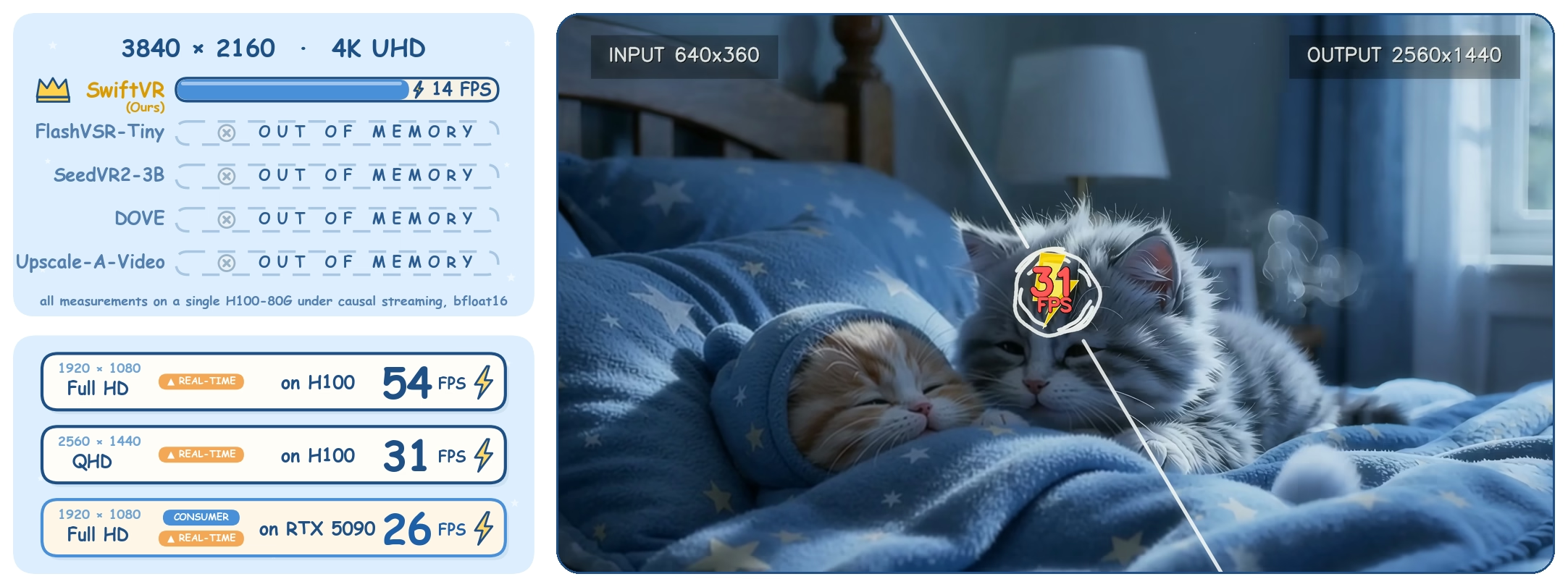
SwiftVR is the first generative video restoration model to reach real-time 1080p streaming on a consumer-grade GPU (≈26 FPS on a single RTX 5090), sustains 31 FPS at QHD (2560×1440) and 14 FPS at 4K (3840×2160) on a single H100, and streams at resolutions where every compared diffusion-based VR baseline runs out of memory.




Single H100, causal streaming, 24 frames.
| Metric | DOVE (tile) | SeedVR2-3B (tile) | FlashVSR-Tiny | SwiftVR (Ours) |
|---|---|---|---|---|
| Avg. Time (s) ↓ | 27.615 | 17.320 | 2.493 | 0.766 |
| FPS ↑ | 0.85 | 1.39 | 9.61 | 31.32 |
| Peak Mem. (GB) ↓ | 59.24 | 35.35 | 34.35 | 38.01 |
At 3840×2160, every compared diffusion-based VR baseline OOMs on a single H100; SwiftVR sustains 14 FPS.
git clone https://github.com/H-oliday/SwiftVR.git
cd SwiftVR

conda create -n swiftvr python=3.10 -y
conda activate swiftvr

# Install PyTorch matching your CUDA toolkit first, e.g. CUDA 12.4:
pip install torch==2.10.0 torchvision==0.25.0 --index-url https://download.pytorch.org/whl/cu124

# Install SwiftVR (editable) and its dependencies:
pip install -e .
| Model Name | Date | Backbone | Link |
|---|---|---|---|
| SwiftVR | 2026.06 | Wan2.2-TI2V-5B | 🤗 HuggingFace |
huggingface-cli download H-oliday/SwiftVR --local-dir checkpoints/
Expected checkpoint layout, where checkpoints/ is the directory passed to from_pretrained:
checkpoints/
├── reae.safetensors             # Restoration-aware Autoencoder weights
├── prompt_embedding.safetensors # precomputed empty-prompt text embedding, key: "prompt_emb"
└── transformer/                 # diffusers-format DiT
    ├── config.json
    └── diffusion_pytorch_model.safetensors
from swiftvr import SwiftVRPipeline

pipe = SwiftVRPipeline.from_pretrained("checkpoints/").to("cuda", dtype="bfloat16")

pipe.restore_video("low_quality.mp4", "restored.mp4", upscale=4)
restore_video also accepts an image folder as input and can write a PNG sequence with png_save=True.
Tunable knobs include:
clip_len: middle chunk size, multiple of 4dit_overlap: overlap for DiT inferencefps: output video frame ratequality: 0–100, mapped to x265 CRFqueue_size: pipeline queue sizeCausal, chunk-by-chunk restoration without future frames.
session = pipe.stream(clip_len=24, resolution=(1920, 1080))

for lq_chunk in read_chunks("low_quality.mp4", n=24):   # lq_chunk: [T, H, W, 3] uint8
    hq = session.step(lq_chunk)                         # [1, T', 3, H', W'] in [0, 1], or None if buffered
    if hq is not None:
        write(hq)

tail = session.flush()                                  # flush the final buffered frames
python scripts/inference.py \
  --input low_quality.mp4 \
  --output restored.mp4 \
  --checkpoint checkpoints/ \
  --upscale 4 \
  --clip-len 24 \
  --dtype bfloat16
Use --png to write a PNG sequence.
SwiftVR/
├── README.md
├── LICENSE
├── requirements.txt
├── setup.py
├── scripts/
│   └── inference.py              # CLI entry point, thin wrapper over SwiftVRPipeline
└── swiftvr/
    ├── __init__.py               # exports SwiftVRPipeline
    ├── pipeline.py               # SwiftVRPipeline: from_pretrained / to / restore_video / stream
    ├── runner.py                 # four-stage pipelined runner: reader → H2D → GPU → writer
    ├── io.py                     # frame reading, GPU preprocessing, mp4 / PNG writing
    ├── models/
    │   ├── reae.py               # Restoration-aware Autoencoder
    │   └── transformer.py        # DiT + mask-free shifted-window self-attention
    └── streaming/
        ├── chunk.py              # fixed-size causal chunk protocol
        ├── tae.py                # streaming autoencoder with causal boundary state
        └── dit.py                # one-step streaming DiT with fixed timestep and RoPE offsets
SwiftVR builds on Wan2.2-TI2V-5B, the lightweight autoencoder TAEHV, and the RealBasicVSR degradation pipeline.
We thank the authors of DOVE, SeedVR2, and FlashVSR for releasing strong baselines, and the UltraVideo team for the training corpus.
The source code in this GitHub repository is licensed under the Apache License 2.0. See the LICENSE file for details.
Copyright 2026 SwiftVR Authors.
Model weights are distributed separately through Hugging Face and are subject to the license included in the corresponding model repository and release.
The Apache License 2.0 applicable to the source code does not automatically apply to separately distributed model weights.
Commercial use of model weights released under the SwiftVR Research License requires prior written authorization from the SwiftVR authors.
For commercial licensing inquiries, please contact:
Historical versions remain subject to the license under which they were originally released. A later license change does not retroactively revoke rights previously granted.
If you have any questions, feel free to reach out:
427 followers · starred Jun 2026
416 followers · starred Jul 2026
Repo for SwiftVR: Real-Time One-Step Generative Video Restoration
Python
117
37 commits
updated Oct 10, 2026
SwiftVR is the first generative video restoration model to reach real-time 1080p streaming on a consumer-grade GPU (≈26 FPS on a single RTX 5090), sustains 31 FPS at QHD (2560×1440) and 14 FPS at 4K (3840×2160) on a single H100, and streams at resolutions where every compared diffusion-based VR baseline runs out of memory.
Single H100, causal streaming, 24 frames.
| Metric | DOVE (tile) | SeedVR2-3B (tile) | FlashVSR-Tiny | SwiftVR (Ours) |
|---|---|---|---|---|
| Avg. Time (s) ↓ | 27.615 | 17.320 | 2.493 | 0.766 |
| FPS ↑ | 0.85 | 1.39 | 9.61 | 31.32 |
| Peak Mem. (GB) ↓ | 59.24 | 35.35 | 34.35 | 38.01 |
At 3840×2160, every compared diffusion-based VR baseline OOMs on a single H100; SwiftVR sustains 14 FPS.
git clone https://github.com/H-oliday/SwiftVR.git
cd SwiftVR

conda create -n swiftvr python=3.10 -y
conda activate swiftvr

# Install PyTorch matching your CUDA toolkit first, e.g. CUDA 12.4:
pip install torch==2.10.0 torchvision==0.25.0 --index-url https://download.pytorch.org/whl/cu124

# Install SwiftVR (editable) and its dependencies:
pip install -e .
| Model Name | Date | Backbone | Link |
|---|---|---|---|
| SwiftVR | 2026.06 | Wan2.2-TI2V-5B | 🤗 HuggingFace |
huggingface-cli download H-oliday/SwiftVR --local-dir checkpoints/
Expected checkpoint layout, where checkpoints/ is the directory passed to from_pretrained:
checkpoints/
├── reae.safetensors             # Restoration-aware Autoencoder weights
├── prompt_embedding.safetensors # precomputed empty-prompt text embedding, key: "prompt_emb"
└── transformer/                 # diffusers-format DiT
    ├── config.json
    └── diffusion_pytorch_model.safetensors
from swiftvr import SwiftVRPipeline

pipe = SwiftVRPipeline.from_pretrained("checkpoints/").to("cuda", dtype="bfloat16")

pipe.restore_video("low_quality.mp4", "restored.mp4", upscale=4)
restore_video also accepts an image folder as input and can write a PNG sequence with png_save=True.
Tunable knobs include:
clip_len: middle chunk size, multiple of 4dit_overlap: overlap for DiT inferencefps: output video frame ratequality: 0–100, mapped to x265 CRFqueue_size: pipeline queue sizeCausal, chunk-by-chunk restoration without future frames.
session = pipe.stream(clip_len=24, resolution=(1920, 1080))

for lq_chunk in read_chunks("low_quality.mp4", n=24):   # lq_chunk: [T, H, W, 3] uint8
    hq = session.step(lq_chunk)                         # [1, T', 3, H', W'] in [0, 1], or None if buffered
    if hq is not None:
        write(hq)

tail = session.flush()                                  # flush the final buffered frames
python scripts/inference.py \
  --input low_quality.mp4 \
  --output restored.mp4 \
  --checkpoint checkpoints/ \
  --upscale 4 \
  --clip-len 24 \
  --dtype bfloat16
Use --png to write a PNG sequence.
SwiftVR/
├── README.md
├── LICENSE
├── requirements.txt
├── setup.py
├── scripts/
│   └── inference.py              # CLI entry point, thin wrapper over SwiftVRPipeline
└── swiftvr/
    ├── __init__.py               # exports SwiftVRPipeline
    ├── pipeline.py               # SwiftVRPipeline: from_pretrained / to / restore_video / stream
    ├── runner.py                 # four-stage pipelined runner: reader → H2D → GPU → writer
    ├── io.py                     # frame reading, GPU preprocessing, mp4 / PNG writing
    ├── models/
    │   ├── reae.py               # Restoration-aware Autoencoder
    │   └── transformer.py        # DiT + mask-free shifted-window self-attention
    └── streaming/
        ├── chunk.py              # fixed-size causal chunk protocol
        ├── tae.py                # streaming autoencoder with causal boundary state
        └── dit.py                # one-step streaming DiT with fixed timestep and RoPE offsets
SwiftVR builds on Wan2.2-TI2V-5B, the lightweight autoencoder TAEHV, and the RealBasicVSR degradation pipeline.
We thank the authors of DOVE, SeedVR2, and FlashVSR for releasing strong baselines, and the UltraVideo team for the training corpus.
The source code in this GitHub repository is licensed under the Apache License 2.0. See the LICENSE file for details.
Copyright 2026 SwiftVR Authors.
Model weights are distributed separately through Hugging Face and are subject to the license included in the corresponding model repository and release.
The Apache License 2.0 applicable to the source code does not automatically apply to separately distributed model weights.
Commercial use of model weights released under the SwiftVR Research License requires prior written authorization from the SwiftVR authors.
For commercial licensing inquiries, please contact:
Historical versions remain subject to the license under which they were originally released. A later license change does not retroactively revoke rights previously granted.
If you have any questions, feel free to reach out:
427 followers · starred Jun 2026
416 followers · starred Jul 2026