A desktop shell language and runtime where animation does not depend on logic. Rust, wgpu, layer-shell, SDF — an alternative to Quickshell.
Rust
114
431 commits
updated Oct 10, 2026







pleamar is a language and a Rust runtime for your desktop shell: bars, launchers, notification centres, docks, lock screens and widgets, written as scenes where every property is a spring and the animation never waits for the logic.
Install
Guide
Reference
pleamar-wm
Marea
Discord

examples/glass.plm, running: a clear lens, a plate that frosts itself where what is behind is busy, smoke and milk.
pleamar is a shell toolkit, like Quickshell. You write your bar, widgets and launchers with it, and they run on the compositor you already use — Hyprland, Sway, niri, KDE… No need to change anything else.
The other two are separate, and optional:
So if you are on Hyprland and just want a new bar, pleamar is all you need.
| Hyprland, Sway, niri, river, Wayfire, Labwc… | ✅ Its home: bars, panels and shells anchor to the screen (layer-shell) |
| KDE Plasma (Wayland) | ✅ Bars and shells work; what is Hyprland's own —its workspaces— does not |
| GNOME (Wayland) | ⚠️ Only scenes in a normal window: GNOME has no layer-shell, so a bar cannot anchor. pleamar-wm can be picked as a session next to it |
| pleamar-wm | ✅ A whole desktop of its own |
| X11 sessions | ❌ pleamar is for Wayland |
cell:) or pixel art kept sharp (pixels). Small games on the
desktop, in the same file as the bar.frost: auto
keeps it clear over something plain and frosts it where words or lines are
behind, smoke darkens it for white text, milk whitens it for dark text.thumbnails.live gives a window's picture as a texture that follows it, for
overviews and switchers that move.Every release, with what changed: Releases.
undefined at runtime.ext-session-lock, where the compositor guarantees nothing
else is seen while it lasts.
Marea, a whole shell in one scene: here she changes her skin to liquid glass.
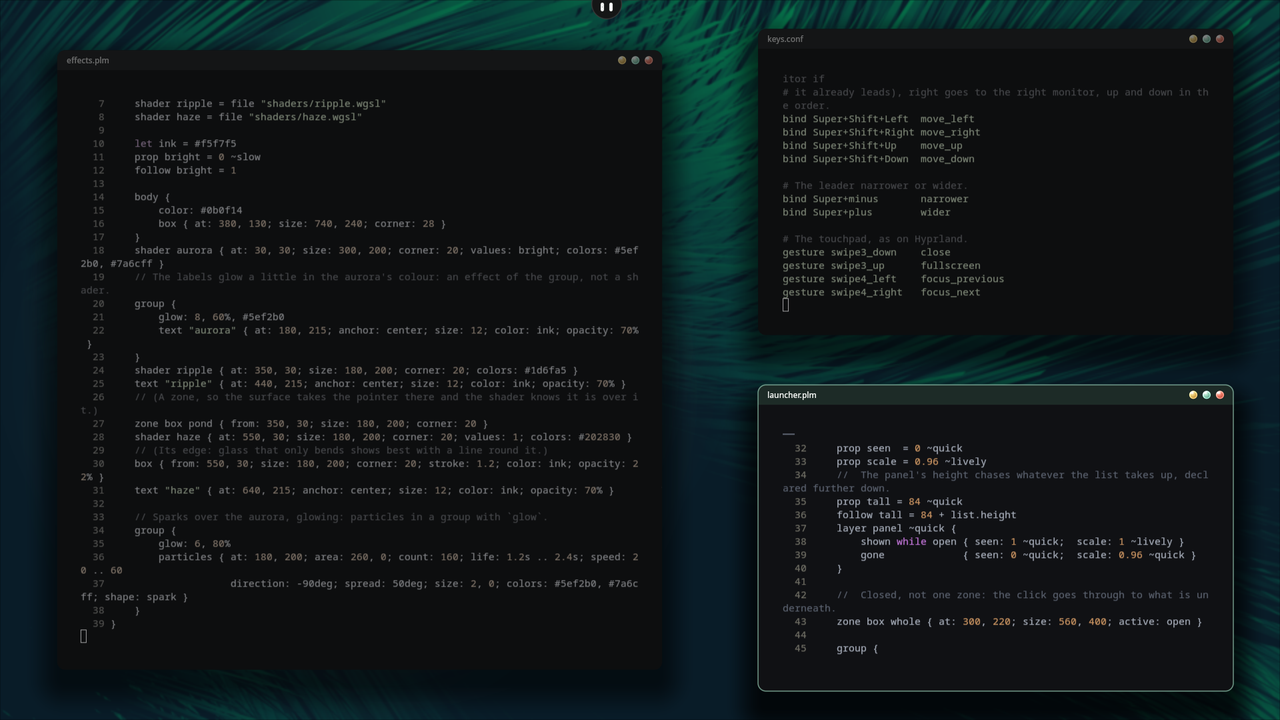
pleamar-wm with Marea: free windows, glass drop buttons, one scene each.
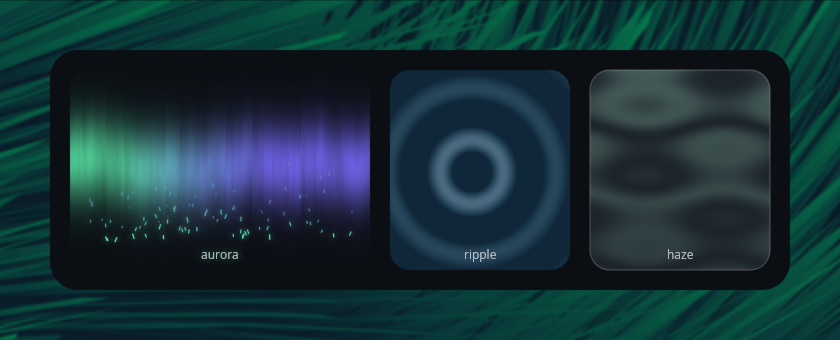
examples/effects.plm: a WGSL aurora with glowing particles, a ripple that follows the pointer, a heat haze.
One line installs pleamar, the pleamar-wm window manager and Marea in your home (nothing outside it), and keeps them up to date:
curl -fsSL https://raw.githubusercontent.com/k4ditano/pleamar/main/install.sh | sh
pleamar-update | new changes, built and put in place (it says what is new) |
pleamar-update --session | also pleamar-wm in the login screen (asks for sudo) |
pleamar-update --agent | AI agents may use your windows in pleamar-wm, with a cursor of their own |
pleamar-update --remote | this desktop from a browser elsewhere: a password and codes made, and pleamar-wm remote started with the session |
pleamar-update --uninstall | the programs go; your ~/.config/pleamar stays |
It tells you what your distribution is missing to build it (pacman, apt, dnf,
zypper) and offers to install it, builds in ~/.local/share/pleamar/src, puts
pleamar, pleamar-wm, pleamar-session, marea and pleamar-update in
~/.local/bin, and makes your ~/.config/pleamar the first time.
Everything of yours lives in ~/.config/pleamar/ — the folder for your
dotfiles: your shells (shells/), what starts with the desktop (autostart;
on Hyprland or any other compositor, exec-once = pleamar --autostart), and for
pleamar-wm its session.conf, keys.conf and your own wm/session.plm.
nix run github:k4ditano/pleamar -- --scene bar.plm
As a flake input (pleamar.url = "github:k4ditano/pleamar"): the package
(pleamar.packages.${system}.default, or pkgs.pleamar through
pleamar.overlays.default) and a home-manager module:
imports = [ inputs.pleamar.homeManagerModules.default ];
programs.pleamar = {
  enable = true;
  autostart = true;   # runs ~/.config/pleamar/autostart with your graphical session
};
The whole desktop (pleamar-wm with Marea, in your login screen) is pleamar-wm's NixOS module. With Nix on another distribution, graphical Nix programs need nixGL to reach your GPU driver.
The installer writes pleamar's skill for every agent it finds — Claude Code,
Codex, OpenCode — and it refreshes itself on every update. Ask one «make me a
bar with the time, the volume and my workspaces» and it knows the language,
where the file goes, how to start it with your desktop, and how to check it
(it compiles it, opens it without a screen and looks at the picture) before
saying it is done. pleamar --install-skill does it by hand;
pleamar --docs prints the documentation of the version you have.
And it can use the desktop. A second skill, pleamar-desktop, teaches it
pleamar-wm's agent hands (pleamar-update --agent, or agent on in
session.conf): ask «go to reddit and find my last post» and it looks at the
window, clicks and types with a mint cursor of its own, on a seat apart from
yours — your mouse and keyboard stay free, the monitor it works on glows while
it does, and it stops to ask before publishing, sending or buying anything.
language 0.1
scene Clock {
    surface { size: 240, 96; anchor: top; margin: 12 }
    permissions { services: "clock" }

    //  The time comes from the system: not a single line of logic here.
    service clock as now { time: text = "--:--"; date: text }

    prop hot = 0 ~quick

    body {
        color: #151616
        rim: 6%
        shadow: 0, 6, 18, 35%
        box { from: 0, 0; size: 240, 96; corner: 20 }
    }
    text now.time { at: 120, 44; anchor: center; size: 34; color: #f5f7f5 }
    text now.date { at: 120, 72; anchor: center; size: 12; color: #9ed6bd; opacity: 45% + hot * 55% }

    zone box whole { from: 0, 0; size: 240, 96; corner: 20 }
    on enter whole { hot: 1 }
    on leave whole { hot: 0 }
}
pleamar --scene clock.plm. Save the file and it reloads without losing
whatever was in motion; save it broken and the last good scene stays on screen,
with a band on top saying what does not compile and where. Rebuild pleamar itself and the
running one starts again with the same arguments.
cargo build --release
./target/release/pleamar --scene examples/bar.plm       # a bar: workspaces, window, time and volume
./target/release/pleamar --scene examples/long-list.plm # five thousand rows in sixteen copies
./target/release/pleamar --scene examples/paths.plm     # paths, curves and gradients
./target/release/pleamar --scene examples/window.plm     # a normal window, with its frame
./target/release/pleamar --scene examples/icons.plm      # the system tray; right-click opens an icon's menu
./target/release/pleamar --scene examples/settings.plm     # saves what you pick in its own folder
./target/release/pleamar --scene examples/tide.plm       # a night sea that rises: a shader, glass, svgs by layers
./target/release/pleamar --scene examples/catch.plm      # a small game: frames, keys, a game controller, sound
./target/release/pleamar --check examples/bar.plm    # reads it, says whether it is fine, exits
./run-tests.sh                                               # the language tests, and the examples in its reference
Options used daily: --screen A,B (which monitors), --say (talk to it from
outside, or from a compositor shortcut), --mouse "360,90@500 click@3200" (a
pretend mouse, to rehearse without touching the real one), --stall MS (stall
the logic on purpose and watch the screen carry on).
If something stutters on your machine, pleamar --report measures every scene
running for 30 seconds while you use the desktop, and writes down what it saw
—frame times, where the late frames went, the card, the CPU's clock and
temperature, what else took the CPU— in ~/pleamar-report-….md, with no personal
data. Send it to us in an issue.
The same bar, written twice: in Quickshell (proyecto-marea, 370 QML files) and
in pleamar (marea-plm, one .plm and one .luau). Both running at once, both
freshly started, same 60 Hz monitor, on an RTX 2060.
| Quickshell | pleamar | |
|---|---|---|
| real memory (PSS) | 336 MB | 81 MB |
| time to first frame | 1876 ms | 175 ms |
| frames per second while animating | ~24 | 60 |
| CPU per painted frame | 0.257 % | 0.083 % |
| CPU with nothing moving | never drops | 0.3 % |
| opening a panel | 6.2 % → 12.3 %, and 9.5 % after closing it | 4.4 % → 4.9 %, and back to 4.5 % |
On raw CPU, with both animating, the difference is 20 %: 4.96 % against 6.17 %. That is what it is, and it should be said before the pretty numbers. What changes the picture is that pleamar is painting two and a half times more frames while spending less, and that when nothing moves it sleeps.
The numbers, how they were taken and what to watch out for: marea-plm/MEDIDAS.md.
A .plm file is a scene: what is seen, and how it reacts.
surface { size: full, 44; anchor: top } | the window it asks for. Several per scene, and kind: window for a normal one |
fact open = false · text title = "…" | what the logic may report. Typed too: fact mode: low | normal | critical |
prop x = 360 ~calm | something that moves. Every property is a spring |
service audio { volume: number; muted: bool } | a system service, by name, with no logic |
model rows max 14 { label: text } · for r in rows { … } | a list the logic fills |
box, ellipse, arc, line, path, text, image, input | what gets drawn |
figure hat = file "hat.svg" | an svg as geometry: its layers are paths, so they melt, tint and turn |
body { color/gradient/rim/light/shadow } | several shapes melted into one silhouette |
row / column | layout, with gap, padding, alignment, view: to scroll and wrap: for a grid |
component Row(r: record) { … } | something to copy, with typed parameters and named slots |
on press hit { open = true } · every 2s { … } | rules, run by the renderer |
follow, blink, wave, spin, look | movement that carries itself |
layer, gesture, posture | who wins a slot, and timelines |
permissions { run: "date"; services: "audio" } | undeclared, the logic cannot |
The full reference, with its grammar and its checked examples, is in
docs/11-language-reference.md. To
start from zero, docs/guide.md; to copy and paste,
docs/recipes.md.
If there is a bar.luau next to bar.plm, that is its logic: Luau in a
sandbox, on its own thread, which the renderer never waits for. It can only cross
the boundary the scene declares — fact.open = true, text.title = …,
model.rows = {…}, emit, and listening with on(…) — plus timers, sys for
services and run for system commands, all behind permissions. Reference in
docs/10-luau-logic.md.
A library with its own .luau next to it is a plugin: its boundary lives
under its name (Clock.now), it runs on its own thread, and its permissions are
approved by whoever uses it, with pleamar --approve. Unapproved, it runs
touching nothing.
pleamar --lsp is a language server over stdio, with this same compiler behind
it: mistakes as you type, which words fit here, what the word under the cursor
means, go to where a name was declared, where it is used, and renaming it.
pleamar --highlight vim|vscode writes the syntax file straight from the
vocabulary, so it cannot fall behind. Both, already generated, in
editor/.
Three threads that never wait for each other: platform (windows and input), logic (Luau) and render (owner of the springs and the clock). Plus one per plugin, one per service, and a workshop thread for text and images.
language/ | From text to scene: tokens tokenises, tree groups without knowing what anything means, compiler gives it meaning and checks the names, vocabulary is the list of what exists |
scene.rs | The contract: properties, expressions, drawing instructions, rules, layers, gestures, zones, surfaces |
render.rs | The interpreter. Still, it does not paint a single frame |
gpu.rs · shape.wgsl | One quad per element; each pixel only runs the shapes of the element covering it |
shapes.rs | The geometry, written once, used three times: the GPU, the mouse and the bounding boxes |
logic_luau.rs | A scene's logic: Luau in a sandbox, with the boundary and nothing else |
text.rs | Real text (cosmic-text) and images (SVG, PNG, JPEG) in an atlas at the monitor's scale |
platform/ | The only part that knows about the system: Wayland, the services, files, the clock |
lsp.rs | The language server and the highlighters, both drawn from the vocabulary |
Measured against two real Quickshell configs (648 QML files between them), in
docs/07-whats-missing.md: a live view of a whole
screen inside the scene (windows come as thumbnails), input methods for Japanese
or Chinese, and list copies that are born and die on their own.
Known limitations, each one with its plan to fix it, in
docs/08-limitations.md. They are written down as
they show up, not at the end.
docs/guide.md | From zero to a bar, step by step |
docs/recipes.md | Patterns that already work, ready to copy |
docs/11-language-reference.md | The reference: grammar, types, every element and every property |
docs/10-luau-logic.md | What the logic can do, and what it cannot |
docs/07-whats-missing.md | Parity with Quickshell, told by real usage |
docs/08-limitations.md | Everything that fails or is missing, with its plan |
docs/02-how-it-works.md | Inside: the threads, the renderer, the why |
skill/ | The skill the installer gives your AI agents |
The working notes (01, 03–06, 09) are the design logbook: how this got here.
wgpu - For every pixel
Luau - For logic that can be sandboxed
cosmic-text - For real text
resvg - For reading svg
Smithay - For the compositor's protocol side
Quickshell - For showing what a desktop written in a language can be
Hyprland - For showing how good a desktop can feel
pleamar is under the BSD 3-Clause License, like Hyprland: use it,
change it, ship it, sell it — keep the copyright notice. Every dependency is
permissive (MIT, Apache-2.0, BSD-3-Clause, Zlib); THIRD-PARTY.md lists them,
and their notices travel with any binary you hand out.
Contributions are welcome, made with AI or without it: see the AI policy.
Made by @k4ditano — follow along on X for what comes next, and come and say hi, ask or show what you made on Discord. If it makes your desktop nicer, you can buy me a coffee on Ko-fi ☕
288 followers · starred Sep 2026
A desktop shell language and runtime where animation does not depend on logic. Rust, wgpu, layer-shell, SDF — an alternative to Quickshell.
Rust
114
431 commits
updated Oct 10, 2026
pleamar is a language and a Rust runtime for your desktop shell: bars, launchers, notification centres, docks, lock screens and widgets, written as scenes where every property is a spring and the animation never waits for the logic.
Install
Guide
Reference
pleamar-wm
Marea
Discord
examples/glass.plm, running: a clear lens, a plate that frosts itself where what is behind is busy, smoke and milk.
pleamar is a shell toolkit, like Quickshell. You write your bar, widgets and launchers with it, and they run on the compositor you already use — Hyprland, Sway, niri, KDE… No need to change anything else.
The other two are separate, and optional:
So if you are on Hyprland and just want a new bar, pleamar is all you need.
| Hyprland, Sway, niri, river, Wayfire, Labwc… | ✅ Its home: bars, panels and shells anchor to the screen (layer-shell) |
| KDE Plasma (Wayland) | ✅ Bars and shells work; what is Hyprland's own —its workspaces— does not |
| GNOME (Wayland) | ⚠️ Only scenes in a normal window: GNOME has no layer-shell, so a bar cannot anchor. pleamar-wm can be picked as a session next to it |
| pleamar-wm | ✅ A whole desktop of its own |
| X11 sessions | ❌ pleamar is for Wayland |
cell:) or pixel art kept sharp (pixels). Small games on the
desktop, in the same file as the bar.frost: auto
keeps it clear over something plain and frosts it where words or lines are
behind, smoke darkens it for white text, milk whitens it for dark text.thumbnails.live gives a window's picture as a texture that follows it, for
overviews and switchers that move.Every release, with what changed: Releases.
undefined at runtime.ext-session-lock, where the compositor guarantees nothing
else is seen while it lasts.
Marea, a whole shell in one scene: here she changes her skin to liquid glass.
pleamar-wm with Marea: free windows, glass drop buttons, one scene each.
examples/effects.plm: a WGSL aurora with glowing particles, a ripple that follows the pointer, a heat haze.
One line installs pleamar, the pleamar-wm window manager and Marea in your home (nothing outside it), and keeps them up to date:
curl -fsSL https://raw.githubusercontent.com/k4ditano/pleamar/main/install.sh | sh
pleamar-update | new changes, built and put in place (it says what is new) |
pleamar-update --session | also pleamar-wm in the login screen (asks for sudo) |
pleamar-update --agent | AI agents may use your windows in pleamar-wm, with a cursor of their own |
pleamar-update --remote | this desktop from a browser elsewhere: a password and codes made, and pleamar-wm remote started with the session |
pleamar-update --uninstall | the programs go; your ~/.config/pleamar stays |
It tells you what your distribution is missing to build it (pacman, apt, dnf,
zypper) and offers to install it, builds in ~/.local/share/pleamar/src, puts
pleamar, pleamar-wm, pleamar-session, marea and pleamar-update in
~/.local/bin, and makes your ~/.config/pleamar the first time.
Everything of yours lives in ~/.config/pleamar/ — the folder for your
dotfiles: your shells (shells/), what starts with the desktop (autostart;
on Hyprland or any other compositor, exec-once = pleamar --autostart), and for
pleamar-wm its session.conf, keys.conf and your own wm/session.plm.
nix run github:k4ditano/pleamar -- --scene bar.plm
As a flake input (pleamar.url = "github:k4ditano/pleamar"): the package
(pleamar.packages.${system}.default, or pkgs.pleamar through
pleamar.overlays.default) and a home-manager module:
imports = [ inputs.pleamar.homeManagerModules.default ];
programs.pleamar = {
  enable = true;
  autostart = true;   # runs ~/.config/pleamar/autostart with your graphical session
};
The whole desktop (pleamar-wm with Marea, in your login screen) is pleamar-wm's NixOS module. With Nix on another distribution, graphical Nix programs need nixGL to reach your GPU driver.
The installer writes pleamar's skill for every agent it finds — Claude Code,
Codex, OpenCode — and it refreshes itself on every update. Ask one «make me a
bar with the time, the volume and my workspaces» and it knows the language,
where the file goes, how to start it with your desktop, and how to check it
(it compiles it, opens it without a screen and looks at the picture) before
saying it is done. pleamar --install-skill does it by hand;
pleamar --docs prints the documentation of the version you have.
And it can use the desktop. A second skill, pleamar-desktop, teaches it
pleamar-wm's agent hands (pleamar-update --agent, or agent on in
session.conf): ask «go to reddit and find my last post» and it looks at the
window, clicks and types with a mint cursor of its own, on a seat apart from
yours — your mouse and keyboard stay free, the monitor it works on glows while
it does, and it stops to ask before publishing, sending or buying anything.
language 0.1
scene Clock {
    surface { size: 240, 96; anchor: top; margin: 12 }
    permissions { services: "clock" }

    //  The time comes from the system: not a single line of logic here.
    service clock as now { time: text = "--:--"; date: text }

    prop hot = 0 ~quick

    body {
        color: #151616
        rim: 6%
        shadow: 0, 6, 18, 35%
        box { from: 0, 0; size: 240, 96; corner: 20 }
    }
    text now.time { at: 120, 44; anchor: center; size: 34; color: #f5f7f5 }
    text now.date { at: 120, 72; anchor: center; size: 12; color: #9ed6bd; opacity: 45% + hot * 55% }

    zone box whole { from: 0, 0; size: 240, 96; corner: 20 }
    on enter whole { hot: 1 }
    on leave whole { hot: 0 }
}
pleamar --scene clock.plm. Save the file and it reloads without losing
whatever was in motion; save it broken and the last good scene stays on screen,
with a band on top saying what does not compile and where. Rebuild pleamar itself and the
running one starts again with the same arguments.
cargo build --release
./target/release/pleamar --scene examples/bar.plm       # a bar: workspaces, window, time and volume
./target/release/pleamar --scene examples/long-list.plm # five thousand rows in sixteen copies
./target/release/pleamar --scene examples/paths.plm     # paths, curves and gradients
./target/release/pleamar --scene examples/window.plm     # a normal window, with its frame
./target/release/pleamar --scene examples/icons.plm      # the system tray; right-click opens an icon's menu
./target/release/pleamar --scene examples/settings.plm     # saves what you pick in its own folder
./target/release/pleamar --scene examples/tide.plm       # a night sea that rises: a shader, glass, svgs by layers
./target/release/pleamar --scene examples/catch.plm      # a small game: frames, keys, a game controller, sound
./target/release/pleamar --check examples/bar.plm    # reads it, says whether it is fine, exits
./run-tests.sh                                               # the language tests, and the examples in its reference
Options used daily: --screen A,B (which monitors), --say (talk to it from
outside, or from a compositor shortcut), --mouse "360,90@500 click@3200" (a
pretend mouse, to rehearse without touching the real one), --stall MS (stall
the logic on purpose and watch the screen carry on).
If something stutters on your machine, pleamar --report measures every scene
running for 30 seconds while you use the desktop, and writes down what it saw
—frame times, where the late frames went, the card, the CPU's clock and
temperature, what else took the CPU— in ~/pleamar-report-….md, with no personal
data. Send it to us in an issue.
The same bar, written twice: in Quickshell (proyecto-marea, 370 QML files) and
in pleamar (marea-plm, one .plm and one .luau). Both running at once, both
freshly started, same 60 Hz monitor, on an RTX 2060.
| Quickshell | pleamar | |
|---|---|---|
| real memory (PSS) | 336 MB | 81 MB |
| time to first frame | 1876 ms | 175 ms |
| frames per second while animating | ~24 | 60 |
| CPU per painted frame | 0.257 % | 0.083 % |
| CPU with nothing moving | never drops | 0.3 % |
| opening a panel | 6.2 % → 12.3 %, and 9.5 % after closing it | 4.4 % → 4.9 %, and back to 4.5 % |
On raw CPU, with both animating, the difference is 20 %: 4.96 % against 6.17 %. That is what it is, and it should be said before the pretty numbers. What changes the picture is that pleamar is painting two and a half times more frames while spending less, and that when nothing moves it sleeps.
The numbers, how they were taken and what to watch out for: marea-plm/MEDIDAS.md.
A .plm file is a scene: what is seen, and how it reacts.
surface { size: full, 44; anchor: top } | the window it asks for. Several per scene, and kind: window for a normal one |
fact open = false · text title = "…" | what the logic may report. Typed too: fact mode: low | normal | critical |
prop x = 360 ~calm | something that moves. Every property is a spring |
service audio { volume: number; muted: bool } | a system service, by name, with no logic |
model rows max 14 { label: text } · for r in rows { … } | a list the logic fills |
box, ellipse, arc, line, path, text, image, input | what gets drawn |
figure hat = file "hat.svg" | an svg as geometry: its layers are paths, so they melt, tint and turn |
body { color/gradient/rim/light/shadow } | several shapes melted into one silhouette |
row / column | layout, with gap, padding, alignment, view: to scroll and wrap: for a grid |
component Row(r: record) { … } | something to copy, with typed parameters and named slots |
on press hit { open = true } · every 2s { … } | rules, run by the renderer |
follow, blink, wave, spin, look | movement that carries itself |
layer, gesture, posture | who wins a slot, and timelines |
permissions { run: "date"; services: "audio" } | undeclared, the logic cannot |
The full reference, with its grammar and its checked examples, is in
docs/11-language-reference.md. To
start from zero, docs/guide.md; to copy and paste,
docs/recipes.md.
If there is a bar.luau next to bar.plm, that is its logic: Luau in a
sandbox, on its own thread, which the renderer never waits for. It can only cross
the boundary the scene declares — fact.open = true, text.title = …,
model.rows = {…}, emit, and listening with on(…) — plus timers, sys for
services and run for system commands, all behind permissions. Reference in
docs/10-luau-logic.md.
A library with its own .luau next to it is a plugin: its boundary lives
under its name (Clock.now), it runs on its own thread, and its permissions are
approved by whoever uses it, with pleamar --approve. Unapproved, it runs
touching nothing.
pleamar --lsp is a language server over stdio, with this same compiler behind
it: mistakes as you type, which words fit here, what the word under the cursor
means, go to where a name was declared, where it is used, and renaming it.
pleamar --highlight vim|vscode writes the syntax file straight from the
vocabulary, so it cannot fall behind. Both, already generated, in
editor/.
Three threads that never wait for each other: platform (windows and input), logic (Luau) and render (owner of the springs and the clock). Plus one per plugin, one per service, and a workshop thread for text and images.
language/ | From text to scene: tokens tokenises, tree groups without knowing what anything means, compiler gives it meaning and checks the names, vocabulary is the list of what exists |
scene.rs | The contract: properties, expressions, drawing instructions, rules, layers, gestures, zones, surfaces |
render.rs | The interpreter. Still, it does not paint a single frame |
gpu.rs · shape.wgsl | One quad per element; each pixel only runs the shapes of the element covering it |
shapes.rs | The geometry, written once, used three times: the GPU, the mouse and the bounding boxes |
logic_luau.rs | A scene's logic: Luau in a sandbox, with the boundary and nothing else |
text.rs | Real text (cosmic-text) and images (SVG, PNG, JPEG) in an atlas at the monitor's scale |
platform/ | The only part that knows about the system: Wayland, the services, files, the clock |
lsp.rs | The language server and the highlighters, both drawn from the vocabulary |
Measured against two real Quickshell configs (648 QML files between them), in
docs/07-whats-missing.md: a live view of a whole
screen inside the scene (windows come as thumbnails), input methods for Japanese
or Chinese, and list copies that are born and die on their own.
Known limitations, each one with its plan to fix it, in
docs/08-limitations.md. They are written down as
they show up, not at the end.
docs/guide.md | From zero to a bar, step by step |
docs/recipes.md | Patterns that already work, ready to copy |
docs/11-language-reference.md | The reference: grammar, types, every element and every property |
docs/10-luau-logic.md | What the logic can do, and what it cannot |
docs/07-whats-missing.md | Parity with Quickshell, told by real usage |
docs/08-limitations.md | Everything that fails or is missing, with its plan |
docs/02-how-it-works.md | Inside: the threads, the renderer, the why |
skill/ | The skill the installer gives your AI agents |
The working notes (01, 03–06, 09) are the design logbook: how this got here.
wgpu - For every pixel
Luau - For logic that can be sandboxed
cosmic-text - For real text
resvg - For reading svg
Smithay - For the compositor's protocol side
Quickshell - For showing what a desktop written in a language can be
Hyprland - For showing how good a desktop can feel
pleamar is under the BSD 3-Clause License, like Hyprland: use it,
change it, ship it, sell it — keep the copyright notice. Every dependency is
permissive (MIT, Apache-2.0, BSD-3-Clause, Zlib); THIRD-PARTY.md lists them,
and their notices travel with any binary you hand out.
Contributions are welcome, made with AI or without it: see the AI policy.
Made by @k4ditano — follow along on X for what comes next, and come and say hi, ask or show what you made on Discord. If it makes your desktop nicer, you can buy me a coffee on Ko-fi ☕
288 followers · starred Sep 2026





