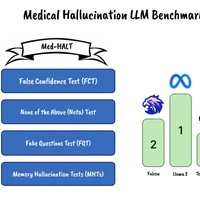
MedHall-Bench is a field-grounded hallucination detection benchmark for medical AI assistants. It decomposes each clinical response into verifiable structured fields (dose value, unit, reference range, ICD/LOINC code, entity relation, ...) and evaluates AI outputs via per-field programmatic matching in addition to sentence-level LLM-as-Judge. Designed for use with the HolyEval framework.
⚠️ Research use only. Content is for benchmarking AI agents and should not be used for diagnosis or treatment decisions.
A single clinical sentence can embed many independently-lethal structured fields. Existing hallucination benchmarks (HaluBench, FActScore, HALoGEN) treat each sentence as one claim and produce a single correctness score, losing the ability to localize which field went wrong. MedHall-Bench drills hallucination evaluation down to the field level across numerical, unit, code, temporal, reference-range, structural, and entity-relation dimensions — enabling field-level localization, programmatic verification, and weighted scoring of lethal errors.
112 cases across 5 hallucination types:
| Type | Description | Cases |
|---|---|---|
factual | Medical facts (dose / contraindication / diagnostic criteria) — LLM-as-Judge | 12 |
contextual | Fabricated information not present in the patient record — LLM-as-Judge + user-data cross-check | 15 |
citation | Non-existent guidelines / papers — LLM-as-Judge + PubMed / CrossRef API | 10 |
numerical | Numerical value + unit + reference-range hallucinations (D1+D2+D5) — programmatic field match | 33 |
relational | Code / temporal / structural / entity-relation hallucinations (D3+D4+D6+D7) — programmatic field match | 42 |
├── manifest.json                                # Change-detection entry point
├── README.md
└── data/
    └── 202604/
        ├── full-20260420.jsonl                  # All 112 cases
        ├── factual-20260420.jsonl               # Per-type splits
        ├── contextual-20260420.jsonl
        ├── citation-20260420.jsonl
        ├── numerical-20260420.jsonl
        ├── relational-20260420.jsonl
        └── <email_id>/                          # Virtual user (e.g. user110_AT_demo)
            ├── profile.json                     # Demographics, history, family history
            ├── exam_data.json                   # Clinical exam records
            └── timeline.json                    # Event + indicator timeline
Contextual cases reference 20 virtual users. Each case's user.target_overrides.*.email field points to the corresponding user directory. User data is included in this repository — no external dataset required.
Each JSONL line is a BenchItem compatible with the HolyEval framework:
{
  "id": "dh_d1_0000",
  "title": "...",
  "description": "...",
  "user": {
    "type": "manual",
    "strict_inputs": ["..."],
    "target_overrides": { "theta_api": { "email": "user110@demo" } }
  },
  "eval": {
    "evaluator": "hallucination",
    "categories": ["data_hallucination"],
    "data_hallu_type": "d1_numerical",
    "context": "...",
    "ground_truth_fields": [ { "field_name": "...", "expected_value": "...", "expected_unit": "...", "verification": "numeric_tolerance", "tolerance": 0.1 } ],
    "known_facts": ["..."],
    "threshold": 0.7
  },
  "tags": ["hallu_type:numerical", "subtype:d1_numerical", "difficulty:l1"]
}
Scored by the hallucination evaluator in HolyEval, which routes by type:
threshold)ground_truth_fields (numeric tolerance, unit normalization, code whitelist, date equality, etc.)Citation cases additionally use NCBI PubMed/PMC + CrossRef DOI + DuckDuckGo multi-source verification (30% API weight + 70% LLM weight).
from huggingface_hub import snapshot_download

path = snapshot_download(repo_id="healthmemoryarena/MedHall-Bench", repo_type="dataset")
# path/manifest.json, path/data/202604/...
from huggingface_hub import hf_hub_download

p = hf_hub_download(
    repo_id="healthmemoryarena/MedHall-Bench",
    filename="data/202604/numerical-20260420.jsonl",
    repo_type="dataset",
)
# Place dataset under benchmark/data/medhall/ (already mirrored in the HolyEval repo)
python -m benchmark.basic_runner medhall full-20260420 --target-model gpt-4.1
python -m benchmark.basic_runner medhall contextual-20260420 --target-type theta_api
Apache 2.0
@software{holyeval,
  title = {HolyEval: Virtual User Evaluation Framework for Medical AI Assistants},
  author = {Theta Health},
  url = {https://github.com/healthmemoryarena/holyeval},
  year = {2026}
}
MedHall-Bench is a field-grounded hallucination detection benchmark for medical AI assistants. It decomposes each clinical response into verifiable structured fields (dose value, unit, reference range, ICD/LOINC code, entity relation, ...) and evaluates AI outputs via per-field programmatic matching in addition to sentence-level LLM-as-Judge. Designed for use with the HolyEval framework.
⚠️ Research use only. Content is for benchmarking AI agents and should not be used for diagnosis or treatment decisions.
A single clinical sentence can embed many independently-lethal structured fields. Existing hallucination benchmarks (HaluBench, FActScore, HALoGEN) treat each sentence as one claim and produce a single correctness score, losing the ability to localize which field went wrong. MedHall-Bench drills hallucination evaluation down to the field level across numerical, unit, code, temporal, reference-range, structural, and entity-relation dimensions — enabling field-level localization, programmatic verification, and weighted scoring of lethal errors.
112 cases across 5 hallucination types:
| Type | Description | Cases |
|---|---|---|
factual | Medical facts (dose / contraindication / diagnostic criteria) — LLM-as-Judge | 12 |
contextual | Fabricated information not present in the patient record — LLM-as-Judge + user-data cross-check | 15 |
citation | Non-existent guidelines / papers — LLM-as-Judge + PubMed / CrossRef API | 10 |
numerical | Numerical value + unit + reference-range hallucinations (D1+D2+D5) — programmatic field match | 33 |
relational | Code / temporal / structural / entity-relation hallucinations (D3+D4+D6+D7) — programmatic field match | 42 |
├── manifest.json                                # Change-detection entry point
├── README.md
└── data/
    └── 202604/
        ├── full-20260420.jsonl                  # All 112 cases
        ├── factual-20260420.jsonl               # Per-type splits
        ├── contextual-20260420.jsonl
        ├── citation-20260420.jsonl
        ├── numerical-20260420.jsonl
        ├── relational-20260420.jsonl
        └── <email_id>/                          # Virtual user (e.g. user110_AT_demo)
            ├── profile.json                     # Demographics, history, family history
            ├── exam_data.json                   # Clinical exam records
            └── timeline.json                    # Event + indicator timeline
Contextual cases reference 20 virtual users. Each case's user.target_overrides.*.email field points to the corresponding user directory. User data is included in this repository — no external dataset required.
Each JSONL line is a BenchItem compatible with the HolyEval framework:
{
  "id": "dh_d1_0000",
  "title": "...",
  "description": "...",
  "user": {
    "type": "manual",
    "strict_inputs": ["..."],
    "target_overrides": { "theta_api": { "email": "user110@demo" } }
  },
  "eval": {
    "evaluator": "hallucination",
    "categories": ["data_hallucination"],
    "data_hallu_type": "d1_numerical",
    "context": "...",
    "ground_truth_fields": [ { "field_name": "...", "expected_value": "...", "expected_unit": "...", "verification": "numeric_tolerance", "tolerance": 0.1 } ],
    "known_facts": ["..."],
    "threshold": 0.7
  },
  "tags": ["hallu_type:numerical", "subtype:d1_numerical", "difficulty:l1"]
}
Scored by the hallucination evaluator in HolyEval, which routes by type:
threshold)ground_truth_fields (numeric tolerance, unit normalization, code whitelist, date equality, etc.)Citation cases additionally use NCBI PubMed/PMC + CrossRef DOI + DuckDuckGo multi-source verification (30% API weight + 70% LLM weight).
from huggingface_hub import snapshot_download

path = snapshot_download(repo_id="healthmemoryarena/MedHall-Bench", repo_type="dataset")
# path/manifest.json, path/data/202604/...
from huggingface_hub import hf_hub_download

p = hf_hub_download(
    repo_id="healthmemoryarena/MedHall-Bench",
    filename="data/202604/numerical-20260420.jsonl",
    repo_type="dataset",
)
# Place dataset under benchmark/data/medhall/ (already mirrored in the HolyEval repo)
python -m benchmark.basic_runner medhall full-20260420 --target-model gpt-4.1
python -m benchmark.basic_runner medhall contextual-20260420 --target-type theta_api
Apache 2.0
@software{holyeval,
  title = {HolyEval: Virtual User Evaluation Framework for Medical AI Assistants},
  author = {Theta Health},
  url = {https://github.com/healthmemoryarena/holyeval},
  year = {2026}
}