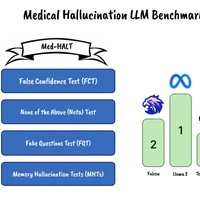
A comparison of hallucination checkers on medical RAG answers. Each checker reads a question, the retrieved documents and the answer, and gives a probability that the answer says something the documents don't support. All of them are scored on the same rows of three public datasets. The checkers include TypeSafe's Jev, two open models of the same kind, open-weight verifiers, LLMs used as judges with and without reasoning, the grounding checks sold by AWS and Google, and two trivial references.
I started it while adding claim verification to ebm-lens, which now uses Jev, but nothing here imports from that project. The write-up is at https://mauroforlin.github.io/rag-hallu-bench/.
An answer is counted as hallucinated when it states something the retrieved documents don't, even if it is medically correct. The test is about faithfulness to the documents and says nothing about whether the documents are right. MedHallu partly mixes in correctness, as noted below.
hallubench build-data writes data/examples.jsonl, 5,246 rows from three datasets pinned to exact Hub revisions and sampled with a fixed seed, so every machine builds the same file. The command prints its sha256 (df950765b366f89c) for checking.
| Dataset | Rows | Answers | Labels | Caveats |
|---|---|---|---|---|
| RAGBench PubMedQA + CovidQA-RAG | 1,000 + 246 | GPT-3.5 and Claude 3 Haiku answering over retrieved passages, the closest thing here to production RAG output | GPT-4-turbo / GPT-4o, sentence by sentence | Labels come from a model, which may favour judges that behave like GPT-4. PubMedQA answers each question twice, once per generator, and both answers share a split and a bootstrap group. RAGBench also ships precomputed RAGAS and TruLens scores |
| HaluBench PubMedQA + CovidQA | 1,000 + 1,000 | Gold answers plus answers rewritten to be plausible but unfaithful | Derived from the source QA datasets | Easy for the strongest checkers, which score 0.95-0.99. Lynx was trained on these sources. In CovidQA about half the answers share their question with another answer |
| MedHallu pqa_labeled | 2,000 (1,000 questions, gold + hallucinated) | PubMedQA gold answers and generated hallucinations, graded easy, medium or hard | Generation pipeline with verification | The gold answer is the abstract's conclusion and the passages are the rest of the abstract, so a gold answer can say more than its passages. Wrong answers are also shorter than gold ones (length alone gives AUROC 0.745). BioDecision was trained on MedHallu's generated split |
Each dataset is split 70/30 into test and dev by a hash of the question, so every answer to the same question lands on the same side: MedHallu's gold/hallucinated pairs, RAGBench's two answers to one question, and HaluBench-CovidQA's faithful and rewritten answers, which have no question ID and are grouped by the question's text. A stratified core slice of about 1,000 rows (19% of each dataset, split and label) is used for the calibration numbers and the prompt ablation.
The Healthcare / Medicine part of ExpertQA (702 claims, each rated by a medical professional) would be the only human-labelled set here. Its loader is in data.py but switched off (INCLUDE_EXPERTQA = False). Every checker scored close to chance on it (AUROC about 0.50), much as every model does on the ExpertQA column of LLM-AggreFact. The stored evidence is an 80-190 word fragment of each page. For 7 of 16 claims that the experts marked as supported and Jev did not, I recovered the full 2023 page from the Wayback Machine, and Jev still found all 7 unsupported. I checked one of them by hand and the page doesn't say what the claim says. The sample is small, but it suggests some ratings follow medical correctness more than support by the cited page.
Every checker outputs one number per row, P(hallucinated) between 0 and 1, and each one's docstring explains how its native output is mapped to it. They are grouped by where the number comes from.
Computed by a model built to return probabilities:
| Name | What it is | Runs on |
|---|---|---|
jev-choice | TypeSafe Jev (jev-1.13.0), one Choice over the whole answer (faithful / unsupported / contradicted), score 1 - P(faithful) | API |
jev-noul | Jev, one Noul asking whether the answer contains anything the documents don't back | API |
jev-sentences | Jev, one Choice per answer sentence (supports / contradicts / says nothing) in a single request, answer scored by its worst sentence | API |
laya | Open decision model of the same kind (Convai, 0.4B encoder, Apache-2.0), asked Jev's exact questions | CPU / GPU |
biodecision-v2-4b | Open medical decision model (Qwen3.5-4B, Together's Tev1 recipe, 1.75M biomedical decisions), asked Jev's exact questions through its authors' server code. Trained on MedHallu/HaluBench-related data, so in-distribution there and clean on RAGBench | GPU |
Computed from token probabilities or a classifier head, by models not trained to calibrate them:
| Name | What it is | Runs on |
|---|---|---|
judge-logprob-qwen3-235b | Qwen3-235B-A22B-Instruct-2507 answering yes or no, score P(no) from its token probabilities. Pinned to one provider (Google Vertex) so every row is judged by the same deployment | API |
hhem | Vectara HHEM-2.1-Open, T5 consistency classifier | CPU / GPU |
minicheck-ft5, minicheck-deberta | MiniCheck (EMNLP 2024) sentence-level checkers, reimplemented from the reference code | CPU / GPU |
alignscore-large | AlignScore (ACL 2023), the RoBERTa-large checkpoint NVIDIA NeMo Guardrails uses, reimplemented from the reference code in its documented nli_sp mode | CPU / GPU |
lettucedetect-large | ModernBERT token classifier trained on RAGTruth, marks the unsupported words | CPU / GPU |
bespoke-minicheck-7b | The strongest MiniCheck model on LLM-AggreFact, read as P(Yes) per sentence | GPU ≥ 24 GB |
granite-guardian-8b | IBM Granite Guardian 3.3, groundedness risk read as P(yes) at the verdict token. It gives "yes" and "no" the same weight, to the precision it runs at, on 26 rows, which therefore sit at 0.5 | GPU ≥ 24 GB |
lynx-8b | Patronus Lynx v1.1, which writes its reasoning before PASS/FAIL, read as P(FAIL) at the verdict token | GPU ≥ 24 GB |
Written by the model as text:
| Name | What it is | Runs on |
|---|---|---|
judge-qwen3-235b | The same Qwen3-235B on the same provider, asked for a JSON verdict with a self-reported confidence like the judges below, so the two Qwen rows differ only in how the number is read | API |
judge-gpt-6-luna | OpenAI GPT-6 Luna as judge, JSON verdict with a self-reported confidence | API |
judge-gpt-5.6-luna | The same prompt on the previous Luna generation | API |
judge-gemini-2.5-flash | The same prompt on Gemini 2.5 Flash with reasoning off | API |
judge-claude-haiku-5.5-thinking | The same prompt on Claude Haiku 5.5 with reasoning on. Anthropic's content filter declines 9 rows (virology, infections), which stay unscored, so its coverage is 99.8% | API |
judge-gemini-3.8-flash-thinking | The same prompt on Gemini 3.8 Flash with reasoning on, RAGBench rows only for cost | API |
ragas-faithfulness, trulens-groundedness | LLM-as-judge pipelines precomputed by the RAGBench authors, RAGBench rows only. The score is a share of supported statements and not a probability | free |
Sold by cloud providers:
| Name | What it is | Runs on |
|---|---|---|
bedrock-contextual-grounding | AWS Bedrock Guardrails' contextual grounding check through the ApplyGuardrail API, given the documents, the question and the answer, score 1 - grounding. Billed per 1,000 characters | AWS |
vertex-check-grounding | Google's Check Grounding API (Vertex AI Search), given the documents (cut into facts of up to 10,000 characters) and the answer, which is all it accepts, score 1 - support. When it finds no claim worth checking it returns no score and flags nothing, and those 110 rows are graded as not flagged (macro AUROC 0.746; 0.761 leaving them out, 0.757 scoring them 0.5) | Google Cloud |
Trivial references, graded like the checkers but kept out of the comparisons with Jev:
| Name | What it is |
|---|---|
baseline-length | The answer's length in words |
baseline-novel-words | The share of the answer's content words that never appear in the documents |
A surface feature can point either way (MedHallu's wrong answers are shorter, RAGBench's longer), so each reference takes its direction from the dev rows of each dataset, the way the checkers take their thresholds.
The LLM judges and the Jev-style models get the same three-way rubric. Qwen3-235B is run both ways, once read through its token probabilities and once writing its confidence, so for that model the effect of the method can be separated from the effect of the model. For the other judges the two still go together.
acting in metrics.json recomputes both at 5, 10 and 20% from each checker's hit rates with Bayes' rule, with intervals. These pool all five datasets; docs/data.json also has them on RAGBench alone (acting_ragbench).ablation, kept out of the main table).results/rerun1/, hallubench compare-runs).run --workers 1 into results/latency/): over the network from Italy for the API checkers, on a Colab A100 for the open ones. The two cloud checks were timed only inside the main parallel run.The scores every checker gave every row are attached to the v1.0 release as scores.zip. With them, every number in the article can be rebuilt without calling any model:
pip install -e .
hallubench reproduce          # download scores.zip, rebuild the rows, grade, compare with docs/data.json
It ends by saying whether every number in docs/data.json came out the same. NumPy doesn't promise the same random streams across versions, so for an exact match install the analysis libraries at the versions in requirements-lock.txt (pip install numpy==2.5.4 scipy==1.18.1 scikit-learn==1.9.1), as notebooks/reproduce.ipynb does on a free Colab runtime.
The article is docs/article.src.html plus docs/data.json. hallubench article regenerates data.json from results/report/, and python docs/build.py builds index.html for GitHub Pages.
python -m venv .venv && .venv/Scripts/activate      # or source .venv/bin/activate
pip install -e ".[jev,local,cloud]" --extra-index-url https://pypi.typesafe.ai/simple/
cp .env.example .env                                  # keys, see below

hallubench build-data                                 # check the printed sha256
hallubench list
hallubench run jev-choice --limit 20                  # smoke test
hallubench run --where api                            # Jev, LLM judges, cloud checks, precomputed
hallubench evaluate                                   # table + results/report/metrics.json
hallubench article                                    # docs/data.json
.env takes OPENROUTER_API_KEY (LLM judges) and TYPESAFE_KEY (Jev); for the cloud checks, AWS_ACCESS_KEY_ID, AWS_SECRET_ACCESS_KEY and AWS_REGION (an IAM user with Bedrock access; the guardrail is created on first use), and GCP_PROJECT with a service-account key in gcp-key.json (role Discovery Engine Editor, Discovery Engine API enabled). The AWS check cost about $2.84 on all rows and Google's well under a cent; the API checkers cost from $0.07 (Jev) to $2.07 (Gemini 3.8 Flash with reasoning) per 1,000 answers.
Runs can be resumed and append to results/raw/<detector>.jsonl, one line per row. Useful flags are --core (core slice only), --datasets ..., --workers N (concurrency for API checkers, batch size for local ones) and --only-errors (retry failed rows without extending a run). Setting HALLUBENCH_RAW to another folder keeps smoke tests apart from real results. The API models and both cloud checks can change behind the same name, so a rerun may not match the published scores exactly.
The open models run in notebooks/colab_gpu.ipynb on an A100. Run all skips every checker already complete on Drive, tries each missing one on 20 rows and stops if those look wrong, then runs it in full; copy the .jsonl files it lists into results/raw/ and run hallubench evaluate again, since runs merge by row ID.
The code is MIT. The datasets keep their own licences: RAGBench is CC-BY-4.0, HaluBench CC-BY-NC-2.0 and ExpertQA MIT, while MedHallu declares none on its Hub card. No data is committed, build-data downloads it from the sources. The released scores hold ids, scores and the checkers' own outputs, and the generative judges' outputs can quote passages from the datasets, so the datasets' licences apply to those too. Among the models, HHEM-2.1-Open, Granite Guardian and Laya are Apache-2.0, AlignScore and LettuceDetect are MIT, Lynx and Bespoke-MiniCheck-7B are CC-BY-NC-4.0 and BioDecision v2 is research-only. They are used here for research.
A comparison of hallucination checkers on medical RAG answers. Each checker reads a question, the retrieved documents and the answer, and gives a probability that the answer says something the documents don't support. All of them are scored on the same rows of three public datasets. The checkers include TypeSafe's Jev, two open models of the same kind, open-weight verifiers, LLMs used as judges with and without reasoning, the grounding checks sold by AWS and Google, and two trivial references.
I started it while adding claim verification to ebm-lens, which now uses Jev, but nothing here imports from that project. The write-up is at https://mauroforlin.github.io/rag-hallu-bench/.
An answer is counted as hallucinated when it states something the retrieved documents don't, even if it is medically correct. The test is about faithfulness to the documents and says nothing about whether the documents are right. MedHallu partly mixes in correctness, as noted below.
hallubench build-data writes data/examples.jsonl, 5,246 rows from three datasets pinned to exact Hub revisions and sampled with a fixed seed, so every machine builds the same file. The command prints its sha256 (df950765b366f89c) for checking.
| Dataset | Rows | Answers | Labels | Caveats |
|---|---|---|---|---|
| RAGBench PubMedQA + CovidQA-RAG | 1,000 + 246 | GPT-3.5 and Claude 3 Haiku answering over retrieved passages, the closest thing here to production RAG output | GPT-4-turbo / GPT-4o, sentence by sentence | Labels come from a model, which may favour judges that behave like GPT-4. PubMedQA answers each question twice, once per generator, and both answers share a split and a bootstrap group. RAGBench also ships precomputed RAGAS and TruLens scores |
| HaluBench PubMedQA + CovidQA | 1,000 + 1,000 | Gold answers plus answers rewritten to be plausible but unfaithful | Derived from the source QA datasets | Easy for the strongest checkers, which score 0.95-0.99. Lynx was trained on these sources. In CovidQA about half the answers share their question with another answer |
| MedHallu pqa_labeled | 2,000 (1,000 questions, gold + hallucinated) | PubMedQA gold answers and generated hallucinations, graded easy, medium or hard | Generation pipeline with verification | The gold answer is the abstract's conclusion and the passages are the rest of the abstract, so a gold answer can say more than its passages. Wrong answers are also shorter than gold ones (length alone gives AUROC 0.745). BioDecision was trained on MedHallu's generated split |
Each dataset is split 70/30 into test and dev by a hash of the question, so every answer to the same question lands on the same side: MedHallu's gold/hallucinated pairs, RAGBench's two answers to one question, and HaluBench-CovidQA's faithful and rewritten answers, which have no question ID and are grouped by the question's text. A stratified core slice of about 1,000 rows (19% of each dataset, split and label) is used for the calibration numbers and the prompt ablation.
The Healthcare / Medicine part of ExpertQA (702 claims, each rated by a medical professional) would be the only human-labelled set here. Its loader is in data.py but switched off (INCLUDE_EXPERTQA = False). Every checker scored close to chance on it (AUROC about 0.50), much as every model does on the ExpertQA column of LLM-AggreFact. The stored evidence is an 80-190 word fragment of each page. For 7 of 16 claims that the experts marked as supported and Jev did not, I recovered the full 2023 page from the Wayback Machine, and Jev still found all 7 unsupported. I checked one of them by hand and the page doesn't say what the claim says. The sample is small, but it suggests some ratings follow medical correctness more than support by the cited page.
Every checker outputs one number per row, P(hallucinated) between 0 and 1, and each one's docstring explains how its native output is mapped to it. They are grouped by where the number comes from.
Computed by a model built to return probabilities:
| Name | What it is | Runs on |
|---|---|---|
jev-choice | TypeSafe Jev (jev-1.13.0), one Choice over the whole answer (faithful / unsupported / contradicted), score 1 - P(faithful) | API |
jev-noul | Jev, one Noul asking whether the answer contains anything the documents don't back | API |
jev-sentences | Jev, one Choice per answer sentence (supports / contradicts / says nothing) in a single request, answer scored by its worst sentence | API |
laya | Open decision model of the same kind (Convai, 0.4B encoder, Apache-2.0), asked Jev's exact questions | CPU / GPU |
biodecision-v2-4b | Open medical decision model (Qwen3.5-4B, Together's Tev1 recipe, 1.75M biomedical decisions), asked Jev's exact questions through its authors' server code. Trained on MedHallu/HaluBench-related data, so in-distribution there and clean on RAGBench | GPU |
Computed from token probabilities or a classifier head, by models not trained to calibrate them:
| Name | What it is | Runs on |
|---|---|---|
judge-logprob-qwen3-235b | Qwen3-235B-A22B-Instruct-2507 answering yes or no, score P(no) from its token probabilities. Pinned to one provider (Google Vertex) so every row is judged by the same deployment | API |
hhem | Vectara HHEM-2.1-Open, T5 consistency classifier | CPU / GPU |
minicheck-ft5, minicheck-deberta | MiniCheck (EMNLP 2024) sentence-level checkers, reimplemented from the reference code | CPU / GPU |
alignscore-large | AlignScore (ACL 2023), the RoBERTa-large checkpoint NVIDIA NeMo Guardrails uses, reimplemented from the reference code in its documented nli_sp mode | CPU / GPU |
lettucedetect-large | ModernBERT token classifier trained on RAGTruth, marks the unsupported words | CPU / GPU |
bespoke-minicheck-7b | The strongest MiniCheck model on LLM-AggreFact, read as P(Yes) per sentence | GPU ≥ 24 GB |
granite-guardian-8b | IBM Granite Guardian 3.3, groundedness risk read as P(yes) at the verdict token. It gives "yes" and "no" the same weight, to the precision it runs at, on 26 rows, which therefore sit at 0.5 | GPU ≥ 24 GB |
lynx-8b | Patronus Lynx v1.1, which writes its reasoning before PASS/FAIL, read as P(FAIL) at the verdict token | GPU ≥ 24 GB |
Written by the model as text:
| Name | What it is | Runs on |
|---|---|---|
judge-qwen3-235b | The same Qwen3-235B on the same provider, asked for a JSON verdict with a self-reported confidence like the judges below, so the two Qwen rows differ only in how the number is read | API |
judge-gpt-6-luna | OpenAI GPT-6 Luna as judge, JSON verdict with a self-reported confidence | API |
judge-gpt-5.6-luna | The same prompt on the previous Luna generation | API |
judge-gemini-2.5-flash | The same prompt on Gemini 2.5 Flash with reasoning off | API |
judge-claude-haiku-5.5-thinking | The same prompt on Claude Haiku 5.5 with reasoning on. Anthropic's content filter declines 9 rows (virology, infections), which stay unscored, so its coverage is 99.8% | API |
judge-gemini-3.8-flash-thinking | The same prompt on Gemini 3.8 Flash with reasoning on, RAGBench rows only for cost | API |
ragas-faithfulness, trulens-groundedness | LLM-as-judge pipelines precomputed by the RAGBench authors, RAGBench rows only. The score is a share of supported statements and not a probability | free |
Sold by cloud providers:
| Name | What it is | Runs on |
|---|---|---|
bedrock-contextual-grounding | AWS Bedrock Guardrails' contextual grounding check through the ApplyGuardrail API, given the documents, the question and the answer, score 1 - grounding. Billed per 1,000 characters | AWS |
vertex-check-grounding | Google's Check Grounding API (Vertex AI Search), given the documents (cut into facts of up to 10,000 characters) and the answer, which is all it accepts, score 1 - support. When it finds no claim worth checking it returns no score and flags nothing, and those 110 rows are graded as not flagged (macro AUROC 0.746; 0.761 leaving them out, 0.757 scoring them 0.5) | Google Cloud |
Trivial references, graded like the checkers but kept out of the comparisons with Jev:
| Name | What it is |
|---|---|
baseline-length | The answer's length in words |
baseline-novel-words | The share of the answer's content words that never appear in the documents |
A surface feature can point either way (MedHallu's wrong answers are shorter, RAGBench's longer), so each reference takes its direction from the dev rows of each dataset, the way the checkers take their thresholds.
The LLM judges and the Jev-style models get the same three-way rubric. Qwen3-235B is run both ways, once read through its token probabilities and once writing its confidence, so for that model the effect of the method can be separated from the effect of the model. For the other judges the two still go together.
acting in metrics.json recomputes both at 5, 10 and 20% from each checker's hit rates with Bayes' rule, with intervals. These pool all five datasets; docs/data.json also has them on RAGBench alone (acting_ragbench).ablation, kept out of the main table).results/rerun1/, hallubench compare-runs).run --workers 1 into results/latency/): over the network from Italy for the API checkers, on a Colab A100 for the open ones. The two cloud checks were timed only inside the main parallel run.The scores every checker gave every row are attached to the v1.0 release as scores.zip. With them, every number in the article can be rebuilt without calling any model:
pip install -e .
hallubench reproduce          # download scores.zip, rebuild the rows, grade, compare with docs/data.json
It ends by saying whether every number in docs/data.json came out the same. NumPy doesn't promise the same random streams across versions, so for an exact match install the analysis libraries at the versions in requirements-lock.txt (pip install numpy==2.5.4 scipy==1.18.1 scikit-learn==1.9.1), as notebooks/reproduce.ipynb does on a free Colab runtime.
The article is docs/article.src.html plus docs/data.json. hallubench article regenerates data.json from results/report/, and python docs/build.py builds index.html for GitHub Pages.
python -m venv .venv && .venv/Scripts/activate      # or source .venv/bin/activate
pip install -e ".[jev,local,cloud]" --extra-index-url https://pypi.typesafe.ai/simple/
cp .env.example .env                                  # keys, see below

hallubench build-data                                 # check the printed sha256
hallubench list
hallubench run jev-choice --limit 20                  # smoke test
hallubench run --where api                            # Jev, LLM judges, cloud checks, precomputed
hallubench evaluate                                   # table + results/report/metrics.json
hallubench article                                    # docs/data.json
.env takes OPENROUTER_API_KEY (LLM judges) and TYPESAFE_KEY (Jev); for the cloud checks, AWS_ACCESS_KEY_ID, AWS_SECRET_ACCESS_KEY and AWS_REGION (an IAM user with Bedrock access; the guardrail is created on first use), and GCP_PROJECT with a service-account key in gcp-key.json (role Discovery Engine Editor, Discovery Engine API enabled). The AWS check cost about $2.84 on all rows and Google's well under a cent; the API checkers cost from $0.07 (Jev) to $2.07 (Gemini 3.8 Flash with reasoning) per 1,000 answers.
Runs can be resumed and append to results/raw/<detector>.jsonl, one line per row. Useful flags are --core (core slice only), --datasets ..., --workers N (concurrency for API checkers, batch size for local ones) and --only-errors (retry failed rows without extending a run). Setting HALLUBENCH_RAW to another folder keeps smoke tests apart from real results. The API models and both cloud checks can change behind the same name, so a rerun may not match the published scores exactly.
The open models run in notebooks/colab_gpu.ipynb on an A100. Run all skips every checker already complete on Drive, tries each missing one on 20 rows and stops if those look wrong, then runs it in full; copy the .jsonl files it lists into results/raw/ and run hallubench evaluate again, since runs merge by row ID.
The code is MIT. The datasets keep their own licences: RAGBench is CC-BY-4.0, HaluBench CC-BY-NC-2.0 and ExpertQA MIT, while MedHallu declares none on its Hub card. No data is committed, build-data downloads it from the sources. The released scores hold ids, scores and the checkers' own outputs, and the generative judges' outputs can quote passages from the datasets, so the datasets' licences apply to those too. Among the models, HHEM-2.1-Open, Granite Guardian and Laya are Apache-2.0, AlignScore and LettuceDetect are MIT, Lynx and Bespoke-MiniCheck-7B are CC-BY-NC-4.0 and BioDecision v2 is research-only. They are used here for research.