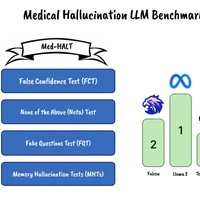
MedHallu is a comprehensive benchmark dataset designed to evaluate the ability of large language models to detect hallucinations in medical question-answering tasks.
MedHallu is intended to assess the reliability of large language models in a critical domain—medical question-answering—by measuring their capacity to detect hallucinated outputs. The dataset includes two distinct splits:
pqa_labeled: 1,000 high-quality samples derived from PubMedQA pqa_labeled split.
pqa_artificial: 9,000 samples generated from PubMedQA pqa_artificial split.
Curated by: UTAustin-AIHealth
Language(s) (NLP): English
License: MIT License
To work with the MedHallu dataset, please install the Hugging Face datasets library using pip:
pip install datasets
Downloading the Dataset:
from datasets import load_dataset

# Load the 'pqa_labeled' split: 1,000 high-quality, human-annotated samples.
medhallu_labeled = load_dataset("UTAustin-AIHealth/MedHallu", "pqa_labeled")

# Load the 'pqa_artificial' split: 9,000 samples generated via an automated pipeline.
medhallu_artificial = load_dataset("UTAustin-AIHealth/MedHallu", "pqa_artificial")
MedHallu is organized into two main splits:
Each sample includes a medical question along with its corresponding ground truth answer, hallucinated answer, difficulty level, and the category of hallucination.
The MedHallu dataset is built upon data sourced from the PubMedQA dataset.
If you use the MedHallu dataset in your research, please consider citing our work:
@misc{pandit2025medhallucomprehensivebenchmarkdetecting,
      title={MedHallu: A Comprehensive Benchmark for Detecting Medical Hallucinations in Large Language Models},
      author={Shrey Pandit and Jiawei Xu and Junyuan Hong and Zhangyang Wang and Tianlong Chen and Kaidi Xu and Ying Ding},
      year={2025},
      eprint={2502.14302},
      archivePrefix={arXiv},
      primaryClass={cs.CL},
      url={https://arxiv.org/abs/2502.14302},
}
MedHallu is a comprehensive benchmark dataset designed to evaluate the ability of large language models to detect hallucinations in medical question-answering tasks.
MedHallu is intended to assess the reliability of large language models in a critical domain—medical question-answering—by measuring their capacity to detect hallucinated outputs. The dataset includes two distinct splits:
pqa_labeled: 1,000 high-quality samples derived from PubMedQA pqa_labeled split.
pqa_artificial: 9,000 samples generated from PubMedQA pqa_artificial split.
Curated by: UTAustin-AIHealth
Language(s) (NLP): English
License: MIT License
To work with the MedHallu dataset, please install the Hugging Face datasets library using pip:
pip install datasets
Downloading the Dataset:
from datasets import load_dataset

# Load the 'pqa_labeled' split: 1,000 high-quality, human-annotated samples.
medhallu_labeled = load_dataset("UTAustin-AIHealth/MedHallu", "pqa_labeled")

# Load the 'pqa_artificial' split: 9,000 samples generated via an automated pipeline.
medhallu_artificial = load_dataset("UTAustin-AIHealth/MedHallu", "pqa_artificial")
MedHallu is organized into two main splits:
Each sample includes a medical question along with its corresponding ground truth answer, hallucinated answer, difficulty level, and the category of hallucination.
The MedHallu dataset is built upon data sourced from the PubMedQA dataset.
If you use the MedHallu dataset in your research, please consider citing our work:
@misc{pandit2025medhallucomprehensivebenchmarkdetecting,
      title={MedHallu: A Comprehensive Benchmark for Detecting Medical Hallucinations in Large Language Models},
      author={Shrey Pandit and Jiawei Xu and Junyuan Hong and Zhangyang Wang and Tianlong Chen and Kaidi Xu and Ying Ding},
      year={2025},
      eprint={2502.14302},
      archivePrefix={arXiv},
      primaryClass={cs.CL},
      url={https://arxiv.org/abs/2502.14302},
}