
A curated list of papers and resources based on the survey "Code as Agent Harness"
705
30 commits
updated May 20, 2026
README
Awesome Code as Agent Harness Papers





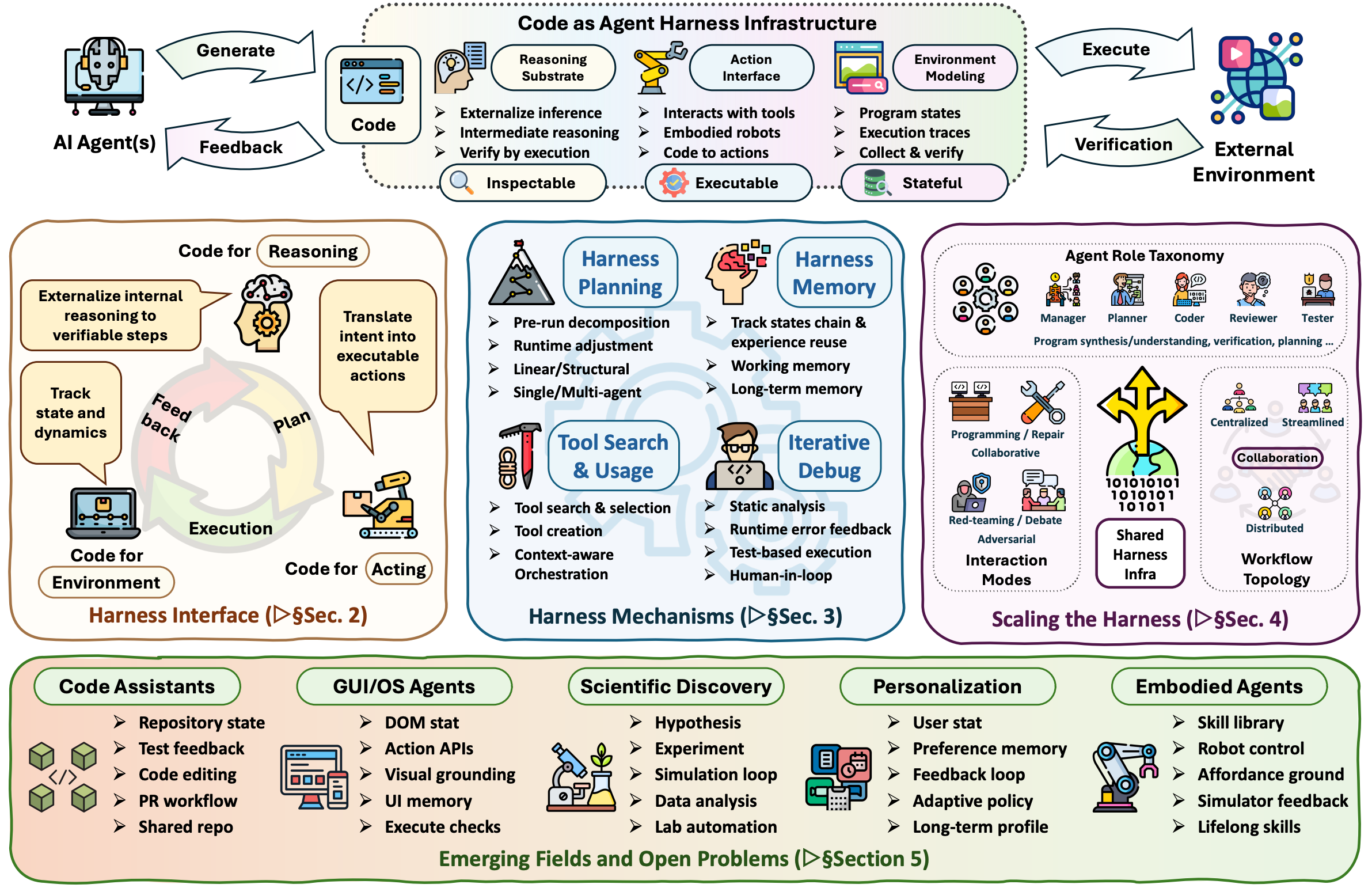
This repository accompanies the survey Code as Agent Harness: Toward Executable, Verifiable, and Stateful Agent Systems. We study the emerging role of code in agentic AI: code is no longer only a generated artifact, but increasingly serves as an executable, inspectable, and stateful harness through which agents reason, act, model environments, receive feedback, and coordinate. The repository organizes representative papers around three connected layers: Harness Interface, Harness Mechanisms, and Scaling the Harness, covering directions such as coding assistants, GUI/OS automation, scientific discovery, and embodied intelligence.
[!TIP] 👋 We welcome paper suggestions, pull requests, and collaborations on code as agent harness. Please contact us at
xuyingn2@illinois.edu,kt42@illinois.edu,twei10@illinois.edu,zihaoli5@illinois.edu, andbei4@illinois.edu. We will keep updating this repository with recent work on code-centric agentic systems and harness engineering.
[!NOTE] 📚 If you find this resource useful, please cite and
the repo:
@article{ning2026codeasharness,
  title   = {Code as Agent Harness: Toward Executable, Verifiable, and Stateful Agent Systems},
  author  = {Ning, Xuying and Tieu, Katherine and Fu, Dongqi and Wei, Tianxin and Li, Zihao and Bei, Yuanchen and others},
  journal = {arXiv preprint arXiv:2605.18747},
  year    = {2026}
}
🔔 News
[2026-05] 🚀 Our survey Code as Agent Harness: Toward Executable, Verifiable, and Stateful Agent Systems is available on arXiv. Slides and project page links will be added here once available.
📋 Table of Contents
- 🔔 News
- 📋 Table of Contents
- 🧩 Harness Interface
- 🛠️ Harness Mechanisms
- 👥 Scaling the Harness: Multi-Agent Code-Centric Systems
- 🚀 Applications and Emerging Fields
🧩 Harness Interface
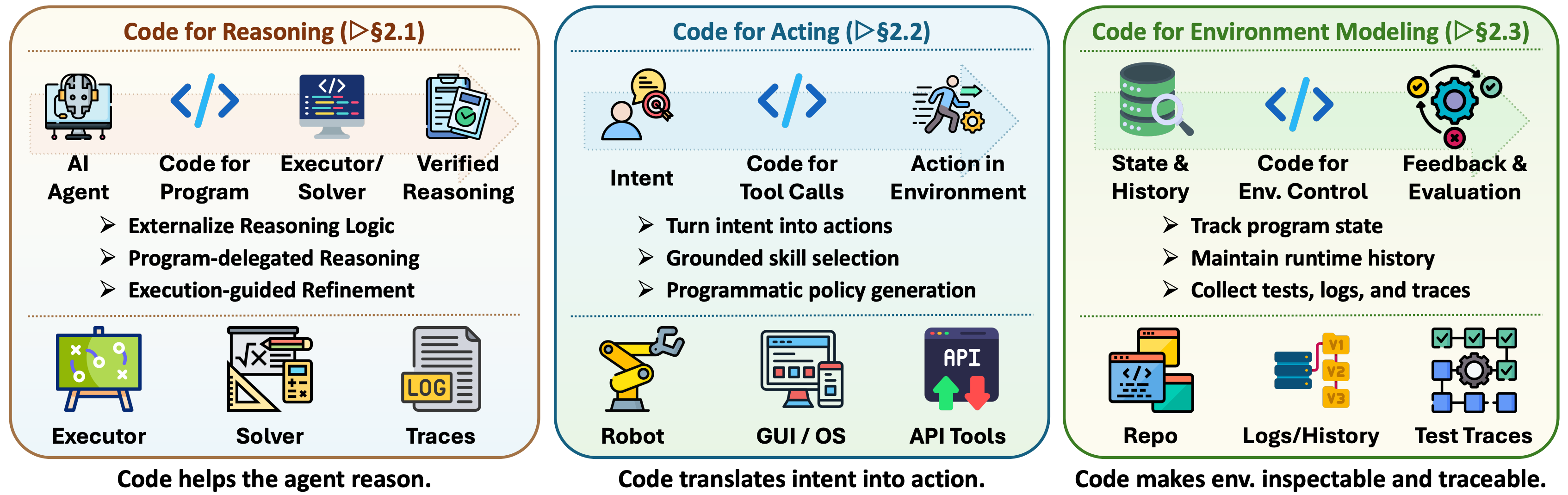
Code as the basic interface between a model and its task environment. Programs convert model outputs into executable, inspectable, and stateful structures: code makes reasoning executable, action programmable, and environment state inspectable.
💭 Code for Reasoning
Programs externalize internal logic into verifiable computation, allowing interpreters, symbolic solvers, execution traces, or process rewards to check and refine intermediate steps.
Program-Delegated Reasoning
Hybrid Symbolic–Neural Execution
Iterative Code-Grounded Reasoning
🤖 Code for Acting
Generated programs serve as policies, tool calls, behavior trees, or reusable skills for embodied, GUI, software, and tool-use environments.
Grounded Skill Selection
Programmatic Policy Generation
Lifelong Code-Based Agents
🌍 Code for Environment Modeling
Program states, repositories, traces, simulators, and tests represent state, dynamics, and feedback signals for agent interaction.
Structured World Representations
Execution-Trace World Modeling
Code-Grounded Evaluation Environments
🛠️ Harness Mechanisms
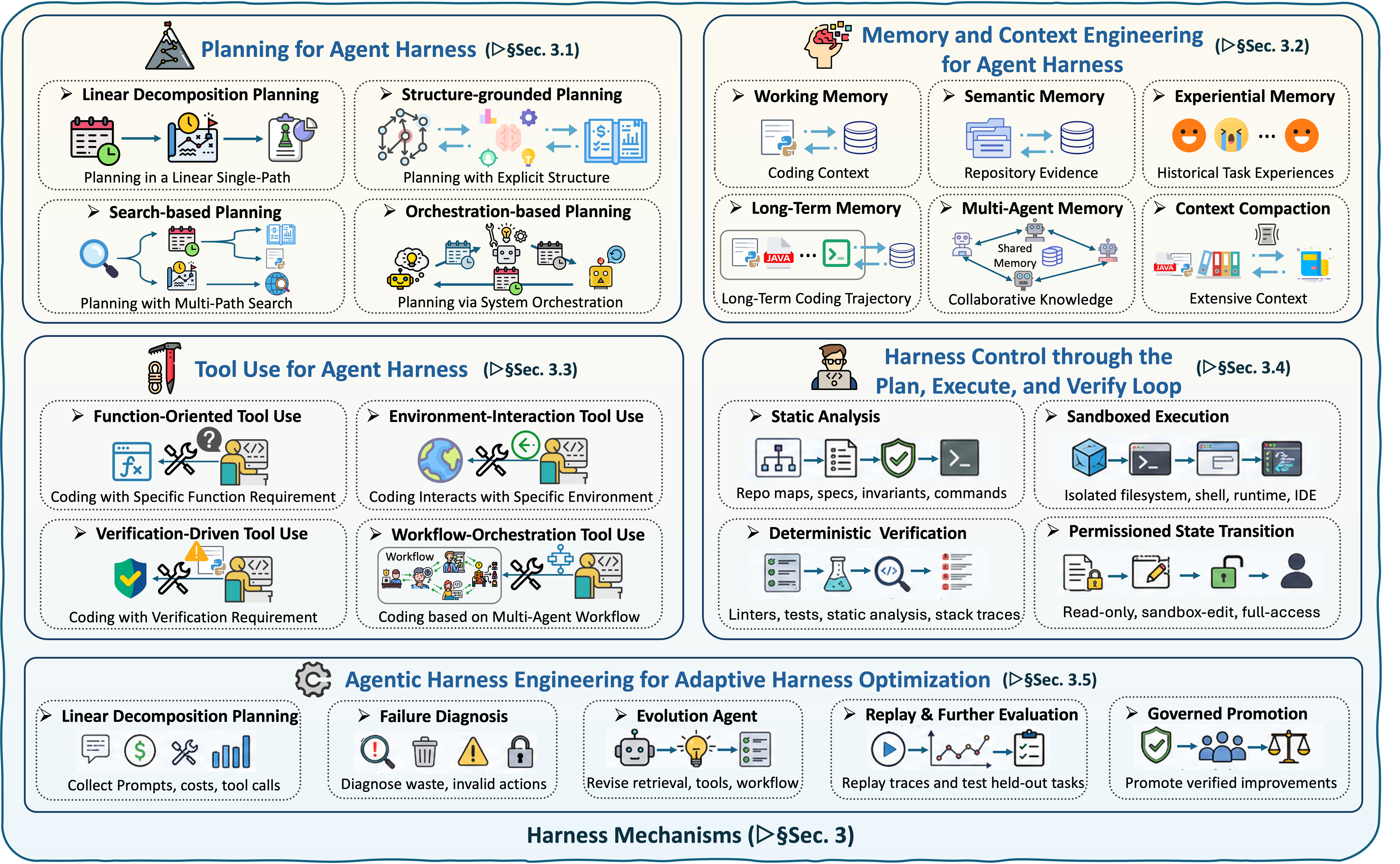
Once code is placed inside the agent loop, the harness must decide what to execute next, preserve useful state, expose the right tools, and convert failures into corrective actions.
🗺️ Planning for Code Agents
Planning is harness control: it structures how the agent externalizes intent into executable steps, schedules interactions with code artifacts and tools, and regulates the trajectory of reasoning, execution, and revision over time.
Linear Decomposition Planning
Structure-Grounded Planning
Search-Based Planning
Orchestration-Based Planning
🧠 Memory and Context Engineering
Memory in code-as-agent-harness systems is a state-management layer: which information stays in the active context, which is compacted, and which is offloaded to durable external storage.
Working Memory
Semantic Memory
Experiential Memory
Long-Term Memory
Multi-Agent Memory
🔧 Tool Usage for Code Agents
Tool usage is the action and observation layer of the code-agent harness: agents search repositories, inspect files, edit code, run commands, execute tests, call APIs, and verify intermediate results — all under typed schemas, sandboxes, and lifecycle hooks.
Function-Oriented Tool Use
Environment-Interaction Tool Use
| Paper | Venue |
|---|---|
| Environment-in-the-Loop: Rethinking Code Migration with LLM-based Agents | arXiv 2026 |
| Test-Time Adaptation for LLM Agents via Environment Interaction | ICLR 2026 |
Verification-Driven Tool Use
Workflow-Orchestration Tool Use
🧪 Feedback-Guided Iterative Debugging
Iterative debugging closes the harness loop: development environments expose feedback (compiler diagnostics, runtime errors, tests, critique), and the agent transforms these signals into diagnosis, revision, and progressively better debugging behavior.
Development Environments for Agentic Coding
Contextual Environments for Repository-Aware Generation
Interactive Environments for Human–LLM Collaboration
Execution and Validation Environments
Engineering Platforms for Deployment and Workflow Integration
Feedback Mechanisms for Iterative Debugging
Compilation and Static-Analysis Feedback
Runtime Error and Exception Feedback
Test-Based Execution Feedback
Critique-Driven Feedback (Human or Auxiliary Agents)
| Paper | Venue |
|---|---|
| Interactive Debugging and Steering of Multi-Agent AI Systems | CHI 2025 |
| RGD: Multi-LLM Based Agent Debugger via Refinement and Generation Guidance | International Conference on Agents 2024 |
Feedback-Driven Debugging and Self-Improvement
| Paper | Venue |
|---|---|
| Teaching Your Models to Understand Code via Focal Preference Alignment | arXiv 2025 |
| ReVeal: Self-Evolving Code Agents via Reliable Self-Verification | NeurIPS 2025 |
👥 Scaling the Harness: Multi-Agent Code-Centric Systems
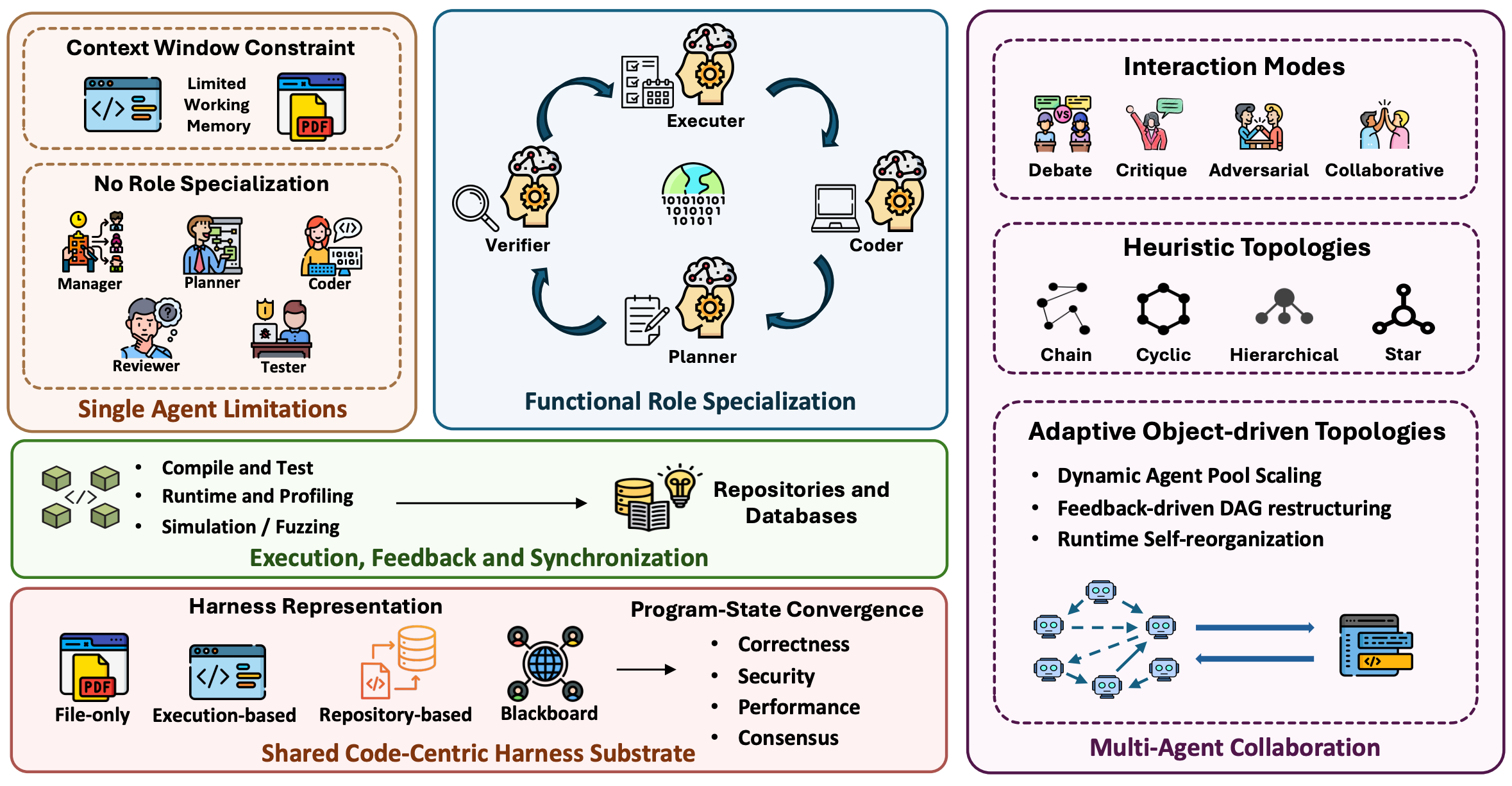
When multiple agents operate over code, the harness must coordinate roles, share intermediate artifacts, maintain common state, and verify collective progress through repositories, tests, traces, and structured workflows.
🎭 Functional Role Specialization
Distinct agents own slices of the shared code harness — synthesis, understanding, verification, execution, and planning.
Program Synthesis Agents
Program Understanding Agents
Verification Agents
Execution Agents
Planning Agents
💬 Interaction Modes
Code-centric multi-agent interaction is artifact-mediated: agents observe and modify shared code, and grounding comes from the objective state exposed by execution.
Collaborative Synthesis
Critique and Repair
| Paper | Venue |
|---|---|
| AgentCoder: Multi-Agent-based Code Generation with Iterative Testing and Optimisation | arXiv 2023 |
| SEW: Self-evolving agentic workflows for automated code generation | arXiv 2025 |
Adversarial Validation
Reasoning Debate
| Paper | Venue |
|---|---|
| ChatDev: Communicative Agents for Software Development | ACL 2024 |
| Hallucination to Consensus: Multi-Agent LLMs for End-to-End JUnit Test Generation | arXiv 2025 |
🕸️ Workflow Topology
Topology of agent interaction (chain, cyclic, hierarchical, star, adaptive) is one of the most consequential design decisions in multi-agent code generation.
Pre-Defined Heuristic Topologies (Waterfall / Iterative / Hierarchical / Star)
Objective-Driven and Adaptive Topologies
⚡ Execution Feedback Integration
Code is uniquely executable, producing objective oracle signals that anchor multi-agent coordination.
Compiler and Syntax Feedback
| Paper | Venue |
|---|---|
| ChatDev: Communicative Agents for Software Development | ACL 2024 |
| L2MAC: Large language model automatic computer for extensive code generation | ICLR 2024 |
Test Pass/Fail Signals
Fuzzer Crash Traces
| Paper | Venue |
|---|---|
| AutoSafeCoder: A Multi-Agent Framework for Securing LLM Code Generation through Static Analysis and Fuzz Testing | arXiv 2024 |
Static Analysis Warnings
| Paper | Venue |
|---|---|
| AutoSafeCoder: A Multi-Agent Framework for Securing LLM Code Generation through Static Analysis and Fuzz Testing | arXiv 2024 |
Performance Profiling Results
| Paper | Venue |
|---|---|
| MARCO: Multi-Agent Code Optimization with Real-Time Knowledge Integration for High-Performance Computing | arXiv 2025 |
Fine-Grained Simulation Feedback
| Paper | Venue |
|---|---|
| MAGE: A multi-agent engine for automated RTL code generation | DAC 2025 |
🔄 Shared-Harness Synchronization
How multi-agent systems maintain a consistent shared view of program state.
Shared Blackboard
| Paper | Venue |
|---|---|
| L2MAC: Large language model automatic computer for extensive code generation | ICLR 2024 |
Parallel Branches with Merge
| Paper | Venue |
|---|---|
| HyperAgent: Generalist software engineering agents to solve coding tasks at scale | arXiv 2024 |
Structured Context Scheduling
| Paper | Venue |
|---|---|
| MetaGPT: Meta Programming for A Multi-Agent Collaborative Framework | ICLR 2024 |
Hierarchical Memory
| Paper | Venue |
|---|---|
| ChatDev: Communicative Agents for Software Development | ACL 2024 |
| Cogito, ergo sum: A Neurobiologically-Inspired Cognition-Memory-Growth System for Code Generation | arXiv 2025 |
Agent Pool Scaling
| Paper | Venue |
|---|---|
| Self-Organized Agents: A LLM Multi-Agent Framework toward Ultra Large-Scale Code Generation and Optimization | arXiv 2024 |
🏛️ Shared Harness Representation
Four levels of formalization for the shared substrate: implicit/file-only, repository-based, execution-based, and blackboard.
Implicit / File-Only Representation
Repository-Based Representation
Execution-Based Representation
Blackboard / Shared-State Representation
🎯 Harness-State Convergence
How a multi-agent code system decides the shared harness has reached an acceptable final state.
Correctness Convergence (Test-Gated)
Security Convergence
| Paper | Venue |
|---|---|
| AutoSafeCoder: A Multi-Agent Framework for Securing LLM Code Generation through Static Analysis and Fuzz Testing | arXiv 2024 |
Performance Convergence
| Paper | Venue |
|---|---|
| MARCO: Multi-Agent Code Optimization with Real-Time Knowledge Integration for High-Performance Computing | arXiv 2025 |
Score-Based Convergence
Consensus Convergence
| Paper | Venue |
|---|---|
| QualityFlow: An agentic workflow for program synthesis controlled by LLM quality checks | arXiv 2025 |
Implicit Convergence
| Paper | Venue |
|---|---|
| ChatDev: Communicative Agents for Software Development | ACL 2024 |
| MetaGPT: Meta Programming for A Multi-Agent Collaborative Framework | ICLR 2024 |
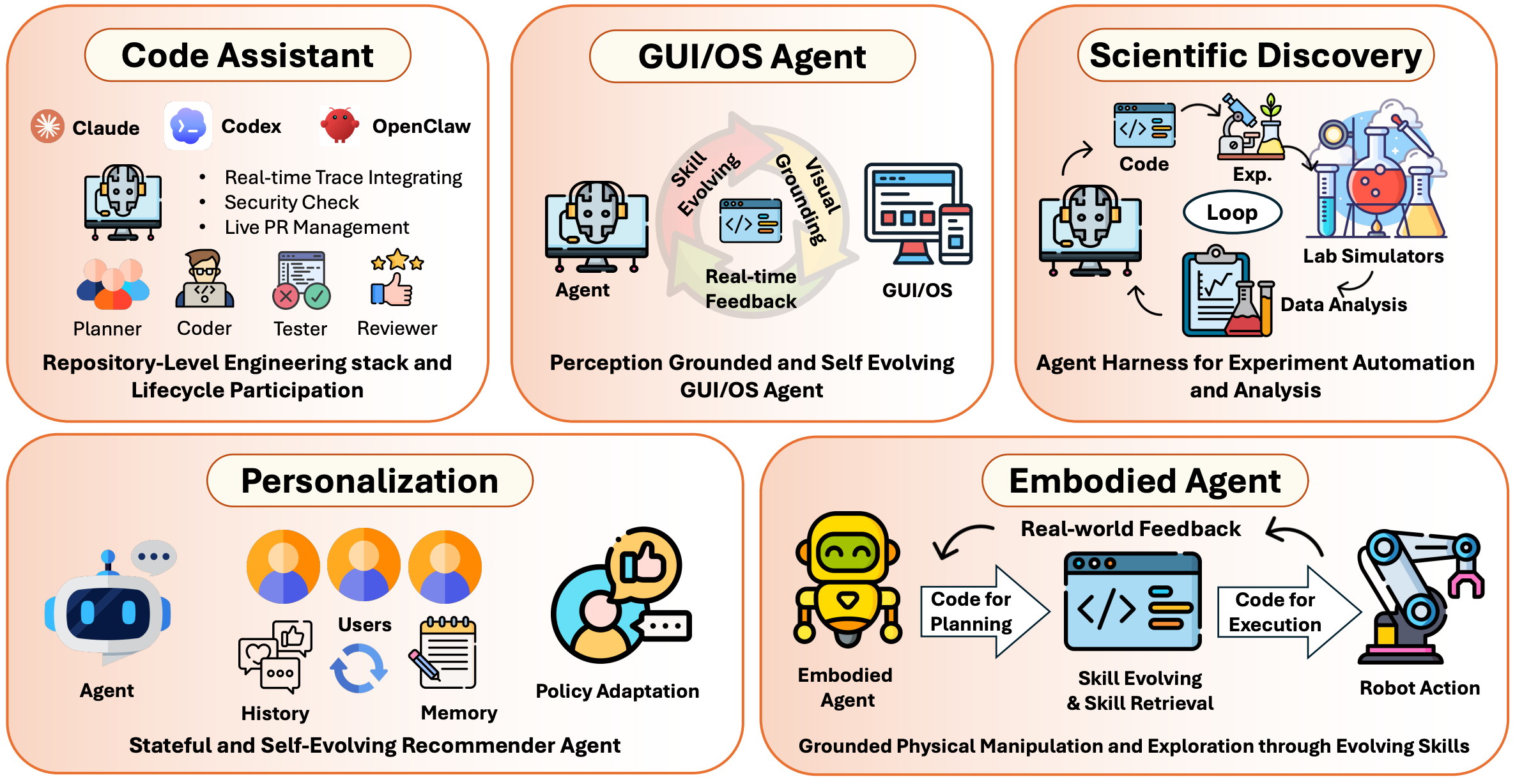
🚀 Applications and Emerging Fields
Code-centric agentic systems become operational in tangible domains where code defines observable state, executable actions, persistent memory, and feedback signals.
💻 Code Assistants
Repositories, tests, issue threads, and development tools form a persistent program world; assistants act over it as code-centric agents.
The Repository as a Persistent Program World
Agent Harnesses as Executable Development Interfaces
Execution Feedback as Grounded Verification
Memory and Context Management at Repository Scale
Developer Intent and Project Conventions as Latent State
| Paper | Venue |
|---|---|
| Learning to Commit: Generating Organic Pull Requests via Online Repository Memory | arXiv 2026 |
| CodeTaste: Can LLMs Generate Human-Level Code Refactorings? | arXiv 2026 |
| SWE-bench+: Enhanced Coding Benchmark for LLMs | ICSE Companion 2025 |
From Inline Completion to Autonomous SWE Agents
From Patch Generation to Software Lifecycle Participation
Multi-Agent Code Assistance and Shared Repositories
The Harness as a Distillation Surface
| Paper | Venue |
|---|---|
| Composer: Building a fast frontier model with reinforcement learning [Blog] | 2025 |
| Improving Composer through real-time reinforcement learning [Blog] | 2025 |
| Addendum to GPT-5 system card: GPT-5-Codex [Report] | 2025 |
| Building more with GPT-5.1-Codex-Max [Blog] | 2025 |
| How Anthropic teams use Claude Code [Report] | 2025 |
Open Challenges for Code-Assistant Harnesses
🖥️ GUI / OS Agents
GUI/OS environments are program worlds in the most literal sense: every observation is rendered code, and every action is a call into another piece of code.
GUI/OS as a Partially Observable Program World
Unifying Perception, Action, and Evaluation Through Code
Memory as Persistent Program State
UI Simulators and Sandboxes as Executable Dynamics
From Simulation to Production: Executable Feedback Loops
| Paper | Venue |
|---|---|
| 3.5 Models and Computer Use [Blog] | 2024 |
| Introducing Operator [Blog] | 2025 |
| Project Mariner [Blog] | 2025 |
| AutoWebGLM: A Large Language Model-based Web Navigating Agent | KDD 2024 |
🤖 Autonomous Embodied Agents
Code grounds embodied actions in physical feasibility, accumulates reusable skills as memory, and supports auditable real-world deployment.
Agent Harness for Grounded and Verifiable Embodied Actions
Reusable Skills as Embodied Memory
Coordinated and Auditable Real-World Deployment
🔬 Scientific Discovery Agents
Hypotheses are encoded as differential equations or generative models; protocols as XDL or Opentrons scripts; analyses as Jupyter notebooks. Code carries scientific reasoning, scientific action, and the scientific environment itself.
Scientific Discovery as a Partially Observable Program World
Unifying Ideation, Experimentation, Analysis, and Communication
Memory as Persistent Program State
| Paper | Venue |
|---|---|
| AIDE: AI-Driven Exploration in the Space of Code | arXiv 2025 |
| El Agente: An autonomous agent for quantum chemistry | Matter 2025 |
| PaperQA: Retrieval-Augmented Generative Agent for Scientific Research | arXiv 2023 |
| Towards an AI co-scientist | arXiv 2025 |
Simulators as Executable Dynamics
| Paper | Venue |
|---|---|
| AlphaEvolve: A coding agent for scientific and algorithmic discovery | arXiv 2025 |
Self-Driving Labs as Executable Feedback Loops
Toward Agentic and Instruction-Following Science
🧠 Agent Personalization
As recommendation moves from static prediction toward interactive agents, personalization systems must reason over latent and evolving user preferences through structured, editable preference states and executable feedback pipelines.
From Static Recommendation to Interactive Personalization
Preference State as an Editable Artifact
Feedback as Policy Adaptation
| Paper | Venue |
|---|---|
| LLM-Powered User Simulator for Recommender System | AAAI 2025 |
| User Behavior Simulation with Large Language Model-Based Agents | ACM TOIS 2025 |
Controllable and Instruction-Following Personalization
| Paper | Venue |
|---|---|
| Conversational Recommendation: Formulation, Methods, and Evaluation | SIGIR 2020 |
✨ Acknowledgements
We thank the broader community for the contributions surveyed here. If your paper should be added or moved, please open a pull request or issue.
📄 License
This repository is released under the MIT License.
Contributors


Similar repos


A curated list of papers and resources based on the survey "Code as Agent Harness"
705
30 commits
updated May 20, 2026
README
Awesome Code as Agent Harness Papers
This repository accompanies the survey Code as Agent Harness: Toward Executable, Verifiable, and Stateful Agent Systems. We study the emerging role of code in agentic AI: code is no longer only a generated artifact, but increasingly serves as an executable, inspectable, and stateful harness through which agents reason, act, model environments, receive feedback, and coordinate. The repository organizes representative papers around three connected layers: Harness Interface, Harness Mechanisms, and Scaling the Harness, covering directions such as coding assistants, GUI/OS automation, scientific discovery, and embodied intelligence.
[!TIP] 👋 We welcome paper suggestions, pull requests, and collaborations on code as agent harness. Please contact us at
xuyingn2@illinois.edu,kt42@illinois.edu,twei10@illinois.edu,zihaoli5@illinois.edu, andbei4@illinois.edu. We will keep updating this repository with recent work on code-centric agentic systems and harness engineering.
[!NOTE] 📚 If you find this resource useful, please cite and
@article{ning2026codeasharness,
  title   = {Code as Agent Harness: Toward Executable, Verifiable, and Stateful Agent Systems},
  author  = {Ning, Xuying and Tieu, Katherine and Fu, Dongqi and Wei, Tianxin and Li, Zihao and Bei, Yuanchen and others},
  journal = {arXiv preprint arXiv:2605.18747},
  year    = {2026}
}
🔔 News
[2026-05] 🚀 Our survey Code as Agent Harness: Toward Executable, Verifiable, and Stateful Agent Systems is available on arXiv. Slides and project page links will be added here once available.
📋 Table of Contents
- 🔔 News
- 📋 Table of Contents
- 🧩 Harness Interface
- 🛠️ Harness Mechanisms
- 👥 Scaling the Harness: Multi-Agent Code-Centric Systems
- 🚀 Applications and Emerging Fields
🧩 Harness Interface
Code as the basic interface between a model and its task environment. Programs convert model outputs into executable, inspectable, and stateful structures: code makes reasoning executable, action programmable, and environment state inspectable.
💭 Code for Reasoning
Programs externalize internal logic into verifiable computation, allowing interpreters, symbolic solvers, execution traces, or process rewards to check and refine intermediate steps.
Program-Delegated Reasoning
Hybrid Symbolic–Neural Execution
Iterative Code-Grounded Reasoning
🤖 Code for Acting
Generated programs serve as policies, tool calls, behavior trees, or reusable skills for embodied, GUI, software, and tool-use environments.
Grounded Skill Selection
Programmatic Policy Generation
Lifelong Code-Based Agents
🌍 Code for Environment Modeling
Program states, repositories, traces, simulators, and tests represent state, dynamics, and feedback signals for agent interaction.
Structured World Representations
Execution-Trace World Modeling
Code-Grounded Evaluation Environments
🛠️ Harness Mechanisms
Once code is placed inside the agent loop, the harness must decide what to execute next, preserve useful state, expose the right tools, and convert failures into corrective actions.
🗺️ Planning for Code Agents
Planning is harness control: it structures how the agent externalizes intent into executable steps, schedules interactions with code artifacts and tools, and regulates the trajectory of reasoning, execution, and revision over time.
Linear Decomposition Planning
Structure-Grounded Planning
Search-Based Planning
Orchestration-Based Planning
🧠 Memory and Context Engineering
Memory in code-as-agent-harness systems is a state-management layer: which information stays in the active context, which is compacted, and which is offloaded to durable external storage.
Working Memory
Semantic Memory
Experiential Memory
Long-Term Memory
Multi-Agent Memory
🔧 Tool Usage for Code Agents
Tool usage is the action and observation layer of the code-agent harness: agents search repositories, inspect files, edit code, run commands, execute tests, call APIs, and verify intermediate results — all under typed schemas, sandboxes, and lifecycle hooks.
Function-Oriented Tool Use
Environment-Interaction Tool Use
| Paper | Venue |
|---|---|
| Environment-in-the-Loop: Rethinking Code Migration with LLM-based Agents | arXiv 2026 |
| Test-Time Adaptation for LLM Agents via Environment Interaction | ICLR 2026 |
Verification-Driven Tool Use
Workflow-Orchestration Tool Use
🧪 Feedback-Guided Iterative Debugging
Iterative debugging closes the harness loop: development environments expose feedback (compiler diagnostics, runtime errors, tests, critique), and the agent transforms these signals into diagnosis, revision, and progressively better debugging behavior.
Development Environments for Agentic Coding
Contextual Environments for Repository-Aware Generation
Interactive Environments for Human–LLM Collaboration
Execution and Validation Environments
Engineering Platforms for Deployment and Workflow Integration
Feedback Mechanisms for Iterative Debugging
Compilation and Static-Analysis Feedback
Runtime Error and Exception Feedback
Test-Based Execution Feedback
Critique-Driven Feedback (Human or Auxiliary Agents)
| Paper | Venue |
|---|---|
| Interactive Debugging and Steering of Multi-Agent AI Systems | CHI 2025 |
| RGD: Multi-LLM Based Agent Debugger via Refinement and Generation Guidance | International Conference on Agents 2024 |
Feedback-Driven Debugging and Self-Improvement
| Paper | Venue |
|---|---|
| Teaching Your Models to Understand Code via Focal Preference Alignment | arXiv 2025 |
| ReVeal: Self-Evolving Code Agents via Reliable Self-Verification | NeurIPS 2025 |
👥 Scaling the Harness: Multi-Agent Code-Centric Systems
When multiple agents operate over code, the harness must coordinate roles, share intermediate artifacts, maintain common state, and verify collective progress through repositories, tests, traces, and structured workflows.
🎭 Functional Role Specialization
Distinct agents own slices of the shared code harness — synthesis, understanding, verification, execution, and planning.
Program Synthesis Agents
Program Understanding Agents
Verification Agents
Execution Agents
Planning Agents
💬 Interaction Modes
Code-centric multi-agent interaction is artifact-mediated: agents observe and modify shared code, and grounding comes from the objective state exposed by execution.
Collaborative Synthesis
Critique and Repair
| Paper | Venue |
|---|---|
| AgentCoder: Multi-Agent-based Code Generation with Iterative Testing and Optimisation | arXiv 2023 |
| SEW: Self-evolving agentic workflows for automated code generation | arXiv 2025 |
Adversarial Validation
Reasoning Debate
| Paper | Venue |
|---|---|
| ChatDev: Communicative Agents for Software Development | ACL 2024 |
| Hallucination to Consensus: Multi-Agent LLMs for End-to-End JUnit Test Generation | arXiv 2025 |
🕸️ Workflow Topology
Topology of agent interaction (chain, cyclic, hierarchical, star, adaptive) is one of the most consequential design decisions in multi-agent code generation.
Pre-Defined Heuristic Topologies (Waterfall / Iterative / Hierarchical / Star)
Objective-Driven and Adaptive Topologies
⚡ Execution Feedback Integration
Code is uniquely executable, producing objective oracle signals that anchor multi-agent coordination.
Compiler and Syntax Feedback
| Paper | Venue |
|---|---|
| ChatDev: Communicative Agents for Software Development | ACL 2024 |
| L2MAC: Large language model automatic computer for extensive code generation | ICLR 2024 |
Test Pass/Fail Signals
Fuzzer Crash Traces
| Paper | Venue |
|---|---|
| AutoSafeCoder: A Multi-Agent Framework for Securing LLM Code Generation through Static Analysis and Fuzz Testing | arXiv 2024 |
Static Analysis Warnings
| Paper | Venue |
|---|---|
| AutoSafeCoder: A Multi-Agent Framework for Securing LLM Code Generation through Static Analysis and Fuzz Testing | arXiv 2024 |
Performance Profiling Results
| Paper | Venue |
|---|---|
| MARCO: Multi-Agent Code Optimization with Real-Time Knowledge Integration for High-Performance Computing | arXiv 2025 |
Fine-Grained Simulation Feedback
| Paper | Venue |
|---|---|
| MAGE: A multi-agent engine for automated RTL code generation | DAC 2025 |
🔄 Shared-Harness Synchronization
How multi-agent systems maintain a consistent shared view of program state.
Shared Blackboard
| Paper | Venue |
|---|---|
| L2MAC: Large language model automatic computer for extensive code generation | ICLR 2024 |
Parallel Branches with Merge
| Paper | Venue |
|---|---|
| HyperAgent: Generalist software engineering agents to solve coding tasks at scale | arXiv 2024 |
Structured Context Scheduling
| Paper | Venue |
|---|---|
| MetaGPT: Meta Programming for A Multi-Agent Collaborative Framework | ICLR 2024 |
Hierarchical Memory
| Paper | Venue |
|---|---|
| ChatDev: Communicative Agents for Software Development | ACL 2024 |
| Cogito, ergo sum: A Neurobiologically-Inspired Cognition-Memory-Growth System for Code Generation | arXiv 2025 |
Agent Pool Scaling
| Paper | Venue |
|---|---|
| Self-Organized Agents: A LLM Multi-Agent Framework toward Ultra Large-Scale Code Generation and Optimization | arXiv 2024 |
🏛️ Shared Harness Representation
Four levels of formalization for the shared substrate: implicit/file-only, repository-based, execution-based, and blackboard.
Implicit / File-Only Representation
Repository-Based Representation
Execution-Based Representation
Blackboard / Shared-State Representation
🎯 Harness-State Convergence
How a multi-agent code system decides the shared harness has reached an acceptable final state.
Correctness Convergence (Test-Gated)
Security Convergence
| Paper | Venue |
|---|---|
| AutoSafeCoder: A Multi-Agent Framework for Securing LLM Code Generation through Static Analysis and Fuzz Testing | arXiv 2024 |
Performance Convergence
| Paper | Venue |
|---|---|
| MARCO: Multi-Agent Code Optimization with Real-Time Knowledge Integration for High-Performance Computing | arXiv 2025 |
Score-Based Convergence
Consensus Convergence
| Paper | Venue |
|---|---|
| QualityFlow: An agentic workflow for program synthesis controlled by LLM quality checks | arXiv 2025 |
Implicit Convergence
| Paper | Venue |
|---|---|
| ChatDev: Communicative Agents for Software Development | ACL 2024 |
| MetaGPT: Meta Programming for A Multi-Agent Collaborative Framework | ICLR 2024 |
🚀 Applications and Emerging Fields
Code-centric agentic systems become operational in tangible domains where code defines observable state, executable actions, persistent memory, and feedback signals.
💻 Code Assistants
Repositories, tests, issue threads, and development tools form a persistent program world; assistants act over it as code-centric agents.
The Repository as a Persistent Program World
Agent Harnesses as Executable Development Interfaces
Execution Feedback as Grounded Verification
Memory and Context Management at Repository Scale
Developer Intent and Project Conventions as Latent State
| Paper | Venue |
|---|---|
| Learning to Commit: Generating Organic Pull Requests via Online Repository Memory | arXiv 2026 |
| CodeTaste: Can LLMs Generate Human-Level Code Refactorings? | arXiv 2026 |
| SWE-bench+: Enhanced Coding Benchmark for LLMs | ICSE Companion 2025 |
From Inline Completion to Autonomous SWE Agents
From Patch Generation to Software Lifecycle Participation
Multi-Agent Code Assistance and Shared Repositories
The Harness as a Distillation Surface
| Paper | Venue |
|---|---|
| Composer: Building a fast frontier model with reinforcement learning [Blog] | 2025 |
| Improving Composer through real-time reinforcement learning [Blog] | 2025 |
| Addendum to GPT-5 system card: GPT-5-Codex [Report] | 2025 |
| Building more with GPT-5.1-Codex-Max [Blog] | 2025 |
| How Anthropic teams use Claude Code [Report] | 2025 |
Open Challenges for Code-Assistant Harnesses
🖥️ GUI / OS Agents
GUI/OS environments are program worlds in the most literal sense: every observation is rendered code, and every action is a call into another piece of code.
GUI/OS as a Partially Observable Program World
Unifying Perception, Action, and Evaluation Through Code
Memory as Persistent Program State
UI Simulators and Sandboxes as Executable Dynamics
From Simulation to Production: Executable Feedback Loops
| Paper | Venue |
|---|---|
| 3.5 Models and Computer Use [Blog] | 2024 |
| Introducing Operator [Blog] | 2025 |
| Project Mariner [Blog] | 2025 |
| AutoWebGLM: A Large Language Model-based Web Navigating Agent | KDD 2024 |
🤖 Autonomous Embodied Agents
Code grounds embodied actions in physical feasibility, accumulates reusable skills as memory, and supports auditable real-world deployment.
Agent Harness for Grounded and Verifiable Embodied Actions
Reusable Skills as Embodied Memory
Coordinated and Auditable Real-World Deployment
🔬 Scientific Discovery Agents
Hypotheses are encoded as differential equations or generative models; protocols as XDL or Opentrons scripts; analyses as Jupyter notebooks. Code carries scientific reasoning, scientific action, and the scientific environment itself.
Scientific Discovery as a Partially Observable Program World
Unifying Ideation, Experimentation, Analysis, and Communication
Memory as Persistent Program State
| Paper | Venue |
|---|---|
| AIDE: AI-Driven Exploration in the Space of Code | arXiv 2025 |
| El Agente: An autonomous agent for quantum chemistry | Matter 2025 |
| PaperQA: Retrieval-Augmented Generative Agent for Scientific Research | arXiv 2023 |
| Towards an AI co-scientist | arXiv 2025 |
Simulators as Executable Dynamics
| Paper | Venue |
|---|---|
| AlphaEvolve: A coding agent for scientific and algorithmic discovery | arXiv 2025 |
Self-Driving Labs as Executable Feedback Loops
Toward Agentic and Instruction-Following Science
🧠 Agent Personalization
As recommendation moves from static prediction toward interactive agents, personalization systems must reason over latent and evolving user preferences through structured, editable preference states and executable feedback pipelines.
From Static Recommendation to Interactive Personalization
Preference State as an Editable Artifact
Feedback as Policy Adaptation
| Paper | Venue |
|---|---|
| LLM-Powered User Simulator for Recommender System | AAAI 2025 |
| User Behavior Simulation with Large Language Model-Based Agents | ACM TOIS 2025 |
Controllable and Instruction-Following Personalization
| Paper | Venue |
|---|---|
| Conversational Recommendation: Formulation, Methods, and Evaluation | SIGIR 2020 |
✨ Acknowledgements
We thank the broader community for the contributions surveyed here. If your paper should be added or moved, please open a pull request or issue.
📄 License
This repository is released under the MIT License.