
A curated list of awesome RL in GUI Agent papers
See the codeREADME
Awesome Reinforcement Learning for GUI Agents



This repository provides a comprehensive and curated list of research papers, datasets, and tools focused on Reinforcement Learning (RL) in GUI Agents. GUI agents are intelligent systems that perceive graphical interfaces visually and execute tasks through human-like inputs (click, swipe, type).
📄 Based on the survey: GUI Agents with Reinforcement Learning: Toward Digital Inhabitants
📋 Table of Contents
- 🔔 News
- 🌟 Introduction
- 📚 Related Surveys
- 🤝 Contributing
- 🏗️ RL Methods
- 🎨 Key Dimensions
- 📊 Training Resources
- 📝 Citation
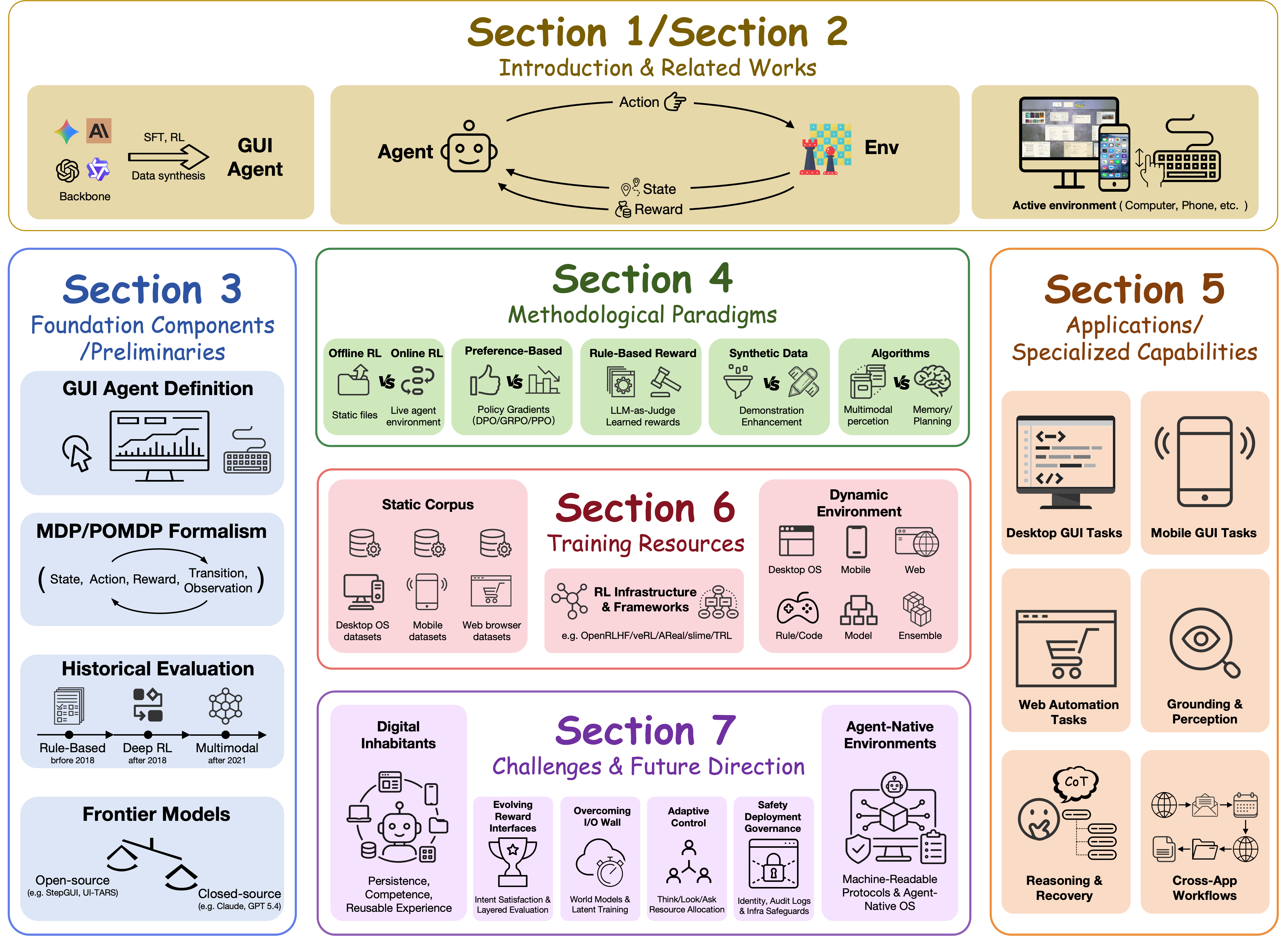
Overview of the survey structure. We organize our analysis into three main pillars: RL Methods, Key Dimensions, and Training Resources.
🔔 News
- [2026-04-30] 📄 Our survey "GUI Agents with Reinforcement Learning: Toward Digital Inhabitants" is now available on arXiv!
- [2026-04-19] 🚀 Repository created! Stay tuned for more updates on RL-based GUI Agents.
🌟 Introduction
Reinforcement Learning for GUI agents addresses the core difficulties of GUI automation: long-horizon credit assignment under sparse rewards, distribution shift across evolving interfaces, and safe exploration. We organize the landscape into three methodological paradigms:
- Offline RL: Learning from static datasets without environment interaction.
- Online RL: Refinement through continuous trial and error in dynamic environments.
- Hybrid Strategies: Bridging pre-training and adaptation via semi-online methods and world models.
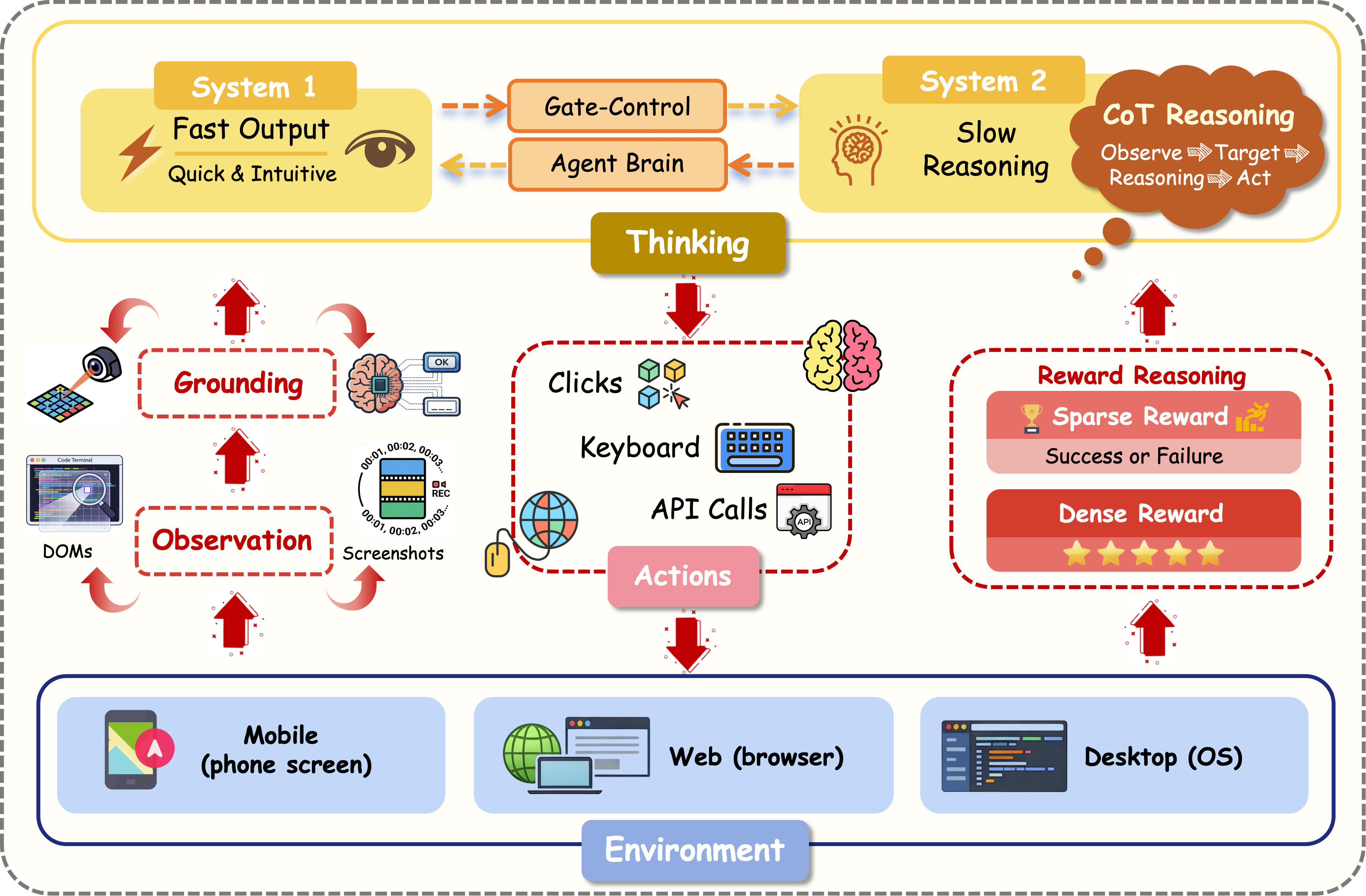
Overview of the RL training pipeline for GUI agents. The agent perceives the GUI environment through screenshots, reasons about the task, and executes actions. RL optimizes the policy through reward signals derived from task completion, visual grounding accuracy, and intermediate reasoning quality.
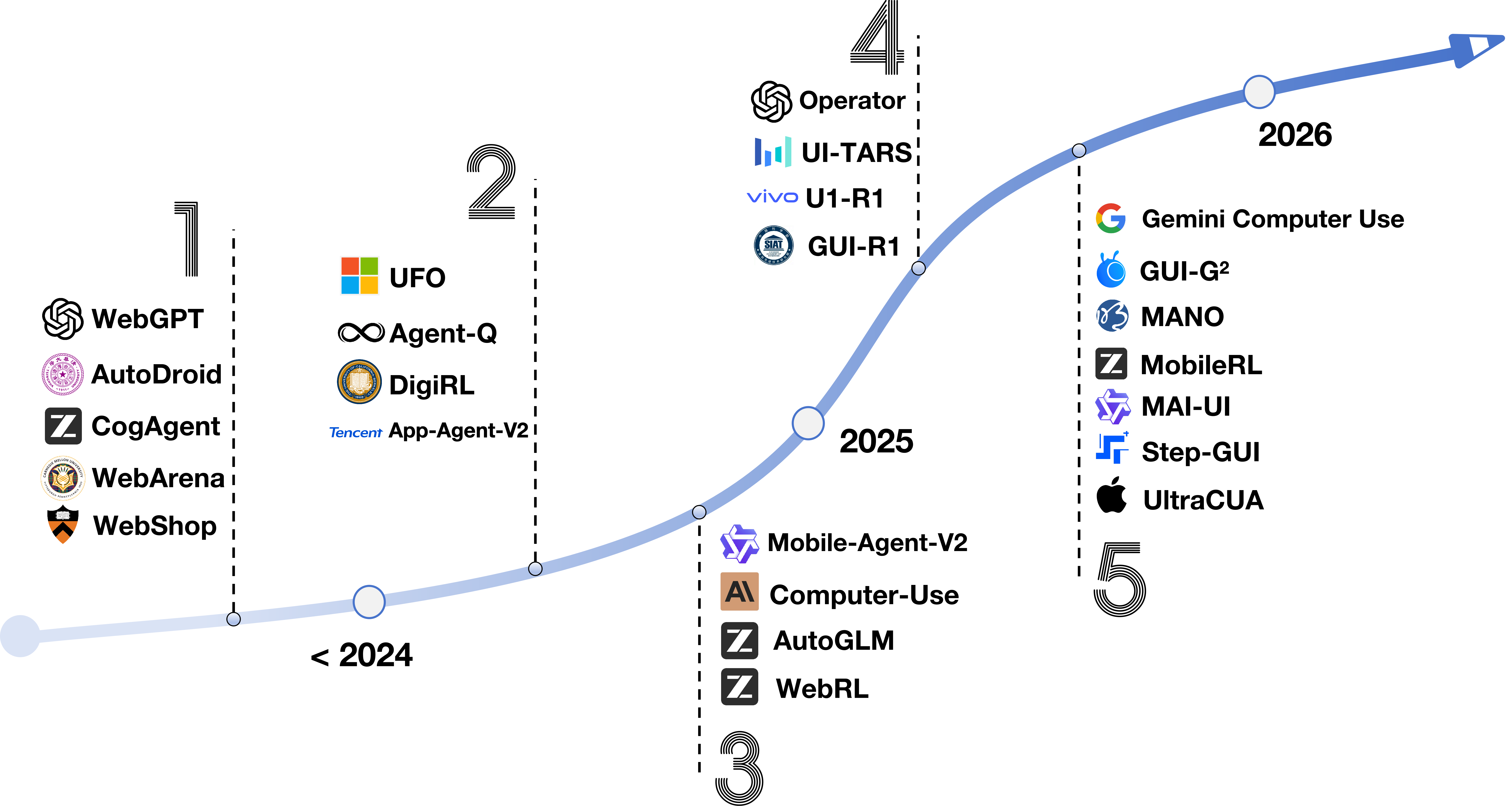
Timeline of GUI Agent Development from rule-based systems to the multimodal LLM era.
📚 Related Surveys
🤝 Contributing
Contributions are welcome! Please see CONTRIBUTING.md for guidelines.
🏗️ RL Methods
Overview of the RL training pipeline for GUI agents. The agent perceives the GUI environment through screenshots, reasons about the task, and executes actions. RL optimizes the policy through reward signals derived from task completion, visual grounding accuracy, and intermediate reasoning quality.
Frontier Models
Reinforcement Learning Paradigms
Offline RFT Methods
Representative Methods
Emerging Directions
Algorithmic Advances: Exploration and Multi-Turn Optimization
🎨 Key Dimensions
Reward Engineering
The process of defining objective feedback signals for GUI tasks.
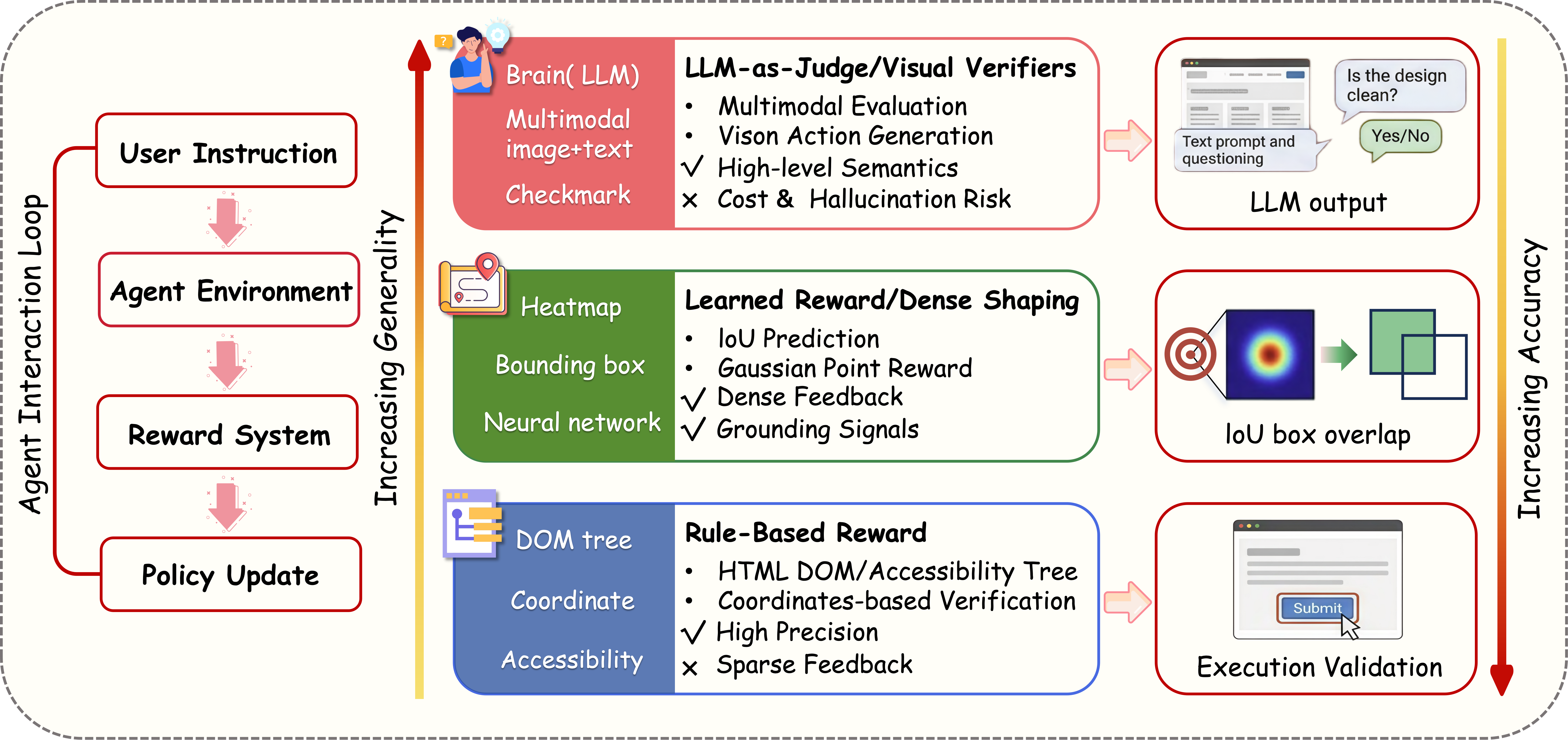
The Reward Engineering Pyramid balances accuracy and generality for GUI Agents: rule-based rewards offer precision, while learned rewards and LLM-as-judge enable semantic depth.
Reward Engineering
Rule-Based Rewards
LLM-as-Judge Rewards
Learned Rewards
| Paper | Venue / Year |
|---|---|
| Infigui-g1: Advancing Gui Grounding with Adaptive Exploration Policy Optimization | AAAI 2026 |
| Gui-g$^2 | 2025 |
Data Efficiency
Synthetic Data via World Models
Enhancement of Human Demonstrations
Iterative Self-Improvement
| Paper | Venue / Year |
|---|---|
| Gui-r1: a Generalist R1-style Vision-language Action Model for Gui Agents | arXiv 2025 |
| Co-epg: a Framework for Co-evolution of Planning and Grounding in Autonomous Gui Agents | arXiv 2025 |
Technical Innovations
Multimodal Perception: Active and Adaptive Visual Grounding
Memory and Planning: Sustaining Context over Long Horizons
📊 Training Resources
Datasets
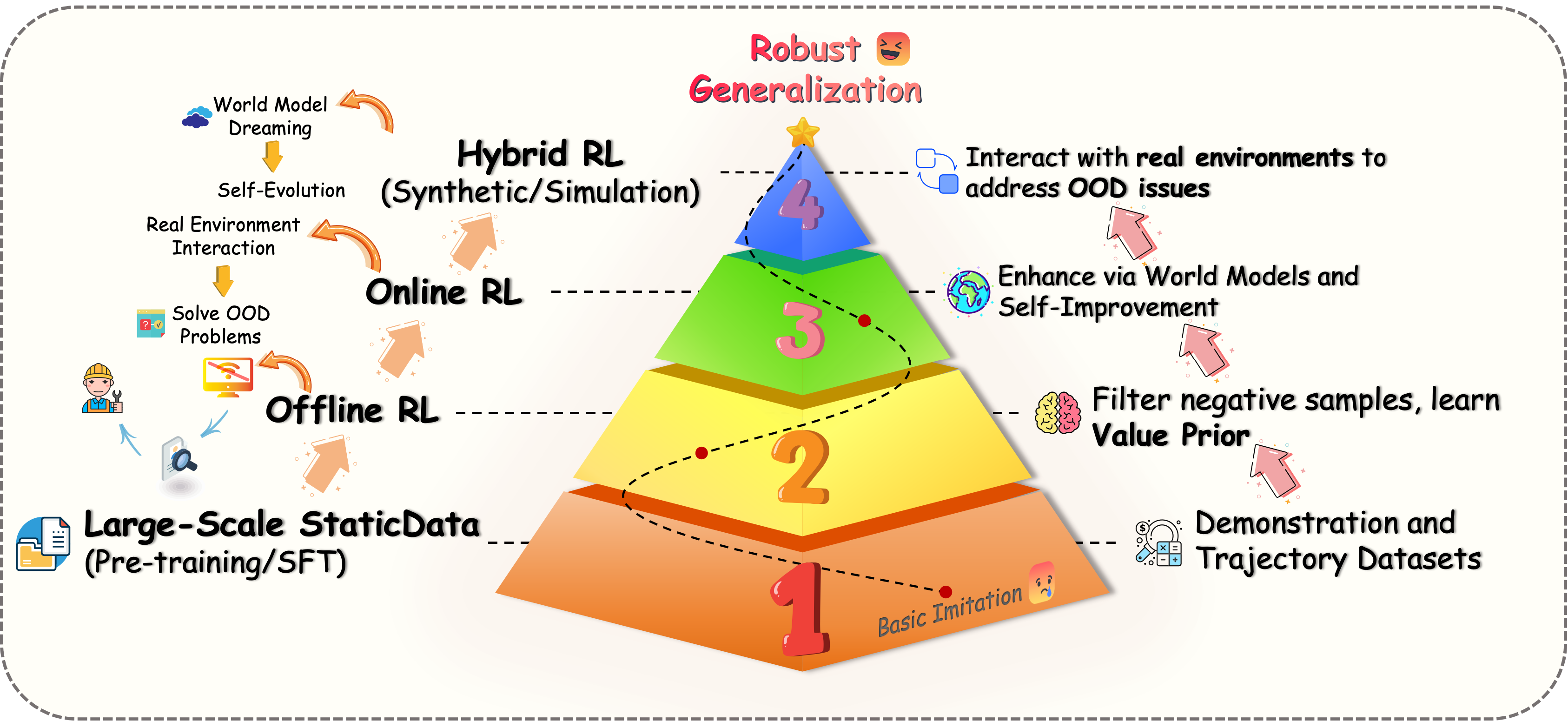
This pyramid depicts a four-stage data-training pipeline for agent capability, progressing from static data imitation to offline RL, synthetic simulation, and online RL.
Demonstration and Trajectory Datasets
Perception and Grounding Datasets
Synthetic and RL-Generated Corpora
Interactive Environments
Web and Browser Environments
Desktop and OS Environments
Mobile Environments
Cross-Platform Trends and Synthesis
RL Infrastructure
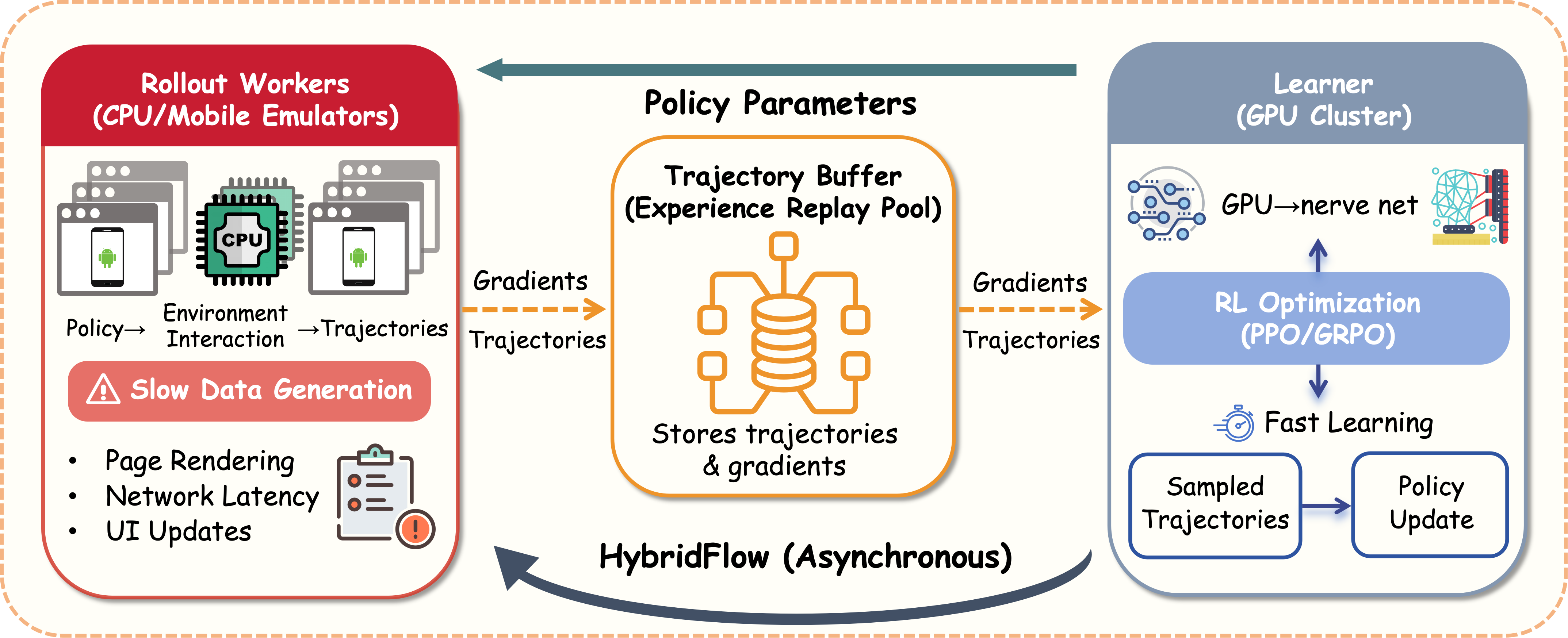
An asynchronous distributed architecture for GUI RL agent training, decoupling slow environment interaction from fast GPU learning.
VLM-RL Algorithm Libraries and Framework Evolution
Distributed Rollout and Training Architectures
Reward Engineering and Verification Systems
Memory Management and Long-Horizon Reasoning
Integration and Ecosystem Standardization
📝 Citation
If you find this repository or our survey useful, please consider citing:
@article{hu2026gui,
  title={GUI Agents with Reinforcement Learning: Toward Digital Inhabitants},
  author={Hu, Junan and Liu, Jian and Lai, Jingxiang and Hu, Jiarui and Sheng, Yiwei and Chen, Shuang and Li, Jian and Du, Dazhao and Guo, Song},
  journal={arXiv preprint arXiv:2604.27955},
  year={2026}
}


Similar repos


Languages
TeX
100.0%
A curated list of awesome RL in GUI Agent papers
See the codeREADME
Awesome Reinforcement Learning for GUI Agents
This repository provides a comprehensive and curated list of research papers, datasets, and tools focused on Reinforcement Learning (RL) in GUI Agents. GUI agents are intelligent systems that perceive graphical interfaces visually and execute tasks through human-like inputs (click, swipe, type).
📄 Based on the survey: GUI Agents with Reinforcement Learning: Toward Digital Inhabitants
📋 Table of Contents
- 🔔 News
- 🌟 Introduction
- 📚 Related Surveys
- 🤝 Contributing
- 🏗️ RL Methods
- 🎨 Key Dimensions
- 📊 Training Resources
- 📝 Citation
Overview of the survey structure. We organize our analysis into three main pillars: RL Methods, Key Dimensions, and Training Resources.
🔔 News
- [2026-04-30] 📄 Our survey "GUI Agents with Reinforcement Learning: Toward Digital Inhabitants" is now available on arXiv!
- [2026-04-19] 🚀 Repository created! Stay tuned for more updates on RL-based GUI Agents.
🌟 Introduction
Reinforcement Learning for GUI agents addresses the core difficulties of GUI automation: long-horizon credit assignment under sparse rewards, distribution shift across evolving interfaces, and safe exploration. We organize the landscape into three methodological paradigms:
- Offline RL: Learning from static datasets without environment interaction.
- Online RL: Refinement through continuous trial and error in dynamic environments.
- Hybrid Strategies: Bridging pre-training and adaptation via semi-online methods and world models.
Overview of the RL training pipeline for GUI agents. The agent perceives the GUI environment through screenshots, reasons about the task, and executes actions. RL optimizes the policy through reward signals derived from task completion, visual grounding accuracy, and intermediate reasoning quality.
Timeline of GUI Agent Development from rule-based systems to the multimodal LLM era.
📚 Related Surveys
🤝 Contributing
Contributions are welcome! Please see CONTRIBUTING.md for guidelines.
🏗️ RL Methods
Overview of the RL training pipeline for GUI agents. The agent perceives the GUI environment through screenshots, reasons about the task, and executes actions. RL optimizes the policy through reward signals derived from task completion, visual grounding accuracy, and intermediate reasoning quality.
Frontier Models
Reinforcement Learning Paradigms
Offline RFT Methods
Representative Methods
Emerging Directions
Algorithmic Advances: Exploration and Multi-Turn Optimization
🎨 Key Dimensions
Reward Engineering
The process of defining objective feedback signals for GUI tasks.
The Reward Engineering Pyramid balances accuracy and generality for GUI Agents: rule-based rewards offer precision, while learned rewards and LLM-as-judge enable semantic depth.
Reward Engineering
Rule-Based Rewards
LLM-as-Judge Rewards
Learned Rewards
| Paper | Venue / Year |
|---|---|
| Infigui-g1: Advancing Gui Grounding with Adaptive Exploration Policy Optimization | AAAI 2026 |
| Gui-g$^2 | 2025 |
Data Efficiency
Synthetic Data via World Models
Enhancement of Human Demonstrations
Iterative Self-Improvement
| Paper | Venue / Year |
|---|---|
| Gui-r1: a Generalist R1-style Vision-language Action Model for Gui Agents | arXiv 2025 |
| Co-epg: a Framework for Co-evolution of Planning and Grounding in Autonomous Gui Agents | arXiv 2025 |
Technical Innovations
Multimodal Perception: Active and Adaptive Visual Grounding
Memory and Planning: Sustaining Context over Long Horizons
📊 Training Resources
Datasets
This pyramid depicts a four-stage data-training pipeline for agent capability, progressing from static data imitation to offline RL, synthetic simulation, and online RL.
Demonstration and Trajectory Datasets
Perception and Grounding Datasets
Synthetic and RL-Generated Corpora
Interactive Environments
Web and Browser Environments
Desktop and OS Environments
Mobile Environments
Cross-Platform Trends and Synthesis
RL Infrastructure
An asynchronous distributed architecture for GUI RL agent training, decoupling slow environment interaction from fast GPU learning.
VLM-RL Algorithm Libraries and Framework Evolution
Distributed Rollout and Training Architectures
Reward Engineering and Verification Systems
Memory Management and Long-Horizon Reasoning
Integration and Ecosystem Standardization
📝 Citation
If you find this repository or our survey useful, please consider citing:
@article{hu2026gui,
  title={GUI Agents with Reinforcement Learning: Toward Digital Inhabitants},
  author={Hu, Junan and Liu, Jian and Lai, Jingxiang and Hu, Jiarui and Sheng, Yiwei and Chen, Shuang and Li, Jian and Du, Dazhao and Guo, Song},
  journal={arXiv preprint arXiv:2604.27955},
  year={2026}
}
Similar repos
Languages
TeX
100.0%