
Unofficial .NET bindings for Google's LiteRT-LM — on-device LLM inference (Gemma) for Windows, Linux, Android, macOS & MAUI
See the codeREADME
LiteRtLmSharp
Run LLMs on-device from any .NET app — Windows, Linux, Android, macOS, MAUI. No server, no cloud.





Documentation · API Reference · Samples · Changelog · Roadmap
.NET 10 bindings for Google's LiteRT-LM — on-device LLM inference (e.g. Gemma) via P/Invoke over its C API, with native binaries distributed per-RID as NuGet packages (LLamaSharp-style). Status: stable (1.x).
| Platform | Native | NuGet | CPU | GPU | Validated on |
|---|---|---|---|---|---|
| win-x64 | ✅ | ✅ | ✅ | ✅ | real hardware |
| linux-x64 | ✅ | ✅ | ✅ | ✅ | real hardware (GPU last checked with the v0.13.1 libraries) |
| linux-arm64 | ✅ | ⏳ | ✅ | — | CI |
| android-arm64 | ✅ | ✅ | ✅ | ✅ | real device |
| android-x64 (emulator) | ✅ | ⏳ | ✅ | — | emulator |
| osx-arm64 | ✅ | ✅ | ✅ | ✅ | CI |
| ios-arm64 | ✅ | ⏳ | — | — | pending |
CPU / GPU = inference validated on that backend. macOS GPU runs in CI on the WebGPU (Dawn→Metal) delegate; the native Metal delegate ships as a real-hardware fallback. linux-arm64 and android-x64 publish with the next release. The iOS runtime package ships once on-device validation lands.
Quick start
<PackageReference Include="LiteRtLmSharp" Version="1.2.0" />
<PackageReference Include="LiteRtLmSharp.runtime.win-x64" Version="1.2.0" />
<!-- or LiteRtLmSharp.runtime.linux-x64 / linux-arm64 / android-arm64 / android-x64 (emulator) / osx-arm64, per target -->
Install the managed package plus the runtime package for your platform, always with the same version number. Which LiteRT-LM native build each release wraps:
| LiteRtLmSharp | LiteRT-LM native |
|---|---|
| 1.2.0 | v0.16.0 (Google's official C API prebuilts) |
| 1.1.1 | v0.14.0 |
| 1.1.0 | v0.14.0 |
| 1.0.0 | v0.13.1 |
| 0.1.0-preview.3 | v0.13.1 |
| 0.1.0-preview.2 | v0.13.1 |
| 0.1.0-preview.1 | v0.13.1 |
using LiteRtLmSharp;

using var engine = LiteRtEngine.Load(new LiteRtEngineOptions
{
    ModelPath = "gemma-4-E2B-it.litertlm",   // from huggingface.co/litert-community
    Backend = LiteRtBackend.Cpu,              // or .Gpu (WebGPU -> D3D12/Vulkan/Metal)
    MaxNumTokens = 4096,                       // total context window
});

using var chat = engine.CreateConversation();

// Blocking:
Console.WriteLine(chat.Send("Hello!").Text);

// Awaitable (pass a CancellationToken to cancel mid-generation):
Console.WriteLine((await chat.SendAsync("Hello!")).Text);

// Streaming: each piece is tagged (answer / thinking / tool call):
await foreach (var chunk in chat.SendStreamingAsync("Tell me a joke"))
    Console.Write(chunk.Text);
Features
Every feature has a full guide on the documentation site:
| Chat | Blocking, awaitable + cancellable, and streaming sends — guide |
| Function calling | Real tool calls with constrained decoding for reliable JSON arguments — guide |
| Reasoning mode | Gemma "thinking", surfaced separately from the answer (blocking & streaming) — guide |
| Multimodal | Image and audio attachments, in-memory or memory-mapped from disk — guide |
| Conversation state | Persist/restore chats across restarts; clone a live conversation to branch it — guide |
| Embeddings | On-device text embeddings (EmbeddingGemma 2) for semantic search and RAG, next to a chat model — guide |
| Model metadata | Read a model file's type, context size, inputs and backends without loading it — guide |
| Token counting | Tokenize/detokenize with the model's own tokenizer; budget the context window — guide |
| Speculative decoding | MTP drafter support plus a built-in benchmark API (tok/s, TTFT) — guide |
| Engine tuning | Activation precision, prefill chunking, thread counts, cache control — guide |
| .NET AI ecosystem | IChatClient, IEmbeddingGenerator + Semantic Kernel connectors (below) |
| AOT & trimming | Source-generated P/Invoke, no runtime marshalling — Native AOT compatible |
.NET AI integrations
Two optional companion packages plug the on-device model into the .NET AI ecosystem:
| Package | Exposes the model as | Works with |
|---|---|---|
LiteRtLmSharp.Extensions.AI | Microsoft.Extensions.AI.IChatClient, IEmbeddingGenerator | Microsoft Agent Framework, Semantic Kernel, plain MEAI |
LiteRtLmSharp.SemanticKernel | IChatCompletionService, embedding generator | Semantic Kernel |
using IChatClient client = new LiteRtChatClient(engine);
Console.WriteLine((await client.GetResponseAsync("One upbeat sentence about on-device AI.")).Text);
// var agent = new ChatClientAgent(client, "You are helpful.");   // Microsoft Agent Framework
Function calling (auto-invocation), reasoning content, multimodal and opt-in stateful
conversations (MEAI ConversationId) are supported — see the
Extensions.AI guide and the
Semantic Kernel guide.
Samples
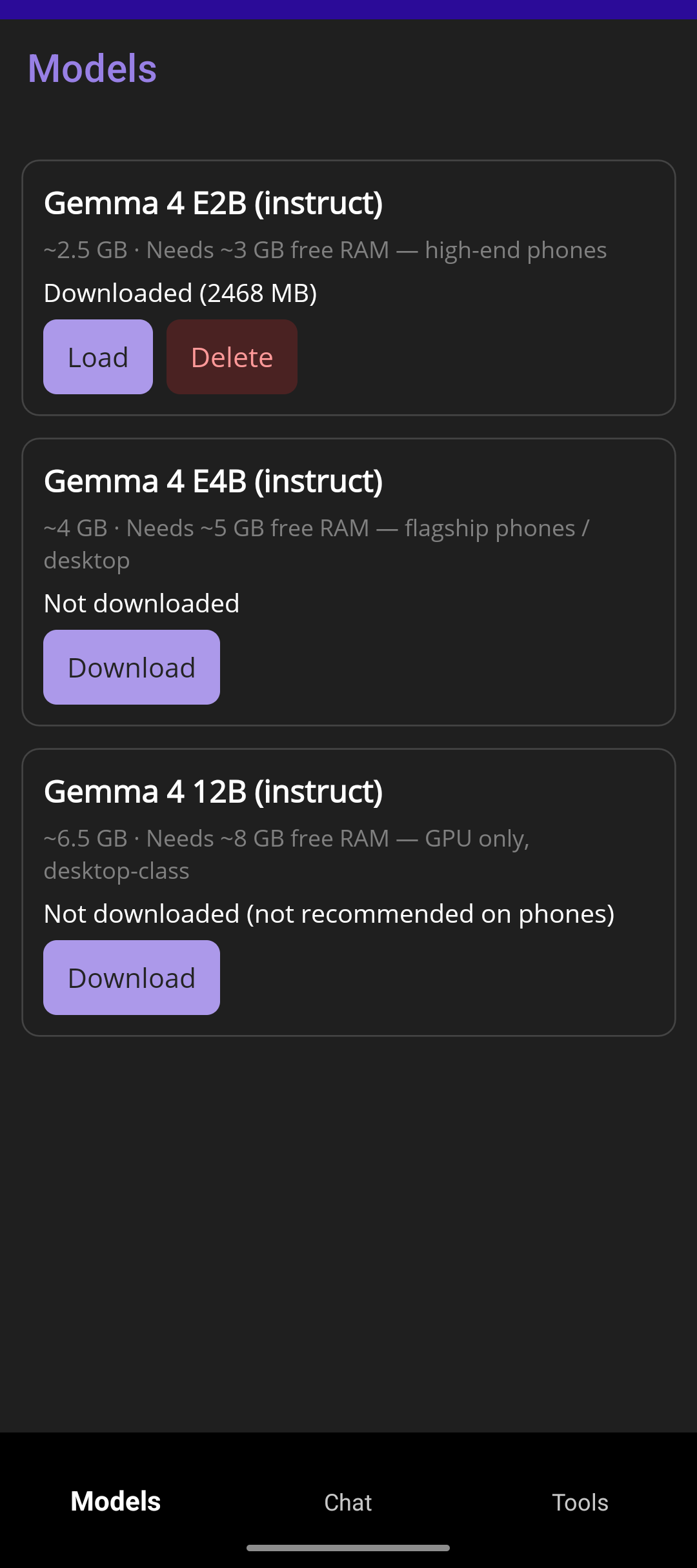
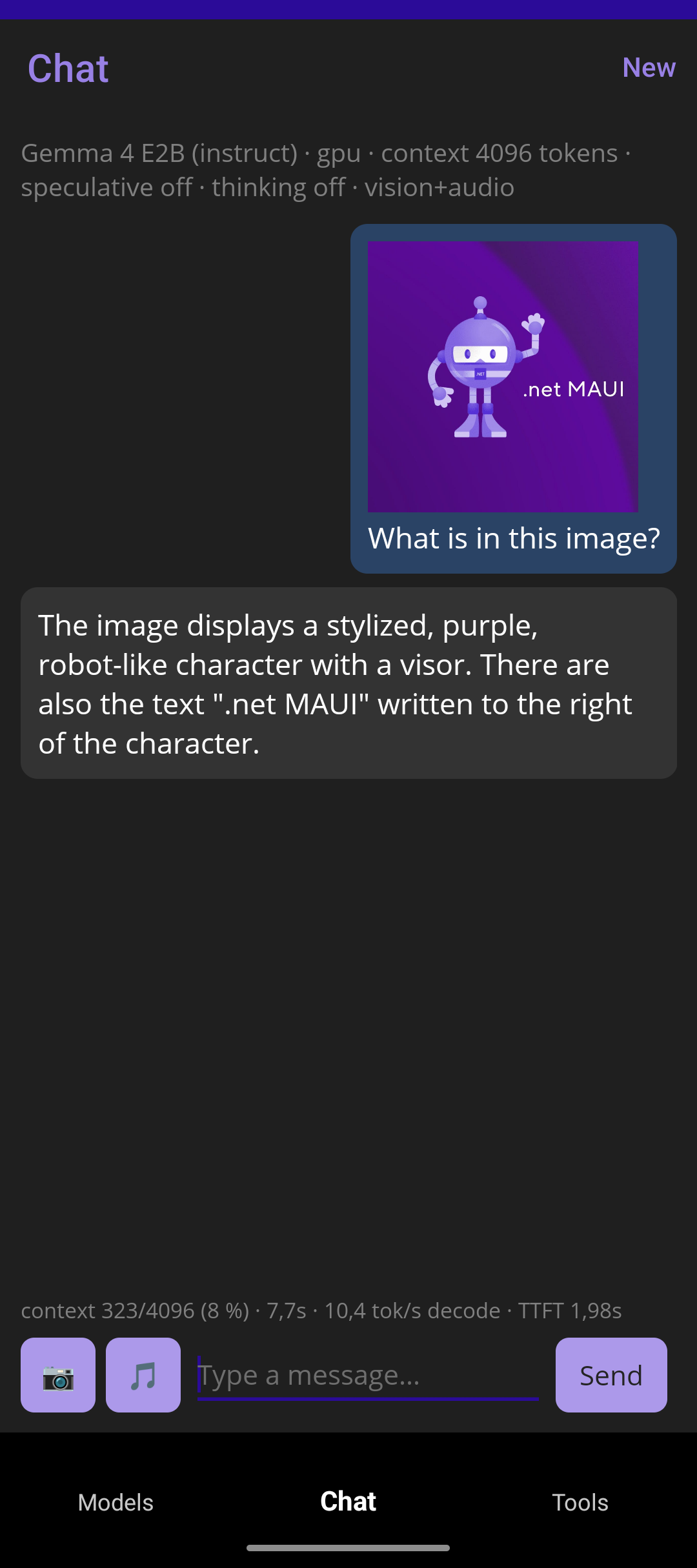
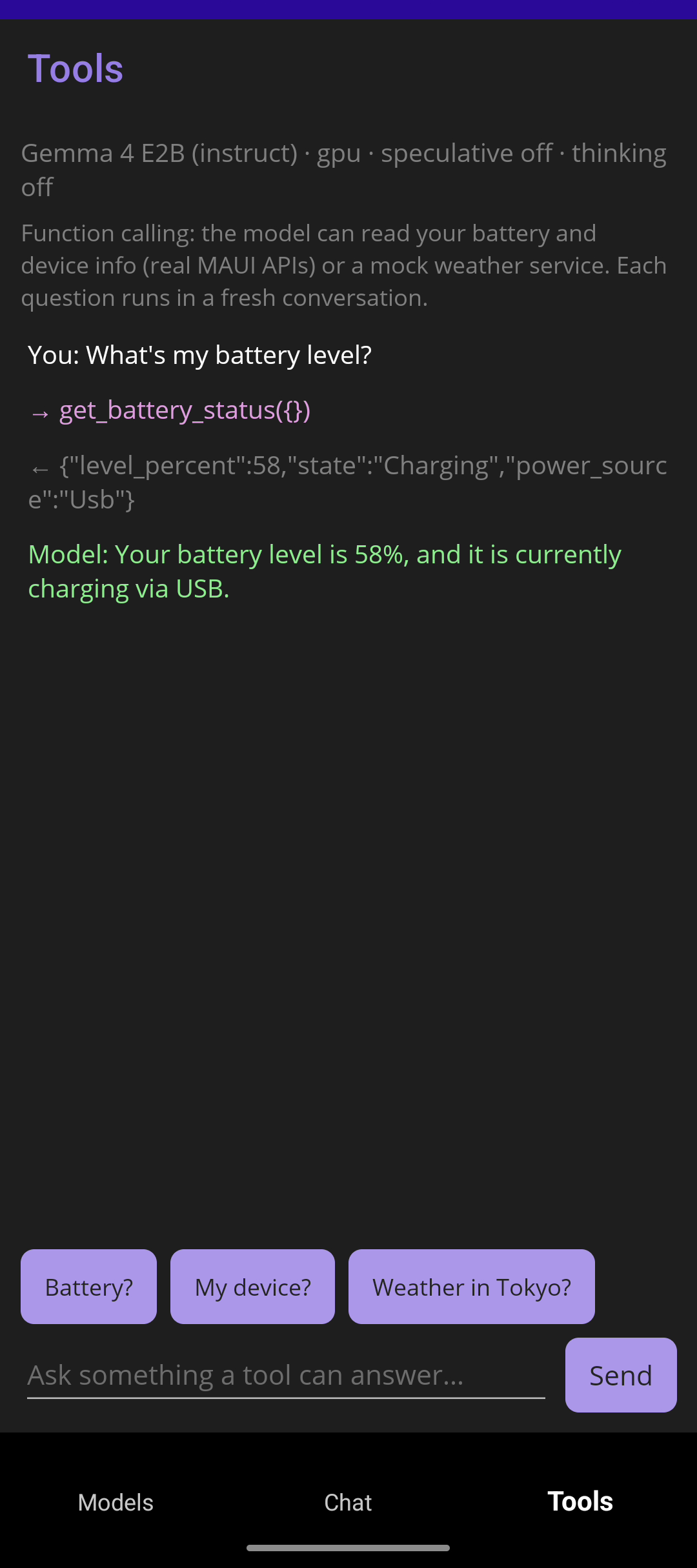
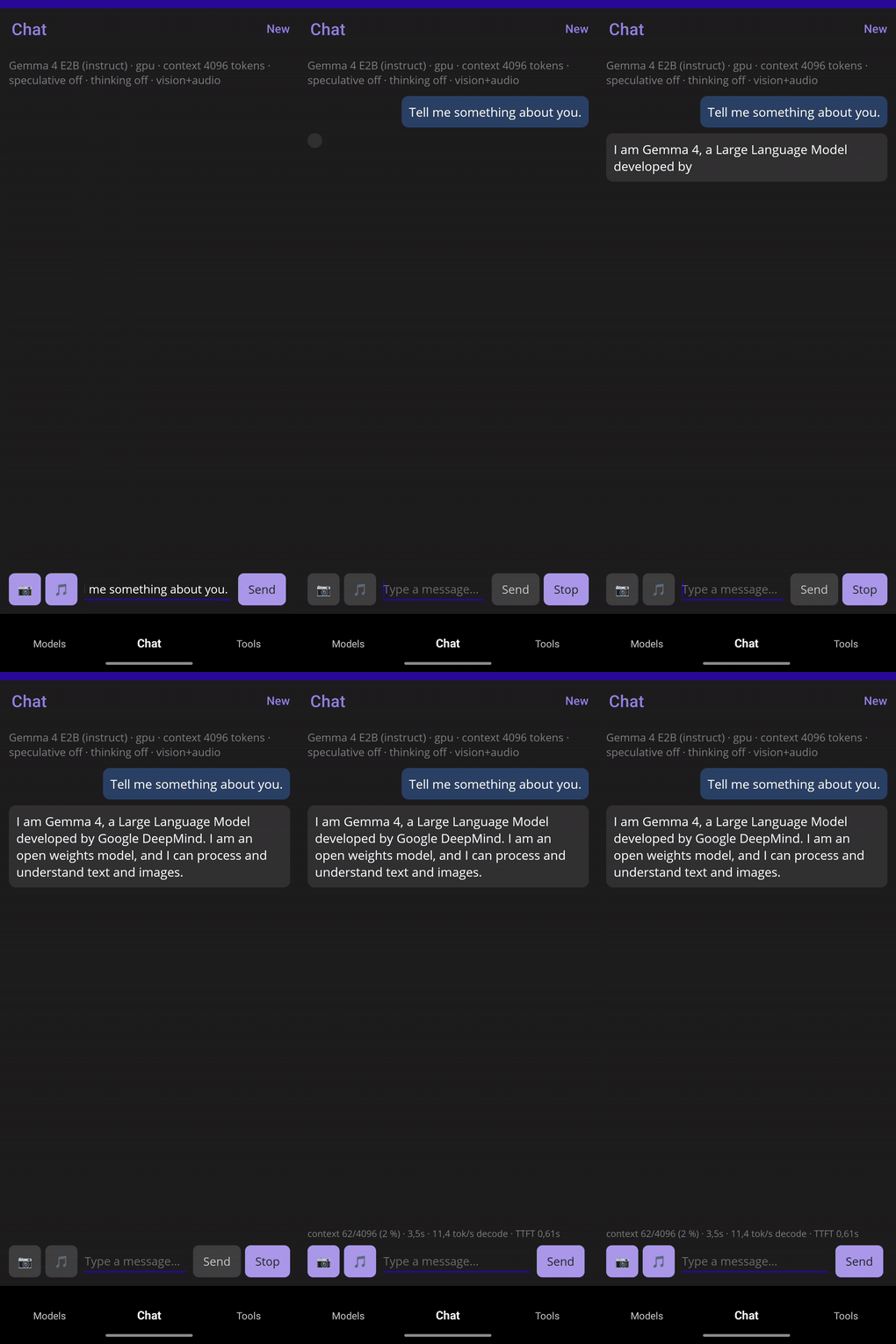
samples/Maui— full Android/Windows chat app: model download with resume, streaming, multimodal attachments, function calling against real device APIs, speculative-decoding and reasoning toggles.samples/Console— chat loop with--tools,--specand--thinkingdemos.samples/SemanticKernel— kernel registration, streaming, and a[KernelFunction]plugin.
Important notes
- One chat engine alive at a time. Loading a second
LiteRtEnginewhile one is alive throws (it would hang in the native layer). To switch model or backend, dispose the conversations and the engine, thenLiteRtEngine.Loadagain — same pattern as Google's Edge Gallery. An embedding engine (LiteRtEmbeddingEngine) does not count, so a chat model and an embedding model can stay loaded together. MaxNumTokensis the total context window (prompt + response, across turns). Use >= 1024; too small can make blocking generation return nothing.- Conversations are not thread-safe — serialize sends per engine (the Microsoft.Extensions.AI client does this for you).
- Linux needs no extra system package for the CPU backend since 1.3.0 (1.2.0's library needed
libvulkan1). The official library has no hard dependency on the Vulkan loader. The GPU backend runs on Vulkan: install your GPU's Vulkan driver and the Vulkan loader (libvulkan1on Debian/Ubuntu). - win-x64 needs no Visual C++ Redistributable since 1.2.0 (the official library links the CRT
statically). The GPU backend's shader compiler (
dxcompiler.dll,dxil.dll) ships in the runtime package. - Android GPU needs manifest declarations. Android 12+ only grants access to vendor native
libraries declared via
<uses-native-library>; withoutlibOpenCL.sothe engine silently picks a Vulkan path that produces garbage on older Adreno drivers. Copy the<uses-native-library>block from the MAUI sample's AndroidManifest. Full diagnosis in the Android guide.
Why .NET 10 only?
.NET 10 is the current LTS. Targeting it exclusively lets the binding use the modern interop stack
as designed — source-generated P/Invoke ([LibraryImport]) and [UnmanagedCallersOnly] callbacks
with no runtime marshalling, which is what makes it AOT- and trim-compatible — and a single
net10.0 TFM is directly consumable from net10.0-android/-ios/-windows MAUI apps without
multi-targeting.
Building from source
Native binaries are not committed — restore them into runtimes/<rid>/native/ from the
native-v* GitHub release, then build:
pwsh scripts/restore-natives.ps1    # -All for every RID, -Rid android-arm64 for one
dotnet build LiteRtLmSharp.slnx && dotnet test
The samples have their own solution (samples/LiteRtLmSharp.Samples.slnx; the MAUI sample needs
dotnet workload install maui). To run the model-backed tests, point LITERTLM_TEST_MODEL at a
.litertlm file. CI: native-release.yml
repackages Google's official LiteRT-LM C API prebuilts for a pinned release (verified against the
sha256 digests GitHub or PyPI publish, each library inspected) into the native-v* release,
pack-nuget.yml
packs and publishes. Internals docs:
native ABI,
native build,
packaging.
Contributing
Issues and PRs are welcome — see CONTRIBUTING.md for the dev setup and guidelines. Please open an issue first for anything beyond a small fix, and use Discussions for questions.
License and trademarks
Apache-2.0 (see LICENSE.txt, NOTICE and THIRD-PARTY-NOTICES.md).
This is an unofficial, community-maintained project. It is not affiliated with, sponsored, or endorsed by Google. LiteRT, LiteRT-LM and Gemma are trademarks of Google LLC. The native binaries are Google's official LiteRT-LM prebuilts (Apache-2.0) at pinned release tags.
Similar repos


Unofficial .NET bindings for Google's LiteRT-LM — on-device LLM inference (Gemma) for Windows, Linux, Android, macOS & MAUI
See the codeREADME
LiteRtLmSharp
Run LLMs on-device from any .NET app — Windows, Linux, Android, macOS, MAUI. No server, no cloud.
Documentation · API Reference · Samples · Changelog · Roadmap
.NET 10 bindings for Google's LiteRT-LM — on-device LLM inference (e.g. Gemma) via P/Invoke over its C API, with native binaries distributed per-RID as NuGet packages (LLamaSharp-style). Status: stable (1.x).
| Platform | Native | NuGet | CPU | GPU | Validated on |
|---|---|---|---|---|---|
| win-x64 | ✅ | ✅ | ✅ | ✅ | real hardware |
| linux-x64 | ✅ | ✅ | ✅ | ✅ | real hardware (GPU last checked with the v0.13.1 libraries) |
| linux-arm64 | ✅ | ⏳ | ✅ | — | CI |
| android-arm64 | ✅ | ✅ | ✅ | ✅ | real device |
| android-x64 (emulator) | ✅ | ⏳ | ✅ | — | emulator |
| osx-arm64 | ✅ | ✅ | ✅ | ✅ | CI |
| ios-arm64 | ✅ | ⏳ | — | — | pending |
CPU / GPU = inference validated on that backend. macOS GPU runs in CI on the WebGPU (Dawn→Metal) delegate; the native Metal delegate ships as a real-hardware fallback. linux-arm64 and android-x64 publish with the next release. The iOS runtime package ships once on-device validation lands.
Quick start
<PackageReference Include="LiteRtLmSharp" Version="1.2.0" />
<PackageReference Include="LiteRtLmSharp.runtime.win-x64" Version="1.2.0" />
<!-- or LiteRtLmSharp.runtime.linux-x64 / linux-arm64 / android-arm64 / android-x64 (emulator) / osx-arm64, per target -->
Install the managed package plus the runtime package for your platform, always with the same version number. Which LiteRT-LM native build each release wraps:
| LiteRtLmSharp | LiteRT-LM native |
|---|---|
| 1.2.0 | v0.16.0 (Google's official C API prebuilts) |
| 1.1.1 | v0.14.0 |
| 1.1.0 | v0.14.0 |
| 1.0.0 | v0.13.1 |
| 0.1.0-preview.3 | v0.13.1 |
| 0.1.0-preview.2 | v0.13.1 |
| 0.1.0-preview.1 | v0.13.1 |
using LiteRtLmSharp;

using var engine = LiteRtEngine.Load(new LiteRtEngineOptions
{
    ModelPath = "gemma-4-E2B-it.litertlm",   // from huggingface.co/litert-community
    Backend = LiteRtBackend.Cpu,              // or .Gpu (WebGPU -> D3D12/Vulkan/Metal)
    MaxNumTokens = 4096,                       // total context window
});

using var chat = engine.CreateConversation();

// Blocking:
Console.WriteLine(chat.Send("Hello!").Text);

// Awaitable (pass a CancellationToken to cancel mid-generation):
Console.WriteLine((await chat.SendAsync("Hello!")).Text);

// Streaming: each piece is tagged (answer / thinking / tool call):
await foreach (var chunk in chat.SendStreamingAsync("Tell me a joke"))
    Console.Write(chunk.Text);
Features
Every feature has a full guide on the documentation site:
| Chat | Blocking, awaitable + cancellable, and streaming sends — guide |
| Function calling | Real tool calls with constrained decoding for reliable JSON arguments — guide |
| Reasoning mode | Gemma "thinking", surfaced separately from the answer (blocking & streaming) — guide |
| Multimodal | Image and audio attachments, in-memory or memory-mapped from disk — guide |
| Conversation state | Persist/restore chats across restarts; clone a live conversation to branch it — guide |
| Embeddings | On-device text embeddings (EmbeddingGemma 2) for semantic search and RAG, next to a chat model — guide |
| Model metadata | Read a model file's type, context size, inputs and backends without loading it — guide |
| Token counting | Tokenize/detokenize with the model's own tokenizer; budget the context window — guide |
| Speculative decoding | MTP drafter support plus a built-in benchmark API (tok/s, TTFT) — guide |
| Engine tuning | Activation precision, prefill chunking, thread counts, cache control — guide |
| .NET AI ecosystem | IChatClient, IEmbeddingGenerator + Semantic Kernel connectors (below) |
| AOT & trimming | Source-generated P/Invoke, no runtime marshalling — Native AOT compatible |
.NET AI integrations
Two optional companion packages plug the on-device model into the .NET AI ecosystem:
| Package | Exposes the model as | Works with |
|---|---|---|
LiteRtLmSharp.Extensions.AI | Microsoft.Extensions.AI.IChatClient, IEmbeddingGenerator | Microsoft Agent Framework, Semantic Kernel, plain MEAI |
LiteRtLmSharp.SemanticKernel | IChatCompletionService, embedding generator | Semantic Kernel |
using IChatClient client = new LiteRtChatClient(engine);
Console.WriteLine((await client.GetResponseAsync("One upbeat sentence about on-device AI.")).Text);
// var agent = new ChatClientAgent(client, "You are helpful.");   // Microsoft Agent Framework
Function calling (auto-invocation), reasoning content, multimodal and opt-in stateful
conversations (MEAI ConversationId) are supported — see the
Extensions.AI guide and the
Semantic Kernel guide.
Samples
samples/Maui— full Android/Windows chat app: model download with resume, streaming, multimodal attachments, function calling against real device APIs, speculative-decoding and reasoning toggles.samples/Console— chat loop with--tools,--specand--thinkingdemos.samples/SemanticKernel— kernel registration, streaming, and a[KernelFunction]plugin.
Important notes
- One chat engine alive at a time. Loading a second
LiteRtEnginewhile one is alive throws (it would hang in the native layer). To switch model or backend, dispose the conversations and the engine, thenLiteRtEngine.Loadagain — same pattern as Google's Edge Gallery. An embedding engine (LiteRtEmbeddingEngine) does not count, so a chat model and an embedding model can stay loaded together. MaxNumTokensis the total context window (prompt + response, across turns). Use >= 1024; too small can make blocking generation return nothing.- Conversations are not thread-safe — serialize sends per engine (the Microsoft.Extensions.AI client does this for you).
- Linux needs no extra system package for the CPU backend since 1.3.0 (1.2.0's library needed
libvulkan1). The official library has no hard dependency on the Vulkan loader. The GPU backend runs on Vulkan: install your GPU's Vulkan driver and the Vulkan loader (libvulkan1on Debian/Ubuntu). - win-x64 needs no Visual C++ Redistributable since 1.2.0 (the official library links the CRT
statically). The GPU backend's shader compiler (
dxcompiler.dll,dxil.dll) ships in the runtime package. - Android GPU needs manifest declarations. Android 12+ only grants access to vendor native
libraries declared via
<uses-native-library>; withoutlibOpenCL.sothe engine silently picks a Vulkan path that produces garbage on older Adreno drivers. Copy the<uses-native-library>block from the MAUI sample's AndroidManifest. Full diagnosis in the Android guide.
Why .NET 10 only?
.NET 10 is the current LTS. Targeting it exclusively lets the binding use the modern interop stack
as designed — source-generated P/Invoke ([LibraryImport]) and [UnmanagedCallersOnly] callbacks
with no runtime marshalling, which is what makes it AOT- and trim-compatible — and a single
net10.0 TFM is directly consumable from net10.0-android/-ios/-windows MAUI apps without
multi-targeting.
Building from source
Native binaries are not committed — restore them into runtimes/<rid>/native/ from the
native-v* GitHub release, then build:
pwsh scripts/restore-natives.ps1    # -All for every RID, -Rid android-arm64 for one
dotnet build LiteRtLmSharp.slnx && dotnet test
The samples have their own solution (samples/LiteRtLmSharp.Samples.slnx; the MAUI sample needs
dotnet workload install maui). To run the model-backed tests, point LITERTLM_TEST_MODEL at a
.litertlm file. CI: native-release.yml
repackages Google's official LiteRT-LM C API prebuilts for a pinned release (verified against the
sha256 digests GitHub or PyPI publish, each library inspected) into the native-v* release,
pack-nuget.yml
packs and publishes. Internals docs:
native ABI,
native build,
packaging.
Contributing
Issues and PRs are welcome — see CONTRIBUTING.md for the dev setup and guidelines. Please open an issue first for anything beyond a small fix, and use Discussions for questions.
License and trademarks
Apache-2.0 (see LICENSE.txt, NOTICE and THIRD-PARTY-NOTICES.md).
This is an unofficial, community-maintained project. It is not affiliated with, sponsored, or endorsed by Google. LiteRT, LiteRT-LM and Gemma are trademarks of Google LLC. The native binaries are Google's official LiteRT-LM prebuilts (Apache-2.0) at pinned release tags.