This is the official repository for PRAGMA: Evaluating Personalized Guidance with Memory Alignment in Lifelong Conversations (EMNLP 2026).

PRAGMA/
  config.yaml
  pipeline/
    config.py
    run_pipeline.py
    sample_users.py
    extract_schema.py
    create_events.py
    event_query.py
    create_traj.py
    traj_query.py
    evid_sessions.py
    filler_sessions.py
    full_sessions.py
  metrics/
    eval_criteria.py
  figures/
    pipeline.png
  requirements.txt
The released benchmark and evaluation rubrics are hosted in the PRAGMA dataset repository on Hugging Face. Download them into the expected local directory with:
python -m pip install -U huggingface_hub
hf download stellahj/PRAGMA \
  --repo-type dataset \
  --include "data/*.json" \
  --local-dir .
Most users only need:
data/full_sessions.json: timestamp-ordered conversation histories for 100 users.data/metadata.json: 400 benchmark queries with query types and gold evidence-session indices.data/response_metrics.json: released alignment and grounding rubrics.Join records by user_id. For each item in metadata.json, evidence_session_index selects the gold evidence sessions from that user's sessions array in full_sessions.json. Match rubric records in response_metrics.json by (user_id, query).
The experiments reported in the paper used GPT-5 (gpt-5-2025-08-07) as the default LLM judge for the released alignment and grounding rubrics.
The construction pipeline is provided for researchers who want to recreate PRAGMA or extend it with additional data.
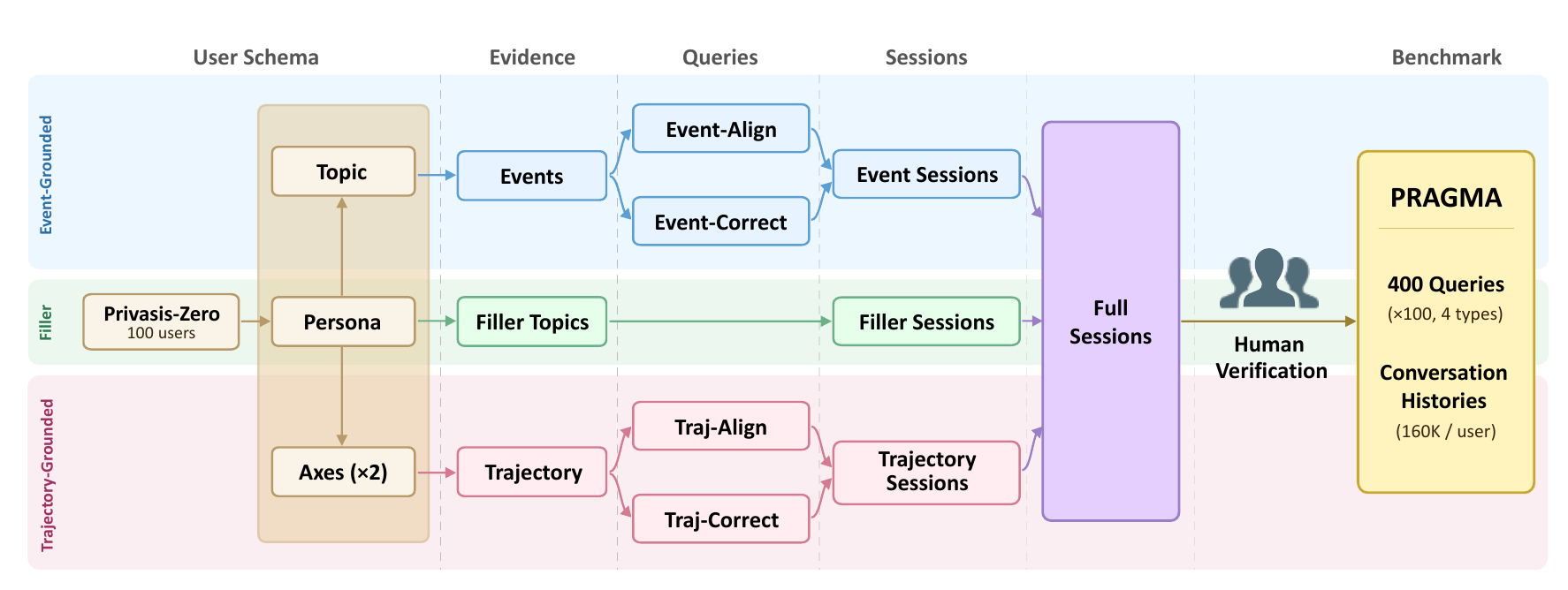
Python 3.10 or newer is recommended.
git clone https://github.com/yuhyojeong/PRAGMA.git
cd PRAGMA
python3 -m venv .venv
source .venv/bin/activate
python -m pip install --upgrade pip
python -m pip install -r requirements.txt
On Windows PowerShell, activate the environment with .venv\Scripts\Activate.ps1 instead of source .venv/bin/activate.
Set an OpenAI API key before generating model-produced artifacts:
export OPENAI_API_KEY="your-api-key"
Edit config.yaml to use other OpenAI models or change generation concurrency, retry limits, and user-sampling settings. Model IDs are configured separately for each construction task, so stages can be changed independently. Stages that request JSON-schema outputs require an OpenAI model that supports Structured Outputs.
evidence_requests and filler_requests directly limit the total number of concurrent API requests in their respective stages. Reduce these values if API rate limits are encountered. All configuration fields are required; missing or invalid values stop the pipeline with an explicit error.
Run all construction stages:
python pipeline/run_pipeline.py
Include evaluation-rubric generation:
python pipeline/run_pipeline.py --with-metrics
The runner supports --start, --end, --only, --skip, and --dry-run:
python pipeline/run_pipeline.py --start create_events
python pipeline/run_pipeline.py --start event_query --end traj_query
python pipeline/run_pipeline.py --only event_query,traj_query
python pipeline/run_pipeline.py --skip sample_users
python pipeline/run_pipeline.py --dry-run
| Step | Script | Input | Output |
|---|---|---|---|
| 1 | pipeline/sample_users.py | Hugging Face nvidia/Privasis-Zero | data/privasis.json |
| 2 | pipeline/extract_schema.py | data/privasis.json | persona, axes, rewritten axes, and topic in query_data.json |
| 3 | pipeline/create_events.py | data/query_data.json | events and event timestamps |
| 4 | pipeline/event_query.py | event fields | type 1/2 queries and type 2 evidence indices |
| 5 | pipeline/create_traj.py | data/query_data.json | trajectory states and timestamps |
| 6 | pipeline/traj_query.py | trajectory fields | type 3/4 queries and type 4 evidence indices |
| 7 | pipeline/evid_sessions.py | data/query_data.json | data/evid_sessions.json |
| 8 | pipeline/filler_sessions.py | data/query_data.json | data/filler_sessions.json |
| 9 | pipeline/full_sessions.py | evidence and filler sessions | full_sessions.json and metadata.json |
| 10 | metrics/eval_criteria.py | metadata and query data | response_metrics.json |
To regenerate rubrics separately, run:
python metrics/eval_criteria.py
This overwrites data/response_metrics.json.
| Type | Name | Gold evidence scope | Expected behavior |
|---|---|---|---|
type1 | Event-Align | All event sessions for the user | Recommend a next step that builds on prior event-level experiences. |
type2 | Event-Correct | Event sessions involved in the incorrect recollection | Detect and correct a mistaken recollection in the query. |
type3 | Trajectory-Align | All trajectory-state sessions for the user | Position the user in a way that reflects their evolving trajectory across multiple states. |
type4 | Trajectory-Correct | Trajectory-state sessions that provide counter-evidence | Detect a decision that conflicts with the user's prior trajectory. |
data/privasis.json — sampled source users.id, profiles, event_list.data/query_data.json — one benchmark specification per user.user_id, persona, axes, topic, events, event_timestamps, type1, type2, type2_evid, trajectory, trajectory_timestamps, rewritten axes, type3, type4, type4_evid.data/evid_sessions.json — generated evidence conversations.user_id, persona, event_timestamps, event_turns, trajectory_timestamps, trajectory_turns.data/filler_sessions.json — unrelated filler conversations.user_id, persona, filler_topics, filler_turns.data/full_sessions.json — final histories sorted by timestamp.user_id, persona, timestamps, session_types, sessions.data/metadata.json — one record per (user_id, query_type).user_id, persona, query_type, query, query_timestamp, evidence_session_timestamps, evidence_session_index, summarized_evidence.data/response_metrics.json — one record per evaluation item.user_id, query_type, query, evidence, alignment_metric, grounding_metric.Index relationships:
type2_evid indexes into events; type4_evid indexes into trajectory.event_turns[i] corresponds to event_timestamps[i]; trajectory_turns[i] corresponds to trajectory_timestamps[i].filler_turns[i] corresponds to filler_topics[i].evidence_session_index indexes into the corresponding user's sessions in full_sessions.json.session_types contains event, trajectory, or filler.@misc{yu2026pragmaevaluatingpersonalizedguidance,
title={PRAGMA: Evaluating Personalized Guidance with Memory Alignment in Lifelong Conversations},
author={Hyojeong Yu and Hyukhun Koh and Minsung Kim and Yunah Jang and Kyomin Jung},
year={2026},
eprint={2609.09664},
archivePrefix={arXiv},
primaryClass={cs.AI},
url={https://arxiv.org/abs/2609.09664},
}
This is the official repository for PRAGMA: Evaluating Personalized Guidance with Memory Alignment in Lifelong Conversations (EMNLP 2026).
PRAGMA/
  config.yaml
  pipeline/
    config.py
    run_pipeline.py
    sample_users.py
    extract_schema.py
    create_events.py
    event_query.py
    create_traj.py
    traj_query.py
    evid_sessions.py
    filler_sessions.py
    full_sessions.py
  metrics/
    eval_criteria.py
  figures/
    pipeline.png
  requirements.txt
The released benchmark and evaluation rubrics are hosted in the PRAGMA dataset repository on Hugging Face. Download them into the expected local directory with:
python -m pip install -U huggingface_hub
hf download stellahj/PRAGMA \
  --repo-type dataset \
  --include "data/*.json" \
  --local-dir .
Most users only need:
data/full_sessions.json: timestamp-ordered conversation histories for 100 users.data/metadata.json: 400 benchmark queries with query types and gold evidence-session indices.data/response_metrics.json: released alignment and grounding rubrics.Join records by user_id. For each item in metadata.json, evidence_session_index selects the gold evidence sessions from that user's sessions array in full_sessions.json. Match rubric records in response_metrics.json by (user_id, query).
The experiments reported in the paper used GPT-5 (gpt-5-2025-08-07) as the default LLM judge for the released alignment and grounding rubrics.
The construction pipeline is provided for researchers who want to recreate PRAGMA or extend it with additional data.
Python 3.10 or newer is recommended.
git clone https://github.com/yuhyojeong/PRAGMA.git
cd PRAGMA
python3 -m venv .venv
source .venv/bin/activate
python -m pip install --upgrade pip
python -m pip install -r requirements.txt
On Windows PowerShell, activate the environment with .venv\Scripts\Activate.ps1 instead of source .venv/bin/activate.
Set an OpenAI API key before generating model-produced artifacts:
export OPENAI_API_KEY="your-api-key"
Edit config.yaml to use other OpenAI models or change generation concurrency, retry limits, and user-sampling settings. Model IDs are configured separately for each construction task, so stages can be changed independently. Stages that request JSON-schema outputs require an OpenAI model that supports Structured Outputs.
evidence_requests and filler_requests directly limit the total number of concurrent API requests in their respective stages. Reduce these values if API rate limits are encountered. All configuration fields are required; missing or invalid values stop the pipeline with an explicit error.
Run all construction stages:
python pipeline/run_pipeline.py
Include evaluation-rubric generation:
python pipeline/run_pipeline.py --with-metrics
The runner supports --start, --end, --only, --skip, and --dry-run:
python pipeline/run_pipeline.py --start create_events
python pipeline/run_pipeline.py --start event_query --end traj_query
python pipeline/run_pipeline.py --only event_query,traj_query
python pipeline/run_pipeline.py --skip sample_users
python pipeline/run_pipeline.py --dry-run
| Step | Script | Input | Output |
|---|---|---|---|
| 1 | pipeline/sample_users.py | Hugging Face nvidia/Privasis-Zero | data/privasis.json |
| 2 | pipeline/extract_schema.py | data/privasis.json | persona, axes, rewritten axes, and topic in query_data.json |
| 3 | pipeline/create_events.py | data/query_data.json | events and event timestamps |
| 4 | pipeline/event_query.py | event fields | type 1/2 queries and type 2 evidence indices |
| 5 | pipeline/create_traj.py | data/query_data.json | trajectory states and timestamps |
| 6 | pipeline/traj_query.py | trajectory fields | type 3/4 queries and type 4 evidence indices |
| 7 | pipeline/evid_sessions.py | data/query_data.json | data/evid_sessions.json |
| 8 | pipeline/filler_sessions.py | data/query_data.json | data/filler_sessions.json |
| 9 | pipeline/full_sessions.py | evidence and filler sessions | full_sessions.json and metadata.json |
| 10 | metrics/eval_criteria.py | metadata and query data | response_metrics.json |
To regenerate rubrics separately, run:
python metrics/eval_criteria.py
This overwrites data/response_metrics.json.
| Type | Name | Gold evidence scope | Expected behavior |
|---|---|---|---|
type1 | Event-Align | All event sessions for the user | Recommend a next step that builds on prior event-level experiences. |
type2 | Event-Correct | Event sessions involved in the incorrect recollection | Detect and correct a mistaken recollection in the query. |
type3 | Trajectory-Align | All trajectory-state sessions for the user | Position the user in a way that reflects their evolving trajectory across multiple states. |
type4 | Trajectory-Correct | Trajectory-state sessions that provide counter-evidence | Detect a decision that conflicts with the user's prior trajectory. |
data/privasis.json — sampled source users.id, profiles, event_list.data/query_data.json — one benchmark specification per user.user_id, persona, axes, topic, events, event_timestamps, type1, type2, type2_evid, trajectory, trajectory_timestamps, rewritten axes, type3, type4, type4_evid.data/evid_sessions.json — generated evidence conversations.user_id, persona, event_timestamps, event_turns, trajectory_timestamps, trajectory_turns.data/filler_sessions.json — unrelated filler conversations.user_id, persona, filler_topics, filler_turns.data/full_sessions.json — final histories sorted by timestamp.user_id, persona, timestamps, session_types, sessions.data/metadata.json — one record per (user_id, query_type).user_id, persona, query_type, query, query_timestamp, evidence_session_timestamps, evidence_session_index, summarized_evidence.data/response_metrics.json — one record per evaluation item.user_id, query_type, query, evidence, alignment_metric, grounding_metric.Index relationships:
type2_evid indexes into events; type4_evid indexes into trajectory.event_turns[i] corresponds to event_timestamps[i]; trajectory_turns[i] corresponds to trajectory_timestamps[i].filler_turns[i] corresponds to filler_topics[i].evidence_session_index indexes into the corresponding user's sessions in full_sessions.json.session_types contains event, trajectory, or filler.@misc{yu2026pragmaevaluatingpersonalizedguidance,
title={PRAGMA: Evaluating Personalized Guidance with Memory Alignment in Lifelong Conversations},
author={Hyojeong Yu and Hyukhun Koh and Minsung Kim and Yunah Jang and Kyomin Jung},
year={2026},
eprint={2609.09664},
archivePrefix={arXiv},
primaryClass={cs.AI},
url={https://arxiv.org/abs/2609.09664},
}





