[EMNLP' 26 Findings] The official code repository for SubtleMemory: A Benchmark for Fine-Grained Relational Memory Discrimination in Long-Horizon AI Agents.
See the code




Overview | Data | Data Construction | Evaluation | Integration Guide | Results | Citation
Long-running assistants accumulate many similar memories about a user, a task, or an external fact. These memories may complement one another, apply only under different contexts, or directly conflict. SubtleMemory tests whether memory systems preserve and use these fine-grained relations instead of only recalling isolated facts.
SubtleMemory contains 10 persona-level histories, 1,090 relation-controlled semantic variant sets, and 1,522 evaluation instances. Each instance asks a downstream question whose answer depends on the relation among target-relevant memories.
| Relation | What must be preserved |
|---|---|
| Complementary | Compatible memories that must be combined, or equivalent memories where any one is sufficient. |
| Nuanced | Time, context, role, scope, or condition boundaries that decide which memory applies. |
| Contradictory | Unresolved conflict that should be surfaced rather than silently collapsed. |
data/subtlememory, with one folder per persona.add -> finalize -> search -> answer -> evaluate protocol.| Path | Purpose |
|---|---|
data/subtlememory/ | Generated bench data, organized as persona_0 through persona_9. |
construction/ | Data construction workflows for user-related, user-unrelated, and merged benchmark data. |
evaluation/cli.py | Main entry point for staged benchmark runs. |
evaluation/config/datasets/ | Dataset configs, including subtlememory.yaml. |
evaluation/config/systems/ | Memory-system configs for hosted APIs, native systems, OpenClaw plugins, and baselines. |
evaluation/src/adapters/ | Adapter implementations for memory systems and baselines. |
evaluation/src/core/stages/ | Stage implementations for add, finalize, search, answer, and evaluate. |
assets/ | Paper and README assets, including the data-construction figure. |
site/ | Project page source. |
Use Python 3.10 or newer. From the repository root:
uv sync
cp env.template .env
Edit .env with the credentials needed by the systems you want to evaluate or
use for data construction. Common variables include:
ANSWER_LLM_API_KEY, ANSWER_LLM_BASE_URL, ANSWER_LLM_MODELJUDGE_LLM_API_KEY, JUDGE_LLM_BASE_URL, JUDGE_LLM_MODELGENERATION_BASE_URL, GENERATION_API_KEY, FILTER_BASE_URL, FILTER_API_KEYMEM0_API_KEY, MEMOS_KEY,
EVERMEMOS_API_KEY, ZEP_API_KEY, and local runtime paths for OpenClaw,
MIRIX, MetaClaw, A-Mem, and MemoBaseThe generated SubtleMemory bench data is available on Hugging Face:
The Hugging Face release preserves the repository data layout and exposes
persona_0 through persona_9 as dataset splits. It provides two configs:
bench_instances for benchmark cases and QA instances, and history_sessions
for chronological conversation sessions.
from datasets import load_dataset

bench_p0 = load_dataset(
    "Yummytanmo/SubtleMemory",
    "bench_instances",
    split="persona_0",
)

history_p0 = load_dataset(
    "Yummytanmo/SubtleMemory",
    "history_sessions",
    split="persona_0",
)
The same data is also stored in this repository at:
data/subtlememory/
  persona_0/
    bench_instances.json
    history_sessions.json
  ...
  persona_9/
    bench_instances.json
    history_sessions.json
Each persona bundle contains chronological history sessions and benchmark instances with relation labels, source facts, target session IDs, correct answers, and incorrect answers. The evaluation loader converts these bundles to the LoCoMo-style runtime format used by the staged pipeline.
For evaluation, copy the generated bench data into the evaluation data location:
mkdir -p evaluation/data/subtlememory
rsync -a data/subtlememory/ evaluation/data/subtlememory/
SubtleMemory is built through a staged construction pipeline that starts from open-source seed data and ends with persona-scoped benchmark bundles.
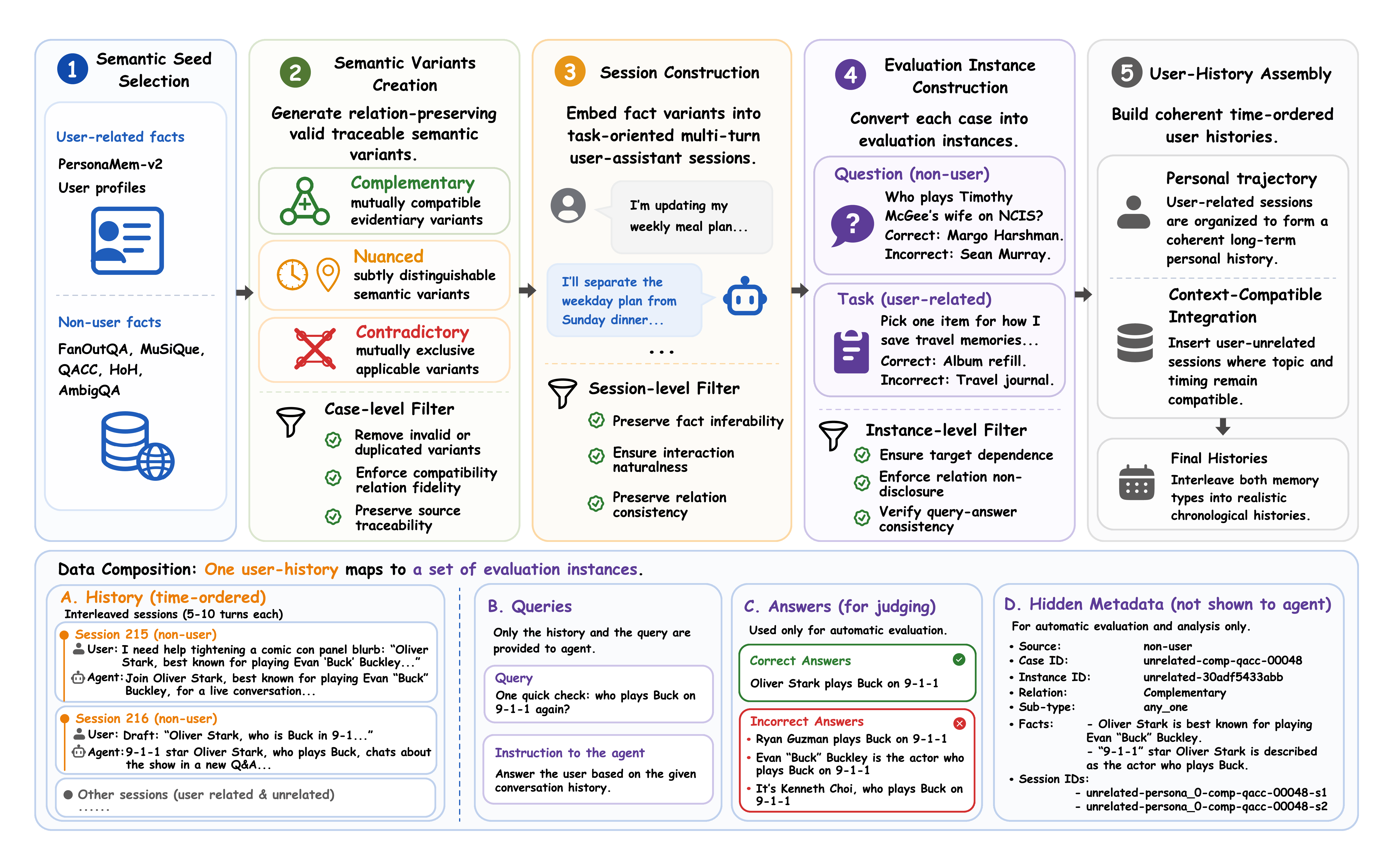
High-resolution PDF: assets/data_construction.pdf
The construction workflow follows five stages:
The main construction entry points are:
uv run python construction/user-related/main.py build
uv run python construction/user-unrelated/main.py generate-to-filter
uv run python construction/user-unrelated/main.py filter
uv run python construction/user-unrelated/main.py build-passed-dataset
uv run python construction/merge_user_related_unrelated.py --help
See construction/README.md for the construction workflow, expected intermediate paths, and links to detailed prompt and data-flow documents.
After copying the data into evaluation/data/subtlememory, run a small smoke
slice:
uv run python -m evaluation.cli \
  --dataset subtlememory \
  --system mem0 \
  --run-name mem0-smoke \
  --from-conv 4 \
  --to-conv 5 \
  --smoke \
  --smoke-messages 10 \
  --smoke-questions 1
Validate the completed run:
uv run python -m evaluation.validate_run \
  --output-dir evaluation/results/subtlememory-mem0-mem0-smoke/subtlememory-mem0-mem0-smoke-api
Run the full staged pipeline for a configured system:
uv run python -m evaluation.cli \
  --dataset subtlememory \
  --system memos \
  --run-name memos-main
Run only later stages after ingestion has completed:
uv run python -m evaluation.cli \
  --dataset subtlememory \
  --system memos \
  --run-name memos-main \
  --stages search answer evaluate
The main leaderboard and aggregate benchmark results are available on the project page:
https://yummytanmo.github.io/SubtleMemory/#results
Standard api mode asks the memory system to retrieve evidence through its
normal search API. readback mode instead uses question provenance, especially
session_ids, to read back memory objects written from the target sessions.
Readback is optional diagnostic support; a memory system can be benchmarked in
normal api mode without implementing it.
api mode:      query -> provider search API -> answer -> evaluate
readback mode: session_ids -> stored memory objects -> answer -> evaluate
Run api first so the system performs add and finalize:
uv run python -m evaluation.cli \
  --dataset subtlememory \
  --system memos \
  --run-name memos-readback-demo \
  --from-conv 4 \
  --to-conv 5 \
  --smoke \
  --smoke-messages 10 \
  --smoke-questions 1
Then run readback while reusing the same add/finalize artifacts:
uv run python -m evaluation.cli \
  --dataset subtlememory \
  --system memos \
  --run-name memos-readback-demo \
  --search-mode readback \
  --reuse-add-artifacts-from evaluation/results/subtlememory-memos-memos-readback-demo/subtlememory-memos-memos-readback-demo-api \
  --from-conv 4 \
  --to-conv 5 \
  --smoke \
  --smoke-messages 10 \
  --smoke-questions 1 \
  --stages search answer evaluate
Readback-specific details are saved to readback_search_readback.jsonl, one row
per question with session IDs, status, read objects, and errors.
| Category | Example configs |
|---|---|
| Hosted memory APIs | mem0, mem0_slow, memos, evermemos, zep, memobase |
| Local or native memory systems | amem, mirix, metaclaw |
| OpenClaw-style agent/plugin runs | openclaw-session-memory, openclaw-mem0-plugin, openclaw-memos-plugin, openclaw-evermemos-plugin |
| Baselines | no-context, oracle-context-gpt-4o-mini, human-baseline-oracle-sessions |
Each system YAML lives under evaluation/config/systems/. Most settings are
configured through .env, so the same config file can be reused across
machines.
To add and benchmark a new memory system, see the detailed
evaluation integration guide. It explains the system
YAML, adapter contract, api versus optional readback search modes, registry
wiring, artifact expectations, validation flow, and a Mem0 worked example.
Each run writes a mode-specific artifact directory under evaluation/results/.
Important files include:
| File | Meaning |
|---|---|
run_config_snapshot.json | Resolved dataset, system, evaluator, and runtime configuration. |
import_manifest.jsonl | Source-unit provenance created during add/import. |
finalize_report.json | Finalize-stage status and readiness details. |
search_results.json | Retrieved or readback evidence for each question. |
answer_results.json | Generated answers and prompt/context metadata. |
qa_results.jsonl | Question-level answer/evaluation projection. |
evaluation_results.jsonl | LLM-judge or evaluator outputs. |
score_summary.json | Aggregate metrics. |
readback_search_readback.jsonl | Readback provenance and read status, only for readback runs. |
The pipeline writes checkpoints so interrupted runs can usually resume without rerunning completed stages.
This repository is adapted from the EverOS evaluation framework. We thank EverOS for the base evaluation pipeline, staged artifact design, adapter abstractions, and config-driven experiment workflow that SubtleMemory builds on.
SubtleMemory evaluates and integrates with several open-source memory and agent systems. Please cite and follow the licenses of the corresponding upstream projects when using those adapters.
If you find SubtleMemory useful, please cite the paper:
@misc{wang2026subtlememory,
  title = {SubtleMemory: A Benchmark for Fine-Grained Relational Memory Discrimination in Long-Horizon AI Agents},
  author = {Wenxuan Wang and Haoyu Sun and Fukuan Hou and Mingyang Song and Weinan Zhang and Yu Cheng and Yang Yang},
  year = {2026},
  eprint = {2606.05761},
  archivePrefix = {arXiv},
  primaryClass = {cs.AI},
  url = {https://arxiv.org/abs/2606.05761}
}
[EMNLP' 26 Findings] The official code repository for SubtleMemory: A Benchmark for Fine-Grained Relational Memory Discrimination in Long-Horizon AI Agents.
See the code
Overview | Data | Data Construction | Evaluation | Integration Guide | Results | Citation
Long-running assistants accumulate many similar memories about a user, a task, or an external fact. These memories may complement one another, apply only under different contexts, or directly conflict. SubtleMemory tests whether memory systems preserve and use these fine-grained relations instead of only recalling isolated facts.
SubtleMemory contains 10 persona-level histories, 1,090 relation-controlled semantic variant sets, and 1,522 evaluation instances. Each instance asks a downstream question whose answer depends on the relation among target-relevant memories.
| Relation | What must be preserved |
|---|---|
| Complementary | Compatible memories that must be combined, or equivalent memories where any one is sufficient. |
| Nuanced | Time, context, role, scope, or condition boundaries that decide which memory applies. |
| Contradictory | Unresolved conflict that should be surfaced rather than silently collapsed. |
data/subtlememory, with one folder per persona.add -> finalize -> search -> answer -> evaluate protocol.| Path | Purpose |
|---|---|
data/subtlememory/ | Generated bench data, organized as persona_0 through persona_9. |
construction/ | Data construction workflows for user-related, user-unrelated, and merged benchmark data. |
evaluation/cli.py | Main entry point for staged benchmark runs. |
evaluation/config/datasets/ | Dataset configs, including subtlememory.yaml. |
evaluation/config/systems/ | Memory-system configs for hosted APIs, native systems, OpenClaw plugins, and baselines. |
evaluation/src/adapters/ | Adapter implementations for memory systems and baselines. |
evaluation/src/core/stages/ | Stage implementations for add, finalize, search, answer, and evaluate. |
assets/ | Paper and README assets, including the data-construction figure. |
site/ | Project page source. |
Use Python 3.10 or newer. From the repository root:
uv sync
cp env.template .env
Edit .env with the credentials needed by the systems you want to evaluate or
use for data construction. Common variables include:
ANSWER_LLM_API_KEY, ANSWER_LLM_BASE_URL, ANSWER_LLM_MODELJUDGE_LLM_API_KEY, JUDGE_LLM_BASE_URL, JUDGE_LLM_MODELGENERATION_BASE_URL, GENERATION_API_KEY, FILTER_BASE_URL, FILTER_API_KEYMEM0_API_KEY, MEMOS_KEY,
EVERMEMOS_API_KEY, ZEP_API_KEY, and local runtime paths for OpenClaw,
MIRIX, MetaClaw, A-Mem, and MemoBaseThe generated SubtleMemory bench data is available on Hugging Face:
The Hugging Face release preserves the repository data layout and exposes
persona_0 through persona_9 as dataset splits. It provides two configs:
bench_instances for benchmark cases and QA instances, and history_sessions
for chronological conversation sessions.
from datasets import load_dataset

bench_p0 = load_dataset(
    "Yummytanmo/SubtleMemory",
    "bench_instances",
    split="persona_0",
)

history_p0 = load_dataset(
    "Yummytanmo/SubtleMemory",
    "history_sessions",
    split="persona_0",
)
The same data is also stored in this repository at:
data/subtlememory/
  persona_0/
    bench_instances.json
    history_sessions.json
  ...
  persona_9/
    bench_instances.json
    history_sessions.json
Each persona bundle contains chronological history sessions and benchmark instances with relation labels, source facts, target session IDs, correct answers, and incorrect answers. The evaluation loader converts these bundles to the LoCoMo-style runtime format used by the staged pipeline.
For evaluation, copy the generated bench data into the evaluation data location:
mkdir -p evaluation/data/subtlememory
rsync -a data/subtlememory/ evaluation/data/subtlememory/
SubtleMemory is built through a staged construction pipeline that starts from open-source seed data and ends with persona-scoped benchmark bundles.
High-resolution PDF: assets/data_construction.pdf
The construction workflow follows five stages:
The main construction entry points are:
uv run python construction/user-related/main.py build
uv run python construction/user-unrelated/main.py generate-to-filter
uv run python construction/user-unrelated/main.py filter
uv run python construction/user-unrelated/main.py build-passed-dataset
uv run python construction/merge_user_related_unrelated.py --help
See construction/README.md for the construction workflow, expected intermediate paths, and links to detailed prompt and data-flow documents.
After copying the data into evaluation/data/subtlememory, run a small smoke
slice:
uv run python -m evaluation.cli \
  --dataset subtlememory \
  --system mem0 \
  --run-name mem0-smoke \
  --from-conv 4 \
  --to-conv 5 \
  --smoke \
  --smoke-messages 10 \
  --smoke-questions 1
Validate the completed run:
uv run python -m evaluation.validate_run \
  --output-dir evaluation/results/subtlememory-mem0-mem0-smoke/subtlememory-mem0-mem0-smoke-api
Run the full staged pipeline for a configured system:
uv run python -m evaluation.cli \
  --dataset subtlememory \
  --system memos \
  --run-name memos-main
Run only later stages after ingestion has completed:
uv run python -m evaluation.cli \
  --dataset subtlememory \
  --system memos \
  --run-name memos-main \
  --stages search answer evaluate
The main leaderboard and aggregate benchmark results are available on the project page:
https://yummytanmo.github.io/SubtleMemory/#results
Standard api mode asks the memory system to retrieve evidence through its
normal search API. readback mode instead uses question provenance, especially
session_ids, to read back memory objects written from the target sessions.
Readback is optional diagnostic support; a memory system can be benchmarked in
normal api mode without implementing it.
api mode:      query -> provider search API -> answer -> evaluate
readback mode: session_ids -> stored memory objects -> answer -> evaluate
Run api first so the system performs add and finalize:
uv run python -m evaluation.cli \
  --dataset subtlememory \
  --system memos \
  --run-name memos-readback-demo \
  --from-conv 4 \
  --to-conv 5 \
  --smoke \
  --smoke-messages 10 \
  --smoke-questions 1
Then run readback while reusing the same add/finalize artifacts:
uv run python -m evaluation.cli \
  --dataset subtlememory \
  --system memos \
  --run-name memos-readback-demo \
  --search-mode readback \
  --reuse-add-artifacts-from evaluation/results/subtlememory-memos-memos-readback-demo/subtlememory-memos-memos-readback-demo-api \
  --from-conv 4 \
  --to-conv 5 \
  --smoke \
  --smoke-messages 10 \
  --smoke-questions 1 \
  --stages search answer evaluate
Readback-specific details are saved to readback_search_readback.jsonl, one row
per question with session IDs, status, read objects, and errors.
| Category | Example configs |
|---|---|
| Hosted memory APIs | mem0, mem0_slow, memos, evermemos, zep, memobase |
| Local or native memory systems | amem, mirix, metaclaw |
| OpenClaw-style agent/plugin runs | openclaw-session-memory, openclaw-mem0-plugin, openclaw-memos-plugin, openclaw-evermemos-plugin |
| Baselines | no-context, oracle-context-gpt-4o-mini, human-baseline-oracle-sessions |
Each system YAML lives under evaluation/config/systems/. Most settings are
configured through .env, so the same config file can be reused across
machines.
To add and benchmark a new memory system, see the detailed
evaluation integration guide. It explains the system
YAML, adapter contract, api versus optional readback search modes, registry
wiring, artifact expectations, validation flow, and a Mem0 worked example.
Each run writes a mode-specific artifact directory under evaluation/results/.
Important files include:
| File | Meaning |
|---|---|
run_config_snapshot.json | Resolved dataset, system, evaluator, and runtime configuration. |
import_manifest.jsonl | Source-unit provenance created during add/import. |
finalize_report.json | Finalize-stage status and readiness details. |
search_results.json | Retrieved or readback evidence for each question. |
answer_results.json | Generated answers and prompt/context metadata. |
qa_results.jsonl | Question-level answer/evaluation projection. |
evaluation_results.jsonl | LLM-judge or evaluator outputs. |
score_summary.json | Aggregate metrics. |
readback_search_readback.jsonl | Readback provenance and read status, only for readback runs. |
The pipeline writes checkpoints so interrupted runs can usually resume without rerunning completed stages.
This repository is adapted from the EverOS evaluation framework. We thank EverOS for the base evaluation pipeline, staged artifact design, adapter abstractions, and config-driven experiment workflow that SubtleMemory builds on.
SubtleMemory evaluates and integrates with several open-source memory and agent systems. Please cite and follow the licenses of the corresponding upstream projects when using those adapters.
If you find SubtleMemory useful, please cite the paper:
@misc{wang2026subtlememory,
  title = {SubtleMemory: A Benchmark for Fine-Grained Relational Memory Discrimination in Long-Horizon AI Agents},
  author = {Wenxuan Wang and Haoyu Sun and Fukuan Hou and Mingyang Song and Weinan Zhang and Yu Cheng and Yang Yang},
  year = {2026},
  eprint = {2606.05761},
  archivePrefix = {arXiv},
  primaryClass = {cs.AI},
  url = {https://arxiv.org/abs/2606.05761}
}



