H2HMem evaluates multimodal LLM memory in realistic human-to-human interactions, spanning both dyadic and multi-party conversations with diverse multimodal memory challenges.
See the codeH2HMem evaluates multimodal LLM memory in realistic human-to-human interactions, spanning both dyadic and multi-party conversations with diverse multimodal memory challenges.
📄 Paper • 🤗 Hugging Face Dataset • 🏆 Leaderboard • 🌐 Project Page • 📦 Submission Template


⭐ If you find H2HMem useful, please consider starring the repository to help others discover the benchmark.
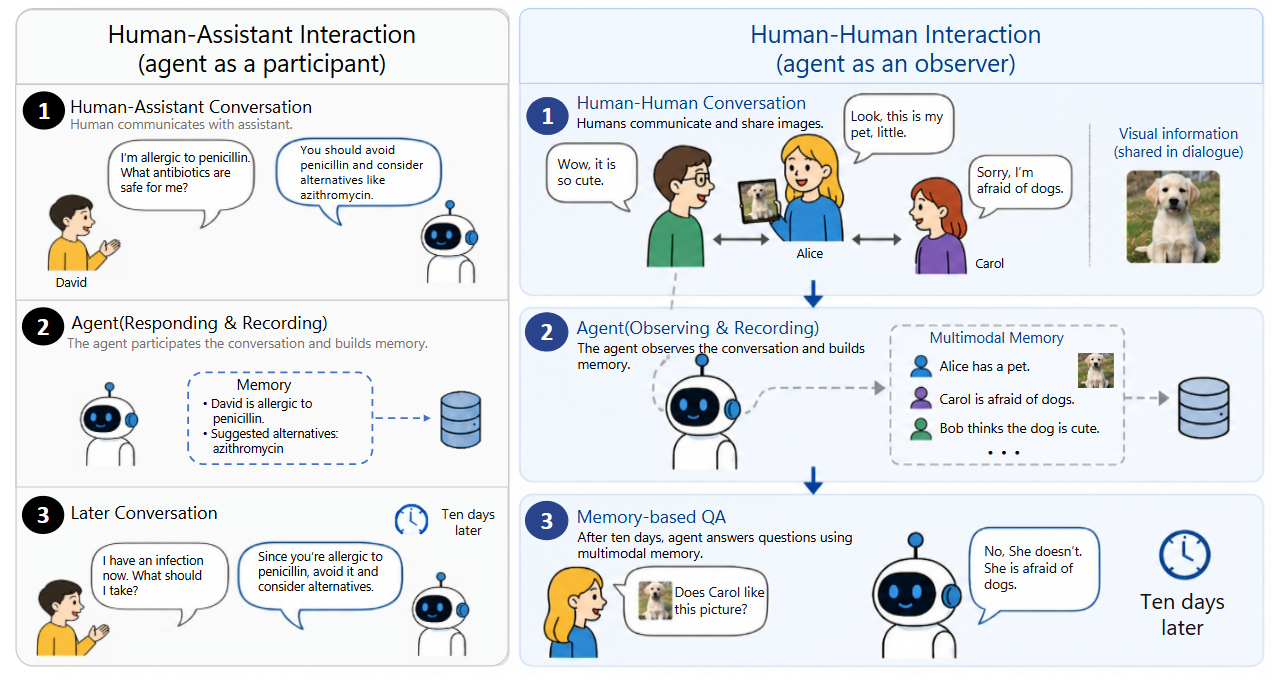
Unlike traditional human–assistant settings (left), H2HMem evaluates LLM agents as observers in human–human interactions (right), where agents must process multimodal conversations, resolve complex discourse phenomena (anaphora, deixis), and handle asynchronous or conflicting information from multiple participants.
Most memory benchmarks ask a simple question:
Can the agent remember information from past interactions?
H2HMem asks a more deployment-relevant one:
Can the agent observe, retain, and utilize multimodal information from complex human–human conversations, spanning multiple participants, sessions, and modalities?
This matters in emerging real-world applications where LLM agents act as observers in human–human interactions, such as:
These environments introduce three fundamental challenges:
| Challenge | Description |
|---|---|
| Multimodality | Conversations naturally interleave text with visual content (photos, screenshots). |
| Complex Discourse | Phenomena like anaphora and discourse deixis require reference resolution against evolving memory. |
| Asynchronous & Conflicting Information | Multiple participants may provide inconsistent or contradictory information. |
H2HMem evaluates three core memory capabilities across nine task types:
| Capability | Task Types | What it Tests |
|---|---|---|
| Memory Recall | UPR, CRR, KR | Can the agent accurately retrieve information from past dialogues? |
| Memory Reasoning | TR, MCR, RET | Can the agent reason over temporal, causal, and evolving references? |
| Memory Application | TTL, CD, AR | Can the agent apply learned information, detect conflicts, and refuse when appropriate? |
| Property | Value |
|---|---|
| Dialogues | 25 (20 dyadic + 5 multi-party) |
| Sessions | 309 (284 dyadic + 25 multi-party) |
| Dialogue Rounds | 7,078 |
| Images | 1,300 |
| QA Pairs | 2,236 |
| Task Categories | Memory Recall, Memory Reasoning, Memory Application |
| Task Types | 9 (UPR, CRR, KR, TR, MCR, RET, TTL, CD, AR) |
| Modalities | Text + Image (Multimodal) |
| Metrics | Lexical Metrics, LLM-as-a-Judge |
Existing memory benchmarks largely focus on single-user, text-only interactions, where an agent recalls information from its own past interactions with a single user. However, a new class of applications is emerging: LLM agents as observers in human–human interactions.
Unlike traditional human–assistant settings, these environments:
This makes H2HMem fundamentally different from prior benchmarks that focus on single-agent recall, personalization, or long-context understanding in isolation. Experiments with advanced agents reveal substantial limitations in constructing, retaining, and utilizing memories across modalities, participants, and sessions, highlighting substantial room for improvement in next-generation LLM agents.
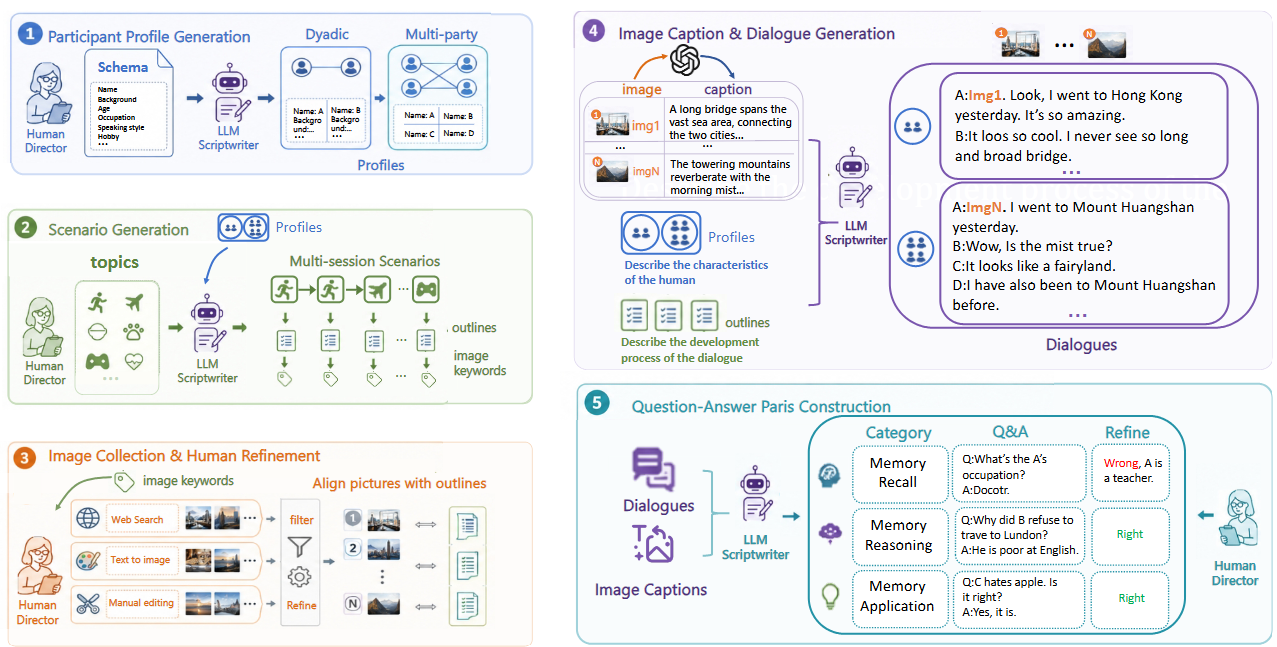
H2HMem is constructed from dyadic and multi-party human-human conversations with multimodal inputs, structured into multiple sessions with diverse QA tasks spanning recall, reasoning, and application.
Experiments reveal substantial limitations in current memory systems. The best weighted average LLM-as-Judge score reaches only 0.5757 (A-Mem). Four major bottlenecks are identified:
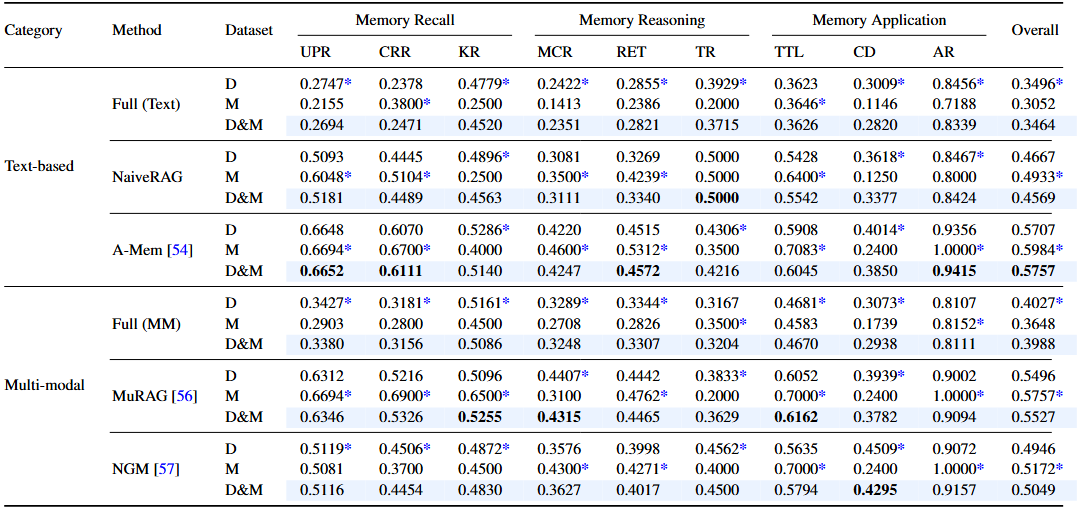
LLM-as-a-judge evaluation results across task types and methods.
Download the dataset from Hugging Face:
Save the contents to the following local folders:
./dataset/dyadic./dataset/multi-partygit clone https://github.com/varib1/H2HMEM.git
cd H2HMEM
pip install -r requirements.txt
This repository supports both text-based and multimodal memory methods.
Text-based methods first convert images into textual captions, then perform evaluation using the corresponding baseline.
Step 1 — Generate Image Captions
bash ./caption/run_caption.sh
Step 2 — Run Evaluation
| Method | Command |
|---|---|
| Full (Text) | bash ./baselines/FullText/evaluate.sh |
| Naive RAG | bash ./baselines/Naive_RAG/evaluate.sh |
| A-MEM | bash ./baselines/A-MEM/memory_construct.sh (build memory)bash ./baselines/A-MEM/evaluate.sh (run evaluation) |
Multimodal methods directly process image-text inputs and do not require caption generation.
| Method | Command |
|---|---|
| Full (MM) | bash ./baselines/FullMM/evaluate.sh |
| MuRAG | bash ./baselines/MuRAG/evaluate.sh |
| NGM | bash ./baselines/NGM/evaluate.sh |
After inference, evaluate the generated responses using the following metrics.
bash ./evaluate_metrics/Lexical_metrics/run_Lexical_metrics.sh
bash ./evaluate_metrics/LLM-as-judge/run_LLM_as_judge.sh
We provide an online leaderboard for evaluating memory methods on H2HMem:
We provide a JSON template file that defines the required submission format:
leaderboard/prediction_template.txt — Template for submission formatYour final submission should include two JSON files:
prediction_dyadic.json
prediction_multiparty.json
prediction_dyadic.json and prediction_multiparty.json.Your submission needs to be reviewed by an administrator before it appears on the public leaderboard.
If you use H2HMem, please cite the accompanying paper.
@misc{zhu2026h2hmemmultimodalmemorybenchmark,
      title={H2HMem: A Multimodal Memory Benchmark for Agents in Human-Human Interactions},
      author={Shiping Zhu and Yibo Yang and Zhengyang Wang and Tiancheng Shen and Dandan Guo and Ming-Hsuan Yang},
      year={2026},
      eprint={2606.09461},
      archivePrefix={arXiv},
      primaryClass={cs.CL},
      url={https://arxiv.org/abs/2606.09461},
}
H2HMem evaluates multimodal LLM memory in realistic human-to-human interactions, spanning both dyadic and multi-party conversations with diverse multimodal memory challenges.
See the codeH2HMem evaluates multimodal LLM memory in realistic human-to-human interactions, spanning both dyadic and multi-party conversations with diverse multimodal memory challenges.
📄 Paper • 🤗 Hugging Face Dataset • 🏆 Leaderboard • 🌐 Project Page • 📦 Submission Template
⭐ If you find H2HMem useful, please consider starring the repository to help others discover the benchmark.
Unlike traditional human–assistant settings (left), H2HMem evaluates LLM agents as observers in human–human interactions (right), where agents must process multimodal conversations, resolve complex discourse phenomena (anaphora, deixis), and handle asynchronous or conflicting information from multiple participants.
Most memory benchmarks ask a simple question:
Can the agent remember information from past interactions?
H2HMem asks a more deployment-relevant one:
Can the agent observe, retain, and utilize multimodal information from complex human–human conversations, spanning multiple participants, sessions, and modalities?
This matters in emerging real-world applications where LLM agents act as observers in human–human interactions, such as:
These environments introduce three fundamental challenges:
| Challenge | Description |
|---|---|
| Multimodality | Conversations naturally interleave text with visual content (photos, screenshots). |
| Complex Discourse | Phenomena like anaphora and discourse deixis require reference resolution against evolving memory. |
| Asynchronous & Conflicting Information | Multiple participants may provide inconsistent or contradictory information. |
H2HMem evaluates three core memory capabilities across nine task types:
| Capability | Task Types | What it Tests |
|---|---|---|
| Memory Recall | UPR, CRR, KR | Can the agent accurately retrieve information from past dialogues? |
| Memory Reasoning | TR, MCR, RET | Can the agent reason over temporal, causal, and evolving references? |
| Memory Application | TTL, CD, AR | Can the agent apply learned information, detect conflicts, and refuse when appropriate? |
| Property | Value |
|---|---|
| Dialogues | 25 (20 dyadic + 5 multi-party) |
| Sessions | 309 (284 dyadic + 25 multi-party) |
| Dialogue Rounds | 7,078 |
| Images | 1,300 |
| QA Pairs | 2,236 |
| Task Categories | Memory Recall, Memory Reasoning, Memory Application |
| Task Types | 9 (UPR, CRR, KR, TR, MCR, RET, TTL, CD, AR) |
| Modalities | Text + Image (Multimodal) |
| Metrics | Lexical Metrics, LLM-as-a-Judge |
Existing memory benchmarks largely focus on single-user, text-only interactions, where an agent recalls information from its own past interactions with a single user. However, a new class of applications is emerging: LLM agents as observers in human–human interactions.
Unlike traditional human–assistant settings, these environments:
This makes H2HMem fundamentally different from prior benchmarks that focus on single-agent recall, personalization, or long-context understanding in isolation. Experiments with advanced agents reveal substantial limitations in constructing, retaining, and utilizing memories across modalities, participants, and sessions, highlighting substantial room for improvement in next-generation LLM agents.
H2HMem is constructed from dyadic and multi-party human-human conversations with multimodal inputs, structured into multiple sessions with diverse QA tasks spanning recall, reasoning, and application.
Experiments reveal substantial limitations in current memory systems. The best weighted average LLM-as-Judge score reaches only 0.5757 (A-Mem). Four major bottlenecks are identified:
LLM-as-a-judge evaluation results across task types and methods.
Download the dataset from Hugging Face:
Save the contents to the following local folders:
./dataset/dyadic./dataset/multi-partygit clone https://github.com/varib1/H2HMEM.git
cd H2HMEM
pip install -r requirements.txt
This repository supports both text-based and multimodal memory methods.
Text-based methods first convert images into textual captions, then perform evaluation using the corresponding baseline.
Step 1 — Generate Image Captions
bash ./caption/run_caption.sh
Step 2 — Run Evaluation
| Method | Command |
|---|---|
| Full (Text) | bash ./baselines/FullText/evaluate.sh |
| Naive RAG | bash ./baselines/Naive_RAG/evaluate.sh |
| A-MEM | bash ./baselines/A-MEM/memory_construct.sh (build memory)bash ./baselines/A-MEM/evaluate.sh (run evaluation) |
Multimodal methods directly process image-text inputs and do not require caption generation.
| Method | Command |
|---|---|
| Full (MM) | bash ./baselines/FullMM/evaluate.sh |
| MuRAG | bash ./baselines/MuRAG/evaluate.sh |
| NGM | bash ./baselines/NGM/evaluate.sh |
After inference, evaluate the generated responses using the following metrics.
bash ./evaluate_metrics/Lexical_metrics/run_Lexical_metrics.sh
bash ./evaluate_metrics/LLM-as-judge/run_LLM_as_judge.sh
We provide an online leaderboard for evaluating memory methods on H2HMem:
We provide a JSON template file that defines the required submission format:
leaderboard/prediction_template.txt — Template for submission formatYour final submission should include two JSON files:
prediction_dyadic.json
prediction_multiparty.json
prediction_dyadic.json and prediction_multiparty.json.Your submission needs to be reviewed by an administrator before it appears on the public leaderboard.
If you use H2HMem, please cite the accompanying paper.
@misc{zhu2026h2hmemmultimodalmemorybenchmark,
      title={H2HMem: A Multimodal Memory Benchmark for Agents in Human-Human Interactions},
      author={Shiping Zhu and Yibo Yang and Zhengyang Wang and Tiancheng Shen and Dandan Guo and Ming-Hsuan Yang},
      year={2026},
      eprint={2606.09461},
      archivePrefix={arXiv},
      primaryClass={cs.CL},
      url={https://arxiv.org/abs/2606.09461},
}