MemEye: A Visual-Centric Evaluation Framework for Multimodal Agent Memory
See the code





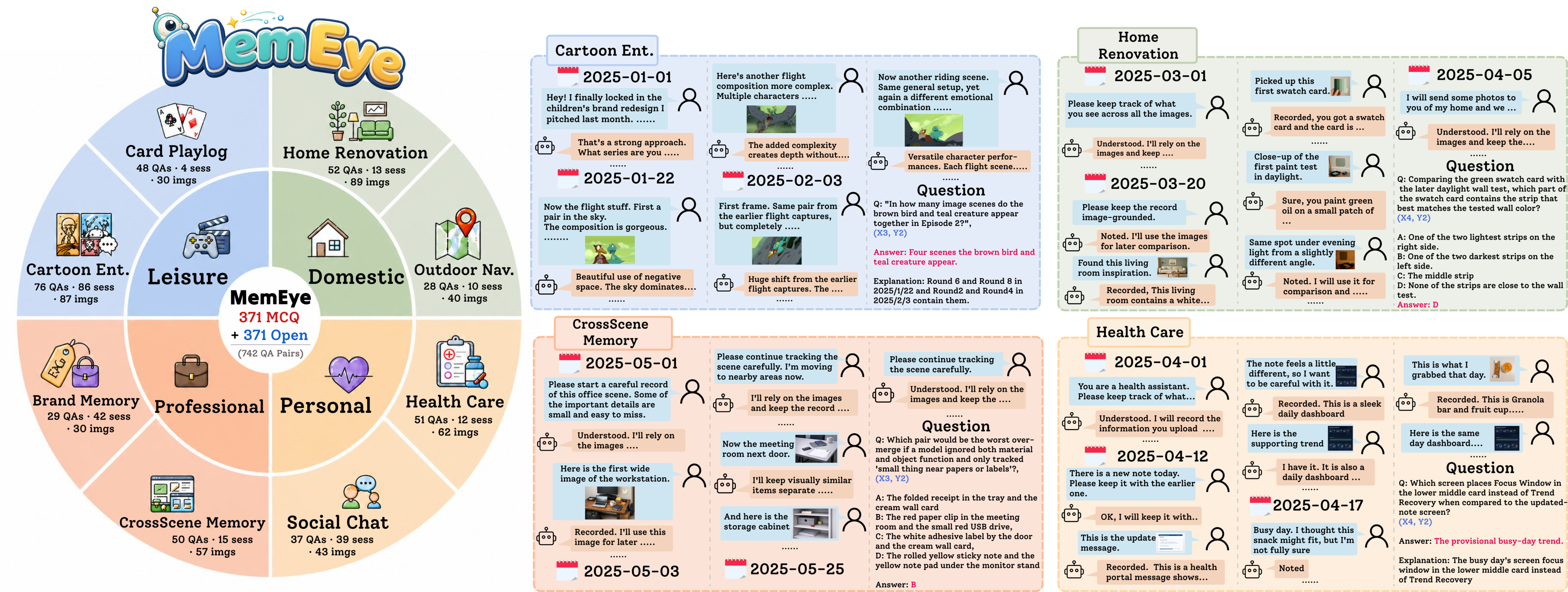
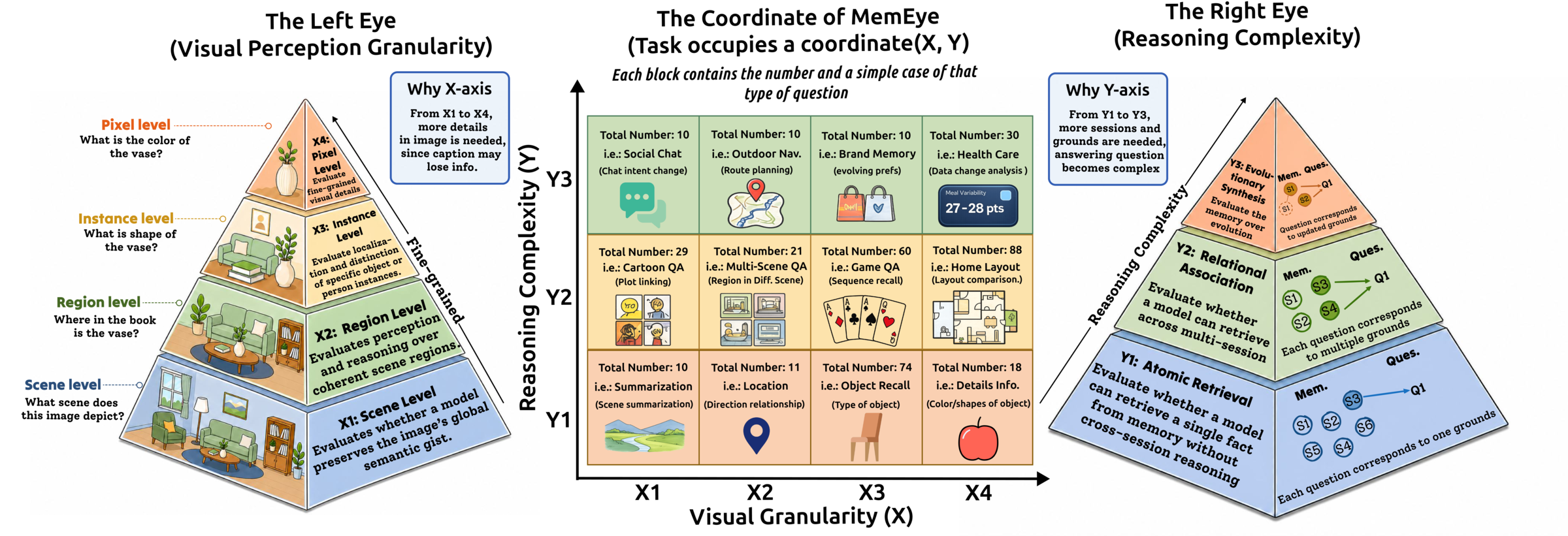
Long-term agent memory is increasingly multimodal, yet existing evaluations rarely test whether agents preserve the visual evidence needed for later reasoning. MemEye is a diagnostic framework that evaluates multimodal agent memory through a two-axis taxonomy:
The benchmark includes 371 mirrored MCQ + open-ended questions across 8 life-scenario tasks, with annotated clue rounds and validation gates for answerability, shortcut resistance, visual necessity, and reasoning structure.
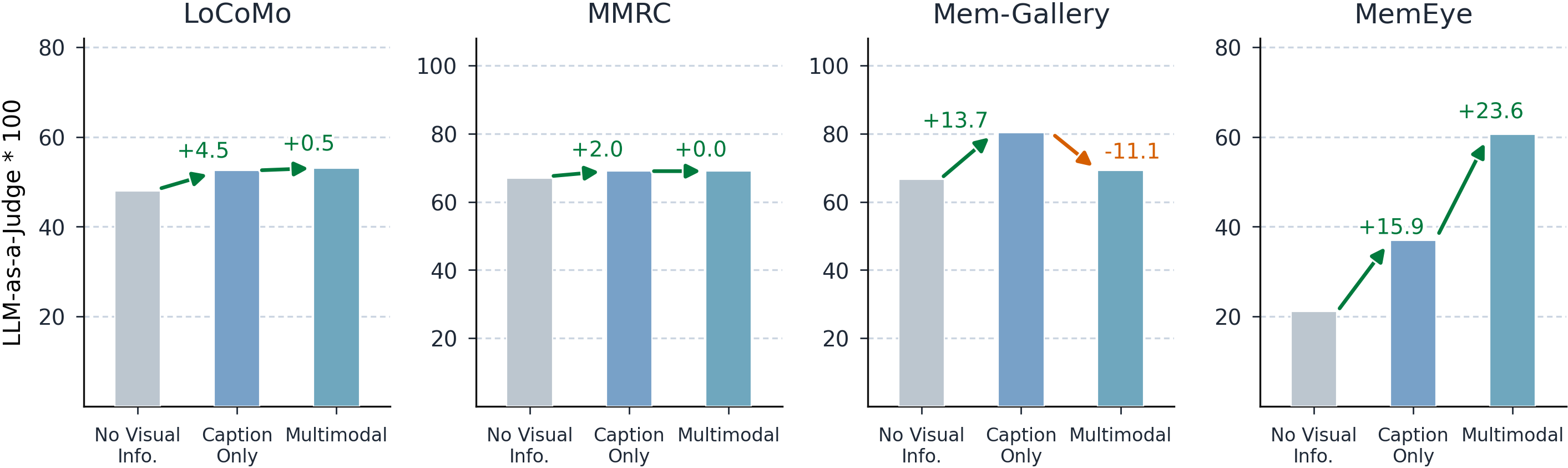
MemEye exhibits stronger visual irreplaceability than prior long-term memory benchmarks — the gap between caption-only and multimodal settings is significantly larger.
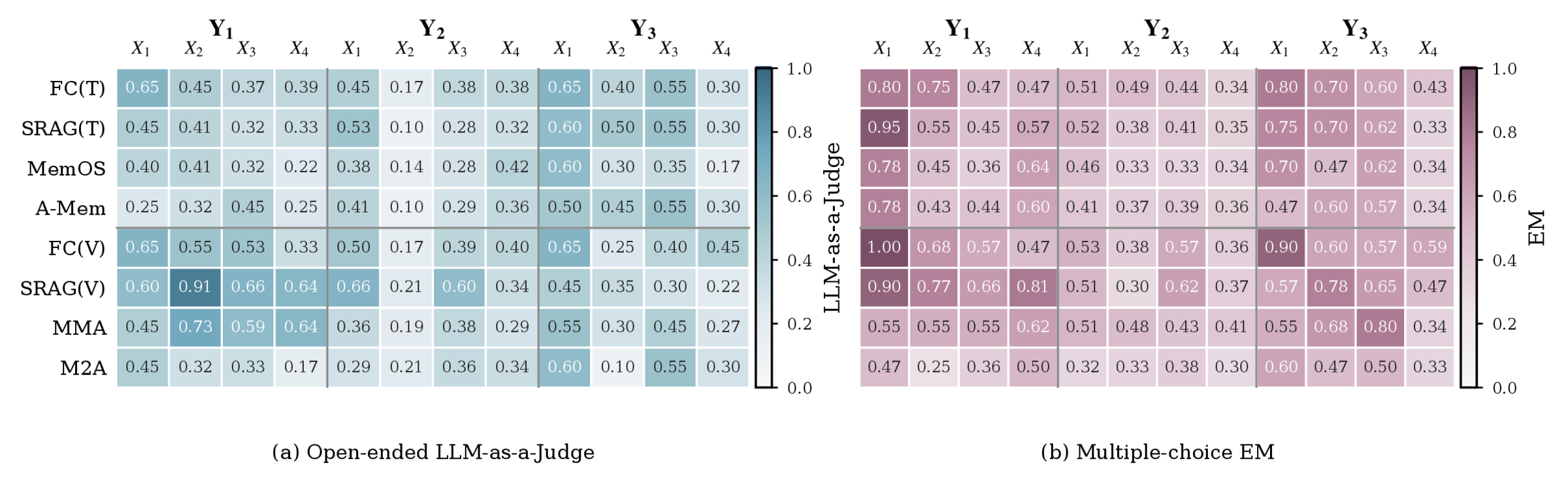
Representative method performance across the MemEye matrix (gpt-5.4-mini). Left: Open-ended LLM-as-a-Judge; Right: Multiple-choice EM.
| Category | Method | Config | Modality |
|---|---|---|---|
| Full Context | FC-Text | full_context_text_only | Text |
| FC-Multimodal | full_context_multimodal | Visual | |
| Retrieval | SRAG-Text | semantic_rag_text_only | Text |
| SRAG-Multimodal | semantic_rag_multimodal | Visual | |
| Summarization | SimpleMem | simplemem | Text |
| SimpleMem-MM | simplemem_multimodal | Visual | |
| Agentic Memory | A-MEM | a_mem | Text |
| Reflexion | reflexion | Text | |
| Gen. Agents | gen_agents | Text | |
| MemoryOS | memoryos | Text | |
| M2A | m2a | Visual | |
| MMA | mma | Visual | |
| MIRIX | mirix | Visual |
* Gen. Agents requires MemEngine (not bundled). See benchmark/gen_agents/SETUP.md.
conda create -n memeye python=3.10 -y
conda activate memeye
pip install -r requirements.txt
The benchmark data (dialogue JSONs + images) is hosted on HuggingFace:
git lfs install
git clone https://huggingface.co/datasets/MemEyeBench/MemEye data
Then generate task configs pointing to your local data:
python register_external_data.py --data-root ./data --overwrite
This creates task configs under config/tasks_external/.
export OPENAI_API_KEY=<your_key>      # for GPT models
export GEMINI_API_KEY=<your_key>      # for Gemini models
python run_benchmark.py \
  --task-config config/tasks_external/brand_memory_test.yaml \
  --model-config config/models/gpt_4_1_nano.yaml \
  --method-config config/methods/full_context_multimodal.yaml
python run_matrix.py \
  --task-config config/tasks_external/brand_memory_test.yaml \
  --model-config config/models/gpt_4_1_nano.yaml \
  --method-config config/methods/full_context_multimodal.yaml \
  --method-config config/methods/semantic_rag_multimodal.yaml \
  --method-config config/methods/m2a.yaml
python score_locked_llm_judge.py \
  --root runs/<model>/open \
  --judge-model gpt-5.2
Each task ships two variants:
| Mode | File Pattern | Scoring |
|---|---|---|
| MCQ | Task_Name.json | Exact match on extracted choice (A/B/C) |
| Open | Task_Name_Open.json | F1, BLEU, BERTScore, LLM-as-a-judge |
The runner auto-detects the variant. LLM-as-a-judge is the recommended primary metric for open-ended evaluation.
Enable rich metrics:
python run_benchmark.py \
  --task-config config/tasks_external/brand_memory_test_open.yaml \
  --model-config config/models/gpt_4_1_nano.yaml \
  --method-config config/methods/full_context_text_only.yaml \
  --enable-bert-score \
  --enable-llm-judge
Each run writes to runs/:
config.json — resolved run configurationmetrics.json — aggregate metrics with breakdowns by X/Y axespredictions.jsonl — per-question predictions and scores{
"character_profile": { "..." },
"multi_session_dialogues": [
{
"session_id": "D1",
"date": "2024-03-10",
"dialogues": [
{
"round": "D1:1",
"user": "...",
"assistant": "...",
"input_image": ["image/Task_Name/IMG.png"]
}
]
}
],
"human-annotated QAs": [
{
"point": [["X2"], ["Y1"]],
"question": "...",
"answer": "...",
"session_id": ["D1"],
"clue": ["D1:1"]
}
]
}
config/tasks/:name: my_task
dataset:
dialog_json: data/dialog/My_Task.json
image_root: data/image
eval:
mode: mcq # or "open"
max_questions: 0
python run_benchmark.py \
  --task-config config/tasks/my_task.yaml \
  --model-config config/models/gpt_4_1_nano.yaml \
  --method-config config/methods/full_context_multimodal.yaml
.
├── run_benchmark.py          # Main benchmark entry point
├── run_matrix.py             # Model x method matrix runner
├── score_locked_llm_judge.py # Post-hoc LLM judge scoring
├── register_external_data.py # Generate task configs from external data
├── benchmark/                # Core modules
│   ├── dataset.py            #   Data loading
│   ├── methods.py            #   Method registry & history construction
│   ├── retrieval.py          #   TF-IDF & dense retrieval
│   ├── embeddings.py         #   Text & multimodal embeddings
│   ├── evaluator.py          #   MCQ & open-ended scoring
│   ├── runner.py             #   Run orchestration
│   ├── m2a/                  #   M2A agentic memory
│   ├── mma/                  #   MMA confidence-aware memory
│   ├── mirix/                #   MIRIX multi-layer agent
│   └── ...                   #   Other method implementations
├── router/                   # Model routers (OpenAI, Gemini, local)
├── config/
│   ├── methods/              # Method configs
│   ├── models/               # Model configs
│   └── tasks/                # Task configs (examples)
├── tools/                    # Utility scripts (HF sync, caption preprocessing)
├── docs/                     # Documentation
@misc{guo2026memeyevisualcentricevaluationframework,
      title={MemEye: A Visual-Centric Evaluation Framework for Multimodal Agent Memory},
      author={Minghao Guo and Qingyue Jiao and Zeru Shi and Yihao Quan and Boxuan Zhang and Danrui Li and Liwei Che and Wujiang Xu and Shilong Liu and Zirui Liu and Mubbasir Kapadia and Vladimir Pavlovic and Jiang Liu and Mengdi Wang and Yiyu Shi and Dimitris N. Metaxas and Ruixiang Tang},
      year={2026},
      eprint={2605.15128},
      archivePrefix={arXiv},
      primaryClass={cs.CV},
      url={https://arxiv.org/abs/2605.15128},
}
This project is licensed under the Apache License 2.0 - see LICENSE for details.
MemEye: A Visual-Centric Evaluation Framework for Multimodal Agent Memory
See the code
Long-term agent memory is increasingly multimodal, yet existing evaluations rarely test whether agents preserve the visual evidence needed for later reasoning. MemEye is a diagnostic framework that evaluates multimodal agent memory through a two-axis taxonomy:
The benchmark includes 371 mirrored MCQ + open-ended questions across 8 life-scenario tasks, with annotated clue rounds and validation gates for answerability, shortcut resistance, visual necessity, and reasoning structure.
MemEye exhibits stronger visual irreplaceability than prior long-term memory benchmarks — the gap between caption-only and multimodal settings is significantly larger.
Representative method performance across the MemEye matrix (gpt-5.4-mini). Left: Open-ended LLM-as-a-Judge; Right: Multiple-choice EM.
| Category | Method | Config | Modality |
|---|---|---|---|
| Full Context | FC-Text | full_context_text_only | Text |
| FC-Multimodal | full_context_multimodal | Visual | |
| Retrieval | SRAG-Text | semantic_rag_text_only | Text |
| SRAG-Multimodal | semantic_rag_multimodal | Visual | |
| Summarization | SimpleMem | simplemem | Text |
| SimpleMem-MM | simplemem_multimodal | Visual | |
| Agentic Memory | A-MEM | a_mem | Text |
| Reflexion | reflexion | Text | |
| Gen. Agents | gen_agents | Text | |
| MemoryOS | memoryos | Text | |
| M2A | m2a | Visual | |
| MMA | mma | Visual | |
| MIRIX | mirix | Visual |
* Gen. Agents requires MemEngine (not bundled). See benchmark/gen_agents/SETUP.md.
conda create -n memeye python=3.10 -y
conda activate memeye
pip install -r requirements.txt
The benchmark data (dialogue JSONs + images) is hosted on HuggingFace:
git lfs install
git clone https://huggingface.co/datasets/MemEyeBench/MemEye data
Then generate task configs pointing to your local data:
python register_external_data.py --data-root ./data --overwrite
This creates task configs under config/tasks_external/.
export OPENAI_API_KEY=<your_key>      # for GPT models
export GEMINI_API_KEY=<your_key>      # for Gemini models
python run_benchmark.py \
  --task-config config/tasks_external/brand_memory_test.yaml \
  --model-config config/models/gpt_4_1_nano.yaml \
  --method-config config/methods/full_context_multimodal.yaml
python run_matrix.py \
  --task-config config/tasks_external/brand_memory_test.yaml \
  --model-config config/models/gpt_4_1_nano.yaml \
  --method-config config/methods/full_context_multimodal.yaml \
  --method-config config/methods/semantic_rag_multimodal.yaml \
  --method-config config/methods/m2a.yaml
python score_locked_llm_judge.py \
  --root runs/<model>/open \
  --judge-model gpt-5.2
Each task ships two variants:
| Mode | File Pattern | Scoring |
|---|---|---|
| MCQ | Task_Name.json | Exact match on extracted choice (A/B/C) |
| Open | Task_Name_Open.json | F1, BLEU, BERTScore, LLM-as-a-judge |
The runner auto-detects the variant. LLM-as-a-judge is the recommended primary metric for open-ended evaluation.
Enable rich metrics:
python run_benchmark.py \
  --task-config config/tasks_external/brand_memory_test_open.yaml \
  --model-config config/models/gpt_4_1_nano.yaml \
  --method-config config/methods/full_context_text_only.yaml \
  --enable-bert-score \
  --enable-llm-judge
Each run writes to runs/:
config.json — resolved run configurationmetrics.json — aggregate metrics with breakdowns by X/Y axespredictions.jsonl — per-question predictions and scores{
"character_profile": { "..." },
"multi_session_dialogues": [
{
"session_id": "D1",
"date": "2024-03-10",
"dialogues": [
{
"round": "D1:1",
"user": "...",
"assistant": "...",
"input_image": ["image/Task_Name/IMG.png"]
}
]
}
],
"human-annotated QAs": [
{
"point": [["X2"], ["Y1"]],
"question": "...",
"answer": "...",
"session_id": ["D1"],
"clue": ["D1:1"]
}
]
}
config/tasks/:name: my_task
dataset:
dialog_json: data/dialog/My_Task.json
image_root: data/image
eval:
mode: mcq # or "open"
max_questions: 0
python run_benchmark.py \
  --task-config config/tasks/my_task.yaml \
  --model-config config/models/gpt_4_1_nano.yaml \
  --method-config config/methods/full_context_multimodal.yaml
.
├── run_benchmark.py          # Main benchmark entry point
├── run_matrix.py             # Model x method matrix runner
├── score_locked_llm_judge.py # Post-hoc LLM judge scoring
├── register_external_data.py # Generate task configs from external data
├── benchmark/                # Core modules
│   ├── dataset.py            #   Data loading
│   ├── methods.py            #   Method registry & history construction
│   ├── retrieval.py          #   TF-IDF & dense retrieval
│   ├── embeddings.py         #   Text & multimodal embeddings
│   ├── evaluator.py          #   MCQ & open-ended scoring
│   ├── runner.py             #   Run orchestration
│   ├── m2a/                  #   M2A agentic memory
│   ├── mma/                  #   MMA confidence-aware memory
│   ├── mirix/                #   MIRIX multi-layer agent
│   └── ...                   #   Other method implementations
├── router/                   # Model routers (OpenAI, Gemini, local)
├── config/
│   ├── methods/              # Method configs
│   ├── models/               # Model configs
│   └── tasks/                # Task configs (examples)
├── tools/                    # Utility scripts (HF sync, caption preprocessing)
├── docs/                     # Documentation
@misc{guo2026memeyevisualcentricevaluationframework,
      title={MemEye: A Visual-Centric Evaluation Framework for Multimodal Agent Memory},
      author={Minghao Guo and Qingyue Jiao and Zeru Shi and Yihao Quan and Boxuan Zhang and Danrui Li and Liwei Che and Wujiang Xu and Shilong Liu and Zirui Liu and Mubbasir Kapadia and Vladimir Pavlovic and Jiang Liu and Mengdi Wang and Yiyu Shi and Dimitris N. Metaxas and Ruixiang Tang},
      year={2026},
      eprint={2605.15128},
      archivePrefix={arXiv},
      primaryClass={cs.CV},
      url={https://arxiv.org/abs/2605.15128},
}
This project is licensed under the Apache License 2.0 - see LICENSE for details.