
"what, how, where, and how well? a survey on test-time scaling in large language models" repository
See the codeREADME
Awesome Test-time-Scaling in LLMs



Our repository, Awesome Test-time-Scaling in LLMs, gathers available papers on test-time scaling, to our current knowledge. Unlike other repositories that categorize papers, we decompose each paper's contributions based on the taxonomy provided by "What, How, Where, and How Well? A Survey on Test-Time Scaling in Large Language Models" facilitating easier understand and comparison for readers.
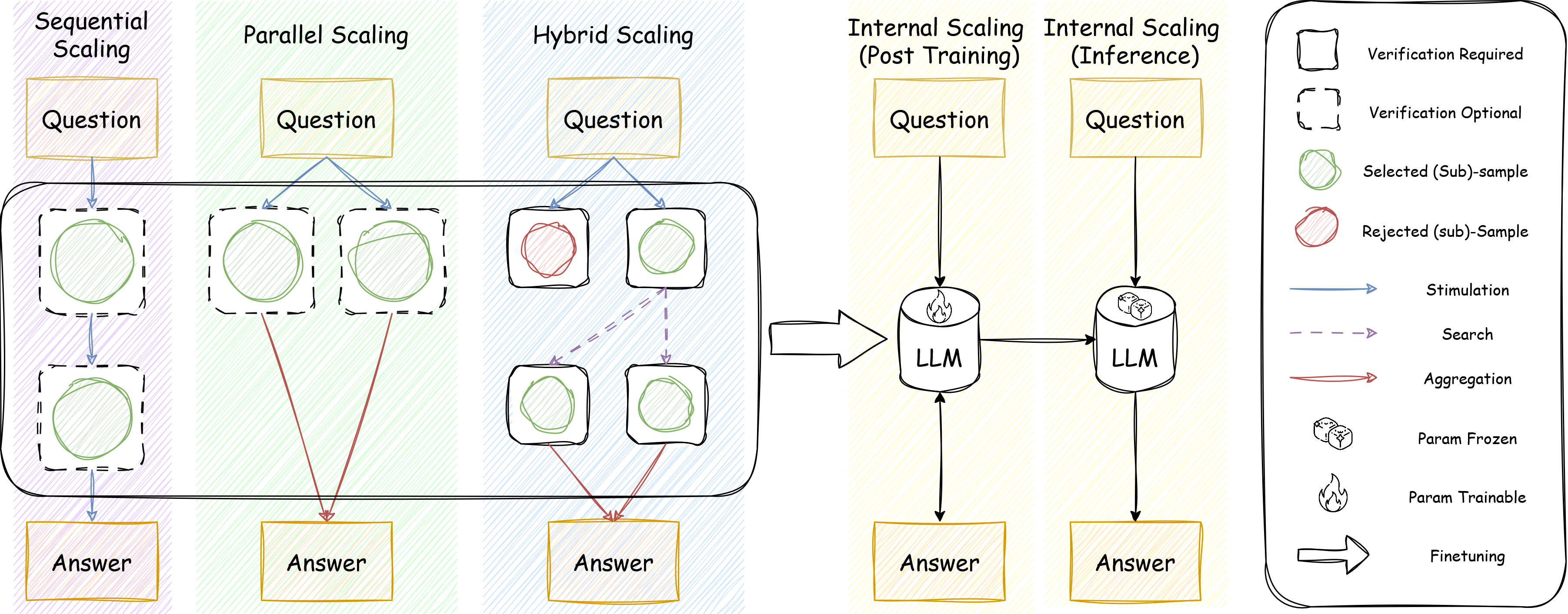
Figure 1: A Visual Map and Comparison: From What to Scale to How to Scale..
📢 News and Updates
-
[13/Apr/2025] 📌 The Second Version is released:
- We correct some typos;
- We include "Evaluation" and "Agentic" Tasks, which were enhanced by TTS;
- We revise the figures and tables, like the color of table 1.
-
[9/Apr/2025] 📌 Our repository is created.
-
[31/Mar/2025] 📌 Our initial survey is on Arxiv!
📘 Introduction
As enthusiasm for scaling computation (data and parameters) in the pertaining era gradually diminished, test-time scaling (TTS)—also referred to as “test-time computing”—has emerged as a prominent research focus. Recent studies demonstrate that TTS can further elicit the problem-solving capabilities of large language models (LLMs), enabling significant breakthroughs not only in reasoning-intensive tasks, such as mathematics and coding, but also in general tasks like open-ended Q&A. However, despite the explosion of recent efforts in this area, there remains an urgent need for a comprehensive survey offering systemic understanding. To fill this gap, we propose a unified, hierarchical framework structured along four orthogonal dimensions of TTS research: what to scale, how to scale, where to scale, and how well to scale. Building upon this taxonomy, we conduct a holistic review of methods, application scenarios, and assessment aspects, and present an organized decomposition that highlights the unique contributions of individual methods within the broader TTS landscape.
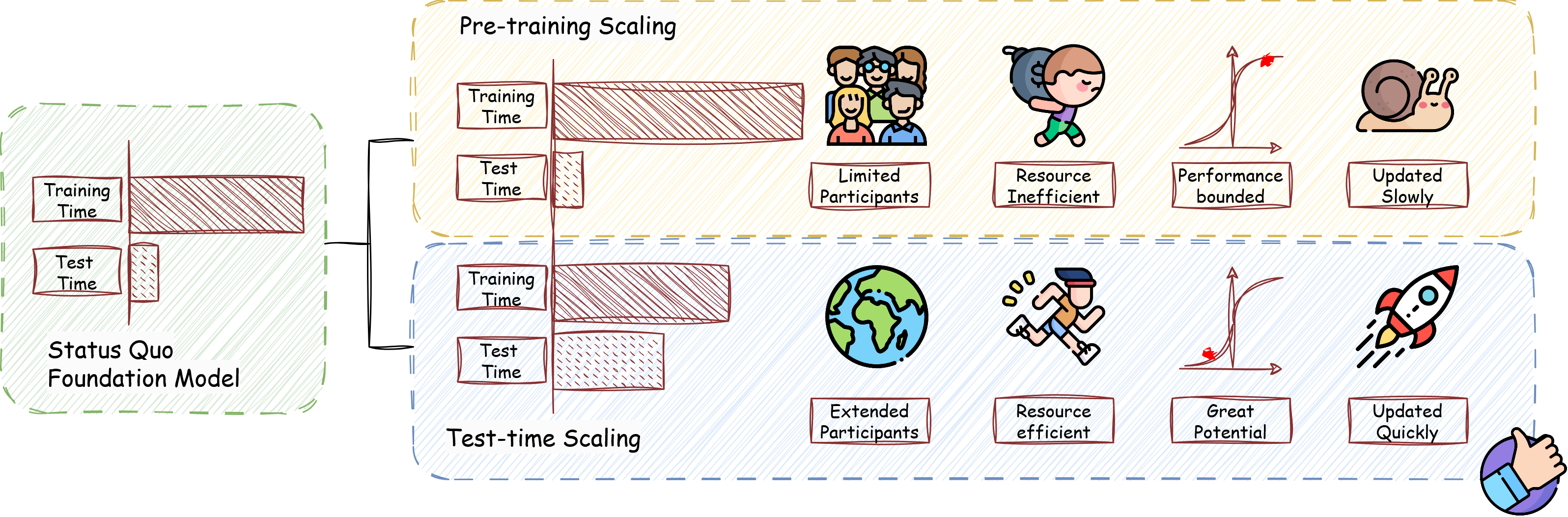
Figure 2: omparison of Scaling Paradigms in Pre-training and Test-time Phases..
🧬 Taxonomy
1. What to Scale
``What to scale'' refers to the specific form of TTS that is expanded or adjusted to enhance an LLM’s performance during inference.
- Parallel Scaling improves test-time performance by generating multiple outputs in parallel and then aggregating them into a final answer.
- Sequential Scaling involves explicitly directing later computations based on intermediate steps.
- Hybrid Scaling exploits the complementary benefits of parallel and sequential scaling.
- Internal Scaling elicits a model to autonomously determine how much computation to allocate for reasoning during testing within the model’s internal parameters, instead of external human-guided strategies.
2. How to Scale
- Tuning
- Supervised Fine-Tuning (SFT): by training on synthetic or distilled long CoT examples, SFT allows a model to imitate extended reasoning patterns.
- Reinforcement Learning (RL): RL can guide a model’s policy to generate longer or more accurate solutions.
- Inference
- Stimulation (STI): It basically stimulates the LLM to generate more and longer samples instead of generating individual samples directly.
- Verification (VER): The verification process plays an important role in the TTS, and it can be adapted to: i) directly selects the output sample among various ones, under the Parallel Scaling paradigm; ii) guides the stimulation process and determines when to stop, under the Sequential Scaling paradigm; iii) serves as the criteria in the search process; iv) determines what sample to aggregate and how to aggregate them, e.g., weights.
- Search (SEA): Search is a time-tested technique for retrieving relevant information from large databases, and it can also systematically explore the potential outputs of LLMs to improve complex reasoning tasks.
- Aggregation (AGG): Aggregation techniques consolidate multiple solutions into a final decision to enhance the reliability and robustness of model predictions at test time.
3. Where to Scale
- Reasoning: Math, Code, Science, Game & Strategy, Medical and so on.
- General-Purpose: Basics, Agents, Knowledge, Open-Ended, Multi-Modal and so on.
4. How Well to Scale
- Performance: This dimension measures the correctness and robustness of outputs.
- Efficiency: it captures the cost-benefit tradeoffs of TTS methods.
- Controllability: This dimension assesses whether TTS methods adhere to resource or output constraints, such as compute budgets or output lengths.
- Scalability: Scalability quantifies how well models improve with more test-time compute (e.g., tokens or steps).
🔍 Paper Tables
Method(PapersTitles) | What | How → | Where | How Well | |||||
|---|---|---|---|---|---|---|---|---|---|
| SFT | RL | STI | SEA | VER | AGG | ||||
Scaling llm test-time compute optimally can be more effective than scaling model parameters.,  | Parallel, Sequential | ✗ | ✗ | ✗ | Beam, LookAhead | Verifier | (Weighted) Best-of-N, Stepwise Aggregation | Math | Pass@1, FLOPsMatched Evaluation |
| Multi-agent verification: Scaling test-time compute with goal verifiers .,  | Parallel | ✗ | ✗ | Self-Repetition | ✗ | Multiple-Agent Verifiers | Best-of-N | Math, Code, General | BoN-MAV (Cons@k), Pass@1 |
| Evolving Deeper LLM Thinking ,  | Sequential | ✗ | ✗ | Self-Refine | ✗ | Functional | ✗ | Open-Ended | Success Rate, Token Cost |
| Meta-reasoner: Dynamic guidance for optimized inference-time reasoning in large language models ,  | Sequential | ✗ | ✗ | CoT + Self-Repetition | ✗ | Bandit | ✗ | Game, Sci, Math | Accuracy, Token Cost |
| START: Self-taught reasoner with tools ,  | Parallel, Sequential | Rejection Sampling | ✗ | Hint-infer | ✗ | Tool | ✗ | Math, Code | Pass@1 |
| " Well, Keep Thinking": Enhancing LLM Reasoning with Adaptive Injection Decoding ,  | Sequential | ✗ | ✗ | Adaptive Injection Decoding | ✗ | ✗ | ✗ | Math, Logical, Commonsense | Accuracy |
| Chain of draft: Thinking faster by writing less ,  | Sequential | ✗ | ✗ | Chain-of-Draft | ✗ | ✗ | ✗ | Math, Symbolic, Commonsense | Accuracy, Latency, Token Cost |
| rStar-Math: Small LLMs Can Master Math Reasoning with Self-Evolved Deep Thinking ,  | Hybrid | imitation | ✗ | ✗ | MCTS | PRM | ✗ | Math | Pass@1 |
| Can 1B LLM Surpass 405B LLM? Rethinking Compute-Optimal Test-Time Scaling ,  | Parallel, Hybrid | ✗ | ✗ | ✗ | DVTS, Beam Search | PRM | Best-of-N | Math | Pass@1, Pass@k, Majority, FLOPS |
| Tree of thoughts: Deliberate problem solving with large language models ,  | Hybrid | ✗ | ✗ | Propose Prompt, Self-Repetition | Tree Search | Self-Evaluate | ✗ | Game, Open-Ended | Success Rate, LLM-as-a-Judge |
| Mindstar: Enhancing math reasoning in pre-trained llms at inference time ,  | Hybrid | ✗ | ✗ | ✗ | LevinTS | PRM | ✗ | Math | Accuracy, Token Cost |
| Inference Scaling Laws: An Empirical Analysis of Compute-Optimal Inference for LLM Problem-Solving ,  | Hybrid | ✗ | ✗ | ✗ | Reward Balanced Search | RM | ✗ | Math | Test Error Rate, FLOPs |
| Reasoning-as-Logic-Units: Scaling Test-Time Reasoning in Large Language Models Through Logic Unit Alignment ,  | Hybrid | ✗ | ✗ | Self-Refine | Control Flow Graph | Self-Evaluate | Prompt Synthesis | Math, Code | Pass@1 |
| PlanGEN: A Multi-Agent Framework for Generating Planning and Reasoning Trajectories for Complex Problem Solving ,  | Parallel, Hybrid | ✗ | ✗ | MoA | ✗ | Verification Agent | Selection Agent | Math, General, Finance | Accuracy, F1 Score |
| A Probabilistic Inference Approach to Inference-Time Scaling of LLMs using Particle-Based Monte Carlo Methods ,  | Hybrid | ✗ | ✗ | ✗ | Particle-based Monte Carlo | PRM + SSM | Particle Filtering | Math | Pass@1, Budget vs. Accuracy |
| Archon: An Architecture Search Framework for Inference-Time Techniques ,  | Hybrid | ✗ | ✗ | MoA, Self-Repetition | ✗ | Verification Agent, Unit Testing (Ensemble) | Fusion | Math, Code, Open-Ended | Pass@1, Win Rate |
| Wider or deeper? scaling llm inference-time compute with adaptive branching tree search ,  | Hybrid | ✗ | ✗ | Mixture-of-Model | AB-MCTS-(M,A) | ✗ | ✗ | Code | Pass@1, RMSLE, ROC-AUC |
| Thinking llms: General instruction following with thought generation ,  | Internal, Parallel | ✗ | DPO | Think | ✗ | Judge Models | ✗ | Open-Ended | Win Rate |
| Self-Evolved Preference Optimization for Enhancing Mathematical Reasoning in Small Language Models ,  | Internal, Hybrid | ✗ | DPO | Diversity Generation | MCTS | Self-Reflect | ✗ | Math | Pass@1 |
| MA-LoT: Multi-Agent Lean-based Long Chain-of-Thought Reasoning enhances Formal Theorem Proving ,  | Internal, Sequential | imitation | ✗ | MoA | ✗ | Tool | ✗ | Math | Pass@k |
| Offline Reinforcement Learning for LLM Multi-Step Reasoning ,  | Internal, Sequential | ✗ | OREO | ✗ | Beam Search | Value Function | ✗ | Math, Agent | Pass@1, Success Rate |
| DeepSeek-R1: Incentivizing Reasoning Capability in LLMs via Reinforcement Learning ,  | Internal | warmup, GRPO, Rule-Based | ✗ | ✗ | ✗ | ✗ | Math, Code, Sci | Pass@1, cons@64, Percentile, Elo Rating, Win Rate | |
| s1: Simple test-time scaling ,  | Internal | distillation | ✗ | Budget Forcing | ✗ | ✗ | ✗ | Math, Sci | Pass@1, Control, Scaling |
| O1 Replication Journey: A Strategic Progress Report -- Part 1 ,  | Internal | imitation | ✗ | ✗ | Journey Learning | PRM, Critique | Multi-Agents | Math | Accuracy |
| From drafts to answers: Unlocking llm potential via aggregation fine-tuning ,  | Internal, Parallel | imitation | ✗ | ✗ | ✗ | Fusion | ✗ | Math, Open-Ended | Win Rate |
| Towards System 2 Reasoning in LLMs: Learning How to Think With Meta Chain-of-Though ,  | Internal, Hybrid | imitation, meta-RL | Think | MCTS, A* | PRM | ✗ | Math, Open-Ended | Win Rate | |
| ReasonFlux: Hierarchical LLM Reasoning via Scaling Thought Templates ,  | Internal, Sequential | ✗ | PPO, Trajectory | Thought Template Retrieve | ✗ | ✗ | Math | Pass@1 | |
| L1: Controlling how long a reasoning model thinks with reinforcement learning ,  | Internal | ✗ | GRPO, Length-Penalty | ✗ | ✗ | ✗ | ✗ | Math | Pass@1, Length Error |
| Marco-o1: Towards Open Reasoning Models for Open-Ended Solutions ,  | Internal, Hybrid | distillation, imitation | ✗ | Reflection Prompt | MCTS | Self-Critic | ✗ | Math | Pass@1, Pass@k |
Contributors


Similar repos


Languages
HTML
87.2%
JavaScript
9.6%
CSS
3.2%
"what, how, where, and how well? a survey on test-time scaling in large language models" repository
See the codeREADME
Awesome Test-time-Scaling in LLMs
Our repository, Awesome Test-time-Scaling in LLMs, gathers available papers on test-time scaling, to our current knowledge. Unlike other repositories that categorize papers, we decompose each paper's contributions based on the taxonomy provided by "What, How, Where, and How Well? A Survey on Test-Time Scaling in Large Language Models" facilitating easier understand and comparison for readers.
Figure 1: A Visual Map and Comparison: From What to Scale to How to Scale..
📢 News and Updates
-
[13/Apr/2025] 📌 The Second Version is released:
- We correct some typos;
- We include "Evaluation" and "Agentic" Tasks, which were enhanced by TTS;
- We revise the figures and tables, like the color of table 1.
-
[9/Apr/2025] 📌 Our repository is created.
-
[31/Mar/2025] 📌 Our initial survey is on Arxiv!
📘 Introduction
As enthusiasm for scaling computation (data and parameters) in the pertaining era gradually diminished, test-time scaling (TTS)—also referred to as “test-time computing”—has emerged as a prominent research focus. Recent studies demonstrate that TTS can further elicit the problem-solving capabilities of large language models (LLMs), enabling significant breakthroughs not only in reasoning-intensive tasks, such as mathematics and coding, but also in general tasks like open-ended Q&A. However, despite the explosion of recent efforts in this area, there remains an urgent need for a comprehensive survey offering systemic understanding. To fill this gap, we propose a unified, hierarchical framework structured along four orthogonal dimensions of TTS research: what to scale, how to scale, where to scale, and how well to scale. Building upon this taxonomy, we conduct a holistic review of methods, application scenarios, and assessment aspects, and present an organized decomposition that highlights the unique contributions of individual methods within the broader TTS landscape.
Figure 2: omparison of Scaling Paradigms in Pre-training and Test-time Phases..
🧬 Taxonomy
1. What to Scale
``What to scale'' refers to the specific form of TTS that is expanded or adjusted to enhance an LLM’s performance during inference.
- Parallel Scaling improves test-time performance by generating multiple outputs in parallel and then aggregating them into a final answer.
- Sequential Scaling involves explicitly directing later computations based on intermediate steps.
- Hybrid Scaling exploits the complementary benefits of parallel and sequential scaling.
- Internal Scaling elicits a model to autonomously determine how much computation to allocate for reasoning during testing within the model’s internal parameters, instead of external human-guided strategies.
2. How to Scale
- Tuning
- Supervised Fine-Tuning (SFT): by training on synthetic or distilled long CoT examples, SFT allows a model to imitate extended reasoning patterns.
- Reinforcement Learning (RL): RL can guide a model’s policy to generate longer or more accurate solutions.
- Inference
- Stimulation (STI): It basically stimulates the LLM to generate more and longer samples instead of generating individual samples directly.
- Verification (VER): The verification process plays an important role in the TTS, and it can be adapted to: i) directly selects the output sample among various ones, under the Parallel Scaling paradigm; ii) guides the stimulation process and determines when to stop, under the Sequential Scaling paradigm; iii) serves as the criteria in the search process; iv) determines what sample to aggregate and how to aggregate them, e.g., weights.
- Search (SEA): Search is a time-tested technique for retrieving relevant information from large databases, and it can also systematically explore the potential outputs of LLMs to improve complex reasoning tasks.
- Aggregation (AGG): Aggregation techniques consolidate multiple solutions into a final decision to enhance the reliability and robustness of model predictions at test time.
3. Where to Scale
- Reasoning: Math, Code, Science, Game & Strategy, Medical and so on.
- General-Purpose: Basics, Agents, Knowledge, Open-Ended, Multi-Modal and so on.
4. How Well to Scale
- Performance: This dimension measures the correctness and robustness of outputs.
- Efficiency: it captures the cost-benefit tradeoffs of TTS methods.
- Controllability: This dimension assesses whether TTS methods adhere to resource or output constraints, such as compute budgets or output lengths.
- Scalability: Scalability quantifies how well models improve with more test-time compute (e.g., tokens or steps).
🔍 Paper Tables
Method(PapersTitles) | What | How → | Where | How Well | |||||
|---|---|---|---|---|---|---|---|---|---|
| SFT | RL | STI | SEA | VER | AGG | ||||
| Scaling llm test-time compute optimally can be more effective than scaling model parameters., | Parallel, Sequential | ✗ | ✗ | ✗ | Beam, LookAhead | Verifier | (Weighted) Best-of-N, Stepwise Aggregation | Math | Pass@1, FLOPsMatched Evaluation |
| Multi-agent verification: Scaling test-time compute with goal verifiers ., | Parallel | ✗ | ✗ | Self-Repetition | ✗ | Multiple-Agent Verifiers | Best-of-N | Math, Code, General | BoN-MAV (Cons@k), Pass@1 |
| Evolving Deeper LLM Thinking , | Sequential | ✗ | ✗ | Self-Refine | ✗ | Functional | ✗ | Open-Ended | Success Rate, Token Cost |
| Meta-reasoner: Dynamic guidance for optimized inference-time reasoning in large language models , | Sequential | ✗ | ✗ | CoT + Self-Repetition | ✗ | Bandit | ✗ | Game, Sci, Math | Accuracy, Token Cost |
| START: Self-taught reasoner with tools , | Parallel, Sequential | Rejection Sampling | ✗ | Hint-infer | ✗ | Tool | ✗ | Math, Code | Pass@1 |
| " Well, Keep Thinking": Enhancing LLM Reasoning with Adaptive Injection Decoding , | Sequential | ✗ | ✗ | Adaptive Injection Decoding | ✗ | ✗ | ✗ | Math, Logical, Commonsense | Accuracy |
| Chain of draft: Thinking faster by writing less , | Sequential | ✗ | ✗ | Chain-of-Draft | ✗ | ✗ | ✗ | Math, Symbolic, Commonsense | Accuracy, Latency, Token Cost |
| rStar-Math: Small LLMs Can Master Math Reasoning with Self-Evolved Deep Thinking , | Hybrid | imitation | ✗ | ✗ | MCTS | PRM | ✗ | Math | Pass@1 |
| Can 1B LLM Surpass 405B LLM? Rethinking Compute-Optimal Test-Time Scaling , | Parallel, Hybrid | ✗ | ✗ | ✗ | DVTS, Beam Search | PRM | Best-of-N | Math | Pass@1, Pass@k, Majority, FLOPS |
| Tree of thoughts: Deliberate problem solving with large language models , | Hybrid | ✗ | ✗ | Propose Prompt, Self-Repetition | Tree Search | Self-Evaluate | ✗ | Game, Open-Ended | Success Rate, LLM-as-a-Judge |
| Mindstar: Enhancing math reasoning in pre-trained llms at inference time , | Hybrid | ✗ | ✗ | ✗ | LevinTS | PRM | ✗ | Math | Accuracy, Token Cost |
| Inference Scaling Laws: An Empirical Analysis of Compute-Optimal Inference for LLM Problem-Solving , | Hybrid | ✗ | ✗ | ✗ | Reward Balanced Search | RM | ✗ | Math | Test Error Rate, FLOPs |
| Reasoning-as-Logic-Units: Scaling Test-Time Reasoning in Large Language Models Through Logic Unit Alignment , | Hybrid | ✗ | ✗ | Self-Refine | Control Flow Graph | Self-Evaluate | Prompt Synthesis | Math, Code | Pass@1 |
| PlanGEN: A Multi-Agent Framework for Generating Planning and Reasoning Trajectories for Complex Problem Solving , | Parallel, Hybrid | ✗ | ✗ | MoA | ✗ | Verification Agent | Selection Agent | Math, General, Finance | Accuracy, F1 Score |
| A Probabilistic Inference Approach to Inference-Time Scaling of LLMs using Particle-Based Monte Carlo Methods , | Hybrid | ✗ | ✗ | ✗ | Particle-based Monte Carlo | PRM + SSM | Particle Filtering | Math | Pass@1, Budget vs. Accuracy |
| Archon: An Architecture Search Framework for Inference-Time Techniques , | Hybrid | ✗ | ✗ | MoA, Self-Repetition | ✗ | Verification Agent, Unit Testing (Ensemble) | Fusion | Math, Code, Open-Ended | Pass@1, Win Rate |
| Wider or deeper? scaling llm inference-time compute with adaptive branching tree search , | Hybrid | ✗ | ✗ | Mixture-of-Model | AB-MCTS-(M,A) | ✗ | ✗ | Code | Pass@1, RMSLE, ROC-AUC |
| Thinking llms: General instruction following with thought generation , | Internal, Parallel | ✗ | DPO | Think | ✗ | Judge Models | ✗ | Open-Ended | Win Rate |
| Self-Evolved Preference Optimization for Enhancing Mathematical Reasoning in Small Language Models , | Internal, Hybrid | ✗ | DPO | Diversity Generation | MCTS | Self-Reflect | ✗ | Math | Pass@1 |
| MA-LoT: Multi-Agent Lean-based Long Chain-of-Thought Reasoning enhances Formal Theorem Proving , | Internal, Sequential | imitation | ✗ | MoA | ✗ | Tool | ✗ | Math | Pass@k |
| Offline Reinforcement Learning for LLM Multi-Step Reasoning , | Internal, Sequential | ✗ | OREO | ✗ | Beam Search | Value Function | ✗ | Math, Agent | Pass@1, Success Rate |
| DeepSeek-R1: Incentivizing Reasoning Capability in LLMs via Reinforcement Learning , | Internal | warmup, GRPO, Rule-Based | ✗ | ✗ | ✗ | ✗ | Math, Code, Sci | Pass@1, cons@64, Percentile, Elo Rating, Win Rate | |
| s1: Simple test-time scaling , | Internal | distillation | ✗ | Budget Forcing | ✗ | ✗ | ✗ | Math, Sci | Pass@1, Control, Scaling |
| O1 Replication Journey: A Strategic Progress Report -- Part 1 , | Internal | imitation | ✗ | ✗ | Journey Learning | PRM, Critique | Multi-Agents | Math | Accuracy |
| From drafts to answers: Unlocking llm potential via aggregation fine-tuning , | Internal, Parallel | imitation | ✗ | ✗ | ✗ | Fusion | ✗ | Math, Open-Ended | Win Rate |
| Towards System 2 Reasoning in LLMs: Learning How to Think With Meta Chain-of-Though , | Internal, Hybrid | imitation, meta-RL | Think | MCTS, A* | PRM | ✗ | Math, Open-Ended | Win Rate | |
| ReasonFlux: Hierarchical LLM Reasoning via Scaling Thought Templates , | Internal, Sequential | ✗ | PPO, Trajectory | Thought Template Retrieve | ✗ | ✗ | Math | Pass@1 | |
| L1: Controlling how long a reasoning model thinks with reinforcement learning , | Internal | ✗ | GRPO, Length-Penalty | ✗ | ✗ | ✗ | ✗ | Math | Pass@1, Length Error |
| Marco-o1: Towards Open Reasoning Models for Open-Ended Solutions , | Internal, Hybrid | distillation, imitation | ✗ | Reflection Prompt | MCTS | Self-Critic | ✗ | Math | Pass@1, Pass@k |
Similar repos
Contributors
Languages
HTML
87.2%
JavaScript
9.6%
CSS
3.2%