title: PhishBrake emoji: 🍬 colorFrom: yellow colorTo: red pinned: true sdk: gradio sdk_version: 6.16.0 python_version: 3.12 app_file: app.py license: mit author: The Jawbreaker Team short_description: Private scam defense for someone you love. tags:

Scam defense for someone you love.
Initiative: ML Empowerment Build Challenge 3.0
Maintained by: The Jawbreaker Team
Why this exists: The motivating user is a friend's grandmother who had already been affected by scam messages. Private details are intentionally omitted, but that family context shaped the product: this is not a generic spam classifier for security experts; it is a calm safety check for someone who needs to know whether to reply, click, call, or ask for help.
llama-cpp-python.eval/, with reports under eval/reports/.PhishBrake is built around direct small-model inference to protect user privacy. The local default uses the MiniCPM5-1B base GGUF; a Transformers backend and an optional adapter remain configurable for deployments that use them.
PhishBrake helps a real person pause before clicking, replying, or sending money. Paste a suspicious text, email, or DM and PhishBrake breaks it into plain-English warning signs: what the sender is pretending to be, what pressure tactic is being used, what they want, and the safest next step.
The problem is specific: scam messages now arrive as urgent, personal, plausible requests. A package fee, a bank callback, a fake recruiter, or a "new phone number" from a family member can pressure someone into clicking or paying before they ask for help. PhishBrake turns that moment into a small safety workflow: paste the message, get a clear verdict, see the warning signs, see whether the message needs more context, and copy a short note to someone you trust.
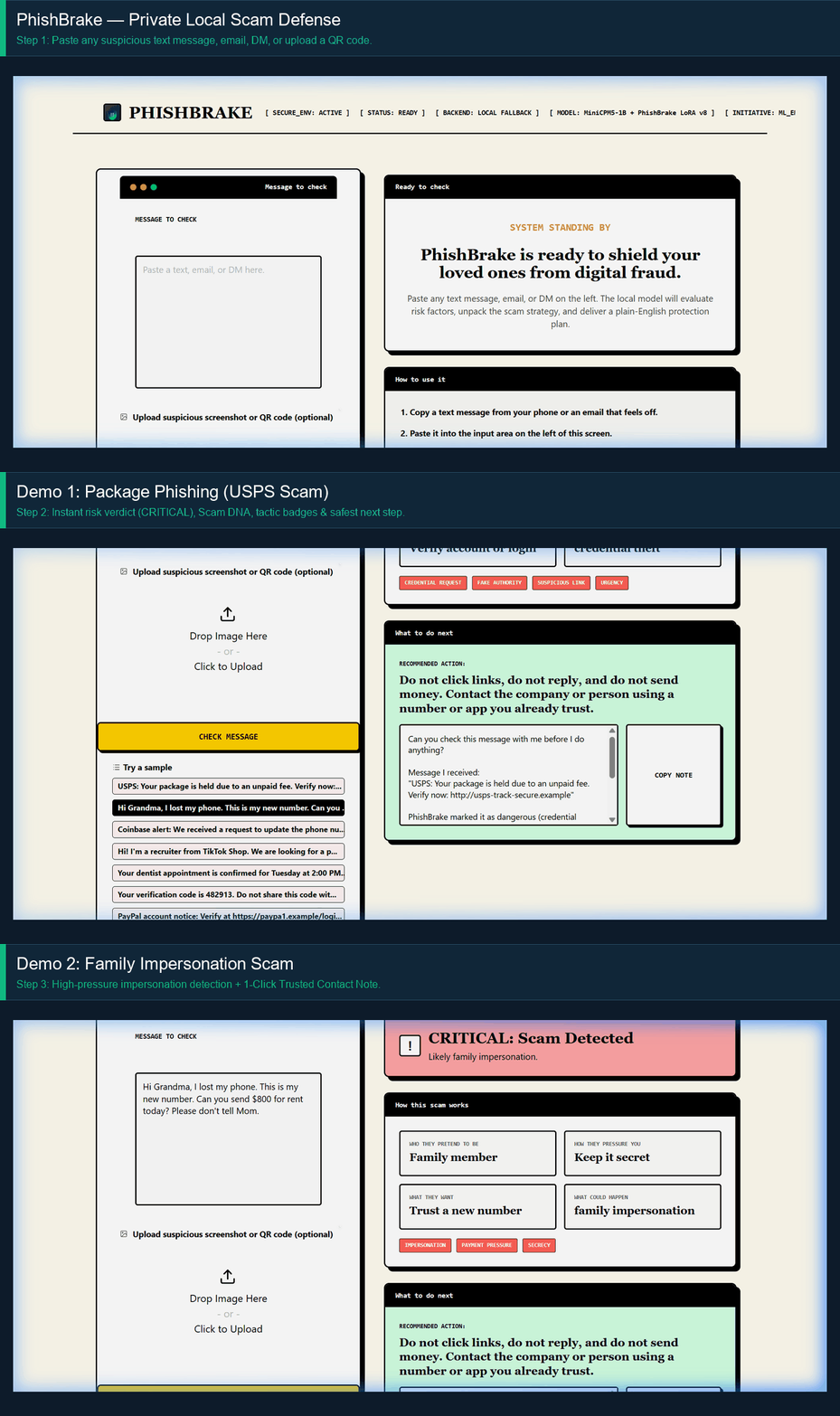
Run the app locally using the steps in SETUP.md, then submit a sanitized suspicious message.
PhishBrake is maintained by The Jawbreaker Team for the ML Empowerment Build Challenge 3.0. The project focuses on a practical scam-safety workflow, with a local small-model runtime, transparent limitations, and reproducible evaluation artifacts.
PhishBrake is deliberately narrow. It does not try to be a general assistant or chatbot. It performs one safety task:
| Component | Model / Library | Where it runs |
|---|---|---|
| Scam analysis | MiniCPM5-1B Q4_K_M GGUF base model | Local llama-cpp-python runtime |
| Safety guard | Schema validation + deterministic heuristic guard | App runtime |
| Interface | Custom gr.Server kitchen-table UI | Local Gradio app |
| Training/eval | PEFT/LoRA + guarded eval harness | Optional research workflow |
The default local app uses the MiniCPM5-1B base model in GGUF format through llama-cpp-python. The repository also retains a configurable Transformers path and the previously trained adapter for comparison and reproducibility:
Why this model:
The eval tools also support Transformers and saved-prediction backends for comparing historical model runs.
Safety architecture:
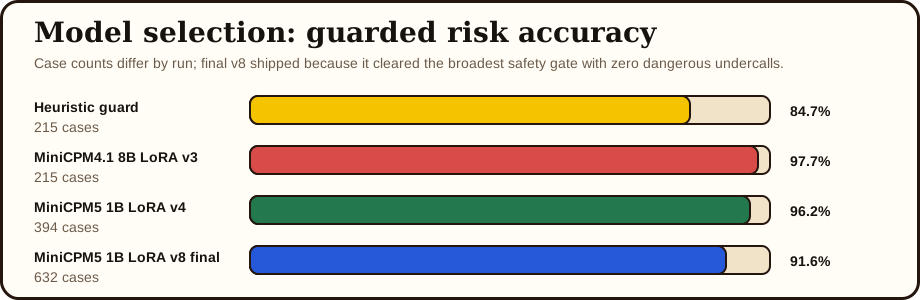
| Candidate | Size | Eval set | Risk accuracy | Dangerous -> safe | Dangerous -> needs check | Safe -> dangerous/suspicious | Invalid JSON | Unsafe actions | Why not final |
|---|---|---|---|---|---|---|---|---|---|
| Heuristic guard | none | 215 hard cases | 84.7% | 0 | 0 | 0 | 0 | 0 | Guard layer only, not model-led. |
| MiniCPM4.1 LoRA v3 | 8B | 215 hard cases | 97.7% | 0 | 0 | 0 | 0 | 0 | Strong, but larger than the local default. |
| MiniCPM5 LoRA v4 | 1B | 394 hard cases | 96.2% | 0 | 0 | 3 | 0 | 0 | Strong, narrower eval and a few safe-message overcalls. |
| MiniCPM5 LoRA v8 | 1B | 632 hard cases | 91.6% | 0 | 0 | 0 | 0 | 0 | Final: broadest safety gate. |
The historical 1B v8 adapter cleared the broadest completed hard safety gate in the included reports. The local default is the base GGUF and should not be represented as that fine-tuned adapter.
Qwen/Qwen3-0.6B was an earlier runtime candidate and remains available for evaluation, but it is not included in the numeric comparison because the committed reports cover the heuristic guard and MiniCPM LoRA candidates.
Training/eval artifacts:
eval/ and training/data/.eval/scam_eval.jsonl: 100 hand-curated synthetic/sanitized eval cases.eval/field_examples.jsonl: sanitized real-world examples from a friend, with names and phone numbers removed.training/generate_jawbreaker_data.py: deterministic generator for larger train/dev/test splits.training/generate_v3_data.py: contrastive hard-case generator used for the v3 LoRA pass.training/generate_v4_data.py, generate_v5_data.py, generate_v6_data.py, generate_v7_data.py, generate_v8_data.py: later calibration generators used to stress-test false positives, trusted-route boundaries, fresh public scam patterns, and wrong-number investment grooming.training/data/train.jsonl, dev.jsonl, test.jsonl: generated SFT records for PhishBrake JSON behavior.training/data/train_v3.jsonl, dev_v3.jsonl, test_v3.jsonl: v3 contrastive training split.eval/generated_eval.jsonl: generated holdout eval set.eval/hard_v2_eval.jsonl: hard eval set used to compare v2 and v3 adapters.eval/hard_v4_eval.jsonl, hard_v5_eval.jsonl, hard_v6_eval.jsonl, hard_v7_eval.jsonl, hard_v8_eval.jsonl: expanded hard evals used during 1B calibration.eval/reports/jawbreaker-minicpm5-1b-lora-v8-hard632-safetyguard-v4.json: main final model evidence.training/train_lora.py: PEFT/LoRA script for publishing PhishBrake MiniCPM adapters.training/modal_train.py: Modal A100 training launcher used for the MiniCPM LoRA passes.training/modal_eval.py: Modal A100 eval launcher used for guarded hard-suite scoring.HONEST_SUBMISSION.md: guardrails to avoid overclaiming synthetic data, fine-tuning, or runtime behavior.PhishBrake is developed by The Jawbreaker Team for the ML Empowerment Build Challenge 3.0. The project keeps its claims tied to included code and evaluation artifacts; historical adapter scores are not claims about the default base GGUF.
PhishBrake is not legal, financial, or cybersecurity advice. It is a local-first safety aid that helps non-experts slow down and verify suspicious messages. The safest action should never ask the user to click the suspicious link or call a number from the suspicious message.
FIELD_NOTES.md is a build-observation log: product decisions, model/runtime pivots, eval results, and packaging notes. It is not presented as ethnographic user research.
title: PhishBrake emoji: 🍬 colorFrom: yellow colorTo: red pinned: true sdk: gradio sdk_version: 6.16.0 python_version: 3.12 app_file: app.py license: mit author: The Jawbreaker Team short_description: Private scam defense for someone you love. tags:
Scam defense for someone you love.
Initiative: ML Empowerment Build Challenge 3.0
Maintained by: The Jawbreaker Team
Why this exists: The motivating user is a friend's grandmother who had already been affected by scam messages. Private details are intentionally omitted, but that family context shaped the product: this is not a generic spam classifier for security experts; it is a calm safety check for someone who needs to know whether to reply, click, call, or ask for help.
llama-cpp-python.eval/, with reports under eval/reports/.PhishBrake is built around direct small-model inference to protect user privacy. The local default uses the MiniCPM5-1B base GGUF; a Transformers backend and an optional adapter remain configurable for deployments that use them.
PhishBrake helps a real person pause before clicking, replying, or sending money. Paste a suspicious text, email, or DM and PhishBrake breaks it into plain-English warning signs: what the sender is pretending to be, what pressure tactic is being used, what they want, and the safest next step.
The problem is specific: scam messages now arrive as urgent, personal, plausible requests. A package fee, a bank callback, a fake recruiter, or a "new phone number" from a family member can pressure someone into clicking or paying before they ask for help. PhishBrake turns that moment into a small safety workflow: paste the message, get a clear verdict, see the warning signs, see whether the message needs more context, and copy a short note to someone you trust.
Run the app locally using the steps in SETUP.md, then submit a sanitized suspicious message.
PhishBrake is maintained by The Jawbreaker Team for the ML Empowerment Build Challenge 3.0. The project focuses on a practical scam-safety workflow, with a local small-model runtime, transparent limitations, and reproducible evaluation artifacts.
PhishBrake is deliberately narrow. It does not try to be a general assistant or chatbot. It performs one safety task:
| Component | Model / Library | Where it runs |
|---|---|---|
| Scam analysis | MiniCPM5-1B Q4_K_M GGUF base model | Local llama-cpp-python runtime |
| Safety guard | Schema validation + deterministic heuristic guard | App runtime |
| Interface | Custom gr.Server kitchen-table UI | Local Gradio app |
| Training/eval | PEFT/LoRA + guarded eval harness | Optional research workflow |
The default local app uses the MiniCPM5-1B base model in GGUF format through llama-cpp-python. The repository also retains a configurable Transformers path and the previously trained adapter for comparison and reproducibility:
Why this model:
The eval tools also support Transformers and saved-prediction backends for comparing historical model runs.
Safety architecture:
| Candidate | Size | Eval set | Risk accuracy | Dangerous -> safe | Dangerous -> needs check | Safe -> dangerous/suspicious | Invalid JSON | Unsafe actions | Why not final |
|---|---|---|---|---|---|---|---|---|---|
| Heuristic guard | none | 215 hard cases | 84.7% | 0 | 0 | 0 | 0 | 0 | Guard layer only, not model-led. |
| MiniCPM4.1 LoRA v3 | 8B | 215 hard cases | 97.7% | 0 | 0 | 0 | 0 | 0 | Strong, but larger than the local default. |
| MiniCPM5 LoRA v4 | 1B | 394 hard cases | 96.2% | 0 | 0 | 3 | 0 | 0 | Strong, narrower eval and a few safe-message overcalls. |
| MiniCPM5 LoRA v8 | 1B | 632 hard cases | 91.6% | 0 | 0 | 0 | 0 | 0 | Final: broadest safety gate. |
The historical 1B v8 adapter cleared the broadest completed hard safety gate in the included reports. The local default is the base GGUF and should not be represented as that fine-tuned adapter.
Qwen/Qwen3-0.6B was an earlier runtime candidate and remains available for evaluation, but it is not included in the numeric comparison because the committed reports cover the heuristic guard and MiniCPM LoRA candidates.
Training/eval artifacts:
eval/ and training/data/.eval/scam_eval.jsonl: 100 hand-curated synthetic/sanitized eval cases.eval/field_examples.jsonl: sanitized real-world examples from a friend, with names and phone numbers removed.training/generate_jawbreaker_data.py: deterministic generator for larger train/dev/test splits.training/generate_v3_data.py: contrastive hard-case generator used for the v3 LoRA pass.training/generate_v4_data.py, generate_v5_data.py, generate_v6_data.py, generate_v7_data.py, generate_v8_data.py: later calibration generators used to stress-test false positives, trusted-route boundaries, fresh public scam patterns, and wrong-number investment grooming.training/data/train.jsonl, dev.jsonl, test.jsonl: generated SFT records for PhishBrake JSON behavior.training/data/train_v3.jsonl, dev_v3.jsonl, test_v3.jsonl: v3 contrastive training split.eval/generated_eval.jsonl: generated holdout eval set.eval/hard_v2_eval.jsonl: hard eval set used to compare v2 and v3 adapters.eval/hard_v4_eval.jsonl, hard_v5_eval.jsonl, hard_v6_eval.jsonl, hard_v7_eval.jsonl, hard_v8_eval.jsonl: expanded hard evals used during 1B calibration.eval/reports/jawbreaker-minicpm5-1b-lora-v8-hard632-safetyguard-v4.json: main final model evidence.training/train_lora.py: PEFT/LoRA script for publishing PhishBrake MiniCPM adapters.training/modal_train.py: Modal A100 training launcher used for the MiniCPM LoRA passes.training/modal_eval.py: Modal A100 eval launcher used for guarded hard-suite scoring.HONEST_SUBMISSION.md: guardrails to avoid overclaiming synthetic data, fine-tuning, or runtime behavior.PhishBrake is developed by The Jawbreaker Team for the ML Empowerment Build Challenge 3.0. The project keeps its claims tied to included code and evaluation artifacts; historical adapter scores are not claims about the default base GGUF.
PhishBrake is not legal, financial, or cybersecurity advice. It is a local-first safety aid that helps non-experts slow down and verify suspicious messages. The safest action should never ask the user to click the suspicious link or call a number from the suspicious message.
FIELD_NOTES.md is a build-observation log: product decisions, model/runtime pivots, eval results, and packaging notes. It is not presented as ethnographic user research.



