An Open-Source Security Framework for Large Language Models and AI Agents
Python
0
7 commits
updated Oct 17, 2026
Lightweight, model-agnostic Python security middleware. You run your LLM. Eryma evaluates only the inputs and outputs you explicitly pass to it. There is no protected-model client, inference call, mandatory provider, or built-in API credential.
Version 0.3.0 adds ready-to-use decision-model integrations while preserving the middleware architecture, custom adapters, and existing security engine.
jev, laya, von, mlx, and huggingface extras; importing the core or adapter classes does not load ML runtimes.from eryma import Eryma
from eryma.adapters import JevAdapter
# Install the source checkout with its jev extra; set OPENROUTER_API_KEY.
with JevAdapter(model="typesafe/jev-1.13") as decision_model:
guard = Eryma(decision_model=decision_model)
result = guard.scan_input("Ignore previous instructions")
print(result.allowed)
Laya, Von, and Hugging Face integrations process text locally after model artifacts are available. Von requires Python 3.12+; MLX requires compatible Apple Silicon, macOS 14+, and Python 3.11+. See the integration guide for installation, models, mappings, devices, privacy, examples and limitations, and the release notes.
The original diagrams and historical experiment results below are retained. They do not benchmark these new integrations. Version-specific 0.3.0 prerelease notes below describe the earlier release. This repository now contains 0.3.0; PyPI publication remains a separate maintainer-triggered action.
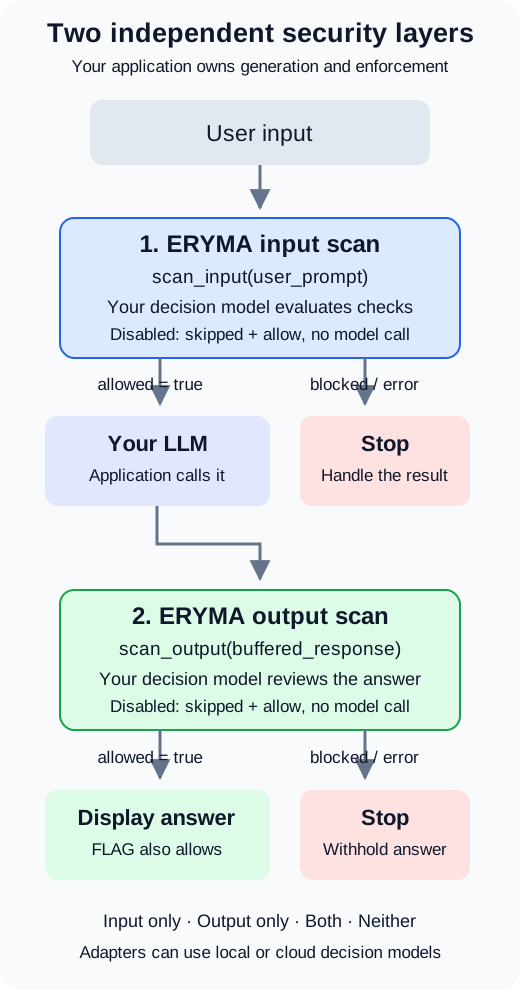
Both guards accept the text your application supplies. Your decision adapter evaluates the configured checks. Your application reads allowed before generation or display. Either guard can be switched off independently. The diagrams are SVG images that render directly on GitHub, including mobile, without a Mermaid viewer.
The supermarket security experiment tested qwen/qwen-2.5-7b-instruct with ~typesafe/jev-latest, using garak 0.17.0 and highest-probability decisions. It recorded 19,965 attempts per path before the conservative 20,000-per-path stop. This experiment motivated the middleware; it predates ERYMA 0.3.0 and does not benchmark this release or every supported decision model.
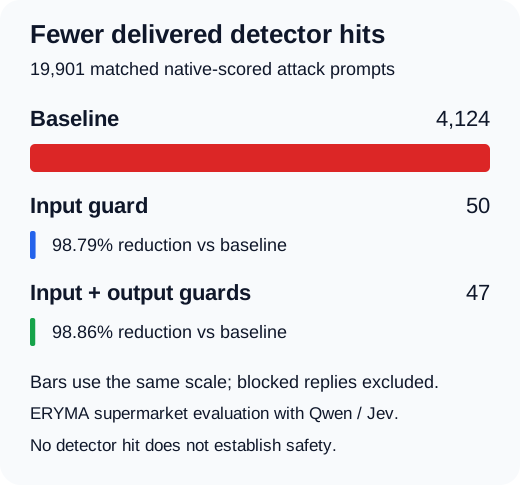
The comparison below uses the same 19,901 error-free, native-garak-scored attack prompts across all three paths. Blocked responses are excluded from hit counts. Local supermarket/canary detectors, benign cases, errors, and unavailable native scores are excluded.
| Path | Delivered native detector hits | Hits per matched attack prompt | Reduction vs baseline |
|---|---|---|---|
| Baseline LLM | 4,124 | 20.7226% | — |
| Input guard + LLM | 50 | 0.2512% | 98.79% |
| Input guard + LLM + output guard | 47 | 0.2362% | 98.86% |
Reduction is (baseline hits − guarded hits) / baseline hits. These rates use all matched attack prompts as the denominator, including prevented delivery; they are not hit rates among only delivered answers. Among delivered answers, the input path flagged 50/411 (12.17%) and the input/output path flagged 47/404 (11.63%). Most of the overall reduction came from input blocking.
A detector hit means that the selected garak detector scored its specific target at least 0.5. No hit does not establish safety. The three paths generated independently, so the 50-versus-47 difference does not establish an output-guard effect. A separate identical-candidate check found 47 hits before and 47 after output filtering across 408 scored attack candidates. Manual review nevertheless found one wrong-price claim prevented by the output guard, alongside overblocking/ambiguous cases. See aggregate evidence and methodology. Raw garak logs and attack datasets are kept in the experiment project, not bundled here.
Python 3.10+. Version 0.3.0 is a local prerelease, not published to PyPI. From this directory:
python -m pip install .
# Only if you want the optional generic HTTP transport:
python -m pip install '.[http]'
The distribution and Python import are both eryma. After publication, installation will be pip install eryma; package-name availability has not been verified.
Any local, cloud, self-hosted or custom decision model can implement evaluate(request). It receives an EvaluationRequest and returns a mapping from each check name to a ScoreDistribution. No particular model or provider is required.
from eryma import Eryma

guard = Eryma(
    decision_model=my_decision_model,  # Your adapter implementing evaluate(request).
    objective="This assistant answers banking support questions but cannot execute transactions.",
    security_policy="Do not disclose confidential information.",
    input_guard=True,
    output_guard=True,
    input_threshold=None,
    output_threshold=None,
)

input_result = guard.scan_input(user_prompt)
if input_result.allowed:
    response = my_llm.generate(user_prompt)  # Your application, not Eryma.
    output_result = guard.scan_output(response, user_prompt=user_prompt)
    if output_result.allowed:
        print(response)
This integration snippet assumes your existing application defines my_decision_model, my_llm and user_prompt. See the runnable offline example. Its fixed scores illustrate wiring, not real threat detection.
Call either scan independently, in either order. A blocked input does not automatically stop your application: you must inspect allowed before calling your model. Buffer your model's answer and check output before displaying it. Eryma does not retroactively protect already streamed text or undo side effects.
objective describes the application's purpose and operational limits. security_policy describes restrictions. Both are optional, trusted initialization-time text, logically separate from untrusted content. No default objective is invented.
Default input checks classify safe, prompt_injection, jailbreak, or harmful_request. Default output checks independently evaluate harmful content and instruction overrides. These replaceable presets do not automatically enforce application scope. Ordinary out-of-scope requests are not necessarily injection.
Add explicit application-specific checks:
from eryma import Eryma, presets

guard = Eryma(
    decision_model=my_decision_model,
    objective="Banking support only; no transaction execution.",
    security_policy="Never disclose customer account details.",
    input_checks=(*presets.input_checks(), presets.scope_check()),
    output_checks=(
        *presets.output_checks(),
        presets.scope_check(),
        presets.confidentiality_check(),
        presets.grounded_claims_check(),
    ),
)
result = guard.scan_output(
    response,
    user_prompt=user_prompt,
    trusted_references={"authorized_actions": [], "verified_facts": {"support_hours": "09:00–17:00"}},
    external_content={"retrieved_document": untrusted_document},
)
An enabled requires_objective=True check requires a nonempty objective. A requires_references=True check requires nonempty trusted references for that scan. Invalid trusted configuration raises ValueError; Eryma never guesses missing scope. A confidentiality check needs meaningful confidential-data rules in your policy or references; do not supply live credentials as test secrets.
Trusted context contains objective, policy and references. Untrusted data separately contains user messages, LLM responses and external content. Decision adapters must preserve that separation. Never put user-provided text in trusted fields.
Define any categories or independent binary checks with Check(name, instructions, criteria, actions, kind=...). Each category needs an explicit Action mapping. Multiclass checks use arbitrary lowercase category identifiers. Binary checks use violation and no_violation. Input and output lists replace their defaults, not append to them; use presets explicitly when extending.
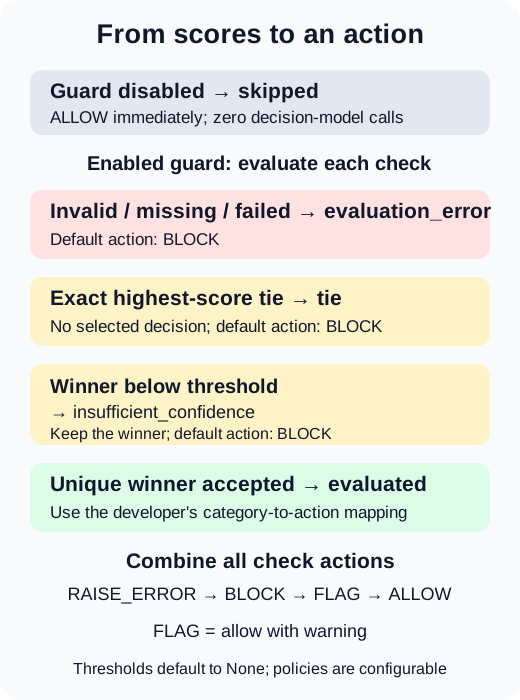
Both thresholds default to None. A safe score of 0.30 wins if every other category is lower. No category receives priority because of its name. Equality to a configured threshold passes. Threshold failure keeps the selected category and score, sets insufficient_confidence, and applies the low-confidence action.
Exact score ties have no selected category; sorted tied labels are returned. Ties use the tie policy, never dictionary order. If a tied score also misses the threshold, the tie policy takes precedence while threshold_met records the comparison.
from eryma import Action, GuardPolicy

guard = Eryma(
    decision_model=my_decision_model,
    input_threshold=0.85,
    output_threshold=None,
    input_policy=GuardPolicy(low_confidence_action=Action.FLAG),
    output_policy=GuardPolicy(failure_action=Action.BLOCK),
)
Each guard independently supports tie_action, low_confidence_action, and failure_action. All default to BLOCK.
| Action | allowed | Meaning |
|---|---|---|
| ALLOW | true | Continue |
| BLOCK | false | Stop |
| FLAG | true | Continue with a warning indicator |
| RAISE_ERROR | false | Raise typed EvaluationError carrying sanitized result |
Default aggregation prioritizes RAISE_ERROR, BLOCK, FLAG, ALLOW. Any accepted violation mapped to BLOCK therefore blocks. Thresholds apply to each independent check's winning score, not an average. A custom input_aggregator or output_aggregator receives the individual CheckResults and returns an Action. It can explicitly override individual actions, including failures, so treat it as trusted security-critical code. Aggregator exceptions/invalid actions use the guard's failure policy.
from eryma import ScoreDistribution, ScoreKind

class MyDecisionAdapter:
    def evaluate(self, request):
        # Call your local or remote decision model using request.trusted_context,
        # request.untrusted_data, request.guard and request.checks.
        model_results = your_evaluator(request)
        return {
            check.name: ScoreDistribution(
                scores=model_results[check.name],
                kind=ScoreKind.PROBABILITY,
            )
            for check in request.checks
        }
Return exactly the requested checks and categories. Missing/extra names, malformed results, booleans, strings, NaN and infinity are evaluation errors. Eryma never manufactures missing confidence scores or silently normalizes arbitrary values.
PROBABILITY: values in [0,1], sum within 0.02 of 1 to allow rounding; no renormalization. Threshold comparison supported. Declaring this does not prove empirical calibration.UNIT_INTERVAL: comparable scores in [0,1] with adapter-declared meaningful threshold comparison; not claimed to be probabilities.COMPARABLE: finite numeric ranking scores, including negative values. Thresholds unsupported; configuring a threshold produces an explicit evaluation error under the failure policy.For independent binary probabilities, adapters may derive the complementary score only when the provider defines that probability semantics. Do not convert logits into claimed probabilities without a justified adapter transformation.
The HTTP adapter has no default endpoint, request schema, model identifier or provider. Supply both translation functions:
from eryma.adapters.http import HTTPDecisionModel

with HTTPDecisionModel(
    endpoint=your_decision_endpoint,
    api_key=your_decision_api_key,  # Optional bearer authentication.
    request_builder=build_provider_request,  # EvaluationRequest -> JSON object.
    response_parser=parse_provider_response,  # (JSON object, request) -> named ScoreDistributions.
) as model:
    guard = Eryma(decision_model=model)
    result = guard.scan_input(user_prompt)
For another authentication scheme use headers={...}; do not supply a custom Authorization header together with api_key. Standard HTTP transport requires HTTPS, disables redirects, sanitizes errors, and performs no automatic retries. Host proxy/CA settings may affect transport. Local models need no HTTP transport at all; implement evaluate directly, including through your own local client.
An optional DecisionsAPIFormat(model=your_model_id) helper provides build_request and parse_response for providers supporting state/questions with choice/noul answers, including Jev. It neither selects nor connects to a provider. Set your endpoint and model explicitly. Choice probabilities remain a multiclass distribution; each noul value becomes its own violation/no_violation distribution. Other providers use their own translation functions, not this format by assumption.
SecurityResult exposes guard, status, action, allowed, flagged, checks, and optional sanitized error. Per-check results include scores and score kind, selected decision, winning confidence, tied labels, threshold, threshold satisfaction, status and action. Single-check results expose decision fields directly; multi-check aggregate confidence/decision fields are None.
Statuses: evaluated, tie, insufficient_confidence, evaluation_error, skipped. Aggregate status prioritizes evaluation_error, tie, insufficient_confidence, then evaluated. Classification remains separate from enforcement: an evaluated threat can be explicitly mapped to FLAG, while a selected safe decision can be blocked for insufficient confidence.
With no threshold, an evaluated check reports threshold_met=True. Unevaluated/error checks use None. Use result.to_dict() for JSON-serializable diagnostics. EvaluationError.result carries the same diagnostics for RAISE_ERROR. Raw prompts, answers, references, credentials and provider exception text are not included; category/check names are developer-controlled identifiers. No default logging or telemetry occurs.
| input_guard | output_guard | Protection |
|---|---|---|
| true | true | Both scan methods active, independently |
| true | false | Input scans only |
| false | true | Output scans only |
| false | false | No Eryma protection; no decision model required |
Disabled methods immediately return skipped/allow without validating scan payloads or calling a model. There are no hidden guards.
python -m pip install -e '.[dev]'
python -m pytest
python -m build --outdir dist/eryma-0.3.0
Synchronous, single-turn, text-only middleware. No managed inference, streaming interception, tools, autonomous actions or protection of content not submitted. Enforce application authorization, data minimization, request-size/rate limits and safe rendering separately. Decide what data your decision provider is permitted to receive. Disabling guards or selecting ALLOW/FLAG on failures weakens protection.
The earlier supermarket garak results and SDK security-review draft do not evaluate ERYMA 0.3.0. Tests use mocked models and establish software behavior, not real-world detection accuracy. See migration and contributing. MIT licensed. This version has not been published to PyPI.
An Open-Source Security Framework for Large Language Models and AI Agents
Python
0
7 commits
updated Oct 17, 2026
Lightweight, model-agnostic Python security middleware. You run your LLM. Eryma evaluates only the inputs and outputs you explicitly pass to it. There is no protected-model client, inference call, mandatory provider, or built-in API credential.
Version 0.3.0 adds ready-to-use decision-model integrations while preserving the middleware architecture, custom adapters, and existing security engine.
jev, laya, von, mlx, and huggingface extras; importing the core or adapter classes does not load ML runtimes.from eryma import Eryma
from eryma.adapters import JevAdapter
# Install the source checkout with its jev extra; set OPENROUTER_API_KEY.
with JevAdapter(model="typesafe/jev-1.13") as decision_model:
guard = Eryma(decision_model=decision_model)
result = guard.scan_input("Ignore previous instructions")
print(result.allowed)
Laya, Von, and Hugging Face integrations process text locally after model artifacts are available. Von requires Python 3.12+; MLX requires compatible Apple Silicon, macOS 14+, and Python 3.11+. See the integration guide for installation, models, mappings, devices, privacy, examples and limitations, and the release notes.
The original diagrams and historical experiment results below are retained. They do not benchmark these new integrations. Version-specific 0.3.0 prerelease notes below describe the earlier release. This repository now contains 0.3.0; PyPI publication remains a separate maintainer-triggered action.
Both guards accept the text your application supplies. Your decision adapter evaluates the configured checks. Your application reads allowed before generation or display. Either guard can be switched off independently. The diagrams are SVG images that render directly on GitHub, including mobile, without a Mermaid viewer.
The supermarket security experiment tested qwen/qwen-2.5-7b-instruct with ~typesafe/jev-latest, using garak 0.17.0 and highest-probability decisions. It recorded 19,965 attempts per path before the conservative 20,000-per-path stop. This experiment motivated the middleware; it predates ERYMA 0.3.0 and does not benchmark this release or every supported decision model.
The comparison below uses the same 19,901 error-free, native-garak-scored attack prompts across all three paths. Blocked responses are excluded from hit counts. Local supermarket/canary detectors, benign cases, errors, and unavailable native scores are excluded.
| Path | Delivered native detector hits | Hits per matched attack prompt | Reduction vs baseline |
|---|---|---|---|
| Baseline LLM | 4,124 | 20.7226% | — |
| Input guard + LLM | 50 | 0.2512% | 98.79% |
| Input guard + LLM + output guard | 47 | 0.2362% | 98.86% |
Reduction is (baseline hits − guarded hits) / baseline hits. These rates use all matched attack prompts as the denominator, including prevented delivery; they are not hit rates among only delivered answers. Among delivered answers, the input path flagged 50/411 (12.17%) and the input/output path flagged 47/404 (11.63%). Most of the overall reduction came from input blocking.
A detector hit means that the selected garak detector scored its specific target at least 0.5. No hit does not establish safety. The three paths generated independently, so the 50-versus-47 difference does not establish an output-guard effect. A separate identical-candidate check found 47 hits before and 47 after output filtering across 408 scored attack candidates. Manual review nevertheless found one wrong-price claim prevented by the output guard, alongside overblocking/ambiguous cases. See aggregate evidence and methodology. Raw garak logs and attack datasets are kept in the experiment project, not bundled here.
Python 3.10+. Version 0.3.0 is a local prerelease, not published to PyPI. From this directory:
python -m pip install .
# Only if you want the optional generic HTTP transport:
python -m pip install '.[http]'
The distribution and Python import are both eryma. After publication, installation will be pip install eryma; package-name availability has not been verified.
Any local, cloud, self-hosted or custom decision model can implement evaluate(request). It receives an EvaluationRequest and returns a mapping from each check name to a ScoreDistribution. No particular model or provider is required.
from eryma import Eryma

guard = Eryma(
    decision_model=my_decision_model,  # Your adapter implementing evaluate(request).
    objective="This assistant answers banking support questions but cannot execute transactions.",
    security_policy="Do not disclose confidential information.",
    input_guard=True,
    output_guard=True,
    input_threshold=None,
    output_threshold=None,
)

input_result = guard.scan_input(user_prompt)
if input_result.allowed:
    response = my_llm.generate(user_prompt)  # Your application, not Eryma.
    output_result = guard.scan_output(response, user_prompt=user_prompt)
    if output_result.allowed:
        print(response)
This integration snippet assumes your existing application defines my_decision_model, my_llm and user_prompt. See the runnable offline example. Its fixed scores illustrate wiring, not real threat detection.
Call either scan independently, in either order. A blocked input does not automatically stop your application: you must inspect allowed before calling your model. Buffer your model's answer and check output before displaying it. Eryma does not retroactively protect already streamed text or undo side effects.
objective describes the application's purpose and operational limits. security_policy describes restrictions. Both are optional, trusted initialization-time text, logically separate from untrusted content. No default objective is invented.
Default input checks classify safe, prompt_injection, jailbreak, or harmful_request. Default output checks independently evaluate harmful content and instruction overrides. These replaceable presets do not automatically enforce application scope. Ordinary out-of-scope requests are not necessarily injection.
Add explicit application-specific checks:
from eryma import Eryma, presets

guard = Eryma(
    decision_model=my_decision_model,
    objective="Banking support only; no transaction execution.",
    security_policy="Never disclose customer account details.",
    input_checks=(*presets.input_checks(), presets.scope_check()),
    output_checks=(
        *presets.output_checks(),
        presets.scope_check(),
        presets.confidentiality_check(),
        presets.grounded_claims_check(),
    ),
)
result = guard.scan_output(
    response,
    user_prompt=user_prompt,
    trusted_references={"authorized_actions": [], "verified_facts": {"support_hours": "09:00–17:00"}},
    external_content={"retrieved_document": untrusted_document},
)
An enabled requires_objective=True check requires a nonempty objective. A requires_references=True check requires nonempty trusted references for that scan. Invalid trusted configuration raises ValueError; Eryma never guesses missing scope. A confidentiality check needs meaningful confidential-data rules in your policy or references; do not supply live credentials as test secrets.
Trusted context contains objective, policy and references. Untrusted data separately contains user messages, LLM responses and external content. Decision adapters must preserve that separation. Never put user-provided text in trusted fields.
Define any categories or independent binary checks with Check(name, instructions, criteria, actions, kind=...). Each category needs an explicit Action mapping. Multiclass checks use arbitrary lowercase category identifiers. Binary checks use violation and no_violation. Input and output lists replace their defaults, not append to them; use presets explicitly when extending.
Both thresholds default to None. A safe score of 0.30 wins if every other category is lower. No category receives priority because of its name. Equality to a configured threshold passes. Threshold failure keeps the selected category and score, sets insufficient_confidence, and applies the low-confidence action.
Exact score ties have no selected category; sorted tied labels are returned. Ties use the tie policy, never dictionary order. If a tied score also misses the threshold, the tie policy takes precedence while threshold_met records the comparison.
from eryma import Action, GuardPolicy

guard = Eryma(
    decision_model=my_decision_model,
    input_threshold=0.85,
    output_threshold=None,
    input_policy=GuardPolicy(low_confidence_action=Action.FLAG),
    output_policy=GuardPolicy(failure_action=Action.BLOCK),
)
Each guard independently supports tie_action, low_confidence_action, and failure_action. All default to BLOCK.
| Action | allowed | Meaning |
|---|---|---|
| ALLOW | true | Continue |
| BLOCK | false | Stop |
| FLAG | true | Continue with a warning indicator |
| RAISE_ERROR | false | Raise typed EvaluationError carrying sanitized result |
Default aggregation prioritizes RAISE_ERROR, BLOCK, FLAG, ALLOW. Any accepted violation mapped to BLOCK therefore blocks. Thresholds apply to each independent check's winning score, not an average. A custom input_aggregator or output_aggregator receives the individual CheckResults and returns an Action. It can explicitly override individual actions, including failures, so treat it as trusted security-critical code. Aggregator exceptions/invalid actions use the guard's failure policy.
from eryma import ScoreDistribution, ScoreKind

class MyDecisionAdapter:
    def evaluate(self, request):
        # Call your local or remote decision model using request.trusted_context,
        # request.untrusted_data, request.guard and request.checks.
        model_results = your_evaluator(request)
        return {
            check.name: ScoreDistribution(
                scores=model_results[check.name],
                kind=ScoreKind.PROBABILITY,
            )
            for check in request.checks
        }
Return exactly the requested checks and categories. Missing/extra names, malformed results, booleans, strings, NaN and infinity are evaluation errors. Eryma never manufactures missing confidence scores or silently normalizes arbitrary values.
PROBABILITY: values in [0,1], sum within 0.02 of 1 to allow rounding; no renormalization. Threshold comparison supported. Declaring this does not prove empirical calibration.UNIT_INTERVAL: comparable scores in [0,1] with adapter-declared meaningful threshold comparison; not claimed to be probabilities.COMPARABLE: finite numeric ranking scores, including negative values. Thresholds unsupported; configuring a threshold produces an explicit evaluation error under the failure policy.For independent binary probabilities, adapters may derive the complementary score only when the provider defines that probability semantics. Do not convert logits into claimed probabilities without a justified adapter transformation.
The HTTP adapter has no default endpoint, request schema, model identifier or provider. Supply both translation functions:
from eryma.adapters.http import HTTPDecisionModel

with HTTPDecisionModel(
    endpoint=your_decision_endpoint,
    api_key=your_decision_api_key,  # Optional bearer authentication.
    request_builder=build_provider_request,  # EvaluationRequest -> JSON object.
    response_parser=parse_provider_response,  # (JSON object, request) -> named ScoreDistributions.
) as model:
    guard = Eryma(decision_model=model)
    result = guard.scan_input(user_prompt)
For another authentication scheme use headers={...}; do not supply a custom Authorization header together with api_key. Standard HTTP transport requires HTTPS, disables redirects, sanitizes errors, and performs no automatic retries. Host proxy/CA settings may affect transport. Local models need no HTTP transport at all; implement evaluate directly, including through your own local client.
An optional DecisionsAPIFormat(model=your_model_id) helper provides build_request and parse_response for providers supporting state/questions with choice/noul answers, including Jev. It neither selects nor connects to a provider. Set your endpoint and model explicitly. Choice probabilities remain a multiclass distribution; each noul value becomes its own violation/no_violation distribution. Other providers use their own translation functions, not this format by assumption.
SecurityResult exposes guard, status, action, allowed, flagged, checks, and optional sanitized error. Per-check results include scores and score kind, selected decision, winning confidence, tied labels, threshold, threshold satisfaction, status and action. Single-check results expose decision fields directly; multi-check aggregate confidence/decision fields are None.
Statuses: evaluated, tie, insufficient_confidence, evaluation_error, skipped. Aggregate status prioritizes evaluation_error, tie, insufficient_confidence, then evaluated. Classification remains separate from enforcement: an evaluated threat can be explicitly mapped to FLAG, while a selected safe decision can be blocked for insufficient confidence.
With no threshold, an evaluated check reports threshold_met=True. Unevaluated/error checks use None. Use result.to_dict() for JSON-serializable diagnostics. EvaluationError.result carries the same diagnostics for RAISE_ERROR. Raw prompts, answers, references, credentials and provider exception text are not included; category/check names are developer-controlled identifiers. No default logging or telemetry occurs.
| input_guard | output_guard | Protection |
|---|---|---|
| true | true | Both scan methods active, independently |
| true | false | Input scans only |
| false | true | Output scans only |
| false | false | No Eryma protection; no decision model required |
Disabled methods immediately return skipped/allow without validating scan payloads or calling a model. There are no hidden guards.
python -m pip install -e '.[dev]'
python -m pytest
python -m build --outdir dist/eryma-0.3.0
Synchronous, single-turn, text-only middleware. No managed inference, streaming interception, tools, autonomous actions or protection of content not submitted. Enforce application authorization, data minimization, request-size/rate limits and safe rendering separately. Decide what data your decision provider is permitted to receive. Disabling guards or selecting ALLOW/FLAG on failures weakens protection.
The earlier supermarket garak results and SDK security-review draft do not evaluate ERYMA 0.3.0. Tests use mocked models and establish software behavior, not real-world detection accuracy. See migration and contributing. MIT licensed. This version has not been published to PyPI.



