
An implementation of numbered theorem environments in typst
See the codeREADME
ctheorems / typst-theorems
An implementation of numbered theorem environments in typst. Available as ctheorems in the official Typst universe. Import with
#import "@preview/ctheorems:2.0.0": *
#show: thm-rules        // Must include!
A standard set of theorem environments in the AMS style is available using
#import thm-themes.ams: *
Features
A theorem environment combines content with automatically updated numbering information. Theorem environments can
- share the same counter (Theorems and Lemmas often do so)
- have their counters attached to headings or other environments (Corollaries are often numbered based upon the parent Theorem)
- be
<label>-ed and@reference-d - be restated or deferred to later in the document.
This package also introduces a few miscellaneous features related to mathematical writing.
- Proof environments, with QED symbols.
- Equation tags (in the manner of LaTeX's
\tag). - Predefined sets of commonly used theorem environments, and a few themes.
Manual and Examples
Get acquainted with ctheorems by checking out the minimal example below!
You can read the manual for a full walkthrough of functionality offered by this module.
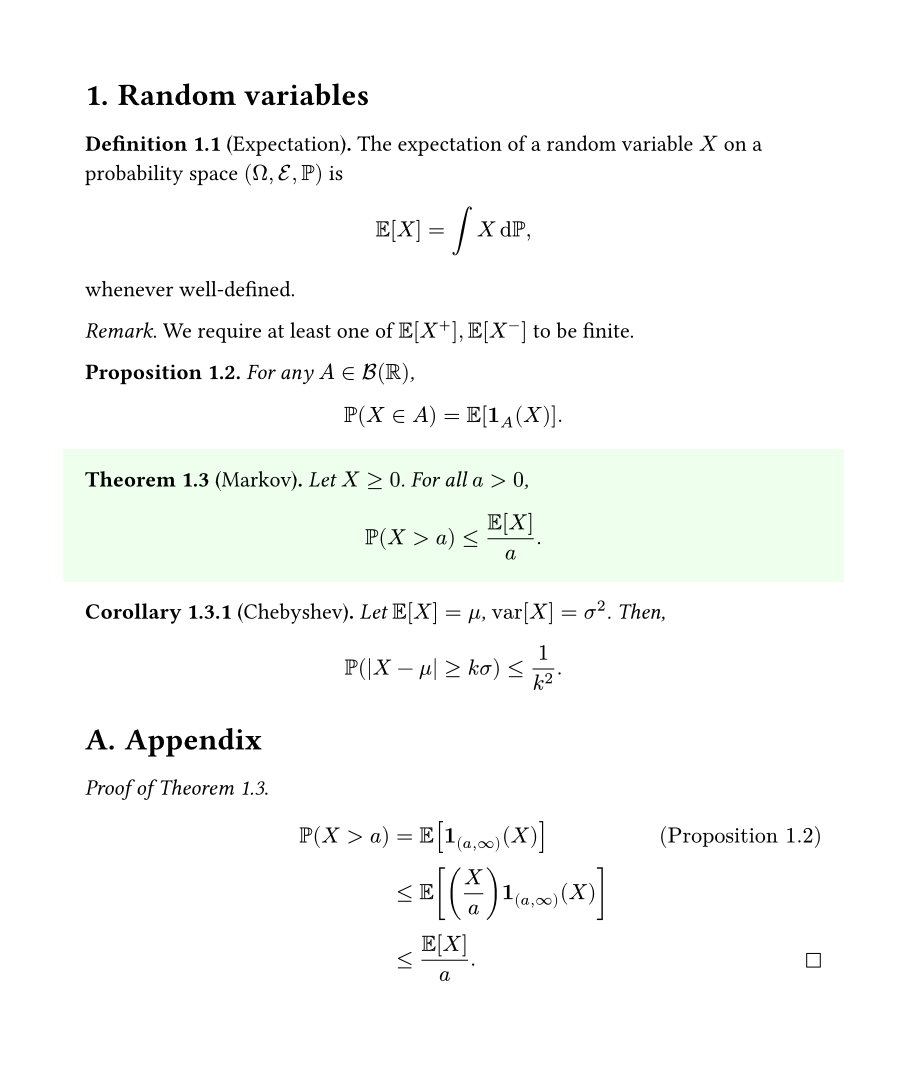
Preamble
#import "@preview/ctheorems:2.0.0": *
#import thm-state: thm-restate
#import thm-themes.ams: *
#show: thm-rules.with(qed-symbol: $square$)

#set page(width: 16cm, height: auto, margin: 1.5cm)
#set heading(numbering: "1.")
#show heading: set block(below: 1em)

#let theorem = theorem.with(
  outset: 1em,
  spacing: 2em,
  fill: rgb("#eeffee"),
)
Document
= Random variables

#definition[Expectation][
  The expectation of a random variable $X$ on a probability space $(Omega, cal(E), PP)$ is $
    EE[X] = integral X dif PP,
  $ whenever well-defined.
] <expectation>

#remark[
  We require at least one of $EE[X^+], EE[X^-]$ to be finite.
]

#proposition[
  For any $A in cal(E)$, $
    PP(X in A) = EE[bold(1)_A (X)].
  $
] <prob-exp>

#theorem[Markov][
  Let $X >= 0$. For all $a > 0$, $
    PP(X > a) <= EE[X] / a.
  $
] <markov>
#proof([of @markov], defer: true)[
  $
    PP(X > a)
      &= EE[bold(1)_((a, oo))(X)]   #tag[(@prob-exp)] \
      &<= EE[(X / a) bold(1)_((a, oo))(X)] \
      &<= EE[X] / a. #qedhere
  $
]

#corollary[Chebyshev][
  Let $EE[X] = mu$, $"var"[X] = sigma^2$. Then, $
    PP(|X - mu| >= k sigma) <= 1 / k^2.
  $
] <chebyshev>


#counter(heading).update(0)
#set heading(numbering: "A.")
= Appendix

#thm-restate()
Changelog
v2.0.0
- Breaking changes: complete overhaul of names and syntax.
- Added 'themes' with commonly used theorem environments predefined.
- Introduced equation tagging.
- Added commands for restating theorem environments, useful for creating outlines and deferring proofs to later sections.
- Separated counter handling into
thm-counter.
v1.1.3
- Fixed alignment and block-breaking issues resulting from breaking changes in Typst 0.12.
v1.1.2
- Introduced the
thmprooffunction for creating proof environments. - Inserting
#qedherein a block equation/list/enum item (in a proof) places the qed symbol on the same line. The qed symbol can be customized viathmrules.
v1.1.1
- Extra named arguments given to a theorem environment produced by
thmbox(orthmplain) are passed toblock.
v1.1.0
- The
supplement(for references) is no longer set inthmenv. It can be passed to the theorem environment directly, along withrefnumberingto control the appearance of@references. - Extra named arguments given to
thmboxare passed toblock. - Fixed spacing bug for unnumbered environments.
- Replaced dummy figure with labelled metadata.
v1.0.0
- Extra named arguments given to a theorem environment are passed to its
formatting function
fmt. - Removed
thmref, introduced normal<label>s and@references. - Import must be followed by
show: thmrules. - Removed
name: ...from theorem environments; use#theorem("Euclid")[]instead of#theorem(name: "Euclid")[]. - Theorems are now wrapped in
figures.
Acknowledgements
Thanks to
- MJHutchinson for suggesting and
implementing the
base-levelandbase: nonefeatures, - rmolinari for suggesting and
implementing the
separator: ...feature, - DVDTSB for contributing
- the idea of passing named arguments from the theorem directly to the
fmtfunction. - the
number: ...override feature. - the
title: ...override feature inthm-box.
- the idea of passing named arguments from the theorem directly to the
- PgBiel for fixing breaking changes in version updates.
- The authors of the LaTeX packages
amsthm,thmtools,apxproof. - The awesome devs of typst.app for their support.
Contributors


Similar repos


Languages
Typst
100.0%
An implementation of numbered theorem environments in typst
See the codeREADME
ctheorems / typst-theorems
An implementation of numbered theorem environments in typst. Available as ctheorems in the official Typst universe. Import with
#import "@preview/ctheorems:2.0.0": *
#show: thm-rules        // Must include!
A standard set of theorem environments in the AMS style is available using
#import thm-themes.ams: *
Features
A theorem environment combines content with automatically updated numbering information. Theorem environments can
- share the same counter (Theorems and Lemmas often do so)
- have their counters attached to headings or other environments (Corollaries are often numbered based upon the parent Theorem)
- be
<label>-ed and@reference-d - be restated or deferred to later in the document.
This package also introduces a few miscellaneous features related to mathematical writing.
- Proof environments, with QED symbols.
- Equation tags (in the manner of LaTeX's
\tag). - Predefined sets of commonly used theorem environments, and a few themes.
Manual and Examples
Get acquainted with ctheorems by checking out the minimal example below!
You can read the manual for a full walkthrough of functionality offered by this module.
Preamble
#import "@preview/ctheorems:2.0.0": *
#import thm-state: thm-restate
#import thm-themes.ams: *
#show: thm-rules.with(qed-symbol: $square$)

#set page(width: 16cm, height: auto, margin: 1.5cm)
#set heading(numbering: "1.")
#show heading: set block(below: 1em)

#let theorem = theorem.with(
  outset: 1em,
  spacing: 2em,
  fill: rgb("#eeffee"),
)
Document
= Random variables

#definition[Expectation][
  The expectation of a random variable $X$ on a probability space $(Omega, cal(E), PP)$ is $
    EE[X] = integral X dif PP,
  $ whenever well-defined.
] <expectation>

#remark[
  We require at least one of $EE[X^+], EE[X^-]$ to be finite.
]

#proposition[
  For any $A in cal(E)$, $
    PP(X in A) = EE[bold(1)_A (X)].
  $
] <prob-exp>

#theorem[Markov][
  Let $X >= 0$. For all $a > 0$, $
    PP(X > a) <= EE[X] / a.
  $
] <markov>
#proof([of @markov], defer: true)[
  $
    PP(X > a)
      &= EE[bold(1)_((a, oo))(X)]   #tag[(@prob-exp)] \
      &<= EE[(X / a) bold(1)_((a, oo))(X)] \
      &<= EE[X] / a. #qedhere
  $
]

#corollary[Chebyshev][
  Let $EE[X] = mu$, $"var"[X] = sigma^2$. Then, $
    PP(|X - mu| >= k sigma) <= 1 / k^2.
  $
] <chebyshev>


#counter(heading).update(0)
#set heading(numbering: "A.")
= Appendix

#thm-restate()
Changelog
v2.0.0
- Breaking changes: complete overhaul of names and syntax.
- Added 'themes' with commonly used theorem environments predefined.
- Introduced equation tagging.
- Added commands for restating theorem environments, useful for creating outlines and deferring proofs to later sections.
- Separated counter handling into
thm-counter.
v1.1.3
- Fixed alignment and block-breaking issues resulting from breaking changes in Typst 0.12.
v1.1.2
- Introduced the
thmprooffunction for creating proof environments. - Inserting
#qedherein a block equation/list/enum item (in a proof) places the qed symbol on the same line. The qed symbol can be customized viathmrules.
v1.1.1
- Extra named arguments given to a theorem environment produced by
thmbox(orthmplain) are passed toblock.
v1.1.0
- The
supplement(for references) is no longer set inthmenv. It can be passed to the theorem environment directly, along withrefnumberingto control the appearance of@references. - Extra named arguments given to
thmboxare passed toblock. - Fixed spacing bug for unnumbered environments.
- Replaced dummy figure with labelled metadata.
v1.0.0
- Extra named arguments given to a theorem environment are passed to its
formatting function
fmt. - Removed
thmref, introduced normal<label>s and@references. - Import must be followed by
show: thmrules. - Removed
name: ...from theorem environments; use#theorem("Euclid")[]instead of#theorem(name: "Euclid")[]. - Theorems are now wrapped in
figures.
Acknowledgements
Thanks to
- MJHutchinson for suggesting and
implementing the
base-levelandbase: nonefeatures, - rmolinari for suggesting and
implementing the
separator: ...feature, - DVDTSB for contributing
- the idea of passing named arguments from the theorem directly to the
fmtfunction. - the
number: ...override feature. - the
title: ...override feature inthm-box.
- the idea of passing named arguments from the theorem directly to the
- PgBiel for fixing breaking changes in version updates.
- The authors of the LaTeX packages
amsthm,thmtools,apxproof. - The awesome devs of typst.app for their support.
Similar repos
Contributors
Languages
Typst
100.0%