
README
Curryst
A Typst package for typesetting proof trees.
Import
You can import the latest version of this package with:
#import "@preview/curryst:0.6.0": rule, prooftree, rule-set
Basic usage
To display a proof tree, you first need to create a tree, using the rule function. Its last argument is the conclusion, and the other positional arguments are the premises. It also accepts a name for the rule name, displayed on the right of the bar, as well as a label, displayed on the left of the bar.
#let tree = rule(
  label: [Label],
  name: [Rule name],
  [Premise 1],
  [Premise 2],
  [Premise 3],
  [Conclusion],
)
Then, you can display the tree with the prooftree function:
#prooftree(tree)
In this case, we get the following result:

Proof trees can be part of mathematical formulas:
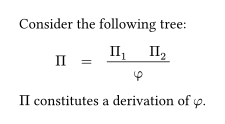
Consider the following tree:
$
  Pi quad = quad prooftree(
    rule(
      Pi_1,
      Pi_2,
      phi,
    )
  )
$
$Pi$ constitutes a derivation of $phi$.
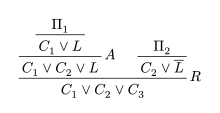
You can specify a rule as the premises of a rule in order to create a tree:
#prooftree(
  rule(
    name: $R$,
    rule(
      name: $A$,
      rule(
        $Pi_1$,
        $C_1 or L$,
      ),
      $C_1 or C_2 or L$,
    ),
    rule(
      $Pi_2$,
      $C_2 or overline(L)$,
    ),
    $C_1 or C_2 or C_3$,
  )
)
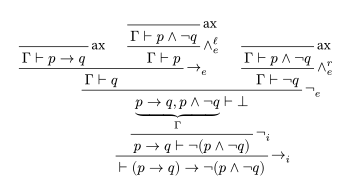
As an example, here is a natural deduction proof tree generated with Curryst:
Show code
#let ax = rule.with(name: [ax])
#let and-el = rule.with(name: $and_e^ell$)
#let and-er = rule.with(name: $and_e^r$)
#let impl-i = rule.with(name: $scripts(->)_i$)
#let impl-e = rule.with(name: $scripts(->)_e$)
#let not-i = rule.with(name: $not_i$)
#let not-e = rule.with(name: $not_e$)

#prooftree(
  impl-i(
    not-i(
      not-e(
        impl-e(
          ax($Gamma tack p -> q$),
          and-el(
            ax($Gamma tack p and not q$),
            $Gamma tack p$,
          ),
          $Gamma tack q$,
        ),
        and-er(
          ax($Gamma tack p and not q$),
          $Gamma tack not q$,
        ),
        $ underbrace(p -> q\, p and not q, Gamma) tack bot $,
      ),
      $p -> q tack  not (p and not q)$,
    ),
    $tack (p -> q) -> not (p and not q)$,
  )
)
Advanced usage
The prooftree function accepts multiple named arguments that let you customize the tree:
min-premise-spacing- The minimum amount of space between two premises.
title-inset- The amount to extend the horizontal bar beyond the content. Also determines how far from the bar labels and names are displayed.
stroke- The stroke to use for the horizontal bars.
vertical-spacing- The space between the bottom of the bar and the conclusion, and between the top of the bar and the premises.
min-bar-height- The minimum height of the box containing the horizontal bar.
dir- The orientation of the proof tree (either
bttorttb,bttbeing the default).
For more information, please refer to the documentation in curryst.typ.
Layout Multiple Rules (a simple way)
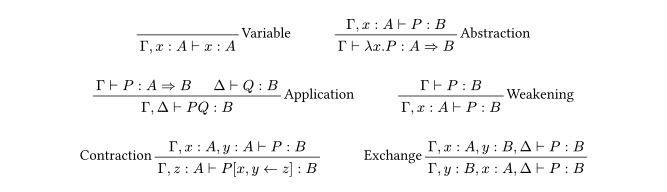
Here we show a way to typeset multiple rules at one time :
Show code
#let variable = prooftree(rule(
  name: [Variable],
  $Gamma, x : A tack x : A$,
))
#let abstraction = prooftree(rule(
  name: [Abstraction],
  $Gamma, x: A tack P : B$,
  $Gamma tack lambda x . P : A => B$,
))

#let application = prooftree(rule(
  name: [Application],
  $Gamma tack P : A => B$,
  $Delta tack Q : B$,
  $Gamma, Delta tack P Q : B$,
))

#let weakening = prooftree(rule(
  name: [Weakening],
  $Gamma tack P : B$,
  $Gamma, x : A tack P : B$,
))

#let contraction = prooftree(rule(
  label: [Contraction],
  $Gamma, x : A, y : A tack P : B$,
  $Gamma, z : A tack P[x, y <- z]: B$,
))

#let exchange = prooftree(rule(
  label: [Exchange],
  $Gamma, x : A, y: B, Delta tack P : B$,
  $Gamma, y : B, x: A, Delta tack P : B$,
))

#align(center, rule-set(
  variable,
  abstraction,
  application,
  weakening,
  contraction,
  exchange
))
The function rule-set is very simple and is implemented this way :
#let rule-set(column-gutter: 3em, row-gutter: 3em, ..rules) = {
  set par(leading: row-gutter, spacing: row-gutter)
  for rules in rules.pos().split(linebreak()) {
    block(rules.map(box).join(h(column-gutter, weak: true)))
  }
}
To have more complex layout you can modify this piece of code at your linking.
However the curryst package is not meant right now for layout of arbritary content
and other packages do it better for more fine grained customization.
Contributors


Similar repos


Languages
Typst
98.3%
Just
1.7%
README
Curryst
A Typst package for typesetting proof trees.
Import
You can import the latest version of this package with:
#import "@preview/curryst:0.6.0": rule, prooftree, rule-set
Basic usage
To display a proof tree, you first need to create a tree, using the rule function. Its last argument is the conclusion, and the other positional arguments are the premises. It also accepts a name for the rule name, displayed on the right of the bar, as well as a label, displayed on the left of the bar.
#let tree = rule(
  label: [Label],
  name: [Rule name],
  [Premise 1],
  [Premise 2],
  [Premise 3],
  [Conclusion],
)
Then, you can display the tree with the prooftree function:
#prooftree(tree)
In this case, we get the following result:
Proof trees can be part of mathematical formulas:
Consider the following tree:
$
  Pi quad = quad prooftree(
    rule(
      Pi_1,
      Pi_2,
      phi,
    )
  )
$
$Pi$ constitutes a derivation of $phi$.
You can specify a rule as the premises of a rule in order to create a tree:
#prooftree(
  rule(
    name: $R$,
    rule(
      name: $A$,
      rule(
        $Pi_1$,
        $C_1 or L$,
      ),
      $C_1 or C_2 or L$,
    ),
    rule(
      $Pi_2$,
      $C_2 or overline(L)$,
    ),
    $C_1 or C_2 or C_3$,
  )
)
As an example, here is a natural deduction proof tree generated with Curryst:
Show code
#let ax = rule.with(name: [ax])
#let and-el = rule.with(name: $and_e^ell$)
#let and-er = rule.with(name: $and_e^r$)
#let impl-i = rule.with(name: $scripts(->)_i$)
#let impl-e = rule.with(name: $scripts(->)_e$)
#let not-i = rule.with(name: $not_i$)
#let not-e = rule.with(name: $not_e$)

#prooftree(
  impl-i(
    not-i(
      not-e(
        impl-e(
          ax($Gamma tack p -> q$),
          and-el(
            ax($Gamma tack p and not q$),
            $Gamma tack p$,
          ),
          $Gamma tack q$,
        ),
        and-er(
          ax($Gamma tack p and not q$),
          $Gamma tack not q$,
        ),
        $ underbrace(p -> q\, p and not q, Gamma) tack bot $,
      ),
      $p -> q tack  not (p and not q)$,
    ),
    $tack (p -> q) -> not (p and not q)$,
  )
)
Advanced usage
The prooftree function accepts multiple named arguments that let you customize the tree:
min-premise-spacing- The minimum amount of space between two premises.
title-inset- The amount to extend the horizontal bar beyond the content. Also determines how far from the bar labels and names are displayed.
stroke- The stroke to use for the horizontal bars.
vertical-spacing- The space between the bottom of the bar and the conclusion, and between the top of the bar and the premises.
min-bar-height- The minimum height of the box containing the horizontal bar.
dir- The orientation of the proof tree (either
bttorttb,bttbeing the default).
For more information, please refer to the documentation in curryst.typ.
Layout Multiple Rules (a simple way)
Here we show a way to typeset multiple rules at one time :
Show code
#let variable = prooftree(rule(
  name: [Variable],
  $Gamma, x : A tack x : A$,
))
#let abstraction = prooftree(rule(
  name: [Abstraction],
  $Gamma, x: A tack P : B$,
  $Gamma tack lambda x . P : A => B$,
))

#let application = prooftree(rule(
  name: [Application],
  $Gamma tack P : A => B$,
  $Delta tack Q : B$,
  $Gamma, Delta tack P Q : B$,
))

#let weakening = prooftree(rule(
  name: [Weakening],
  $Gamma tack P : B$,
  $Gamma, x : A tack P : B$,
))

#let contraction = prooftree(rule(
  label: [Contraction],
  $Gamma, x : A, y : A tack P : B$,
  $Gamma, z : A tack P[x, y <- z]: B$,
))

#let exchange = prooftree(rule(
  label: [Exchange],
  $Gamma, x : A, y: B, Delta tack P : B$,
  $Gamma, y : B, x: A, Delta tack P : B$,
))

#align(center, rule-set(
  variable,
  abstraction,
  application,
  weakening,
  contraction,
  exchange
))
The function rule-set is very simple and is implemented this way :
#let rule-set(column-gutter: 3em, row-gutter: 3em, ..rules) = {
  set par(leading: row-gutter, spacing: row-gutter)
  for rules in rules.pos().split(linebreak()) {
    block(rules.map(box).join(h(column-gutter, weak: true)))
  }
}
To have more complex layout you can modify this piece of code at your linking.
However the curryst package is not meant right now for layout of arbritary content
and other packages do it better for more fine grained customization.
Similar repos
Contributors
Languages
Typst
98.3%
Just
1.7%