PROTAC-Splitter: a machine learning framework designed for automated annotation of PROTAC substructures.
Jupyter Notebook
31
231 commits
updated Oct 14, 2026
This repository contains the program code to split PROTAC molecules into their three constituent substructures: the E3 ligand, the linker, and the POI warhead.
A Gradio app is available to split PROTAC molecules and visualize the results: https://huggingface.co/spaces/ailab-bio/PROTAC-Splitter-App.
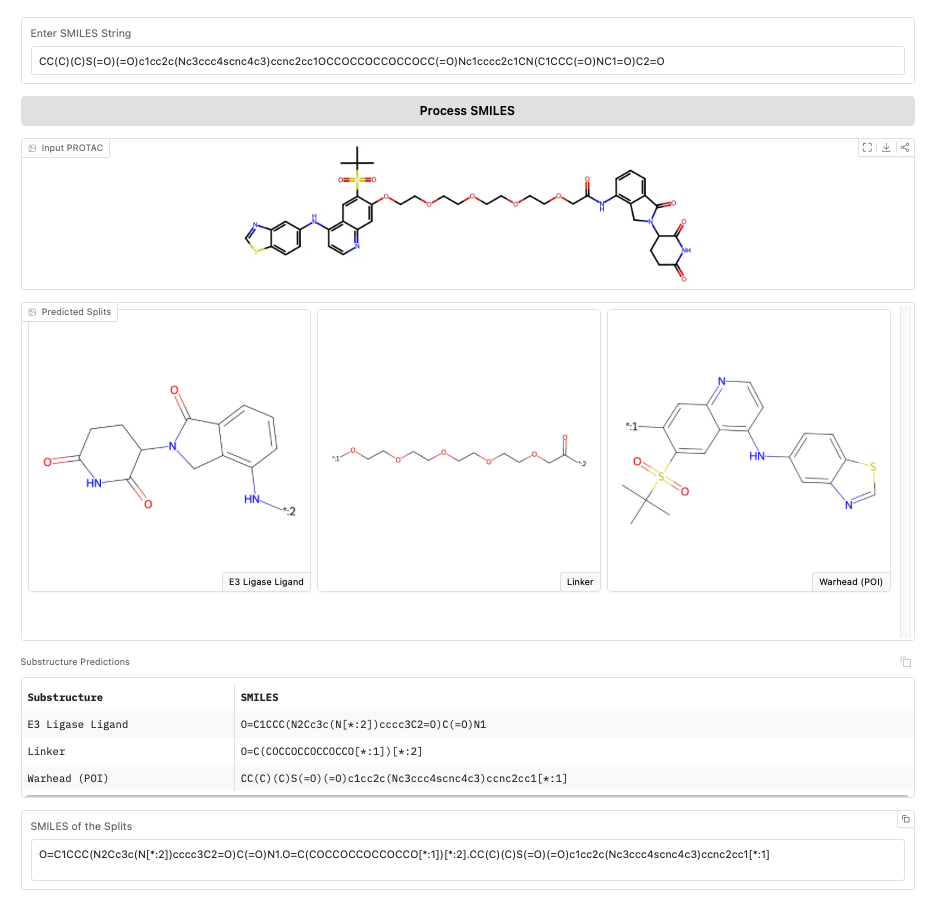
Requires Python 3.10+. Always use a virtual environment.
# Core package — includes XGBoost and heuristic splitting (no GPU required)
pip install git+https://github.com/ribesstefano/PROTAC-Splitter.git

# With Transformer model support (adds PyTorch; ~2 GB download)
pip install "git+https://github.com/ribesstefano/PROTAC-Splitter.git[transformer]"

# With Gradio app + plotting dependencies
pip install "git+https://github.com/ribesstefano/PROTAC-Splitter.git[scripts]"

# With the HTTP server (`protac-splitter serve`)
pip install "git+https://github.com/ribesstefano/PROTAC-Splitter.git[serve]"

# Full development install (all extras + pytest)
pip install "git+https://github.com/ribesstefano/PROTAC-Splitter.git[dev]"
git clone https://github.com/ribesstefano/PROTAC-Splitter.git
cd PROTAC-Splitter
pip install uv
uv sync --extra dev        # install all extras into .venv
source .venv/bin/activate
Both the XGBoost (ailab-bio/PROTAC-Splitter-XGBoost) and Transformer (ailab-bio/PROTAC-Splitter) models are hosted on the HuggingFace Hub and downloaded automatically on first use — the XGBoost model via GraphEdgeClassifier.from_pretrained(), the Transformer via transformers. Both share the same standard huggingface_hub cache, controlled by the HF_HOME environment variable (default ~/.cache/huggingface; see here for details).
To set a custom cache directory, create a .env file in your working directory (or copy .env.example) to override defaults:
cp .env.example .env
# .env
# Directory where pretrained models (XGBoost + Transformer) are cached
HF_HOME=~/.cache/huggingface
Environment variables are loaded automatically via python-dotenv when the package is imported.
[!TIP] On a shared/HPC filesystem where
~/.cachemay hit a home-directory quota, pointHF_HOMEat a directory with more headroom — both models will follow it.
from protac_splitter import split_protac

# --- Single SMILES string ---
protac = (
    "CC(C)(C)S(=O)(=O)c1cc2c(Nc3ccc4scnc4c3)ccnc2cc1OCCOCCOCCOCCOCC(=O)Nc1cccc2c1CN(C1CCC(=O)NC1=O)C2=O"
    "Cc1nnc2n1-c1sc(C#Cc3cnn(-c4cccc5c4C(=O)N(C4CCC(=O)NC4=O)C5=O)c3)c(Cc3ccccc3)c1COC2"
)
result = split_protac(protac)
print(result)
# {'SMILES': '...', 'default_pred_n0': 'e3_smiles.linker_smiles.poi_smiles', 'model_name': 'Heuristic', 'heuristic_params': '...', 'n_flags': 0, 'review_reasons': ''}

# --- List of SMILES ---
results = split_protac([protac, protac])
for r in results:
    print(r["default_pred_n0"])

# --- pandas DataFrame ---
import pandas as pd
df = pd.read_csv("protacs.csv") # must have a column for SMILES strings
result_df = split_protac(df, protac_smiles_col="PROTAC SMILES")
print(result_df[["PROTAC SMILES", "default_pred_n0", "model_name"]].head())
split_protac arguments:
| Parameter | Type | Default | Description |
|---|---|---|---|
protac_smiles | str | list | DataFrame | (required) | SMILES to split. Single string, list of strings, or DataFrame with a protac_smiles_col column. |
model | str | "adaptive" | Splitting strategy. See Splitting strategies for valid values. |
fix_predictions | bool | True | Apply cheminformatics post-processing to Transformer predictions before reassembly check. |
protac_smiles_col | str | "SMILES" | Column name for SMILES when input is a DataFrame; also used as key name in output dicts. |
batch_size | int | 1 | Inference batch size (Transformer only). |
beam_size | int | 5 | Beam-search width (Transformer only). Higher values may improve quality at the cost of speed. |
device | int | str | None | None | Torch device for the Transformer ("cpu", "cuda", 0, …). Auto-detects GPU when None. |
num_proc | int | 1 | Parallel worker processes. Effective for heuristic only (XGBoost is always single-process). |
verbose | int | 0 | Verbosity level (0 = silent). |
betweenness_threshold | float | 0.4 | Betweenness-centrality cut-off for the heuristic. Higher values are more conservative. |
use_capacity_weight | bool | False | Weight graph edges by bond order when computing betweenness centrality (heuristic only). |
betweenness_approx_frac | float | None | None | Fraction of nodes to sample for approximate betweenness centrality. None uses exact computation. |
adaptive_heuristic_grid | list[tuple[float, bool]] | None | None | model="adaptive" only. (betweenness_threshold, use_capacity_weight) pairs to try, in order. None uses a built-in 6-point grid seeded with the package default first. |
adaptive_use_xgboost | bool | True | model="adaptive" only. Whether the XGBoost stage runs on molecules the heuristic grid left flagged. |
adaptive_use_transformer | bool | False | model="adaptive" only. Whether the Transformer stage runs on molecules still flagged after XGBoost. Off by default (needs the [transformer] extra; GPU recommended). |
use_transformer | bool | None | None | Deprecated. Use model='transformer' instead. |
use_xgboost | bool | None | None | Deprecated. Use model='xgboost' instead. |
model="adaptive" returns three extra keys beyond the usual default_pred_n0 / model_name: heuristic_params (which grid point won, when model_name == "Heuristic", else None), n_flags, and review_reasons — a semicolon-joined list of the evaluation.score_split() plausibility checks that still fired on the winning candidate (empty string if none). Running model="adaptive" over a batch of test molecules and looking at which heuristic_params wins most often is a good way to pick new defaults for betweenness_threshold / use_capacity_weight.
result = split_protac(protac, model="adaptive")
print(result["model_name"], result["heuristic_params"], result["n_flags"], result["review_reasons"])
# 'Heuristic' 'betweenness_threshold=0.4,use_capacity_weight=False' 0 ''
After installation the protac-splitter command is available:
# Split a single SMILES with the default adaptive strategy
protac-splitter --smiles "CC(C)(C)S(=O)(=O)c1cc2c..."

# Use the heuristic algorithm (no model download)
protac-splitter --smiles "..." --model heuristic

# Tune the heuristic threshold
protac-splitter --smiles "..." --model heuristic --betweenness-threshold 0.5

# Use bond-capacity weighting in betweenness centrality
protac-splitter --smiles "..." --model heuristic --use-capacity-weight

# Transformer model (requires [transformer] extra)
protac-splitter --smiles "..." --model transformer

# Transformer with XGBoost fallback
protac-splitter --smiles "..." --model "transformer->xgboost"

# XGBoost with heuristic fallback
protac-splitter --smiles "..." --model "xgboost->heuristic"

# QC-gated escalation (default): heuristic grid -> XGBoost -> (optionally)
# Transformer, scored by evaluation.score_split; prints which method/params
# won plus the remaining QC flags (if any) -- equivalent to omitting --model
protac-splitter --smiles "..." --model adaptive
protac-splitter --smiles "..." --model adaptive --adaptive-use-transformer

# Batch processing from CSV
protac-splitter --input-csv protacs.csv --smiles-col "SMILES" \
                --output-csv results.csv --model xgboost

# Machine-readable CSV output
protac-splitter --smiles "..." --model heuristic --output-format csv

# Show all options
protac-splitter --help
protac-splitter serve keeps the models loaded and splits SMILES over HTTP, so a client in
another Python environment (e.g. a generative-design loop) can call it without installing
this package. It needs the serve extra (pip install ".[serve]" from a checkout):
# Takes the same strategy options as the CLI (--model, --betweenness-threshold, ...)
protac-splitter serve --model adaptive --port 8778

# Let the OS pick a free port and publish it, so several jobs can share a node
protac-splitter serve --port 0 --port-file /tmp/protac_splitter.port
Models are loaded and warmed up before the server starts listening, so a missing
[transformer] extra or a failed download stops it at launch instead of failing every
request. It binds 127.0.0.1 and has no authentication; keep it that way on a shared node.
| Endpoint | |
|---|---|
GET /health | Cheap liveness probe. |
GET /info | Strategy, options and output keys the server was started with. |
POST /split | {"smiles": [...]} -> {"results": [...], "n_invalid": n}. |
Each entry of results is the dict split_protac returns for that molecule, plus the parsed
e3, linker and poi. The list always matches the request: an unparseable SMILES, or one
the strategy cannot split, gives null in its place (counted in n_invalid) rather than
failing the batch. Interactive docs are at /docs.
curl -s localhost:8778/split -H 'content-type: application/json' \
  -d '{"smiles": ["N#Cc1ccc(O[C@H]2CC[C@H](NC(=O)c3ccc(N4CCN(CCCCCNc5ccc6c(c5)C(=O)N(C5CCC(=O)NC5=O)C6=O)CC4)cc3)CC2)cc1Cl"]}'
The server runs one worker and serialises requests, so send many SMILES per request rather than many concurrent requests.
All strategies return predictions in a dot-separated SMILES format:
e3_smiles.linker_smiles.poi_smiles
Attachment points are encoded as [*:1] (POI side) and [*:2] (E3 side).
PROTAC-Splitter supports multiple strategies, selectable via --model (CLI) or via the model argument (Python API):
| Value | Description |
|---|---|
adaptive (default) | QC-gated escalation, not just fallback-on-failure: a small heuristic (betweenness_threshold, use_capacity_weight) grid runs first, then XGBoost, then — only with --adaptive-use-transformer / adaptive_use_transformer=True — the Transformer. Each stage only runs on molecules the previous stage left flagged by evaluation.score_split() (structural validity, fragment size, linker topology, known-ligand similarity), and a later stage only replaces the current best if it scores strictly better. Slower than a single strategy, but reports which method/params won — see adaptive_* arguments above. |
xgboost | XGBoost graph edge classifier — no GPU required. Model downloaded automatically on first use (~17 MB). |
heuristic | Betweenness-centrality graph algorithm — no model download needed. |
transformer | Seq2seq Transformer (requires [transformer] extra; GPU recommended). |
transformer->xgboost | Transformer first; XGBoost replaces any failed predictions. |
xgboost->heuristic | XGBoost first; heuristic replaces any failed predictions. |
heuristic->xgboost | Heuristic first; XGBoost replaces any failed predictions. |
xgboost+heuristic or heuristic+xgboost | Run both and pick the best result. |
[!IMPORTANT]
The above strategies must be passed as a double-quoted string in the CLI (e.g.,--model "transformer->xgboost"). The>operator is a shell redirection operator, so it must be quoted to avoid shell interpretation.
The default strategy is adaptive, which trades speed for a QC-scored search over methods and parameters, generally giving the best-quality split. For higher-throughput batch jobs where a single robust pass is enough, heuristic->xgboost is a faster alternative. See docs/adaptive_splitting.md for the full pipeline reference: every stage, every QC flag it checks, and how each threshold was calibrated.
[!TIP] We recommend increasing the
num_procargument to maximize the amount of parallelism when using the default strategy.
To run the Gradio app locally, install the [scripts] extra and run:
gradio scripts/protac_splitter_app.py
Then open http://localhost:7860 in your browser to use the app.
Curated datasets and trained models are available on Zenodo:
https://doi.org/10.5281/zenodo.15797309
At runtime, the XGBoost model is instead downloaded automatically from the HuggingFace Hub (ailab-bio/PROTAC-Splitter-XGBoost) and cached under $HF_HOME on first use — no manual download step is needed. See Models Cache Configuration above.
We welcome contributions! If you have suggestions for improvements, bug fixes, or new features, please open an issue or submit a pull request.
This project is licensed under the MIT License — see the LICENSE file for details.
If you find this work useful, please consider citing it:
@article{ribes2026protac,
  title={{PROTAC-Splitter: a machine learning framework for automated identification of PROTAC substructures: S. Ribes et al.}},
  author={Ribes, Stefano and Zhang, Ranxuan and Cropsal, T{\'e}lio and K{\"a}llberg, Anders and Tyrchan, Christian and Nittinger, Eva and Mercado, Roc{\'\i}o},
  journal={Journal of Cheminformatics},
  volume={18},
  number={1},
  pages={30},
  year={2026},
  publisher={Springer}
}
PROTAC-Splitter: a machine learning framework designed for automated annotation of PROTAC substructures.
Jupyter Notebook
31
231 commits
updated Oct 14, 2026
This repository contains the program code to split PROTAC molecules into their three constituent substructures: the E3 ligand, the linker, and the POI warhead.
A Gradio app is available to split PROTAC molecules and visualize the results: https://huggingface.co/spaces/ailab-bio/PROTAC-Splitter-App.
Requires Python 3.10+. Always use a virtual environment.
# Core package — includes XGBoost and heuristic splitting (no GPU required)
pip install git+https://github.com/ribesstefano/PROTAC-Splitter.git

# With Transformer model support (adds PyTorch; ~2 GB download)
pip install "git+https://github.com/ribesstefano/PROTAC-Splitter.git[transformer]"

# With Gradio app + plotting dependencies
pip install "git+https://github.com/ribesstefano/PROTAC-Splitter.git[scripts]"

# With the HTTP server (`protac-splitter serve`)
pip install "git+https://github.com/ribesstefano/PROTAC-Splitter.git[serve]"

# Full development install (all extras + pytest)
pip install "git+https://github.com/ribesstefano/PROTAC-Splitter.git[dev]"
git clone https://github.com/ribesstefano/PROTAC-Splitter.git
cd PROTAC-Splitter
pip install uv
uv sync --extra dev        # install all extras into .venv
source .venv/bin/activate
Both the XGBoost (ailab-bio/PROTAC-Splitter-XGBoost) and Transformer (ailab-bio/PROTAC-Splitter) models are hosted on the HuggingFace Hub and downloaded automatically on first use — the XGBoost model via GraphEdgeClassifier.from_pretrained(), the Transformer via transformers. Both share the same standard huggingface_hub cache, controlled by the HF_HOME environment variable (default ~/.cache/huggingface; see here for details).
To set a custom cache directory, create a .env file in your working directory (or copy .env.example) to override defaults:
cp .env.example .env
# .env
# Directory where pretrained models (XGBoost + Transformer) are cached
HF_HOME=~/.cache/huggingface
Environment variables are loaded automatically via python-dotenv when the package is imported.
[!TIP] On a shared/HPC filesystem where
~/.cachemay hit a home-directory quota, pointHF_HOMEat a directory with more headroom — both models will follow it.
from protac_splitter import split_protac

# --- Single SMILES string ---
protac = (
    "CC(C)(C)S(=O)(=O)c1cc2c(Nc3ccc4scnc4c3)ccnc2cc1OCCOCCOCCOCCOCC(=O)Nc1cccc2c1CN(C1CCC(=O)NC1=O)C2=O"
    "Cc1nnc2n1-c1sc(C#Cc3cnn(-c4cccc5c4C(=O)N(C4CCC(=O)NC4=O)C5=O)c3)c(Cc3ccccc3)c1COC2"
)
result = split_protac(protac)
print(result)
# {'SMILES': '...', 'default_pred_n0': 'e3_smiles.linker_smiles.poi_smiles', 'model_name': 'Heuristic', 'heuristic_params': '...', 'n_flags': 0, 'review_reasons': ''}

# --- List of SMILES ---
results = split_protac([protac, protac])
for r in results:
    print(r["default_pred_n0"])

# --- pandas DataFrame ---
import pandas as pd
df = pd.read_csv("protacs.csv") # must have a column for SMILES strings
result_df = split_protac(df, protac_smiles_col="PROTAC SMILES")
print(result_df[["PROTAC SMILES", "default_pred_n0", "model_name"]].head())
split_protac arguments:
| Parameter | Type | Default | Description |
|---|---|---|---|
protac_smiles | str | list | DataFrame | (required) | SMILES to split. Single string, list of strings, or DataFrame with a protac_smiles_col column. |
model | str | "adaptive" | Splitting strategy. See Splitting strategies for valid values. |
fix_predictions | bool | True | Apply cheminformatics post-processing to Transformer predictions before reassembly check. |
protac_smiles_col | str | "SMILES" | Column name for SMILES when input is a DataFrame; also used as key name in output dicts. |
batch_size | int | 1 | Inference batch size (Transformer only). |
beam_size | int | 5 | Beam-search width (Transformer only). Higher values may improve quality at the cost of speed. |
device | int | str | None | None | Torch device for the Transformer ("cpu", "cuda", 0, …). Auto-detects GPU when None. |
num_proc | int | 1 | Parallel worker processes. Effective for heuristic only (XGBoost is always single-process). |
verbose | int | 0 | Verbosity level (0 = silent). |
betweenness_threshold | float | 0.4 | Betweenness-centrality cut-off for the heuristic. Higher values are more conservative. |
use_capacity_weight | bool | False | Weight graph edges by bond order when computing betweenness centrality (heuristic only). |
betweenness_approx_frac | float | None | None | Fraction of nodes to sample for approximate betweenness centrality. None uses exact computation. |
adaptive_heuristic_grid | list[tuple[float, bool]] | None | None | model="adaptive" only. (betweenness_threshold, use_capacity_weight) pairs to try, in order. None uses a built-in 6-point grid seeded with the package default first. |
adaptive_use_xgboost | bool | True | model="adaptive" only. Whether the XGBoost stage runs on molecules the heuristic grid left flagged. |
adaptive_use_transformer | bool | False | model="adaptive" only. Whether the Transformer stage runs on molecules still flagged after XGBoost. Off by default (needs the [transformer] extra; GPU recommended). |
use_transformer | bool | None | None | Deprecated. Use model='transformer' instead. |
use_xgboost | bool | None | None | Deprecated. Use model='xgboost' instead. |
model="adaptive" returns three extra keys beyond the usual default_pred_n0 / model_name: heuristic_params (which grid point won, when model_name == "Heuristic", else None), n_flags, and review_reasons — a semicolon-joined list of the evaluation.score_split() plausibility checks that still fired on the winning candidate (empty string if none). Running model="adaptive" over a batch of test molecules and looking at which heuristic_params wins most often is a good way to pick new defaults for betweenness_threshold / use_capacity_weight.
result = split_protac(protac, model="adaptive")
print(result["model_name"], result["heuristic_params"], result["n_flags"], result["review_reasons"])
# 'Heuristic' 'betweenness_threshold=0.4,use_capacity_weight=False' 0 ''
After installation the protac-splitter command is available:
# Split a single SMILES with the default adaptive strategy
protac-splitter --smiles "CC(C)(C)S(=O)(=O)c1cc2c..."

# Use the heuristic algorithm (no model download)
protac-splitter --smiles "..." --model heuristic

# Tune the heuristic threshold
protac-splitter --smiles "..." --model heuristic --betweenness-threshold 0.5

# Use bond-capacity weighting in betweenness centrality
protac-splitter --smiles "..." --model heuristic --use-capacity-weight

# Transformer model (requires [transformer] extra)
protac-splitter --smiles "..." --model transformer

# Transformer with XGBoost fallback
protac-splitter --smiles "..." --model "transformer->xgboost"

# XGBoost with heuristic fallback
protac-splitter --smiles "..." --model "xgboost->heuristic"

# QC-gated escalation (default): heuristic grid -> XGBoost -> (optionally)
# Transformer, scored by evaluation.score_split; prints which method/params
# won plus the remaining QC flags (if any) -- equivalent to omitting --model
protac-splitter --smiles "..." --model adaptive
protac-splitter --smiles "..." --model adaptive --adaptive-use-transformer

# Batch processing from CSV
protac-splitter --input-csv protacs.csv --smiles-col "SMILES" \
                --output-csv results.csv --model xgboost

# Machine-readable CSV output
protac-splitter --smiles "..." --model heuristic --output-format csv

# Show all options
protac-splitter --help
protac-splitter serve keeps the models loaded and splits SMILES over HTTP, so a client in
another Python environment (e.g. a generative-design loop) can call it without installing
this package. It needs the serve extra (pip install ".[serve]" from a checkout):
# Takes the same strategy options as the CLI (--model, --betweenness-threshold, ...)
protac-splitter serve --model adaptive --port 8778

# Let the OS pick a free port and publish it, so several jobs can share a node
protac-splitter serve --port 0 --port-file /tmp/protac_splitter.port
Models are loaded and warmed up before the server starts listening, so a missing
[transformer] extra or a failed download stops it at launch instead of failing every
request. It binds 127.0.0.1 and has no authentication; keep it that way on a shared node.
| Endpoint | |
|---|---|
GET /health | Cheap liveness probe. |
GET /info | Strategy, options and output keys the server was started with. |
POST /split | {"smiles": [...]} -> {"results": [...], "n_invalid": n}. |
Each entry of results is the dict split_protac returns for that molecule, plus the parsed
e3, linker and poi. The list always matches the request: an unparseable SMILES, or one
the strategy cannot split, gives null in its place (counted in n_invalid) rather than
failing the batch. Interactive docs are at /docs.
curl -s localhost:8778/split -H 'content-type: application/json' \
  -d '{"smiles": ["N#Cc1ccc(O[C@H]2CC[C@H](NC(=O)c3ccc(N4CCN(CCCCCNc5ccc6c(c5)C(=O)N(C5CCC(=O)NC5=O)C6=O)CC4)cc3)CC2)cc1Cl"]}'
The server runs one worker and serialises requests, so send many SMILES per request rather than many concurrent requests.
All strategies return predictions in a dot-separated SMILES format:
e3_smiles.linker_smiles.poi_smiles
Attachment points are encoded as [*:1] (POI side) and [*:2] (E3 side).
PROTAC-Splitter supports multiple strategies, selectable via --model (CLI) or via the model argument (Python API):
| Value | Description |
|---|---|
adaptive (default) | QC-gated escalation, not just fallback-on-failure: a small heuristic (betweenness_threshold, use_capacity_weight) grid runs first, then XGBoost, then — only with --adaptive-use-transformer / adaptive_use_transformer=True — the Transformer. Each stage only runs on molecules the previous stage left flagged by evaluation.score_split() (structural validity, fragment size, linker topology, known-ligand similarity), and a later stage only replaces the current best if it scores strictly better. Slower than a single strategy, but reports which method/params won — see adaptive_* arguments above. |
xgboost | XGBoost graph edge classifier — no GPU required. Model downloaded automatically on first use (~17 MB). |
heuristic | Betweenness-centrality graph algorithm — no model download needed. |
transformer | Seq2seq Transformer (requires [transformer] extra; GPU recommended). |
transformer->xgboost | Transformer first; XGBoost replaces any failed predictions. |
xgboost->heuristic | XGBoost first; heuristic replaces any failed predictions. |
heuristic->xgboost | Heuristic first; XGBoost replaces any failed predictions. |
xgboost+heuristic or heuristic+xgboost | Run both and pick the best result. |
[!IMPORTANT]
The above strategies must be passed as a double-quoted string in the CLI (e.g.,--model "transformer->xgboost"). The>operator is a shell redirection operator, so it must be quoted to avoid shell interpretation.
The default strategy is adaptive, which trades speed for a QC-scored search over methods and parameters, generally giving the best-quality split. For higher-throughput batch jobs where a single robust pass is enough, heuristic->xgboost is a faster alternative. See docs/adaptive_splitting.md for the full pipeline reference: every stage, every QC flag it checks, and how each threshold was calibrated.
[!TIP] We recommend increasing the
num_procargument to maximize the amount of parallelism when using the default strategy.
To run the Gradio app locally, install the [scripts] extra and run:
gradio scripts/protac_splitter_app.py
Then open http://localhost:7860 in your browser to use the app.
Curated datasets and trained models are available on Zenodo:
https://doi.org/10.5281/zenodo.15797309
At runtime, the XGBoost model is instead downloaded automatically from the HuggingFace Hub (ailab-bio/PROTAC-Splitter-XGBoost) and cached under $HF_HOME on first use — no manual download step is needed. See Models Cache Configuration above.
We welcome contributions! If you have suggestions for improvements, bug fixes, or new features, please open an issue or submit a pull request.
This project is licensed under the MIT License — see the LICENSE file for details.
If you find this work useful, please consider citing it:
@article{ribes2026protac,
  title={{PROTAC-Splitter: a machine learning framework for automated identification of PROTAC substructures: S. Ribes et al.}},
  author={Ribes, Stefano and Zhang, Ranxuan and Cropsal, T{\'e}lio and K{\"a}llberg, Anders and Tyrchan, Christian and Nittinger, Eva and Mercado, Roc{\'\i}o},
  journal={Journal of Cheminformatics},
  volume={18},
  number={1},
  pages={30},
  year={2026},
  publisher={Springer}
}



