A statistical evaluation of degradation activity on a novel TArgeting Chimeras Knowledge dataset.
Jupyter Notebook
8
148 commits
updated Oct 15, 2026
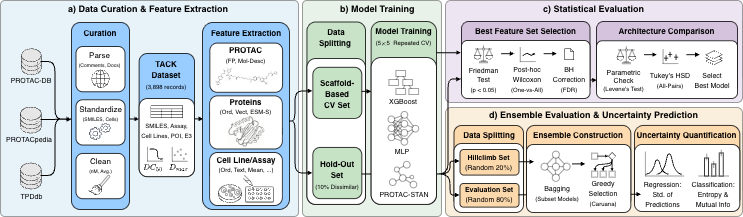





TACK predicts PROTAC-induced protein degradation — Dmax, DC50 and binary activity — from a molecule plus its experimental context: target protein, E3 ligase, cell line, assay and treatment time. The repository ships the curated dataset, its curation pipeline, and two sets of pre-trained models.
The fast ensembles are the default way to run TACK: gradient-boosted ensembles over a
fused molecular + context design matrix. CPU only, no torch, milliseconds per molecule, and
molecules are featurised on the fly so unseen compounds can be scored.
git clone https://github.com/ribesstefano/TACK.git && cd TACK
uv venv --python 3.13 && source .venv/bin/activate
uv pip install -e .
from tackai.fusion import FusionData, XGBStackedEnsemble

context_encoder = FusionData.from_pretrained("ailab-bio/TACK-Context-Encoding")
model = XGBStackedEnsemble.from_pretrained("ailab-bio/TACK-Fast-Ensemble", subfolder="dmax")

X = context_encoder.transform([{
    "smiles": "N#Cc1cccc(-c2ccc(=O)n(Cc3cccc(-c4ncc(OCC5CCN(CCCCC(=O)Nc6cccc7c6C(=O)N(C6CCC(=O)NC6=O)C7=O)CC5)cn4)c3)n2)c1",
    "poi_seq": "MKAPAVLAPGILVLLFTLVQRSNG...",  # target protein, full sequence
    "e3_seq": "MAGEGDQQDAAHNMGNHLPLLPAE...",   # E3 ligase, full sequence
    "cell_id": "CVCL_0333",                    # Cellosaurus accession
    "assay": "western blot",
    "assay_time": 72.0,                        # hours
}])

model.predict(X)  # {'mean': ..., 'std': ..., 'std_noise': ..., 'std_disagreement': ...}
| Task | subfolder | Output | Meaning |
|---|---|---|---|
| Max degradation | dmax | mean ∈ [0, 1] | Dmax as a fraction |
| Potency | pdc50 | mean | −log₁₀(DC50 / M); 9.0 = 1 nM |
| Activity | activity | proba ∈ [0, 1] | P(Dmax > 80% and DC50 < 1 µM) |
Every prediction carries its own error bar, split into model noise and ensemble disagreement.
FusionData.help() and XGBStackedEnsemble.help(show_extras=True) describe the accepted
record fields, the cached vocabularies and every output key.
Tutorial: notebooks/fast_TACK_models_tutorial.ipynb
| Command | Adds |
|---|---|
uv pip install -e . | fast ensembles — FusionData + XGBStackedEnsemble, no torch |
uv pip install -e ".[training]" | the legacy pipeline and the dataset curation scripts |
uv pip install -e ".[dev]" | plotting, notebooks, pytest |
Pre-computed context_encoder embeddings land in TACKAI_CACHE (copy .env.example to .env to set
it; default ~/.cache/tackai/). On macOS, export OMP_NUM_THREADS=1 before importing —
torch and xgboost bundle separate libomp copies and segfault when both run
multi-threaded in one process.
Please be aware of the following caveats when using the fast ensembles:
context_encoder.encoder.register_sequence().activity means Dmax > 80% and pDC50 > 6, hard-coded in
tackai.fusion.data.assay_time is the mean of the reported DC50/Dmax hours and
defaults to 24 h when absent.std widens outside the training domain, but nothing
checks the applicability domain for you, and the conformal lower/upper bounds exist only
for an ensemble that has been through calibrate(). The provided models are calibrated.DC50 > 10 µM is read as 10 µM: the
operator columns are ignored, and repeated measurements are not de-duplicated.The curated dataset is on the Hub at
ailab-bio/TACK:
from datasets import load_dataset

dmax = load_dataset("ailab-bio/TACK", "Dmax", split="train")
dc50 = load_dataset("ailab-bio/TACK", "DC50", split="train")
multi = load_dataset("ailab-bio/TACK", "multitask", split="train")
It integrates TPDdb, PROTAC-DB and PROTACpedia with deduplication, POI/E3 normalisation and
scaffold clustering, and ships SMILES_Held_Out, SMILES_Scaffold_Cluster and
SMILES_Butina_Cluster columns so the held-out scaffolds never leak into training. To
re-run the curation, see tack_dataset/README.md.
The legacy pipeline is kept for reproducibility: Lightning/XGBoost models trained with repeated 5×5 cross-validation and combined by Caruana's greedy forward selection.
uv pip install -e ".[dev,training]"
Inference with the published ensembles. Checkpoints and the shared embedding cache are on
Zenodo (doi:10.5281/zenodo.15691822) as
ensembles.zip (per-task checkpoints, _hparams.yaml/_state.pt data-processing state and
ensemble_weights_*.json) and cache.zip (ESM protein, cell-line and molecular embeddings,
which must match the versions used during training). Unzip cache.zip and point
TACKAI_CACHE at it, or let the Hub do both:
from tackai.ensemble_predictor import EnsemblePredictor

predictor = EnsemblePredictor.from_pretrained("ailab-bio/TACK-ensembles", subfolder="dmax_caruana")
result = predictor.predict({"SMILES": "CCO", "POI_Name": "BRD4", ...})
from_pretrained also takes a local directory, for compute nodes without outbound internet.
See notebooks/ensemble_predictor_tutorial.ipynb.
Training and evaluation. Runs are composed with Hydra from
configs/train.yaml by picking a feature set (data=, a file stem under configs/data/) and
a model (model=, a file stem under configs/model/); any leaf can be overridden inline.
tack train model=xgboost data=fp task=dmax group=scaffold    # one 5×5 CV experiment
tack collect --predictions-dir ./predictions                 # merge per-fold prediction CSVs
tack evaluate --predictions-dir ./predictions --output-dir ./evaluation
python scripts/ensemble_comparison.py --task dmax --prediction_dir ./predictions --output_dir ./ensemble_results
tack evaluate ranks methods per task with autorank
and writes report.md, ranking.csv, metrics.csv and critical-difference diagrams. There
is no sweep subcommand — loop over configurations from the shell:
for enc in minmax onehot embedding; do
    tack train model=xgboost data=fp task=dmax data.categorical_encoding=$enc
done
Run identity is encoded in prediction filenames
(preds-model=…-task=…-group=…-fold=…-split=….csv) and in per-row method/task/group/
fold/split columns. Batch inference over a CSV of PROTACs:
tack predict --checkpoints-dir ensembles/dmax \
    --weights ensemble_weights_dmax_caruana_ensemble.json \
    --input-csv compounds.csv --output-csv predictions.csv
For the PROTAC-STAN baseline, see protac_stan/README.md.
TACK/
├── tackai/
│   ├── fusion/          # fast surrogates: design matrix, context encoder, ensembles
│   ├── data/            # legacy datamodule, tasks, embeddings
│   ├── models/          # MLP / BERT / multi-embedding backbones
│   ├── training/        # cross-validation, splitting, persistence
│   ├── evaluation/      # discovery, ranking, reports
│   └── cli.py           # tack train / predict / collect / evaluate
├── tack_dataset/        # dataset curation (scraping, dedup, clustering)
├── configs/             # Hydra configs for the legacy pipeline
├── notebooks/           # tutorials and the fusion experiment record
├── protac_stan/         # PROTAC-STAN baseline
├── scripts/             # ensemble selection and legacy helpers
└── test/                # pytest suite
To run the full test suite, install the dev dependencies and run:
OMP_NUM_THREADS=1 pytest # the full suite needs ".[dev,gp,training]"
MIT — see LICENSE.
@inproceedings{ribes_tack_2026,
	address = {New York, NY, USA},
	series = {{KDD} '26},
	title = {{TACK}: {A} {Statistical} {Evaluation} of {Degradation} {Activity} on a {Novel} {TArgeting} {Chimeras} {Knowledge} {Dataset}},
	isbn = {979-8-4007-2259-2},
	shorttitle = {{TACK}},
	url = {https://dl.acm.org/doi/10.1145/3770855.3819052},
	doi = {10.1145/3770855.3819052},
	urldate = {2026-10-12},
	booktitle = {Proceedings of the 32nd {ACM} {SIGKDD} {Conference} on {Knowledge} {Discovery} and {Data} {Mining} {V}.2},
	publisher = {Association for Computing Machinery},
	author = {Ribes, Stefano and Dunlop, Nils and Mercado, Rocío},
	month = aug,
	year = {2026},
	pages = {11912--11923},
	file = {Full Text PDF:/Users/ribes/Zotero/storage/QN359RNF/Ribes et al. - 2026 - TACK A Statistical Evaluation of Degradation Activity on a Novel TArgeting Chimeras Knowledge Datas.pdf:application/pdf},
}
The authors acknowledge funding provided by the Chalmers Gender Initiative for Excellence (Genie), and by the Wallenberg AI, Autonomous Systems, and Software Program (WASP), supported by the Knut and Alice Wallenberg Foundation. The authors thank Yossra Gharbi, Alexander Persson, and Felix Erngård for helpful discussions. The computations and data storage were enabled by resources provided by Chalmers e-Commons and by the National Academic Infrastructure for Supercomputing in Sweden (NAISS), partially funded by the Swedish Research Council through grant agreement no. 2022-06725.
A statistical evaluation of degradation activity on a novel TArgeting Chimeras Knowledge dataset.
Jupyter Notebook
8
148 commits
updated Oct 15, 2026
TACK predicts PROTAC-induced protein degradation — Dmax, DC50 and binary activity — from a molecule plus its experimental context: target protein, E3 ligase, cell line, assay and treatment time. The repository ships the curated dataset, its curation pipeline, and two sets of pre-trained models.
The fast ensembles are the default way to run TACK: gradient-boosted ensembles over a
fused molecular + context design matrix. CPU only, no torch, milliseconds per molecule, and
molecules are featurised on the fly so unseen compounds can be scored.
git clone https://github.com/ribesstefano/TACK.git && cd TACK
uv venv --python 3.13 && source .venv/bin/activate
uv pip install -e .
from tackai.fusion import FusionData, XGBStackedEnsemble

context_encoder = FusionData.from_pretrained("ailab-bio/TACK-Context-Encoding")
model = XGBStackedEnsemble.from_pretrained("ailab-bio/TACK-Fast-Ensemble", subfolder="dmax")

X = context_encoder.transform([{
    "smiles": "N#Cc1cccc(-c2ccc(=O)n(Cc3cccc(-c4ncc(OCC5CCN(CCCCC(=O)Nc6cccc7c6C(=O)N(C6CCC(=O)NC6=O)C7=O)CC5)cn4)c3)n2)c1",
    "poi_seq": "MKAPAVLAPGILVLLFTLVQRSNG...",  # target protein, full sequence
    "e3_seq": "MAGEGDQQDAAHNMGNHLPLLPAE...",   # E3 ligase, full sequence
    "cell_id": "CVCL_0333",                    # Cellosaurus accession
    "assay": "western blot",
    "assay_time": 72.0,                        # hours
}])

model.predict(X)  # {'mean': ..., 'std': ..., 'std_noise': ..., 'std_disagreement': ...}
| Task | subfolder | Output | Meaning |
|---|---|---|---|
| Max degradation | dmax | mean ∈ [0, 1] | Dmax as a fraction |
| Potency | pdc50 | mean | −log₁₀(DC50 / M); 9.0 = 1 nM |
| Activity | activity | proba ∈ [0, 1] | P(Dmax > 80% and DC50 < 1 µM) |
Every prediction carries its own error bar, split into model noise and ensemble disagreement.
FusionData.help() and XGBStackedEnsemble.help(show_extras=True) describe the accepted
record fields, the cached vocabularies and every output key.
Tutorial: notebooks/fast_TACK_models_tutorial.ipynb
| Command | Adds |
|---|---|
uv pip install -e . | fast ensembles — FusionData + XGBStackedEnsemble, no torch |
uv pip install -e ".[training]" | the legacy pipeline and the dataset curation scripts |
uv pip install -e ".[dev]" | plotting, notebooks, pytest |
Pre-computed context_encoder embeddings land in TACKAI_CACHE (copy .env.example to .env to set
it; default ~/.cache/tackai/). On macOS, export OMP_NUM_THREADS=1 before importing —
torch and xgboost bundle separate libomp copies and segfault when both run
multi-threaded in one process.
Please be aware of the following caveats when using the fast ensembles:
context_encoder.encoder.register_sequence().activity means Dmax > 80% and pDC50 > 6, hard-coded in
tackai.fusion.data.assay_time is the mean of the reported DC50/Dmax hours and
defaults to 24 h when absent.std widens outside the training domain, but nothing
checks the applicability domain for you, and the conformal lower/upper bounds exist only
for an ensemble that has been through calibrate(). The provided models are calibrated.DC50 > 10 µM is read as 10 µM: the
operator columns are ignored, and repeated measurements are not de-duplicated.The curated dataset is on the Hub at
ailab-bio/TACK:
from datasets import load_dataset

dmax = load_dataset("ailab-bio/TACK", "Dmax", split="train")
dc50 = load_dataset("ailab-bio/TACK", "DC50", split="train")
multi = load_dataset("ailab-bio/TACK", "multitask", split="train")
It integrates TPDdb, PROTAC-DB and PROTACpedia with deduplication, POI/E3 normalisation and
scaffold clustering, and ships SMILES_Held_Out, SMILES_Scaffold_Cluster and
SMILES_Butina_Cluster columns so the held-out scaffolds never leak into training. To
re-run the curation, see tack_dataset/README.md.
The legacy pipeline is kept for reproducibility: Lightning/XGBoost models trained with repeated 5×5 cross-validation and combined by Caruana's greedy forward selection.
uv pip install -e ".[dev,training]"
Inference with the published ensembles. Checkpoints and the shared embedding cache are on
Zenodo (doi:10.5281/zenodo.15691822) as
ensembles.zip (per-task checkpoints, _hparams.yaml/_state.pt data-processing state and
ensemble_weights_*.json) and cache.zip (ESM protein, cell-line and molecular embeddings,
which must match the versions used during training). Unzip cache.zip and point
TACKAI_CACHE at it, or let the Hub do both:
from tackai.ensemble_predictor import EnsemblePredictor

predictor = EnsemblePredictor.from_pretrained("ailab-bio/TACK-ensembles", subfolder="dmax_caruana")
result = predictor.predict({"SMILES": "CCO", "POI_Name": "BRD4", ...})
from_pretrained also takes a local directory, for compute nodes without outbound internet.
See notebooks/ensemble_predictor_tutorial.ipynb.
Training and evaluation. Runs are composed with Hydra from
configs/train.yaml by picking a feature set (data=, a file stem under configs/data/) and
a model (model=, a file stem under configs/model/); any leaf can be overridden inline.
tack train model=xgboost data=fp task=dmax group=scaffold    # one 5×5 CV experiment
tack collect --predictions-dir ./predictions                 # merge per-fold prediction CSVs
tack evaluate --predictions-dir ./predictions --output-dir ./evaluation
python scripts/ensemble_comparison.py --task dmax --prediction_dir ./predictions --output_dir ./ensemble_results
tack evaluate ranks methods per task with autorank
and writes report.md, ranking.csv, metrics.csv and critical-difference diagrams. There
is no sweep subcommand — loop over configurations from the shell:
for enc in minmax onehot embedding; do
    tack train model=xgboost data=fp task=dmax data.categorical_encoding=$enc
done
Run identity is encoded in prediction filenames
(preds-model=…-task=…-group=…-fold=…-split=….csv) and in per-row method/task/group/
fold/split columns. Batch inference over a CSV of PROTACs:
tack predict --checkpoints-dir ensembles/dmax \
    --weights ensemble_weights_dmax_caruana_ensemble.json \
    --input-csv compounds.csv --output-csv predictions.csv
For the PROTAC-STAN baseline, see protac_stan/README.md.
TACK/
├── tackai/
│   ├── fusion/          # fast surrogates: design matrix, context encoder, ensembles
│   ├── data/            # legacy datamodule, tasks, embeddings
│   ├── models/          # MLP / BERT / multi-embedding backbones
│   ├── training/        # cross-validation, splitting, persistence
│   ├── evaluation/      # discovery, ranking, reports
│   └── cli.py           # tack train / predict / collect / evaluate
├── tack_dataset/        # dataset curation (scraping, dedup, clustering)
├── configs/             # Hydra configs for the legacy pipeline
├── notebooks/           # tutorials and the fusion experiment record
├── protac_stan/         # PROTAC-STAN baseline
├── scripts/             # ensemble selection and legacy helpers
└── test/                # pytest suite
To run the full test suite, install the dev dependencies and run:
OMP_NUM_THREADS=1 pytest # the full suite needs ".[dev,gp,training]"
MIT — see LICENSE.
@inproceedings{ribes_tack_2026,
	address = {New York, NY, USA},
	series = {{KDD} '26},
	title = {{TACK}: {A} {Statistical} {Evaluation} of {Degradation} {Activity} on a {Novel} {TArgeting} {Chimeras} {Knowledge} {Dataset}},
	isbn = {979-8-4007-2259-2},
	shorttitle = {{TACK}},
	url = {https://dl.acm.org/doi/10.1145/3770855.3819052},
	doi = {10.1145/3770855.3819052},
	urldate = {2026-10-12},
	booktitle = {Proceedings of the 32nd {ACM} {SIGKDD} {Conference} on {Knowledge} {Discovery} and {Data} {Mining} {V}.2},
	publisher = {Association for Computing Machinery},
	author = {Ribes, Stefano and Dunlop, Nils and Mercado, Rocío},
	month = aug,
	year = {2026},
	pages = {11912--11923},
	file = {Full Text PDF:/Users/ribes/Zotero/storage/QN359RNF/Ribes et al. - 2026 - TACK A Statistical Evaluation of Degradation Activity on a Novel TArgeting Chimeras Knowledge Datas.pdf:application/pdf},
}
The authors acknowledge funding provided by the Chalmers Gender Initiative for Excellence (Genie), and by the Wallenberg AI, Autonomous Systems, and Software Program (WASP), supported by the Knut and Alice Wallenberg Foundation. The authors thank Yossra Gharbi, Alexander Persson, and Felix Erngård for helpful discussions. The computations and data storage were enabled by resources provided by Chalmers e-Commons and by the National Academic Infrastructure for Supercomputing in Sweden (NAISS), partially funded by the Swedish Research Council through grant agreement no. 2022-06725.



