
The official GitHub page for the survey paper "From Models to Systems: A Comprehensive Survey of Efficient Multimodal Learning". And this paper is under review.
21
88 commits
updated Sep 18, 2026
README
From Models to Systems: A Comprehensive Survey of Efficient Multimodal Learning
The official GitHub page for the survey paper "From Models to Systems: A Comprehensive Survey of Efficient Multimodal Learning". This paper is accepted by Transactions on Machine Learning Research (TMLR) and awarded the Survey Certificate.
Abstract
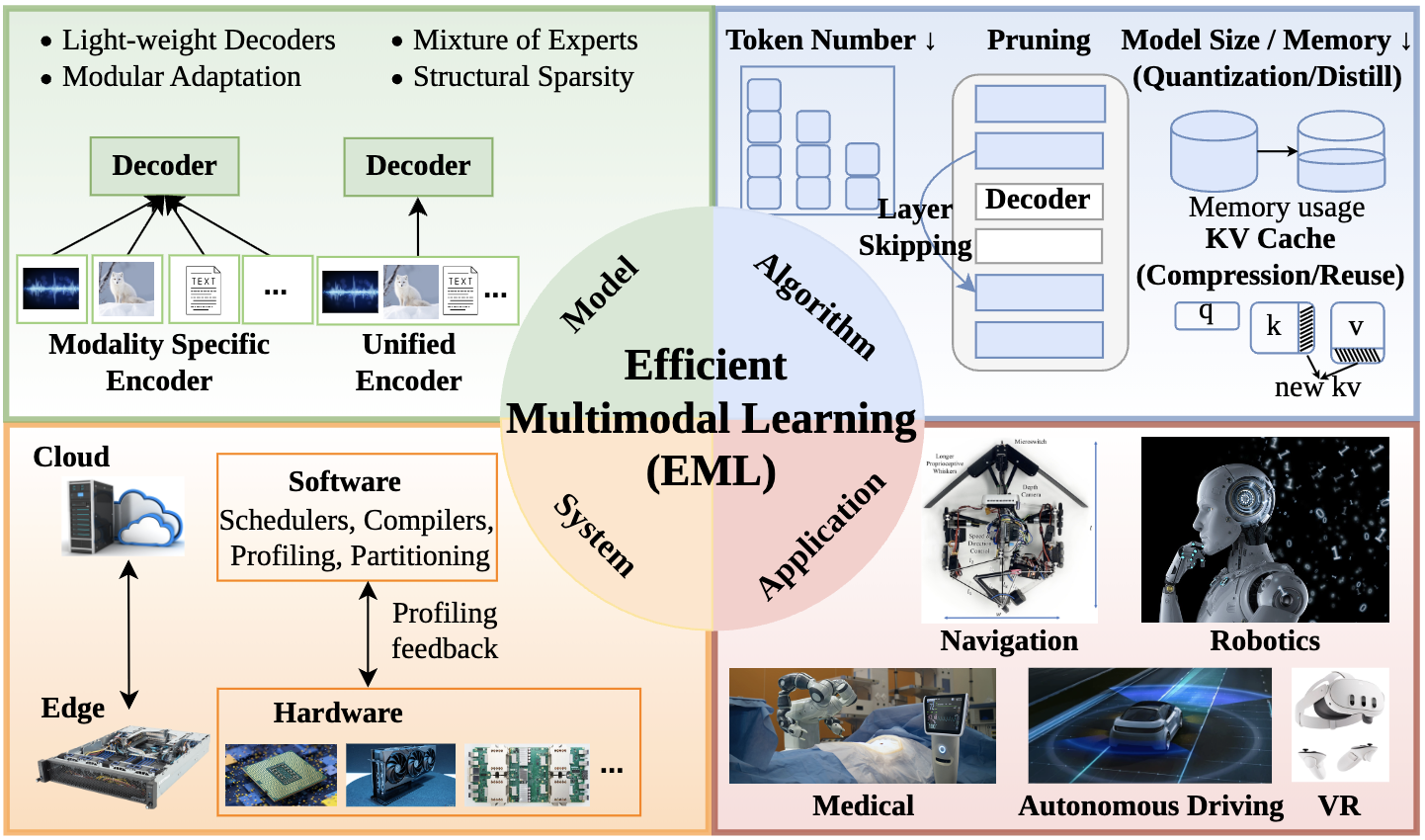
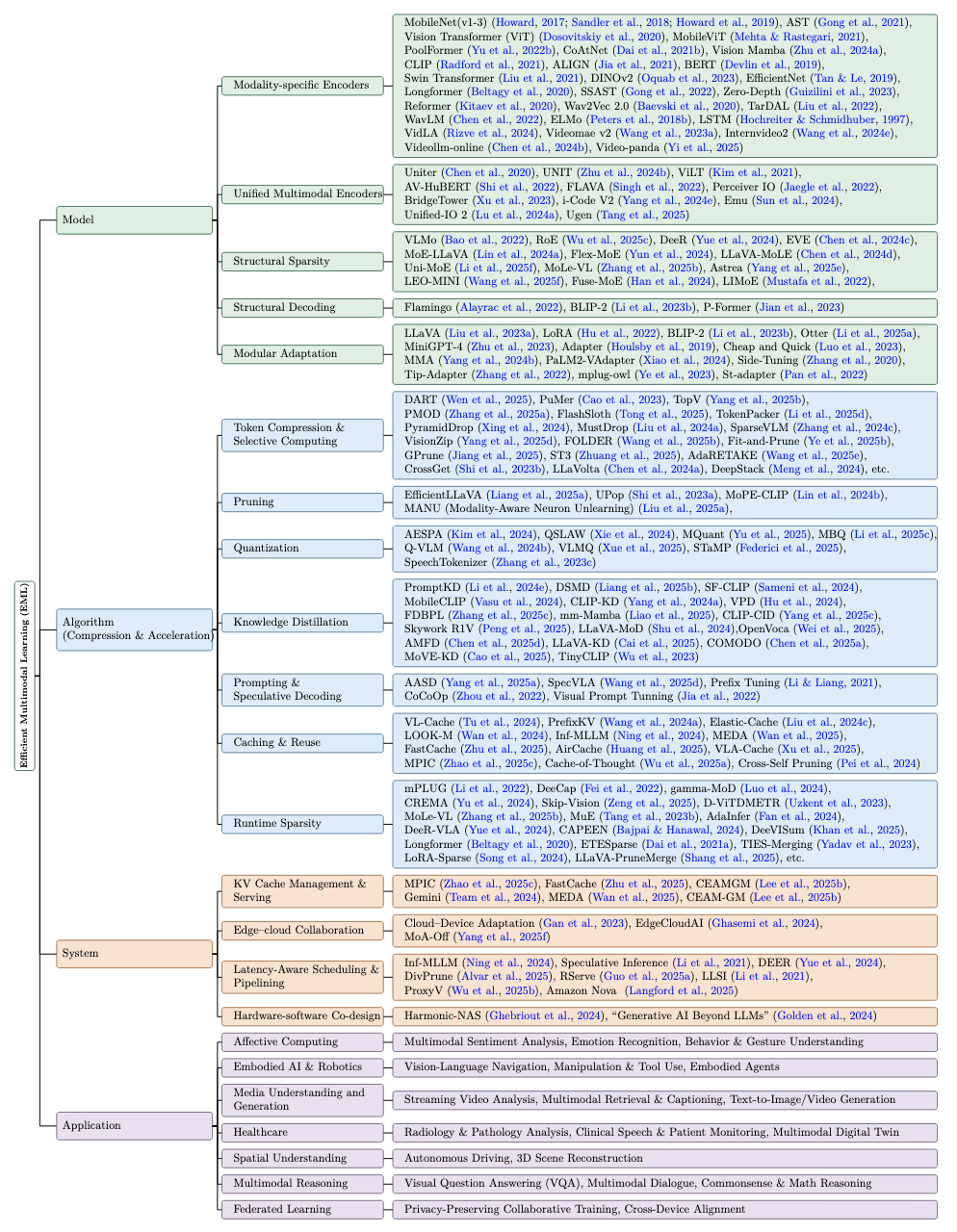
The rapid expansion of multimodal models has surfaced formidable bottlenecks in computation, memory, and deployment, catalyzing the rise of Efficient Multimodal Learning (EML) as a pivotal research frontier. Despite intensive progress, a cohesive understanding of what, how, and where efficiency is manifested across the learning stack remains fragmented. This survey systematizes the EML landscape by introducing the first structured, model-to-system taxonomy. We distill insights from over 300 seminal works into three hierarchical levels—model, algorithm, and system—addressing architectural parsimony, execution refinement, and hardware-aware orchestration, respectively. Moving beyond a purely categorical review, we offer a methodological synthesis of the vertical synergies between these layers, elucidating how cross-layer co-design contributes to the fundamental "Efficiency-Utility-Privacy" trade-off. Through an integrative case study of Multimodal Large Language Models (MLLMs), we trace the field’s evolutionary trajectory from initial structural adjustments to modern full-stack resource orchestration. Furthermore, we provide a holistic discussion and application-specific optimization blueprints for diverse domains and posit a paradigm shift toward self-regulating intelligence, where efficiency is an intrinsic, emergent property of the model’s fundamental design rather than a post-hoc constraint. Finally, we present open challenges and future directions that will define the trajectory of EML research. This survey establishes a structured framework for multimodal systems that are not only high-performing and generalizable but natively efficient and ready for ubiquitous deployment. A continuously updated version is available at https://github.com/pwang322/Efficient-Multimodal-Learning-Survey.
Model
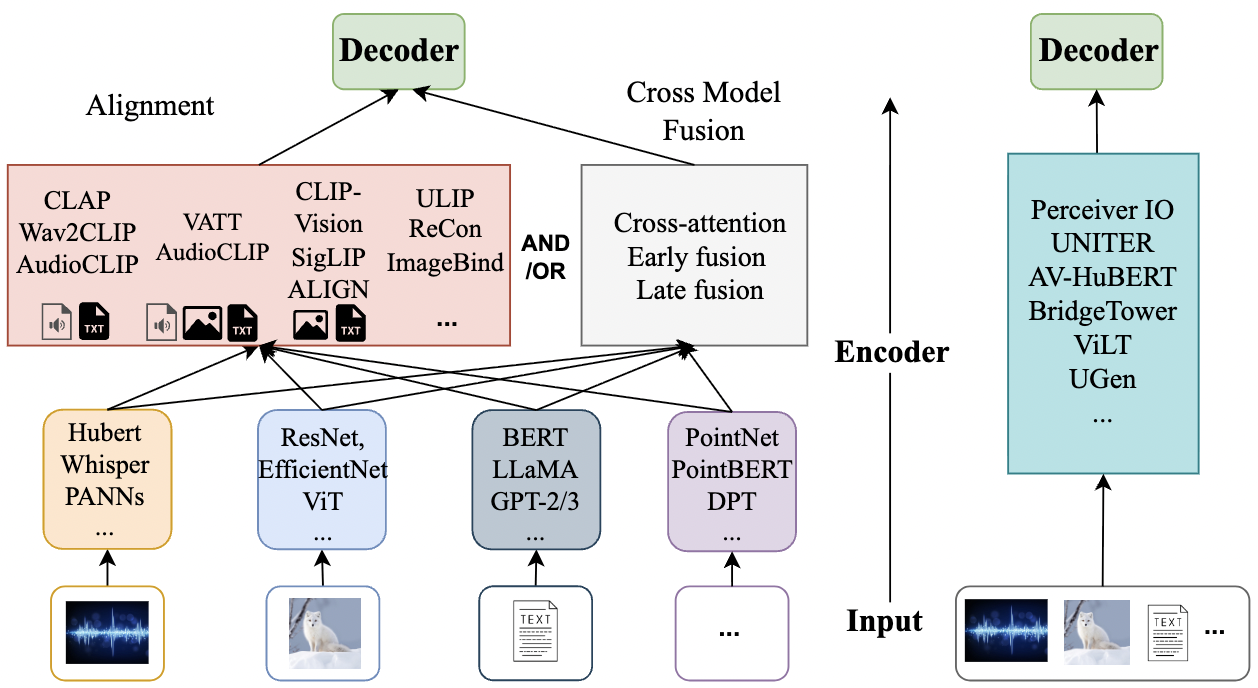
Modality-specific Encoders
Vision Encoder
- 2017_arXiv_Mobilenets: Efficient convolutional neural networks for mobile vision applications arXiv
- 2018_CVPR_Shufflenet: An extremely efficient convolutional neural network for mobile devices arXiv
- 2019_ICML_Efficientnet: Rethinking model scaling for convolutional neural networks arXiv
- 2021_arXiv_Mobilevit: light-weight, general-purpose, and mobile-friendly vision transformer arXiv
- 2021_NeurIPS_Coatnet: Marrying convolution and attention for all data sizes arXiv
- 2022_CVPR_Metaformer is actually what you need for vision arXiv
- 2020_arXiv_An image is worth 16x16 words: Transformers for image recognition at scale arXiv
- 2021_ICCV_Swin transformer: Hierarchical vision transformer using shifted windows arXivICCV
- 2021_CVPR_Masked autoencoders are scalable vision learners arXiv
- 2022_arXiv_Beit v2: Masked image modeling with vector-quantized visual tokenizers arXiv
- 2023_COLM_Mamba: Linear-Time Sequence Modeling with Selective State Spaces arXiv
- 2024_arXiv_Vision mamba: Efficient visual representation learning with bidirectional state space model arXiv
- 2024_arXiv_Kan: Kolmogorov-arnold networks arXiv
- 2021_ICLR_Learning transferable visual models from natural language supervision arXiv
- 2021_ICLR_Scaling up visual and vision-language representation learning with noisy text supervision arXiv
- 2023_ICCV_Sigmoid loss for language image pre-training arXiv
- 2021_ICCV_Emerging properties in self-supervised vision transformers arXiv
- 2023_arXiv_Dinov2: Learning robust visual features without supervision arXiv
- 2025_arXiv_DINOv3 arXiv
Text Encoders
- 1997_NeuralComputation_Hochreiter, Sepp and Schmidhuber, Jürgen IEEE
- 2014_EMNLP_Learning phrase representations using RNN encoder-decoder for statistical machine translation arXiv
- 2018_NAACL_Deep contextualized word representations arXiv
- 2018_CVPR_Independently Recurrent Neural Network (IndRNN): Building A Longer and Deeper RNN arXiv
- 2016_NeurIPS_LightRNN: Memory and computation-efficient recurrent neural networks arXiv
- 2017_NeurIPS_Attention is all you need arXiv
- 2019_NAACL_Bert: Pre-training of deep bidirectional transformers for language understanding arXiv
- 2020_arXiv_Longformer: The long-document transformer arXiv
- 2020_NeurIPS_Big Bird: Transformers for Longer Sequences arXiv
- 2020_arXiv_Reformer: The efficient transformer arXiv
- 2020_arXiv_Linformer: Self-Attention with Linear Complexity arXiv
- 2023_arXiv_Llama: Open and efficient foundation language models arXiv
- 2020_ICLR_Transformers are rnns: Fast autoregressive transformers with linear attention arXiv
- 2025_arXiv_TextMamba: Scene Text Detector with Mamba arXiv
Audio Encoders
- 2017_ICASSP_CNN ARCHITECTURES FOR LARGE-SCALE AUDIO CLASSIFICATION arXiv
- 2020_TASLP_Panns: Large-scale pretrained audio neural networks for audio pattern recognition arXiv
- 2020_NeurIPS_wav2vec 2.0: a framework for self-supervised learning of speech representations arXiv
- 2021_TASLP_Hubert: Self-supervised speech representation learning by masked prediction of hidden units arXiv
- 2021_Interspeech_AST: Audio Spectrogram Transformer arXiv
- 2022_AAAI_SSAST: Self-Supervised Audio Spectrogram Transformer arXiv
- 2024_Interspeech_Audio Mamba: Selective State Spaces for Self-Supervised Audio Representations arXix
- 2022_JSTSP_WavLM: Large-Scale Self-Supervised Pre-Training for Full Stack Speech Processing arXiv
Thermal/Depth/Time-series
- 2022_CVPR_Target‑aware Dual Adversarial Learning and a Multi‑scenario Multi‑Modality Benchmark to Fuse Infrared and Visible for Object Detection arXiv
- 2024_CVPR_Flexible Window‑based Self‑attention Transformer in Thermal Image Super‑Resolution CVPR
- 2023_CVPR_Lite-Mono: A Lightweight CNN and Transformer Architecture for Self-Supervised Monocular Depth Estimation arXiv
- 2023_ICCV_MonoDETR: Depth‑guided Transformer for Monocular 3D Object Detection arXiv
- 2021_AAAI_Informer: Beyond efficient transformer for long sequence time-series forecasting arXiv
- 2023_COLM_Mamba: Linear-Time Sequence Modeling with Selective State Spaces arXiv
- 2023_ICLR_Liquid Structural State-Space Models arXiv
- 2023_CVF_Towards zero-shot scale-aware monocular depth estimation arXiv
Unified Encoders
- 2020_ECCV_Uniter: Universal image-text representation learning arXiv
- 2021_ICLR_ViLT: Vision‑and‑Language Transformer Without Convolution or Region Supervision arXiv
- 2023_AAAI_BridgeTower: Building Bridges Between Encoders in Vision-Language Representation Learning arXiv
- 2022_arXiv_Learning audio-visual speech representation by masked multimodal cluster prediction arXiv
- 2022_CVPR_Flava: A foundational language and vision alignment model arXiv
- 2022_ICLR_Perceiver IO: A General Architecture for Structured Inputs & Outputs arXiv
- 2023_WACV_Perceiver-vl: Efficient vision-and-language modeling with iterative latent attention arXiv
- 2024_NeurIPS_UNIT: Unifying Image and Text Recognition in One Vision Encoder arXiv
- 2024_ICLR_Emu: Generative Pretraining in Multimodality arXiv
- 2024_CVPR_Unified‑IO 2: Scaling Autoregressive Multimodal Models with Vision Language Audio and Action arXiv
- 2024_NAACL_i‑Code V2: An Autoregressive Generation Framework over Vision, Language, and Speech Data arXiv
- 2025_arXiv_UGen: Unified Autoregressive Multimodal Model with Progressive Vocabulary Learning arXiv
- 2024_Grok-1.5 Vision: a preview of xAI’s multimodal model XAI
Structural Sparsity
- 2022_NeurIPS_Vlmo: Unified vision-language pre-training with mixture-of-modality-experts arXiv
- 2022_NeurIPS_Multimodal contrastive learning with limoe: the language-image mixture of experts arXiv
- 2025_TPAMI_Uni-moe: Scaling unified multimodal llms with mixture of experts arXiv
- 2025_arXiv_LEO-MINI: An Efficient Multimodal Large Language Model using Conditional Token Reduction and Mixture of Multi-Modal Experts arXiv
- 2024_arXiv_Flex-moe: Modeling arbitrary modality combination via the flexible mixture-of-experts arXiv
- 2025_CVPR_Nvila: Efficient frontier visual language models arXiv
- 2025_arXiv_Smolvlm: Redefining small and efficient multimodal models arXiv
- 2024_arXiv_Llava-mole: Sparse mixture of lora experts for mitigating data conflicts in instruction finetuning mllms arXiv
- 2024_arXiv_Moe-llava: Mixture of experts for large vision-language models arXiv
- 2024_NeurIPS_Deer-vla: Dynamic inference of multimodal large language models for efficient robot execution arXiv
- 2025_arXiv_MoLe-VLA: Dynamic Layer-skipping Vision Language Action Model via Mixture-of-Layers for Efficient Robot Manipulation arXiv
- 2024_AAAI_EVE: efficient vision-language pre-training with masked prediction and modality-aware moe arXiv
- 2025_arXiv_Astrea: A MOE-based Visual Understanding Model with Progressive Alignment arXiv
- 2024_arXiv_Routing experts: Learning to route dynamic experts in multi-modal large language models arXiv
- 2024_arXiv_Fusemoe: Mixture-of-experts transformers for fleximodal fusion arXiv
Structural Decoding
- 2022_neurIPS_Flamingo: a visual language model for few-shot learning arXiv
- 2023_ICLR_Blip-2: Bootstrapping language-image pre-training with frozen image encoders and large language models arXiv
- 2023_NeurIPS_Bootstrapping Vision‑Language Learning with Decoupled Language Pre‑training arXiv
Modular Adaptation
- 2019_ICML_Parameter-efficient transfer learning for NLP arXiv
- 2022_ICLR_Lora: Low-rank adaptation of large language models arXiv
- 2022_CVPR_Vl-adapter: Parameter-efficient transfer learning for vision-and-language tasks arXiv
- 2022_NeurIPS_Lst: Ladder side-tuning for parameter and memory efficient transfer learning arXiv
- 2023_NeurIPS_Visual instruction tuning arXiv
- 2023_arXiv_Minigpt-4: Enhancing vision-language understanding with advanced large language models arXiv
- 2025_AAAI_A wander through the multimodal landscape: Efficient transfer learning via low-rank sequence multimodal adapter arXiv
- 2024_CVPR_Mma: Multi-modal adapter for vision-language models arXiv
- 2024_arXiv_PaLM2-VAdapter: progressively aligned language model makes a strong vision-language adapter arXiv
- 2023_ICLR_Blip-2: Bootstrapping language-image pre-training with frozen image encoders and large language models arXiv
- 2023_NeurIPS_Cheap and quick: Efficient vision-language instruction tuning for large language models arXiv
- 2022_ECCV_Tip-adapter: Training-free adaption of clip for few-shot classification arXiv
- 2023_arXiv_mplug-owl: Modularization empowers large language models with multimodality arXiv
- 2025_TPAMI_Otter: A multi-modal model with in-context instruction tuning arXiv
Algorithm
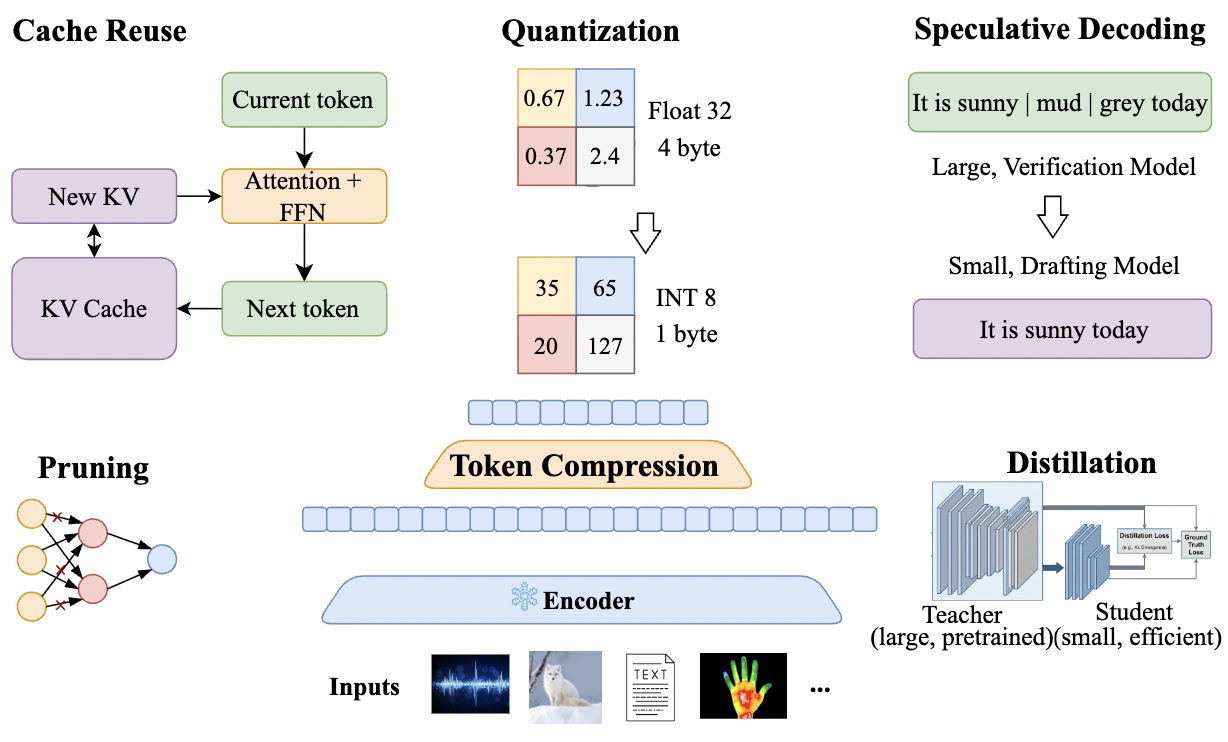
Token Compression & Selective Computing
- 2023_arXiv_D2 pruning: Message passing for balancing diversity and difficulty in data pruning arXiv
Tranining-free
- 2024_arXiv_Sparsevlm: Visual token sparsification for efficient vision-language model inference arXiv
- 2025_AAAI_ST3: Accelerating Multimodal Large Language Model by Spatial-Temporal Visual Token Trimming arXiv
- 2025_arXiv_Stop looking for important tokens in multimodal language models: Duplication matters more arXiv
- 2025_CVPR_Topv: Compatible token pruning with inference time optimization for fast and low-memory multimodal vision language model arXiv
- 2025_CVPR_Visionzip: Longer is better but not necessary in vision language models arXiv
- 2025_arXiv_Tokencarve: Information-preserving visual token compression in multimodal large language models arXiv
- 2024_arXiv_Multi-Stage Vision Token Dropping: Towards Efficient Multimodal Large Language Model arXiv
- 2025_arXiv_Adaretake: Adaptive redundancy reduction to perceive longer for video-language understanding arXiv
- 2025_arXiv_What Kind of Visual Tokens Do We Need? Training-free Visual Token Pruning for Multi-modal Large Language Models from the Perspective of Graph arXiv
- 2024_arXiv_Pyramiddrop: Accelerating your large vision-language models via pyramid visual redundancy reduction arXiv
- 2025_AAAI_HiRED: Attention-Guided Token Dropping for Efficient Inference of High-Resolution Vision-Language Models arXiv
- 2025_AAAI_Fit and prune: Fast and training-free visual token pruning for multi-modal large language models arXiv
- 2025_arXiv_Token Sequence Compression for Efficient Multimodal Computing arXiv
- 2024_NeurIPS_Efficient large multi-modal models via visual context compression arXiv
- 2023_arXiv_Crossget: Cross-guided ensemble of tokens for accelerating vision-language transformers arXiv
- 2024_arXiv_Multi-Stage Vision Token Dropping: Towards Efficient Multimodal Large Language Model arXiv
- 2025_arXiv_What Kind of Visual Tokens Do We Need? Training-free Visual Token Pruning for Multi-modal Large Language Models from the Perspective of Graph arXiv
- 2025_arXiv_Stop looking for important tokens in multimodal language models: Duplication matters more arXiv
- 2024_NeurIPS_Efficient large multi-modal models via visual context compression arXiv
Training-based
- 2023_arXiv_PuMer: Pruning and merging tokens for efficient vision language models arXiv
- 2024_arXiv_p-MoD: Building Mixture-of-Depths MLLMs via Progressive Ratio Decay arXiv
- 2025_arXiv_Fast: Efficient action tokenization for vision-language-action models arXiv
- 2024_arXiv_Tokenpacker: Efficient visual projector for multimodal llm arXiv
- 2025_arXiv_Folder: Accelerating multi-modal large language models with enhanced performance arXiv
- 2025_CVPR_Visionzip: Longer is better but not necessary in vision language models arXiv
- 2024_NeurIPS_Efficient large multi-modal models via visual context compression arXiv
- 2024_NeurIPS_Deepstack: Deeply stacking visual tokens is surprisingly simple and effective for lmms arXiv
- 2024_arXiv_FlashSloth: Lightning Multimodal Large Language Models via Embedded Visual Compression arXiv
Pruning
- 2024_MM_Large multimodal model compression via iterative efficient pruning and distillation arXiv
- 2023_arXiv_Ecoflap: Efficient coarse-to-fine layer-wise pruning for vision-language models arXiv
- 2025_arXiv_EfficientLLaVA: Generalizable Auto-Pruning for Large Vision-language Models arXiv
- 2023_ICLR_UPop: Unified and progressive pruning for compressing vision-language transformers arXiv
- 2025_arXiv_Modality-Aware Neuron Pruning for Unlearning in Multimodal Large Language Models arXiv
- 2024_CVPR_MoPE-CLIP: Structured Pruning for Efficient Vision-Language Models with Module-wise Pruning Error Metric arXiv
Quantization
- 2024_NeurIPS_Q-vlm: Post-training quantization for large vision-language models arXiv
- 2025_CVPR_Mbq: Modality-balanced quantization for large vision-language models arXiv
- 2025_arXiv_Vlmq: Efficient post-training quantization for large vision-language models via hessian augmentation arXiv
- 2025_ACM_Mquant: Unleashing the inference potential of multimodal large language models via static quaantization arXiv
- 2025_arXiv_STaMP: Sequence Transformation and Mixed Precision for Low-Precision Activation QuantizationSTaMP: Sequence Transformation and Mixed Precision for Low-Precision Activation Quantization arXiv
- 2024_MM_Advancing Multimodal Large Language Models with Quantization-Aware Scale Learning for Efficient Adaptation arXiv
- 2024_NuerIPS_Towards Next-Level Post-Training Quantization of Hyper-Scale Transformers arXiv
- 2024_MM_Advancing Multimodal Large Language Models with Quantization-Aware Scale Learning for Efficient Adaptation ACM
Knowledge Distillation
Prediction-level
- 2021_CVPR_Thinking fast and slow: Efficient text-to-visual retrieval with transformers arXiv
- 2025_arXiv_Simple Semi-supervised Knowledge Distillation from Vision-Language Models via Dual-Head Optimization arXiv
- 2024_CVPR_Promptkd: Unsupervised prompt distillation for vision-language models arXiv
- 2025_arXiv_FDBPL: Faster Distillation-Based Prompt Learning for Region-Aware Vision-Language Models Adaptation arXiv
- 2025_AAAI_Clip-cid: Efficient clip distillation via cluster-instance discrimination arXiv
- 2025_ICLR_Open-vocabulary customization from clip via data-free knowledge distillation arXiv
- 2024_arXiv_LLaVA-KD: A Framework of Distilling Multimodal Large Language Models arXiv
- 2025_arXiv_MoVE-KD: Knowledge Distillation for VLMs with Mixture of Visual Encoders arXiv
Representation-level
- 2024_CVPR_Clip-kd: An empirical study of clip model distillation arXiv
- 2023_ICCV_Tinyclip: Clip distillation via affinity mimicking and weight inheritance arXiv
- 2024_arXiv_Dynamic Self-adaptive Multiscale Distillation from Pre-trained Multimodal Large Model for Efficient Cross-modal Representation Learning arXiv
- 2024_CVPR_Building vision-language models on solid foundations with masked distillation CVPR
- 2024_CVPR_Mobileclip: Fast image-text models through multi-modal reinforced training arXiv
- 2025_arXiv_Multimodal mamba: Decoder-only multimodal state space model via quadratic to linear distillation arXiv
- 2024_arXiv_AMFD: Distillation via Adaptive Multimodal Fusion for Multispectral Pedestrian Detection arXiv
- 2025_arXiv_Comodo: Cross-modal video-to-imu distillation for efficient egocentric human activity recognition arXiv
Behavior-level
- 2025_arXiv_Skywork r1v: pioneering multimodal reasoning with chain-of-thought arXiv
- 2024_CVPR_Visual program distillation: Distilling tools and programmatic reasoning into vision-language models arXiv
- 2024_arXiv_Llava-mod: Making llava tiny via moe knowledge distillation arXiv
Prompting & Speculative Decoding
- 2022_ECCV_Visual prompt tuning arXiv
- 2021_ACL_Prefix-Tuning: Optimizing Continuous Prompts for Generation arXiv
- 2022_CVPR_Conditional Prompt Learning for Vision-Language Models arXiv
- 2024_CVPR_On speculative decoding for multimodal large language models arXiv
- 2025_DAC_AASD: Accelerate Inference by Aligning Speculative Decoding in Multimodal Large Language Models IEEE
- 2025_arXiv_Speculative decoding and beyond: An in-depth survey of techniques arXiv
- 2025_arXiv_Spec-vla: speculative decoding for vision-language-action models with relaxed acceptance arXiv
Caching & Reuse
- 2024_arXiv_VL-Cache: Sparsity and Modality-Aware KV Cache Compression for Vision-Language Model Inference Acceleration arXiv
- 2024_ECCV_Efficient inference of vision instruction-following models with elastic cache arXiv
- 2024_arXiv_Look-m: Look-once optimization in kv cache for efficient multimodal long-context inference arXiv
- 2024_arXiv_Cross-Self KV Cache Pruning for Efficient Vision-Language Inference arXiv
- 2025_arXiv_Fastcache: Optimizing multimodal llm serving through lightweight kv-cache compression framework arXiv
- 2025_arXiv_AirCache: Activating Inter-modal Relevancy KV Cache Compression for Efficient Large Vision-Language Model Inference arXiv
- 2025_arXiv_VLA-Cache: Towards Efficient Vision-Language-Action Model via Adaptive Token Caching in Robotic Manipulation arXiv
- 2024_arXiv_Inf-MLLM: Efficient streaming inference of multimodal large language models on a single GPU arXiv
- 2025_arXiv_MPIC: Position-Independent Multimodal Context Caching System for Efficient MLLM Serving arXiv
- 2025_arXiv_Cache-of-Thought: Master-Apprentice Framework for Cost-Effective Vision Language Model Inference arXiv
- 2024_arXiv_Prefixkv: Adaptive prefix kv cache is what vision instruction-following models need for efficient generation arXiv
- 2025_arXiv_Meda: Dynamic kv cache allocation for efficient multimodal long-context inference arXiv
Runtime Sparsity
- 2025_arXiv_Skip-Vision: Efficient and Scalable Acceleration of Vision-Language Models via Adaptive Token Skipping arXiv
- 2023_CVPR_Dynamic inference with grounding based vision and language models CVPR
- 2025_arXiv_MoLe-VLA: Dynamic Layer-skipping Vision Language Action Model via Mixture-of-Layers for Efficient Robot Manipulation arXiv
- 2024_arXiv_γ-MoD: Exploring Mixture-of-Depth Adaptation for Multimodal Large Language Models arXiv
- 2020_arXiv_Longformer: The long-document transformer arXiv
- 2020_NeurIPS_Big Bird: Transformers for Longer Sequences arXiv
- 2022_arXiv_mplug: Effective and efficient vision-language learning by cross-modal skip-connections arXiv
- 2022_CVPR_Deecap: Dynamic early exiting for efficient image captioning CVPR
- 2023_CVPR_You need multiple exiting: Dynamic early exiting for accelerating unified vision language model arXiv
- 2024_NeurIPS_Deer-vla: Dynamic inference of multimodal large language models for efficient robot execution arXiv
- 2024_arXiv_Not all layers of llms are necessary during inference arXiv
- 2024_arXiv_Crema: Generalizable and efficient video-language reasoning via multimodal modular fusion arXiv
- 2024_arXiv_CAPEEN: Image Captioning with Early Exits and Knowledge Distillation arXiv
- 2021_NAACL_Multimodal End‑to‑End Sparse Model for Emotion Recognition arXiv
- 2024_CVPR_Low‑Rank Approximation for Sparse Attention in Multi‑Modal LLMs CVPR
- 2023_NeurIPS_Ties-merging: Resolving interference when merging models arXiv
- 2023_arXiv_An empirical study of multimodal model merging arXiv
- 2024_arXiv_Llava-prumerge: Adaptive token reduction for efficient large multimodal models arXiv
- 2023_CVPR_You need multiple exiting: Dynamic early exiting for accelerating unified vision language model arXiv
- 2024_arXiv_Not all layers of llms are necessary during inference arXiv
- 2025_arXiv_Early Exit and Multi Stage Knowledge Distillation in VLMs for Video Summarization arXiv
System
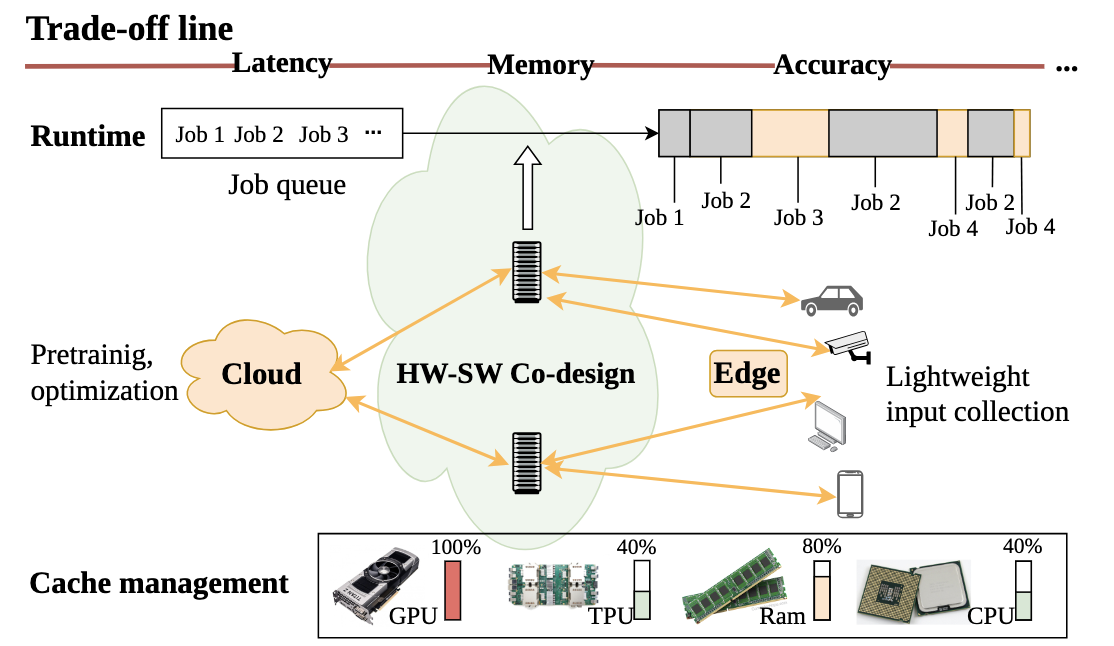
KV Cache Management & Serving
- 2025_arXiv_Characterizing and Efficiently Accelerating Multimodal Generation Models arXiv
- 2025_arXiv_Fastcache: Optimizing multimodal llm serving through lightweight kv-cache compression framework arXiv
- 2025_arXiv_Meda: Dynamic kv cache allocation for efficient multimodal long-context inference arXiv
- 2025_arXiv_MPIC: Position-Independent Multimodal Context Caching System for Efficient MLLM Serving arXiv
- 2024_arXiv_Gemini 1.5: Unlocking multimodal understanding across millions of tokens of context arXiv
Edge–cloud Collaboration
- 2024_MobiCom_EdgeCloudAI: Edge-Cloud Distributed Video Analytics ACM
- 2025_arXiv_MoA-Off: Adaptive Heterogeneous Modality-Aware Offloading with Edge-Cloud Collaboration for Efficient Multimodal LLM Inference arXiv
- 2020_MobiCom_Challenge: COSMOS: A city-scale programmable testbed for experimentation with advanced wireless ACM
- 2023_CVPR_Cloud-Device Collaborative Adaptation to Continual Changing Environments in the Real-world arXiv
Latency-Aware Scheduling & Pipelining
- 2025_arXiv_RServe: Overlapping Encoding and Prefill for Efficient LMM Inference arXiv
- 2024_arXiv_Inf-MLLM: Efficient streaming inference of multimodal large language models on a single GPU arXiv
- 2023_NeurIPS_H2o: Heavy-hitter oracle for efficient generative inference of large language models arXiv
- 2025_TAAS_Adaptive Scheduling of Multimodal Large Language Model in Intelligent Edge Computing ACM
- 2025_arXiv_The Amazon Nova Family of Models: Technical Report and Model Card arXiv
- 2021_MobiSys_Low-latency Speculative Inference On Distributed Multi-modal Data Streams ACM
- 2024_NeurIPS_Deer-vla: Dynamic inference of multimodal large language models for efficient robot execution arXiv
- 2025_CVPR_DivPrune: Diversity-based Visual Token Pruning for Large Multimodal Models arXiv
- 2025_ICML_Streamline Without Sacrifice - Squeeze out Computation Redundancy in LMM arXiv
Hardware-software Co-design
- 2024_ISPASS_Generative AI Beyond LLMs: System Implications of Multi-Modal Generation arXiv
- 2023_ACML_Harmonic-NAS: Hardware-Aware Multimodal Neural Architecture Search on Resource-constrained Devices arXiv
Efficient Multimodal Large Language Model
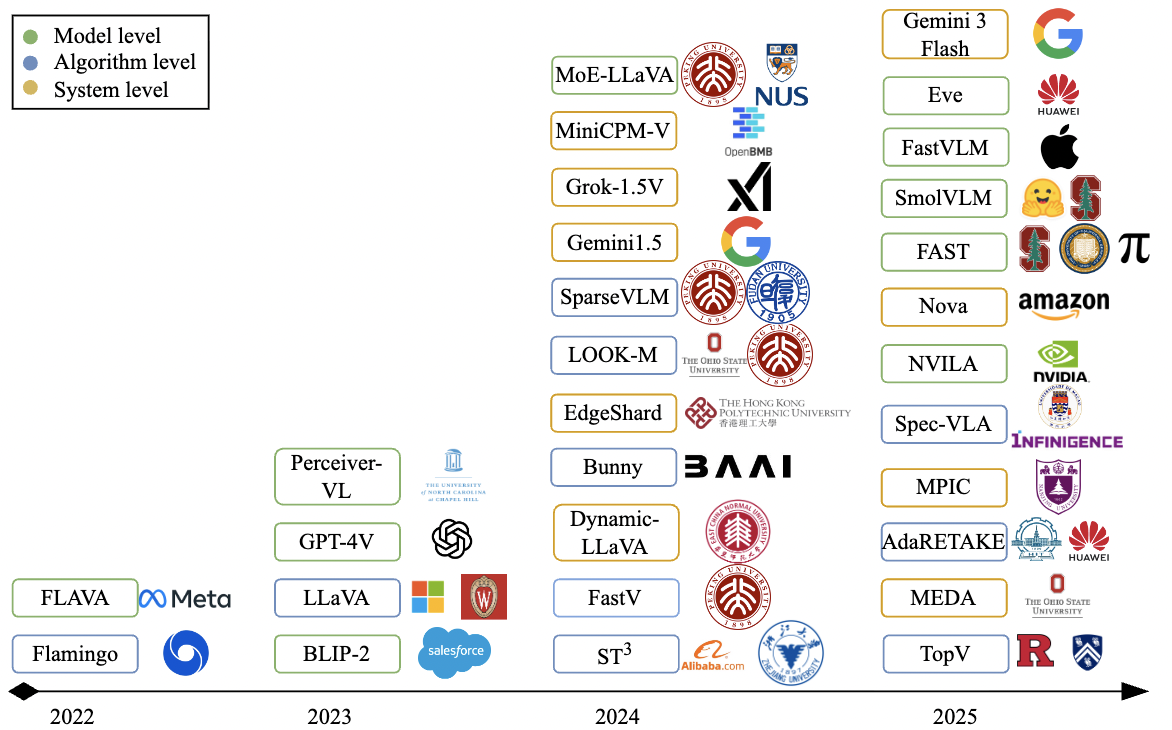
Application
Affective Computing
- 2025_AAAI_DLF: Disentangled-language-focused multimodal sentiment analysis arXiv
- 2025_ICRA_Ugotme: An embodied system for affective human-robot interaction arXiv
Embodied AI & Robotics
- 2018_NeurIPS_Speaker-follower models for vision-and-language navigation arXiv
- 2022_CoRL_A persistent spatial semantic representation for high-level natural language instruction execution arXiv
- 2022_AAAI_Teach: Task-driven embodied agents that chat arXiv
- 2023_CoRL_Do as i can, not as i say: Grounding language in robotic affordances arXiv
- 2025_arXiv_CrayonRobo: Object-Centric Prompt-Driven Vision-Language-Action Model for Robotic Manipulation arXiv
- 2023_CoRL_Rt-2: Vision-language-action models transfer web knowledge to robotic control arXiv
- 2024_arXiv_Openvla: An open-source vision-language-action model arXiv
- 2025_arXiv_M3ET: Efficient Vision-Language Learning for Robotics based on Multimodal Mamba-Enhanced Transformer arXiv
Media Understanding and Generation
- 2021_EMNLP_VideoCLIP: Contrastive Pre-training for Zero-shot Video-Text Understanding arXiv
- 2024_arXiv_Towards Bridging the Cross-modal Semantic Gap for Multi-modal Recommendation arXiv
- 2023_CVPR_Vop: Text-video co-operative prompt tuning for cross-modal retrieval arXiv
- 2024_ACL_Video-ChatGPT: Towards Detailed Video Understanding via Large Vision and Language Models arXiv
- 2024_CVPR_MVBench: A Comprehensive Multi-modal Video Understanding Benchmark arXiv
- 2024_arXiv_Video-MME: The First-Ever Comprehensive Evaluation Benchmark of Multi-modal LLMs in Video Analysis arXiv
- 2022_ECCV_End-to-end active speaker detection arXiv
- 2023_CVPR_A light weight model for active speaker detection arXiv
- 2025_arXiv_EMMA: Efficient Multimodal Understanding, Generation, and Editing with a Unified Architecture arXiv
Healthcare
- 2023_CVPR_Learning to exploit temporal structure for biomedical vision-language processing arXiv
- 2024_MICCAI_KARGEN: Knowledge-Enhanced Automated Radiology report generation using large language models arXiv
- 2025_springer_CXR-LLAVA: a multimodal large language model for interpreting chest X-ray images arXiv
- 2023_NeurIPS_Llava-med: Training a large language-and-vision assistant for biomedicine in one day arXiv
- 2024_SenSys_Advancing PPG-based continuous blood pressure monitoring from a generative perspective ACM
Spatial Understanding
- 2019_CVPR_Pointpillars: Fast encoders for object detection from point clouds arXiv
- 2023_ICRA_BEVFusion: Multi-Task Multi-Sensor Fusion with Unified Bird's-Eye View Representation arXiv
- 2021_ITSC_Fusionpainting: Multimodal fusion with adaptive attention for 3d object detection arXiv
- 2023_ICCV_On-device real-time custom hand gesture recognition arXiv
- 2025_ICCV_MM-Spatial: Exploring 3D Spatial Understanding in Multimodal LLMs arXiv
Multimodal Reasoning
- 2019_arXiv_Lxmert: Learning cross-modality encoder representations from transformers arXiv
- 2020_ECCV_Uniter: Universal image-text representation learning arXiv
- 2023_IGARSS_Lit-4-rsvqa: Lightweight transformer-based visual question answering in remote sensing arXiv
- 2023_arXiv_Llava-interactive: An all-in-one demo for image chat, segmentation, generation and editing arXiv
- 2023_arXiv_Minigpt-4: Enhancing vision-language understanding with advanced large language models arXiv
- 2024_arXiv_Mathglm-vision: solving mathematical problems with multi-modal large language model arXiv
- 2023_ICCV_ViperGPT: Visual Inference via Python Execution for Reasoning arXiv
- 2025_arXiv_Stable and Efficient Single-Rollout RL for Multimodal Reasoning arXiv
- 2025_arXiv_Towards Efficient Multimodal Unified Reasoning Model via Model Merging arXiv
Federated Learning
- 2023_ICLR_FedCLIP: Fast Generalization and Personalization for CLIP in Federated Learning arXiv
- 2023_WWW_pFedPrompt: Learning Personalized Prompt for Vision-Language Models in Federated Learning ACM
- 2023_ICLR_Multimodal Federated Learning via Contrastive Representation Ensemble arXiv
- 2025_Neural Networks_FedMEKT: Distillation-Based Embedding Knowledge Transfer for Multimodal Federated Learning arXiv ACM
- 2021_SIGIR_FedCMR: Federated Cross-Modal Retrieval ACM
- 2023_arXiv_Multimodal Federated Learning with Missing Modality via Prototype Mask and Contrast arXiv
- 2024_arXiv_Communication-Efficient Multimodal Federated Learning: Joint Modality and Client Selection arXiv
- 2022_AAAI_Cross-Modal Federated Human Activity Recognition via Modality-Agnostic and Modality-Specifc Representation Learning AAAI
- 2024_TPAMI_Cross-Modal Federated Human Activity Recognition IEEE
- 2020_AAAI_Federated Learning for Vision-and-Language Grounding Problems AAAI
- 2023_TGRS_FedFusion: Manifold Driven Federated Learning for Multi-satellite and Multi-modality Fusion arXiv
Citation
If you find this repository or survey helpful in your research or work, please cite the following paper:
@article{wang2026models,
  title={From models to systems: A comprehensive survey of efficient multimodal learning},
  author={Wang, Pan and Song, Siwei and Ji, Hui and Cao, Siqi and Yu, Heng and Liu, Zhijian and Yang, Huanrui and Lin, Yingyan Celine and Chen, Beidi and Bansal, Mohit and others},
  journal={Transactions on Machine Learning Research},
  year={2026}
}
Contributors

64 commits

24 commits
Similar repos


The official GitHub page for the survey paper "From Models to Systems: A Comprehensive Survey of Efficient Multimodal Learning". And this paper is under review.
21
88 commits
updated Sep 18, 2026
README
From Models to Systems: A Comprehensive Survey of Efficient Multimodal Learning
The official GitHub page for the survey paper "From Models to Systems: A Comprehensive Survey of Efficient Multimodal Learning". This paper is accepted by Transactions on Machine Learning Research (TMLR) and awarded the Survey Certificate.
Abstract
The rapid expansion of multimodal models has surfaced formidable bottlenecks in computation, memory, and deployment, catalyzing the rise of Efficient Multimodal Learning (EML) as a pivotal research frontier. Despite intensive progress, a cohesive understanding of what, how, and where efficiency is manifested across the learning stack remains fragmented. This survey systematizes the EML landscape by introducing the first structured, model-to-system taxonomy. We distill insights from over 300 seminal works into three hierarchical levels—model, algorithm, and system—addressing architectural parsimony, execution refinement, and hardware-aware orchestration, respectively. Moving beyond a purely categorical review, we offer a methodological synthesis of the vertical synergies between these layers, elucidating how cross-layer co-design contributes to the fundamental "Efficiency-Utility-Privacy" trade-off. Through an integrative case study of Multimodal Large Language Models (MLLMs), we trace the field’s evolutionary trajectory from initial structural adjustments to modern full-stack resource orchestration. Furthermore, we provide a holistic discussion and application-specific optimization blueprints for diverse domains and posit a paradigm shift toward self-regulating intelligence, where efficiency is an intrinsic, emergent property of the model’s fundamental design rather than a post-hoc constraint. Finally, we present open challenges and future directions that will define the trajectory of EML research. This survey establishes a structured framework for multimodal systems that are not only high-performing and generalizable but natively efficient and ready for ubiquitous deployment. A continuously updated version is available at https://github.com/pwang322/Efficient-Multimodal-Learning-Survey.
Model
Modality-specific Encoders
Vision Encoder
- 2017_arXiv_Mobilenets: Efficient convolutional neural networks for mobile vision applications arXiv
- 2018_CVPR_Shufflenet: An extremely efficient convolutional neural network for mobile devices arXiv
- 2019_ICML_Efficientnet: Rethinking model scaling for convolutional neural networks arXiv
- 2021_arXiv_Mobilevit: light-weight, general-purpose, and mobile-friendly vision transformer arXiv
- 2021_NeurIPS_Coatnet: Marrying convolution and attention for all data sizes arXiv
- 2022_CVPR_Metaformer is actually what you need for vision arXiv
- 2020_arXiv_An image is worth 16x16 words: Transformers for image recognition at scale arXiv
- 2021_ICCV_Swin transformer: Hierarchical vision transformer using shifted windows arXivICCV
- 2021_CVPR_Masked autoencoders are scalable vision learners arXiv
- 2022_arXiv_Beit v2: Masked image modeling with vector-quantized visual tokenizers arXiv
- 2023_COLM_Mamba: Linear-Time Sequence Modeling with Selective State Spaces arXiv
- 2024_arXiv_Vision mamba: Efficient visual representation learning with bidirectional state space model arXiv
- 2024_arXiv_Kan: Kolmogorov-arnold networks arXiv
- 2021_ICLR_Learning transferable visual models from natural language supervision arXiv
- 2021_ICLR_Scaling up visual and vision-language representation learning with noisy text supervision arXiv
- 2023_ICCV_Sigmoid loss for language image pre-training arXiv
- 2021_ICCV_Emerging properties in self-supervised vision transformers arXiv
- 2023_arXiv_Dinov2: Learning robust visual features without supervision arXiv
- 2025_arXiv_DINOv3 arXiv
Text Encoders
- 1997_NeuralComputation_Hochreiter, Sepp and Schmidhuber, Jürgen IEEE
- 2014_EMNLP_Learning phrase representations using RNN encoder-decoder for statistical machine translation arXiv
- 2018_NAACL_Deep contextualized word representations arXiv
- 2018_CVPR_Independently Recurrent Neural Network (IndRNN): Building A Longer and Deeper RNN arXiv
- 2016_NeurIPS_LightRNN: Memory and computation-efficient recurrent neural networks arXiv
- 2017_NeurIPS_Attention is all you need arXiv
- 2019_NAACL_Bert: Pre-training of deep bidirectional transformers for language understanding arXiv
- 2020_arXiv_Longformer: The long-document transformer arXiv
- 2020_NeurIPS_Big Bird: Transformers for Longer Sequences arXiv
- 2020_arXiv_Reformer: The efficient transformer arXiv
- 2020_arXiv_Linformer: Self-Attention with Linear Complexity arXiv
- 2023_arXiv_Llama: Open and efficient foundation language models arXiv
- 2020_ICLR_Transformers are rnns: Fast autoregressive transformers with linear attention arXiv
- 2025_arXiv_TextMamba: Scene Text Detector with Mamba arXiv
Audio Encoders
- 2017_ICASSP_CNN ARCHITECTURES FOR LARGE-SCALE AUDIO CLASSIFICATION arXiv
- 2020_TASLP_Panns: Large-scale pretrained audio neural networks for audio pattern recognition arXiv
- 2020_NeurIPS_wav2vec 2.0: a framework for self-supervised learning of speech representations arXiv
- 2021_TASLP_Hubert: Self-supervised speech representation learning by masked prediction of hidden units arXiv
- 2021_Interspeech_AST: Audio Spectrogram Transformer arXiv
- 2022_AAAI_SSAST: Self-Supervised Audio Spectrogram Transformer arXiv
- 2024_Interspeech_Audio Mamba: Selective State Spaces for Self-Supervised Audio Representations arXix
- 2022_JSTSP_WavLM: Large-Scale Self-Supervised Pre-Training for Full Stack Speech Processing arXiv
Thermal/Depth/Time-series
- 2022_CVPR_Target‑aware Dual Adversarial Learning and a Multi‑scenario Multi‑Modality Benchmark to Fuse Infrared and Visible for Object Detection arXiv
- 2024_CVPR_Flexible Window‑based Self‑attention Transformer in Thermal Image Super‑Resolution CVPR
- 2023_CVPR_Lite-Mono: A Lightweight CNN and Transformer Architecture for Self-Supervised Monocular Depth Estimation arXiv
- 2023_ICCV_MonoDETR: Depth‑guided Transformer for Monocular 3D Object Detection arXiv
- 2021_AAAI_Informer: Beyond efficient transformer for long sequence time-series forecasting arXiv
- 2023_COLM_Mamba: Linear-Time Sequence Modeling with Selective State Spaces arXiv
- 2023_ICLR_Liquid Structural State-Space Models arXiv
- 2023_CVF_Towards zero-shot scale-aware monocular depth estimation arXiv
Unified Encoders
- 2020_ECCV_Uniter: Universal image-text representation learning arXiv
- 2021_ICLR_ViLT: Vision‑and‑Language Transformer Without Convolution or Region Supervision arXiv
- 2023_AAAI_BridgeTower: Building Bridges Between Encoders in Vision-Language Representation Learning arXiv
- 2022_arXiv_Learning audio-visual speech representation by masked multimodal cluster prediction arXiv
- 2022_CVPR_Flava: A foundational language and vision alignment model arXiv
- 2022_ICLR_Perceiver IO: A General Architecture for Structured Inputs & Outputs arXiv
- 2023_WACV_Perceiver-vl: Efficient vision-and-language modeling with iterative latent attention arXiv
- 2024_NeurIPS_UNIT: Unifying Image and Text Recognition in One Vision Encoder arXiv
- 2024_ICLR_Emu: Generative Pretraining in Multimodality arXiv
- 2024_CVPR_Unified‑IO 2: Scaling Autoregressive Multimodal Models with Vision Language Audio and Action arXiv
- 2024_NAACL_i‑Code V2: An Autoregressive Generation Framework over Vision, Language, and Speech Data arXiv
- 2025_arXiv_UGen: Unified Autoregressive Multimodal Model with Progressive Vocabulary Learning arXiv
- 2024_Grok-1.5 Vision: a preview of xAI’s multimodal model XAI
Structural Sparsity
- 2022_NeurIPS_Vlmo: Unified vision-language pre-training with mixture-of-modality-experts arXiv
- 2022_NeurIPS_Multimodal contrastive learning with limoe: the language-image mixture of experts arXiv
- 2025_TPAMI_Uni-moe: Scaling unified multimodal llms with mixture of experts arXiv
- 2025_arXiv_LEO-MINI: An Efficient Multimodal Large Language Model using Conditional Token Reduction and Mixture of Multi-Modal Experts arXiv
- 2024_arXiv_Flex-moe: Modeling arbitrary modality combination via the flexible mixture-of-experts arXiv
- 2025_CVPR_Nvila: Efficient frontier visual language models arXiv
- 2025_arXiv_Smolvlm: Redefining small and efficient multimodal models arXiv
- 2024_arXiv_Llava-mole: Sparse mixture of lora experts for mitigating data conflicts in instruction finetuning mllms arXiv
- 2024_arXiv_Moe-llava: Mixture of experts for large vision-language models arXiv
- 2024_NeurIPS_Deer-vla: Dynamic inference of multimodal large language models for efficient robot execution arXiv
- 2025_arXiv_MoLe-VLA: Dynamic Layer-skipping Vision Language Action Model via Mixture-of-Layers for Efficient Robot Manipulation arXiv
- 2024_AAAI_EVE: efficient vision-language pre-training with masked prediction and modality-aware moe arXiv
- 2025_arXiv_Astrea: A MOE-based Visual Understanding Model with Progressive Alignment arXiv
- 2024_arXiv_Routing experts: Learning to route dynamic experts in multi-modal large language models arXiv
- 2024_arXiv_Fusemoe: Mixture-of-experts transformers for fleximodal fusion arXiv
Structural Decoding
- 2022_neurIPS_Flamingo: a visual language model for few-shot learning arXiv
- 2023_ICLR_Blip-2: Bootstrapping language-image pre-training with frozen image encoders and large language models arXiv
- 2023_NeurIPS_Bootstrapping Vision‑Language Learning with Decoupled Language Pre‑training arXiv
Modular Adaptation
- 2019_ICML_Parameter-efficient transfer learning for NLP arXiv
- 2022_ICLR_Lora: Low-rank adaptation of large language models arXiv
- 2022_CVPR_Vl-adapter: Parameter-efficient transfer learning for vision-and-language tasks arXiv
- 2022_NeurIPS_Lst: Ladder side-tuning for parameter and memory efficient transfer learning arXiv
- 2023_NeurIPS_Visual instruction tuning arXiv
- 2023_arXiv_Minigpt-4: Enhancing vision-language understanding with advanced large language models arXiv
- 2025_AAAI_A wander through the multimodal landscape: Efficient transfer learning via low-rank sequence multimodal adapter arXiv
- 2024_CVPR_Mma: Multi-modal adapter for vision-language models arXiv
- 2024_arXiv_PaLM2-VAdapter: progressively aligned language model makes a strong vision-language adapter arXiv
- 2023_ICLR_Blip-2: Bootstrapping language-image pre-training with frozen image encoders and large language models arXiv
- 2023_NeurIPS_Cheap and quick: Efficient vision-language instruction tuning for large language models arXiv
- 2022_ECCV_Tip-adapter: Training-free adaption of clip for few-shot classification arXiv
- 2023_arXiv_mplug-owl: Modularization empowers large language models with multimodality arXiv
- 2025_TPAMI_Otter: A multi-modal model with in-context instruction tuning arXiv
Algorithm
Token Compression & Selective Computing
- 2023_arXiv_D2 pruning: Message passing for balancing diversity and difficulty in data pruning arXiv
Tranining-free
- 2024_arXiv_Sparsevlm: Visual token sparsification for efficient vision-language model inference arXiv
- 2025_AAAI_ST3: Accelerating Multimodal Large Language Model by Spatial-Temporal Visual Token Trimming arXiv
- 2025_arXiv_Stop looking for important tokens in multimodal language models: Duplication matters more arXiv
- 2025_CVPR_Topv: Compatible token pruning with inference time optimization for fast and low-memory multimodal vision language model arXiv
- 2025_CVPR_Visionzip: Longer is better but not necessary in vision language models arXiv
- 2025_arXiv_Tokencarve: Information-preserving visual token compression in multimodal large language models arXiv
- 2024_arXiv_Multi-Stage Vision Token Dropping: Towards Efficient Multimodal Large Language Model arXiv
- 2025_arXiv_Adaretake: Adaptive redundancy reduction to perceive longer for video-language understanding arXiv
- 2025_arXiv_What Kind of Visual Tokens Do We Need? Training-free Visual Token Pruning for Multi-modal Large Language Models from the Perspective of Graph arXiv
- 2024_arXiv_Pyramiddrop: Accelerating your large vision-language models via pyramid visual redundancy reduction arXiv
- 2025_AAAI_HiRED: Attention-Guided Token Dropping for Efficient Inference of High-Resolution Vision-Language Models arXiv
- 2025_AAAI_Fit and prune: Fast and training-free visual token pruning for multi-modal large language models arXiv
- 2025_arXiv_Token Sequence Compression for Efficient Multimodal Computing arXiv
- 2024_NeurIPS_Efficient large multi-modal models via visual context compression arXiv
- 2023_arXiv_Crossget: Cross-guided ensemble of tokens for accelerating vision-language transformers arXiv
- 2024_arXiv_Multi-Stage Vision Token Dropping: Towards Efficient Multimodal Large Language Model arXiv
- 2025_arXiv_What Kind of Visual Tokens Do We Need? Training-free Visual Token Pruning for Multi-modal Large Language Models from the Perspective of Graph arXiv
- 2025_arXiv_Stop looking for important tokens in multimodal language models: Duplication matters more arXiv
- 2024_NeurIPS_Efficient large multi-modal models via visual context compression arXiv
Training-based
- 2023_arXiv_PuMer: Pruning and merging tokens for efficient vision language models arXiv
- 2024_arXiv_p-MoD: Building Mixture-of-Depths MLLMs via Progressive Ratio Decay arXiv
- 2025_arXiv_Fast: Efficient action tokenization for vision-language-action models arXiv
- 2024_arXiv_Tokenpacker: Efficient visual projector for multimodal llm arXiv
- 2025_arXiv_Folder: Accelerating multi-modal large language models with enhanced performance arXiv
- 2025_CVPR_Visionzip: Longer is better but not necessary in vision language models arXiv
- 2024_NeurIPS_Efficient large multi-modal models via visual context compression arXiv
- 2024_NeurIPS_Deepstack: Deeply stacking visual tokens is surprisingly simple and effective for lmms arXiv
- 2024_arXiv_FlashSloth: Lightning Multimodal Large Language Models via Embedded Visual Compression arXiv
Pruning
- 2024_MM_Large multimodal model compression via iterative efficient pruning and distillation arXiv
- 2023_arXiv_Ecoflap: Efficient coarse-to-fine layer-wise pruning for vision-language models arXiv
- 2025_arXiv_EfficientLLaVA: Generalizable Auto-Pruning for Large Vision-language Models arXiv
- 2023_ICLR_UPop: Unified and progressive pruning for compressing vision-language transformers arXiv
- 2025_arXiv_Modality-Aware Neuron Pruning for Unlearning in Multimodal Large Language Models arXiv
- 2024_CVPR_MoPE-CLIP: Structured Pruning for Efficient Vision-Language Models with Module-wise Pruning Error Metric arXiv
Quantization
- 2024_NeurIPS_Q-vlm: Post-training quantization for large vision-language models arXiv
- 2025_CVPR_Mbq: Modality-balanced quantization for large vision-language models arXiv
- 2025_arXiv_Vlmq: Efficient post-training quantization for large vision-language models via hessian augmentation arXiv
- 2025_ACM_Mquant: Unleashing the inference potential of multimodal large language models via static quaantization arXiv
- 2025_arXiv_STaMP: Sequence Transformation and Mixed Precision for Low-Precision Activation QuantizationSTaMP: Sequence Transformation and Mixed Precision for Low-Precision Activation Quantization arXiv
- 2024_MM_Advancing Multimodal Large Language Models with Quantization-Aware Scale Learning for Efficient Adaptation arXiv
- 2024_NuerIPS_Towards Next-Level Post-Training Quantization of Hyper-Scale Transformers arXiv
- 2024_MM_Advancing Multimodal Large Language Models with Quantization-Aware Scale Learning for Efficient Adaptation ACM
Knowledge Distillation
Prediction-level
- 2021_CVPR_Thinking fast and slow: Efficient text-to-visual retrieval with transformers arXiv
- 2025_arXiv_Simple Semi-supervised Knowledge Distillation from Vision-Language Models via Dual-Head Optimization arXiv
- 2024_CVPR_Promptkd: Unsupervised prompt distillation for vision-language models arXiv
- 2025_arXiv_FDBPL: Faster Distillation-Based Prompt Learning for Region-Aware Vision-Language Models Adaptation arXiv
- 2025_AAAI_Clip-cid: Efficient clip distillation via cluster-instance discrimination arXiv
- 2025_ICLR_Open-vocabulary customization from clip via data-free knowledge distillation arXiv
- 2024_arXiv_LLaVA-KD: A Framework of Distilling Multimodal Large Language Models arXiv
- 2025_arXiv_MoVE-KD: Knowledge Distillation for VLMs with Mixture of Visual Encoders arXiv
Representation-level
- 2024_CVPR_Clip-kd: An empirical study of clip model distillation arXiv
- 2023_ICCV_Tinyclip: Clip distillation via affinity mimicking and weight inheritance arXiv
- 2024_arXiv_Dynamic Self-adaptive Multiscale Distillation from Pre-trained Multimodal Large Model for Efficient Cross-modal Representation Learning arXiv
- 2024_CVPR_Building vision-language models on solid foundations with masked distillation CVPR
- 2024_CVPR_Mobileclip: Fast image-text models through multi-modal reinforced training arXiv
- 2025_arXiv_Multimodal mamba: Decoder-only multimodal state space model via quadratic to linear distillation arXiv
- 2024_arXiv_AMFD: Distillation via Adaptive Multimodal Fusion for Multispectral Pedestrian Detection arXiv
- 2025_arXiv_Comodo: Cross-modal video-to-imu distillation for efficient egocentric human activity recognition arXiv
Behavior-level
- 2025_arXiv_Skywork r1v: pioneering multimodal reasoning with chain-of-thought arXiv
- 2024_CVPR_Visual program distillation: Distilling tools and programmatic reasoning into vision-language models arXiv
- 2024_arXiv_Llava-mod: Making llava tiny via moe knowledge distillation arXiv
Prompting & Speculative Decoding
- 2022_ECCV_Visual prompt tuning arXiv
- 2021_ACL_Prefix-Tuning: Optimizing Continuous Prompts for Generation arXiv
- 2022_CVPR_Conditional Prompt Learning for Vision-Language Models arXiv
- 2024_CVPR_On speculative decoding for multimodal large language models arXiv
- 2025_DAC_AASD: Accelerate Inference by Aligning Speculative Decoding in Multimodal Large Language Models IEEE
- 2025_arXiv_Speculative decoding and beyond: An in-depth survey of techniques arXiv
- 2025_arXiv_Spec-vla: speculative decoding for vision-language-action models with relaxed acceptance arXiv
Caching & Reuse
- 2024_arXiv_VL-Cache: Sparsity and Modality-Aware KV Cache Compression for Vision-Language Model Inference Acceleration arXiv
- 2024_ECCV_Efficient inference of vision instruction-following models with elastic cache arXiv
- 2024_arXiv_Look-m: Look-once optimization in kv cache for efficient multimodal long-context inference arXiv
- 2024_arXiv_Cross-Self KV Cache Pruning for Efficient Vision-Language Inference arXiv
- 2025_arXiv_Fastcache: Optimizing multimodal llm serving through lightweight kv-cache compression framework arXiv
- 2025_arXiv_AirCache: Activating Inter-modal Relevancy KV Cache Compression for Efficient Large Vision-Language Model Inference arXiv
- 2025_arXiv_VLA-Cache: Towards Efficient Vision-Language-Action Model via Adaptive Token Caching in Robotic Manipulation arXiv
- 2024_arXiv_Inf-MLLM: Efficient streaming inference of multimodal large language models on a single GPU arXiv
- 2025_arXiv_MPIC: Position-Independent Multimodal Context Caching System for Efficient MLLM Serving arXiv
- 2025_arXiv_Cache-of-Thought: Master-Apprentice Framework for Cost-Effective Vision Language Model Inference arXiv
- 2024_arXiv_Prefixkv: Adaptive prefix kv cache is what vision instruction-following models need for efficient generation arXiv
- 2025_arXiv_Meda: Dynamic kv cache allocation for efficient multimodal long-context inference arXiv
Runtime Sparsity
- 2025_arXiv_Skip-Vision: Efficient and Scalable Acceleration of Vision-Language Models via Adaptive Token Skipping arXiv
- 2023_CVPR_Dynamic inference with grounding based vision and language models CVPR
- 2025_arXiv_MoLe-VLA: Dynamic Layer-skipping Vision Language Action Model via Mixture-of-Layers for Efficient Robot Manipulation arXiv
- 2024_arXiv_γ-MoD: Exploring Mixture-of-Depth Adaptation for Multimodal Large Language Models arXiv
- 2020_arXiv_Longformer: The long-document transformer arXiv
- 2020_NeurIPS_Big Bird: Transformers for Longer Sequences arXiv
- 2022_arXiv_mplug: Effective and efficient vision-language learning by cross-modal skip-connections arXiv
- 2022_CVPR_Deecap: Dynamic early exiting for efficient image captioning CVPR
- 2023_CVPR_You need multiple exiting: Dynamic early exiting for accelerating unified vision language model arXiv
- 2024_NeurIPS_Deer-vla: Dynamic inference of multimodal large language models for efficient robot execution arXiv
- 2024_arXiv_Not all layers of llms are necessary during inference arXiv
- 2024_arXiv_Crema: Generalizable and efficient video-language reasoning via multimodal modular fusion arXiv
- 2024_arXiv_CAPEEN: Image Captioning with Early Exits and Knowledge Distillation arXiv
- 2021_NAACL_Multimodal End‑to‑End Sparse Model for Emotion Recognition arXiv
- 2024_CVPR_Low‑Rank Approximation for Sparse Attention in Multi‑Modal LLMs CVPR
- 2023_NeurIPS_Ties-merging: Resolving interference when merging models arXiv
- 2023_arXiv_An empirical study of multimodal model merging arXiv
- 2024_arXiv_Llava-prumerge: Adaptive token reduction for efficient large multimodal models arXiv
- 2023_CVPR_You need multiple exiting: Dynamic early exiting for accelerating unified vision language model arXiv
- 2024_arXiv_Not all layers of llms are necessary during inference arXiv
- 2025_arXiv_Early Exit and Multi Stage Knowledge Distillation in VLMs for Video Summarization arXiv
System
KV Cache Management & Serving
- 2025_arXiv_Characterizing and Efficiently Accelerating Multimodal Generation Models arXiv
- 2025_arXiv_Fastcache: Optimizing multimodal llm serving through lightweight kv-cache compression framework arXiv
- 2025_arXiv_Meda: Dynamic kv cache allocation for efficient multimodal long-context inference arXiv
- 2025_arXiv_MPIC: Position-Independent Multimodal Context Caching System for Efficient MLLM Serving arXiv
- 2024_arXiv_Gemini 1.5: Unlocking multimodal understanding across millions of tokens of context arXiv
Edge–cloud Collaboration
- 2024_MobiCom_EdgeCloudAI: Edge-Cloud Distributed Video Analytics ACM
- 2025_arXiv_MoA-Off: Adaptive Heterogeneous Modality-Aware Offloading with Edge-Cloud Collaboration for Efficient Multimodal LLM Inference arXiv
- 2020_MobiCom_Challenge: COSMOS: A city-scale programmable testbed for experimentation with advanced wireless ACM
- 2023_CVPR_Cloud-Device Collaborative Adaptation to Continual Changing Environments in the Real-world arXiv
Latency-Aware Scheduling & Pipelining
- 2025_arXiv_RServe: Overlapping Encoding and Prefill for Efficient LMM Inference arXiv
- 2024_arXiv_Inf-MLLM: Efficient streaming inference of multimodal large language models on a single GPU arXiv
- 2023_NeurIPS_H2o: Heavy-hitter oracle for efficient generative inference of large language models arXiv
- 2025_TAAS_Adaptive Scheduling of Multimodal Large Language Model in Intelligent Edge Computing ACM
- 2025_arXiv_The Amazon Nova Family of Models: Technical Report and Model Card arXiv
- 2021_MobiSys_Low-latency Speculative Inference On Distributed Multi-modal Data Streams ACM
- 2024_NeurIPS_Deer-vla: Dynamic inference of multimodal large language models for efficient robot execution arXiv
- 2025_CVPR_DivPrune: Diversity-based Visual Token Pruning for Large Multimodal Models arXiv
- 2025_ICML_Streamline Without Sacrifice - Squeeze out Computation Redundancy in LMM arXiv
Hardware-software Co-design
- 2024_ISPASS_Generative AI Beyond LLMs: System Implications of Multi-Modal Generation arXiv
- 2023_ACML_Harmonic-NAS: Hardware-Aware Multimodal Neural Architecture Search on Resource-constrained Devices arXiv
Efficient Multimodal Large Language Model
Application
Affective Computing
- 2025_AAAI_DLF: Disentangled-language-focused multimodal sentiment analysis arXiv
- 2025_ICRA_Ugotme: An embodied system for affective human-robot interaction arXiv
Embodied AI & Robotics
- 2018_NeurIPS_Speaker-follower models for vision-and-language navigation arXiv
- 2022_CoRL_A persistent spatial semantic representation for high-level natural language instruction execution arXiv
- 2022_AAAI_Teach: Task-driven embodied agents that chat arXiv
- 2023_CoRL_Do as i can, not as i say: Grounding language in robotic affordances arXiv
- 2025_arXiv_CrayonRobo: Object-Centric Prompt-Driven Vision-Language-Action Model for Robotic Manipulation arXiv
- 2023_CoRL_Rt-2: Vision-language-action models transfer web knowledge to robotic control arXiv
- 2024_arXiv_Openvla: An open-source vision-language-action model arXiv
- 2025_arXiv_M3ET: Efficient Vision-Language Learning for Robotics based on Multimodal Mamba-Enhanced Transformer arXiv
Media Understanding and Generation
- 2021_EMNLP_VideoCLIP: Contrastive Pre-training for Zero-shot Video-Text Understanding arXiv
- 2024_arXiv_Towards Bridging the Cross-modal Semantic Gap for Multi-modal Recommendation arXiv
- 2023_CVPR_Vop: Text-video co-operative prompt tuning for cross-modal retrieval arXiv
- 2024_ACL_Video-ChatGPT: Towards Detailed Video Understanding via Large Vision and Language Models arXiv
- 2024_CVPR_MVBench: A Comprehensive Multi-modal Video Understanding Benchmark arXiv
- 2024_arXiv_Video-MME: The First-Ever Comprehensive Evaluation Benchmark of Multi-modal LLMs in Video Analysis arXiv
- 2022_ECCV_End-to-end active speaker detection arXiv
- 2023_CVPR_A light weight model for active speaker detection arXiv
- 2025_arXiv_EMMA: Efficient Multimodal Understanding, Generation, and Editing with a Unified Architecture arXiv
Healthcare
- 2023_CVPR_Learning to exploit temporal structure for biomedical vision-language processing arXiv
- 2024_MICCAI_KARGEN: Knowledge-Enhanced Automated Radiology report generation using large language models arXiv
- 2025_springer_CXR-LLAVA: a multimodal large language model for interpreting chest X-ray images arXiv
- 2023_NeurIPS_Llava-med: Training a large language-and-vision assistant for biomedicine in one day arXiv
- 2024_SenSys_Advancing PPG-based continuous blood pressure monitoring from a generative perspective ACM
Spatial Understanding
- 2019_CVPR_Pointpillars: Fast encoders for object detection from point clouds arXiv
- 2023_ICRA_BEVFusion: Multi-Task Multi-Sensor Fusion with Unified Bird's-Eye View Representation arXiv
- 2021_ITSC_Fusionpainting: Multimodal fusion with adaptive attention for 3d object detection arXiv
- 2023_ICCV_On-device real-time custom hand gesture recognition arXiv
- 2025_ICCV_MM-Spatial: Exploring 3D Spatial Understanding in Multimodal LLMs arXiv
Multimodal Reasoning
- 2019_arXiv_Lxmert: Learning cross-modality encoder representations from transformers arXiv
- 2020_ECCV_Uniter: Universal image-text representation learning arXiv
- 2023_IGARSS_Lit-4-rsvqa: Lightweight transformer-based visual question answering in remote sensing arXiv
- 2023_arXiv_Llava-interactive: An all-in-one demo for image chat, segmentation, generation and editing arXiv
- 2023_arXiv_Minigpt-4: Enhancing vision-language understanding with advanced large language models arXiv
- 2024_arXiv_Mathglm-vision: solving mathematical problems with multi-modal large language model arXiv
- 2023_ICCV_ViperGPT: Visual Inference via Python Execution for Reasoning arXiv
- 2025_arXiv_Stable and Efficient Single-Rollout RL for Multimodal Reasoning arXiv
- 2025_arXiv_Towards Efficient Multimodal Unified Reasoning Model via Model Merging arXiv
Federated Learning
- 2023_ICLR_FedCLIP: Fast Generalization and Personalization for CLIP in Federated Learning arXiv
- 2023_WWW_pFedPrompt: Learning Personalized Prompt for Vision-Language Models in Federated Learning ACM
- 2023_ICLR_Multimodal Federated Learning via Contrastive Representation Ensemble arXiv
- 2025_Neural Networks_FedMEKT: Distillation-Based Embedding Knowledge Transfer for Multimodal Federated Learning arXiv ACM
- 2021_SIGIR_FedCMR: Federated Cross-Modal Retrieval ACM
- 2023_arXiv_Multimodal Federated Learning with Missing Modality via Prototype Mask and Contrast arXiv
- 2024_arXiv_Communication-Efficient Multimodal Federated Learning: Joint Modality and Client Selection arXiv
- 2022_AAAI_Cross-Modal Federated Human Activity Recognition via Modality-Agnostic and Modality-Specifc Representation Learning AAAI
- 2024_TPAMI_Cross-Modal Federated Human Activity Recognition IEEE
- 2020_AAAI_Federated Learning for Vision-and-Language Grounding Problems AAAI
- 2023_TGRS_FedFusion: Manifold Driven Federated Learning for Multi-satellite and Multi-modality Fusion arXiv
Citation
If you find this repository or survey helpful in your research or work, please cite the following paper:
@article{wang2026models,
  title={From models to systems: A comprehensive survey of efficient multimodal learning},
  author={Wang, Pan and Song, Siwei and Ji, Hui and Cao, Siqi and Yu, Heng and Liu, Zhijian and Yang, Huanrui and Lin, Yingyan Celine and Chen, Beidi and Bansal, Mohit and others},
  journal={Transactions on Machine Learning Research},
  year={2026}
}
Similar repos
Contributors
64 commits
24 commits