Mirai S (Qwen3.8-27B-S trellis GGUF) on a 12 GB RTX 4070: 262k q8_0 tiered cache, MTP drafting at every depth, harness-proofing, the layer; receipts.
Python
89
43 commits
updated Oct 10, 2026
This repository serves Mirai S 27B on one RTX 4070 with 12 GB of VRAM.
Mirai S is a version of Qwen3.8-27B from Mirai Labs. Mirai Labs compressed the model with their trellis codec to approximately 2.4 bits of information for each weight. alesha-pro converted the model to GGUF (11.17 GB) and ported the Mirai S codec to llama.cpp.
This serve adds these items:
effort: "high" or very small output caps.docs/HYPERQWEN.md.The weights are the same as the published weights. Before all other measurements, this project checked each kernel against alesha-pro's reference fork, greedy and token for token. This repository does not replace the work of Mirai Labs or alesha-pro. It is a serving layer on that work: it adds the cache, the drafting, the server flags and the measurements that a 12 GB card needs.
| Contribution | By |
|---|---|
The model Qwen3.8-27B-S-experimental, the Mirai S trellis codec and the vLLM plugin with the original CUDA kernels | Mirai Labs |
| The base model Qwen3.8-27B and the vision encoder | Qwen (Alibaba) |
The GGUF conversion, Qwen3.8-27B-S-mirai-GGUF. The trellis codes are copied bit for bit. | alesha-pro |
The port of the Mirai S codec to llama.cpp and ggml (types 90-93, CPU and CUDA kernels), in the reference fork llama.cpp-mirai-s. This serve started from that fork and checks its outputs against it. | alesha-pro |
The refusal-direction control vector and the --cvec-mode project engine mode (refer to Remove refusals) | alesha-pro |
The Linux launcher start-server.sh and the Linux check on an RTX 3090 (refer to Quick start (Linux)) | alesha-pro |
| The llama.cpp fork that the engine uses | PrismML |
| The planar activation layout and the batch-invariant mode (PrismML PR #218, in the engine with the original authorship) | sudoingX |
| llama.cpp and ggml | the ggml authors (ggml-org) |
The optional DFlash drafter, ggml-org/Qwen3.8-27B-GGUF | ggml-org |
| The tiered KV cache, drafting at every depth, harness-proofing, the prefill work, the launcher for Windows, the layer, the suite and the measurements | Cary Palmer (this repository) |
The table compares alesha-pro's reference fork with this serve. Both ran on the same RTX 4070 12 GB with one slot.
| RTX 4070 12 GB, served, one slot | alesha-pro's reference fork (llama.cpp-mirai-s, the starting point) | this serve |
|---|---|---|
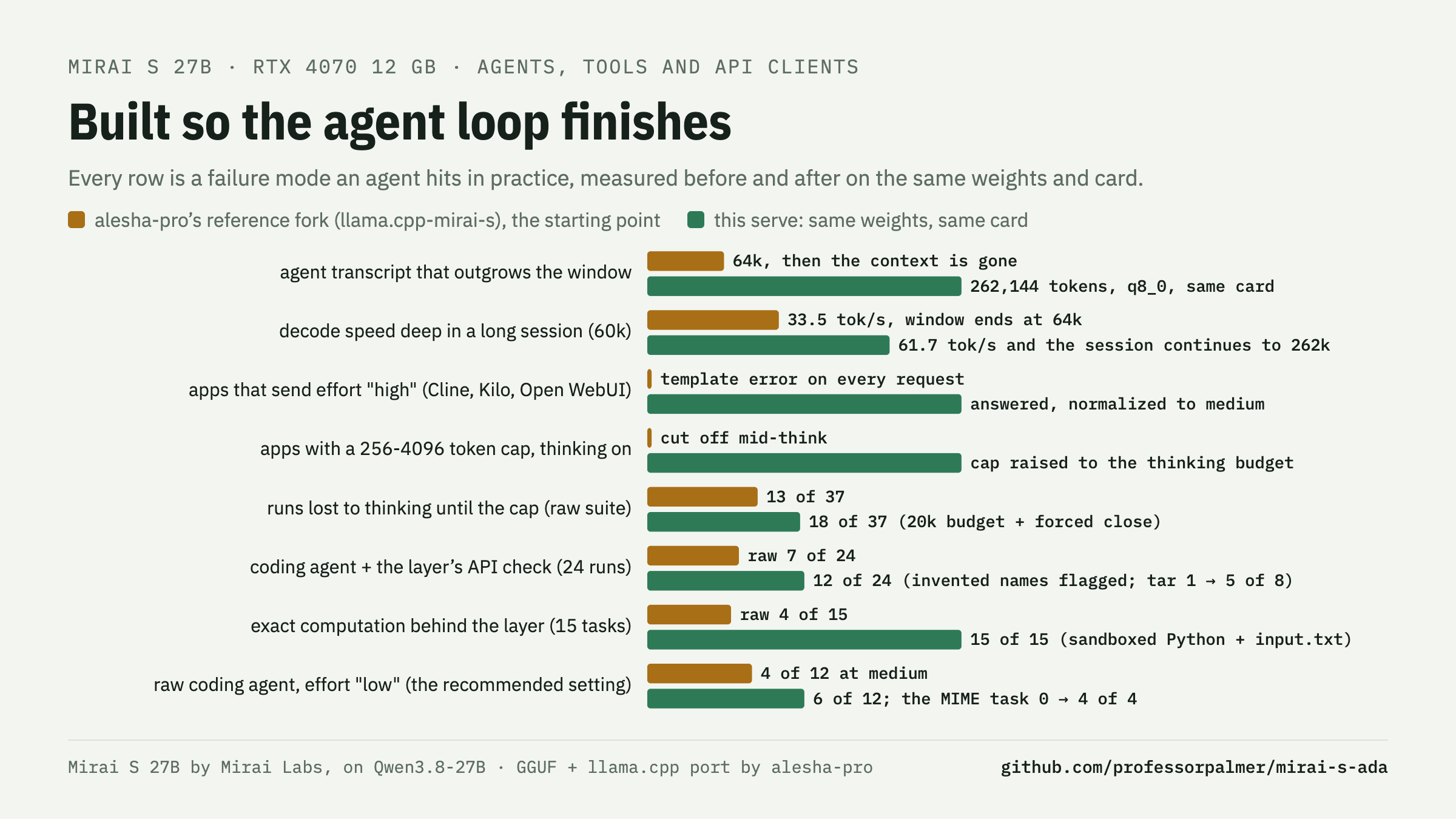
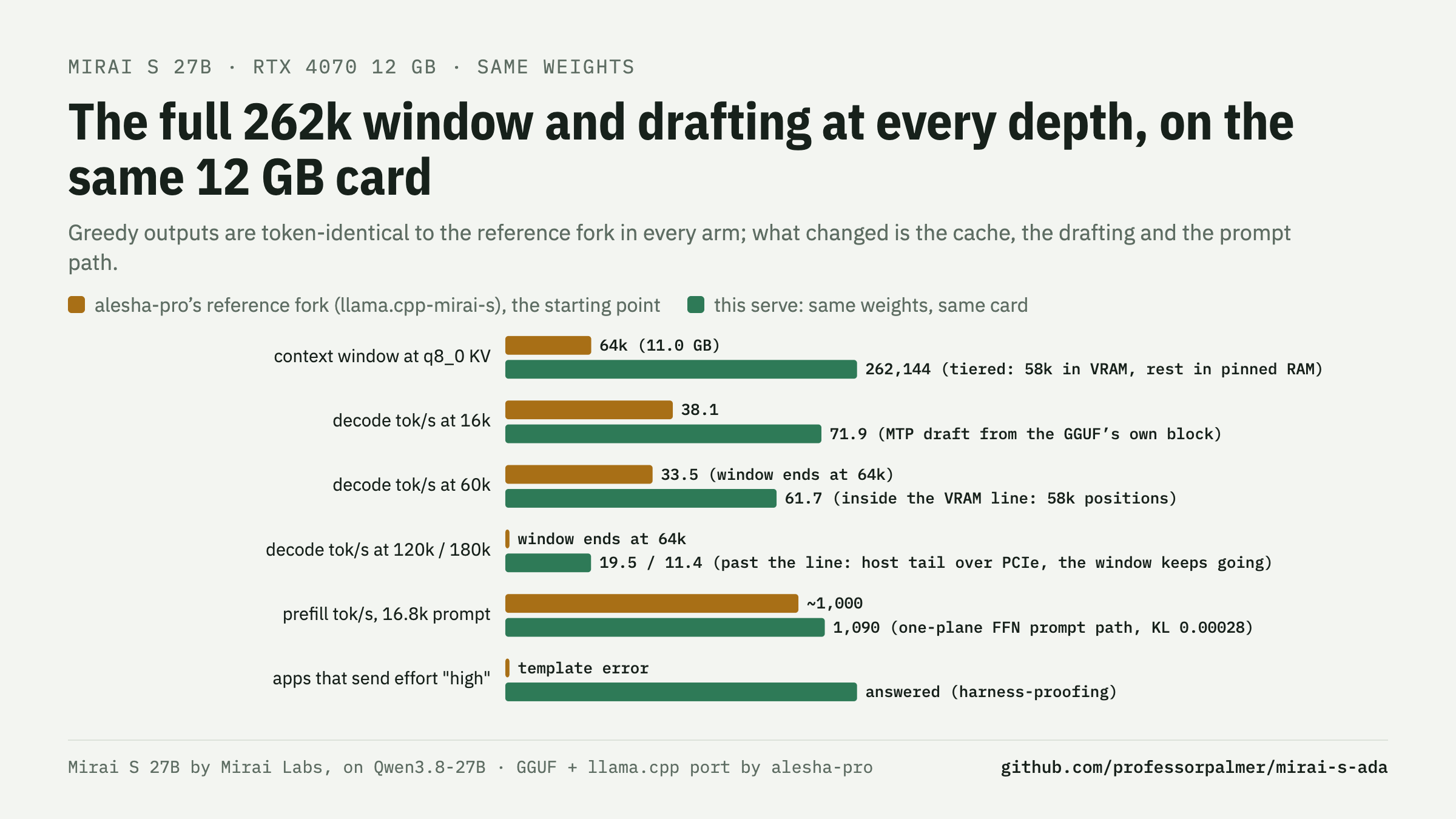
| context window with q8_0 KV | 64k (11.0 GB) | 262,144 (tiered: approximately 58k positions in VRAM, the remainder in pinned RAM) |
| decode, tok/s, at 0 / 16k / 60k / 120k / 180k | 40.0 / 38.1 / 33.5 (60k) / - / - | 76.6 / 72.6 / 61.7 / 19.5 / 11.4 (60k is inside the VRAM line since the evening of 10-06; before that, 40.3) |
| prefill, 16.8k-token prompt | approximately 1,000 | 1,090 (2048 micro-batch mode: 1,148) |
| prefill, 130k-token prompt (cumulative) | - (64k window) | 639 (since bundle-20261008b; before: 509) |
| decode when the answer copies the context (rewrite a 150-line file), tok/s, at 4k / 130k | - | 265.6 / 84.9 (lookup drafting in front of the MTP draft, since bundle-20261008; before: 86.5 / 20.1. New text: 75.7 / 17.3, the same as before. Same output) |
| speculative decoding | none | MTP draft at every depth, outputs identical to drafting off |
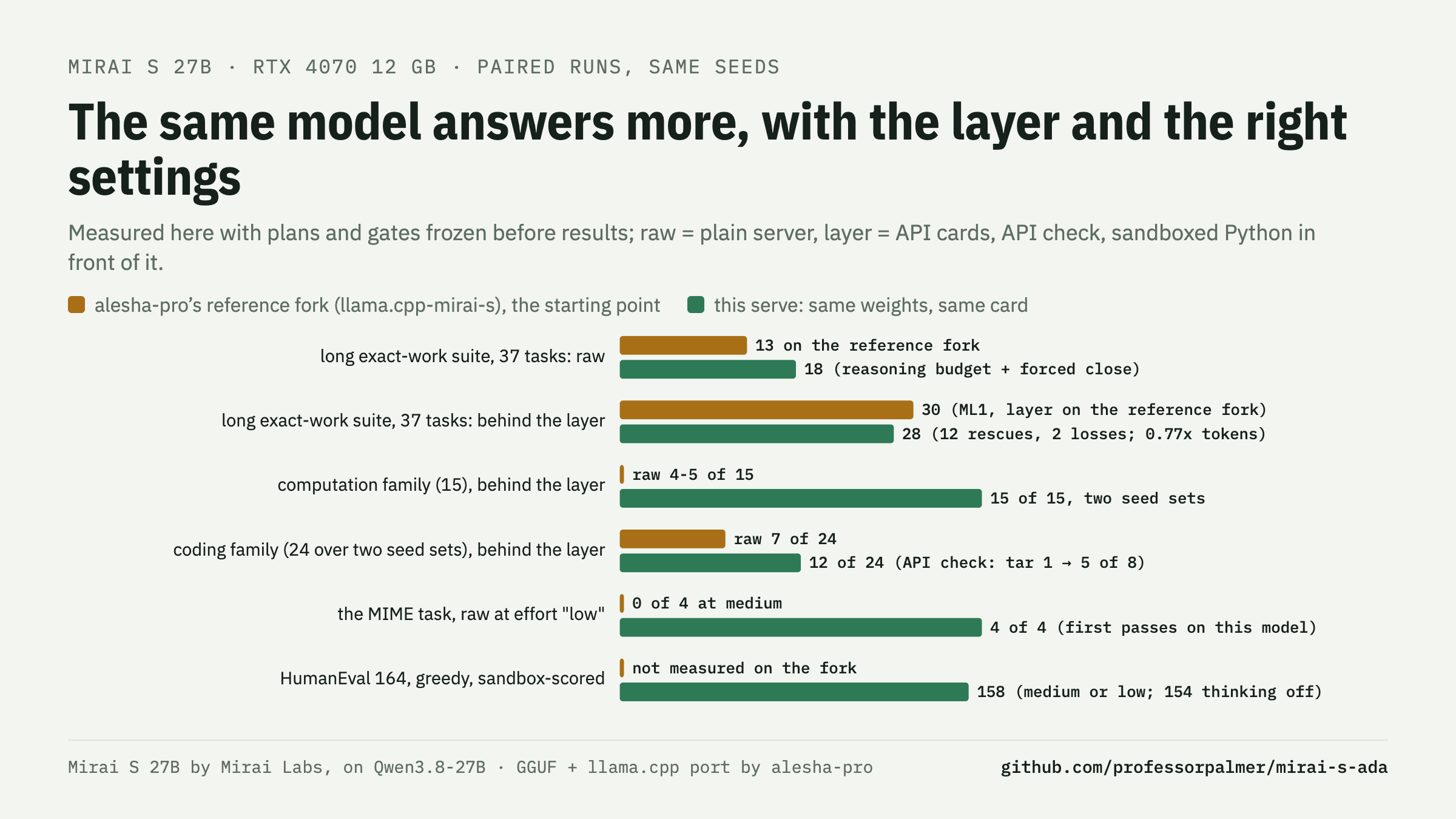
| HumanEval 164, greedy, tests run in a sandbox | 158 at medium or at effort "low"; 154 with thinking off; 160 through the layer with the example check (since bundle-20261009) | |
| long exact-work suite, 37 tasks, raw / through the layer | 13 / 30 (on the reference fork) | 18 / 28 (12 rescues, 2 losses); coding family over two seed sets 7 / 12 of 24, at effort "low" 6 / 8 of 12 |
apps that send effort: "high" | template error on each request | answered (changed to medium) |
The receipts for each row are in receipts/mirai-port/ and bench/. docs/REPORT.md and docs/PREFILL.md tell how
this project got each number and what did not work. The numbers are from 2026-10-05 and 2026-10-06. The
decode-by-depth numbers are from the evening of 10-06 (receipts/mirai-port/decode_by_depth.log). The GDDR6X memory
was at stock clocks. The display was on the integrated GPU of the CPU (refer to
Get more positions into VRAM).
Download mirai-s-bundle-win-x64.zip from Releases. Unzip it into this repository. It fills
bin\. You can also build the binaries (refer to Build from source (Windows)).
The binaries contain sm_89 machine code (RTX 40). They need only the NVIDIA driver.
Download Qwen3.8-27B-S-mirai.gguf from alesha-pro on Hugging Face.
Put it in models\. The MTP draft block is in that file. This project does not graft a draft block.
Optional: make a copy of the GGUF with a smaller draft block. This step takes approximately two minutes on the CPU.
It needs numpy and the engine submodule, or pip install gguf.
python tooling\requant_mtp.py models\Qwen3.8-27B-S-mirai.gguf models\Qwen3.8-27B-S-mirai-mtpq4.gguf
The script requantizes only the MTP draft block, from Q8_0 to Q4_0. All other tensors stay byte-identical. When
the copy is present, the launcher uses it. The copy gives 204 MiB more K/V in VRAM (approximately 6k positions).
The outputs are identical by construction, because speculation is exact. The draft acceptance is 77.7% against
78.2% (receipts/mirai-port/mtp_q4_probe.log).
Optional, one time: run layer\fetch_runtime.ps1. The script downloads the sandbox runtime (CPython 3.12 on WASI,
with checksums) and runs its isolation canaries. Without the runtime, the plain server starts.
Start the server:
.\start-server.ps1
The server gives an OpenAI-compatible API on http://<host>:8080/v1. The bearer key is in
artifacts\api_key.txt. The launcher makes this file on the first run.
The launcher reads the free VRAM. It keeps a safety margin below the point where Windows demotes the memory of a background process. Then it puts as many positions of the 262k cache in VRAM as possible. On this card, that is 57,856 positions headless with the Q4 draft-block copy, and approximately 51k with the published file. The launcher prints the line that it chose.
alesha-pro wrote the Linux launcher, start-server.sh. alesha-pro also checked this procedure on Ubuntu 22.04 with an
RTX 3090, the CUDA 12.8 toolkit, gcc 11.4 and cmake 3.22 (receipts/ubuntu-3090/).
git clone --recurse-submodules https://github.com/professorpalmer/mirai-s-ada && cd mirai-s-ada
cmake -S engine -B build -DCMAKE_BUILD_TYPE=Release -DGGML_CUDA=ON -DLLAMA_CURL=OFF -DCMAKE_CUDA_ARCHITECTURES=native
cmake --build build -j --target llama-server            # approximately 4 min on 32 threads
hf download alesha-pro/Qwen3.8-27B-S-mirai-GGUF --local-dir models
MIRAI_KV_VRAM_CELLS=44000 ./start-server.sh             # raw server on http://127.0.0.1:8080/v1
nvcc or fails, add the paths of a
CUDA 12 or 13 toolkit: -DCUDAToolkit_ROOT=/usr/local/cuda -DCMAKE_CUDA_COMPILER=/usr/local/cuda/bin/nvcc. On the
Ubuntu test computer, an older system nvcc was first on the PATH, and the configure step needed these paths.CMAKE_CUDA_ARCHITECTURES=native compiles for the GPU in the computer. It needs cmake 3.24 or later and a GPU
that the driver can see when you configure. With an older cmake, use the number for your GPU: 75 for RTX 20, 86
for RTX 30, 89 for RTX 40, 120 for RTX 50. Without a value, an older cmake compiles the kernels for all
generations. That build took 17 minutes on the test computer.start-server.sh.start-server.sh starts only the raw server. It uses the same flags and environment as start-server.ps1. It does
not start the layer, and it does not calculate the VRAM line. Set MIRAI_KV_VRAM_CELLS for your card. The
knobs table applies. The script also reads MIRAI_HOST, MIRAI_API_KEY,
MIRAI_MMPROJ (images, with the encoder on the CPU) and MIRAI_CVEC (refer to
Remove refusals).
alesha-pro measured these results on the Ubuntu computer with the 12 GB recipe of the morning of 10-06. The recipe
used 44,000 positions in VRAM and the published GGUF. The card was at 300 W on PCIe 3.0 x16
(receipts/ubuntu-3090/).
| Ubuntu 22.04, RTX 3090 | |
|---|---|
| greedy identity against the reference dumps, thinking off | 5 of 5 |
| thinking on (the 300-token reference is a prefix of the output) | 5 of 5 |
| VRAM at load / peak over a 180k-token prompt | 11,533 / 11,719 MiB |
| decode, tok/s, at 8k / 60k / 120k / 180k | 66.9 / 27.9 / 9.5 / 5.8 |
| prefill, 8k-token prompt | 1,124 tok/s |
| MTP draft acceptance, thinking off / on | 71% / 65% |
Past the VRAM line, this computer is slower than the RTX 4070. At 60k, it decoded 27.9 tok/s. The RTX 4070 decoded 40.3 tok/s at 60k when its line was also at 44-45k. Now the RTX 4070 keeps 60k inside the line (refer to the Results table). This computer reads the tail over PCIe 3.0. That is the probable cause, but this project did not isolate it.
These numbers come from one llama-server command line:
llama-server -m Qwen3.8-27B-S-mirai.gguf -ngl 99 -fa on -c 262144 -np 1 -ctk q8_0 -ctv q8_0 --kv-vram-cells 44000 \
  -b 2048 -ub 1024 --kq-mask-packed \
  --spec-type draft-mtp --spec-draft-n-max 2 --spec-draft-n-max-tail 2 --spec-draft-window 16384 -ctkd q8_0 -ctvd q8_0 \
  --reasoning-effort-allow medium --reasoning-max-tokens-floor 24576 --reasoning-budget 20480 --backend-sampling \
  --chat-template-file templates/bonsai-template.jinja --chat-template-kwargs '{"reasoning_effort":"medium"}' --jinja
The environment also has GGML_CUDA_BATCH_INVARIANT=1 and GGML_MIRAI_PREFILL_PLANES=ffn. start-server.sh sets
both.
alesha-pro measured the refusal direction of the quantized model. alesha-pro published this direction as a 1.3 MB
control vector next to the weights. The engine can remove the direction from the residual stream at run time with
--cvec-mode project. alesha-pro also wrote this engine mode.
Download the vector:
hf download alesha-pro/Qwen3.8-27B-S-mirai-GGUF Qwen3.8-27B-S-mirai-refusal-direction.gguf --local-dir models
Add two arguments to the llama-server command line:
--control-vector-scaled models/Qwen3.8-27B-S-mirai-refusal-direction.gguf:1.0 --cvec-mode project
On Linux, you can set MIRAI_CVEC instead:
MIRAI_CVEC=models/Qwen3.8-27B-S-mirai-refusal-direction.gguf ./start-server.sh. start-server.ps1 does not
pass these arguments yet.
docs/CONTROL-VECTOR.md has the measurements, the method and the caveats of alesha-pro. It
also tells what this repository checked and did not check with the vector. The vector is off if you do not give the
file. This project did not measure the vector on the suite.
127.0.0.1:18080, or the
layer with "api_cards": false): send reasoning_effort: "low". Start the server with
MIRAI_EFFORT_ALLOWED=low,medium, so that the server accepts that value. On the coding family of the suite, raw,
with the same seeds, the result went from 4 to 6 of 12. The MIME task went from 0 to 4 of 4. HumanEval stayed at
158/164. The cost is longer tool loops (+31% completion tokens).MIRAI_SPEC_TYPE=dflash.
Put the Q4_0 DFlash drafter from ggml-org/Qwen3.8-27B-GGUF in models\. Results (E22, three runs): 86 / 78
tok/s at 0 / 16k, against 76 / 72 with the MTP block. The greedy outputs are identical, and the acceptance is 70% at
draft 3. Drafts of 4 or more are slower. The drafter uses approximately 17k of the approximately 58k positions in
VRAM. For this reason, the default keeps the MTP block for long agent sessions.chat_template_kwargs: {"enable_thinking": false} in
each request (HumanEval 154/164 at 0.19x the tokens).| Variable | Default | Function |
|---|---|---|
MIRAI_CTX | 262144 | context window |
MIRAI_CTK | q8_0 | K/V cache type |
MIRAI_TIER | 1 | 0 = all-VRAM cache (then a 64k window) |
MIRAI_KV_VRAM_CELLS | auto | sets a fixed VRAM line |
MIRAI_VRAM_MARGIN | 800 headless, 1300 with the display on this card | MiB that stay free below the demotion point |
MIRAI_SPEC / MIRAI_SPEC_DEEP | 2 / 2 (3 with dflash) | draft size, and draft size past the VRAM line |
MIRAI_SPEC_TYPE / MIRAI_DRAFTER | mtp / models\dflash-Qwen3.8-27B-Q4_0.gguf | dflash drafts with the DFlash drafter of ggml-org, not with the MTP block of the GGUF: +13% decode at depth 0, +8.5% at 16k, outputs identical, approximately 590 MiB more VRAM (approximately 17k fewer positions in VRAM). Download the drafter from ggml-org/Qwen3.8-27B-GGUF into models\ |
MIRAI_DRAFT_WINDOW | 16384 | rows that the draft block keeps |
MIRAI_LOOKUP / MIRAI_LOOKUP_N | ngram-mod / 32 | lookup drafter in front of the draft block: it drafts text that is already in the context (file rewrites, edit calls, quoted logs), up to N tokens at a time; the draft block drafts when it finds no match. 0 = off. Not used with dflash |
MIRAI_SPEC_ARGS | none | more drafter flags, passed to the server as they are |
MIRAI_EFFORT / MIRAI_EFFORT_ALLOWED | medium / medium | default effort of the server; effort words that the template gets (the server changes other words to medium) |
MIRAI_THINK / MIRAI_THINK_BUDGET | 1 / 20480 | thinking on; tokens before a forced close |
MIRAI_HARNESS_PROOF | 1 | 0 = do not change effort words and output caps |
MIRAI_PREFILL_PLANES | ffn | numerics for prompt tokens: ffn (one int8 plane for the FFN matmuls, +18% prefill, KL 0.00028), 2 exact, 1 one plane for all matmuls |
MIRAI_KQ_MASK_PACKED / MIRAI_UBATCH | 1 / 1024 | 1-bit attention mask; micro-batch (2048 = +5.6% prefill for approximately 570 MiB of VRAM) |
MIRAI_LEVELS_MIB | 128 | memory size of the level-decode chunk for long prompts |
MIRAI_SHARED_POOL | 1 | one transient CUDA pool for the target and draft contexts, with a 256-token draft micro-batch: gives back 188 MiB of VRAM (approximately 5.7k positions); outputs, decode and acceptance do not change (E23); 0 disables it |
MIRAI_LAYER | 1 | 0 = no layer |
MIRAI_STDERR_FILE / MIRAI_RESTARTS | none / 3 | file that keeps the raw stderr of the server (assert text); number of restarts after an abort before the launcher stops |
MIRAI_PORT, MIRAI_MODEL, MIRAI_LOG_FILE | 8080, auto, none | model: models\Qwen3.8-27B-S-mirai-mtpq4.gguf if present, else the published file |
Each GB of VRAM that the desktop does not use gives approximately 30k more q8_0 positions at full speed. To get this VRAM:
The launcher margin then decreases from 1300 MiB to 800 MiB headless.
Past the line, each step reads the host tail over PCIe. In that range, drafting gives 2.2x the speed of no drafting.
MIRAI_SPEC=0 moves the line to approximately 80k positions. But below the line, you then lose the 1.85x gain from
drafting (docs/REPORT.md, sections 5b and 6e).
docs/PREFILL.md). Each of the remaining options
gives only a few percent.MIRAI_CTK=q4_0) puts approximately two times the positions in
VRAM. This project did not measure its quality cost on this model. Thus it is a knob and not a default.-np 1). The reference fork also requires one slot for this model.start-server.ps1 (Windows) calculates the VRAM line and starts the layer. start-server.sh
(Linux) starts the raw server with the line that you give. On Linux, the layer is not connected or tested.MIRAI_EFFORT_ALLOWED=low,medium. The server
does not silently accept or reject the effort of a request. It maps the effort, and the server log records the
change.MIRAI_PREFILL_PLANES=2 gives the exact path at -18%
prefill.docs/REPORT.md,
determinism probe).docs/REPORT.md 6e). Now the launcher monitors the server:
MIRAI_RESTARTS times (default 3) in ten minutes.MIRAI_STDERR_FILE=logs\product.stderr, it keeps the raw stderr of the server. An assert prints its text
there.logs\product.log. If you set
MIRAI_STDERR_FILE, also attach logs\product.stderr.Run these commands to repeat the measurements:
python bench\compare_servers.py --base http://127.0.0.1:18080 --against receipts\mirai-port\stock-greedy-nothink.json   # greedy identity against alesha-pro's reference fork
bash bench\product_smoke.sh                                   # identity, layer round trip, decode by depth
bash bench\prefill_probe.sh                                   # prefill by prompt length
python suite\run_suite.py --base http://127.0.0.1:18080 --base-b http://127.0.0.1:8080 --out suite-out   # the paired suite
python bench\humaneval_wasi.py --arm medium                    # HumanEval 164, scored in a sandbox
python bench\determinism_probe.py                             # same request and seed, seven conditions
| Path | Contents |
|---|---|
engine/ | Submodule: professorpalmer/llama.cpp-ada-mirai. The PrismML llama.cpp fork with these additions: the serving patches (tiered KV cache, draft window and tail, reasoning flags, batch-invariant kernels, op timing); the Mirai S codec as alesha-pro ported it to ggml (ggml types 90-93, CPU and CUDA kernels, rotation and scale tensors, split attention gate, graph hook); the prefill work of this project (one-plane FFN prompt numerics, packed 1-bit KQ mask, level-decode chunks). |
start-server.ps1 | The Windows launcher. It calculates the VRAM line from measured fixed costs and starts the layer in front of llama-server. |
start-server.sh | The Linux launcher, from alesha-pro. It starts the raw server with the same flags. Optional: images (MIRAI_MMPROJ) and the refusal-direction vector (MIRAI_CVEC, docs/CONTROL-VECTOR.md). |
tooling/ | build_engine.bat (Ninja + pip CUDA 13, sm_89), install_bin.ps1, serve.ps1 / stop.ps1 (hidden test server, log and PID files). |
layer/, suite/ | The layer and the long exact-work suite, from bonsai-ada-surgery, with the changes of this project (layer/ORIGIN.md). |
bench/ | The measurement scripts, and the scoreboard and results of each run (ML1..ML2f, E18..E21, HumanEval arms). |
receipts/ | Small text receipts that the documents refer to: profiles, greedy dumps from alesha-pro's reference fork, probe logs. ubuntu-3090/ is the Linux check of alesha-pro (RTX 3090). |
templates/bonsai-template.jinja | The chat template for all measurements (reasoning_effort, thinking on/off). |
docs/REPORT.md, docs/PREFILL.md, docs/ROADMAP.md, docs/CONTROL-VECTOR.md | The findings, the prefill investigation, the remaining work, and the run-time refusal removal of alesha-pro. |
You need the C++ workload of VS 2022 Build Tools and the NVIDIA pip wheels. You do not need the CUDA toolkit. For Linux, refer to Quick start (Linux).
python -m pip install cmake ninja nvidia-cuda-nvcc nvidia-cuda-runtime nvidia-cublas nvidia-cuda-nvrtc
git clone --recurse-submodules https://github.com/professorpalmer/mirai-s-ada
cd mirai-s-ada
tooling\build_engine.bat llama-server      # approximately 30 min the first time
tooling\install_bin.ps1                      # copies the result into bin\ next to the CUDA runtime DLLs
engine/): llama.cpp is MIT (the ggml authors). The PrismML fork and the alesha-pro fork are also MIT.
The engine tree keeps their notices. The Mirai S codec is the work of Mirai Labs. The ggml and CUDA kernels for the
codec in the engine come from the port by alesha-pro. The commit history and engine/README.md record this
attribution.trymirai/Qwen3.8-27B-S-experimental from Mirai Labs,
a quantization of Qwen3.8-27B from Alibaba. Qwen3.8-27B-S-mirai-GGUF is the community conversion of that model by
alesha-pro. Its license is on its Hugging Face card (Apache 2.0, the same as Qwen3.8). Download the GGUF from there
and keep its notices.Mirai S (Qwen3.8-27B-S trellis GGUF) on a 12 GB RTX 4070: 262k q8_0 tiered cache, MTP drafting at every depth, harness-proofing, the layer; receipts.
Python
89
43 commits
updated Oct 10, 2026
This repository serves Mirai S 27B on one RTX 4070 with 12 GB of VRAM.
Mirai S is a version of Qwen3.8-27B from Mirai Labs. Mirai Labs compressed the model with their trellis codec to approximately 2.4 bits of information for each weight. alesha-pro converted the model to GGUF (11.17 GB) and ported the Mirai S codec to llama.cpp.
This serve adds these items:
effort: "high" or very small output caps.docs/HYPERQWEN.md.The weights are the same as the published weights. Before all other measurements, this project checked each kernel against alesha-pro's reference fork, greedy and token for token. This repository does not replace the work of Mirai Labs or alesha-pro. It is a serving layer on that work: it adds the cache, the drafting, the server flags and the measurements that a 12 GB card needs.
| Contribution | By |
|---|---|
The model Qwen3.8-27B-S-experimental, the Mirai S trellis codec and the vLLM plugin with the original CUDA kernels | Mirai Labs |
| The base model Qwen3.8-27B and the vision encoder | Qwen (Alibaba) |
The GGUF conversion, Qwen3.8-27B-S-mirai-GGUF. The trellis codes are copied bit for bit. | alesha-pro |
The port of the Mirai S codec to llama.cpp and ggml (types 90-93, CPU and CUDA kernels), in the reference fork llama.cpp-mirai-s. This serve started from that fork and checks its outputs against it. | alesha-pro |
The refusal-direction control vector and the --cvec-mode project engine mode (refer to Remove refusals) | alesha-pro |
The Linux launcher start-server.sh and the Linux check on an RTX 3090 (refer to Quick start (Linux)) | alesha-pro |
| The llama.cpp fork that the engine uses | PrismML |
| The planar activation layout and the batch-invariant mode (PrismML PR #218, in the engine with the original authorship) | sudoingX |
| llama.cpp and ggml | the ggml authors (ggml-org) |
The optional DFlash drafter, ggml-org/Qwen3.8-27B-GGUF | ggml-org |
| The tiered KV cache, drafting at every depth, harness-proofing, the prefill work, the launcher for Windows, the layer, the suite and the measurements | Cary Palmer (this repository) |
The table compares alesha-pro's reference fork with this serve. Both ran on the same RTX 4070 12 GB with one slot.
| RTX 4070 12 GB, served, one slot | alesha-pro's reference fork (llama.cpp-mirai-s, the starting point) | this serve |
|---|---|---|
| context window with q8_0 KV | 64k (11.0 GB) | 262,144 (tiered: approximately 58k positions in VRAM, the remainder in pinned RAM) |
| decode, tok/s, at 0 / 16k / 60k / 120k / 180k | 40.0 / 38.1 / 33.5 (60k) / - / - | 76.6 / 72.6 / 61.7 / 19.5 / 11.4 (60k is inside the VRAM line since the evening of 10-06; before that, 40.3) |
| prefill, 16.8k-token prompt | approximately 1,000 | 1,090 (2048 micro-batch mode: 1,148) |
| prefill, 130k-token prompt (cumulative) | - (64k window) | 639 (since bundle-20261008b; before: 509) |
| decode when the answer copies the context (rewrite a 150-line file), tok/s, at 4k / 130k | - | 265.6 / 84.9 (lookup drafting in front of the MTP draft, since bundle-20261008; before: 86.5 / 20.1. New text: 75.7 / 17.3, the same as before. Same output) |
| speculative decoding | none | MTP draft at every depth, outputs identical to drafting off |
| HumanEval 164, greedy, tests run in a sandbox | 158 at medium or at effort "low"; 154 with thinking off; 160 through the layer with the example check (since bundle-20261009) | |
| long exact-work suite, 37 tasks, raw / through the layer | 13 / 30 (on the reference fork) | 18 / 28 (12 rescues, 2 losses); coding family over two seed sets 7 / 12 of 24, at effort "low" 6 / 8 of 12 |
apps that send effort: "high" | template error on each request | answered (changed to medium) |
The receipts for each row are in receipts/mirai-port/ and bench/. docs/REPORT.md and docs/PREFILL.md tell how
this project got each number and what did not work. The numbers are from 2026-10-05 and 2026-10-06. The
decode-by-depth numbers are from the evening of 10-06 (receipts/mirai-port/decode_by_depth.log). The GDDR6X memory
was at stock clocks. The display was on the integrated GPU of the CPU (refer to
Get more positions into VRAM).
Download mirai-s-bundle-win-x64.zip from Releases. Unzip it into this repository. It fills
bin\. You can also build the binaries (refer to Build from source (Windows)).
The binaries contain sm_89 machine code (RTX 40). They need only the NVIDIA driver.
Download Qwen3.8-27B-S-mirai.gguf from alesha-pro on Hugging Face.
Put it in models\. The MTP draft block is in that file. This project does not graft a draft block.
Optional: make a copy of the GGUF with a smaller draft block. This step takes approximately two minutes on the CPU.
It needs numpy and the engine submodule, or pip install gguf.
python tooling\requant_mtp.py models\Qwen3.8-27B-S-mirai.gguf models\Qwen3.8-27B-S-mirai-mtpq4.gguf
The script requantizes only the MTP draft block, from Q8_0 to Q4_0. All other tensors stay byte-identical. When
the copy is present, the launcher uses it. The copy gives 204 MiB more K/V in VRAM (approximately 6k positions).
The outputs are identical by construction, because speculation is exact. The draft acceptance is 77.7% against
78.2% (receipts/mirai-port/mtp_q4_probe.log).
Optional, one time: run layer\fetch_runtime.ps1. The script downloads the sandbox runtime (CPython 3.12 on WASI,
with checksums) and runs its isolation canaries. Without the runtime, the plain server starts.
Start the server:
.\start-server.ps1
The server gives an OpenAI-compatible API on http://<host>:8080/v1. The bearer key is in
artifacts\api_key.txt. The launcher makes this file on the first run.
The launcher reads the free VRAM. It keeps a safety margin below the point where Windows demotes the memory of a background process. Then it puts as many positions of the 262k cache in VRAM as possible. On this card, that is 57,856 positions headless with the Q4 draft-block copy, and approximately 51k with the published file. The launcher prints the line that it chose.
alesha-pro wrote the Linux launcher, start-server.sh. alesha-pro also checked this procedure on Ubuntu 22.04 with an
RTX 3090, the CUDA 12.8 toolkit, gcc 11.4 and cmake 3.22 (receipts/ubuntu-3090/).
git clone --recurse-submodules https://github.com/professorpalmer/mirai-s-ada && cd mirai-s-ada
cmake -S engine -B build -DCMAKE_BUILD_TYPE=Release -DGGML_CUDA=ON -DLLAMA_CURL=OFF -DCMAKE_CUDA_ARCHITECTURES=native
cmake --build build -j --target llama-server            # approximately 4 min on 32 threads
hf download alesha-pro/Qwen3.8-27B-S-mirai-GGUF --local-dir models
MIRAI_KV_VRAM_CELLS=44000 ./start-server.sh             # raw server on http://127.0.0.1:8080/v1
nvcc or fails, add the paths of a
CUDA 12 or 13 toolkit: -DCUDAToolkit_ROOT=/usr/local/cuda -DCMAKE_CUDA_COMPILER=/usr/local/cuda/bin/nvcc. On the
Ubuntu test computer, an older system nvcc was first on the PATH, and the configure step needed these paths.CMAKE_CUDA_ARCHITECTURES=native compiles for the GPU in the computer. It needs cmake 3.24 or later and a GPU
that the driver can see when you configure. With an older cmake, use the number for your GPU: 75 for RTX 20, 86
for RTX 30, 89 for RTX 40, 120 for RTX 50. Without a value, an older cmake compiles the kernels for all
generations. That build took 17 minutes on the test computer.start-server.sh.start-server.sh starts only the raw server. It uses the same flags and environment as start-server.ps1. It does
not start the layer, and it does not calculate the VRAM line. Set MIRAI_KV_VRAM_CELLS for your card. The
knobs table applies. The script also reads MIRAI_HOST, MIRAI_API_KEY,
MIRAI_MMPROJ (images, with the encoder on the CPU) and MIRAI_CVEC (refer to
Remove refusals).
alesha-pro measured these results on the Ubuntu computer with the 12 GB recipe of the morning of 10-06. The recipe
used 44,000 positions in VRAM and the published GGUF. The card was at 300 W on PCIe 3.0 x16
(receipts/ubuntu-3090/).
| Ubuntu 22.04, RTX 3090 | |
|---|---|
| greedy identity against the reference dumps, thinking off | 5 of 5 |
| thinking on (the 300-token reference is a prefix of the output) | 5 of 5 |
| VRAM at load / peak over a 180k-token prompt | 11,533 / 11,719 MiB |
| decode, tok/s, at 8k / 60k / 120k / 180k | 66.9 / 27.9 / 9.5 / 5.8 |
| prefill, 8k-token prompt | 1,124 tok/s |
| MTP draft acceptance, thinking off / on | 71% / 65% |
Past the VRAM line, this computer is slower than the RTX 4070. At 60k, it decoded 27.9 tok/s. The RTX 4070 decoded 40.3 tok/s at 60k when its line was also at 44-45k. Now the RTX 4070 keeps 60k inside the line (refer to the Results table). This computer reads the tail over PCIe 3.0. That is the probable cause, but this project did not isolate it.
These numbers come from one llama-server command line:
llama-server -m Qwen3.8-27B-S-mirai.gguf -ngl 99 -fa on -c 262144 -np 1 -ctk q8_0 -ctv q8_0 --kv-vram-cells 44000 \
  -b 2048 -ub 1024 --kq-mask-packed \
  --spec-type draft-mtp --spec-draft-n-max 2 --spec-draft-n-max-tail 2 --spec-draft-window 16384 -ctkd q8_0 -ctvd q8_0 \
  --reasoning-effort-allow medium --reasoning-max-tokens-floor 24576 --reasoning-budget 20480 --backend-sampling \
  --chat-template-file templates/bonsai-template.jinja --chat-template-kwargs '{"reasoning_effort":"medium"}' --jinja
The environment also has GGML_CUDA_BATCH_INVARIANT=1 and GGML_MIRAI_PREFILL_PLANES=ffn. start-server.sh sets
both.
alesha-pro measured the refusal direction of the quantized model. alesha-pro published this direction as a 1.3 MB
control vector next to the weights. The engine can remove the direction from the residual stream at run time with
--cvec-mode project. alesha-pro also wrote this engine mode.
Download the vector:
hf download alesha-pro/Qwen3.8-27B-S-mirai-GGUF Qwen3.8-27B-S-mirai-refusal-direction.gguf --local-dir models
Add two arguments to the llama-server command line:
--control-vector-scaled models/Qwen3.8-27B-S-mirai-refusal-direction.gguf:1.0 --cvec-mode project
On Linux, you can set MIRAI_CVEC instead:
MIRAI_CVEC=models/Qwen3.8-27B-S-mirai-refusal-direction.gguf ./start-server.sh. start-server.ps1 does not
pass these arguments yet.
docs/CONTROL-VECTOR.md has the measurements, the method and the caveats of alesha-pro. It
also tells what this repository checked and did not check with the vector. The vector is off if you do not give the
file. This project did not measure the vector on the suite.
127.0.0.1:18080, or the
layer with "api_cards": false): send reasoning_effort: "low". Start the server with
MIRAI_EFFORT_ALLOWED=low,medium, so that the server accepts that value. On the coding family of the suite, raw,
with the same seeds, the result went from 4 to 6 of 12. The MIME task went from 0 to 4 of 4. HumanEval stayed at
158/164. The cost is longer tool loops (+31% completion tokens).MIRAI_SPEC_TYPE=dflash.
Put the Q4_0 DFlash drafter from ggml-org/Qwen3.8-27B-GGUF in models\. Results (E22, three runs): 86 / 78
tok/s at 0 / 16k, against 76 / 72 with the MTP block. The greedy outputs are identical, and the acceptance is 70% at
draft 3. Drafts of 4 or more are slower. The drafter uses approximately 17k of the approximately 58k positions in
VRAM. For this reason, the default keeps the MTP block for long agent sessions.chat_template_kwargs: {"enable_thinking": false} in
each request (HumanEval 154/164 at 0.19x the tokens).| Variable | Default | Function |
|---|---|---|
MIRAI_CTX | 262144 | context window |
MIRAI_CTK | q8_0 | K/V cache type |
MIRAI_TIER | 1 | 0 = all-VRAM cache (then a 64k window) |
MIRAI_KV_VRAM_CELLS | auto | sets a fixed VRAM line |
MIRAI_VRAM_MARGIN | 800 headless, 1300 with the display on this card | MiB that stay free below the demotion point |
MIRAI_SPEC / MIRAI_SPEC_DEEP | 2 / 2 (3 with dflash) | draft size, and draft size past the VRAM line |
MIRAI_SPEC_TYPE / MIRAI_DRAFTER | mtp / models\dflash-Qwen3.8-27B-Q4_0.gguf | dflash drafts with the DFlash drafter of ggml-org, not with the MTP block of the GGUF: +13% decode at depth 0, +8.5% at 16k, outputs identical, approximately 590 MiB more VRAM (approximately 17k fewer positions in VRAM). Download the drafter from ggml-org/Qwen3.8-27B-GGUF into models\ |
MIRAI_DRAFT_WINDOW | 16384 | rows that the draft block keeps |
MIRAI_LOOKUP / MIRAI_LOOKUP_N | ngram-mod / 32 | lookup drafter in front of the draft block: it drafts text that is already in the context (file rewrites, edit calls, quoted logs), up to N tokens at a time; the draft block drafts when it finds no match. 0 = off. Not used with dflash |
MIRAI_SPEC_ARGS | none | more drafter flags, passed to the server as they are |
MIRAI_EFFORT / MIRAI_EFFORT_ALLOWED | medium / medium | default effort of the server; effort words that the template gets (the server changes other words to medium) |
MIRAI_THINK / MIRAI_THINK_BUDGET | 1 / 20480 | thinking on; tokens before a forced close |
MIRAI_HARNESS_PROOF | 1 | 0 = do not change effort words and output caps |
MIRAI_PREFILL_PLANES | ffn | numerics for prompt tokens: ffn (one int8 plane for the FFN matmuls, +18% prefill, KL 0.00028), 2 exact, 1 one plane for all matmuls |
MIRAI_KQ_MASK_PACKED / MIRAI_UBATCH | 1 / 1024 | 1-bit attention mask; micro-batch (2048 = +5.6% prefill for approximately 570 MiB of VRAM) |
MIRAI_LEVELS_MIB | 128 | memory size of the level-decode chunk for long prompts |
MIRAI_SHARED_POOL | 1 | one transient CUDA pool for the target and draft contexts, with a 256-token draft micro-batch: gives back 188 MiB of VRAM (approximately 5.7k positions); outputs, decode and acceptance do not change (E23); 0 disables it |
MIRAI_LAYER | 1 | 0 = no layer |
MIRAI_STDERR_FILE / MIRAI_RESTARTS | none / 3 | file that keeps the raw stderr of the server (assert text); number of restarts after an abort before the launcher stops |
MIRAI_PORT, MIRAI_MODEL, MIRAI_LOG_FILE | 8080, auto, none | model: models\Qwen3.8-27B-S-mirai-mtpq4.gguf if present, else the published file |
Each GB of VRAM that the desktop does not use gives approximately 30k more q8_0 positions at full speed. To get this VRAM:
The launcher margin then decreases from 1300 MiB to 800 MiB headless.
Past the line, each step reads the host tail over PCIe. In that range, drafting gives 2.2x the speed of no drafting.
MIRAI_SPEC=0 moves the line to approximately 80k positions. But below the line, you then lose the 1.85x gain from
drafting (docs/REPORT.md, sections 5b and 6e).
docs/PREFILL.md). Each of the remaining options
gives only a few percent.MIRAI_CTK=q4_0) puts approximately two times the positions in
VRAM. This project did not measure its quality cost on this model. Thus it is a knob and not a default.-np 1). The reference fork also requires one slot for this model.start-server.ps1 (Windows) calculates the VRAM line and starts the layer. start-server.sh
(Linux) starts the raw server with the line that you give. On Linux, the layer is not connected or tested.MIRAI_EFFORT_ALLOWED=low,medium. The server
does not silently accept or reject the effort of a request. It maps the effort, and the server log records the
change.MIRAI_PREFILL_PLANES=2 gives the exact path at -18%
prefill.docs/REPORT.md,
determinism probe).docs/REPORT.md 6e). Now the launcher monitors the server:
MIRAI_RESTARTS times (default 3) in ten minutes.MIRAI_STDERR_FILE=logs\product.stderr, it keeps the raw stderr of the server. An assert prints its text
there.logs\product.log. If you set
MIRAI_STDERR_FILE, also attach logs\product.stderr.Run these commands to repeat the measurements:
python bench\compare_servers.py --base http://127.0.0.1:18080 --against receipts\mirai-port\stock-greedy-nothink.json   # greedy identity against alesha-pro's reference fork
bash bench\product_smoke.sh                                   # identity, layer round trip, decode by depth
bash bench\prefill_probe.sh                                   # prefill by prompt length
python suite\run_suite.py --base http://127.0.0.1:18080 --base-b http://127.0.0.1:8080 --out suite-out   # the paired suite
python bench\humaneval_wasi.py --arm medium                    # HumanEval 164, scored in a sandbox
python bench\determinism_probe.py                             # same request and seed, seven conditions
| Path | Contents |
|---|---|
engine/ | Submodule: professorpalmer/llama.cpp-ada-mirai. The PrismML llama.cpp fork with these additions: the serving patches (tiered KV cache, draft window and tail, reasoning flags, batch-invariant kernels, op timing); the Mirai S codec as alesha-pro ported it to ggml (ggml types 90-93, CPU and CUDA kernels, rotation and scale tensors, split attention gate, graph hook); the prefill work of this project (one-plane FFN prompt numerics, packed 1-bit KQ mask, level-decode chunks). |
start-server.ps1 | The Windows launcher. It calculates the VRAM line from measured fixed costs and starts the layer in front of llama-server. |
start-server.sh | The Linux launcher, from alesha-pro. It starts the raw server with the same flags. Optional: images (MIRAI_MMPROJ) and the refusal-direction vector (MIRAI_CVEC, docs/CONTROL-VECTOR.md). |
tooling/ | build_engine.bat (Ninja + pip CUDA 13, sm_89), install_bin.ps1, serve.ps1 / stop.ps1 (hidden test server, log and PID files). |
layer/, suite/ | The layer and the long exact-work suite, from bonsai-ada-surgery, with the changes of this project (layer/ORIGIN.md). |
bench/ | The measurement scripts, and the scoreboard and results of each run (ML1..ML2f, E18..E21, HumanEval arms). |
receipts/ | Small text receipts that the documents refer to: profiles, greedy dumps from alesha-pro's reference fork, probe logs. ubuntu-3090/ is the Linux check of alesha-pro (RTX 3090). |
templates/bonsai-template.jinja | The chat template for all measurements (reasoning_effort, thinking on/off). |
docs/REPORT.md, docs/PREFILL.md, docs/ROADMAP.md, docs/CONTROL-VECTOR.md | The findings, the prefill investigation, the remaining work, and the run-time refusal removal of alesha-pro. |
You need the C++ workload of VS 2022 Build Tools and the NVIDIA pip wheels. You do not need the CUDA toolkit. For Linux, refer to Quick start (Linux).
python -m pip install cmake ninja nvidia-cuda-nvcc nvidia-cuda-runtime nvidia-cublas nvidia-cuda-nvrtc
git clone --recurse-submodules https://github.com/professorpalmer/mirai-s-ada
cd mirai-s-ada
tooling\build_engine.bat llama-server      # approximately 30 min the first time
tooling\install_bin.ps1                      # copies the result into bin\ next to the CUDA runtime DLLs
engine/): llama.cpp is MIT (the ggml authors). The PrismML fork and the alesha-pro fork are also MIT.
The engine tree keeps their notices. The Mirai S codec is the work of Mirai Labs. The ggml and CUDA kernels for the
codec in the engine come from the port by alesha-pro. The commit history and engine/README.md record this
attribution.trymirai/Qwen3.8-27B-S-experimental from Mirai Labs,
a quantization of Qwen3.8-27B from Alibaba. Qwen3.8-27B-S-mirai-GGUF is the community conversion of that model by
alesha-pro. Its license is on its Hugging Face card (Apache 2.0, the same as Qwen3.8). Download the GGUF from there
and keep its notices.


