[ICCV25 Highlight] The official implementation of the paper "LEGION: Learning to Ground and Explain for Synthetic Image Detection"
See the codeHengrui Kang*, Siwei Wen*, Zichen Wen*, Junyan Ye, Weijia Li†
Peilin Feng, Baichuan Zhou, Bin Wang, Dahua Lin, Linfeng Zhang, Conghui He†



 Overview
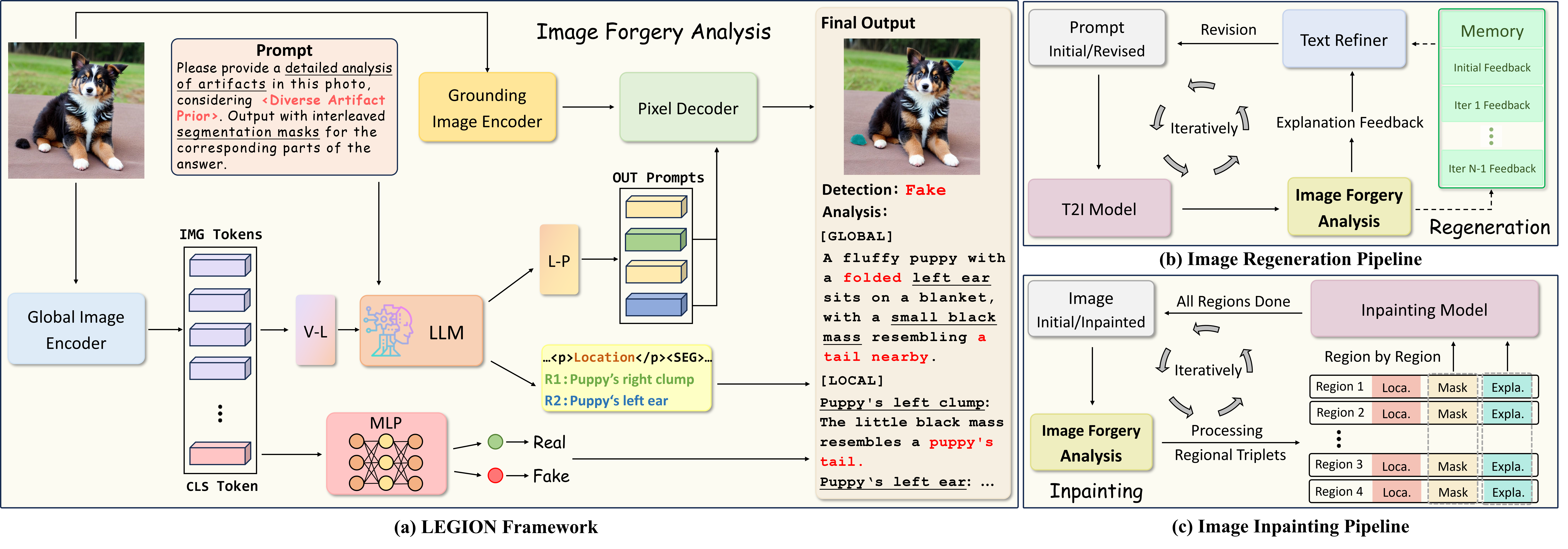
The rapid advancements in generative technology have emerged as a double-edged sword. While offering powerful tools that enhance convenience, they also pose significant social concerns. As defenders, current synthetic image detection methods often lack artifact-level textual interpretability and are overly focused on image manipulation detection, and current datasets usually suffer from outdated generators and a lack of fine-grained annotations. In this paper, we introduce SynthScars, a high-quality and diverse dataset consisting of 12,236 fully synthetic images with human-expert annotations. It features 4 distinct image content types, 3 categories of artifacts, and fine-grained annotations covering pixel-level segmentation, detailed textual explanations, and artifact category labels. Furthermore, we propose LEGION (LEarning to Ground and explain for Synthetic Image detectiON), a multimodal large language model (MLLM)-based image forgery analysis framework that integrates artifact detection, segmentation, and explanation. Building upon this capability, we further explore LEGION as a controller, integrating it into image refinement pipelines to guide the generation of higher-quality and more realistic images. Extensive experiments show that LEGION outperforms existing methods across multiple benchmarks, particularly surpassing the second-best traditional expert on SynthScars by 3.31% in mIoU and 7.75% in F1 score. Moreover, the refined images generated under its guidance exhibit stronger alignment with human preferences. The code, model, and dataset will be released.
Please clone our repository and change directory to the folder:
git clone [email protected]:opendatalab/LEGION.git
cd LEGION
Our model is based on the GLaMM environment. Please follow the steps below to configure the environment.
conda create -n legion python=3.10
conda activate legion
pip install -r requirements/default.txt

# Install mmcv
git clone https://github.com/open-mmlab/mmcv
cd mmcv
git checkout v1.4.7
MMCV_WITH_OPS=1 pip install -e .
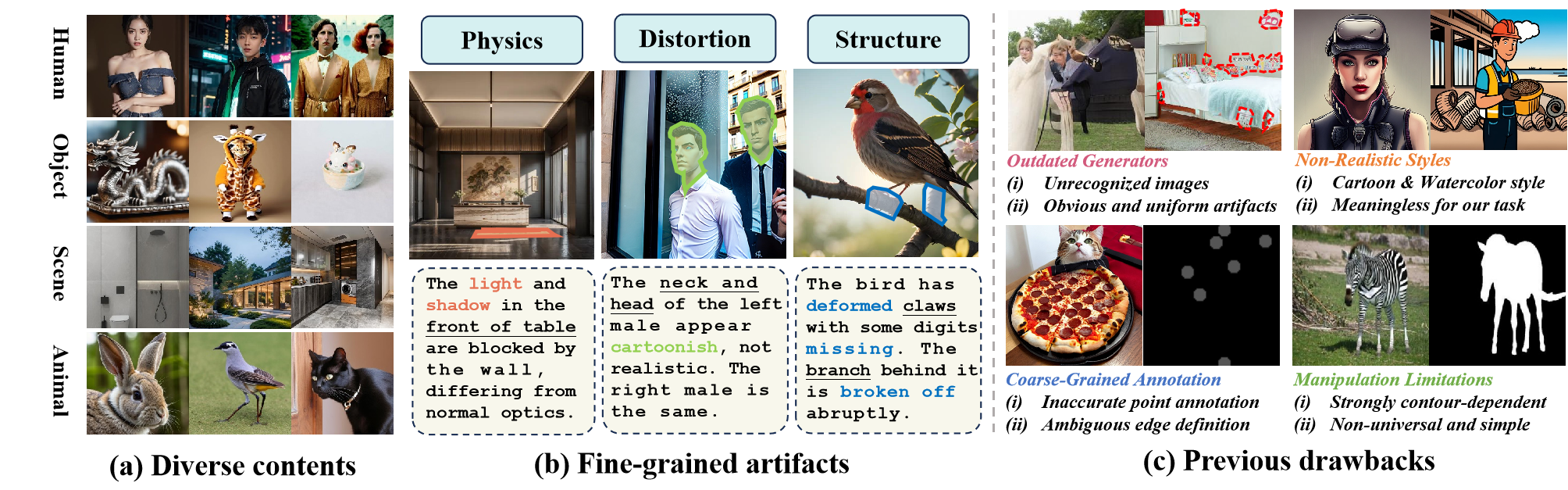
SynthScars is a high-quality and diverse dataset consisting of 12,236 fully synthetic images with human-expert annotations. It features 4 distinct image content types, 3 categories of artifacts, and fine-grained annotations covering pixel-level segmentation, detailed textual explanations, and artifact category labels. Please download it from HuggingFace, unzip it into the ./data folder, and ensure it follows the structure below:
./data
└── SynthScars
    ├── train
    │   ├── images
    │   │   ├── xxx.jpg
    │   │   └── ...
    │   └── annoations
    │       └── train.json
    └── test
        ├── images
        │   ├── xxx.jpg
        │   └── ...
        └── annoations
            └── test.json
As a defender, we provide the training and evaluation code for the image forgery analysis task as follows:
 Localization and
 Explanation
bash scripts/loc_exp/train.sh
  bash scripts/merge_weights/step1.sh
  bash scripts/merge_weights/step2.sh
bash scripts/loc_exp/infer.sh
 Detection
bash scripts/cls/train.sh
bash scripts/cls/eval.sh
As a controller, we provide the pipelines of both image regeneration and inpainting for high-quality and more realistic image generation:
  conda create -n regenerator python=3.10 -y
  conda activate regenerator
  pip install -r requirements/regenerator.txt
  bash scripts/refine/regenerator.sh
bash scripts/refine/inpainter.sh
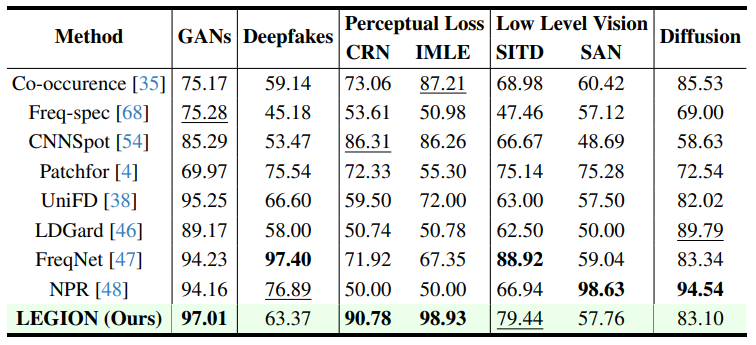
As a defender, we evaluate LEGION's performance on three key subtasks: artifact localization, explanation generation, and deepfake detection.
Localization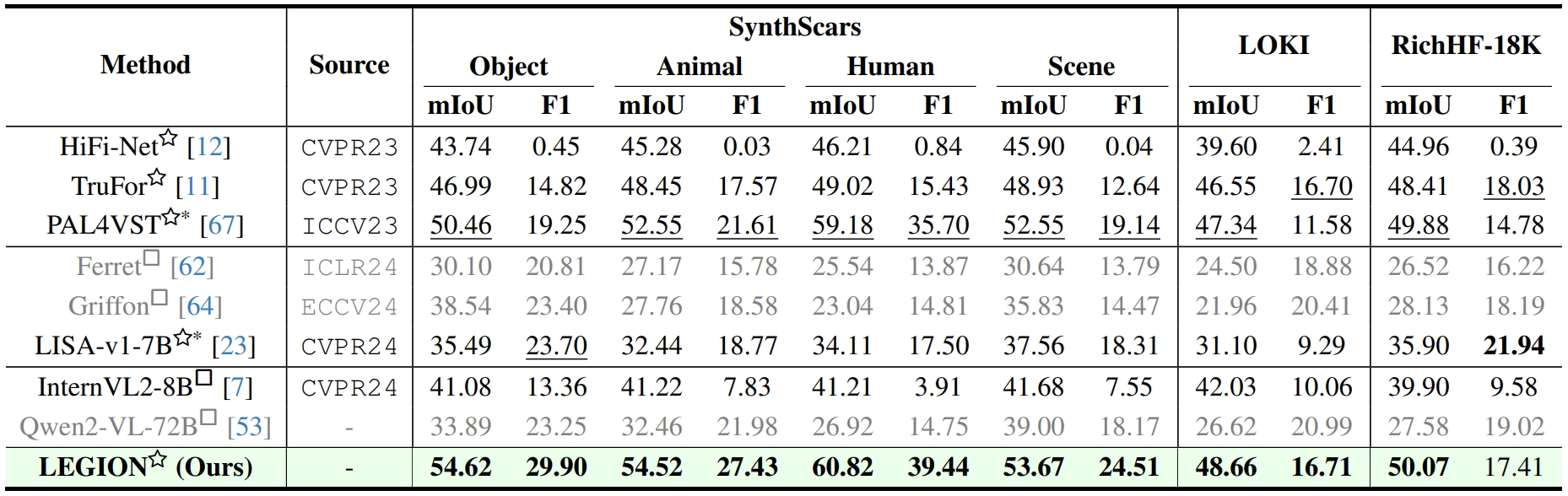 Explanation
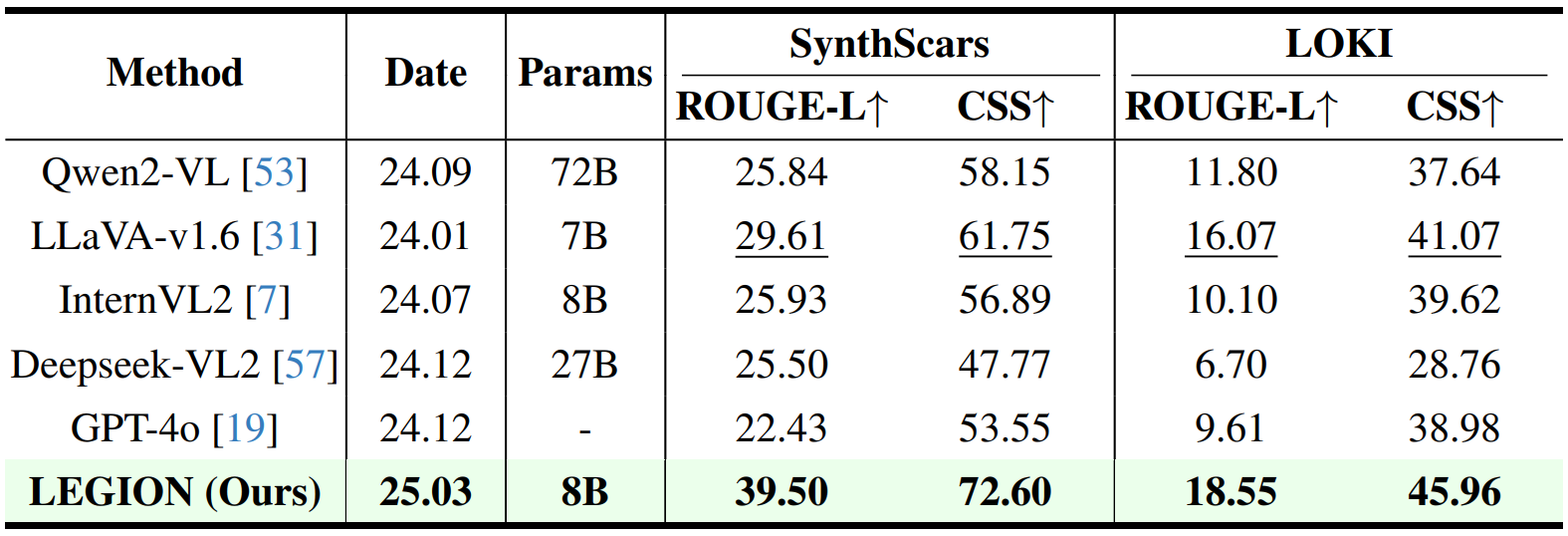 Detection
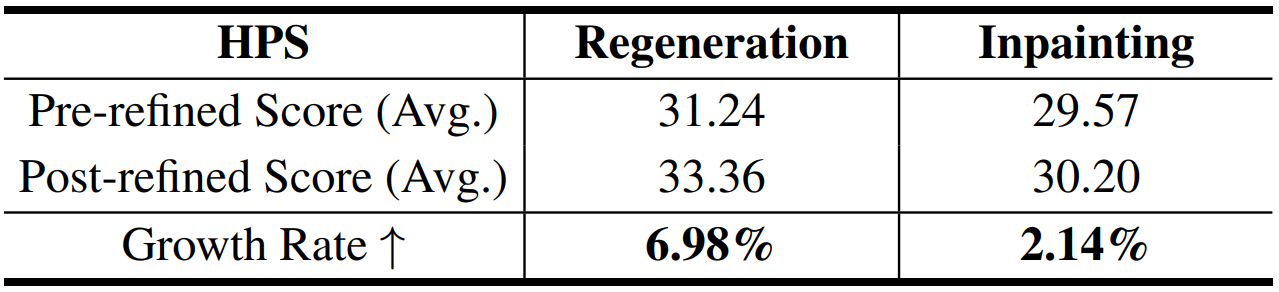
As a controller, we explore LEGION's capability to guide image generation through two pipelines: image regeneration and inpainting, based on its analytical feedback.
Note: More visualization results and case studies please refer to our Project Page.
This repository is built upon the work of GLaMM. We appreciate their contributions and insights that have provided a strong foundation for our research.
If you find our work interesting and helpful, please consider giving our repo a star. Additionally, if you would like to cite our work, please use the following format:
@article{kang2025legion,
  title={Legion: Learning to ground and explain for synthetic image detection},
  author={Kang, Hengrui and Wen, Siwei and Wen, Zichen and Ye, Junyan and Li, Weijia and Feng, Peilin and Zhou, Baichuan and Wang, Bin and Lin, Dahua and Zhang, Linfeng and others},
  journal={arXiv preprint arXiv:2503.15264},
  year={2025}
}
[ICCV25 Highlight] The official implementation of the paper "LEGION: Learning to Ground and Explain for Synthetic Image Detection"
See the codeHengrui Kang*, Siwei Wen*, Zichen Wen*, Junyan Ye, Weijia Li†
Peilin Feng, Baichuan Zhou, Bin Wang, Dahua Lin, Linfeng Zhang, Conghui He†
OverviewThe rapid advancements in generative technology have emerged as a double-edged sword. While offering powerful tools that enhance convenience, they also pose significant social concerns. As defenders, current synthetic image detection methods often lack artifact-level textual interpretability and are overly focused on image manipulation detection, and current datasets usually suffer from outdated generators and a lack of fine-grained annotations. In this paper, we introduce SynthScars, a high-quality and diverse dataset consisting of 12,236 fully synthetic images with human-expert annotations. It features 4 distinct image content types, 3 categories of artifacts, and fine-grained annotations covering pixel-level segmentation, detailed textual explanations, and artifact category labels. Furthermore, we propose LEGION (LEarning to Ground and explain for Synthetic Image detectiON), a multimodal large language model (MLLM)-based image forgery analysis framework that integrates artifact detection, segmentation, and explanation. Building upon this capability, we further explore LEGION as a controller, integrating it into image refinement pipelines to guide the generation of higher-quality and more realistic images. Extensive experiments show that LEGION outperforms existing methods across multiple benchmarks, particularly surpassing the second-best traditional expert on SynthScars by 3.31% in mIoU and 7.75% in F1 score. Moreover, the refined images generated under its guidance exhibit stronger alignment with human preferences. The code, model, and dataset will be released.
Please clone our repository and change directory to the folder:
git clone [email protected]:opendatalab/LEGION.git
cd LEGION
Our model is based on the GLaMM environment. Please follow the steps below to configure the environment.
conda create -n legion python=3.10
conda activate legion
pip install -r requirements/default.txt

# Install mmcv
git clone https://github.com/open-mmlab/mmcv
cd mmcv
git checkout v1.4.7
MMCV_WITH_OPS=1 pip install -e .
SynthScars is a high-quality and diverse dataset consisting of 12,236 fully synthetic images with human-expert annotations. It features 4 distinct image content types, 3 categories of artifacts, and fine-grained annotations covering pixel-level segmentation, detailed textual explanations, and artifact category labels. Please download it from HuggingFace, unzip it into the ./data folder, and ensure it follows the structure below:
./data
└── SynthScars
    ├── train
    │   ├── images
    │   │   ├── xxx.jpg
    │   │   └── ...
    │   └── annoations
    │       └── train.json
    └── test
        ├── images
        │   ├── xxx.jpg
        │   └── ...
        └── annoations
            └── test.json
As a defender, we provide the training and evaluation code for the image forgery analysis task as follows:
Localization and Explanation bash scripts/loc_exp/train.sh
  bash scripts/merge_weights/step1.sh
  bash scripts/merge_weights/step2.sh
bash scripts/loc_exp/infer.sh
bash scripts/cls/train.sh
bash scripts/cls/eval.sh
As a controller, we provide the pipelines of both image regeneration and inpainting for high-quality and more realistic image generation:
  conda create -n regenerator python=3.10 -y
  conda activate regenerator
  pip install -r requirements/regenerator.txt
  bash scripts/refine/regenerator.sh
bash scripts/refine/inpainter.sh
As a defender, we evaluate LEGION's performance on three key subtasks: artifact localization, explanation generation, and deepfake detection.
Localization
Explanation
Detection
As a controller, we explore LEGION's capability to guide image generation through two pipelines: image regeneration and inpainting, based on its analytical feedback.
Note: More visualization results and case studies please refer to our Project Page.
This repository is built upon the work of GLaMM. We appreciate their contributions and insights that have provided a strong foundation for our research.
If you find our work interesting and helpful, please consider giving our repo a star. Additionally, if you would like to cite our work, please use the following format:
@article{kang2025legion,
  title={Legion: Learning to ground and explain for synthetic image detection},
  author={Kang, Hengrui and Wen, Siwei and Wen, Zichen and Ye, Junyan and Li, Weijia and Feng, Peilin and Zhou, Baichuan and Wang, Bin and Lin, Dahua and Zhang, Linfeng and others},
  journal={arXiv preprint arXiv:2503.15264},
  year={2025}
}



