A high-throughput and memory-efficient inference and serving engine for LLMs
See the codeUpstream vLLM refuses to run this model with pipeline parallelism, needs a 102 GB table pinned in host RAM, and its
fp8 KV cache crashes on Ampere. This branch is upstream vLLM (nightly 7d0b4e57a, 2026-10-09) plus a small set of
Python-only fixes that make the model run on machines like a 6 × RTX 3090 box with 187 GB RAM. Measured
2026-10-11/12 on that machine (AMD 7950X, four of the six cards behind Thunderbolt, no NVLink for most pairs),
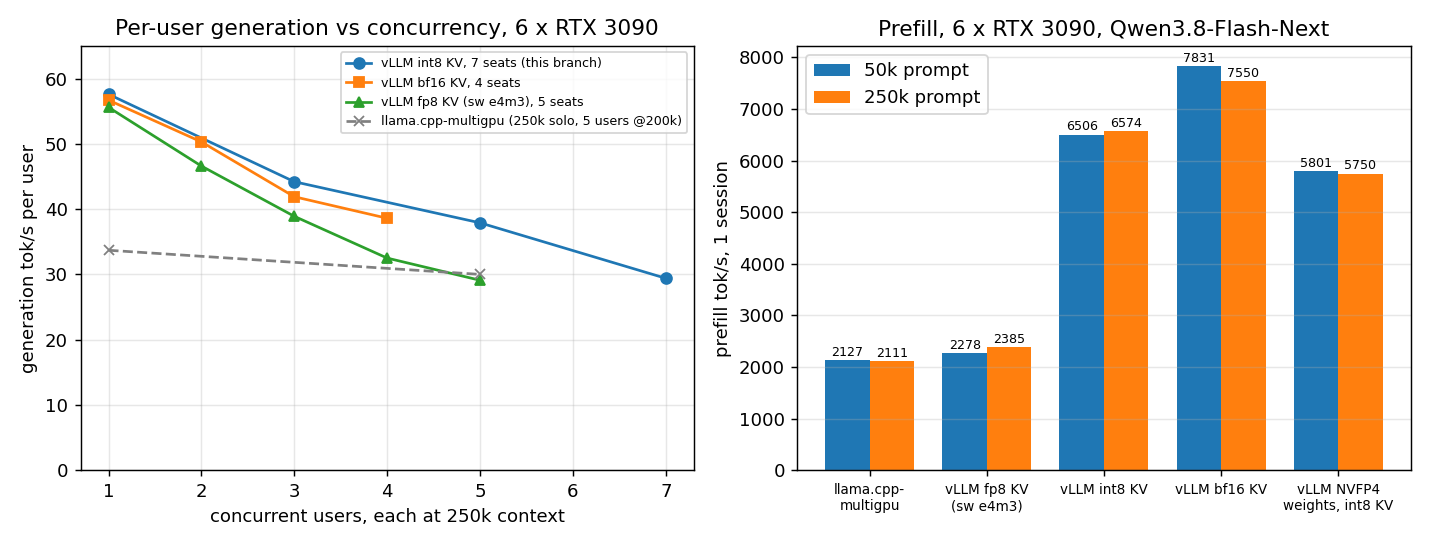
GPTQ-INT4 checkpoint, one streaming request per cell unless stated:
| workload | context | llama.cpp-multigpu (same box) | this branch, int8 KV | this branch, bf16 KV |
|---|---|---|---|---|
| prefill, 1 session | 50k | 2,127 t/s | 6,506 t/s | 7,831 t/s |
| prefill, 1 session | 250k | 2,111 t/s | 6,574 t/s | 7,550 t/s |
| time to first token, 250k prompt | 250k | 118 s | 37.8 s | 33 s |
| generation, 1 session | 250k | 33.7 t/s | 57.6 t/s | 56.7 t/s |
| generation, 3 sessions (per session / sum) | 250k | – | 44.2 / 133 t/s | 41.9 / 126 t/s |
| generation, 5 sessions (per session / sum) | 250k | 30 / 150 t/s (at 200k) | 37.9 / 190 t/s | does not fit |
| generation, 7 sessions (per session / sum) | 250k | does not fit (5 slots) | 29.4 / 206 t/s | does not fit |
| 262k contexts resident in GPU KV | 5 | 7.33 | 4.03 | |
| host RAM available with the server idle | 154 GiB | 141 GiB | 142 GiB | |
| needle-in-haystack 50k / 200k | pass / pass | pass / pass | pass / pass |
The llama.cpp column is llama.cpp-multigpu, the patched
llama.cpp that runs the same model on the same machine; stock llama.cpp is 4-10x slower than that again. Stock vLLM
has no column because it does not start: the model's pipeline-parallel guard refuses --pipeline-parallel-size > 1,
and a 24 GB card cannot hold the model at TP=1 (TP must be 1, 2, 4 or 8, so six cards cannot be used with TP either).
Full tables, the fp8 and NVFP4 experiments, the host-RAM KV tier test and the raw JSON: docs/ampere-multigpu/benchmarks.md. What each change does, with file names: docs/ampere-multigpu/patches.md. How to run it: §3. Where it does not help: §5.
Status: a fixing branch, not a project. This is upstream vLLM with 16 files touched (1,742 lines, Python only, no
new kernels outside the model's own Triton ops). It exists so that people with the same kind of hardware can run this
model today; the intended end state is that the fixes land upstream and this branch is deleted. Everything else about
vLLM is unchanged: same image, same vllm serve, same OpenAI API, same options.
| Upstream | vllm-project/vllm (Apache-2.0), the project this branch tracks |
| This branch | ampere-multigpu: upstream 7d0b4e57a + the fixes below, the only branch meant for use |
| Base image | vllm/vllm-openai:cu129-nightly-7d0b4e57aac4c4323225b0eee9ae960ce75ffffe (the changed files are bind-mounted over it, see §3) |
| Upstream README | README-upstream.md |
Six things, all for the Qwen4Exp model family (Qwen3.8-Flash-Next) on NVIDIA GPUs; details and file names in patches.md:
model_state modules rejected PP outright.
They now require VLLM_PP_LAYER_PARTITION and check that the n-gram (PLE) layer stays on stage 0, the only rank that
sees raw input ids. A KV-cache allocation bug that killed every non-first rank under PP is fixed with it.--engram-config '{"host_file_gather": true}'): rows are read from the safetensors shards each step and
cached by the page cache instead of being pinned in host RAM. Host RAM available with the server idle went from
15 GiB to 141 GiB on the test box, load time from ~400 s to 240 s, speed unchanged (measured).--kv-cache-dtype int8_per_token_head (int8 plus one
fp32 scale per token and head) is implemented in the fused prepare and sparse paged attention kernels. 1.8x the KV
capacity of bf16 at 83-87 % of its prefill speed and equal generation speed; 7 x 262k contexts on six 24 GB cards.--kv-offloading-size: a 230k-token context evicted from the GPUs comes
back in ~3 s instead of a 43 s re-prefill (no code change, included because the combination with int8 KV and PP was
unproven).| machine | GPUs | host | interconnect | notes |
|---|---|---|---|---|
| machine-01 | 6 × RTX 3090 24 GB (sm_86) | AMD 7950X, 187 GB DDR5, PCIe 4 NVMe | GPU0/1 PCIe 4 x8 + NVLink, GPU2-5 behind Thunderbolt (~1 GB/s under load) | all numbers above |
| dev | 1 × RTX 5060 Ti 16 GB (sm_120) | same box | kernel unit tests only (int8 and e4m3 paths bit-exact against oracles) |
PP=6 with one stage per card is the only layout that fits: the model is 125B parameters (GPTQ-INT4 body 85 GB, PLE table 102 GB bf16 served from disk). Each card holds eight layers plus its share of the KV cache. The slow interconnect is survivable because pipeline parallelism moves one activation tensor per layer boundary per step, not weights.
Checkpoint: btbtyler09/Qwen3.8-Flash-Next-GPTQ-4bit (the NVFP4 checkpoints also load but are slower on Ampere, see benchmarks.md). The branch is Python-only, so the simplest deployment is the stock nightly image with the changed files mounted over it:
# files this branch changes relative to upstream 7d0b4e57a (16 files; the two under tests/ are optional)
git diff 7d0b4e57a --name-only -- vllm/
# that nightly image ships a torchcodec that links a missing libnvrtc.so.13 and breaks `vllm serve` at import:
printf 'FROM vllm/vllm-openai:cu129-nightly-7d0b4e57aac4c4323225b0eee9ae960ce75ffffe\nRUN pip uninstall -y torchcodec\n' | docker build -t vllm-ampere:7d0b4e57a -
Mount every changed file at /usr/local/lib/python3.12/dist-packages/vllm/<same path> (-v $PWD/vllm/x.py:/usr/local/lib/python3.12/dist-packages/vllm/x.py:ro,
docker creates mount points for files the image lacks) and run:
VLLM_PP_LAYER_PARTITION=8,8,8,8,8,8 \
vllm serve /models/Qwen3.8-Flash-Next-GPTQ-4bit \
  --served-model-name qwen3.8-flash-next --dtype bfloat16 \
  --pipeline-parallel-size 6 --tensor-parallel-size 1 --distributed-executor-backend mp \
  --max-model-len 262144 --max-num-seqs 7 --gpu-memory-utilization 0.92 \
  --kv-cache-dtype int8_per_token_head \
  --engram-config '{"host_file_gather": true}' \
  --kv-offloading-size 36 --kv-offloading-backend native \
  --long-prefill-token-threshold 1024 \
  --reasoning-parser qwen3 --enable-auto-tool-choice --tool-call-parser qwen3_xml \
  --trust-remote-code
VLLM_PP_LAYER_PARTITION must sum to 48 and its first entry must be >= 2 (PLE layer index 1 on stage 0).--kv-cache-dtype int8_per_token_head --max-num-seqs 7: 1.92M KV tokens = 7 x 262k. Drop both for bf16 (4 x 262k,
~17 % faster prefill). fp8 also works on Ampere but costs 3.3x on prefill.--kv-offloading-size 36 (GiB of host RAM) keeps evicted contexts in RAM; size it at 4.5 GiB per 262k context in int8.
Omit it if RAM is short.--engram-config '{"cpu_offload": true}' instead of host_file_gather pins the 102 GB table in RAM (the upstream
default); it is not faster, measured.--max-num-batched-tokens at its default (2048 on 24 GB cards): 16384 halves the KV cache (activation memory),
8192 ran out of memory in the indexer prefill at 230k context (measured 2026-10-12). Add
--long-prefill-token-threshold 1024 instead: while another request waits, a long prefill takes only half of each
step, so a 3k prompt sent behind a 230k one gets its first token in 2.3 s instead of ~40 s, with the long prompt's
own time unchanged (42 s solo, 40 s shared) and no memory cost. Two long prompts then share round-robin (67 / 70 s
instead of 40 / 80 s).pip install -e . of this tree works as well; nothing native needs rebuilding.Load to /health takes 4-5 minutes (the first start after a reboot reads the PLE shards from disk, later starts hit
the page cache).
One server start per configuration, same image, same checkpoint, same six cards, production llama.cpp stopped. Client
side via the OpenAI API with streaming: prefill tok/s = prompt tokens / time to first token; generation tok/s per
session = 128 tokens / (wall - time to first token); the sum over sessions is the aggregate. "N sessions" rows are the
second round of decode_round2.py: every session re-sends its own cached 250k prefix and all N generate 128 tokens at
once with no prefill in flight (the only way to get a per-user generation rate under PP that compares with llama.cpp's
grouped decode). Needle test: a code word placed in a 50k / 200k prompt must be returned verbatim. Scripts and raw JSON
for every row: docs/ampere-multigpu/benches/.
--long-prefill-token-threshold 1024 (§3) a short prompt no longer waits behind a long one, and two
long ones share the budget instead of queueing; nothing makes seven simultaneous 230k prompts finish sooner than the
aggregate prefill rate allows.amd/model_state.py guard change mirrors the NVIDIA one but was never run.model_state guard removal is still
needed on current upstream (this branch keeps a partition check instead); the rest has been upstreamed or replaced.
If you are on AMD, start there.int8_per_token_head page format (from the unified Triton attention
backend) inside the model's own QSA kernels.Everything in this branch is offered upstream; the PP guard, the GPTQ loading and the KV-cache allocation fix are generic enough to be submitted as-is, the int8 and fp8-on-Ampere kernels are model-specific and will go wherever upstream wants them. Issues and pull requests here are welcome, but the better place for anything not specific to this hardware class is upstream vLLM.
A high-throughput and memory-efficient inference and serving engine for LLMs
See the codeUpstream vLLM refuses to run this model with pipeline parallelism, needs a 102 GB table pinned in host RAM, and its
fp8 KV cache crashes on Ampere. This branch is upstream vLLM (nightly 7d0b4e57a, 2026-10-09) plus a small set of
Python-only fixes that make the model run on machines like a 6 × RTX 3090 box with 187 GB RAM. Measured
2026-10-11/12 on that machine (AMD 7950X, four of the six cards behind Thunderbolt, no NVLink for most pairs),
GPTQ-INT4 checkpoint, one streaming request per cell unless stated:
| workload | context | llama.cpp-multigpu (same box) | this branch, int8 KV | this branch, bf16 KV |
|---|---|---|---|---|
| prefill, 1 session | 50k | 2,127 t/s | 6,506 t/s | 7,831 t/s |
| prefill, 1 session | 250k | 2,111 t/s | 6,574 t/s | 7,550 t/s |
| time to first token, 250k prompt | 250k | 118 s | 37.8 s | 33 s |
| generation, 1 session | 250k | 33.7 t/s | 57.6 t/s | 56.7 t/s |
| generation, 3 sessions (per session / sum) | 250k | – | 44.2 / 133 t/s | 41.9 / 126 t/s |
| generation, 5 sessions (per session / sum) | 250k | 30 / 150 t/s (at 200k) | 37.9 / 190 t/s | does not fit |
| generation, 7 sessions (per session / sum) | 250k | does not fit (5 slots) | 29.4 / 206 t/s | does not fit |
| 262k contexts resident in GPU KV | 5 | 7.33 | 4.03 | |
| host RAM available with the server idle | 154 GiB | 141 GiB | 142 GiB | |
| needle-in-haystack 50k / 200k | pass / pass | pass / pass | pass / pass |
The llama.cpp column is llama.cpp-multigpu, the patched
llama.cpp that runs the same model on the same machine; stock llama.cpp is 4-10x slower than that again. Stock vLLM
has no column because it does not start: the model's pipeline-parallel guard refuses --pipeline-parallel-size > 1,
and a 24 GB card cannot hold the model at TP=1 (TP must be 1, 2, 4 or 8, so six cards cannot be used with TP either).
Full tables, the fp8 and NVFP4 experiments, the host-RAM KV tier test and the raw JSON: docs/ampere-multigpu/benchmarks.md. What each change does, with file names: docs/ampere-multigpu/patches.md. How to run it: §3. Where it does not help: §5.
Status: a fixing branch, not a project. This is upstream vLLM with 16 files touched (1,742 lines, Python only, no
new kernels outside the model's own Triton ops). It exists so that people with the same kind of hardware can run this
model today; the intended end state is that the fixes land upstream and this branch is deleted. Everything else about
vLLM is unchanged: same image, same vllm serve, same OpenAI API, same options.
| Upstream | vllm-project/vllm (Apache-2.0), the project this branch tracks |
| This branch | ampere-multigpu: upstream 7d0b4e57a + the fixes below, the only branch meant for use |
| Base image | vllm/vllm-openai:cu129-nightly-7d0b4e57aac4c4323225b0eee9ae960ce75ffffe (the changed files are bind-mounted over it, see §3) |
| Upstream README | README-upstream.md |
Six things, all for the Qwen4Exp model family (Qwen3.8-Flash-Next) on NVIDIA GPUs; details and file names in patches.md:
model_state modules rejected PP outright.
They now require VLLM_PP_LAYER_PARTITION and check that the n-gram (PLE) layer stays on stage 0, the only rank that
sees raw input ids. A KV-cache allocation bug that killed every non-first rank under PP is fixed with it.--engram-config '{"host_file_gather": true}'): rows are read from the safetensors shards each step and
cached by the page cache instead of being pinned in host RAM. Host RAM available with the server idle went from
15 GiB to 141 GiB on the test box, load time from ~400 s to 240 s, speed unchanged (measured).--kv-cache-dtype int8_per_token_head (int8 plus one
fp32 scale per token and head) is implemented in the fused prepare and sparse paged attention kernels. 1.8x the KV
capacity of bf16 at 83-87 % of its prefill speed and equal generation speed; 7 x 262k contexts on six 24 GB cards.--kv-offloading-size: a 230k-token context evicted from the GPUs comes
back in ~3 s instead of a 43 s re-prefill (no code change, included because the combination with int8 KV and PP was
unproven).| machine | GPUs | host | interconnect | notes |
|---|---|---|---|---|
| machine-01 | 6 × RTX 3090 24 GB (sm_86) | AMD 7950X, 187 GB DDR5, PCIe 4 NVMe | GPU0/1 PCIe 4 x8 + NVLink, GPU2-5 behind Thunderbolt (~1 GB/s under load) | all numbers above |
| dev | 1 × RTX 5060 Ti 16 GB (sm_120) | same box | kernel unit tests only (int8 and e4m3 paths bit-exact against oracles) |
PP=6 with one stage per card is the only layout that fits: the model is 125B parameters (GPTQ-INT4 body 85 GB, PLE table 102 GB bf16 served from disk). Each card holds eight layers plus its share of the KV cache. The slow interconnect is survivable because pipeline parallelism moves one activation tensor per layer boundary per step, not weights.
Checkpoint: btbtyler09/Qwen3.8-Flash-Next-GPTQ-4bit (the NVFP4 checkpoints also load but are slower on Ampere, see benchmarks.md). The branch is Python-only, so the simplest deployment is the stock nightly image with the changed files mounted over it:
# files this branch changes relative to upstream 7d0b4e57a (16 files; the two under tests/ are optional)
git diff 7d0b4e57a --name-only -- vllm/
# that nightly image ships a torchcodec that links a missing libnvrtc.so.13 and breaks `vllm serve` at import:
printf 'FROM vllm/vllm-openai:cu129-nightly-7d0b4e57aac4c4323225b0eee9ae960ce75ffffe\nRUN pip uninstall -y torchcodec\n' | docker build -t vllm-ampere:7d0b4e57a -
Mount every changed file at /usr/local/lib/python3.12/dist-packages/vllm/<same path> (-v $PWD/vllm/x.py:/usr/local/lib/python3.12/dist-packages/vllm/x.py:ro,
docker creates mount points for files the image lacks) and run:
VLLM_PP_LAYER_PARTITION=8,8,8,8,8,8 \
vllm serve /models/Qwen3.8-Flash-Next-GPTQ-4bit \
  --served-model-name qwen3.8-flash-next --dtype bfloat16 \
  --pipeline-parallel-size 6 --tensor-parallel-size 1 --distributed-executor-backend mp \
  --max-model-len 262144 --max-num-seqs 7 --gpu-memory-utilization 0.92 \
  --kv-cache-dtype int8_per_token_head \
  --engram-config '{"host_file_gather": true}' \
  --kv-offloading-size 36 --kv-offloading-backend native \
  --long-prefill-token-threshold 1024 \
  --reasoning-parser qwen3 --enable-auto-tool-choice --tool-call-parser qwen3_xml \
  --trust-remote-code
VLLM_PP_LAYER_PARTITION must sum to 48 and its first entry must be >= 2 (PLE layer index 1 on stage 0).--kv-cache-dtype int8_per_token_head --max-num-seqs 7: 1.92M KV tokens = 7 x 262k. Drop both for bf16 (4 x 262k,
~17 % faster prefill). fp8 also works on Ampere but costs 3.3x on prefill.--kv-offloading-size 36 (GiB of host RAM) keeps evicted contexts in RAM; size it at 4.5 GiB per 262k context in int8.
Omit it if RAM is short.--engram-config '{"cpu_offload": true}' instead of host_file_gather pins the 102 GB table in RAM (the upstream
default); it is not faster, measured.--max-num-batched-tokens at its default (2048 on 24 GB cards): 16384 halves the KV cache (activation memory),
8192 ran out of memory in the indexer prefill at 230k context (measured 2026-10-12). Add
--long-prefill-token-threshold 1024 instead: while another request waits, a long prefill takes only half of each
step, so a 3k prompt sent behind a 230k one gets its first token in 2.3 s instead of ~40 s, with the long prompt's
own time unchanged (42 s solo, 40 s shared) and no memory cost. Two long prompts then share round-robin (67 / 70 s
instead of 40 / 80 s).pip install -e . of this tree works as well; nothing native needs rebuilding.Load to /health takes 4-5 minutes (the first start after a reboot reads the PLE shards from disk, later starts hit
the page cache).
One server start per configuration, same image, same checkpoint, same six cards, production llama.cpp stopped. Client
side via the OpenAI API with streaming: prefill tok/s = prompt tokens / time to first token; generation tok/s per
session = 128 tokens / (wall - time to first token); the sum over sessions is the aggregate. "N sessions" rows are the
second round of decode_round2.py: every session re-sends its own cached 250k prefix and all N generate 128 tokens at
once with no prefill in flight (the only way to get a per-user generation rate under PP that compares with llama.cpp's
grouped decode). Needle test: a code word placed in a 50k / 200k prompt must be returned verbatim. Scripts and raw JSON
for every row: docs/ampere-multigpu/benches/.
--long-prefill-token-threshold 1024 (§3) a short prompt no longer waits behind a long one, and two
long ones share the budget instead of queueing; nothing makes seven simultaneous 230k prompts finish sooner than the
aggregate prefill rate allows.amd/model_state.py guard change mirrors the NVIDIA one but was never run.model_state guard removal is still
needed on current upstream (this branch keeps a partition check instead); the rest has been upstreamed or replaced.
If you are on AMD, start there.int8_per_token_head page format (from the unified Triton attention
backend) inside the model's own QSA kernels.Everything in this branch is offered upstream; the PP guard, the GPTQ loading and the KV-cache allocation fix are generic enough to be submitted as-is, the int8 and fp8-on-Ampere kernels are model-specific and will go wherever upstream wants them. Issues and pull requests here are welcome, but the better place for anything not specific to this hardware class is upstream vLLM.



