
README
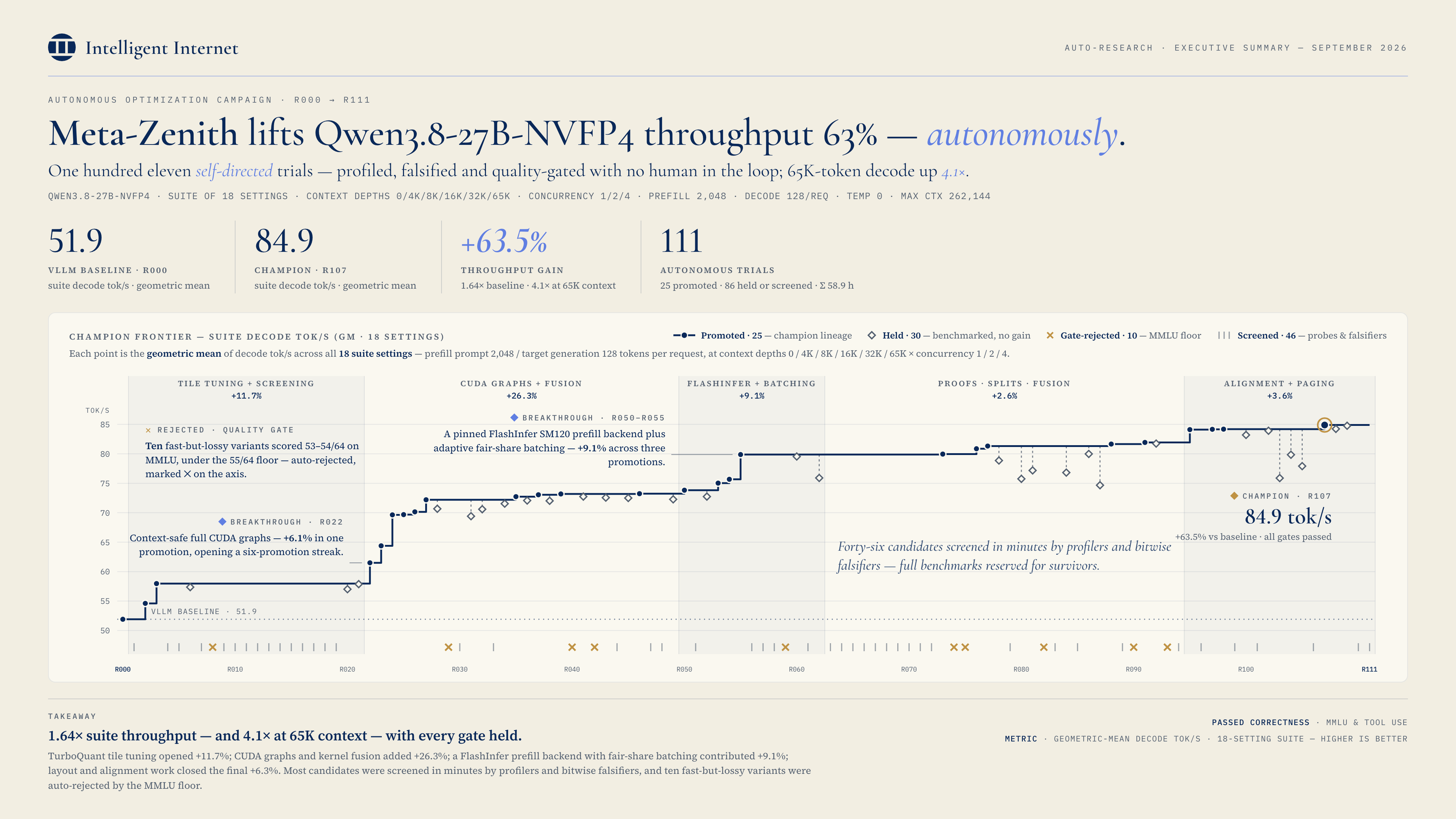
Optimized Qwen3.8 NVFP4 Inference on RTX 5090
This repository contains a specialized vLLM source tree for serving
RadixArk/Qwen3.8-27B-NVFP4 on a single NVIDIA GeForce RTX 5090 (sm_120).
It is the result of an iterative optimization effort focused on exact
inference, long-context serving, speculative decoding, and the model's
TurboQuant and Gated Delta Network (GDN) execution paths.
This is not a general replacement for upstream vLLM. The current code is a hardware- and workload-specific fork whose primary target is:
- Model:
RadixArk/Qwen3.8-27B-NVFP4 - GPU: one NVIDIA GeForce RTX 5090
- CUDA architecture:
sm_120 - Quantization: NVFP4 weights with TurboQuant 4-bit KV cache
- Speculative decoding: the model's MTP path
- Long-context inference: up to 262,144 tokens in the optimized workload
Serving, validation, and benchmark documentation will be added after the source and release interface have been reviewed.
Starting point
The initial baseline is recorded by the first commit in this repository. It was built from:
- vLLM tag
v0.27.1 - Upstream commit
6e448d0ea9bf3d88d898b65449ca6dc2aec170ac - The TurboQuant MTP K+1 verification-routing correction from upstream PR #40914
That routing correction was the only source-level deviation from the vLLM tag in the baseline. It prevents context-blind CUDA Graph capture and incorrect outputs when MTP is used with the 4-bit KV cache.
The baseline used one editable local vLLM build and a fixed serving workload so that later experiments changed the inference implementation without silently changing the model, server configuration, or dependency environment.
Optimization journey
The commits after the baseline preserve the progression from isolated decode changes to a composed inference pipeline. The main stages are summarized below in chronological order.
1. TurboQuant decode working set and context-aware dispatch
The first changes reduced the token-tile working set of the Triton TurboQuant decode kernel and selected different decode layouts according to context length. CUDA Graph dispatch was then made aware of the same context regimes so that short- and long-context paths could be captured safely.
This stage introduced:
- Smaller decode tiles to reduce per-launch working data.
- Context-dependent TurboQuant kernel selection.
- Full CUDA Graph capture boundaries aligned with kernel dispatch boundaries.
- Composition of the TurboQuant GQA decode path with full graphs.
- A specialized six-head KV reduction path for the target model layout.
2. NVFP4 output projection and speculative GDN input handling
The next stage optimized work around the attention kernels:
- Small language-model-head workloads are dispatched to the FlashInfer B12x NVFP4 GEMM path when supported.
- The speculative GDN update reads Q, K, and V directly from the packed QKV representation instead of materializing equivalent intermediate tensors.
These changes reduce conversion and materialization overhead in the small, latency-sensitive operations surrounding decode.
3. Native exact TurboQuant decode kernels
Two CUDA implementations were added for exact TurboQuant decode:
- A head-parallel kernel for context regimes where independent head work is preferable.
- A shared high-batch kernel that reuses dequantized KV data across compatible requests and heads.
The dispatcher selects between these implementations and the Triton paths using batch shape, context length, KV layout, and speculative-decoding state. The kernels were subsequently composed with the full CUDA Graph pipeline.
4. Direct-output paths and GDN prefill on Blackwell
Several intermediate output copies were removed by allowing attention and GDN
operations to write directly into their final output buffers. The pure-prefill
GDN path was enabled through FlashInfer on sm_120, while speculative GDN
updates retained an exact packed-input implementation.
This stage focused on eliminating redundant memory traffic while preserving the same inference results.
5. Batched-prefill scheduling and KV-cache preparation
The serving pipeline was adjusted so optimized kernels receive suitable memory and scheduling conditions:
- Hybrid KV-cache capacity is reserved for batched prefills.
- FlashInfer tuning runs before KV-cache allocation where supported.
- Long prefill chunks adapt to the active requests' fair share of the token budget instead of relying only on a fixed threshold.
These changes target mixed decode/prefill workloads and reduce avoidable contention between long prompts.
6. Exact prefill fusion
The GDN prefill path was progressively fused into the surrounding operations:
- Convolution outputs are routed directly into the GDN prefill computation.
- Q/K normalization is performed inside the fused path.
- NVFP4 activation quantization and GDN prefill outputs are composed into the same optimized pipeline where the target shapes allow it.
The goal is to avoid round trips through temporary tensors between convolution, normalization, quantization, and recurrent-attention preparation.
7. TurboQuant layout and high-batch refinements
The final optimization stage tightened the specialized TurboQuant paths:
- Reused layout proofs and cached norm information outside repeated inner work.
- Rebalanced long-context B4 splits.
- Vectorized packed B4 KV loads.
- Warmed the continuation-prefill dequantization and inverse-rotation path.
- Shortened score lifetimes in the B16 shared kernel to reduce register pressure.
- Aligned the packed value payload and slot ABI across store, dispatch, Triton, and CUDA implementations.
At the current revision, the optimization delta relative to the recorded baseline touches 24 upstream source files, with approximately 3,309 inserted lines and 186 removed lines. Most of that delta is concentrated in TurboQuant decode, GDN prefill/speculative decode, CUDA Graph dispatch, and scheduler/KV cache integration.
Repository layout
upstream/— the vendored vLLM source tree and all optimized runtime code.benchmarks/— reproducible throughput and tool-call benchmark wrappers.pyproject.toml— the local editable-build environment definition.uv.lock— the frozen Python dependency resolution used during development.LICENSE— the retained Apache License 2.0.
Benchmarks
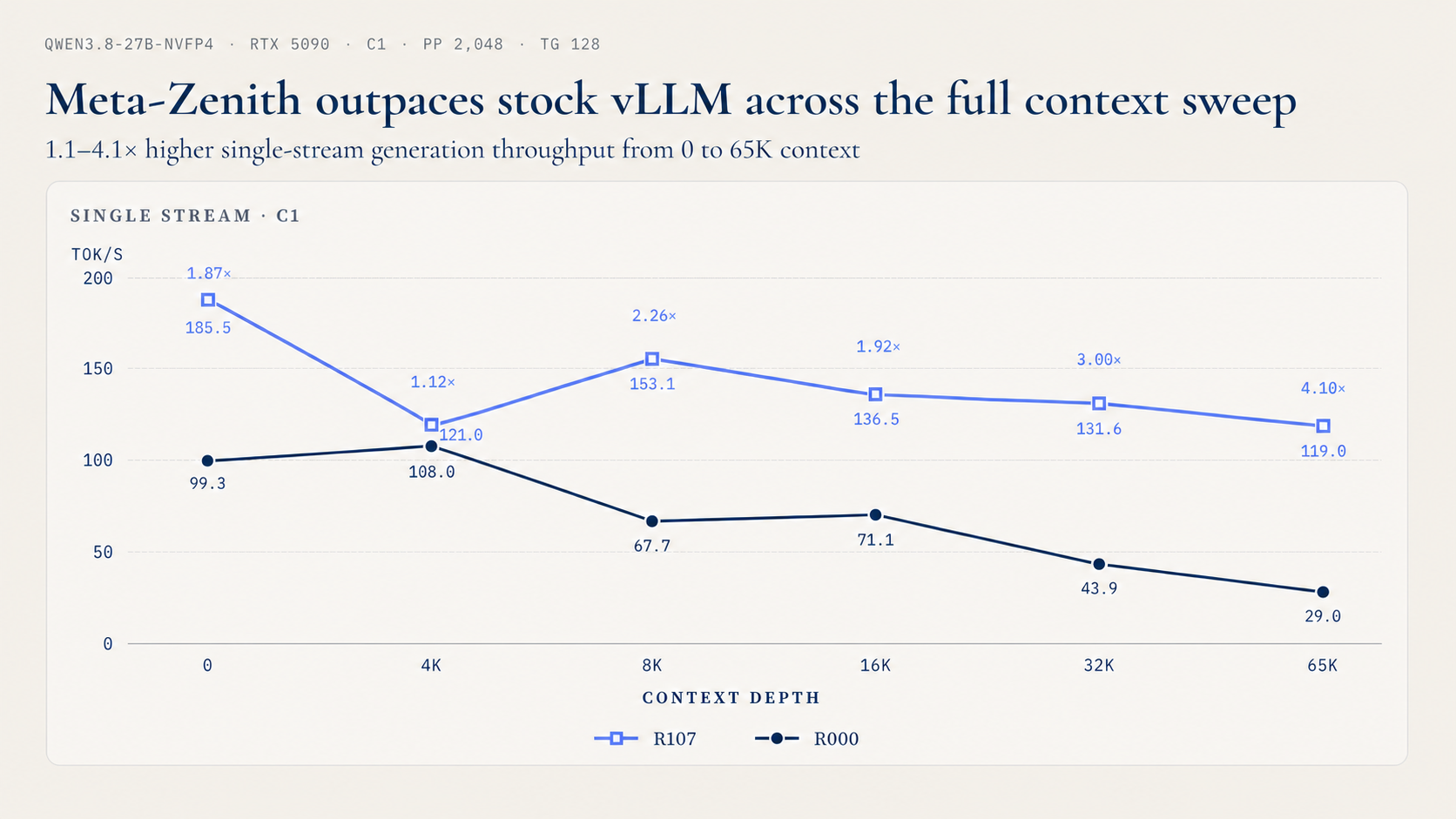
The following comparison shows single-request (c1) generation throughput for
the R000 baseline and the R107 release across the fixed pp2048 / tg128
context-depth sweep. Values are aggregate generated tokens per second; the
annotations report R107 speedup relative to R000.
The full 18-cell grid (pp2048 / tg128, context depths 0 to 65,536,
concurrency 1, 2, and 4) is listed below. Values are the client-observed
aggregate tg t/s for each cell and include prefill time; the geometric mean
across all cells improves from 51.9 to 84.9 (+63.5%).
| Context | Concurrency | R000 tg/s | R107 tg/s | Delta |
|---|---|---|---|---|
| 0 | 1 | 99.3 | 185.5 | +86.81% |
| 0 | 2 | 129.7 | 215.2 | +65.92% |
| 0 | 4 | 219.7 | 297.7 | +35.50% |
| 4,096 | 1 | 108.0 | 121.0 | +12.04% |
| 4,096 | 2 | 86.2 | 144.5 | +67.63% |
| 4,096 | 4 | 125.0 | 159.7 | +27.76% |
| 8,192 | 1 | 67.7 | 153.1 | +126.14% |
| 8,192 | 2 | 62.1 | 101.6 | +63.61% |
| 8,192 | 4 | 81.6 | 106.8 | +30.88% |
| 16,384 | 1 | 71.1 | 136.5 | +91.98% |
| 16,384 | 2 | 41.1 | 55.4 | +34.79% |
| 16,384 | 4 | 45.3 | 62.4 | +37.75% |
| 32,768 | 1 | 43.9 | 131.6 | +199.77% |
| 32,768 | 2 | 20.2 | 28.2 | +39.60% |
| 32,768 | 4 | 22.3 | 29.7 | +33.18% |
| 65,536 | 1 | 29.0 | 119.0 | +310.34% |
| 65,536 | 2 | 9.4 | 12.5 | +32.98% |
| 65,536 | 4 | 9.3 | 12.3 | +32.26% |
The release includes client-side scripts for measuring serving throughput and
tool-call quality against a running OpenAI-compatible endpoint. See
benchmarks/README.md for the pinned benchmark client,
server requirements, workload controls, and result locations. The exact r107
server and workload configuration is preserved in
benchmarks/profiles/r107-sm120.md.
Plain-text terminal logs for R000 and R107 are available in
benchmarks/results/.
Installation
The first supported build profile is intentionally narrow:
- Ubuntu 24.04 or another
x86_64Linux distribution with glibc 2.38 or newer. - Python 3.12.
- NVIDIA GeForce RTX 5090, compute capability 12.0 (
sm_120). - An NVIDIA driver compatible with CUDA 13.0.
- CUDA Toolkit 13.0 with
nvcconly when building from source. - The dependency versions recorded in
requirements-prebuilt.txtfor the wheel, oruv.lockfor a source build.
Other environments may work, but they have not yet been included in the release validation matrix.
Pre-built artifacts
The pre-built wheel is the recommended installation method because compiling the vendored vLLM CUDA extensions can take a long time. The first validated artifact is:
vllm-0.27.1+qwen38.r107.cu130.sm120-cp312-cp312-linux_x86_64.whl
It targets CPython 3.12, CUDA 13.0, and sm_120. It was built on Ubuntu 24.04
and requires glibc 2.38 or newer. Installing the wheel does not require the
CUDA Toolkit or nvcc; the machine still needs a compatible NVIDIA driver.
Install Git, curl, and uv, then run the commands
below. Cloning the release tag ensures that requirements-prebuilt.txt matches
the wheel:
RELEASE_TAG=v0.27.1-qwen38-r107-cu130-sm120
WHEEL=vllm-0.27.1+qwen38.r107.cu130.sm120-cp312-cp312-linux_x86_64.whl

git clone --branch "$RELEASE_TAG" --depth 1 \
  https://github.com/Intelligent-Internet/Qwen3.8-Inference-AutoResearch.git
cd Qwen3.8-Inference-AutoResearch

mkdir -p release-assets
curl -fL \
  "https://github.com/Intelligent-Internet/Qwen3.8-Inference-AutoResearch/releases/download/$RELEASE_TAG/vllm-0.27.1%2Bqwen38.r107.cu130.sm120-cp312-cp312-linux_x86_64.whl" \
  -o "release-assets/$WHEEL"
curl -fL \
  "https://github.com/Intelligent-Internet/Qwen3.8-Inference-AutoResearch/releases/download/$RELEASE_TAG/SHA256SUMS" \
  -o release-assets/SHA256SUMS

(cd release-assets && sha256sum -c SHA256SUMS)

uv venv --python 3.12
uv pip sync requirements-prebuilt.txt
uv pip install --no-deps "release-assets/$WHEEL"
Use the virtual environment directly so that the project manager does not try to replace the wheel with the editable source dependency:
.venv/bin/python - <<'PY'
import torch
import vllm

print("vLLM:", vllm.__version__)
print("PyTorch:", torch.__version__)
print("CUDA runtime:", torch.version.cuda)
print("GPU:", torch.cuda.get_device_name())
print("Compute capability:", torch.cuda.get_device_capability())
PY
The expected vLLM version is
0.27.1+qwen38.r107.cu130.sm120, and the compute capability must be (12, 0).
For subsequent commands, call executables through .venv/bin/, or use
uv run --no-sync; a plain uv run may synchronize the editable source build.
The sha256sum step must report the wheel as OK. Do not substitute an
upstream vLLM wheel: this fork changes C++ and CUDA code, so upstream pre-built
extensions do not contain the optimized kernels.
Build from source
Install the following system prerequisites:
- A recent NVIDIA driver that supports the installed CUDA 13 runtime.
- CUDA Toolkit 13.0, including
nvcc. - GCC and G++ 11.3 or newer.
- Git and uv.
Confirm that the GPU and compiler are visible:
nvidia-smi --query-gpu=name,compute_cap --format=csv,noheader
nvcc --version
Clone the repository, then build the locked environment:
git clone https://github.com/Intelligent-Internet/Qwen3.8-Inference-AutoResearch.git
cd Qwen3.8-Inference-AutoResearch

export TORCH_CUDA_ARCH_LIST=12.0
export MAX_JOBS=8
export NVCC_THREADS=2
export VLLM_VERSION_OVERRIDE=0.27.1

uv sync --frozen
uv sync --frozen creates .venv, installs the exact dependency resolution
from uv.lock, and builds the optimized vLLM source in upstream/ as an
editable local dependency. Do not run a separate pip install vllm, because
that can replace the optimized local build with an upstream package.
MAX_JOBS and NVCC_THREADS control build parallelism. The values above were
used on the development machine; reduce them if compilation exhausts system
memory.
Verify the resulting environment:
uv run python - <<'PY'
import torch
import vllm

print("vLLM:", vllm.__file__)
print("PyTorch:", torch.__version__)
print("CUDA runtime:", torch.version.cuda)
print("GPU:", torch.cuda.get_device_name())
print("Compute capability:", torch.cuda.get_device_capability())
PY
The vLLM module path must resolve inside this checkout's upstream/ directory,
and the reported compute capability must be (12, 0) for the validated RTX
5090 profile.
CUDA version versus compute capability
CUDA 13.0 and sm_120 describe different things:
- CUDA 13.0 is the compiler/toolkit and runtime generation.
- 12.0 in
TORCH_CUDA_ARCH_LIST=12.0is the GPU compute capability and produces code forsm_120.
The current CUDA 13.0 compiler and this vLLM source tree support Blackwell
targets through sm_121; they do not define an sm_130 target. Therefore,
TORCH_CUDA_ARCH_LIST="12.0 13.0" is not a valid build configuration for this
release.
A wheel may contain code for multiple supported compute capabilities by using
a space-separated architecture list, for example "12.0 12.1". Such a build
is larger, takes longer to compile, and still requires correctness and
performance testing on every included GPU. The optimized path in this
repository has currently been validated only on sm_120, so the first release
will use a dedicated sm_120 binary rather than an unvalidated multi-GPU
wheel.
Contributors

34 commits

1 commits
Similar repos


Languages
Python
74.0%
HTML
11.4%
Rust
5.7%
Cuda
4.3%
C++
3.0%
README
Optimized Qwen3.8 NVFP4 Inference on RTX 5090
This repository contains a specialized vLLM source tree for serving
RadixArk/Qwen3.8-27B-NVFP4 on a single NVIDIA GeForce RTX 5090 (sm_120).
It is the result of an iterative optimization effort focused on exact
inference, long-context serving, speculative decoding, and the model's
TurboQuant and Gated Delta Network (GDN) execution paths.
This is not a general replacement for upstream vLLM. The current code is a hardware- and workload-specific fork whose primary target is:
- Model:
RadixArk/Qwen3.8-27B-NVFP4 - GPU: one NVIDIA GeForce RTX 5090
- CUDA architecture:
sm_120 - Quantization: NVFP4 weights with TurboQuant 4-bit KV cache
- Speculative decoding: the model's MTP path
- Long-context inference: up to 262,144 tokens in the optimized workload
Serving, validation, and benchmark documentation will be added after the source and release interface have been reviewed.
Starting point
The initial baseline is recorded by the first commit in this repository. It was built from:
- vLLM tag
v0.27.1 - Upstream commit
6e448d0ea9bf3d88d898b65449ca6dc2aec170ac - The TurboQuant MTP K+1 verification-routing correction from upstream PR #40914
That routing correction was the only source-level deviation from the vLLM tag in the baseline. It prevents context-blind CUDA Graph capture and incorrect outputs when MTP is used with the 4-bit KV cache.
The baseline used one editable local vLLM build and a fixed serving workload so that later experiments changed the inference implementation without silently changing the model, server configuration, or dependency environment.
Optimization journey
The commits after the baseline preserve the progression from isolated decode changes to a composed inference pipeline. The main stages are summarized below in chronological order.
1. TurboQuant decode working set and context-aware dispatch
The first changes reduced the token-tile working set of the Triton TurboQuant decode kernel and selected different decode layouts according to context length. CUDA Graph dispatch was then made aware of the same context regimes so that short- and long-context paths could be captured safely.
This stage introduced:
- Smaller decode tiles to reduce per-launch working data.
- Context-dependent TurboQuant kernel selection.
- Full CUDA Graph capture boundaries aligned with kernel dispatch boundaries.
- Composition of the TurboQuant GQA decode path with full graphs.
- A specialized six-head KV reduction path for the target model layout.
2. NVFP4 output projection and speculative GDN input handling
The next stage optimized work around the attention kernels:
- Small language-model-head workloads are dispatched to the FlashInfer B12x NVFP4 GEMM path when supported.
- The speculative GDN update reads Q, K, and V directly from the packed QKV representation instead of materializing equivalent intermediate tensors.
These changes reduce conversion and materialization overhead in the small, latency-sensitive operations surrounding decode.
3. Native exact TurboQuant decode kernels
Two CUDA implementations were added for exact TurboQuant decode:
- A head-parallel kernel for context regimes where independent head work is preferable.
- A shared high-batch kernel that reuses dequantized KV data across compatible requests and heads.
The dispatcher selects between these implementations and the Triton paths using batch shape, context length, KV layout, and speculative-decoding state. The kernels were subsequently composed with the full CUDA Graph pipeline.
4. Direct-output paths and GDN prefill on Blackwell
Several intermediate output copies were removed by allowing attention and GDN
operations to write directly into their final output buffers. The pure-prefill
GDN path was enabled through FlashInfer on sm_120, while speculative GDN
updates retained an exact packed-input implementation.
This stage focused on eliminating redundant memory traffic while preserving the same inference results.
5. Batched-prefill scheduling and KV-cache preparation
The serving pipeline was adjusted so optimized kernels receive suitable memory and scheduling conditions:
- Hybrid KV-cache capacity is reserved for batched prefills.
- FlashInfer tuning runs before KV-cache allocation where supported.
- Long prefill chunks adapt to the active requests' fair share of the token budget instead of relying only on a fixed threshold.
These changes target mixed decode/prefill workloads and reduce avoidable contention between long prompts.
6. Exact prefill fusion
The GDN prefill path was progressively fused into the surrounding operations:
- Convolution outputs are routed directly into the GDN prefill computation.
- Q/K normalization is performed inside the fused path.
- NVFP4 activation quantization and GDN prefill outputs are composed into the same optimized pipeline where the target shapes allow it.
The goal is to avoid round trips through temporary tensors between convolution, normalization, quantization, and recurrent-attention preparation.
7. TurboQuant layout and high-batch refinements
The final optimization stage tightened the specialized TurboQuant paths:
- Reused layout proofs and cached norm information outside repeated inner work.
- Rebalanced long-context B4 splits.
- Vectorized packed B4 KV loads.
- Warmed the continuation-prefill dequantization and inverse-rotation path.
- Shortened score lifetimes in the B16 shared kernel to reduce register pressure.
- Aligned the packed value payload and slot ABI across store, dispatch, Triton, and CUDA implementations.
At the current revision, the optimization delta relative to the recorded baseline touches 24 upstream source files, with approximately 3,309 inserted lines and 186 removed lines. Most of that delta is concentrated in TurboQuant decode, GDN prefill/speculative decode, CUDA Graph dispatch, and scheduler/KV cache integration.
Repository layout
upstream/— the vendored vLLM source tree and all optimized runtime code.benchmarks/— reproducible throughput and tool-call benchmark wrappers.pyproject.toml— the local editable-build environment definition.uv.lock— the frozen Python dependency resolution used during development.LICENSE— the retained Apache License 2.0.
Benchmarks
The following comparison shows single-request (c1) generation throughput for
the R000 baseline and the R107 release across the fixed pp2048 / tg128
context-depth sweep. Values are aggregate generated tokens per second; the
annotations report R107 speedup relative to R000.
The full 18-cell grid (pp2048 / tg128, context depths 0 to 65,536,
concurrency 1, 2, and 4) is listed below. Values are the client-observed
aggregate tg t/s for each cell and include prefill time; the geometric mean
across all cells improves from 51.9 to 84.9 (+63.5%).
| Context | Concurrency | R000 tg/s | R107 tg/s | Delta |
|---|---|---|---|---|
| 0 | 1 | 99.3 | 185.5 | +86.81% |
| 0 | 2 | 129.7 | 215.2 | +65.92% |
| 0 | 4 | 219.7 | 297.7 | +35.50% |
| 4,096 | 1 | 108.0 | 121.0 | +12.04% |
| 4,096 | 2 | 86.2 | 144.5 | +67.63% |
| 4,096 | 4 | 125.0 | 159.7 | +27.76% |
| 8,192 | 1 | 67.7 | 153.1 | +126.14% |
| 8,192 | 2 | 62.1 | 101.6 | +63.61% |
| 8,192 | 4 | 81.6 | 106.8 | +30.88% |
| 16,384 | 1 | 71.1 | 136.5 | +91.98% |
| 16,384 | 2 | 41.1 | 55.4 | +34.79% |
| 16,384 | 4 | 45.3 | 62.4 | +37.75% |
| 32,768 | 1 | 43.9 | 131.6 | +199.77% |
| 32,768 | 2 | 20.2 | 28.2 | +39.60% |
| 32,768 | 4 | 22.3 | 29.7 | +33.18% |
| 65,536 | 1 | 29.0 | 119.0 | +310.34% |
| 65,536 | 2 | 9.4 | 12.5 | +32.98% |
| 65,536 | 4 | 9.3 | 12.3 | +32.26% |
The release includes client-side scripts for measuring serving throughput and
tool-call quality against a running OpenAI-compatible endpoint. See
benchmarks/README.md for the pinned benchmark client,
server requirements, workload controls, and result locations. The exact r107
server and workload configuration is preserved in
benchmarks/profiles/r107-sm120.md.
Plain-text terminal logs for R000 and R107 are available in
benchmarks/results/.
Installation
The first supported build profile is intentionally narrow:
- Ubuntu 24.04 or another
x86_64Linux distribution with glibc 2.38 or newer. - Python 3.12.
- NVIDIA GeForce RTX 5090, compute capability 12.0 (
sm_120). - An NVIDIA driver compatible with CUDA 13.0.
- CUDA Toolkit 13.0 with
nvcconly when building from source. - The dependency versions recorded in
requirements-prebuilt.txtfor the wheel, oruv.lockfor a source build.
Other environments may work, but they have not yet been included in the release validation matrix.
Pre-built artifacts
The pre-built wheel is the recommended installation method because compiling the vendored vLLM CUDA extensions can take a long time. The first validated artifact is:
vllm-0.27.1+qwen38.r107.cu130.sm120-cp312-cp312-linux_x86_64.whl
It targets CPython 3.12, CUDA 13.0, and sm_120. It was built on Ubuntu 24.04
and requires glibc 2.38 or newer. Installing the wheel does not require the
CUDA Toolkit or nvcc; the machine still needs a compatible NVIDIA driver.
Install Git, curl, and uv, then run the commands
below. Cloning the release tag ensures that requirements-prebuilt.txt matches
the wheel:
RELEASE_TAG=v0.27.1-qwen38-r107-cu130-sm120
WHEEL=vllm-0.27.1+qwen38.r107.cu130.sm120-cp312-cp312-linux_x86_64.whl

git clone --branch "$RELEASE_TAG" --depth 1 \
  https://github.com/Intelligent-Internet/Qwen3.8-Inference-AutoResearch.git
cd Qwen3.8-Inference-AutoResearch

mkdir -p release-assets
curl -fL \
  "https://github.com/Intelligent-Internet/Qwen3.8-Inference-AutoResearch/releases/download/$RELEASE_TAG/vllm-0.27.1%2Bqwen38.r107.cu130.sm120-cp312-cp312-linux_x86_64.whl" \
  -o "release-assets/$WHEEL"
curl -fL \
  "https://github.com/Intelligent-Internet/Qwen3.8-Inference-AutoResearch/releases/download/$RELEASE_TAG/SHA256SUMS" \
  -o release-assets/SHA256SUMS

(cd release-assets && sha256sum -c SHA256SUMS)

uv venv --python 3.12
uv pip sync requirements-prebuilt.txt
uv pip install --no-deps "release-assets/$WHEEL"
Use the virtual environment directly so that the project manager does not try to replace the wheel with the editable source dependency:
.venv/bin/python - <<'PY'
import torch
import vllm

print("vLLM:", vllm.__version__)
print("PyTorch:", torch.__version__)
print("CUDA runtime:", torch.version.cuda)
print("GPU:", torch.cuda.get_device_name())
print("Compute capability:", torch.cuda.get_device_capability())
PY
The expected vLLM version is
0.27.1+qwen38.r107.cu130.sm120, and the compute capability must be (12, 0).
For subsequent commands, call executables through .venv/bin/, or use
uv run --no-sync; a plain uv run may synchronize the editable source build.
The sha256sum step must report the wheel as OK. Do not substitute an
upstream vLLM wheel: this fork changes C++ and CUDA code, so upstream pre-built
extensions do not contain the optimized kernels.
Build from source
Install the following system prerequisites:
- A recent NVIDIA driver that supports the installed CUDA 13 runtime.
- CUDA Toolkit 13.0, including
nvcc. - GCC and G++ 11.3 or newer.
- Git and uv.
Confirm that the GPU and compiler are visible:
nvidia-smi --query-gpu=name,compute_cap --format=csv,noheader
nvcc --version
Clone the repository, then build the locked environment:
git clone https://github.com/Intelligent-Internet/Qwen3.8-Inference-AutoResearch.git
cd Qwen3.8-Inference-AutoResearch

export TORCH_CUDA_ARCH_LIST=12.0
export MAX_JOBS=8
export NVCC_THREADS=2
export VLLM_VERSION_OVERRIDE=0.27.1

uv sync --frozen
uv sync --frozen creates .venv, installs the exact dependency resolution
from uv.lock, and builds the optimized vLLM source in upstream/ as an
editable local dependency. Do not run a separate pip install vllm, because
that can replace the optimized local build with an upstream package.
MAX_JOBS and NVCC_THREADS control build parallelism. The values above were
used on the development machine; reduce them if compilation exhausts system
memory.
Verify the resulting environment:
uv run python - <<'PY'
import torch
import vllm

print("vLLM:", vllm.__file__)
print("PyTorch:", torch.__version__)
print("CUDA runtime:", torch.version.cuda)
print("GPU:", torch.cuda.get_device_name())
print("Compute capability:", torch.cuda.get_device_capability())
PY
The vLLM module path must resolve inside this checkout's upstream/ directory,
and the reported compute capability must be (12, 0) for the validated RTX
5090 profile.
CUDA version versus compute capability
CUDA 13.0 and sm_120 describe different things:
- CUDA 13.0 is the compiler/toolkit and runtime generation.
- 12.0 in
TORCH_CUDA_ARCH_LIST=12.0is the GPU compute capability and produces code forsm_120.
The current CUDA 13.0 compiler and this vLLM source tree support Blackwell
targets through sm_121; they do not define an sm_130 target. Therefore,
TORCH_CUDA_ARCH_LIST="12.0 13.0" is not a valid build configuration for this
release.
A wheel may contain code for multiple supported compute capabilities by using
a space-separated architecture list, for example "12.0 12.1". Such a build
is larger, takes longer to compile, and still requires correctness and
performance testing on every included GPU. The optimized path in this
repository has currently been validated only on sm_120, so the first release
will use a dedicated sm_120 binary rather than an unvalidated multi-GPU
wheel.
Similar repos
Contributors
34 commits
1 commits
Languages
Python
74.0%
HTML
11.4%
Rust
5.7%
Cuda
4.3%
C++
3.0%