Repository for ETHZ Robot Learning Project 1, group 47
Python
0
52 commits
updated Aug 13, 2026
Language-conditioned robot manipulation using a VLA model on a SO-101 robot arm.
Robot Learning course — ETH Zürich, Spring 2026.
This project explores language-conditioned manipulation with a Vision-Language-Action model on a real robot. We used SmolVLA 0.5B (HuggingFaceTB/SmolVLA-500M) — built on SmolVLM2 — as our VLA backbone, training it on three progressively harder tasks on a SO-101 6-DOF follower arm.
| Task | Language | |
|---|---|---|
| Eval 1 | Color bowl | "Put the banana in the blue bowl." |
| Eval 2 | Relational bowl | "Put the banana into the bowl to the right of the red bowl." |
| Eval 3 | Open-vocabulary placement | "Place the coke on Taylor Swift." |
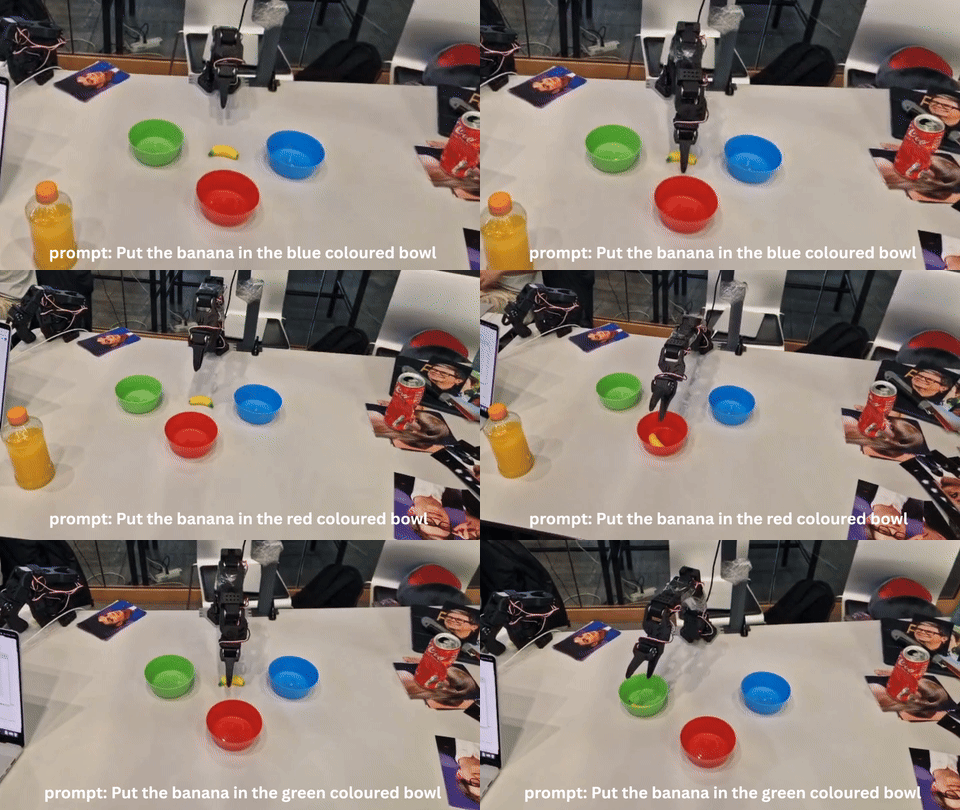
The robot picks up a banana and places it into a target bowl identified by color (red, green, or blue). Three bowls are always present; the language prompt specifies which one. We collected 60 teleoperated demonstrations across fixed bowl positions and trained SmolVLA 0.5B on this data.
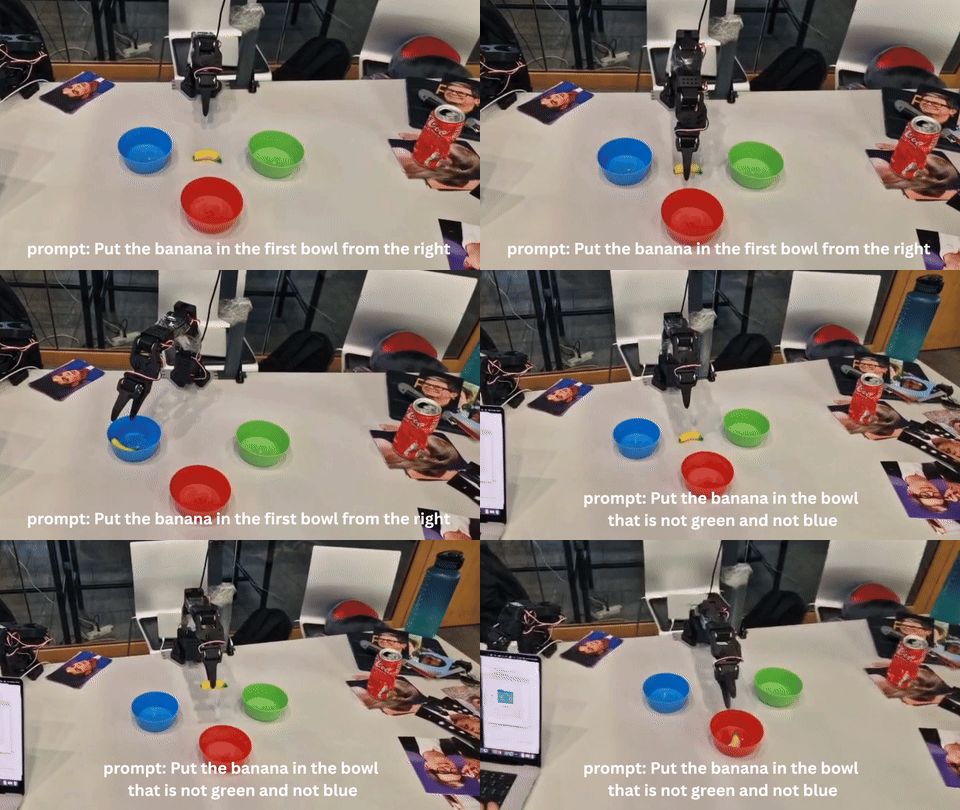
A harder generalization test: three bowls appear in varying color-and-order permutations (18 combinations in total), and the prompt uses positional ("1st from the left"), relational ("to the right of the red bowl"), or negation ("not red and not blue") language. We collected 108 demonstrations across all combinations and trained SmolVLA 0.5B.
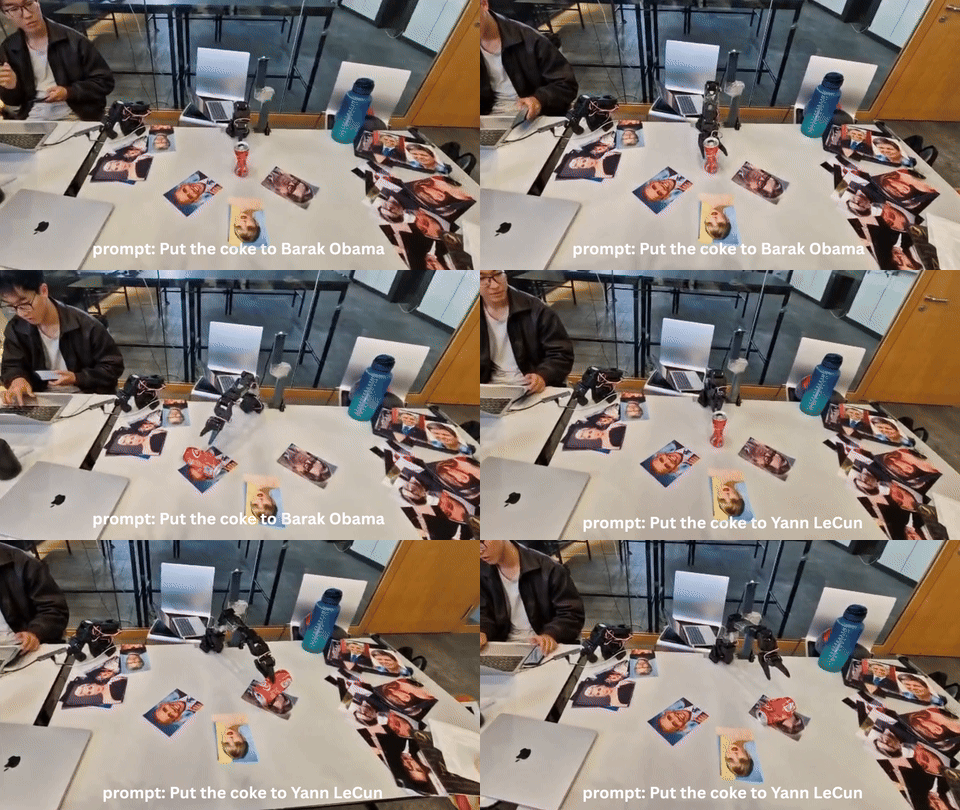
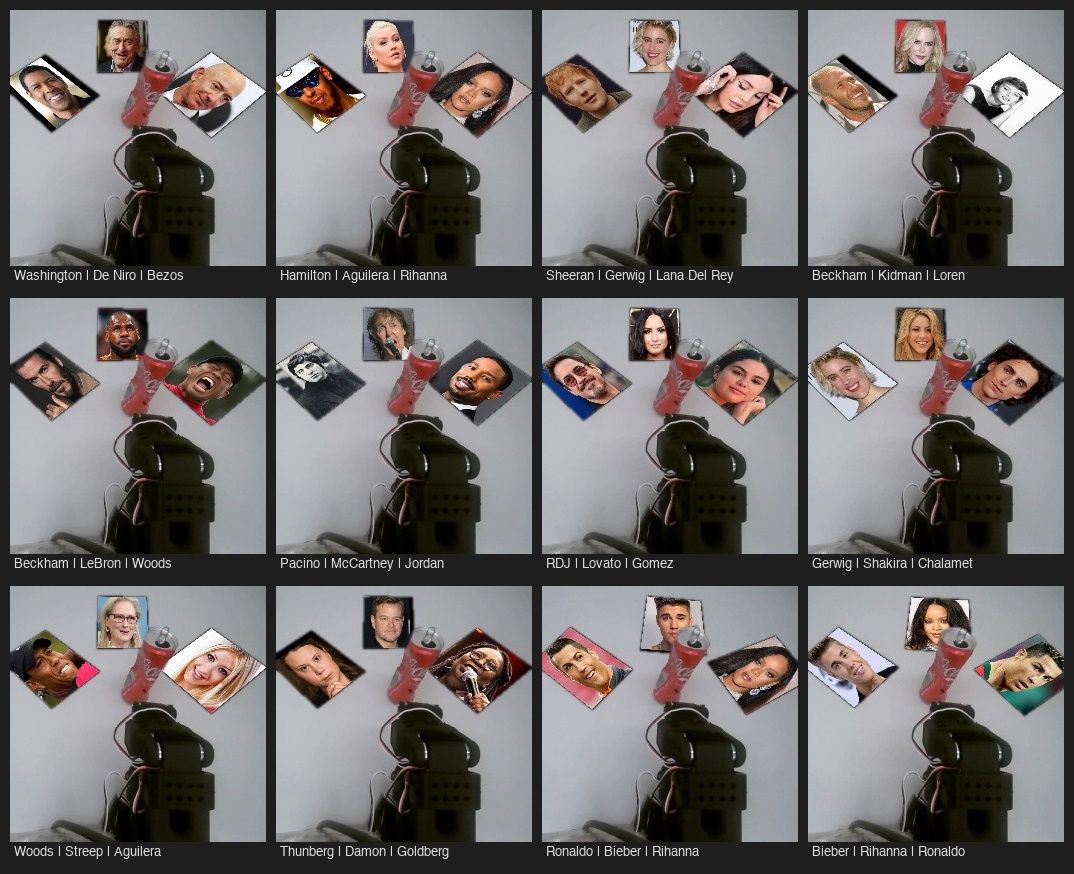
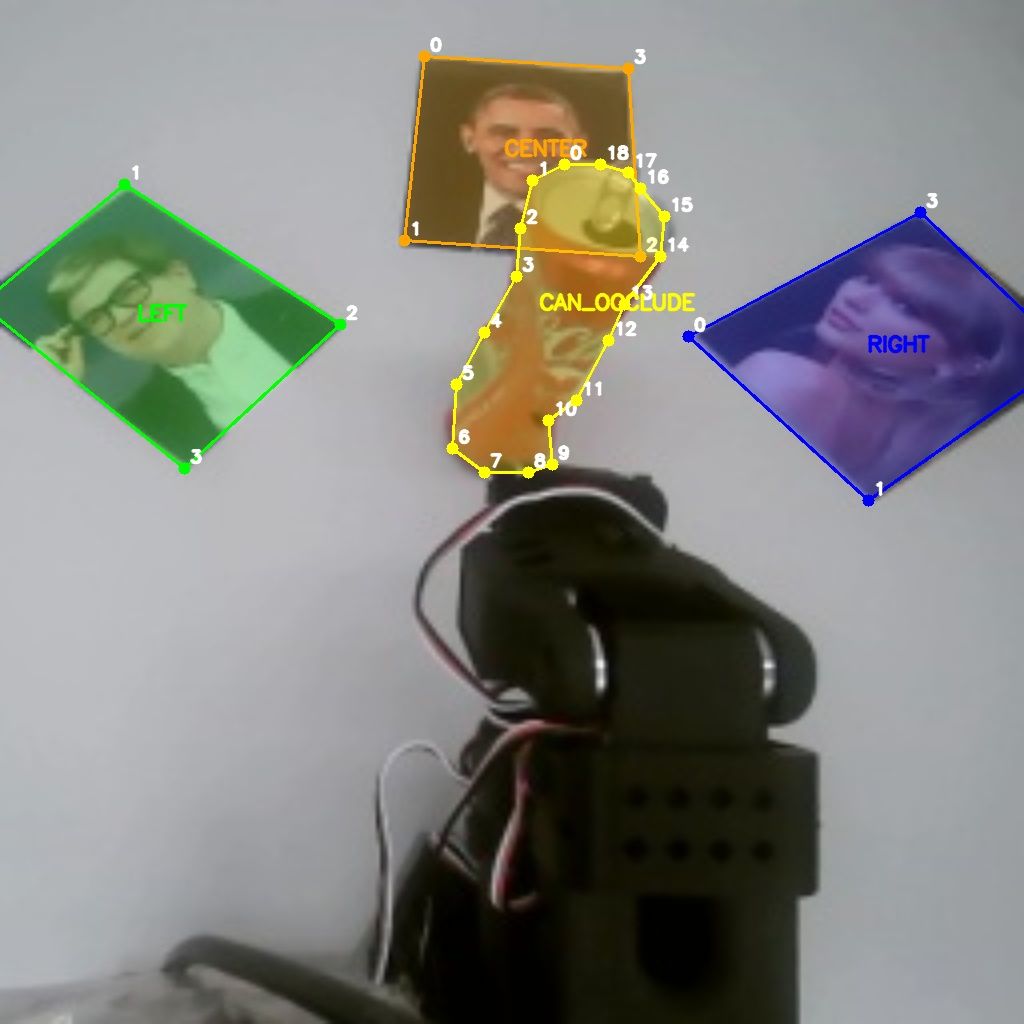
The robot must pick up a coke can and place it precisely on top of a small celebrity photo card lying flat on the table — identified only by the person's name in the prompt. Solved with SmolVLA 0.5B.
Requirements: macOS or Linux · Python 3.12+ · ffmpeg · uv
# Clone with submodule
git clone --recursive https://github.com/lorefrigo/robot-learning-ethz-vla.git
cd robot-learning-ethz-vla

# Install system dependencies
brew install ffmpeg uv                  # macOS
# sudo apt install ffmpeg && curl -LsSf https://astral.sh/uv/install.sh | sh  # Linux

# Create virtual environment
uv sync && source .venv/bin/activate

# Find your robot ports, then export them
lerobot-find-port
export FOLLOWER_PORT=/dev/tty.usbmodemXXXX
export LEADER_PORT=/dev/tty.usbmodemYYYY
Models and the camera patch are downloaded automatically on first run. Add the export lines to ~/.zshrc or ~/.bashrc to avoid re-typing each session.
bash run_eval_1.sh
bash run_eval_2.sh
TASK="Place the coke on Taylor Swift." bash run_eval_3_TOY.sh
TASK="Place the coke on Rihanna." bash run_eval_3_celeb.sh
All three evals use SmolVLA 0.5B (HuggingFaceTB/SmolVLA-500M) as the VLA backbone.
Weights are not stored in git — they live on HuggingFace under robot-learning-group47/ and are downloaded automatically on first run. To pre-fetch:
bash scripts/download_models.sh
models/
├── eval1/       ← SmolVLA 0.5B checkpoint
├── eval2/       ← SmolVLA 0.5B checkpoint
└── eval3/
    └── runtime/ ← inference code (git-tracked)
Hosted on HuggingFace under robot-learning-group47/. Download with:
bash scripts/download_datasets.sh          # all three
bash scripts/download_datasets.sh eval1    # single eval
Downloaded data lands in training_pipeline/eval*/data/.
source .venv/bin/activate
python robot/teleop.py   # requires FOLLOWER_PORT and LEADER_PORT
robot-learning-ethz-vla/
│
├── run_eval_1.sh                 — Eval 1 one-command runner
├── run_eval_2.sh                 — Eval 2 one-command runner
├── run_eval_3_TOY.sh             — Eval 3 TOY figures runner
├── run_eval_3_celeb.sh           — Eval 3 celebrity cards runner
│
├── robot/                        — Hardware scripts, calibration & config
│   ├── calibration/              — Arm calibration files for group 47
│   ├── config/                   — Robot config and initial pose YAML
│   └── patches/                  — OpenCV camera stability patch
│
├── models/                       — Checkpoints (gitignored, auto-downloaded)
│   ├── eval1/                    — SmolVLA 0.5B checkpoint
│   ├── eval2/                    — SmolVLA 0.5B checkpoint
│   └── eval3/runtime/            — Eval 3 inference code (git-tracked)
│
├── training_pipeline/
│   ├── eval1/
│   │   ├── data/                 — Training datasets (gitignored)
│   │   ├── shells/               — Recording, training & evaluation shell scripts
│   │   └── src/                  — Training, evaluation & dataset scripts
│   ├── eval2/
│   │   ├── data/                 — Training datasets & image assets (gitignored)
│   │   ├── shells/               — Recording, training & evaluation shell scripts
│   │   └── src/                  — Training, probing & dataset construction scripts
│   ├── eval3/
│   │   ├── data/                 — Training datasets & image assets (gitignored)
│   │   ├── shells/               — Recording & training shell scripts
│   │   └── src/
│   │       ├── vla/              — VLA action model training scripts
│   │       └── vlm/              — VLM scene understanding training scripts
│   └── logs/                     — Experiment logs & probe results
│
├── scripts/
│   ├── download_models.sh
│   └── download_datasets.sh
│
└── lerobot/                      — LeRobot submodule (v0.5.2)
robot/calibration/so101_group47//dev/tty.usbmodem* if env vars are not setsource .venv/bin/activate
lerobot-calibrate \
--robot.type=so101_follower \
--robot.port=$FOLLOWER_PORT \
--robot.id=my_follower \
--robot.calibration_dir=robot/calibration/so101_group47/follower
Repository for ETHZ Robot Learning Project 1, group 47
Python
0
52 commits
updated Aug 13, 2026
Language-conditioned robot manipulation using a VLA model on a SO-101 robot arm.
Robot Learning course — ETH Zürich, Spring 2026.
This project explores language-conditioned manipulation with a Vision-Language-Action model on a real robot. We used SmolVLA 0.5B (HuggingFaceTB/SmolVLA-500M) — built on SmolVLM2 — as our VLA backbone, training it on three progressively harder tasks on a SO-101 6-DOF follower arm.
| Task | Language | |
|---|---|---|
| Eval 1 | Color bowl | "Put the banana in the blue bowl." |
| Eval 2 | Relational bowl | "Put the banana into the bowl to the right of the red bowl." |
| Eval 3 | Open-vocabulary placement | "Place the coke on Taylor Swift." |
The robot picks up a banana and places it into a target bowl identified by color (red, green, or blue). Three bowls are always present; the language prompt specifies which one. We collected 60 teleoperated demonstrations across fixed bowl positions and trained SmolVLA 0.5B on this data.
A harder generalization test: three bowls appear in varying color-and-order permutations (18 combinations in total), and the prompt uses positional ("1st from the left"), relational ("to the right of the red bowl"), or negation ("not red and not blue") language. We collected 108 demonstrations across all combinations and trained SmolVLA 0.5B.
The robot must pick up a coke can and place it precisely on top of a small celebrity photo card lying flat on the table — identified only by the person's name in the prompt. Solved with SmolVLA 0.5B.
Requirements: macOS or Linux · Python 3.12+ · ffmpeg · uv
# Clone with submodule
git clone --recursive https://github.com/lorefrigo/robot-learning-ethz-vla.git
cd robot-learning-ethz-vla

# Install system dependencies
brew install ffmpeg uv                  # macOS
# sudo apt install ffmpeg && curl -LsSf https://astral.sh/uv/install.sh | sh  # Linux

# Create virtual environment
uv sync && source .venv/bin/activate

# Find your robot ports, then export them
lerobot-find-port
export FOLLOWER_PORT=/dev/tty.usbmodemXXXX
export LEADER_PORT=/dev/tty.usbmodemYYYY
Models and the camera patch are downloaded automatically on first run. Add the export lines to ~/.zshrc or ~/.bashrc to avoid re-typing each session.
bash run_eval_1.sh
bash run_eval_2.sh
TASK="Place the coke on Taylor Swift." bash run_eval_3_TOY.sh
TASK="Place the coke on Rihanna." bash run_eval_3_celeb.sh
All three evals use SmolVLA 0.5B (HuggingFaceTB/SmolVLA-500M) as the VLA backbone.
Weights are not stored in git — they live on HuggingFace under robot-learning-group47/ and are downloaded automatically on first run. To pre-fetch:
bash scripts/download_models.sh
models/
├── eval1/       ← SmolVLA 0.5B checkpoint
├── eval2/       ← SmolVLA 0.5B checkpoint
└── eval3/
    └── runtime/ ← inference code (git-tracked)
Hosted on HuggingFace under robot-learning-group47/. Download with:
bash scripts/download_datasets.sh          # all three
bash scripts/download_datasets.sh eval1    # single eval
Downloaded data lands in training_pipeline/eval*/data/.
source .venv/bin/activate
python robot/teleop.py   # requires FOLLOWER_PORT and LEADER_PORT
robot-learning-ethz-vla/
│
├── run_eval_1.sh                 — Eval 1 one-command runner
├── run_eval_2.sh                 — Eval 2 one-command runner
├── run_eval_3_TOY.sh             — Eval 3 TOY figures runner
├── run_eval_3_celeb.sh           — Eval 3 celebrity cards runner
│
├── robot/                        — Hardware scripts, calibration & config
│   ├── calibration/              — Arm calibration files for group 47
│   ├── config/                   — Robot config and initial pose YAML
│   └── patches/                  — OpenCV camera stability patch
│
├── models/                       — Checkpoints (gitignored, auto-downloaded)
│   ├── eval1/                    — SmolVLA 0.5B checkpoint
│   ├── eval2/                    — SmolVLA 0.5B checkpoint
│   └── eval3/runtime/            — Eval 3 inference code (git-tracked)
│
├── training_pipeline/
│   ├── eval1/
│   │   ├── data/                 — Training datasets (gitignored)
│   │   ├── shells/               — Recording, training & evaluation shell scripts
│   │   └── src/                  — Training, evaluation & dataset scripts
│   ├── eval2/
│   │   ├── data/                 — Training datasets & image assets (gitignored)
│   │   ├── shells/               — Recording, training & evaluation shell scripts
│   │   └── src/                  — Training, probing & dataset construction scripts
│   ├── eval3/
│   │   ├── data/                 — Training datasets & image assets (gitignored)
│   │   ├── shells/               — Recording & training shell scripts
│   │   └── src/
│   │       ├── vla/              — VLA action model training scripts
│   │       └── vlm/              — VLM scene understanding training scripts
│   └── logs/                     — Experiment logs & probe results
│
├── scripts/
│   ├── download_models.sh
│   └── download_datasets.sh
│
└── lerobot/                      — LeRobot submodule (v0.5.2)
robot/calibration/so101_group47//dev/tty.usbmodem* if env vars are not setsource .venv/bin/activate
lerobot-calibrate \
--robot.type=so101_follower \
--robot.port=$FOLLOWER_PORT \
--robot.id=my_follower \
--robot.calibration_dir=robot/calibration/so101_group47/follower



