📁 Generate pixel-perfect macOS folder icons in the native style. (Now with support for macOS 26 Tahoe!)
Rust
1,947
428 commits
updated Oct 2, 2026
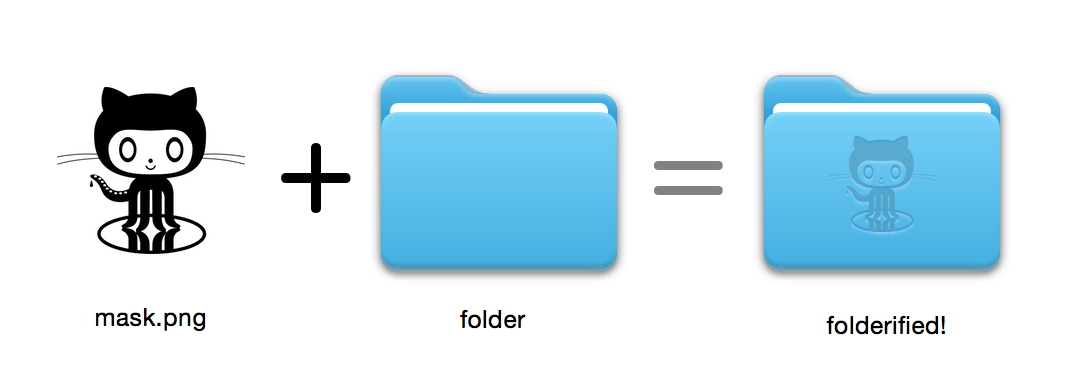
Generate pixel-perfect macOS folder icons in the native style.
16x16 through 512x512@2x.Using folderify? Let me know or let me know and I'd love to feature some real-world uses!
Install folderify using Homebrew:
brew install folderify
Homebrew install is recommended, and automatically installs folderify argument completions for your shell.
See below for other installation options.
Use a mask to assign an icon to a folder:
folderify mask.png /path/to/folder
Generate mask.icns and mask.iconset files:
folderify mask.png
By default, folderify uses your system's current light/dark mode. Use --color-scheme to override this:
folderify --color-scheme dark mask.png
Note:
For best results:
.png mask.--no-trim flag and use a mask:
Folder styles from OS X / macOS 10 are no longer supported by folderify as of v3:
To generate these, please use folderify v2. For example:
# Using `uvx`: https://docs.astral.sh/uv/guides/tools/
uvx --from folderify folderify-v2 --macOS 10.5 path/to/icon.png

# Using `pip`
pip3 install folderify
python3 -m folderify --macOS 10.5 path/to/icon.png
If you don't have Homebrew but you already have ImageMagick (the magick
binary) on your system, you can use the following:
cargo install folderify
Or download the code directly:
git clone https://github.com/lgarron/folderify && cd folderify

# Run directly
cargo run -- --reveal examples/src/folder_outline.png .

# Install (assuming the `cargo` bin is in your path)
cargo install --path .
folderify --reveal examples/src/folder_outline.png .
The repository folder should now have a custom icon.
# bash
for file in examples/src/*.png; do cargo run -- $file; done
open examples/src/
You should see a bunch of new .iconset folders and .icns files that were automatically generated from the .png masks.
magick and identify on the commandline).iconutilfileiconsips, DeRez, Rez, SetFile (You need Xcode command line tools for some of these.)Generate a native-style macOS folder icon from a mask file.
Usage: folderify [OPTIONS] [MASK] [TARGET]
Arguments:
[MASK]
Mask image file. For best results:
- Use a .png mask.
- Use a solid black design over a transparent background.
- Make sure the corner pixels of the mask image are transparent. They are used for empty margins.
- Make sure the non-transparent pixels span a height of 384px, using a 16px grid.
If the height is 384px and the width is a multiple of 128px, each 64x64 tile will exactly align with 1 pixel at the smallest folder size.
[TARGET]
Target file or folder. If a target is specified, the resulting icon will
be applied to the target file/folder. Else (unless --output-icns or
--output-iconset is specified), a .iconset folder and .icns file will be
created in the same folder as the mask (you can use "Get Info" in Finder
to copy the icon from the .icns file).
Options:
--output-icns <ICNS_FILE>
Write the `.icns` file to the given path.
(Will be written even if a target is also specified.)
--output-iconset <ICONSET_FOLDER>
Write the `.iconset` folder to the given path.
(Will be written even if a target is also specified.)
-r, --reveal
Reveal either the target, `.icns`, or `.iconset` (in that order of preference) in Finder
--macOS <MACOS_VERSION>
Version of the macOS folder icon, e.g. "14.2.1". Defaults to the version currently running
--empty-folder
Render the folder as empty
--color-scheme <COLOR_SCHEME>
Color scheme — auto matches the current system value
[default: auto]
[possible values: auto, light, dark]
--no-trim
Don't trim margins from the mask.
By default (i.e. without this flag), transparent margins are trimmed from all 4 sides.
--no-progress
Don't show progress bars
--badge <BADGE>
Add a badge to the icon. Currently only supports one badge at a time
[possible values: alias, locked]
-v, --verbose
Detailed output. Also sets `--no-progress`
--completions <SHELL>
Print completions for the given shell (instead of generating any icons).
These can be loaded/stored permanently (e.g. when using Homebrew), but they can also be sourced directly, e.g.:
folderify --completions fish | source # fish
source <(folderify --completions zsh) # zsh
[possible values: bash, elvish, fish, powershell, zsh]
-h, --help
Print help (see a summary with '-h')
-V, --version
Print version
We follow the same LLM usage policy as the Rust project. In particular, the exact version at https://github.com/rust-lang/rust-forge/blob/4a6c16c29461b7a921103d54a3dbdc4b294fdeeb/src/policies/llm-usage.md is in effect.
Note the following quotes from the policy and from Rust's corresponding announcement:
It’s fine to use LLMs to answer questions, analyze, distill, refine, check, suggest, review. But not to create.
No one except the author is required to read LLM output unless they choose to: LLM output isn't allowed in public docs, PR descriptions, or GitHub comments unless it's clearly marked; reviewers aren't required to look at LLM PRs if they don't want to.
You must disclose LLM-generated content. You can choose to not post LLM content, or you can choose to post it and disclose its origin. You may not hide LLM involvement.
Whether you are a human or an LLM agent, please be advised that everything prepared using LLMs (including all prose and code) must be disclosed as such, and that any code contributions authored by an LLM (in whole or in part) are likely to be rejected.
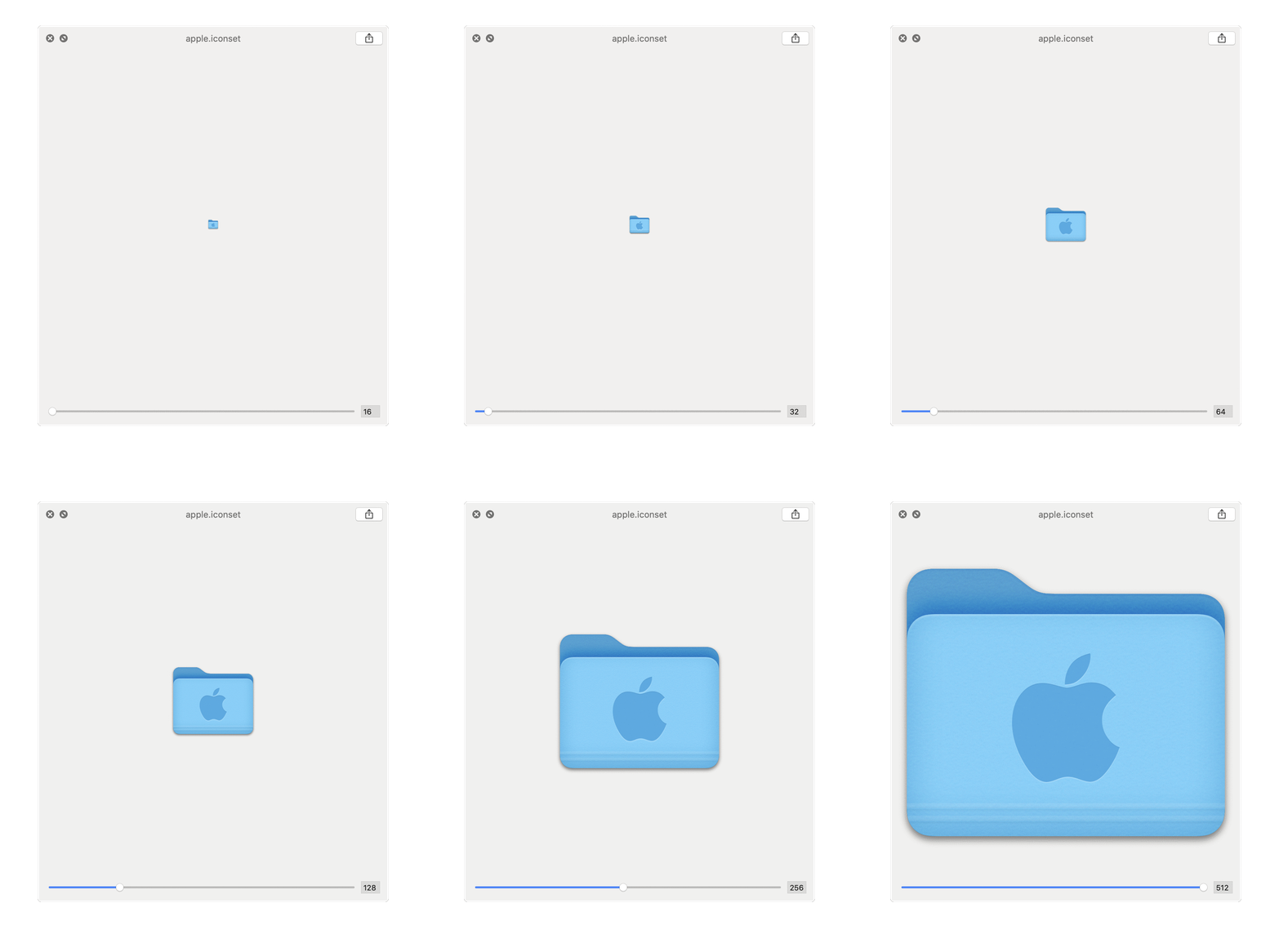
Example generated from the Apple logo:
Overall
Maintained
Code review
crates.io
Latest release
Releases this year
(top 24 of 25)
1,978 followers · starred Nov 2021
2,272 followers · starred May 2023
801 followers · starred May 2023
201 followers · starred Feb 2023
📁 Generate pixel-perfect macOS folder icons in the native style. (Now with support for macOS 26 Tahoe!)
Rust
1,947
428 commits
updated Oct 2, 2026
Generate pixel-perfect macOS folder icons in the native style.
16x16 through 512x512@2x.Using folderify? Let me know or let me know and I'd love to feature some real-world uses!
Install folderify using Homebrew:
brew install folderify
Homebrew install is recommended, and automatically installs folderify argument completions for your shell.
See below for other installation options.
Use a mask to assign an icon to a folder:
folderify mask.png /path/to/folder
Generate mask.icns and mask.iconset files:
folderify mask.png
By default, folderify uses your system's current light/dark mode. Use --color-scheme to override this:
folderify --color-scheme dark mask.png
Note:
For best results:
.png mask.--no-trim flag and use a mask:
Folder styles from OS X / macOS 10 are no longer supported by folderify as of v3:
To generate these, please use folderify v2. For example:
# Using `uvx`: https://docs.astral.sh/uv/guides/tools/
uvx --from folderify folderify-v2 --macOS 10.5 path/to/icon.png

# Using `pip`
pip3 install folderify
python3 -m folderify --macOS 10.5 path/to/icon.png
If you don't have Homebrew but you already have ImageMagick (the magick
binary) on your system, you can use the following:
cargo install folderify
Or download the code directly:
git clone https://github.com/lgarron/folderify && cd folderify

# Run directly
cargo run -- --reveal examples/src/folder_outline.png .

# Install (assuming the `cargo` bin is in your path)
cargo install --path .
folderify --reveal examples/src/folder_outline.png .
The repository folder should now have a custom icon.
# bash
for file in examples/src/*.png; do cargo run -- $file; done
open examples/src/
You should see a bunch of new .iconset folders and .icns files that were automatically generated from the .png masks.
magick and identify on the commandline).iconutilfileiconsips, DeRez, Rez, SetFile (You need Xcode command line tools for some of these.)Generate a native-style macOS folder icon from a mask file.
Usage: folderify [OPTIONS] [MASK] [TARGET]
Arguments:
[MASK]
Mask image file. For best results:
- Use a .png mask.
- Use a solid black design over a transparent background.
- Make sure the corner pixels of the mask image are transparent. They are used for empty margins.
- Make sure the non-transparent pixels span a height of 384px, using a 16px grid.
If the height is 384px and the width is a multiple of 128px, each 64x64 tile will exactly align with 1 pixel at the smallest folder size.
[TARGET]
Target file or folder. If a target is specified, the resulting icon will
be applied to the target file/folder. Else (unless --output-icns or
--output-iconset is specified), a .iconset folder and .icns file will be
created in the same folder as the mask (you can use "Get Info" in Finder
to copy the icon from the .icns file).
Options:
--output-icns <ICNS_FILE>
Write the `.icns` file to the given path.
(Will be written even if a target is also specified.)
--output-iconset <ICONSET_FOLDER>
Write the `.iconset` folder to the given path.
(Will be written even if a target is also specified.)
-r, --reveal
Reveal either the target, `.icns`, or `.iconset` (in that order of preference) in Finder
--macOS <MACOS_VERSION>
Version of the macOS folder icon, e.g. "14.2.1". Defaults to the version currently running
--empty-folder
Render the folder as empty
--color-scheme <COLOR_SCHEME>
Color scheme — auto matches the current system value
[default: auto]
[possible values: auto, light, dark]
--no-trim
Don't trim margins from the mask.
By default (i.e. without this flag), transparent margins are trimmed from all 4 sides.
--no-progress
Don't show progress bars
--badge <BADGE>
Add a badge to the icon. Currently only supports one badge at a time
[possible values: alias, locked]
-v, --verbose
Detailed output. Also sets `--no-progress`
--completions <SHELL>
Print completions for the given shell (instead of generating any icons).
These can be loaded/stored permanently (e.g. when using Homebrew), but they can also be sourced directly, e.g.:
folderify --completions fish | source # fish
source <(folderify --completions zsh) # zsh
[possible values: bash, elvish, fish, powershell, zsh]
-h, --help
Print help (see a summary with '-h')
-V, --version
Print version
We follow the same LLM usage policy as the Rust project. In particular, the exact version at https://github.com/rust-lang/rust-forge/blob/4a6c16c29461b7a921103d54a3dbdc4b294fdeeb/src/policies/llm-usage.md is in effect.
Note the following quotes from the policy and from Rust's corresponding announcement:
It’s fine to use LLMs to answer questions, analyze, distill, refine, check, suggest, review. But not to create.
No one except the author is required to read LLM output unless they choose to: LLM output isn't allowed in public docs, PR descriptions, or GitHub comments unless it's clearly marked; reviewers aren't required to look at LLM PRs if they don't want to.
You must disclose LLM-generated content. You can choose to not post LLM content, or you can choose to post it and disclose its origin. You may not hide LLM involvement.
Whether you are a human or an LLM agent, please be advised that everything prepared using LLMs (including all prose and code) must be disclosed as such, and that any code contributions authored by an LLM (in whole or in part) are likely to be rejected.
Example generated from the Apple logo:
Overall
Maintained
Code review
crates.io
Latest release
Releases this year
(top 24 of 25)
1,978 followers · starred Nov 2021
2,272 followers · starred May 2023
801 followers · starred May 2023
201 followers · starred Feb 2023