A user-friendly, lightweight TUI for disk imaging
Rust
2,391
613 commits
updated Sep 17, 2026

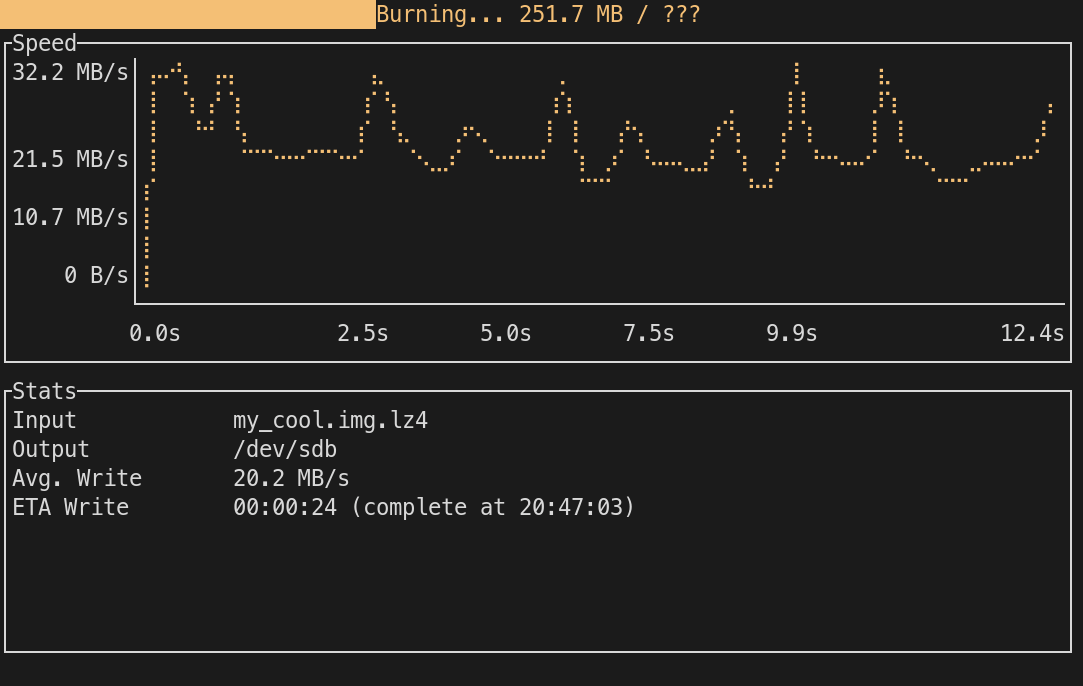
Caligula is a user-friendly, lightweight TUI for imaging disks.
$ caligula
A lightweight, user-friendly disk imaging tool

Usage: caligula
       caligula burn [OPTIONS] <IMAGE>
       caligula help [COMMAND]...

Options:
  -h, --help     Print help
  -V, --version  Print version

caligula burn:
A lightweight, user-friendly disk imaging tool
  <IMAGE>                          Input image to burn
  -o <OUT>                         Where to write the output. If not supplied, we will search for possible disks and ask you for where you want to burn
  -z, --compression <COMPRESSION>  What compression format the input file is in [default: ask] [possible values: ask, auto, none, gz, bz2, xz, lz4, zst]
  -s, --hash <HASH>                The hash of the input file. For more information, see long help (--help) [default: ask]
      --hash-file <HASH_FILE>      Where to look for the hash of the input file
      --hash-of <HASH_OF>          Is the hash calculated from the raw file, or the compressed file? [possible values: raw, compressed]
      --show-all-disks             If provided, we will show all disks, removable or not
      --interactive <INTERACTIVE>  If we should run in interactive mode or not [default: auto] [possible values: auto, always, never]
  -f, --force                      If supplied, we will not ask for confirmation before destroying your disk
      --root <ROOT>                If we don't have permissions on the output file, should we try to become root? [default: ask] [possible values: ask, always, never]
  -h, --help                       Print help (see more with '--help')
  -V, --version                    Print version

caligula help:
Print this message or the help of the given subcommand(s)
  [COMMAND]...  Print help for the subcommand(s)
root earlier (it happens)
There are a couple of ways to install Caligula.
pacman -S caligulamain branchmain branchnix-env -i caligulagithub:ifd3f/caligula. You should probably pin to a version, though, because main can potentially break.brew tap philocalyst/tap && brew install caligulacargo install caligulagit clone and cargo build --release it.| OS | Architecture | Automated builds | Basic tests | Full tests |
|---|---|---|---|---|
| Linux | x86_64 | ✅ | ✅ | ✅ |
| aarch64 | ✅ | ❌ | ❌ | |
| MacOS | x86_64 | ✅ | ✅ | ❌ |
| aarch64 | ✅ | ✅ | ❌ |
Notes on definitions:
caligula --help works. Caligula is likely to work on this platform, but there is potential for uncaught issues between releases.Because I had to image one too many USB drives and wanted a nice, user-friendly dd alternative that wasn't 90 95 413 MB.
No really. A certain other tool doing the same exact thing has ballooned to 413 MB now.
% unzip balenaEtcher-linux-x64-2.1.4.zip
% du -sh balenaEtcher-linux-x64
413M	balenaEtcher-linux-x64
There used to be a tool called Nero Burning ROM, so I chose another crazy Roman emperor to name this software after. It's a very uncreative name. I was originally planning on changing it later, but it's stuck.
dd not good enough for you? Do you not know how to use it?I know how dd works. In fact, to prove it, I have written a tutorial on it here, without using any AI.
dd to write ISOs to a USB drive or SD cardFirst, take a hash of your file, just to make sure that it didn't get corrupted in transit or bitrotted while living on your disk, because that happens occasionally. Most people forget to do this step, or are too lazy to. Most tutorials neglect to mention this step as well.
$ sha256sum some-image-file.iso.gz
After you have verified that the hashes match, you can finally unzip your file, if it came zipped.
$ gunzip some-image-file.iso.gz
Once that's done, you can finally start typing out your dd command. Using bs=4M because someone online recommended it and you forgot why, you type:
$ dd bs=4M if=some-image-file.iso of=/dev/
You get to this point in typing it out before realizing you forgot to consult lsblk!
$ lsblk
NAME        MAJ:MIN RM   SIZE RO TYPE MOUNTPOINTS
sda           8:0    0   1.8T  0 disk
└─sda1        8:1    0   1.8T  0 part
sdb           8:16   1   3.6G  0 disk
└─sdb1        8:17   1   3.6G  0 part
sdc           8:32   1    60G  0 disk
nvme0n1     259:0    0 931.5G  0 disk
├─nvme0n1p1 259:1    0   550M  0 part /boot
└─nvme0n1p2 259:2    0   931G  0 part
You probably want the disk here either called sdc. Make sure you don't confuse it with any of the other disks plugged into your computer, removable or otherwise. That would be bad, because you might overwrite important data.
$ dd bs=4M if=some-image-file.iso of=/dev/sdc
Pause here one more time, cross referencing what you typed in with the output of lsblk, to double-confirm that you are indeed typing in the correct disk and not the wrong disk so that you don't nuke any important disks storing important data such as your /home or your OS.
Then, open a new terminal and type
$ lsblk
again to triple-confirm that you are indeed typing in the correct disk and not the wrong disk so that you don't nuke any important disks storing important data such as your /home or your OS. Doing so would really ruin your day.
Once you have quadruple-confirmed that you are indeed typing in the correct disk and not the wrong disk so that you don't nuke any important disks storing important data such as your /home or your OS, you can hit the enter key and finally actually run dd.
dd: failed to open '/dev/sdc': Permission denied
Of course, you probably forgot to type sudo. Make sure you do that.
$ sudo dd bs=4M if=some-image-file.iso of=/dev/sdc
By default, dd does not have any output. If you want to see the progress, you will need to cancel the command and add status=progress on.
^C^C^C
$ sudo dd bs=4M if=some-image-file.iso of=/dev/sdc status=progress
2684354560 bytes (2.7 GB, 2.5 GiB) copied, 1 s, 2.7 GB/s
Now, it's finally written!
At this point, it's probably a good idea to verify that the disk was written correctly. I personally don't know the command to do that. Do you know the command to do that? If you ask most pro sysadmins this, could they name the command? If you look at any tutorial online, do they list the command? The answer to all of these is no, because nobody bothers to do this.
While dd is nice for scripting, after doing this process manually hundreds of times with hundreds of files and tens of drives, why don't you try using a simpler, more user-friendly process?
caligula to write ISOs to a USB drive or SD cardTypically, you would run
$ caligula burn some-image-file.iso.gz
and follow prompts in the terminal to allow the computer to fill in the blanks. In general, computers are good at filling in blanks. In fact, that was a big part of why we invented them.
Because it's 🚀🚀🚀 BLAZING FAST 🚀🚀🚀 and 💾💾💾 MEMORY SAFE 💾💾💾 and 🦀🦀🦀 CRAB 🦀🦀🦀
On a serious note, I just like the language.
It makes the CI more predictable.
To be fair, Rust doesn't have a very comprehensive standard library, and I only use one or two functions in most of those dependencies. Thanks to dead code elimination, inlining, and other optimizations, they don't end up contributing much to the overall binary size.
burn? Will you add other subcommands later?Yes. I Eventually™ plan on adding other capabilities, like Windows install disk support and secure disk erasure, and those will end up in their own subcommands.
I have a full-time job that is not working on Caligula. If you would like to help with this problem, contributions are appreciated.
(top 24 of 50)
2,927 followers · starred Dec 2024
487 followers · starred Nov 2024
907 followers · starred Apr 2026
642 followers · starred May 2026
A user-friendly, lightweight TUI for disk imaging
Rust
2,391
613 commits
updated Sep 17, 2026
Caligula is a user-friendly, lightweight TUI for imaging disks.
$ caligula
A lightweight, user-friendly disk imaging tool

Usage: caligula
       caligula burn [OPTIONS] <IMAGE>
       caligula help [COMMAND]...

Options:
  -h, --help     Print help
  -V, --version  Print version

caligula burn:
A lightweight, user-friendly disk imaging tool
  <IMAGE>                          Input image to burn
  -o <OUT>                         Where to write the output. If not supplied, we will search for possible disks and ask you for where you want to burn
  -z, --compression <COMPRESSION>  What compression format the input file is in [default: ask] [possible values: ask, auto, none, gz, bz2, xz, lz4, zst]
  -s, --hash <HASH>                The hash of the input file. For more information, see long help (--help) [default: ask]
      --hash-file <HASH_FILE>      Where to look for the hash of the input file
      --hash-of <HASH_OF>          Is the hash calculated from the raw file, or the compressed file? [possible values: raw, compressed]
      --show-all-disks             If provided, we will show all disks, removable or not
      --interactive <INTERACTIVE>  If we should run in interactive mode or not [default: auto] [possible values: auto, always, never]
  -f, --force                      If supplied, we will not ask for confirmation before destroying your disk
      --root <ROOT>                If we don't have permissions on the output file, should we try to become root? [default: ask] [possible values: ask, always, never]
  -h, --help                       Print help (see more with '--help')
  -V, --version                    Print version

caligula help:
Print this message or the help of the given subcommand(s)
  [COMMAND]...  Print help for the subcommand(s)
root earlier (it happens)
There are a couple of ways to install Caligula.
pacman -S caligulamain branchmain branchnix-env -i caligulagithub:ifd3f/caligula. You should probably pin to a version, though, because main can potentially break.brew tap philocalyst/tap && brew install caligulacargo install caligulagit clone and cargo build --release it.| OS | Architecture | Automated builds | Basic tests | Full tests |
|---|---|---|---|---|
| Linux | x86_64 | ✅ | ✅ | ✅ |
| aarch64 | ✅ | ❌ | ❌ | |
| MacOS | x86_64 | ✅ | ✅ | ❌ |
| aarch64 | ✅ | ✅ | ❌ |
Notes on definitions:
caligula --help works. Caligula is likely to work on this platform, but there is potential for uncaught issues between releases.Because I had to image one too many USB drives and wanted a nice, user-friendly dd alternative that wasn't 90 95 413 MB.
No really. A certain other tool doing the same exact thing has ballooned to 413 MB now.
% unzip balenaEtcher-linux-x64-2.1.4.zip
% du -sh balenaEtcher-linux-x64
413M	balenaEtcher-linux-x64
There used to be a tool called Nero Burning ROM, so I chose another crazy Roman emperor to name this software after. It's a very uncreative name. I was originally planning on changing it later, but it's stuck.
dd not good enough for you? Do you not know how to use it?I know how dd works. In fact, to prove it, I have written a tutorial on it here, without using any AI.
dd to write ISOs to a USB drive or SD cardFirst, take a hash of your file, just to make sure that it didn't get corrupted in transit or bitrotted while living on your disk, because that happens occasionally. Most people forget to do this step, or are too lazy to. Most tutorials neglect to mention this step as well.
$ sha256sum some-image-file.iso.gz
After you have verified that the hashes match, you can finally unzip your file, if it came zipped.
$ gunzip some-image-file.iso.gz
Once that's done, you can finally start typing out your dd command. Using bs=4M because someone online recommended it and you forgot why, you type:
$ dd bs=4M if=some-image-file.iso of=/dev/
You get to this point in typing it out before realizing you forgot to consult lsblk!
$ lsblk
NAME        MAJ:MIN RM   SIZE RO TYPE MOUNTPOINTS
sda           8:0    0   1.8T  0 disk
└─sda1        8:1    0   1.8T  0 part
sdb           8:16   1   3.6G  0 disk
└─sdb1        8:17   1   3.6G  0 part
sdc           8:32   1    60G  0 disk
nvme0n1     259:0    0 931.5G  0 disk
├─nvme0n1p1 259:1    0   550M  0 part /boot
└─nvme0n1p2 259:2    0   931G  0 part
You probably want the disk here either called sdc. Make sure you don't confuse it with any of the other disks plugged into your computer, removable or otherwise. That would be bad, because you might overwrite important data.
$ dd bs=4M if=some-image-file.iso of=/dev/sdc
Pause here one more time, cross referencing what you typed in with the output of lsblk, to double-confirm that you are indeed typing in the correct disk and not the wrong disk so that you don't nuke any important disks storing important data such as your /home or your OS.
Then, open a new terminal and type
$ lsblk
again to triple-confirm that you are indeed typing in the correct disk and not the wrong disk so that you don't nuke any important disks storing important data such as your /home or your OS. Doing so would really ruin your day.
Once you have quadruple-confirmed that you are indeed typing in the correct disk and not the wrong disk so that you don't nuke any important disks storing important data such as your /home or your OS, you can hit the enter key and finally actually run dd.
dd: failed to open '/dev/sdc': Permission denied
Of course, you probably forgot to type sudo. Make sure you do that.
$ sudo dd bs=4M if=some-image-file.iso of=/dev/sdc
By default, dd does not have any output. If you want to see the progress, you will need to cancel the command and add status=progress on.
^C^C^C
$ sudo dd bs=4M if=some-image-file.iso of=/dev/sdc status=progress
2684354560 bytes (2.7 GB, 2.5 GiB) copied, 1 s, 2.7 GB/s
Now, it's finally written!
At this point, it's probably a good idea to verify that the disk was written correctly. I personally don't know the command to do that. Do you know the command to do that? If you ask most pro sysadmins this, could they name the command? If you look at any tutorial online, do they list the command? The answer to all of these is no, because nobody bothers to do this.
While dd is nice for scripting, after doing this process manually hundreds of times with hundreds of files and tens of drives, why don't you try using a simpler, more user-friendly process?
caligula to write ISOs to a USB drive or SD cardTypically, you would run
$ caligula burn some-image-file.iso.gz
and follow prompts in the terminal to allow the computer to fill in the blanks. In general, computers are good at filling in blanks. In fact, that was a big part of why we invented them.
Because it's 🚀🚀🚀 BLAZING FAST 🚀🚀🚀 and 💾💾💾 MEMORY SAFE 💾💾💾 and 🦀🦀🦀 CRAB 🦀🦀🦀
On a serious note, I just like the language.
It makes the CI more predictable.
To be fair, Rust doesn't have a very comprehensive standard library, and I only use one or two functions in most of those dependencies. Thanks to dead code elimination, inlining, and other optimizations, they don't end up contributing much to the overall binary size.
burn? Will you add other subcommands later?Yes. I Eventually™ plan on adding other capabilities, like Windows install disk support and secure disk erasure, and those will end up in their own subcommands.
I have a full-time job that is not working on Caligula. If you would like to help with this problem, contributions are appreciated.
(top 24 of 50)
2,927 followers · starred Dec 2024
487 followers · starred Nov 2024
907 followers · starred Apr 2026
642 followers · starred May 2026



