MultiModal Audio Generation in Raw Waveform Space.
Python
158
6 commits
updated May 26, 2026
Feiyan Zhou1,2 · Luyuan Wang1 · Shoufa Chen1,* · Zhe Wang1 · Zhiheng Liu1 · Yuren Cong1 · Xiaohui Zhang1 · Fanny Yang1 · Belinda Zeng1
1 Meta AI · 2 Northeastern University
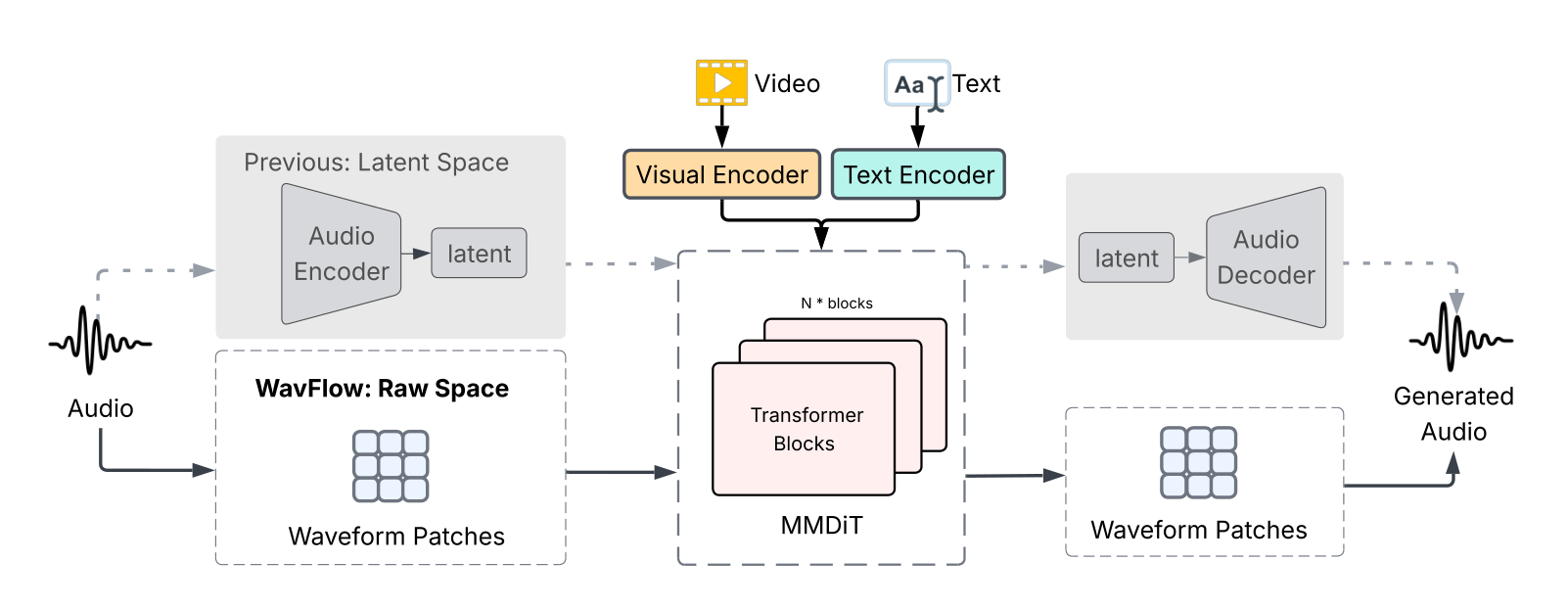
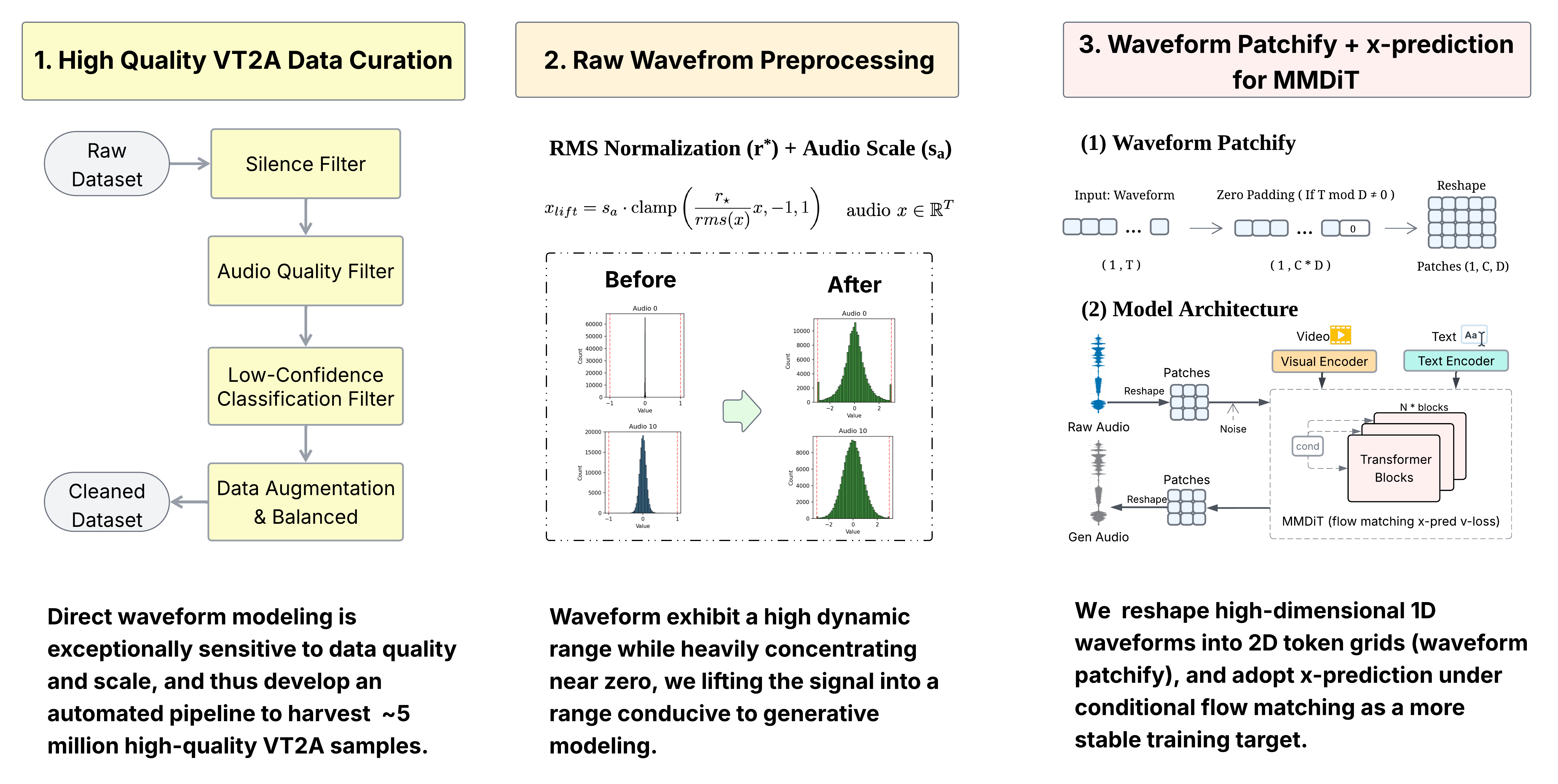
WavFlow introduces a paradigm for generating synchronized, high-fidelity audio from video and text inputs directly in the raw waveform space, bypassing latent compression entirely. Through waveform patchifying and amplitude lifting, WavFlow enables stable flow matching on raw audio via direct x-prediction. Evaluation on the VGGSound (VT2A) and AudioCaps (T2A) benchmarks shows that WavFlow delivers performance on par with established latent-based methods, proving that end-to-end waveform generation can match traditional frameworks in acoustic richness, fidelity, and synchronization.
See the Project Page for 24+ samples and side-by-side benchmark comparisons.
git clone https://github.com/facebookresearch/WavFlow.git
cd WavFlow
bash scripts/setup.sh        # creates conda env 'wavflow' and installs everything
conda activate wavflow
conda create -n wavflow python=3.10 -y
conda activate wavflow
pip install -r requirements.txt
pip install -e . --no-deps
conda install -n wavflow -c conda-forge "ffmpeg<7" -y    # for torio video decoding
All required external weights (CLIP, Synchformer, the empty-string CFG embedding) are downloaded or computed automatically on first run and cached under
~/.cache/wavflow/.
⚠️ Due to organizational policy constraints, we are currently unable to release the production-trained checkpoints. We are working on a foundation checkpoint trained on fully open-source data; in the meantime you can train your own — see the training guide.
Once you have a trained checkpoint, run:
bash scripts/launch/predict.sh [--gpu N] [--config PATH]
The default config is wavflow/configs/infer.yaml. The input CSV (data.csv_path) accepts video, text, or both:
video_path,caption,video_exist,text_exist
/abs/path/sample1.mp4,a whistling rocket explodes,1,1   # video + text
/abs/path/sample2.mp4,birds chirping in a forest,1,1    # video + text
,a whistling rocket explodes,0,1                        # text-only
/abs/path/sample3.mp4,,1,0                              # video-only
| Flag / env | Default | Description |
|---|---|---|
--gpu N (or GPU=N) | 0 | CUDA device index |
--config PATH (or CONFIG_PATH=...) | wavflow/configs/infer.yaml | YAML config to load |
WAVFLOW_ENV | wavflow | conda env name to auto-activate |
Any extra positional argument is forwarded to python -m wavflow.infer.
infer.yaml| Field | What to set |
|---|---|
data.csv_path | the input CSV (above) |
model.name | one of medium_16k, medium_44k, large_16k, large_44k (must match the trained ckpt) |
model.ckpt_path | a checkpoint_*.pth (full ckpt) or ema_epoch_*.pth (EMA-only) |
model.use_ema | true to load model_ema1 from a full ckpt; false to use the live model weights |
data.duration_sec / data.target_sample_rate | output length and SR (must match model arch) |
inference.cfg, sampling.num_steps, sampling.noise_scale, sampling.noise_shift, sampling.prediction_type, seed | sampling hyperparameters |
inference.batch_size | rows per ODE batch |
inference.trim_to_duration | trim output to duration_sec |
output.output_dir | where wavs are written |
output.loudness_norm, loudness_target_lufs | optional pyloudnorm post-processing |
video_exist=0 → uses learned empty CLIP/Sync tokens (no video decode)text_exist=0 → uses learned empty CLIP-text token (caption ignored)id column; otherwise the wav file name is derived from Path(video_path).stem, falling back to row_<idx> for text-only rowsThe EMA tensor stored as model_ema1 is updated with ema_decay = 0.9999 per step. After only a few hundred / thousand steps it still contains random-init values and produces noise during inference. Set model.use_ema: false (or pass an ema_epoch_*.pth saved after enough steps) when sampling from a short / overfit run.
For feature extraction and training (single-node and multi-node), see TRAINING.md.
@article{zhou2026wavflow,
  title={WavFlow: Audio Generation in Waveform Space},
  author={Zhou, Feiyan and Wang, Luyuan and Chen, Shoufa and Wang, Zhe and Liu, Zhiheng and Cong, Yuren and Zhang, Xiaohui and Yang, Fanny and Zeng, Belinda},
  journal={arXiv preprint arXiv:2605.18749},
  year={2026}
}
WavFlow builds on the open-source community. We gratefully acknowledge:
The majority of WavFlow is licensed under CC-BY-NC 4.0. Portions of the project are vendored from third-party open source projects under their original license terms (MIT, Apache 2.0, CC BY-NC 4.0, and Stability AI Community License). See NOTICE.txt for the full per-component breakdown and license texts.
1,105 followers · starred May 2026
971 followers · starred May 2026
597 followers · starred May 2026
72 followers · starred May 2026
MultiModal Audio Generation in Raw Waveform Space.
Python
158
6 commits
updated May 26, 2026
Feiyan Zhou1,2 · Luyuan Wang1 · Shoufa Chen1,* · Zhe Wang1 · Zhiheng Liu1 · Yuren Cong1 · Xiaohui Zhang1 · Fanny Yang1 · Belinda Zeng1
1 Meta AI · 2 Northeastern University
WavFlow introduces a paradigm for generating synchronized, high-fidelity audio from video and text inputs directly in the raw waveform space, bypassing latent compression entirely. Through waveform patchifying and amplitude lifting, WavFlow enables stable flow matching on raw audio via direct x-prediction. Evaluation on the VGGSound (VT2A) and AudioCaps (T2A) benchmarks shows that WavFlow delivers performance on par with established latent-based methods, proving that end-to-end waveform generation can match traditional frameworks in acoustic richness, fidelity, and synchronization.
See the Project Page for 24+ samples and side-by-side benchmark comparisons.
git clone https://github.com/facebookresearch/WavFlow.git
cd WavFlow
bash scripts/setup.sh        # creates conda env 'wavflow' and installs everything
conda activate wavflow
conda create -n wavflow python=3.10 -y
conda activate wavflow
pip install -r requirements.txt
pip install -e . --no-deps
conda install -n wavflow -c conda-forge "ffmpeg<7" -y    # for torio video decoding
All required external weights (CLIP, Synchformer, the empty-string CFG embedding) are downloaded or computed automatically on first run and cached under
~/.cache/wavflow/.
⚠️ Due to organizational policy constraints, we are currently unable to release the production-trained checkpoints. We are working on a foundation checkpoint trained on fully open-source data; in the meantime you can train your own — see the training guide.
Once you have a trained checkpoint, run:
bash scripts/launch/predict.sh [--gpu N] [--config PATH]
The default config is wavflow/configs/infer.yaml. The input CSV (data.csv_path) accepts video, text, or both:
video_path,caption,video_exist,text_exist
/abs/path/sample1.mp4,a whistling rocket explodes,1,1   # video + text
/abs/path/sample2.mp4,birds chirping in a forest,1,1    # video + text
,a whistling rocket explodes,0,1                        # text-only
/abs/path/sample3.mp4,,1,0                              # video-only
| Flag / env | Default | Description |
|---|---|---|
--gpu N (or GPU=N) | 0 | CUDA device index |
--config PATH (or CONFIG_PATH=...) | wavflow/configs/infer.yaml | YAML config to load |
WAVFLOW_ENV | wavflow | conda env name to auto-activate |
Any extra positional argument is forwarded to python -m wavflow.infer.
infer.yaml| Field | What to set |
|---|---|
data.csv_path | the input CSV (above) |
model.name | one of medium_16k, medium_44k, large_16k, large_44k (must match the trained ckpt) |
model.ckpt_path | a checkpoint_*.pth (full ckpt) or ema_epoch_*.pth (EMA-only) |
model.use_ema | true to load model_ema1 from a full ckpt; false to use the live model weights |
data.duration_sec / data.target_sample_rate | output length and SR (must match model arch) |
inference.cfg, sampling.num_steps, sampling.noise_scale, sampling.noise_shift, sampling.prediction_type, seed | sampling hyperparameters |
inference.batch_size | rows per ODE batch |
inference.trim_to_duration | trim output to duration_sec |
output.output_dir | where wavs are written |
output.loudness_norm, loudness_target_lufs | optional pyloudnorm post-processing |
video_exist=0 → uses learned empty CLIP/Sync tokens (no video decode)text_exist=0 → uses learned empty CLIP-text token (caption ignored)id column; otherwise the wav file name is derived from Path(video_path).stem, falling back to row_<idx> for text-only rowsThe EMA tensor stored as model_ema1 is updated with ema_decay = 0.9999 per step. After only a few hundred / thousand steps it still contains random-init values and produces noise during inference. Set model.use_ema: false (or pass an ema_epoch_*.pth saved after enough steps) when sampling from a short / overfit run.
For feature extraction and training (single-node and multi-node), see TRAINING.md.
@article{zhou2026wavflow,
  title={WavFlow: Audio Generation in Waveform Space},
  author={Zhou, Feiyan and Wang, Luyuan and Chen, Shoufa and Wang, Zhe and Liu, Zhiheng and Cong, Yuren and Zhang, Xiaohui and Yang, Fanny and Zeng, Belinda},
  journal={arXiv preprint arXiv:2605.18749},
  year={2026}
}
WavFlow builds on the open-source community. We gratefully acknowledge:
The majority of WavFlow is licensed under CC-BY-NC 4.0. Portions of the project are vendored from third-party open source projects under their original license terms (MIT, Apache 2.0, CC BY-NC 4.0, and Stability AI Community License). See NOTICE.txt for the full per-component breakdown and license texts.
1,105 followers · starred May 2026
971 followers · starred May 2026
597 followers · starred May 2026
72 followers · starred May 2026



