Pass-minimal out-of-cache FFT and the benchmark that derived it from the 'integer multiplication below n log n' research
See the codeSweepFFT: Pass-Minimal Algorithms for Out-of-Cache Fast Fourier Transforms.
Recent work proves integer multiplication and the DFT in O(n (log n)^{1-κ}) on a multitape Turing machine:
The gain itself, is unmeasurable at any size that fits in RAM. But the cost model the proofs optimise, passes over a tape, maps closely onto sweeps through DRAM, and that is what limits large FFTs.
At the largest transform length common to all systems, SweepFFT is 1.15–1.96× faster than MKL and 1.27–3.52× faster than FFTW under the headline protocol. The advantage depends on cache footprint, factorization, plan- ning and paging. A factorial ablation on one system attributes 94.5–99.6% of explained out-of-cache log-runtime variation to batching, fusion, their interaction, and non-temporal stores.
Full write-up: results/REPORT.md.
Each machine ran the full suite (scripts/run_machine.sh <label> --all) with the final code, including
both pre-registered studies from results/ENDPOINTS.md. Each study has 10 blocks of
fresh pinned processes, uses the geometric mean over 2^22 – 2^26, and reports 95% block-bootstrap intervals.
Every primary endpoint below favours pmfft with p_Holm = 0.002. Ordinary means caller arrays allocated
the ordinary way (the primary study); huge means caller arrays on 2 MB pages.
| machine | vs FFTW, ordinary | vs FFTW, huge | vs MKL, ordinary | vs MKL, huge | large non-powers of two vs MKL |
|---|---|---|---|---|---|
| Intel i7-13700H (laptop) | 1.18 [1.16, 1.20] | 1.45 | 1.03 [1.02, 1.04] | 1.13 | 2.29 |
| Intel Xeon Gold 6234 (server, Cascade Lake) | 1.23 [1.20, 1.25] | 1.39 | 1.18 [1.15, 1.20] | 1.19 | 1.20 |
| AMD EPYC 7302 (server, Zen 2) | 1.32 [1.30, 1.34] | 1.56 | 1.17 [1.16, 1.18] | 1.65 | 1.97 |
| AMD Ryzen 9 3900X (desktop, Zen 2) | 1.31 [1.30, 1.31] | 1.60 | 1.22 [1.22, 1.22] | 1.74 | 2.00 |
| AMD Ryzen 7 7800X3D (desktop, Zen 4, 96 MB L3) | 1.23 [1.22, 1.24] | 1.45 | 1.28 [1.26, 1.30] | 1.15 | 2.08 |
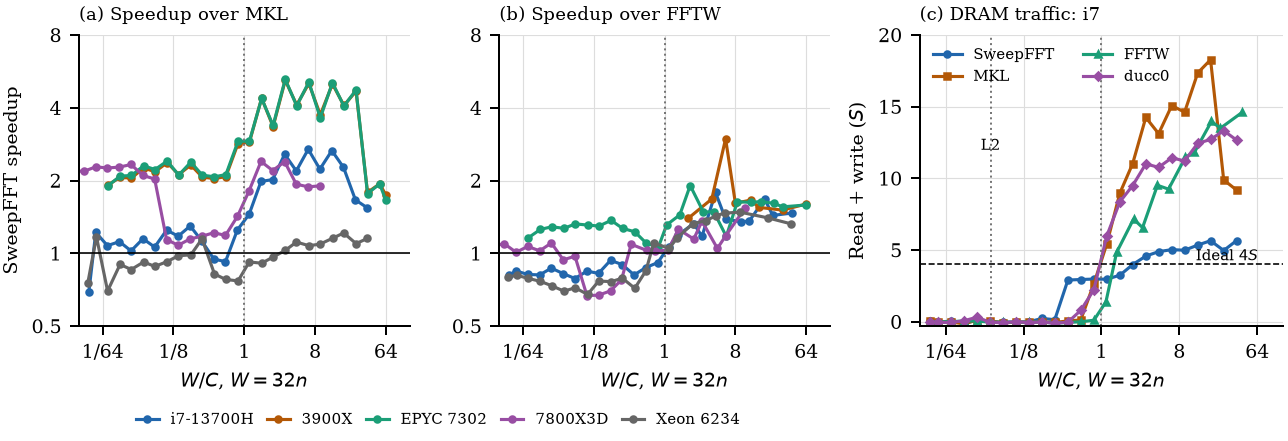
Fig. 1. SweepFFT's speedup over MKL (a) and FFTW (b) on all five machines, against W/C. W = 32n is the size of input plus output, and C is the local last-level cache. The curves are half-octave geometric means over 97 smooth sizes. The lead appears once the data no longer fit in the cache (W/C > 1). (c) DRAM traffic per transform on the i7, in sweeps S = 16n bytes, from calibrated memory-controller counters. The dashed line is the two-pass ideal of 4 S. Beyond the cache, SweepFFT stays near that ideal while the libraries move 2–3× more bytes.
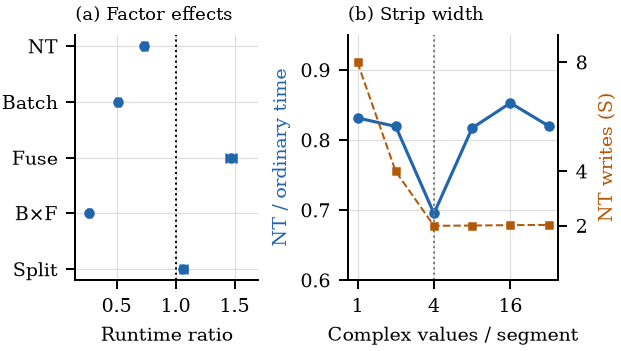
Fig. 2. Factorial ablation on the i7-13700H at 2^22. (a) Effect of each design choice on runtime, with 95% intervals: non-temporal stores (NT), batched strips (Batch), fused passes (Fuse), their interaction (B×F, a ratio of ratios; 1 would mean independence) and the split shape (Split). (b) Non-temporal over ordinary stores, in runtime and write traffic, against strip width. Non-temporal stores pay off once each segment covers a full cache line (four complex values).
Requirements:
git clone https://github.com/dzako/sweepfft && cd sweepfft
uv sync                                   # Python env (pandas, numpy, ...) for the scripts
scripts/setup_third_party.sh              # download + build FFTW 3.3.10, MKL 2024.2.2 (wheels), ducc0 (~5 min)
scripts/build.sh                          # build all benchmarks into build/
scripts/run_machine.sh my-box --quick     # 5-minute smoke test -> results/machines/my-box-quick/
scripts/run_machine.sh <label>            # full run (45-90 min)  -> results/machines/<label>/
scripts/run_machine.sh <label> --all      # every study below (~12-20 h)
Unless --mt is given, everything runs single-core, using the same protocol as the report:
fast=1;Add --mt for the multithreaded comparison. It runs pmfft_mt against threaded MKL and threaded
FFTW in one process, with 1, 2, 4, … threads up to the number of physical cores on socket 0 (on hybrid Intel CPUs that includes the E-cores), and with
DRAM traffic at the full thread count when the counters are enabled. FFTW plans every (threads, n) for up
to FFTW_TIMELIMIT_MT seconds (default 300), so --mt adds roughly 1 – 3 hours; many-core servers are
at the long end. It needs build/bench_dft_mt, which scripts/build.sh builds once
setup_third_party.sh has built FFTW with OpenMP. To run it alone:
uv run scripts/scale_mt.py --quick (smoke test) or uv run scripts/scale_mt.py --sizes 2^22,2^24.
On laptops, keep the machine plugged in and cool. Sustained all-core load triggers power limits that
move the results by 10 – 20%.
Add --cache-transition for the dense sweep of 97 smooth sizes across the L2, LLC and 2 – 8 × LLC
boundaries (about 1 hour; adds a phase-diagram figure), and --factorial for the full 2^4 factorial ablation of
NT stores × batching × fused transposes × split policy with an interaction model on log runtime (about
1 hour). Both use the DRAM counters when they are enabled.
Five further options test whether the results are robust and useful:
--fairness (~3–4 h): protocol sensitivity. It covers in-place, cold caches, fresh arrays, 4 KB or
all-huge pages, FFTW ESTIMATE / MEASURE / PATIENT with and without wisdom, first-call timing, an
x86-64-v3 build, and a matched-protocol comparison.--repro (~2–3 h): the reproducibility study with the endpoints fixed in advance in
results/ENDPOINTS.md. It runs 10 blocks, keeps every sample, logs clock and
temperature, and reports block-bootstrap intervals. It runs twice: with ordinarily allocated caller
arrays (the primary study, repro_plain.*) and with caller arrays on huge pages (repro.*).--caller-pages (~40 min): how the paging of the caller's arrays changes every library (huge-page
vs ordinary allocation, interleaved), plus the strided-gather microbenchmark that exposes L2 set
aliasing (GB/s vs rows, segment size, page size, stride padding).--overhead (~45 min): planning and memory overhead. It reports total time for 1 to 10,000 transforms,
break-even reuse counts, and the memory held after planning, the planning peak and the execution scratch.--contention (~2 h): controlled bandwidth contention, in two parts:
--ceiling (~1 h) times the two-pass plan with its arithmetic removed, with its memory traffic removed,
and as two plain streaming passes. This shows how much of the time is data movement, how much is
arithmetic, and how much the two overlap. It also maps the error budget of the Gaussian-resampling DFT for
large primes.
--all turns on every optional study (--ablations --mt --factorial --cache-transition --fairness --repro --overhead --contention --caller-pages --ceiling).
Add --ablations to re-check whether the key ideas carry over to your hardware: non-temporal stores,
batching, the four-step split shape, and explicit transposes.
DRAM-traffic counters (recommended). If system-wide perf counters are allowed, the run also measures DRAM bytes per transform. Enable them before the run (no reboot needed; the setting reverts at reboot):
sudo sysctl kernel.perf_event_paranoid=0
Counter support:
/sys/bus/event_source/devices has no amd_df, load the uncore driver first:
sudo modprobe amd_uncore.Pass --no-counters to skip it.
performance governor where you can: sudo cpupower frequency-set -g performance.madvise or always.BENCH_CPU=<cpu> and BENCH_CPUS=<a,b,c,...>.-march=native for your CPU, is the vendor-neutral one.FFTW_TIMELIMIT seconds per size
(default 60). On slower machines the large sizes can hit the cap, which yields a truncated, slow
plan; summary.md flags those sizes. For a fair comparison there:
results/machines/<label>/fftw_wisdom.dat;FFTW_TIMELIMIT=600 scripts/run_machine.sh <label>. This adds up to about 10 min of
planning per affected size.ryzen-3900x-wsl.After a full run, results/machines/<label>/ contains:
machine.txt, with lscpu, kernel, compiler, governor and memory size (no hostname or user data);summary.md;results/machines/COMPARISON.md puts all machines side by side. Commit the directory together with
the regenerated COMPARISON.md and open a pull request:
uv run scripts/compare_machines.py
git add results/machines/<label> results/machines/COMPARISON.md
scripts/run_all.sh reruns all ablations, the final comparisons, the Toeplitz tests (T1–T3) and the
analysis on the reference layout results/*.csv. It takes about 70 minutes. uv run scripts/analyze.py
regenerates results/tables.md and the figures.
csrc/common/common.h         aligned / huge-page allocation, timers, AVX2 complex helpers, accurate twiddles
csrc/ref/ref.h               __float128 reference DFT (error measurement)
csrc/dft/stockham.h          batched mixed-radix Stockham engine, fused radix-2^f passes      [I2, I9]
csrc/dft/rec4.h              recursive batched four-step, fused transposes, NT stores         [I1, I3, I4, I5, I11]
csrc/dft/rdit.h              depth-first recursive DIT for mid sizes
csrc/dft/arbitrary.h         Bluestein, Rader, Gaussian-resampling DFT                        [I7]
csrc/bench/impl_ours.c       all our variants + pmfft (the measuring planner), pmfft_heur, pmfft_mt
csrc/bench/impl_ext.c        FFTW / MKL wrappers;  impl_ducc.cpp: ducc0 wrapper
csrc/bench/bench_dft.c       driver -> CSV (time, GFlop/s = 5 n log2 n / t, error vs quad reference)
csrc/bench/bench_conv.c      cyclic convolution: library vs 3-sweep transposed-spectrum fusion [I9]
csrc/bench/bench_2d.c        2-D: Nussbaumer polynomial transform vs row-column               [I8]
csrc/tests/                  codelet/engine tests, transpose & axis-permutation benchmarks     [I1-toy, I14]
tests/test_toeplitz.py       Toeplitz representation tests T1-T3
scripts/                     setup_third_party.sh, build.sh, run_machine.sh, run_all.sh, run_bench.py,
                             scale_mp.py, scale_mt.py, mem_traffic.py, cache_transition.py (+ plot_cache_transition.py),
                             factorial.py, compare_machines.py, analyze.py, gen_codelets.py, cpus.py
results/                     reference-machine data, REPORT.md, tables.md, figures; machines/<label>/ per machine
If you use SweepFFT or its results, please cite the paper (doi:10.5281/zenodo.23322613):
@misc{cyranka2026sweepfft,
  author    = {Cyranka, Jacek},
  title     = {{SweepFFT}: Pass-Minimal Algorithms for Out-of-Cache Fast {Fourier} Transforms},
  year      = {2026},
  publisher = {Zenodo},
  note      = {Working paper, version 1},
  doi       = {10.5281/zenodo.23322613},
  url       = {https://doi.org/10.5281/zenodo.23322613}
}
GPL-2.0-or-later (see LICENSE).
The benchmark links against the following libraries. scripts/setup_third_party.sh downloads them; they
are not distributed with this repository:
Pass-minimal out-of-cache FFT and the benchmark that derived it from the 'integer multiplication below n log n' research
See the codeSweepFFT: Pass-Minimal Algorithms for Out-of-Cache Fast Fourier Transforms.
Recent work proves integer multiplication and the DFT in O(n (log n)^{1-κ}) on a multitape Turing machine:
The gain itself, is unmeasurable at any size that fits in RAM. But the cost model the proofs optimise, passes over a tape, maps closely onto sweeps through DRAM, and that is what limits large FFTs.
At the largest transform length common to all systems, SweepFFT is 1.15–1.96× faster than MKL and 1.27–3.52× faster than FFTW under the headline protocol. The advantage depends on cache footprint, factorization, plan- ning and paging. A factorial ablation on one system attributes 94.5–99.6% of explained out-of-cache log-runtime variation to batching, fusion, their interaction, and non-temporal stores.
Full write-up: results/REPORT.md.
Each machine ran the full suite (scripts/run_machine.sh <label> --all) with the final code, including
both pre-registered studies from results/ENDPOINTS.md. Each study has 10 blocks of
fresh pinned processes, uses the geometric mean over 2^22 – 2^26, and reports 95% block-bootstrap intervals.
Every primary endpoint below favours pmfft with p_Holm = 0.002. Ordinary means caller arrays allocated
the ordinary way (the primary study); huge means caller arrays on 2 MB pages.
| machine | vs FFTW, ordinary | vs FFTW, huge | vs MKL, ordinary | vs MKL, huge | large non-powers of two vs MKL |
|---|---|---|---|---|---|
| Intel i7-13700H (laptop) | 1.18 [1.16, 1.20] | 1.45 | 1.03 [1.02, 1.04] | 1.13 | 2.29 |
| Intel Xeon Gold 6234 (server, Cascade Lake) | 1.23 [1.20, 1.25] | 1.39 | 1.18 [1.15, 1.20] | 1.19 | 1.20 |
| AMD EPYC 7302 (server, Zen 2) | 1.32 [1.30, 1.34] | 1.56 | 1.17 [1.16, 1.18] | 1.65 | 1.97 |
| AMD Ryzen 9 3900X (desktop, Zen 2) | 1.31 [1.30, 1.31] | 1.60 | 1.22 [1.22, 1.22] | 1.74 | 2.00 |
| AMD Ryzen 7 7800X3D (desktop, Zen 4, 96 MB L3) | 1.23 [1.22, 1.24] | 1.45 | 1.28 [1.26, 1.30] | 1.15 | 2.08 |
Fig. 1. SweepFFT's speedup over MKL (a) and FFTW (b) on all five machines, against W/C. W = 32n is the size of input plus output, and C is the local last-level cache. The curves are half-octave geometric means over 97 smooth sizes. The lead appears once the data no longer fit in the cache (W/C > 1). (c) DRAM traffic per transform on the i7, in sweeps S = 16n bytes, from calibrated memory-controller counters. The dashed line is the two-pass ideal of 4 S. Beyond the cache, SweepFFT stays near that ideal while the libraries move 2–3× more bytes.
Fig. 2. Factorial ablation on the i7-13700H at 2^22. (a) Effect of each design choice on runtime, with 95% intervals: non-temporal stores (NT), batched strips (Batch), fused passes (Fuse), their interaction (B×F, a ratio of ratios; 1 would mean independence) and the split shape (Split). (b) Non-temporal over ordinary stores, in runtime and write traffic, against strip width. Non-temporal stores pay off once each segment covers a full cache line (four complex values).
Requirements:
git clone https://github.com/dzako/sweepfft && cd sweepfft
uv sync                                   # Python env (pandas, numpy, ...) for the scripts
scripts/setup_third_party.sh              # download + build FFTW 3.3.10, MKL 2024.2.2 (wheels), ducc0 (~5 min)
scripts/build.sh                          # build all benchmarks into build/
scripts/run_machine.sh my-box --quick     # 5-minute smoke test -> results/machines/my-box-quick/
scripts/run_machine.sh <label>            # full run (45-90 min)  -> results/machines/<label>/
scripts/run_machine.sh <label> --all      # every study below (~12-20 h)
Unless --mt is given, everything runs single-core, using the same protocol as the report:
fast=1;Add --mt for the multithreaded comparison. It runs pmfft_mt against threaded MKL and threaded
FFTW in one process, with 1, 2, 4, … threads up to the number of physical cores on socket 0 (on hybrid Intel CPUs that includes the E-cores), and with
DRAM traffic at the full thread count when the counters are enabled. FFTW plans every (threads, n) for up
to FFTW_TIMELIMIT_MT seconds (default 300), so --mt adds roughly 1 – 3 hours; many-core servers are
at the long end. It needs build/bench_dft_mt, which scripts/build.sh builds once
setup_third_party.sh has built FFTW with OpenMP. To run it alone:
uv run scripts/scale_mt.py --quick (smoke test) or uv run scripts/scale_mt.py --sizes 2^22,2^24.
On laptops, keep the machine plugged in and cool. Sustained all-core load triggers power limits that
move the results by 10 – 20%.
Add --cache-transition for the dense sweep of 97 smooth sizes across the L2, LLC and 2 – 8 × LLC
boundaries (about 1 hour; adds a phase-diagram figure), and --factorial for the full 2^4 factorial ablation of
NT stores × batching × fused transposes × split policy with an interaction model on log runtime (about
1 hour). Both use the DRAM counters when they are enabled.
Five further options test whether the results are robust and useful:
--fairness (~3–4 h): protocol sensitivity. It covers in-place, cold caches, fresh arrays, 4 KB or
all-huge pages, FFTW ESTIMATE / MEASURE / PATIENT with and without wisdom, first-call timing, an
x86-64-v3 build, and a matched-protocol comparison.--repro (~2–3 h): the reproducibility study with the endpoints fixed in advance in
results/ENDPOINTS.md. It runs 10 blocks, keeps every sample, logs clock and
temperature, and reports block-bootstrap intervals. It runs twice: with ordinarily allocated caller
arrays (the primary study, repro_plain.*) and with caller arrays on huge pages (repro.*).--caller-pages (~40 min): how the paging of the caller's arrays changes every library (huge-page
vs ordinary allocation, interleaved), plus the strided-gather microbenchmark that exposes L2 set
aliasing (GB/s vs rows, segment size, page size, stride padding).--overhead (~45 min): planning and memory overhead. It reports total time for 1 to 10,000 transforms,
break-even reuse counts, and the memory held after planning, the planning peak and the execution scratch.--contention (~2 h): controlled bandwidth contention, in two parts:
--ceiling (~1 h) times the two-pass plan with its arithmetic removed, with its memory traffic removed,
and as two plain streaming passes. This shows how much of the time is data movement, how much is
arithmetic, and how much the two overlap. It also maps the error budget of the Gaussian-resampling DFT for
large primes.
--all turns on every optional study (--ablations --mt --factorial --cache-transition --fairness --repro --overhead --contention --caller-pages --ceiling).
Add --ablations to re-check whether the key ideas carry over to your hardware: non-temporal stores,
batching, the four-step split shape, and explicit transposes.
DRAM-traffic counters (recommended). If system-wide perf counters are allowed, the run also measures DRAM bytes per transform. Enable them before the run (no reboot needed; the setting reverts at reboot):
sudo sysctl kernel.perf_event_paranoid=0
Counter support:
/sys/bus/event_source/devices has no amd_df, load the uncore driver first:
sudo modprobe amd_uncore.Pass --no-counters to skip it.
performance governor where you can: sudo cpupower frequency-set -g performance.madvise or always.BENCH_CPU=<cpu> and BENCH_CPUS=<a,b,c,...>.-march=native for your CPU, is the vendor-neutral one.FFTW_TIMELIMIT seconds per size
(default 60). On slower machines the large sizes can hit the cap, which yields a truncated, slow
plan; summary.md flags those sizes. For a fair comparison there:
results/machines/<label>/fftw_wisdom.dat;FFTW_TIMELIMIT=600 scripts/run_machine.sh <label>. This adds up to about 10 min of
planning per affected size.ryzen-3900x-wsl.After a full run, results/machines/<label>/ contains:
machine.txt, with lscpu, kernel, compiler, governor and memory size (no hostname or user data);summary.md;results/machines/COMPARISON.md puts all machines side by side. Commit the directory together with
the regenerated COMPARISON.md and open a pull request:
uv run scripts/compare_machines.py
git add results/machines/<label> results/machines/COMPARISON.md
scripts/run_all.sh reruns all ablations, the final comparisons, the Toeplitz tests (T1–T3) and the
analysis on the reference layout results/*.csv. It takes about 70 minutes. uv run scripts/analyze.py
regenerates results/tables.md and the figures.
csrc/common/common.h         aligned / huge-page allocation, timers, AVX2 complex helpers, accurate twiddles
csrc/ref/ref.h               __float128 reference DFT (error measurement)
csrc/dft/stockham.h          batched mixed-radix Stockham engine, fused radix-2^f passes      [I2, I9]
csrc/dft/rec4.h              recursive batched four-step, fused transposes, NT stores         [I1, I3, I4, I5, I11]
csrc/dft/rdit.h              depth-first recursive DIT for mid sizes
csrc/dft/arbitrary.h         Bluestein, Rader, Gaussian-resampling DFT                        [I7]
csrc/bench/impl_ours.c       all our variants + pmfft (the measuring planner), pmfft_heur, pmfft_mt
csrc/bench/impl_ext.c        FFTW / MKL wrappers;  impl_ducc.cpp: ducc0 wrapper
csrc/bench/bench_dft.c       driver -> CSV (time, GFlop/s = 5 n log2 n / t, error vs quad reference)
csrc/bench/bench_conv.c      cyclic convolution: library vs 3-sweep transposed-spectrum fusion [I9]
csrc/bench/bench_2d.c        2-D: Nussbaumer polynomial transform vs row-column               [I8]
csrc/tests/                  codelet/engine tests, transpose & axis-permutation benchmarks     [I1-toy, I14]
tests/test_toeplitz.py       Toeplitz representation tests T1-T3
scripts/                     setup_third_party.sh, build.sh, run_machine.sh, run_all.sh, run_bench.py,
                             scale_mp.py, scale_mt.py, mem_traffic.py, cache_transition.py (+ plot_cache_transition.py),
                             factorial.py, compare_machines.py, analyze.py, gen_codelets.py, cpus.py
results/                     reference-machine data, REPORT.md, tables.md, figures; machines/<label>/ per machine
If you use SweepFFT or its results, please cite the paper (doi:10.5281/zenodo.23322613):
@misc{cyranka2026sweepfft,
  author    = {Cyranka, Jacek},
  title     = {{SweepFFT}: Pass-Minimal Algorithms for Out-of-Cache Fast {Fourier} Transforms},
  year      = {2026},
  publisher = {Zenodo},
  note      = {Working paper, version 1},
  doi       = {10.5281/zenodo.23322613},
  url       = {https://doi.org/10.5281/zenodo.23322613}
}
GPL-2.0-or-later (see LICENSE).
The benchmark links against the following libraries. scripts/setup_third_party.sh downloads them; they
are not distributed with this repository:



