
FlashFFTConv: Efficient Convolutions for Long Sequences with Tensor Cores
C++
355
35 commits
updated Dec 28, 2024
README
FlashFFTConv: Efficient Convolutions for Long Sequences with Tensor Cores
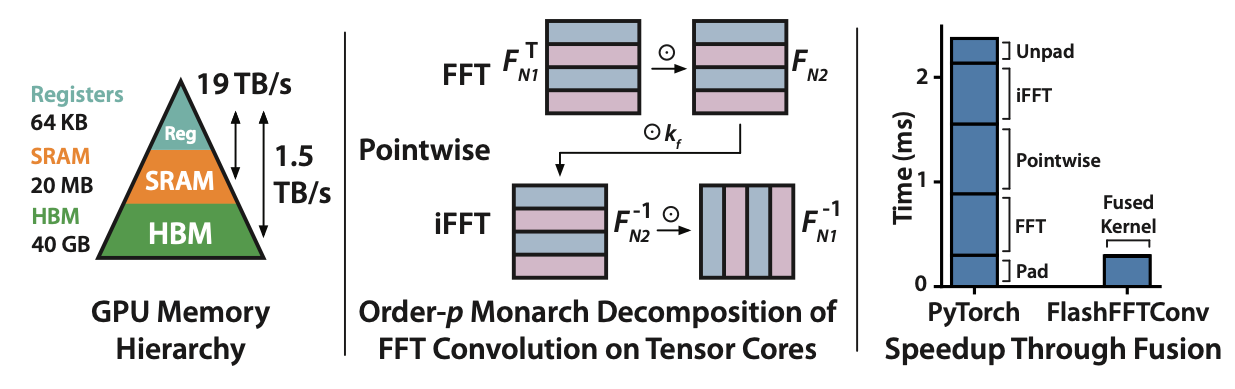
This repository contains the official code for FlashFFTConv, a fast algorithm for computing long depthwise convolutions using the FFT algorithm.
FlashFFTConv computes convolutions up to 7.93 times faster than PyTorch FFT convolutions, with up to 8.21 times less memory usage. FlashFFTConv supports convolution kernel lengths up to 4,194,304.
We also provide a fast kernel for short 1D depthwise convolutions (e.g., where the kernel length is on the order of 3/5), which runs 7 times faster than PyTorch Conv1D. This module is useful for additional speedup for language models like Monarch Mixer, H3, and Hyena.
FlashFFTConv: Efficient Convolutions for Long Sequences with Tensor Cores
Daniel Y. Fu*, Hermann Kumbong*, Eric Nguyen, Christopher Ré
Paper: https://arxiv.org/abs/2311.05908
Blog: https://hazyresearch.stanford.edu/blog/2023-11-13-flashfftconv

Examples and Usage
We've been happy to use FlashFFTConv to support various projects, including Monarch Mixer, Hyena/H3, HyenaDNA, and more. FlashFFTConv is also being used to train various new models that haven't been released yet - we'll be updating this README with pointers as they're publicly announced.
Check out the examples folder for end-to-end examples of how to use FlashFFTConv in your models.
You can also run a standalone CIFAR example to see usage as soon as the package is installed:
python standalone_cifar.py
Installation
Requirements: We recommend using the Nvidia PyTorch docker container. We've tested and developed this library on version 23.05.
- PyTorch 2.0 Required
- We have tested with CUDA version 12.1 and toolkit version 12.1
- We have tested this on A100 and H100, but it should work on any Ampere/Hopper architecture (3090, 4090, etc)
To check your CUDA version:
- Run
nvcc --versionand check the version number of your CUDA toolkit. Our Docker ships with version 12.1. - Run
nvidia-smito check the version of your CUDA drivers. Our Docker ships with version 12.1.
You can install via pip:
pip install git+https://github.com/HazyResearch/flash-fft-conv.git#subdirectory=csrc/flashfftconv
pip install git+https://github.com/HazyResearch/flash-fft-conv.git
Or from source:
git clone https://github.com/HazyResearch/flash-fft-conv.git

cd flash-fft-conv

cd csrc/flashfftconv
python setup.py install

cd ../..

python setup.py install
Once it's installed, you should be able to run the test suite:
pytest -s -q tests/test_flashfftconv.py
This test should run on machines with 40GB of GPU memory.
Short Depthwise Kernel
The short depthwise kernel is also installed with these commands. You can run this like this:
pytest -s -q tests/test_conv1d.py
How to Use FlashFFTConv
The flashfftconv package contains a PyTorch interface called FlashFFTConv, which is initialized with a particular FFT size.
This module computes an FFT convolution (iFFT(FFT(u) * FFT(k))).
from flashfftconv import FlashFFTConv
Usage:
from flashfftconv import FlashFFTConv

# size of the FFT
my_flashfftconv = FlashFFTConv(32768, dtype=torch.bfloat16) # generally more stable!

# B is batch size, H is model dimension, L is sequence length
B = 16
H = 768
# input can be smaller than FFT size, but needs to be divisible by 2
L = 16384

# the input, B H L
x = torch.randn(B, H, L, dtype=torch.bfloat16) # same type as the input
k = torch.randn(H, L, dtype=torch.float32) # kernel needs to be fp32 for now

out = my_flashfftconv(x, k)
Example Model
We recommend creating one FlashFFTConv object per model, and reusing it between layers.
For example:
import torch
from flashfftconv import FlashFFTConv

def MyModel(torch.nn.Module):
    def __init__(self, H, seqlen, num_layers):
        super().__init__()

        self.H = H
        self.seqlen = seqlen
        self.num_layers = num_layers
        self.flashfftconv = FlashFFTConv(seqlen, dtype=torch.bfloat16)

        # create your conv layers
        self.long_conv_layers = torch.nn.ModuleList([
            ConvLayer(H, seqlen)
            for i in range(num_layers)
        ])

        # add a pointer to the flashfft object in each layer
        for layer in self.long_conv_layers:
            layer.flashfftconv = self.flashfftconv

        ...

    def forward(self, x):
        for layer in self.long_conv_layers:
            x = layer(x)

        return x

def ConvLayer(torch.nn.Module):
    def __init__(self, H, seqlen):
        self.k = torch.nn.Parameter(torch.randn(H, seqlen, dtype=torch.float32))
        ...

    def forward(self, x):
        return self.flashfftconv(x, self.k) # self.flashfftconv comes from the wrapper model!
Gating and Implicit Padding
A common use case for long FFT convolutions is for language modeling. These architectures often use gated convolutions and pad the inputs with zeros to ensure causality.
For example, a gated causal convolution might look like this in PyTorch:
def gated_conv(u, k, in_gate, out_gate):
    # u, in_gate, and out_gate have shape B, H, L
    # k has shape H, L
    B, H, L = u.shape
    fft_size = 2 * L
    padding = fft_size - L
    u = torch.nn.functional.pad(u, (0, padding))
    k = torch.nn.functional.pad(k, (0, padding))
    in_gate = torch.nn.functional.pad(in_gate, (0, padding))
    out_gate = torch.nn.functional.pad(out_gate, (0, padding))

    # compute the gated convolution
    u_f = torch.fft.fft(u * in_gate, dim=-1)
    k_f = torch.fft.fft(k, dim=-1)
    y_f = u_f * k_f
    y = torch.fft.ifft(y_f, dim=-1).real * out_gate
    return y
Each of these padding operations, as well as the gating operations, incur expensive memory I/Os, which slows down the model.
FlashFFTConv supports implicit padding and gating without the need for extra I/O:
L = ... # get L from somewhere
flashfftconv = FlashFFTConv(2 * L, dtype=torch.bfloat16) # bf16 is usually necessary for gating
y = flashfftconv(u, k, in_gate, out_gate)
Short Depthwise Convolutions
For short, depthwise convolutions (groups = dimension in PyTorch Conv1D), you can run them like this:
from flashfftconv import FlashDepthwiseConv1d

# set up PyTorch equivalent to get the weights
# in_channels = out_channels, and kernel size must be odd
conv1d_torch = nn.Conv1d(
    in_channels = d,
    out_channels = d,
    kernel_size = k,
    groups = d,
    padding = padding,
    dtype = dtype
)

flash_conv1d = FlashDepthWiseConv1d(
    channels = d,
    kernel_size=k,
    padding=padding,
    weights=conv1d_torch.weight,
    bias=conv1d_torch.bias,
    dtype = dtype # this should be the dtype of the weights
)

out_torch = conv1d_torch(x) # x is B, d, L
out_flash = flash_conv1d(x) # x can be a different dtype than weights

# out_torch and out_flash should be the same!
To support mixed precision training, FlashDepthWiseConv1d supports using fp32 weights with fp16 inputs (or fp32 inputs).
Currently the bf16 backward pass has a bug, but the forward pass is supported.
Benchmarking
FlashFFTConv Benchmarks
To run FlashFFTConv benchmarks, install the module and run python benchmarks/benchmark_flashfftconv.py.
These are the runtimes we see for a gated convolution for various sequence lengths, on one H100-SXM. All results scaled to batch size 64, hidden dimension 768.
| Sequence Length | 256 | 1K | 4K | 8K | 16K | 32K | 1M | 2M | 4M |
|---|---|---|---|---|---|---|---|---|---|
| PyTorch | 0.62 | 2.30 | 9.49 | 19.4 | 29.9 | 84.8 | 3,071.4 | 6,342.6 | 13,031.2 |
| FlashFFTConv | 0.11 | 0.29 | 1.43 | 3.58 | 12.2 | 26.3 | 1,768.9 | 4,623.5 | 10,049.4 |
| Speedup | 5.64× | 7.93× | 6.64× | 5.42× | 2.45× | 3.22× | 1.74× | 1.37× | 1.30× |
| Memory Savings | 6.65× | 6.40× | 6.35× | 6.34× | 6.17× | 5.87× | 2.82× | 2.81× | 2.81× |
Please see our paper for more benchmarks!
Short Depthwise Convolution Benchmarks
To benchmark short depthwise convolutions, install the module and run python benchmarks/benchmark_conv1d.py.
Here are some results for BLH input on H100:
| B | L | D | K | torch time (ms) | cudatime (ms) | speedup |
|---|---|---|---|---|---|---|
| 16 | 1024 | 768 | 5 | 0.19 | 0.03 | 5.50 |
| 16 | 1024 | 1024 | 5 | 0.25 | 0.04 | 6.00 |
| 16 | 1024 | 2048 | 5 | 0.50 | 0.08 | 6.50 |
| 16 | 1024 | 8192 | 5 | 2.08 | 0.29 | 7.21 |
| 16 | 2048 | 768 | 5 | 0.37 | 0.06 | 5.91 |
| 16 | 2048 | 1024 | 5 | 0.50 | 0.08 | 6.33 |
| 16 | 2048 | 2048 | 5 | 1.00 | 0.15 | 6.77 |
| 16 | 2048 | 8192 | 5 | 4.17 | 0.57 | 7.31 |
| 16 | 4096 | 768 | 5 | 0.74 | 0.12 | 6.17 |
| 16 | 4096 | 1024 | 5 | 0.99 | 0.15 | 6.56 |
| 16 | 4096 | 2048 | 5 | 2.03 | 0.29 | 7.04 |
| 16 | 4096 | 8192 | 5 | 8.25 | 1.14 | 7.27 |
| 16 | 8192 | 768 | 5 | 1.49 | 0.23 | 6.36 |
| 16 | 8192 | 1024 | 5 | 2.01 | 0.30 | 6.80 |
| 16 | 8192 | 2048 | 5 | 4.10 | 0.57 | 7.18 |
| 16 | 8192 | 8192 | 5 | 16.42 | 2.26 | 7.26 |
We also support BHL input, but it's a bit slower (still optimizing!).
Input Requirements and Notes
Currently, we have a few requirements on the inputs to the interface to FlashFFTConv:
- We assume that the input
uhas shape(B, H, L), and the kernelkhas shape(H, L). - These inputs must be contiguous in GPU memory (
u.is_contiguous()should be True). - The FFT size (
seqlenthatFlashFFTConvis initialized with) must be a power of two between 256 and 4,194,304. - For FFT sizes larger than 32,768,
Hmust be a multiple of 16. Lcan be smaller than FFT size but must be divisible by 2. For FFT sizes512and2048,Lmust be divisible by 4.- We only support FP16 and BF16 for now. FP16 is faster, but we generally find BF16 more stable during training.
- For short depthwise convs, we only support FP16 for now, and the kernel size has to be odd.
Citation
This work builds on a line of work studying how to make FFT convolutions efficient on GPUs:
- Monarch Mixer: A Simple Sub-Quadratic GEMM-Based Architecture
- Simple Hardware-Efficient Long Convolutions for Sequence Modeling
- Hungry Hungry Hippos: Towards Language Modeling with State Space Models
If you use this codebase or otherwise found the ideas useful, please reach out to let us know - we love hearing about how our work is being used! You can reach Dan at danfu@cs.stanford.edu.
You can also cite our work:
@inproceedings{fu2024flashfftconv,
  title={Flash{FFTC}onv: Efficient Convolutions for Long Sequences with Tensor Cores},
  author={Fu, Daniel Y. and Kumbong, Hermann and Nguyen, Eric and R{\'e}, Christopher},
  booktitle={International Conference on Learning Representations},
  year={2024}
}

@inproceedings{fu2023monarch,
  title={Monarch {M}ixer: A Simple Sub-Quadratic GEMM-Based Architecture},
  author={Fu, Daniel Y. and Arora, Simran and Grogan, Jessica and Johnson, Isys and Eyuboglu, Sabri and Thomas, Armin W and Spector, Benjamin and Poli, Michael and Rudra, Atri and R{\'e}, Christopher},
  booktitle={Advances in Neural Information Processing Systems},
  year={2023}
}

@inproceedings{fu2023simple,
  title={Simple Hardware-Efficient Long Convolutions for Sequence Modeling},
  author={Fu, Daniel Y. and Epstein, Elliot L. and Nguyen, Eric and Thomas, Armin W. and Zhang, Michael and Dao, Tri and Rudra, Atri and R{\'e}, Christopher},
  journal={International Conference on Machine Learning},
  year={2023}
}

@inproceedings{fu2023hungry,
  title={Hungry {H}ungry {H}ippos: Towards Language Modeling with State Space Models},
  author={Fu, Daniel Y. and Dao, Tri and Saab, Khaled K. and Thomas, Armin W.
  and Rudra, Atri and R{\'e}, Christopher},
  booktitle={International Conference on Learning Representations},
  year={2023}
}
Contributors


Similar repos


Languages
C++
62.5%
Cuda
25.5%
Python
12.0%
FlashFFTConv: Efficient Convolutions for Long Sequences with Tensor Cores
C++
355
35 commits
updated Dec 28, 2024
README
FlashFFTConv: Efficient Convolutions for Long Sequences with Tensor Cores
This repository contains the official code for FlashFFTConv, a fast algorithm for computing long depthwise convolutions using the FFT algorithm.
FlashFFTConv computes convolutions up to 7.93 times faster than PyTorch FFT convolutions, with up to 8.21 times less memory usage. FlashFFTConv supports convolution kernel lengths up to 4,194,304.
We also provide a fast kernel for short 1D depthwise convolutions (e.g., where the kernel length is on the order of 3/5), which runs 7 times faster than PyTorch Conv1D. This module is useful for additional speedup for language models like Monarch Mixer, H3, and Hyena.
FlashFFTConv: Efficient Convolutions for Long Sequences with Tensor Cores
Daniel Y. Fu*, Hermann Kumbong*, Eric Nguyen, Christopher Ré
Paper: https://arxiv.org/abs/2311.05908
Blog: https://hazyresearch.stanford.edu/blog/2023-11-13-flashfftconv
Examples and Usage
We've been happy to use FlashFFTConv to support various projects, including Monarch Mixer, Hyena/H3, HyenaDNA, and more. FlashFFTConv is also being used to train various new models that haven't been released yet - we'll be updating this README with pointers as they're publicly announced.
Check out the examples folder for end-to-end examples of how to use FlashFFTConv in your models.
You can also run a standalone CIFAR example to see usage as soon as the package is installed:
python standalone_cifar.py
Installation
Requirements: We recommend using the Nvidia PyTorch docker container. We've tested and developed this library on version 23.05.
- PyTorch 2.0 Required
- We have tested with CUDA version 12.1 and toolkit version 12.1
- We have tested this on A100 and H100, but it should work on any Ampere/Hopper architecture (3090, 4090, etc)
To check your CUDA version:
- Run
nvcc --versionand check the version number of your CUDA toolkit. Our Docker ships with version 12.1. - Run
nvidia-smito check the version of your CUDA drivers. Our Docker ships with version 12.1.
You can install via pip:
pip install git+https://github.com/HazyResearch/flash-fft-conv.git#subdirectory=csrc/flashfftconv
pip install git+https://github.com/HazyResearch/flash-fft-conv.git
Or from source:
git clone https://github.com/HazyResearch/flash-fft-conv.git

cd flash-fft-conv

cd csrc/flashfftconv
python setup.py install

cd ../..

python setup.py install
Once it's installed, you should be able to run the test suite:
pytest -s -q tests/test_flashfftconv.py
This test should run on machines with 40GB of GPU memory.
Short Depthwise Kernel
The short depthwise kernel is also installed with these commands. You can run this like this:
pytest -s -q tests/test_conv1d.py
How to Use FlashFFTConv
The flashfftconv package contains a PyTorch interface called FlashFFTConv, which is initialized with a particular FFT size.
This module computes an FFT convolution (iFFT(FFT(u) * FFT(k))).
from flashfftconv import FlashFFTConv
Usage:
from flashfftconv import FlashFFTConv

# size of the FFT
my_flashfftconv = FlashFFTConv(32768, dtype=torch.bfloat16) # generally more stable!

# B is batch size, H is model dimension, L is sequence length
B = 16
H = 768
# input can be smaller than FFT size, but needs to be divisible by 2
L = 16384

# the input, B H L
x = torch.randn(B, H, L, dtype=torch.bfloat16) # same type as the input
k = torch.randn(H, L, dtype=torch.float32) # kernel needs to be fp32 for now

out = my_flashfftconv(x, k)
Example Model
We recommend creating one FlashFFTConv object per model, and reusing it between layers.
For example:
import torch
from flashfftconv import FlashFFTConv

def MyModel(torch.nn.Module):
    def __init__(self, H, seqlen, num_layers):
        super().__init__()

        self.H = H
        self.seqlen = seqlen
        self.num_layers = num_layers
        self.flashfftconv = FlashFFTConv(seqlen, dtype=torch.bfloat16)

        # create your conv layers
        self.long_conv_layers = torch.nn.ModuleList([
            ConvLayer(H, seqlen)
            for i in range(num_layers)
        ])

        # add a pointer to the flashfft object in each layer
        for layer in self.long_conv_layers:
            layer.flashfftconv = self.flashfftconv

        ...

    def forward(self, x):
        for layer in self.long_conv_layers:
            x = layer(x)

        return x

def ConvLayer(torch.nn.Module):
    def __init__(self, H, seqlen):
        self.k = torch.nn.Parameter(torch.randn(H, seqlen, dtype=torch.float32))
        ...

    def forward(self, x):
        return self.flashfftconv(x, self.k) # self.flashfftconv comes from the wrapper model!
Gating and Implicit Padding
A common use case for long FFT convolutions is for language modeling. These architectures often use gated convolutions and pad the inputs with zeros to ensure causality.
For example, a gated causal convolution might look like this in PyTorch:
def gated_conv(u, k, in_gate, out_gate):
    # u, in_gate, and out_gate have shape B, H, L
    # k has shape H, L
    B, H, L = u.shape
    fft_size = 2 * L
    padding = fft_size - L
    u = torch.nn.functional.pad(u, (0, padding))
    k = torch.nn.functional.pad(k, (0, padding))
    in_gate = torch.nn.functional.pad(in_gate, (0, padding))
    out_gate = torch.nn.functional.pad(out_gate, (0, padding))

    # compute the gated convolution
    u_f = torch.fft.fft(u * in_gate, dim=-1)
    k_f = torch.fft.fft(k, dim=-1)
    y_f = u_f * k_f
    y = torch.fft.ifft(y_f, dim=-1).real * out_gate
    return y
Each of these padding operations, as well as the gating operations, incur expensive memory I/Os, which slows down the model.
FlashFFTConv supports implicit padding and gating without the need for extra I/O:
L = ... # get L from somewhere
flashfftconv = FlashFFTConv(2 * L, dtype=torch.bfloat16) # bf16 is usually necessary for gating
y = flashfftconv(u, k, in_gate, out_gate)
Short Depthwise Convolutions
For short, depthwise convolutions (groups = dimension in PyTorch Conv1D), you can run them like this:
from flashfftconv import FlashDepthwiseConv1d

# set up PyTorch equivalent to get the weights
# in_channels = out_channels, and kernel size must be odd
conv1d_torch = nn.Conv1d(
    in_channels = d,
    out_channels = d,
    kernel_size = k,
    groups = d,
    padding = padding,
    dtype = dtype
)

flash_conv1d = FlashDepthWiseConv1d(
    channels = d,
    kernel_size=k,
    padding=padding,
    weights=conv1d_torch.weight,
    bias=conv1d_torch.bias,
    dtype = dtype # this should be the dtype of the weights
)

out_torch = conv1d_torch(x) # x is B, d, L
out_flash = flash_conv1d(x) # x can be a different dtype than weights

# out_torch and out_flash should be the same!
To support mixed precision training, FlashDepthWiseConv1d supports using fp32 weights with fp16 inputs (or fp32 inputs).
Currently the bf16 backward pass has a bug, but the forward pass is supported.
Benchmarking
FlashFFTConv Benchmarks
To run FlashFFTConv benchmarks, install the module and run python benchmarks/benchmark_flashfftconv.py.
These are the runtimes we see for a gated convolution for various sequence lengths, on one H100-SXM. All results scaled to batch size 64, hidden dimension 768.
| Sequence Length | 256 | 1K | 4K | 8K | 16K | 32K | 1M | 2M | 4M |
|---|---|---|---|---|---|---|---|---|---|
| PyTorch | 0.62 | 2.30 | 9.49 | 19.4 | 29.9 | 84.8 | 3,071.4 | 6,342.6 | 13,031.2 |
| FlashFFTConv | 0.11 | 0.29 | 1.43 | 3.58 | 12.2 | 26.3 | 1,768.9 | 4,623.5 | 10,049.4 |
| Speedup | 5.64× | 7.93× | 6.64× | 5.42× | 2.45× | 3.22× | 1.74× | 1.37× | 1.30× |
| Memory Savings | 6.65× | 6.40× | 6.35× | 6.34× | 6.17× | 5.87× | 2.82× | 2.81× | 2.81× |
Please see our paper for more benchmarks!
Short Depthwise Convolution Benchmarks
To benchmark short depthwise convolutions, install the module and run python benchmarks/benchmark_conv1d.py.
Here are some results for BLH input on H100:
| B | L | D | K | torch time (ms) | cudatime (ms) | speedup |
|---|---|---|---|---|---|---|
| 16 | 1024 | 768 | 5 | 0.19 | 0.03 | 5.50 |
| 16 | 1024 | 1024 | 5 | 0.25 | 0.04 | 6.00 |
| 16 | 1024 | 2048 | 5 | 0.50 | 0.08 | 6.50 |
| 16 | 1024 | 8192 | 5 | 2.08 | 0.29 | 7.21 |
| 16 | 2048 | 768 | 5 | 0.37 | 0.06 | 5.91 |
| 16 | 2048 | 1024 | 5 | 0.50 | 0.08 | 6.33 |
| 16 | 2048 | 2048 | 5 | 1.00 | 0.15 | 6.77 |
| 16 | 2048 | 8192 | 5 | 4.17 | 0.57 | 7.31 |
| 16 | 4096 | 768 | 5 | 0.74 | 0.12 | 6.17 |
| 16 | 4096 | 1024 | 5 | 0.99 | 0.15 | 6.56 |
| 16 | 4096 | 2048 | 5 | 2.03 | 0.29 | 7.04 |
| 16 | 4096 | 8192 | 5 | 8.25 | 1.14 | 7.27 |
| 16 | 8192 | 768 | 5 | 1.49 | 0.23 | 6.36 |
| 16 | 8192 | 1024 | 5 | 2.01 | 0.30 | 6.80 |
| 16 | 8192 | 2048 | 5 | 4.10 | 0.57 | 7.18 |
| 16 | 8192 | 8192 | 5 | 16.42 | 2.26 | 7.26 |
We also support BHL input, but it's a bit slower (still optimizing!).
Input Requirements and Notes
Currently, we have a few requirements on the inputs to the interface to FlashFFTConv:
- We assume that the input
uhas shape(B, H, L), and the kernelkhas shape(H, L). - These inputs must be contiguous in GPU memory (
u.is_contiguous()should be True). - The FFT size (
seqlenthatFlashFFTConvis initialized with) must be a power of two between 256 and 4,194,304. - For FFT sizes larger than 32,768,
Hmust be a multiple of 16. Lcan be smaller than FFT size but must be divisible by 2. For FFT sizes512and2048,Lmust be divisible by 4.- We only support FP16 and BF16 for now. FP16 is faster, but we generally find BF16 more stable during training.
- For short depthwise convs, we only support FP16 for now, and the kernel size has to be odd.
Citation
This work builds on a line of work studying how to make FFT convolutions efficient on GPUs:
- Monarch Mixer: A Simple Sub-Quadratic GEMM-Based Architecture
- Simple Hardware-Efficient Long Convolutions for Sequence Modeling
- Hungry Hungry Hippos: Towards Language Modeling with State Space Models
If you use this codebase or otherwise found the ideas useful, please reach out to let us know - we love hearing about how our work is being used! You can reach Dan at danfu@cs.stanford.edu.
You can also cite our work:
@inproceedings{fu2024flashfftconv,
  title={Flash{FFTC}onv: Efficient Convolutions for Long Sequences with Tensor Cores},
  author={Fu, Daniel Y. and Kumbong, Hermann and Nguyen, Eric and R{\'e}, Christopher},
  booktitle={International Conference on Learning Representations},
  year={2024}
}

@inproceedings{fu2023monarch,
  title={Monarch {M}ixer: A Simple Sub-Quadratic GEMM-Based Architecture},
  author={Fu, Daniel Y. and Arora, Simran and Grogan, Jessica and Johnson, Isys and Eyuboglu, Sabri and Thomas, Armin W and Spector, Benjamin and Poli, Michael and Rudra, Atri and R{\'e}, Christopher},
  booktitle={Advances in Neural Information Processing Systems},
  year={2023}
}

@inproceedings{fu2023simple,
  title={Simple Hardware-Efficient Long Convolutions for Sequence Modeling},
  author={Fu, Daniel Y. and Epstein, Elliot L. and Nguyen, Eric and Thomas, Armin W. and Zhang, Michael and Dao, Tri and Rudra, Atri and R{\'e}, Christopher},
  journal={International Conference on Machine Learning},
  year={2023}
}

@inproceedings{fu2023hungry,
  title={Hungry {H}ungry {H}ippos: Towards Language Modeling with State Space Models},
  author={Fu, Daniel Y. and Dao, Tri and Saab, Khaled K. and Thomas, Armin W.
  and Rudra, Atri and R{\'e}, Christopher},
  booktitle={International Conference on Learning Representations},
  year={2023}
}
Similar repos
Contributors
Languages
C++
62.5%
Cuda
25.5%
Python
12.0%