Decision models (Laya, Kev) in any web page: a zero-dependency Rust engine compiled to WebAssembly, with WebGPU kernels. One import, no server.
See the codeAsk questions about text with Laya, Kev, H2O-Lightning, Clef-flash, SemIf, and Gemma 4 running on the user's own hardware.
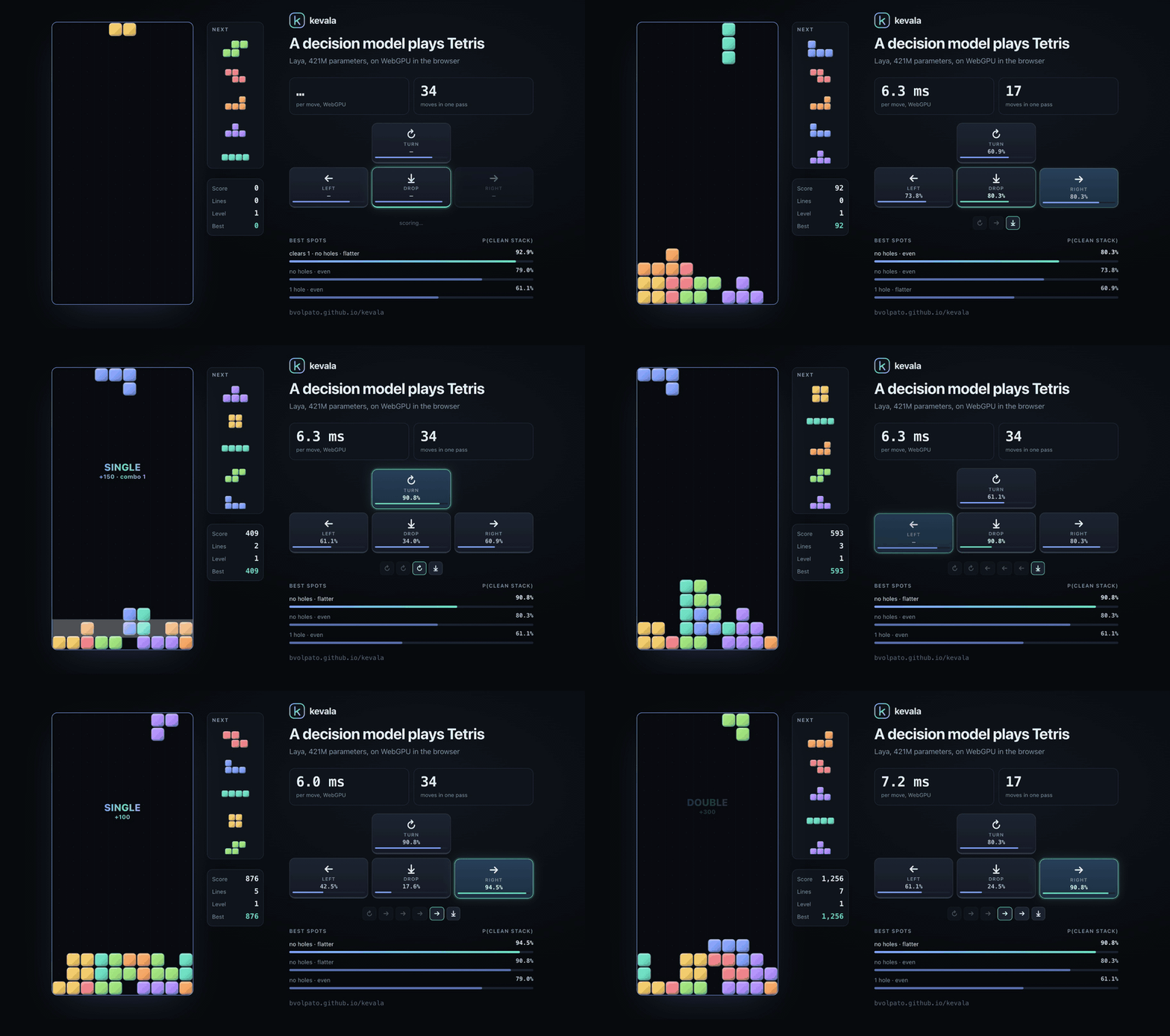
Live site · Playground · Tetris · npm · Examples · How it works
kevala runs Laya,
Kev v1.0, H2O-Lightning-4B,
Cloudflare Clef-flash, frozen Qwen3.5 models, and
Gemma 4 with SemIf option scoring
inside the browser.
You give it text or JSON and typed questions (noul for yes/no, choice, score), and it scores
the options without generating an answer token by token. There is no model server, no API key,
and no data leaving the tab.
Gemma 4 E2B also accepts images when you load its compatible vision companion on WebGPU.
The engine is Rust with zero dependencies, compiled to WebAssembly, plus WebGPU kernels written for these models. The browser runtime is a few plain ES modules. Existing Laya, SemIf, and Gemma packs download from Hugging Face and are cached in the browser. Kev v1.0 and the new H2O and Clef entries default to BF16 conversion; Q8 is an explicit smaller-pack option. Kev-0.8B can convert in the browser. Larger models need a native converted pack, and the new packs are not published yet.
From a CDN, in any page:
<script type="module">
  import { Kevala } from "https://cdn.jsdelivr.net/npm/kevala@latest/js/src/index.js";

  const kevala = await Kevala.load({ model: "laya", onProgress: console.log });
  const r = await kevala.decide("We were billed twice. Refund the duplicate today or we cancel.", {
    team: { type: "choice", instructions: "Which team should handle this?",
            criteria: { billing: "invoices, payments, refunds", technical: "bugs, outages", other: "anything else" } },
    churn: { type: "noul", instructions: "Does the customer threaten to leave?" },
  });
  console.log(r.answers.team.choice, r.answers.churn.noul); // "billing" 0.87
</script>
The current npm release contains Laya and Kev-0.8B. To load the other families before the next release, import the runtime that the website serves:
import { Kevala } from "https://bvolpato.github.io/kevala/js/src/index.js";
Or install from the npm registry with pnpm, with any bundler (Vite, webpack, esbuild) or none:
pnpm add kevala
import { Kevala } from "kevala";
Building with a coding agent? The site has a prompt to paste into it,
and skills/kevala/SKILL.md is the same guide as an agent skill.
The first visit downloads a published pack or the pinned source checkpoint, depending on the model.
Browser storage
avoids that download on later visits; loading still includes reading the weights, allocating memory,
and warming up the backend. Time depends on the model and hardware. It works from any origin and
needs no special headers. For Laya or Kev-0.8B, pass from: "checkpoint" to convert the original
weights in the browser. To serve weights yourself, pass the URL of a .kevala file. See
Packs for both, and for how the packs are made and published.
| Family | Model name | Decision readout | Output pack size |
|---|---|---|---|
| Laya | laya | Marker scorer and act head | 479 MB Q8 |
| Kev v1.0 | kev-0.8b | Trained pointer head | 1.51 GB BF16; 857 MB Q8 |
| Kev v1.0 | kev-4b | Trained pointer head | 8.43 GB BF16; 4.76 GB Q8 |
| Kev v1.0 | kev-9b | Trained pointer head | 15.90 GB BF16; 8.96 GB Q8 |
| H2O-Lightning | h2o-lightning-4b | Calibrated option-label scores | 8.43 GB BF16; 4.75 GB Q8 |
| Cloudflare | clef-flash | Joint decision head | About 18.41 GB BF16; 10.59 GB Q8 |
| SemIf | semif-qwen3.5-0.8b | Native option-label logits | 855 MB |
| SemIf | semif-qwen3.5-2b | Native option-label logits | 2.13 GB |
| SemIf | semif-qwen3.5-4b | Native option-label logits | 4.75 GB |
| Gemma 4 | gemma-4-e2b | Native option-label logits | 5.22 GB |
| Gemma 4 | gemma-4-e4b | Native option-label logits | 8.41 GB |
Clef sizes are estimates; the other BF16/Q8 output sizes come from exact local conversions or published pack manifests.
The local conversions also write SHA-256 manifests; the new packs are not published yet. The refreshed Kev, H2O, and Clef
packs default to BF16. Pass precision: "q8" to opt into quantization and a smaller download;
probabilities can change. H2O and Clef are text-only in this runtime, even though their upstream
materials include image capabilities.
Laya uses a ModernBERT-large encoder. Kev v1.0 uses Qwen3.5 base models with its merged LoRA adapter and trained pointer head. Its response uses four decimal places and a revised confidence calculation. H2O-Lightning uses its own decision prompt, label readout, and calibration. Clef-flash uses a separate joint decision head. SemIf applies direct option scoring to frozen Qwen3.5 instruction models. Gemma 4 uses Google's frozen E2B and E4B instruction weights with the same direct option readout; these are dense text-only packs with Gemma's per-layer embeddings, not MoE models. See the model guide and Gemma 4 notes for their differences and backend limits.
Published Laya, SemIf, and Gemma 4 packs load directly. Kev-0.8B converts its pinned checkpoint in the browser; Kev-4B/9B, H2O-Lightning, and Clef-flash need native conversion until their packs are published. You can load a converted pack by URL through the runtime API. In the 4B website preview, Kev-4B and H2O-Lightning expose a required URL field when no matching local pack is available; Kev-9B and Clef-flash are outside the picker cap.
The website preview picker is limited to 4B and smaller: Laya, Kev-0.8B/4B, H2O-Lightning-4B, and SemIf 0.8B/2B/4B, with Gemma 4 E2B as an explicit exception for the image demo. Kev-9B, Clef-flash, and Gemma 4 E4B remain in the runtime catalog but are not shown in this picker while the preview cap is active. Use the JS API with a published pack by name or a converted pack URL for those models. Selecting a family starts at its smallest size; changing sizes waits for Load before downloading.
When running the development server, the picker automatically discovers validated packs in tmp/
and shows only the model and precision variants that exist. Add ?pack=local to make loading
local-only; an unavailable local variant stays disabled.
Sizes use decimal MB/GB and describe the pack, not total runtime memory. Each local conversion writes a SHA-256 manifest alongside its pack. The Gemma packs are exactly 5,217,421,952 bytes (E2B) and 8,407,043,136 bytes (E4B). Load these as pre-converted packs published on Hugging Face at a pinned revision. Browser checkpoint conversion is available only for Laya and Kev-0.8B. Gemma 4 requires WebGPU in the browser or the native 64-bit CPU CLI for text decisions; its maximum input is 4096 tokens. E2B image decisions require the separate vision companion and WebGPU.
Families are pluggable: see Adding a model family.
Snapshot (UTC): 2026-09-23 to 2026-09-24, Apple M4 Max (40 GPU cores), 64 GiB unified memory, macOS 26.4.1, Chrome 151.0.7922.34 (hidden). Text-only choice requests; Q8 packs; batch size one; inference caching and GPU profiling disabled. Downloads, loading, tuning, and warmup are excluded.
| Model | Kevala accuracy | SemIf authored accuracy | SemIf perturbation accuracy | Mean decide ms | p95 ms | Pass mean range ms |
|---|---|---|---|---|---|---|
laya | 75.0% (243/324) | 62.3% (807/1296) | 69.4% (675/972) | 23.8 | 48.8 | 19.2-30.3 |
kev-0.8b | 89.8% (291/324) | 71.1% (921/1296) | 70.7% (687/972) | 30.4 | 62.2 | 25.8-32.7 |
kev-4b | 91.7% (297/324) | 89.4% (1158/1296) | 90.1% (876/972) | 183.7 | 324.1 | 144.6-258.9 |
kev-9b | 96.3% (312/324) | 91.9% (1191/1296) | 96.3% (936/972) | 360.9 | 669.9 | 344.1-372.6 |
semif-qwen3.5-0.8b | 60.2% (195/324) | 50.9% (660/1296) | 41.7% (405/972) | 56.1 | 83.2 | 53.6-58.3 |
semif-qwen3.5-2b | 85.2% (276/324) | 63.4% (822/1296) | 55.2% (537/972) | 106.6 | 148.0 | 104.1-109.9 |
semif-qwen3.5-4b | 100.0% (324/324) | 84.0% (1089/1296) | 74.7% (726/972) | 363.0 | 575.0 | 353.4-381.5 |
gemma-4-e2b | 94.4% (306/324) | 78.2% (1014/1296) | 71.3% (693/972) | 61.0 | 88.6 | 60.2-62.5 |
gemma-4-e4b | 100.0% (324/324) | 89.1% (1155/1296) | 90.1% (876/972) | 251.0 | 524.2 | 237.0-258.3 |
Mean latency is the arithmetic mean of all 2592 awaited decide() calls per model across 3 full passes, including tokenization and GPU readback, not summed kernel time. Failures count against accuracy; coverage and source-group confidence intervals are in the full report.
Pass mean ranges show repeat variability, not confidence intervals. An interactive workstation can have substantial timing noise; this is not a dedicated-GPU performance limit.
Datasets and hashes: 36 Kevala cases, 144 SemIf authored variants, and 108 related perturbations, each in three option orders. There are only 72 independent source groups; rotations and perturbations are not independent examples. The suites stay separate instead of inflating one headline score. Labels have not been independently human adjudicated, and training overlap has not been audited; this is a synthetic regression benchmark, not general model accuracy.
Build caveat: this build contains uncommitted changes; the served JS/WASM fingerprint is recorded with every result.
Runtime build revision: c71b14a7a4a5455edf33fee289c2cfd339c6fe55. Raw decisions and timings.
The table is generated from validated raw outputs, not edited by hand. See the benchmark protocol and reproduction commands.
The table includes the local Gemma GELU repair. It predates Bruv and the additional Qwen kernel safety fixes. Those changes are not measured here.
For GPU measurements across the seven Laya, Kev, and SemIf models on Firefox/Linux, see GPU matrix tuning. Gemma 4's E2B and E4B checks are in the Gemma 4 notes. Performance depends on the model, request, and hardware.
The September 25 M4 Max kernel sweep compares all registered kernels, records rejected experiments, and validates the retained optimizations. The repeated 140-token Laya comparison reduces mean awaited latency from 24.78 to 20.74 ms (16.3%). The report includes measured latencies for all 11 models registered at the time.
On an Apple M4 Max, with WebGPU in Chrome:
| Laya | Kev-0.8B | |
|---|---|---|
| short request (one question, 30 to 45 tokens) | 11 ms | 11 ms |
| the same state asked again (cache hit) | 10 ms |
Laya scores 32 states in one pass in 186 ms, and Kev answers a 533-token state in 116 ms. Without
WebGPU, a short request takes about 0.4 s on one CPU core. The Playground's Profile tab (or
kevala.profile(true)) shows the time of every GPU kernel for any request. bench.html measures your own machine.
Kev and SemIf reuse their state caches: all questions about a state share one pass over it, and the carries of recent states stay resident, so a repeated state only runs its question tokens and a state that extends a cached one (a growing conversation) only runs its new tokens. Laya is a bidirectional encoder, where a KV cache is impossible; it packs every question of a request into one pass instead.
Decision accuracy, option-order stability, and browser latency for the supported packs: BENCHMARK.md. The report includes Gemma base versus IT and Q8 versus BF16 comparisons, with raw outputs and reproducible scoring.
Reference checks for Laya, Kev, and SemIf: GPU validation. Gemma 4 checks: Gemma 4 notes. Conversion fidelity and seeded game results: model validation.
The following fixtures are checked against upstream reference code
(tools/golden.py runs the laya SDK, tools/golden_kev.py runs Kev's own code, and
tools/golden_gemma.py runs the Gemma Transformers reference), natively and in
the browser. These results do not establish parity or quality beyond the listed fixtures.
| token ids | argmax agreement | max probability difference | |
|---|---|---|---|
| Laya, f32 weights | 41 / 41 exact | 41 / 41 | < 0.0001 |
| Laya, int8 pack (CPU, WebAssembly, WebGPU) | 41 / 41 exact | 41 / 41 | 0.024 |
| Kev-0.8B, pre-v1.0 Q8 pack (CPU, WebAssembly, WebGPU) | 8 / 8 requests exact | 13 / 13 | 0.0097 |
| Gemma 4 E2B, int8 pack (WebGPU) | shared tokenizer | 12 / 12 | 0.01906186 |
| Gemma 4 E4B, int8 pack (WebGPU) | shared tokenizer | 12 / 12 | 0.0120864 |
| Gemma 4 E2B, int8 pack (native CPU) | 12 / 12 exact | 12 / 12 | 0.019120 |
| Gemma 4 E4B, int8 pack (native CPU, selected cases) | 3 / 3 exact | 3 / 3 | 0.009941 |
The Laya and Qwen tokenizers match the Hugging Face tokenizers library on the fixture corpora and
on about ten million fuzzed strings. Gemma's pinned tokenizer IDs are recorded by its reference
generator; see the Gemma 4 notes. Open
parity.html to rerun the Laya check in your own browser.
#/reaction): scores visible people and facial expressions with an
image-capable loaded model. Camera access starts only after Start camera. It processes one
frame at a time without queuing older frames; Pause stops camera tracks. Analysis detail
switches between Fast, Balanced (default), and Detail without reloading the model. Its visible-cue scores
are uncalibrated and do not establish a person's inner mood. Frames are not recorded or uploaded.examples/: complete single-file pages you can copy into a site: a minimal page, a
comment form that blocks toxic posts, an LLM cascade that escalates only the unsure cases, a game
loop.skills/kevala/SKILL.md: teaches a coding agent to add kevala to a site.import { Kevala, MODELS, cacheInfo, clearCache } from "kevala";
const kevala = await Kevala.load({
model: "laya", // a MODELS name, a .kevala URL, or an ArrayBuffer/Blob
backend: "auto", // "webgpu", "wasm", or "auto" (WebGPU, then CPU if GPU loading fails)
onPage: false, // run on the page, not in a worker (automatic when only pages get WebGPU)
threads: "auto", // measure CPU worker counts; 1..16 overrides, capped by the model
cpuKernel: "auto", // measure CPU register tiles; "2x4" or "4x4" overrides
gpuKernel: "auto", // measure GPU matrices; "generic" or "wide" overrides
retune: false, // reuse the browser's CPU tuning profile; true measures again
submit: "await", // GPU chunks: "await" favors responsiveness; "split" reduces queue waits
from: "pack", // "checkpoint" conversion is available for Laya and Kev-0.8B
cache: true, // keep the pack and CPU tuning profile in origin storage
onProgress: (p) => {}, // { phase: download | convert | cache | init | warmup, loaded, total }
signal, // AbortSignal
plugins: [], // URLs of extra architecture plugins
});
// Refreshed Kev, H2O-Lightning, and Clef-flash default to BF16. Pass precision: "q8" only to quantize.
await kevala.decide(state, questions, { parts }); // score a request's questions
await kevala.decideMany([{ state, questions }]); // batch requests; GPU work may split to fit
kevala.info; // { arch, backend, gpu, gpuUnavailable, threads, cpuTiles, cpuTuning, gpuTuning, modalities, model, config, pack, loadMs }
await kevala.profile(true); // later responses carry timing.gpu: milliseconds per GPU kernel
kevala.dispose();
CPU tuning runs automatically and caches its result for the browser and model. See CPU tuning and API overrides for the measurements, limits, and diagnostics. All model families also select GPU matrix kernels using the loaded model's shapes and GPU timestamps. See GPU matrix tuning for the Laya, Kev, and SemIf results, and Gemma 4 notes for the Gemma checks and backend details.
Questions use the System One request shape (type, instructions, criteria), and each family
answers in its own reference format: Laya like laya 0.3.5 (action.act_probability, 4 decimals),
Kev v1.0 uses four decimals and a revised normalized confidence calculation; older Kev packs retain
their original response format. Kev responses also include raw_probabilities at full precision. SemIf packs use
the Kev response shape and return probability_status to identify uncalibrated conditional option
scores. They support at most 16 options per question. For starting points,
import { presets } from "kevala" has the laya SDK's question sets for triage, email,
guardrails, moderation and routing.
Requests may carry typed parts ({ type: "text", text }; image and audio only for a model
whose info.modalities list them). Legacy images and videos fields are rejected; a part the
model cannot read is an error, never silently dropped. The newly added H2O-Lightning and Clef-flash
integrations are text-only here.
Use the current repository runtime with the published Q8 decoder and BF16 vision companion. The companion is 337,302,144 bytes and preserves the source vision weights without added quantization. The Reaction Recorder picker offers image models and loads this companion by default. The API accepts its pinned URL explicitly:
import { Kevala, MODELS } from "kevala";

const kevala = await Kevala.load({
  model: "gemma-4-e2b",
  vision: MODELS["gemma-4-e2b"].vision.hosted,
  imageTokens: 70,
  backend: "webgpu",
});
if (!kevala.info.modalities.includes("image")) throw new Error("Image input is unavailable");

const result = await kevala.decide("Classify the visible contents of this image.", {
  person: { type: "noul", instructions: "Is a person visibly present?" },
}, { parts: [{ type: "image", data: imageData }] }); // ImageData from your canvas
console.log(result.answers.person.noul);
An image part's data accepts ImageData, { width, height, data } containing RGBA bytes,
a Blob, encoded image bytes (ArrayBuffer or a typed array), or an HTTP/HTTPS/blob/data URL.
Use absolute image URLs; remote images must permit browser fetching. There are at most four images
per request, 8192 pixels per side, 16 megapixels per image, and 32 MiB per encoded image.
Encoded files must be opaque PNG, JPEG, or WebP so dimensions can be checked before
decompression. Alpha-bearing encoded files require conversion to raw RGBA or ImageData:
browser decoders can discard or round their RGB values. The raw path preserves RGB and
the model's preprocessing ignores alpha.
imageTokens sets the maximum soft tokens per image; actual counts depend on resized dimensions.
The load-time default capacity is 70. A Gemma 4 decision can request any integer budget from
1 to that capacity using decide(state, questions, { parts, imageTokens: 40 }), or imageTokens
on each decideMany item. Omitting it preserves the loaded budget. Smaller budgets trade image
detail for speed; budgets below Google's documented presets are experimental. The recorder's
Balanced setting analyzes a 320 × 240 capture at 336 × 240 (35 actual image tokens), Fast at
192 × 144 (12), and Detail at the previous 432 × 336 (63). Use Detail for small or distant faces.
Compatible vision grids use fused F32 attention, with visionAttention: "split" at load time
available for comparisons. The camera resolution benchmark
runs the actual model on your device and can export its timings; it loads weights only when started.
Check the loaded
kevala.info.modalities, which includes "image" only after a compatible companion loads.
The returned scores are conditional option scores, not calibrated decision confidence.
Image sessions keep original Q8 per-layer embedding tables in a temporary OPFS file, or system
RAM when OPFS is unavailable, and upload only the rows needed for inference. OPFS sessions
also store token embeddings on disk, reducing GPU weight storage by about 3.1 GB in total.
Repeated prompts reuse a bounded GPU row cache. info.memory
reports GPU, host, and OPFS weight bytes; scratch buffers and browser overhead need additional space.
Server side, the same engine runs in Node.js, Deno or Bun without workers or a GPU:
import { loadFile } from "kevala/node";
const kevala = await loadFile("laya-q8.kevala");
kevala.decide("I want my money back.", { refund: { type: "noul", instructions: "Does the customer ask for money back?" } });
page ─► index.js ─► engine worker ─► coordinator (Rust → WebAssembly): tokenizer, template, readout
                         ├─► WebGPU trunk and embedding row gathers: matmul (split-K), attention, DeltaNet, norms
                         └─► WebAssembly shard workers: tensor-parallel layers, no SharedArrayBuffer needed
.kevala pack format and the checkpoint converters (safetensors,
LoRA adapters, torch.save files) are all in crates/kevala, and the same code runs natively for the
CLI and tests..wgsl sources in
crates/kevala/src/wgsl, specialized by Rust (f16 tiles, tile rows for the input length, subgroup
variants) and served by the WebAssembly binary. The JavaScript only builds pipelines and dispatches..kevala packs hold Q8 weights with a scale per 32 values or unquantized BF16/f32 matrices,
64-byte aligned, and can be split while they stream: the coordinator, the GPU and each CPU shard
receive only the bytes they keep.config.arch picks a family from a registry in Rust and an
architecture plugin in JavaScript. Each family owns its template, backbone and head, and declares its
modalities.Details: docs/architecture.md. Packs, and how to convert and publish them: docs/packs.md.
Use pnpm for development. package.json pins pnpm 12.5.1
and Node.js 24.21.0 LTS. pnpm install downloads the project Node runtime, and pnpm scripts
use it automatically. CI uses the same pins and requires the committed lockfile.
pnpm install --frozen-lockfile
pnpm check                                  # JavaScript syntax, including inline scripts in HTML pages
pnpm test                                   # JavaScript regression tests
pnpm lint:rust                              # rustfmt and Clippy
pnpm test:rust                              # Rust tests
pnpm build                                  # js/src/kevala-{relaxed,simd,base}.wasm
pnpm check:wasm                             # each module exports every function the runtime calls
pnpm pack --pack-destination dist/package   # prepack rebuilds modules, then creates a tarball
pnpm check:package dist/package/kevala-*.tgz
pnpm stage:site                             # stage the allowlisted Pages tree in dist/site
cargo build --release -p kevala-cli            # target/release/kevala

kevala convert <checkpoint-dir> -o model.kevala
kevala convert <qwen3.5-dir> --adapter <adapter-dir> -o model.kevala
# The config selects a supported architecture and validates its decision readout.
kevala decide model.kevala --state "..." --questions '{"q": {"type": "noul", "instructions": "..."}}'
kevala parity model.kevala reference.json    # use the reference for this checkpoint
kevala bench model.kevala --tokens 128
kevala wgsl matmul --f16 --rows 3                  # a GPU kernel, specialized

pnpm serve                                 # static server at http://127.0.0.1:8080
pnpm smoke model.kevala                    # one request through the Node entry point
uv run tools/record_tetris.py              # record tmp/tetris.gif and tmp/tetris.mp4 (needs port 8123)
CONTRIBUTING.md describes the repository layout, the checks that CI runs, and
the GPU and model checks that need a local machine. The Rust parity tests compare against reference
tokenizers. scripts/fetch-test-tokenizers.sh downloads them, and without them those tests skip.
The repository pins Rust 1.95.0 in rust-toolchain.toml, including the
wasm32-unknown-unknown target, rustfmt, and Clippy. Python helpers generate reference fixtures and automate
browser GPU benchmarks through uv.
WebAssembly binaries are generated artifacts and are not tracked in Git. After cloning, run
pnpm build before serving the site or using local Node imports. The modules are written beside the
runtime in js/src/ and ignored by Git. Rust source, Cargo.lock, and the pinned toolchain define the
build; CI builds and validates all three flavors on every PR.
pnpm pack rebuilds the modules through prepack, then includes them in the package. Registry and
CDN users receive ready-to-use binaries and do not need Rust. Pages deploys the validated site artifact
from CI, with its generated modules included. The repository's Pages source must be GitHub Actions.
Keep build outputs in CI artifacts, deployed sites, and published packages; review source changes in Git.
For reproducible GPU timing, model parity checks, and Firefox/Linux measurements, see docs/gpu-benchmarks.md. The benchmark distinguishes GPU kernel time from end-to-end browser latency.
For CPU profiles, worker scaling, SIMD validation, and retained optimization results, see docs/cpu-benchmarks.md.
kevala.info.gpuPowerPreference reports the successful preference. In auto mode, failures during
allocation, shader compilation or warmup fall back to the CPU; backend: "webgpu" reports an error
if both GPU attempts fail. kevala.info.gpuUnavailable preserves the failures when Auto uses the CPU.images or videos
fields are rejected; typed parts must match the loaded model's modalities.On Linux, Firefox's WebGPU backend uses Vulkan,
not CUDA. Check the WebGPU entries in about:support and the GPU's available memory when a load
fails. Buffer with '' label is invalid can be a later symptom of a failed allocation; Kevala now
captures allocation errors while uploading weights, initializing kernels, and running Gemma
inference. The Reaction Recorder stops the camera and unloads the model on a GPU failure.
Free GPU memory by
closing other GPU-heavy applications, then retry. Browser storage caching saves the download but
does not reduce the GPU memory needed to load the model. Firefox Linux support also depends on the
browser channel and settings; see Mozilla's WebGPU support notes.
kevala is licensed under Apache-2.0. Converted packs are distributed separately on Hugging Face, with pinned source revisions and the original model licenses. Model weights and generated WebAssembly binaries are not tracked in Git.
Decision models (Laya, Kev) in any web page: a zero-dependency Rust engine compiled to WebAssembly, with WebGPU kernels. One import, no server.
See the codeAsk questions about text with Laya, Kev, H2O-Lightning, Clef-flash, SemIf, and Gemma 4 running on the user's own hardware.
Live site · Playground · Tetris · npm · Examples · How it works
kevala runs Laya,
Kev v1.0, H2O-Lightning-4B,
Cloudflare Clef-flash, frozen Qwen3.5 models, and
Gemma 4 with SemIf option scoring
inside the browser.
You give it text or JSON and typed questions (noul for yes/no, choice, score), and it scores
the options without generating an answer token by token. There is no model server, no API key,
and no data leaving the tab.
Gemma 4 E2B also accepts images when you load its compatible vision companion on WebGPU.
The engine is Rust with zero dependencies, compiled to WebAssembly, plus WebGPU kernels written for these models. The browser runtime is a few plain ES modules. Existing Laya, SemIf, and Gemma packs download from Hugging Face and are cached in the browser. Kev v1.0 and the new H2O and Clef entries default to BF16 conversion; Q8 is an explicit smaller-pack option. Kev-0.8B can convert in the browser. Larger models need a native converted pack, and the new packs are not published yet.
From a CDN, in any page:
<script type="module">
  import { Kevala } from "https://cdn.jsdelivr.net/npm/kevala@latest/js/src/index.js";

  const kevala = await Kevala.load({ model: "laya", onProgress: console.log });
  const r = await kevala.decide("We were billed twice. Refund the duplicate today or we cancel.", {
    team: { type: "choice", instructions: "Which team should handle this?",
            criteria: { billing: "invoices, payments, refunds", technical: "bugs, outages", other: "anything else" } },
    churn: { type: "noul", instructions: "Does the customer threaten to leave?" },
  });
  console.log(r.answers.team.choice, r.answers.churn.noul); // "billing" 0.87
</script>
The current npm release contains Laya and Kev-0.8B. To load the other families before the next release, import the runtime that the website serves:
import { Kevala } from "https://bvolpato.github.io/kevala/js/src/index.js";
Or install from the npm registry with pnpm, with any bundler (Vite, webpack, esbuild) or none:
pnpm add kevala
import { Kevala } from "kevala";
Building with a coding agent? The site has a prompt to paste into it,
and skills/kevala/SKILL.md is the same guide as an agent skill.
The first visit downloads a published pack or the pinned source checkpoint, depending on the model.
Browser storage
avoids that download on later visits; loading still includes reading the weights, allocating memory,
and warming up the backend. Time depends on the model and hardware. It works from any origin and
needs no special headers. For Laya or Kev-0.8B, pass from: "checkpoint" to convert the original
weights in the browser. To serve weights yourself, pass the URL of a .kevala file. See
Packs for both, and for how the packs are made and published.
| Family | Model name | Decision readout | Output pack size |
|---|---|---|---|
| Laya | laya | Marker scorer and act head | 479 MB Q8 |
| Kev v1.0 | kev-0.8b | Trained pointer head | 1.51 GB BF16; 857 MB Q8 |
| Kev v1.0 | kev-4b | Trained pointer head | 8.43 GB BF16; 4.76 GB Q8 |
| Kev v1.0 | kev-9b | Trained pointer head | 15.90 GB BF16; 8.96 GB Q8 |
| H2O-Lightning | h2o-lightning-4b | Calibrated option-label scores | 8.43 GB BF16; 4.75 GB Q8 |
| Cloudflare | clef-flash | Joint decision head | About 18.41 GB BF16; 10.59 GB Q8 |
| SemIf | semif-qwen3.5-0.8b | Native option-label logits | 855 MB |
| SemIf | semif-qwen3.5-2b | Native option-label logits | 2.13 GB |
| SemIf | semif-qwen3.5-4b | Native option-label logits | 4.75 GB |
| Gemma 4 | gemma-4-e2b | Native option-label logits | 5.22 GB |
| Gemma 4 | gemma-4-e4b | Native option-label logits | 8.41 GB |
Clef sizes are estimates; the other BF16/Q8 output sizes come from exact local conversions or published pack manifests.
The local conversions also write SHA-256 manifests; the new packs are not published yet. The refreshed Kev, H2O, and Clef
packs default to BF16. Pass precision: "q8" to opt into quantization and a smaller download;
probabilities can change. H2O and Clef are text-only in this runtime, even though their upstream
materials include image capabilities.
Laya uses a ModernBERT-large encoder. Kev v1.0 uses Qwen3.5 base models with its merged LoRA adapter and trained pointer head. Its response uses four decimal places and a revised confidence calculation. H2O-Lightning uses its own decision prompt, label readout, and calibration. Clef-flash uses a separate joint decision head. SemIf applies direct option scoring to frozen Qwen3.5 instruction models. Gemma 4 uses Google's frozen E2B and E4B instruction weights with the same direct option readout; these are dense text-only packs with Gemma's per-layer embeddings, not MoE models. See the model guide and Gemma 4 notes for their differences and backend limits.
Published Laya, SemIf, and Gemma 4 packs load directly. Kev-0.8B converts its pinned checkpoint in the browser; Kev-4B/9B, H2O-Lightning, and Clef-flash need native conversion until their packs are published. You can load a converted pack by URL through the runtime API. In the 4B website preview, Kev-4B and H2O-Lightning expose a required URL field when no matching local pack is available; Kev-9B and Clef-flash are outside the picker cap.
The website preview picker is limited to 4B and smaller: Laya, Kev-0.8B/4B, H2O-Lightning-4B, and SemIf 0.8B/2B/4B, with Gemma 4 E2B as an explicit exception for the image demo. Kev-9B, Clef-flash, and Gemma 4 E4B remain in the runtime catalog but are not shown in this picker while the preview cap is active. Use the JS API with a published pack by name or a converted pack URL for those models. Selecting a family starts at its smallest size; changing sizes waits for Load before downloading.
When running the development server, the picker automatically discovers validated packs in tmp/
and shows only the model and precision variants that exist. Add ?pack=local to make loading
local-only; an unavailable local variant stays disabled.
Sizes use decimal MB/GB and describe the pack, not total runtime memory. Each local conversion writes a SHA-256 manifest alongside its pack. The Gemma packs are exactly 5,217,421,952 bytes (E2B) and 8,407,043,136 bytes (E4B). Load these as pre-converted packs published on Hugging Face at a pinned revision. Browser checkpoint conversion is available only for Laya and Kev-0.8B. Gemma 4 requires WebGPU in the browser or the native 64-bit CPU CLI for text decisions; its maximum input is 4096 tokens. E2B image decisions require the separate vision companion and WebGPU.
Families are pluggable: see Adding a model family.
Snapshot (UTC): 2026-09-23 to 2026-09-24, Apple M4 Max (40 GPU cores), 64 GiB unified memory, macOS 26.4.1, Chrome 151.0.7922.34 (hidden). Text-only choice requests; Q8 packs; batch size one; inference caching and GPU profiling disabled. Downloads, loading, tuning, and warmup are excluded.
| Model | Kevala accuracy | SemIf authored accuracy | SemIf perturbation accuracy | Mean decide ms | p95 ms | Pass mean range ms |
|---|---|---|---|---|---|---|
laya | 75.0% (243/324) | 62.3% (807/1296) | 69.4% (675/972) | 23.8 | 48.8 | 19.2-30.3 |
kev-0.8b | 89.8% (291/324) | 71.1% (921/1296) | 70.7% (687/972) | 30.4 | 62.2 | 25.8-32.7 |
kev-4b | 91.7% (297/324) | 89.4% (1158/1296) | 90.1% (876/972) | 183.7 | 324.1 | 144.6-258.9 |
kev-9b | 96.3% (312/324) | 91.9% (1191/1296) | 96.3% (936/972) | 360.9 | 669.9 | 344.1-372.6 |
semif-qwen3.5-0.8b | 60.2% (195/324) | 50.9% (660/1296) | 41.7% (405/972) | 56.1 | 83.2 | 53.6-58.3 |
semif-qwen3.5-2b | 85.2% (276/324) | 63.4% (822/1296) | 55.2% (537/972) | 106.6 | 148.0 | 104.1-109.9 |
semif-qwen3.5-4b | 100.0% (324/324) | 84.0% (1089/1296) | 74.7% (726/972) | 363.0 | 575.0 | 353.4-381.5 |
gemma-4-e2b | 94.4% (306/324) | 78.2% (1014/1296) | 71.3% (693/972) | 61.0 | 88.6 | 60.2-62.5 |
gemma-4-e4b | 100.0% (324/324) | 89.1% (1155/1296) | 90.1% (876/972) | 251.0 | 524.2 | 237.0-258.3 |
Mean latency is the arithmetic mean of all 2592 awaited decide() calls per model across 3 full passes, including tokenization and GPU readback, not summed kernel time. Failures count against accuracy; coverage and source-group confidence intervals are in the full report.
Pass mean ranges show repeat variability, not confidence intervals. An interactive workstation can have substantial timing noise; this is not a dedicated-GPU performance limit.
Datasets and hashes: 36 Kevala cases, 144 SemIf authored variants, and 108 related perturbations, each in three option orders. There are only 72 independent source groups; rotations and perturbations are not independent examples. The suites stay separate instead of inflating one headline score. Labels have not been independently human adjudicated, and training overlap has not been audited; this is a synthetic regression benchmark, not general model accuracy.
Build caveat: this build contains uncommitted changes; the served JS/WASM fingerprint is recorded with every result.
Runtime build revision: c71b14a7a4a5455edf33fee289c2cfd339c6fe55. Raw decisions and timings.
The table is generated from validated raw outputs, not edited by hand. See the benchmark protocol and reproduction commands.
The table includes the local Gemma GELU repair. It predates Bruv and the additional Qwen kernel safety fixes. Those changes are not measured here.
For GPU measurements across the seven Laya, Kev, and SemIf models on Firefox/Linux, see GPU matrix tuning. Gemma 4's E2B and E4B checks are in the Gemma 4 notes. Performance depends on the model, request, and hardware.
The September 25 M4 Max kernel sweep compares all registered kernels, records rejected experiments, and validates the retained optimizations. The repeated 140-token Laya comparison reduces mean awaited latency from 24.78 to 20.74 ms (16.3%). The report includes measured latencies for all 11 models registered at the time.
On an Apple M4 Max, with WebGPU in Chrome:
| Laya | Kev-0.8B | |
|---|---|---|
| short request (one question, 30 to 45 tokens) | 11 ms | 11 ms |
| the same state asked again (cache hit) | 10 ms |
Laya scores 32 states in one pass in 186 ms, and Kev answers a 533-token state in 116 ms. Without
WebGPU, a short request takes about 0.4 s on one CPU core. The Playground's Profile tab (or
kevala.profile(true)) shows the time of every GPU kernel for any request. bench.html measures your own machine.
Kev and SemIf reuse their state caches: all questions about a state share one pass over it, and the carries of recent states stay resident, so a repeated state only runs its question tokens and a state that extends a cached one (a growing conversation) only runs its new tokens. Laya is a bidirectional encoder, where a KV cache is impossible; it packs every question of a request into one pass instead.
Decision accuracy, option-order stability, and browser latency for the supported packs: BENCHMARK.md. The report includes Gemma base versus IT and Q8 versus BF16 comparisons, with raw outputs and reproducible scoring.
Reference checks for Laya, Kev, and SemIf: GPU validation. Gemma 4 checks: Gemma 4 notes. Conversion fidelity and seeded game results: model validation.
The following fixtures are checked against upstream reference code
(tools/golden.py runs the laya SDK, tools/golden_kev.py runs Kev's own code, and
tools/golden_gemma.py runs the Gemma Transformers reference), natively and in
the browser. These results do not establish parity or quality beyond the listed fixtures.
| token ids | argmax agreement | max probability difference | |
|---|---|---|---|
| Laya, f32 weights | 41 / 41 exact | 41 / 41 | < 0.0001 |
| Laya, int8 pack (CPU, WebAssembly, WebGPU) | 41 / 41 exact | 41 / 41 | 0.024 |
| Kev-0.8B, pre-v1.0 Q8 pack (CPU, WebAssembly, WebGPU) | 8 / 8 requests exact | 13 / 13 | 0.0097 |
| Gemma 4 E2B, int8 pack (WebGPU) | shared tokenizer | 12 / 12 | 0.01906186 |
| Gemma 4 E4B, int8 pack (WebGPU) | shared tokenizer | 12 / 12 | 0.0120864 |
| Gemma 4 E2B, int8 pack (native CPU) | 12 / 12 exact | 12 / 12 | 0.019120 |
| Gemma 4 E4B, int8 pack (native CPU, selected cases) | 3 / 3 exact | 3 / 3 | 0.009941 |
The Laya and Qwen tokenizers match the Hugging Face tokenizers library on the fixture corpora and
on about ten million fuzzed strings. Gemma's pinned tokenizer IDs are recorded by its reference
generator; see the Gemma 4 notes. Open
parity.html to rerun the Laya check in your own browser.
#/reaction): scores visible people and facial expressions with an
image-capable loaded model. Camera access starts only after Start camera. It processes one
frame at a time without queuing older frames; Pause stops camera tracks. Analysis detail
switches between Fast, Balanced (default), and Detail without reloading the model. Its visible-cue scores
are uncalibrated and do not establish a person's inner mood. Frames are not recorded or uploaded.examples/: complete single-file pages you can copy into a site: a minimal page, a
comment form that blocks toxic posts, an LLM cascade that escalates only the unsure cases, a game
loop.skills/kevala/SKILL.md: teaches a coding agent to add kevala to a site.import { Kevala, MODELS, cacheInfo, clearCache } from "kevala";
const kevala = await Kevala.load({
model: "laya", // a MODELS name, a .kevala URL, or an ArrayBuffer/Blob
backend: "auto", // "webgpu", "wasm", or "auto" (WebGPU, then CPU if GPU loading fails)
onPage: false, // run on the page, not in a worker (automatic when only pages get WebGPU)
threads: "auto", // measure CPU worker counts; 1..16 overrides, capped by the model
cpuKernel: "auto", // measure CPU register tiles; "2x4" or "4x4" overrides
gpuKernel: "auto", // measure GPU matrices; "generic" or "wide" overrides
retune: false, // reuse the browser's CPU tuning profile; true measures again
submit: "await", // GPU chunks: "await" favors responsiveness; "split" reduces queue waits
from: "pack", // "checkpoint" conversion is available for Laya and Kev-0.8B
cache: true, // keep the pack and CPU tuning profile in origin storage
onProgress: (p) => {}, // { phase: download | convert | cache | init | warmup, loaded, total }
signal, // AbortSignal
plugins: [], // URLs of extra architecture plugins
});
// Refreshed Kev, H2O-Lightning, and Clef-flash default to BF16. Pass precision: "q8" only to quantize.
await kevala.decide(state, questions, { parts }); // score a request's questions
await kevala.decideMany([{ state, questions }]); // batch requests; GPU work may split to fit
kevala.info; // { arch, backend, gpu, gpuUnavailable, threads, cpuTiles, cpuTuning, gpuTuning, modalities, model, config, pack, loadMs }
await kevala.profile(true); // later responses carry timing.gpu: milliseconds per GPU kernel
kevala.dispose();
CPU tuning runs automatically and caches its result for the browser and model. See CPU tuning and API overrides for the measurements, limits, and diagnostics. All model families also select GPU matrix kernels using the loaded model's shapes and GPU timestamps. See GPU matrix tuning for the Laya, Kev, and SemIf results, and Gemma 4 notes for the Gemma checks and backend details.
Questions use the System One request shape (type, instructions, criteria), and each family
answers in its own reference format: Laya like laya 0.3.5 (action.act_probability, 4 decimals),
Kev v1.0 uses four decimals and a revised normalized confidence calculation; older Kev packs retain
their original response format. Kev responses also include raw_probabilities at full precision. SemIf packs use
the Kev response shape and return probability_status to identify uncalibrated conditional option
scores. They support at most 16 options per question. For starting points,
import { presets } from "kevala" has the laya SDK's question sets for triage, email,
guardrails, moderation and routing.
Requests may carry typed parts ({ type: "text", text }; image and audio only for a model
whose info.modalities list them). Legacy images and videos fields are rejected; a part the
model cannot read is an error, never silently dropped. The newly added H2O-Lightning and Clef-flash
integrations are text-only here.
Use the current repository runtime with the published Q8 decoder and BF16 vision companion. The companion is 337,302,144 bytes and preserves the source vision weights without added quantization. The Reaction Recorder picker offers image models and loads this companion by default. The API accepts its pinned URL explicitly:
import { Kevala, MODELS } from "kevala";

const kevala = await Kevala.load({
  model: "gemma-4-e2b",
  vision: MODELS["gemma-4-e2b"].vision.hosted,
  imageTokens: 70,
  backend: "webgpu",
});
if (!kevala.info.modalities.includes("image")) throw new Error("Image input is unavailable");

const result = await kevala.decide("Classify the visible contents of this image.", {
  person: { type: "noul", instructions: "Is a person visibly present?" },
}, { parts: [{ type: "image", data: imageData }] }); // ImageData from your canvas
console.log(result.answers.person.noul);
An image part's data accepts ImageData, { width, height, data } containing RGBA bytes,
a Blob, encoded image bytes (ArrayBuffer or a typed array), or an HTTP/HTTPS/blob/data URL.
Use absolute image URLs; remote images must permit browser fetching. There are at most four images
per request, 8192 pixels per side, 16 megapixels per image, and 32 MiB per encoded image.
Encoded files must be opaque PNG, JPEG, or WebP so dimensions can be checked before
decompression. Alpha-bearing encoded files require conversion to raw RGBA or ImageData:
browser decoders can discard or round their RGB values. The raw path preserves RGB and
the model's preprocessing ignores alpha.
imageTokens sets the maximum soft tokens per image; actual counts depend on resized dimensions.
The load-time default capacity is 70. A Gemma 4 decision can request any integer budget from
1 to that capacity using decide(state, questions, { parts, imageTokens: 40 }), or imageTokens
on each decideMany item. Omitting it preserves the loaded budget. Smaller budgets trade image
detail for speed; budgets below Google's documented presets are experimental. The recorder's
Balanced setting analyzes a 320 × 240 capture at 336 × 240 (35 actual image tokens), Fast at
192 × 144 (12), and Detail at the previous 432 × 336 (63). Use Detail for small or distant faces.
Compatible vision grids use fused F32 attention, with visionAttention: "split" at load time
available for comparisons. The camera resolution benchmark
runs the actual model on your device and can export its timings; it loads weights only when started.
Check the loaded
kevala.info.modalities, which includes "image" only after a compatible companion loads.
The returned scores are conditional option scores, not calibrated decision confidence.
Image sessions keep original Q8 per-layer embedding tables in a temporary OPFS file, or system
RAM when OPFS is unavailable, and upload only the rows needed for inference. OPFS sessions
also store token embeddings on disk, reducing GPU weight storage by about 3.1 GB in total.
Repeated prompts reuse a bounded GPU row cache. info.memory
reports GPU, host, and OPFS weight bytes; scratch buffers and browser overhead need additional space.
Server side, the same engine runs in Node.js, Deno or Bun without workers or a GPU:
import { loadFile } from "kevala/node";
const kevala = await loadFile("laya-q8.kevala");
kevala.decide("I want my money back.", { refund: { type: "noul", instructions: "Does the customer ask for money back?" } });
page ─► index.js ─► engine worker ─► coordinator (Rust → WebAssembly): tokenizer, template, readout
                         ├─► WebGPU trunk and embedding row gathers: matmul (split-K), attention, DeltaNet, norms
                         └─► WebAssembly shard workers: tensor-parallel layers, no SharedArrayBuffer needed
.kevala pack format and the checkpoint converters (safetensors,
LoRA adapters, torch.save files) are all in crates/kevala, and the same code runs natively for the
CLI and tests..wgsl sources in
crates/kevala/src/wgsl, specialized by Rust (f16 tiles, tile rows for the input length, subgroup
variants) and served by the WebAssembly binary. The JavaScript only builds pipelines and dispatches..kevala packs hold Q8 weights with a scale per 32 values or unquantized BF16/f32 matrices,
64-byte aligned, and can be split while they stream: the coordinator, the GPU and each CPU shard
receive only the bytes they keep.config.arch picks a family from a registry in Rust and an
architecture plugin in JavaScript. Each family owns its template, backbone and head, and declares its
modalities.Details: docs/architecture.md. Packs, and how to convert and publish them: docs/packs.md.
Use pnpm for development. package.json pins pnpm 12.5.1
and Node.js 24.21.0 LTS. pnpm install downloads the project Node runtime, and pnpm scripts
use it automatically. CI uses the same pins and requires the committed lockfile.
pnpm install --frozen-lockfile
pnpm check                                  # JavaScript syntax, including inline scripts in HTML pages
pnpm test                                   # JavaScript regression tests
pnpm lint:rust                              # rustfmt and Clippy
pnpm test:rust                              # Rust tests
pnpm build                                  # js/src/kevala-{relaxed,simd,base}.wasm
pnpm check:wasm                             # each module exports every function the runtime calls
pnpm pack --pack-destination dist/package   # prepack rebuilds modules, then creates a tarball
pnpm check:package dist/package/kevala-*.tgz
pnpm stage:site                             # stage the allowlisted Pages tree in dist/site
cargo build --release -p kevala-cli            # target/release/kevala

kevala convert <checkpoint-dir> -o model.kevala
kevala convert <qwen3.5-dir> --adapter <adapter-dir> -o model.kevala
# The config selects a supported architecture and validates its decision readout.
kevala decide model.kevala --state "..." --questions '{"q": {"type": "noul", "instructions": "..."}}'
kevala parity model.kevala reference.json    # use the reference for this checkpoint
kevala bench model.kevala --tokens 128
kevala wgsl matmul --f16 --rows 3                  # a GPU kernel, specialized

pnpm serve                                 # static server at http://127.0.0.1:8080
pnpm smoke model.kevala                    # one request through the Node entry point
uv run tools/record_tetris.py              # record tmp/tetris.gif and tmp/tetris.mp4 (needs port 8123)
CONTRIBUTING.md describes the repository layout, the checks that CI runs, and
the GPU and model checks that need a local machine. The Rust parity tests compare against reference
tokenizers. scripts/fetch-test-tokenizers.sh downloads them, and without them those tests skip.
The repository pins Rust 1.95.0 in rust-toolchain.toml, including the
wasm32-unknown-unknown target, rustfmt, and Clippy. Python helpers generate reference fixtures and automate
browser GPU benchmarks through uv.
WebAssembly binaries are generated artifacts and are not tracked in Git. After cloning, run
pnpm build before serving the site or using local Node imports. The modules are written beside the
runtime in js/src/ and ignored by Git. Rust source, Cargo.lock, and the pinned toolchain define the
build; CI builds and validates all three flavors on every PR.
pnpm pack rebuilds the modules through prepack, then includes them in the package. Registry and
CDN users receive ready-to-use binaries and do not need Rust. Pages deploys the validated site artifact
from CI, with its generated modules included. The repository's Pages source must be GitHub Actions.
Keep build outputs in CI artifacts, deployed sites, and published packages; review source changes in Git.
For reproducible GPU timing, model parity checks, and Firefox/Linux measurements, see docs/gpu-benchmarks.md. The benchmark distinguishes GPU kernel time from end-to-end browser latency.
For CPU profiles, worker scaling, SIMD validation, and retained optimization results, see docs/cpu-benchmarks.md.
kevala.info.gpuPowerPreference reports the successful preference. In auto mode, failures during
allocation, shader compilation or warmup fall back to the CPU; backend: "webgpu" reports an error
if both GPU attempts fail. kevala.info.gpuUnavailable preserves the failures when Auto uses the CPU.images or videos
fields are rejected; typed parts must match the loaded model's modalities.On Linux, Firefox's WebGPU backend uses Vulkan,
not CUDA. Check the WebGPU entries in about:support and the GPU's available memory when a load
fails. Buffer with '' label is invalid can be a later symptom of a failed allocation; Kevala now
captures allocation errors while uploading weights, initializing kernels, and running Gemma
inference. The Reaction Recorder stops the camera and unloads the model on a GPU failure.
Free GPU memory by
closing other GPU-heavy applications, then retry. Browser storage caching saves the download but
does not reduce the GPU memory needed to load the model. Firefox Linux support also depends on the
browser channel and settings; see Mozilla's WebGPU support notes.
kevala is licensed under Apache-2.0. Converted packs are distributed separately on Hugging Face, with pinned source revisions and the original model licenses. Model weights and generated WebAssembly binaries are not tracked in Git.
215 followers · starred Sep 2026