Run open decision models locally: pull and serve Laya, decider, NLI and GLiClass behind a TypeSafe-compatible API. Ollama for decision models.
See the code

Run open decision models locally, the way Ollama runs LLMs.
Website · Models · Results · Docs · Releases · Hugging Face
Created and maintained by Mert Cobanov (@mertcobanov).
A decision model reads a state (a message, an email, a ticket, any JSON) plus typed questions
(choice, score, noul) and returns calibrated probabilities in a single forward pass, in
milliseconds. It never generates text. Ollaya pulls these models by name, serves them from a
local daemon, and speaks TypeSafe's /v1/systemone wire format, so existing Jev clients work by
changing one environment variable.
curl -fsSL https://ollaya.dev/install.sh | sh
ollaya run winnow:e4b --preset triage "Third time this year you've double-charged me. Refund it today or I'm cancelling and moving to a competitor."
intent            refund                                ███████████████░ 0.91
is_urgent         yes                                   ███████████████░ 0.92
frustration       2.89 / 3  very angry or using stron…  ██████████████░░ 0.86
refund_requested  yes                                   ████████████████ 0.99
churn_risk        yes                                   ████████████████ 0.99
winnow:e4b is the recommended model: 0.722 accuracy on typed decisions (TypeSafe's Jev: 0.738)
and 89 ms for these five questions on an RTX 4090. It is a 4B-class language model, so without an
NVIDIA GPU start with laya, which answers in a fraction of a second on a CPU. All models and their
numbers: ollaya.dev/search.
ollaya serve runs the daemon; ollaya run, pull, list, ps, show, rm,
cp, stop and create work the way they do in Ollama. If the daemon isn't running, the CLI
starts it.POST /v1/systemone, /v1/decisions and GET /v1/models are
wire-identical to TypeSafe. The official SDK works unchanged when you set
TYPESAFE_BASE_URL=http://localhost:11435./api/decide adds routing information and timings. /api/pull streams
NDJSON progress, and there are /api/tags, /api/show, /api/ps and more. See
docs/api.md.model.safetensors) from the author's
Hugging Face repository, pinned to a commit and verified by sha256. Models whose authors publish
GGUF files (winnow, jevk5, jeb) run that file itself on llama.cpp. Ollaya never re-hosts weights.ollaya mcp serves the models to Claude Code, Claude Desktop, Cursor and other
MCP clients (claude mcp add ollaya -- ollaya mcp), and the
ollaya-decisions skill teaches agents when and how to use
them (npx skills add ollaya-dev/ollaya --skill ollaya-decisions).laya detects the script and language of each request, then answers with
laya:en or laya:multilingual.FROM laya
QUESTIONS ./triage.json
PARAMETER precision fp32
ollaya create triage -f Modelfile and ollaya run triage "…".| Model | What it is |
|---|---|
winnow:e4b | Recommended. EldanRing's Winnow-E4B, a Gemma 4 fine-tune run from the author's Q8_0 GGUF on llama.cpp: 0.722 on typed-decisions (Jev: 0.738), 89 ms for five questions on an RTX 4090 |
credence:e4b, credence:e4b-calibrated | Txoka's MiCA refinements of Winnow-E4B, Q8_0: accuracy-focused and public-calibration variants; see the measured tradeoffs in the family documentation |
laya | Router: picks laya:en or laya:multilingual by language |
laya:en | English decision model (ModernBERT-large, 421M). The fastest: 8–10 ms for five questions on an RTX 4090 |
laya:multilingual | 100+ languages (mmBERT-base, 322M) |
laya:typed-decisions | Fine-tuned on the typed-decisions workflows |
decider, decider:4b, decider:0.8b | Mapika's Qwen3.5 decoders, 2B (the default), 4B and 0.8B: 0.680 on typed-decisions for 4B, 0.591 for 2B |
decider:2b-vision | Mapika's Qwen3.5-2B vision-language decider: questions about an image (--image, images on /api/decide) as well as the state |
kev, kev:0.8b, kev:9b | Jared Palmer's Kev: a LoRA and a pointer head on Qwen3.5 (4B by default, 0.8B, 9B), calibrated. kev:4b scores 0.669 on typed-decisions and kev:9b 0.722, as much as winnow:e4b |
decision | Decision 1.0 Eos by the vLLM Semantic Router contributors: a fine-tuned Qwen3.5-0.8B with an endpoint head, 16k-token rows |
qwen3guard | Qwen3Guard-Gen-0.6B safety guard with built-in questions: safe, controversial or unsafe, and the category |
nli, nli:modernbert-large | Moritz Laurer's zero-shot NLI classifiers (DeBERTa-v3-large, ModernBERT-large) |
gliclass | Knowledgator's instruction-following zero-shot classifier (DeBERTa-v3-large) |
von | Victor Hugo Panisa's Von 1.1 (ModernBERT-large): every option scored at its own marker, 8k-token context |
winnow | EldanRing's Winnow-12B, the larger sibling of winnow:e4b: 0.702 on typed-decisions |
clm | Contrastive-LM's CLM-v0.1-8B: the Qwen3-8B encoder and two projection heads score options by similarity, with questions and options cached. 0.357 on typed-decisions; built for agent, game and tool-calling states |
jevk5 | alibiserikbay's JevK5 v0.3, a Qwen3.5-4B fine-tune run from the author's Q8_0 GGUF on llama.cpp, up to 16 options |
nimble | Bespoke Labs' Nimble v2: a LoRA on Qwen3.5-9B that reads the whole request as a JSON schema and scores option codes, with the author's temperature: 0.665 on typed-decisions, up to 255 options, ~2.3 s for five questions on an RTX 4090 |
jeb, jeb:4b, jeb:27b | Jason Brashear's Jebadiah (AINode): LoRAs merged into Qwen3.5 (9B by default, 4B) and Qwen3.8-27B, run from the authors' GGUF on llama.cpp with their per-type temperatures; jeb:9b answers five questions in 124 ms on an RTX 4090 |
jeeves | PostHog's Jeeves-9B without its reasoning chain: Qwen3.5-9B (LoRA merged) and a pointer head: 0.680 on typed-decisions with an ECE of 0.031, 838 ms for five questions on an RTX 4090 |
clef | Cloudflare's Clef-Flash: Qwen3.5-9B, fully post-trained, with a joint schema head that scores every question's options in one forward pass: 0.703 on typed-decisions with an ECE of 0.020 and no fitted temperature, 532 ms for five questions on an RTX 4090 |
cygnet | blockbrain-ai's Cygnet: frozen Gemma 4 12B IT (Q8_0 GGUF) with a letter-readout prompt and temperature 3.4: 0.683 on typed-decisions, 202 ms for five questions on an RTX 4090 |
snap | logitlab's snap1-2b: MiniCPM5-2B fine-tuned on the prompt of emnlmn's snap engine, run from the author's Q8_0 GGUF on llama.cpp with snap's own prompt: 0.648 on typed-decisions, up to 26 options, 68 ms for five questions on an RTX 4090 |
decima, decima:agent, decima:small | A. M. Madani's Decima: multilingual encoders with a late-interaction scorer that reads every option against the state. decima:base (mmBERT-base, 321M) scores 0.495 on typed-decisions in 15 ms for five questions on an RTX 4090; decima:agent is fine-tuned for coding-agent decisions; decima:small (122M) takes 146 ms on a CPU |
arbiter | Codekins' Arbiter v3.3 (Zyot Lab): a LoRA and a fixed 24-slot head on Gemma 3 4B IT, one forward pass per question. It answers noul, choices of up to 16 options and scores of exactly 6 levels |
Browse them at ollaya.dev/search. Laya tags ending in
-fp32 or -fp16 pin the precision. The derived files of every model are also published at
huggingface.co/ollaya-dev.
Ollama 0.35 also serves decision models: Nimble and Tev1, through the same TypeSafe wire format. The FAQ compares the two projects.
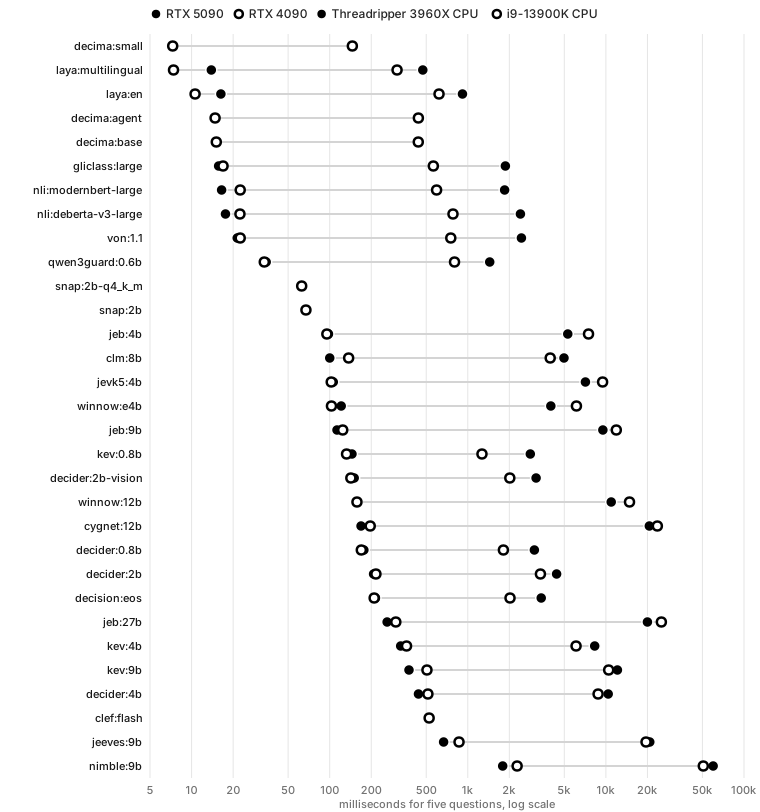
We measure every model on our own GPUs and CPUs and publish all of it, with the raw data, at ollaya.dev/results: accuracy and calibration on public benchmarks, speed on every machine, and parity with the authors' own code on each device.
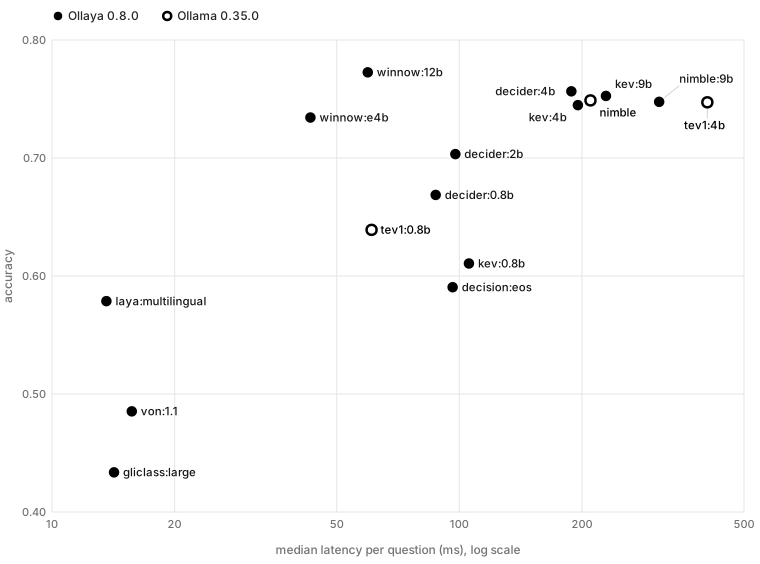
winnow:12b scores 0.773 at 60 ms per question.
Ollama's best, Nimble, scores 0.749 at 210 ms.laya, nli,
gliclass, von, qwen3guard, decima) take 7 to 35 ms on a GPU and 0.15 to 2.4 s on a CPU; the decoders
0.1 to 0.9 s on a GPU and 1.3 to 25 s on a CPU; nimble:9b 1.8 to 2.3 s on a GPU.
curl -fsSL https://ollaya.dev/install.sh | sh. When an NVIDIA GPU is present
(driver R525+), the installer adds the CUDA runtime: CUDA 13 for R580+, CUDA 12 for older drivers.irm https://ollaya.dev/install.ps1 | iex in PowerShell. When an NVIDIA GPU is
present (driver R527+), the installer adds the CUDA runtime, as on Linux.docker run -d --gpus=all -p 11435:11435 ghcr.io/ollaya-dev/ollaya:cuda
(:cuda12 for host drivers older than R580), or ghcr.io/ollaya-dev/ollaya for CPU only.Configuration is through environment variables: OLLAYA_HOST, OLLAYA_MODELS,
OLLAYA_KEEP_ALIVE, OLLAYA_DEVICE, OLLAYA_API_KEY and others, listed in
docs/api.md §15.
| Path | What |
|---|---|
crates/ollaya | The binary: CLI, daemon, runner |
crates/ollaya-server | HTTP API, scheduler (one runner process per model), model resolution |
crates/ollaya-api | API types and client; the contract is docs/api.md |
crates/ollaya-registry | Model names, manifests, blob store, resumable pulls |
crates/ollaya-decision | Question schema, sequence layouts, calibration, answers |
crates/ollaya-runner | Inference engines (ONNX Runtime, and llama.cpp for GGUF models) |
crates/ollaya-lang | Script and language detection for routers |
convert/ | Build-time Python: ONNX export, parity checks, packaging |
site/ | The website and the static model registry host |
cargo test --workspace
cargo build --release -p ollaya --features cuda   # CUDA build (x86-64 Linux and Windows)
convert/ rebuilds models. It exports them, checks parity against the PyTorch reference,
generates golden fixtures, and packages the result into registry/. See the module docstrings.
cd convert && uv sync installs it: with CUDA 13 torch on Linux and Windows, and with the CPU and
MPS build from PyPI on Apple silicon Macs, where exports and parity run on the CPU.
Apache-2.0. Each model keeps its own license: laya (Convai Innovations), decider (Mapika),
kev (Jared Palmer, on Qwen3.5 by the Qwen team), decision (the vLLM Semantic Router
contributors, on Qwen3.5), qwen3guard (Qwen team), gliclass (Knowledgator), von (Victor Hugo
Panisa), winnow (EldanRing, on Gemma 4 by Google DeepMind), jevk5 (alibiserikbay, on Qwen3.5), nimble
(Bespoke Labs, on Qwen3.5), jeeves (PostHog, on Qwen3.5), clef (Cloudflare, on Qwen3.5), jeb (Jason Brashear, on Qwen3.5 and Qwen3.8), cygnet (Gemma 4 by Google
DeepMind; the Cygnet recipe is MIT), snap (logitlab, on MiniCPM5 by OpenBMB; snap's prompt is MIT), decima (A. M. Madani, on mmBERT-base by JHU CLSP and multilingual-e5-small by intfloat, both MIT) and nli:modernbert-large are Apache-2.0, and nli:deberta-v3-large (Moritz Laurer) is MIT. arbiter's LoRA adapter and head (Codekins Pvt Ltd, Zyot Lab) are Apache-2.0; its base model, Gemma 3 4B IT by Google DeepMind, is under the Gemma Terms of Use. llama.cpp, which Ollaya ships for
GGUF models, is MIT.
Ollaya is an independent project. It is not affiliated with or endorsed by Ollama or TypeSafe.
931 followers · starred Sep 2026
421 followers · starred Sep 2026
69 followers · starred Sep 2026
396 followers · starred Sep 2026
Run open decision models locally: pull and serve Laya, decider, NLI and GLiClass behind a TypeSafe-compatible API. Ollama for decision models.
See the code
Run open decision models locally, the way Ollama runs LLMs.
Website · Models · Results · Docs · Releases · Hugging Face
Created and maintained by Mert Cobanov (@mertcobanov).
A decision model reads a state (a message, an email, a ticket, any JSON) plus typed questions
(choice, score, noul) and returns calibrated probabilities in a single forward pass, in
milliseconds. It never generates text. Ollaya pulls these models by name, serves them from a
local daemon, and speaks TypeSafe's /v1/systemone wire format, so existing Jev clients work by
changing one environment variable.
curl -fsSL https://ollaya.dev/install.sh | sh
ollaya run winnow:e4b --preset triage "Third time this year you've double-charged me. Refund it today or I'm cancelling and moving to a competitor."
intent            refund                                ███████████████░ 0.91
is_urgent         yes                                   ███████████████░ 0.92
frustration       2.89 / 3  very angry or using stron…  ██████████████░░ 0.86
refund_requested  yes                                   ████████████████ 0.99
churn_risk        yes                                   ████████████████ 0.99
winnow:e4b is the recommended model: 0.722 accuracy on typed decisions (TypeSafe's Jev: 0.738)
and 89 ms for these five questions on an RTX 4090. It is a 4B-class language model, so without an
NVIDIA GPU start with laya, which answers in a fraction of a second on a CPU. All models and their
numbers: ollaya.dev/search.
ollaya serve runs the daemon; ollaya run, pull, list, ps, show, rm,
cp, stop and create work the way they do in Ollama. If the daemon isn't running, the CLI
starts it.POST /v1/systemone, /v1/decisions and GET /v1/models are
wire-identical to TypeSafe. The official SDK works unchanged when you set
TYPESAFE_BASE_URL=http://localhost:11435./api/decide adds routing information and timings. /api/pull streams
NDJSON progress, and there are /api/tags, /api/show, /api/ps and more. See
docs/api.md.model.safetensors) from the author's
Hugging Face repository, pinned to a commit and verified by sha256. Models whose authors publish
GGUF files (winnow, jevk5, jeb) run that file itself on llama.cpp. Ollaya never re-hosts weights.ollaya mcp serves the models to Claude Code, Claude Desktop, Cursor and other
MCP clients (claude mcp add ollaya -- ollaya mcp), and the
ollaya-decisions skill teaches agents when and how to use
them (npx skills add ollaya-dev/ollaya --skill ollaya-decisions).laya detects the script and language of each request, then answers with
laya:en or laya:multilingual.FROM laya
QUESTIONS ./triage.json
PARAMETER precision fp32
ollaya create triage -f Modelfile and ollaya run triage "…".| Model | What it is |
|---|---|
winnow:e4b | Recommended. EldanRing's Winnow-E4B, a Gemma 4 fine-tune run from the author's Q8_0 GGUF on llama.cpp: 0.722 on typed-decisions (Jev: 0.738), 89 ms for five questions on an RTX 4090 |
credence:e4b, credence:e4b-calibrated | Txoka's MiCA refinements of Winnow-E4B, Q8_0: accuracy-focused and public-calibration variants; see the measured tradeoffs in the family documentation |
laya | Router: picks laya:en or laya:multilingual by language |
laya:en | English decision model (ModernBERT-large, 421M). The fastest: 8–10 ms for five questions on an RTX 4090 |
laya:multilingual | 100+ languages (mmBERT-base, 322M) |
laya:typed-decisions | Fine-tuned on the typed-decisions workflows |
decider, decider:4b, decider:0.8b | Mapika's Qwen3.5 decoders, 2B (the default), 4B and 0.8B: 0.680 on typed-decisions for 4B, 0.591 for 2B |
decider:2b-vision | Mapika's Qwen3.5-2B vision-language decider: questions about an image (--image, images on /api/decide) as well as the state |
kev, kev:0.8b, kev:9b | Jared Palmer's Kev: a LoRA and a pointer head on Qwen3.5 (4B by default, 0.8B, 9B), calibrated. kev:4b scores 0.669 on typed-decisions and kev:9b 0.722, as much as winnow:e4b |
decision | Decision 1.0 Eos by the vLLM Semantic Router contributors: a fine-tuned Qwen3.5-0.8B with an endpoint head, 16k-token rows |
qwen3guard | Qwen3Guard-Gen-0.6B safety guard with built-in questions: safe, controversial or unsafe, and the category |
nli, nli:modernbert-large | Moritz Laurer's zero-shot NLI classifiers (DeBERTa-v3-large, ModernBERT-large) |
gliclass | Knowledgator's instruction-following zero-shot classifier (DeBERTa-v3-large) |
von | Victor Hugo Panisa's Von 1.1 (ModernBERT-large): every option scored at its own marker, 8k-token context |
winnow | EldanRing's Winnow-12B, the larger sibling of winnow:e4b: 0.702 on typed-decisions |
clm | Contrastive-LM's CLM-v0.1-8B: the Qwen3-8B encoder and two projection heads score options by similarity, with questions and options cached. 0.357 on typed-decisions; built for agent, game and tool-calling states |
jevk5 | alibiserikbay's JevK5 v0.3, a Qwen3.5-4B fine-tune run from the author's Q8_0 GGUF on llama.cpp, up to 16 options |
nimble | Bespoke Labs' Nimble v2: a LoRA on Qwen3.5-9B that reads the whole request as a JSON schema and scores option codes, with the author's temperature: 0.665 on typed-decisions, up to 255 options, ~2.3 s for five questions on an RTX 4090 |
jeb, jeb:4b, jeb:27b | Jason Brashear's Jebadiah (AINode): LoRAs merged into Qwen3.5 (9B by default, 4B) and Qwen3.8-27B, run from the authors' GGUF on llama.cpp with their per-type temperatures; jeb:9b answers five questions in 124 ms on an RTX 4090 |
jeeves | PostHog's Jeeves-9B without its reasoning chain: Qwen3.5-9B (LoRA merged) and a pointer head: 0.680 on typed-decisions with an ECE of 0.031, 838 ms for five questions on an RTX 4090 |
clef | Cloudflare's Clef-Flash: Qwen3.5-9B, fully post-trained, with a joint schema head that scores every question's options in one forward pass: 0.703 on typed-decisions with an ECE of 0.020 and no fitted temperature, 532 ms for five questions on an RTX 4090 |
cygnet | blockbrain-ai's Cygnet: frozen Gemma 4 12B IT (Q8_0 GGUF) with a letter-readout prompt and temperature 3.4: 0.683 on typed-decisions, 202 ms for five questions on an RTX 4090 |
snap | logitlab's snap1-2b: MiniCPM5-2B fine-tuned on the prompt of emnlmn's snap engine, run from the author's Q8_0 GGUF on llama.cpp with snap's own prompt: 0.648 on typed-decisions, up to 26 options, 68 ms for five questions on an RTX 4090 |
decima, decima:agent, decima:small | A. M. Madani's Decima: multilingual encoders with a late-interaction scorer that reads every option against the state. decima:base (mmBERT-base, 321M) scores 0.495 on typed-decisions in 15 ms for five questions on an RTX 4090; decima:agent is fine-tuned for coding-agent decisions; decima:small (122M) takes 146 ms on a CPU |
arbiter | Codekins' Arbiter v3.3 (Zyot Lab): a LoRA and a fixed 24-slot head on Gemma 3 4B IT, one forward pass per question. It answers noul, choices of up to 16 options and scores of exactly 6 levels |
Browse them at ollaya.dev/search. Laya tags ending in
-fp32 or -fp16 pin the precision. The derived files of every model are also published at
huggingface.co/ollaya-dev.
Ollama 0.35 also serves decision models: Nimble and Tev1, through the same TypeSafe wire format. The FAQ compares the two projects.
We measure every model on our own GPUs and CPUs and publish all of it, with the raw data, at ollaya.dev/results: accuracy and calibration on public benchmarks, speed on every machine, and parity with the authors' own code on each device.
winnow:12b scores 0.773 at 60 ms per question.
Ollama's best, Nimble, scores 0.749 at 210 ms.laya, nli,
gliclass, von, qwen3guard, decima) take 7 to 35 ms on a GPU and 0.15 to 2.4 s on a CPU; the decoders
0.1 to 0.9 s on a GPU and 1.3 to 25 s on a CPU; nimble:9b 1.8 to 2.3 s on a GPU.
curl -fsSL https://ollaya.dev/install.sh | sh. When an NVIDIA GPU is present
(driver R525+), the installer adds the CUDA runtime: CUDA 13 for R580+, CUDA 12 for older drivers.irm https://ollaya.dev/install.ps1 | iex in PowerShell. When an NVIDIA GPU is
present (driver R527+), the installer adds the CUDA runtime, as on Linux.docker run -d --gpus=all -p 11435:11435 ghcr.io/ollaya-dev/ollaya:cuda
(:cuda12 for host drivers older than R580), or ghcr.io/ollaya-dev/ollaya for CPU only.Configuration is through environment variables: OLLAYA_HOST, OLLAYA_MODELS,
OLLAYA_KEEP_ALIVE, OLLAYA_DEVICE, OLLAYA_API_KEY and others, listed in
docs/api.md §15.
| Path | What |
|---|---|
crates/ollaya | The binary: CLI, daemon, runner |
crates/ollaya-server | HTTP API, scheduler (one runner process per model), model resolution |
crates/ollaya-api | API types and client; the contract is docs/api.md |
crates/ollaya-registry | Model names, manifests, blob store, resumable pulls |
crates/ollaya-decision | Question schema, sequence layouts, calibration, answers |
crates/ollaya-runner | Inference engines (ONNX Runtime, and llama.cpp for GGUF models) |
crates/ollaya-lang | Script and language detection for routers |
convert/ | Build-time Python: ONNX export, parity checks, packaging |
site/ | The website and the static model registry host |
cargo test --workspace
cargo build --release -p ollaya --features cuda   # CUDA build (x86-64 Linux and Windows)
convert/ rebuilds models. It exports them, checks parity against the PyTorch reference,
generates golden fixtures, and packages the result into registry/. See the module docstrings.
cd convert && uv sync installs it: with CUDA 13 torch on Linux and Windows, and with the CPU and
MPS build from PyPI on Apple silicon Macs, where exports and parity run on the CPU.
Apache-2.0. Each model keeps its own license: laya (Convai Innovations), decider (Mapika),
kev (Jared Palmer, on Qwen3.5 by the Qwen team), decision (the vLLM Semantic Router
contributors, on Qwen3.5), qwen3guard (Qwen team), gliclass (Knowledgator), von (Victor Hugo
Panisa), winnow (EldanRing, on Gemma 4 by Google DeepMind), jevk5 (alibiserikbay, on Qwen3.5), nimble
(Bespoke Labs, on Qwen3.5), jeeves (PostHog, on Qwen3.5), clef (Cloudflare, on Qwen3.5), jeb (Jason Brashear, on Qwen3.5 and Qwen3.8), cygnet (Gemma 4 by Google
DeepMind; the Cygnet recipe is MIT), snap (logitlab, on MiniCPM5 by OpenBMB; snap's prompt is MIT), decima (A. M. Madani, on mmBERT-base by JHU CLSP and multilingual-e5-small by intfloat, both MIT) and nli:modernbert-large are Apache-2.0, and nli:deberta-v3-large (Moritz Laurer) is MIT. arbiter's LoRA adapter and head (Codekins Pvt Ltd, Zyot Lab) are Apache-2.0; its base model, Gemma 3 4B IT by Google DeepMind, is under the Gemma Terms of Use. llama.cpp, which Ollaya ships for
GGUF models, is MIT.
Ollaya is an independent project. It is not affiliated with or endorsed by Ollama or TypeSafe.
931 followers · starred Sep 2026
421 followers · starred Sep 2026
69 followers · starred Sep 2026
396 followers · starred Sep 2026