A tiny 0.6B Jev-like model fine-tuned from Kev for browser use: 32.2% step success on Mind2Web, runs in your browser on WebGPU.
See the codeA tiny 0.6B Jev-like model, fine-tuned from Kev-0.6B for browser use.
Model on Hugging Face · Web build (ONNX) · Live demo



A decision model for browser agents. It reads a goal and a table of the page's candidate elements, then returns which element to act on and whether to click, type or select, as probabilities, in one forward pass. It never writes text.
32.2% step success on Mind2Web, the best of any open-weights model that runs in a browser, at 80 ms per decision.
1,000 steps from Mind2Web's test set. Each step gives a goal, the previous actions and 10 candidate elements. Every model sees the same text and the same candidates.
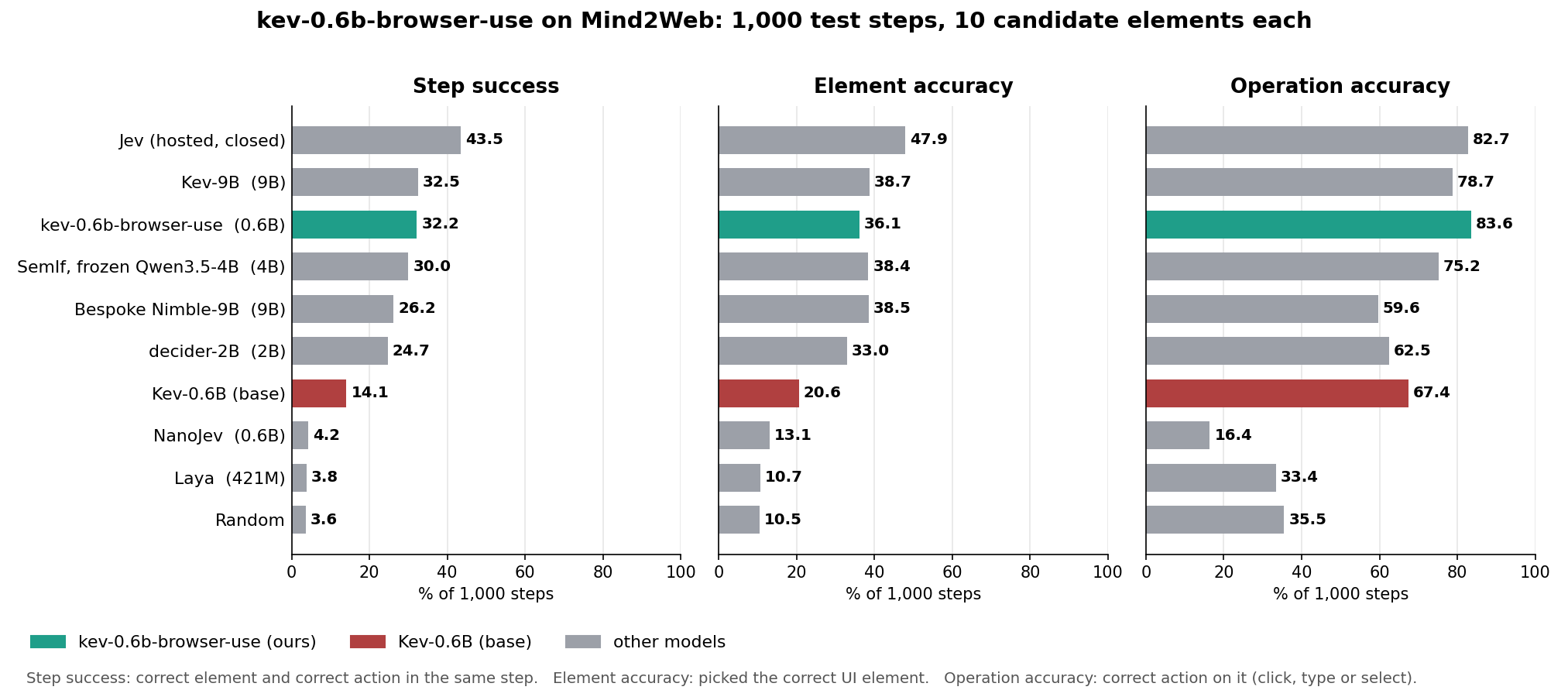
| Model | Size | Step success | Element accuracy | Operation accuracy | Brier (lower is better) | p50 latency |
|---|---|---|---|---|---|---|
| Jev (TypeSafe, hosted API) | closed | 43.5 | 47.9 | 82.7 | 0.73 | network |
| Kev-9B | 9B | 32.5 | 38.7 | 78.7 | 0.76 | 428 ms |
| kev-0.6b-browser-use | 0.6B | 32.2 | 36.1 | 83.6 | 0.84 | 80 ms |
| SemIf, frozen Qwen3.5-4B | 4B | 30.0 | 38.4 | 75.2 | 0.85 | 289 ms |
| Bespoke Nimble-9B | 9B | 26.2 | 38.5 | 59.6 | 0.87 | 979 ms |
| decider-2B | 2B | 24.7 | 33.0 | 62.5 | 0.87 | 139 ms |
| Kev-0.6B (base) | 0.6B | 14.1 | 20.6 | 67.4 | 1.06 | 78 ms |
| NanoJev | 0.6B | 4.2 | 13.1 | 16.4 | 0.92 | 245 ms |
| Laya | 421M | 3.8 | 10.7 | 33.4 | 0.98 | 40 ms |
| Random | 3.6 | 10.5 | 35.5 | 0.94 |
Latency is one decision on an NVIDIA L4. python3 eval/harness.py table builds the table from results/ and python3 eval/plot_results.py draws the chart.
The 4-bit web build (348 MB, WebGPU) runs with open-jev.
npm install open-jev @huggingface/transformers
import { OpenJev, choice } from "open-jev";

const kev = await OpenJev.load({ model: "arbazsiddiqui/kev-0.6b-browser-use-ONNX", dtype: "q4f16" });

const state = `Goal: Type "Alan Turing" into the search box
Candidate elements:
[0] <a> role=None "Main page"
[1] <input> role=searchbox "Search Wikipedia"
[2] <button> role=None "Search"`;

const { element, operation } = await kev.decide(state, {
  element: choice("Which element should be acted on?", [
    '[0] <a> "Main page"',
    '[1] <input> "Search Wikipedia"',
    '[2] <button> "Search"',
  ]),
  operation: choice("What operation should be performed on the target element?", ["CLICK", "TYPE", "SELECT"]),
});

element.choice;     // '[1] <input> "Search Wikipedia"', confidence 0.93
operation.choice;   // "TYPE", confidence 0.74
The full-precision checkpoint is a LoRA adapter plus a pointer head in Kev's format, served by Kev's own server.
git clone https://github.com/jaredpalmer/kev.git && cd kev && uv sync --extra serve
uv run --extra serve python -m kev.serve --run arbazsiddiqui/kev-0.6b-browser-use --port 8009
curl -s localhost:8009/v1/systemone -H 'content-type: application/json' -d '{
  "model": "kev-latest",
  "state": "Goal: Search Wikipedia for \"Alan Turing\"\nCandidate elements:\n[0] <a> role=None \"Main page\"\n[1] <input> role=searchbox \"Search Wikipedia\"\n[2] <button> role=None \"Search\"",
  "questions": {
    "element":   {"type": "choice", "instructions": "Which element should be acted on?",
                  "criteria": {"[0] <a> \"Main page\"": null, "[1] <input> \"Search Wikipedia\"": null, "[2] <button> \"Search\"": null}},
    "operation": {"type": "choice", "instructions": "What operation should be performed on the target element?",
                  "criteria": {"CLICK": null, "TYPE": null, "SELECT": null}}}}'
Both take the same text: a Goal: line, optional Previous actions:, then one line per candidate element. The model card documents the format.
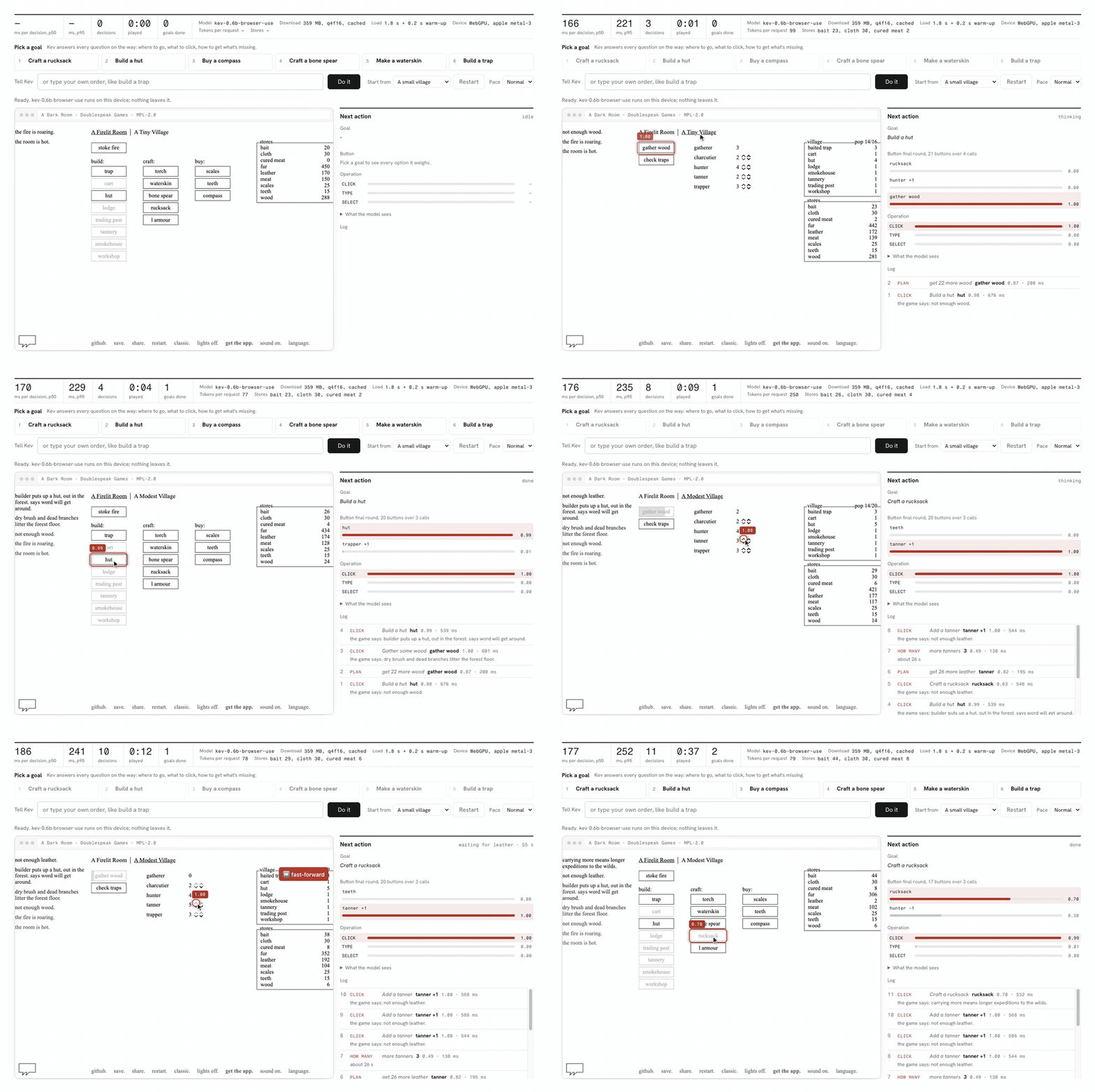
Runs entirely in your browser on WebGPU: arbazsiddiqui.me/kev-browser-use. The model downloads once (348 MB, cached after that), then plays A Dark Room, an unmodified text adventure. Pick a goal like "Craft a rucksack" and the model makes every choice on the way: which button out of about 20, how to get what's missing, and how many villagers to put on it. The page only reads the game's data and waits.
| Training data | Step success | Element accuracy |
|---|---|---|
| none: Kev-0.6B (base) | 14.1 | 20.6 |
| Mind2Web train, 13.8K steps | 29.9 | 34.8 |
| Mind2Web train + WebChain, 4x the rows | 32.2 | 36.1 |
Mind2Web did the heavy lifting; WebChain added 2.3 points through volume. At equal size, more websites and teacher-labelled rows did not help, and the Mind2Web paper reports 30 to 32 step success for a fine-tuned 250M model and 39 to 40 for 3B, so the gap to Jev looks like model size.
eval/      build the 1,000-step eval from Mind2Web's test set, harness, one adapter per model
train/     Mind2Web and WebChain data builders, the training recipe, ONNX export for the browser
results/   every model's eval output; the table and chart are built from these
assets/    the demo GIF and the results chart
Apache-2.0. Built on Kev and Qwen3 (Apache-2.0). Training data: Mind2Web and WebChain, both CC BY 4.0.
142 followers · starred Oct 2026
A tiny 0.6B Jev-like model fine-tuned from Kev for browser use: 32.2% step success on Mind2Web, runs in your browser on WebGPU.
See the codeA tiny 0.6B Jev-like model, fine-tuned from Kev-0.6B for browser use.
Model on Hugging Face · Web build (ONNX) · Live demo
A decision model for browser agents. It reads a goal and a table of the page's candidate elements, then returns which element to act on and whether to click, type or select, as probabilities, in one forward pass. It never writes text.
32.2% step success on Mind2Web, the best of any open-weights model that runs in a browser, at 80 ms per decision.
1,000 steps from Mind2Web's test set. Each step gives a goal, the previous actions and 10 candidate elements. Every model sees the same text and the same candidates.
| Model | Size | Step success | Element accuracy | Operation accuracy | Brier (lower is better) | p50 latency |
|---|---|---|---|---|---|---|
| Jev (TypeSafe, hosted API) | closed | 43.5 | 47.9 | 82.7 | 0.73 | network |
| Kev-9B | 9B | 32.5 | 38.7 | 78.7 | 0.76 | 428 ms |
| kev-0.6b-browser-use | 0.6B | 32.2 | 36.1 | 83.6 | 0.84 | 80 ms |
| SemIf, frozen Qwen3.5-4B | 4B | 30.0 | 38.4 | 75.2 | 0.85 | 289 ms |
| Bespoke Nimble-9B | 9B | 26.2 | 38.5 | 59.6 | 0.87 | 979 ms |
| decider-2B | 2B | 24.7 | 33.0 | 62.5 | 0.87 | 139 ms |
| Kev-0.6B (base) | 0.6B | 14.1 | 20.6 | 67.4 | 1.06 | 78 ms |
| NanoJev | 0.6B | 4.2 | 13.1 | 16.4 | 0.92 | 245 ms |
| Laya | 421M | 3.8 | 10.7 | 33.4 | 0.98 | 40 ms |
| Random | 3.6 | 10.5 | 35.5 | 0.94 |
Latency is one decision on an NVIDIA L4. python3 eval/harness.py table builds the table from results/ and python3 eval/plot_results.py draws the chart.
The 4-bit web build (348 MB, WebGPU) runs with open-jev.
npm install open-jev @huggingface/transformers
import { OpenJev, choice } from "open-jev";

const kev = await OpenJev.load({ model: "arbazsiddiqui/kev-0.6b-browser-use-ONNX", dtype: "q4f16" });

const state = `Goal: Type "Alan Turing" into the search box
Candidate elements:
[0] <a> role=None "Main page"
[1] <input> role=searchbox "Search Wikipedia"
[2] <button> role=None "Search"`;

const { element, operation } = await kev.decide(state, {
  element: choice("Which element should be acted on?", [
    '[0] <a> "Main page"',
    '[1] <input> "Search Wikipedia"',
    '[2] <button> "Search"',
  ]),
  operation: choice("What operation should be performed on the target element?", ["CLICK", "TYPE", "SELECT"]),
});

element.choice;     // '[1] <input> "Search Wikipedia"', confidence 0.93
operation.choice;   // "TYPE", confidence 0.74
The full-precision checkpoint is a LoRA adapter plus a pointer head in Kev's format, served by Kev's own server.
git clone https://github.com/jaredpalmer/kev.git && cd kev && uv sync --extra serve
uv run --extra serve python -m kev.serve --run arbazsiddiqui/kev-0.6b-browser-use --port 8009
curl -s localhost:8009/v1/systemone -H 'content-type: application/json' -d '{
  "model": "kev-latest",
  "state": "Goal: Search Wikipedia for \"Alan Turing\"\nCandidate elements:\n[0] <a> role=None \"Main page\"\n[1] <input> role=searchbox \"Search Wikipedia\"\n[2] <button> role=None \"Search\"",
  "questions": {
    "element":   {"type": "choice", "instructions": "Which element should be acted on?",
                  "criteria": {"[0] <a> \"Main page\"": null, "[1] <input> \"Search Wikipedia\"": null, "[2] <button> \"Search\"": null}},
    "operation": {"type": "choice", "instructions": "What operation should be performed on the target element?",
                  "criteria": {"CLICK": null, "TYPE": null, "SELECT": null}}}}'
Both take the same text: a Goal: line, optional Previous actions:, then one line per candidate element. The model card documents the format.
Runs entirely in your browser on WebGPU: arbazsiddiqui.me/kev-browser-use. The model downloads once (348 MB, cached after that), then plays A Dark Room, an unmodified text adventure. Pick a goal like "Craft a rucksack" and the model makes every choice on the way: which button out of about 20, how to get what's missing, and how many villagers to put on it. The page only reads the game's data and waits.
| Training data | Step success | Element accuracy |
|---|---|---|
| none: Kev-0.6B (base) | 14.1 | 20.6 |
| Mind2Web train, 13.8K steps | 29.9 | 34.8 |
| Mind2Web train + WebChain, 4x the rows | 32.2 | 36.1 |
Mind2Web did the heavy lifting; WebChain added 2.3 points through volume. At equal size, more websites and teacher-labelled rows did not help, and the Mind2Web paper reports 30 to 32 step success for a fine-tuned 250M model and 39 to 40 for 3B, so the gap to Jev looks like model size.
eval/      build the 1,000-step eval from Mind2Web's test set, harness, one adapter per model
train/     Mind2Web and WebChain data builders, the training recipe, ONNX export for the browser
results/   every model's eval output; the table and chart are built from these
assets/    the demo GIF and the results chart
Apache-2.0. Built on Kev and Qwen3 (Apache-2.0). Training data: Mind2Web and WebChain, both CC BY 4.0.
142 followers · starred Oct 2026



