[CVPR2024, Highlight] Official code for DragDiffusion
See the code
Yujun Shi
Chuhui Xue
Jun Hao Liew
Jiachun Pan
Hanshu Yan
Wenqing Zhang
Vincent Y. F. Tan
Song Bai
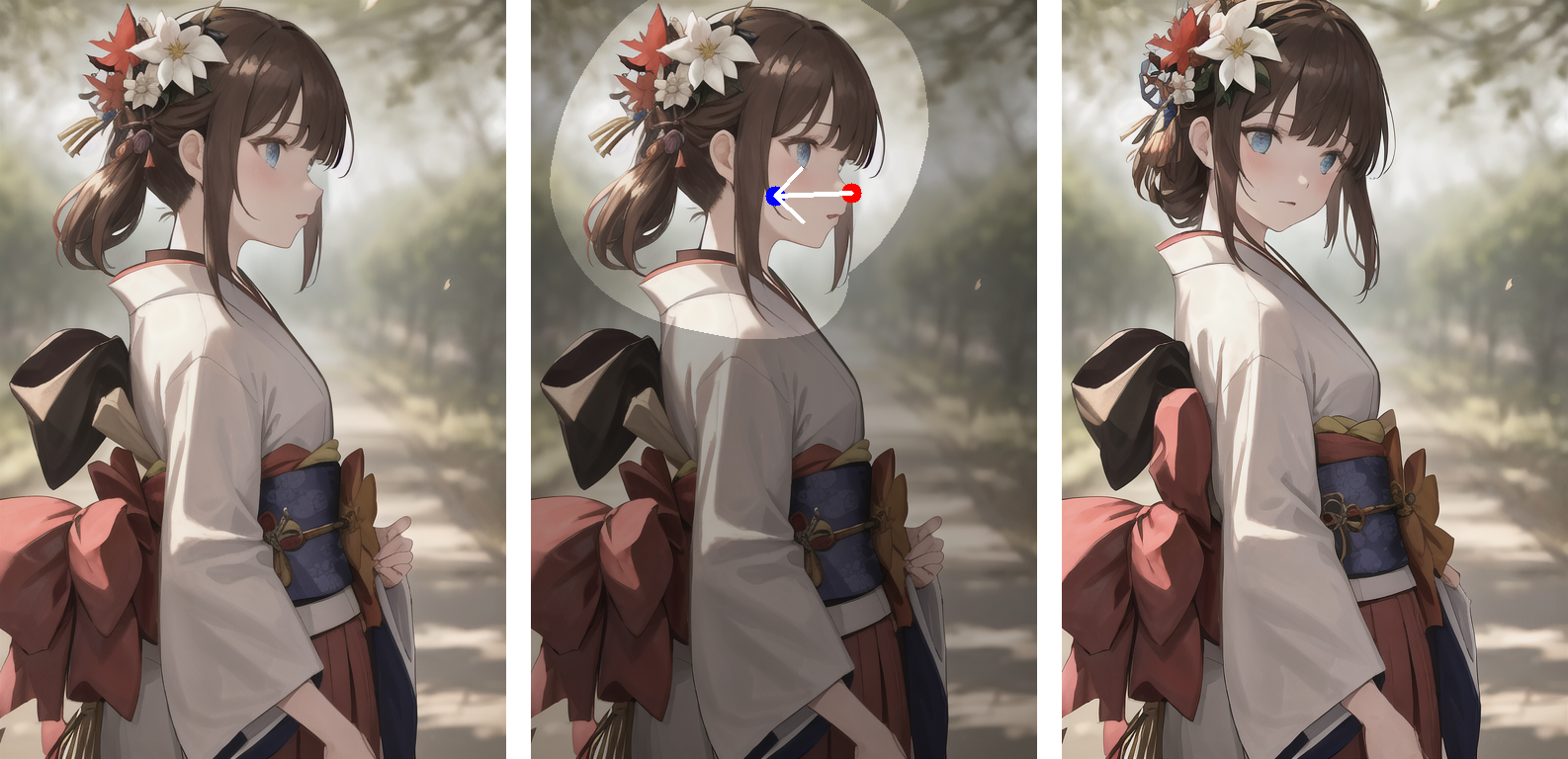





This is a research project, NOT a commercial product. Users are granted the freedom to create images using this tool, but they are expected to comply with local laws and utilize it in a responsible manner. The developers do not assume any responsibility for potential misuse by users.
It is recommended to run our code on a Nvidia GPU with a linux system. We have not yet tested on other configurations. Currently, it requires around 14 GB GPU memory to run our method. We will continue to optimize memory efficiency
To install the required libraries, simply run the following command:
conda env create -f environment.yaml
conda activate dragdiff
To start with, in command line, run the following to start the gradio user interface:
python3 drag_ui.py
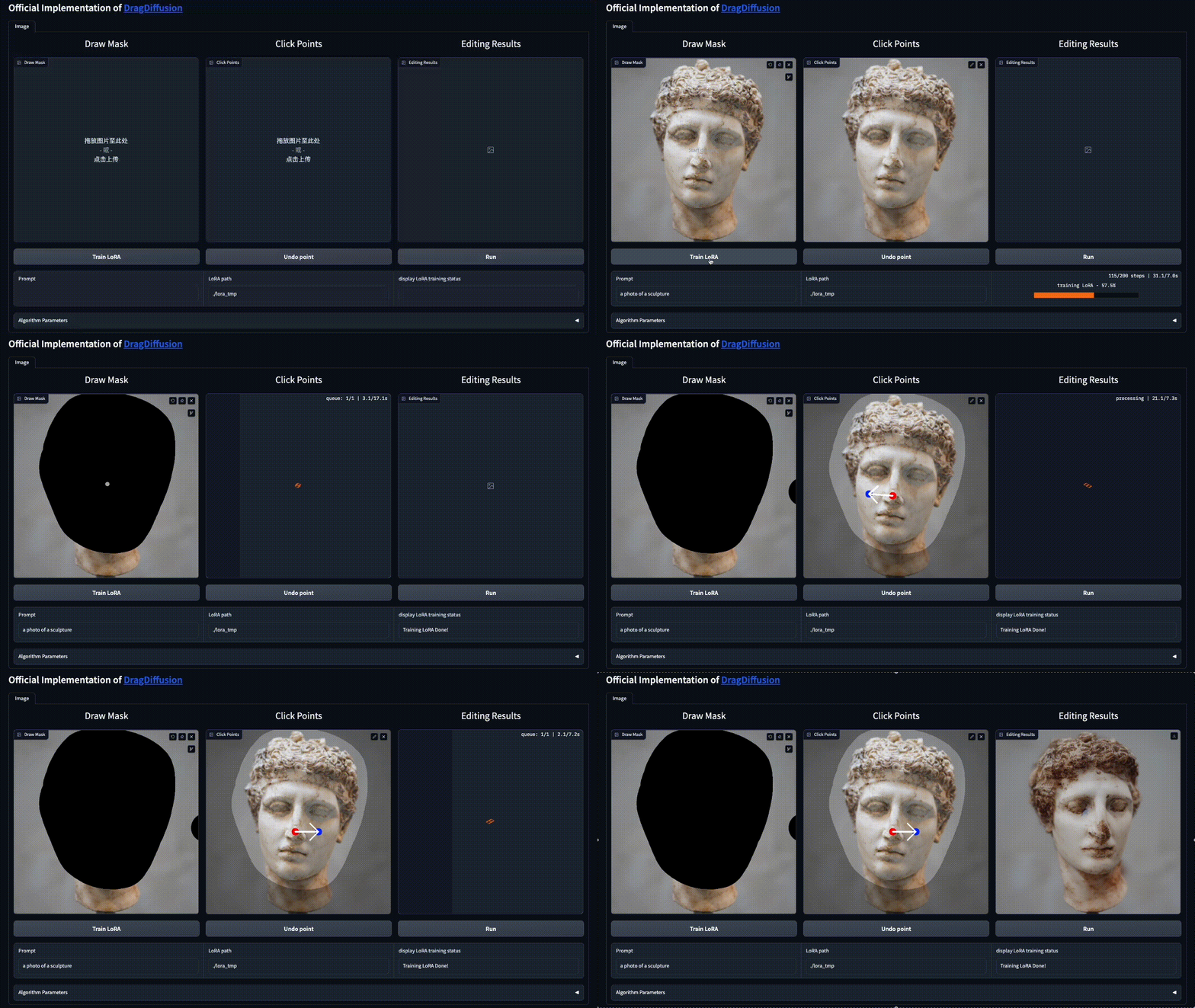
You may check our GIF above that demonstrate the usage of UI in a step-by-step manner.
Basically, it consists of the following steps:
Code related to the DragDiffusion algorithm is under Apache 2.0 license.
If you find our repo helpful, please consider leaving a star or cite our paper :)
@article{shi2023dragdiffusion,
  title={DragDiffusion: Harnessing Diffusion Models for Interactive Point-based Image Editing},
  author={Shi, Yujun and Xue, Chuhui and Pan, Jiachun and Zhang, Wenqing and Tan, Vincent YF and Bai, Song},
  journal={arXiv preprint arXiv:2306.14435},
  year={2023}
}
For any questions on this project, please contact Yujun ([email protected])
This work is inspired by the amazing DragGAN. The lora training code is modified from an example of diffusers. Image samples are collected from unsplash, pexels, pixabay. Finally, a huge shout-out to all the amazing open source diffusion models and libraries.
2,124 followers · starred Jul 2023
7,139 followers · starred Jun 2024
644 followers · starred Oct 2023
47 followers · starred Feb 2024
[CVPR2024, Highlight] Official code for DragDiffusion
See the code
Yujun Shi
Chuhui Xue
Jun Hao Liew
Jiachun Pan
Hanshu Yan
Wenqing Zhang
Vincent Y. F. Tan
Song Bai
This is a research project, NOT a commercial product. Users are granted the freedom to create images using this tool, but they are expected to comply with local laws and utilize it in a responsible manner. The developers do not assume any responsibility for potential misuse by users.
It is recommended to run our code on a Nvidia GPU with a linux system. We have not yet tested on other configurations. Currently, it requires around 14 GB GPU memory to run our method. We will continue to optimize memory efficiency
To install the required libraries, simply run the following command:
conda env create -f environment.yaml
conda activate dragdiff
To start with, in command line, run the following to start the gradio user interface:
python3 drag_ui.py
You may check our GIF above that demonstrate the usage of UI in a step-by-step manner.
Basically, it consists of the following steps:
Code related to the DragDiffusion algorithm is under Apache 2.0 license.
If you find our repo helpful, please consider leaving a star or cite our paper :)
@article{shi2023dragdiffusion,
  title={DragDiffusion: Harnessing Diffusion Models for Interactive Point-based Image Editing},
  author={Shi, Yujun and Xue, Chuhui and Pan, Jiachun and Zhang, Wenqing and Tan, Vincent YF and Bai, Song},
  journal={arXiv preprint arXiv:2306.14435},
  year={2023}
}
For any questions on this project, please contact Yujun ([email protected])
This work is inspired by the amazing DragGAN. The lora training code is modified from an example of diffusers. Image samples are collected from unsplash, pexels, pixabay. Finally, a huge shout-out to all the amazing open source diffusion models and libraries.
2,124 followers · starred Jul 2023
7,139 followers · starred Jun 2024
644 followers · starred Oct 2023
47 followers · starred Feb 2024