
[TPAMI 2026]🔥This is a curated list of "A survey on Efficient Vision-Language Action Models" research. We will continue to maintain and update the repository, so follow us to keep up with the latest developments!!!
191
223 commits
updated Sep 10, 2026
README
🚀A Survey on Efficient Vision-Language-Action Models



⭐ Give us a star if you like it~ ⭐
This is a curated list of "A Survey on Efficient Vision-Language Action Models" research.
To the best of our knowledge, this work presents the first comprehensive survey specifically dedicated to the realm of Efficient VLAs that covers the entire "data-model-training" process. We will continue to UPDATE this repository to provide you with the latest cutting-edge developments, so stay tuned!😘 We hope that our work will bring some inspiration to you~😉
News 🔥
2026.09.10: Our paper has been accepted by IEEE TPAMI!2026.08.23: Several recent papers on efficient VLA have been updated2026.06.18: Refreshed the paper lists and added recent robot-efficient-VLA papers, with an emphasis on model efficiency, adaptation efficiency, and data efficiency for robotic manipulation.2025.09.12: This repository was initialized.
Overview
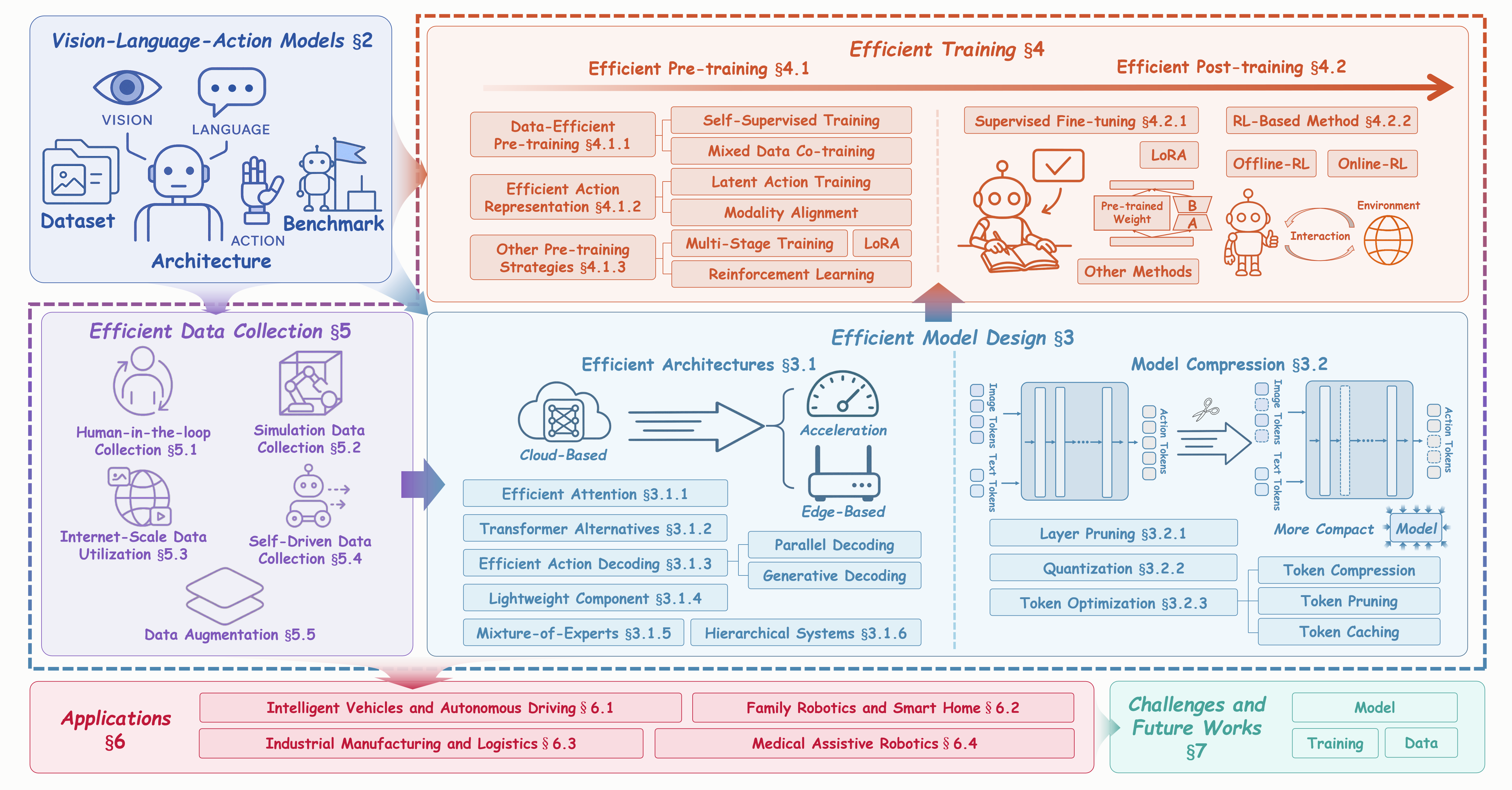 Fig. 1: The Organization of Our Survey. We systematically categorize efficient VLAs into three core pillars: (1) Efficient Model Design, encompassing efficient architectures and model compression techniques; (2) Efficient Training, covering efficient pre-training and post-training strategies; and (3) Efficient Data Collection, including efficient data collection and augmentation methods. The framework also reviews VLA foundations, key applications, challenges, and future directions, establishing the groundwork for advancing scalable embodied intelligence.
Table of Contents
- 🔍 Table of Contents
- 🚀Efficient Model Design
- 🤖Efficient Training
- 📖Efficient Data Collection
- 🔖 Citation
- 📧 Contact Us
Efficient VLAs
Efficient Model Design
Efficient Architectures
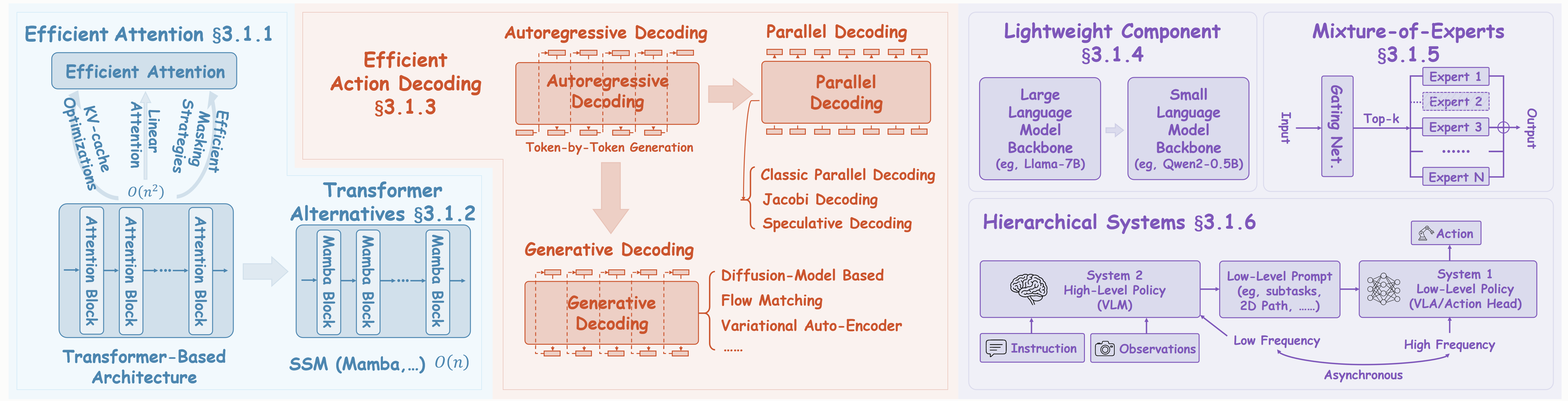 Fig. 2: Key strategies for Efficient Architectures in VLAs. We illustrate six primary approaches: (a) Efficient Attention, mitigating the O(n^2) complexity of standard self-attention; (b) Transformer Alternatives, such as Mamba; (c) Efficient Action Decoding, advancing from autoregressive generation to parallel and generative methods; (d) Lightweight Components, adopting smaller model backbones; (e) Mixture-of-Experts, employing sparse activation via input routing; and (f) Hierarchical Systems, which decouple high-level VLM planning from low-level VLA execution.
Efficient Attention
Transformer Alternatives
Efficient Action Decoding
Lightweight Component
Mixture-of-Experts
Hierarchical Systems
Model Compression
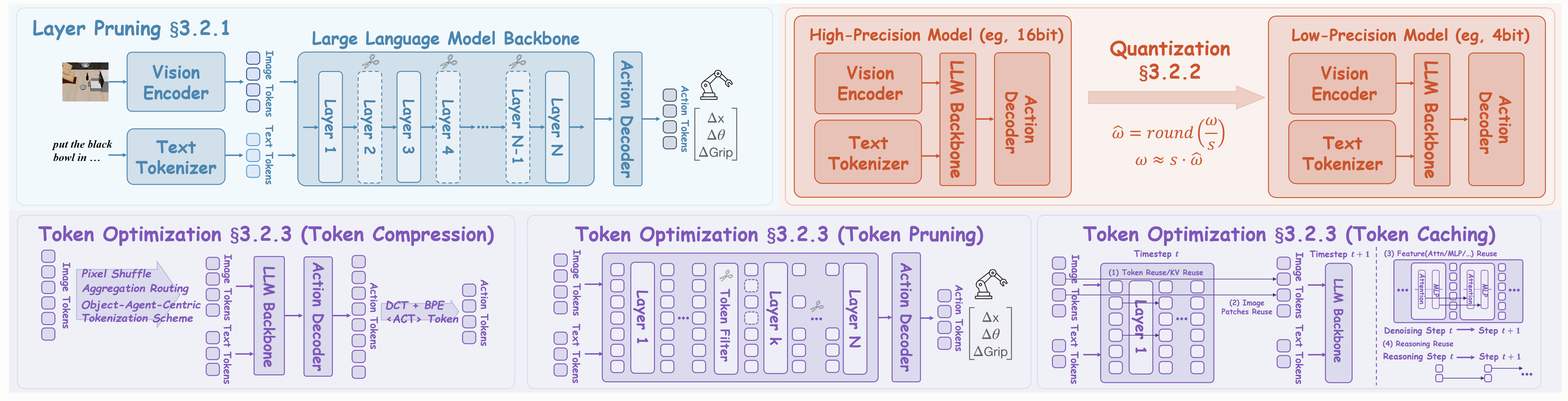 Fig. 3: Key strategies for Model Compression in VLAs. We illustrate three primary approaches: (a) Layer Pruning, which removes redundant layers to reduce model depth and computational cost; (b) Quantization, which reduces the numerical precision of model parameters to decrease memory footprint and accelerate inference; and (c) Token Optimization, which minimizes the number of processed tokens via token compression (merging tokens), token pruning (dropping non-essential tokens), and token caching (reusing static tokens).
Layer Pruning
Quantization
Token Optimization
Efficient Training
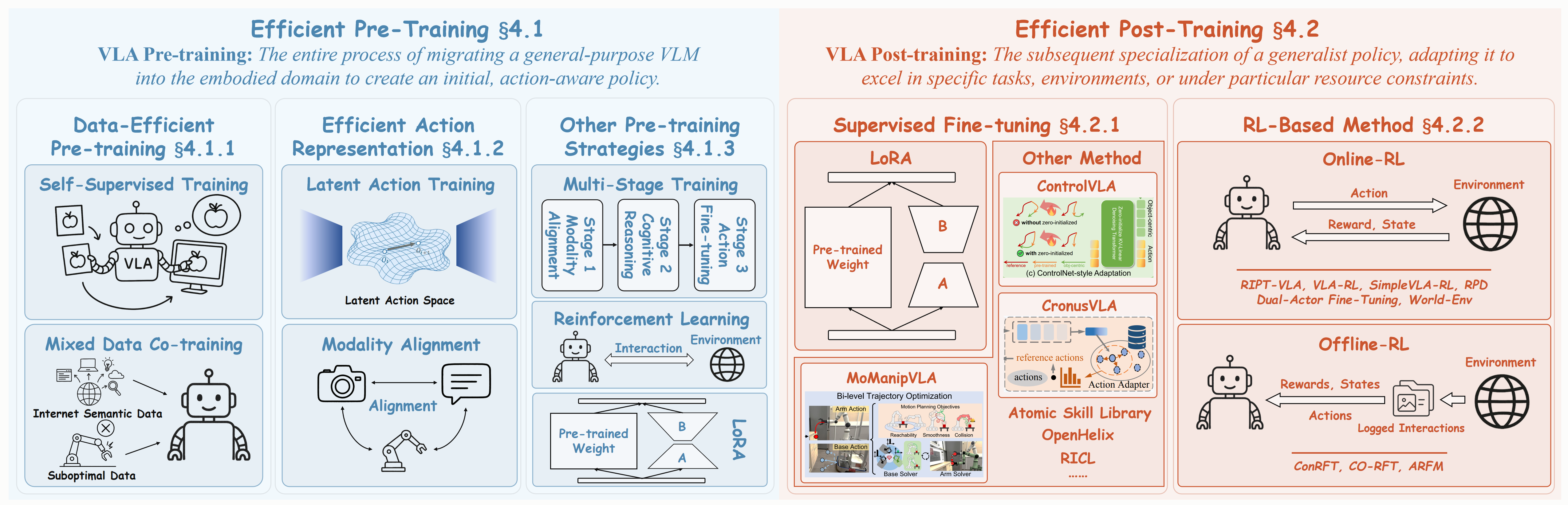 Fig. 4: Key strategies for Efficient Training in VLAs, divided into two main stages. (a) Efficient Pre-Training migrates general-purpose VLMs into the embodied domain to create an initial, action-aware policy, encompassing Data-Efficient Pre-training, Efficient Action Representation, and Other Pre-training Strategies. (b) Efficient Post-Training subsequently specializes this policy for specific tasks, leveraging Supervised Fine-tuning and RL-Based Methods.
Efficient Pre-Training
Data-Efficient Pre-training
Efficient Action Representation
Other Pre-training Strategies
Efficient Post-Training
Supervised Fine-tuning
RL-Based Method
Efficient Data Collection
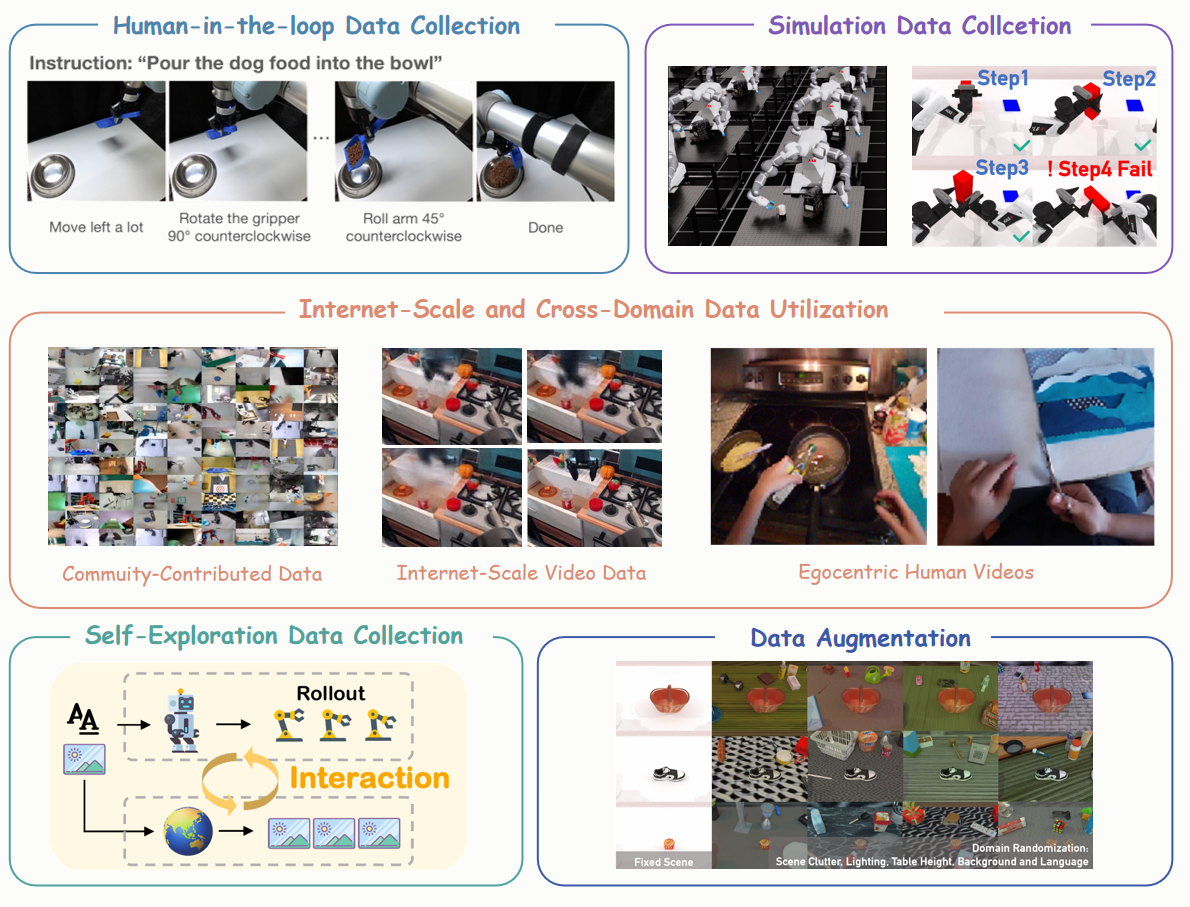 Fig. 5: Taxonomy of Efficient Data Collection strategies in VLAs. This figure illustrates the primary approaches, encompassing human-in-the-loop, simulated, reusability-oriented, self-driven, and augmentative techniques for scalable acquisition of high-quality robotic datasets while minimizing resource overhead.
Human-in-the-Loop Data Collection
Simulation Data Collection
Internet-Scale and Cross-Domain Data Utilization
Self-Exploration Data Collection
Data Augmentation
Citation
If you find this survey helpful for your research or applications, please consider citing it using the following BibTeX entry:
@article{yu2025survey,
  title={A survey on efficient vision-language-action models},
  author={Yu, Zhaoshu and Wang, Bo and Zeng, Pengpeng and Zhang, Haonan and Zhang, Ji and Wang, Zheng and Gao, Lianli and Song, Jingkuan and Sebe, Nicu and Shen, Heng Tao},
  journal={arXiv preprint arXiv:2510.24795},
  year={2025}
}
Contact Us
For any questions or suggestions, please feel free to contact us at:
Email: yuzhaoshu@gmail.com
Star History
Contributors


Similar repos


[TPAMI 2026]🔥This is a curated list of "A survey on Efficient Vision-Language Action Models" research. We will continue to maintain and update the repository, so follow us to keep up with the latest developments!!!
191
223 commits
updated Sep 10, 2026
README
🚀A Survey on Efficient Vision-Language-Action Models
⭐ Give us a star if you like it~ ⭐
This is a curated list of "A Survey on Efficient Vision-Language Action Models" research.
To the best of our knowledge, this work presents the first comprehensive survey specifically dedicated to the realm of Efficient VLAs that covers the entire "data-model-training" process. We will continue to UPDATE this repository to provide you with the latest cutting-edge developments, so stay tuned!😘 We hope that our work will bring some inspiration to you~😉
News 🔥
2026.09.10: Our paper has been accepted by IEEE TPAMI!2026.08.23: Several recent papers on efficient VLA have been updated2026.06.18: Refreshed the paper lists and added recent robot-efficient-VLA papers, with an emphasis on model efficiency, adaptation efficiency, and data efficiency for robotic manipulation.2025.09.12: This repository was initialized.
Overview
Fig. 1: The Organization of Our Survey. We systematically categorize efficient VLAs into three core pillars: (1) Efficient Model Design, encompassing efficient architectures and model compression techniques; (2) Efficient Training, covering efficient pre-training and post-training strategies; and (3) Efficient Data Collection, including efficient data collection and augmentation methods. The framework also reviews VLA foundations, key applications, challenges, and future directions, establishing the groundwork for advancing scalable embodied intelligence.
Table of Contents
- 🔍 Table of Contents
- 🚀Efficient Model Design
- 🤖Efficient Training
- 📖Efficient Data Collection
- 🔖 Citation
- 📧 Contact Us
Efficient VLAs
Efficient Model Design
Efficient Architectures
Fig. 2: Key strategies for Efficient Architectures in VLAs. We illustrate six primary approaches: (a) Efficient Attention, mitigating the O(n^2) complexity of standard self-attention; (b) Transformer Alternatives, such as Mamba; (c) Efficient Action Decoding, advancing from autoregressive generation to parallel and generative methods; (d) Lightweight Components, adopting smaller model backbones; (e) Mixture-of-Experts, employing sparse activation via input routing; and (f) Hierarchical Systems, which decouple high-level VLM planning from low-level VLA execution.
Efficient Attention
Transformer Alternatives
Efficient Action Decoding
Lightweight Component
Mixture-of-Experts
Hierarchical Systems
Model Compression
Fig. 3: Key strategies for Model Compression in VLAs. We illustrate three primary approaches: (a) Layer Pruning, which removes redundant layers to reduce model depth and computational cost; (b) Quantization, which reduces the numerical precision of model parameters to decrease memory footprint and accelerate inference; and (c) Token Optimization, which minimizes the number of processed tokens via token compression (merging tokens), token pruning (dropping non-essential tokens), and token caching (reusing static tokens).
Layer Pruning
Quantization
Token Optimization
Efficient Training
Fig. 4: Key strategies for Efficient Training in VLAs, divided into two main stages. (a) Efficient Pre-Training migrates general-purpose VLMs into the embodied domain to create an initial, action-aware policy, encompassing Data-Efficient Pre-training, Efficient Action Representation, and Other Pre-training Strategies. (b) Efficient Post-Training subsequently specializes this policy for specific tasks, leveraging Supervised Fine-tuning and RL-Based Methods.
Efficient Pre-Training
Data-Efficient Pre-training
Efficient Action Representation
Other Pre-training Strategies
Efficient Post-Training
Supervised Fine-tuning
RL-Based Method
Efficient Data Collection
Fig. 5: Taxonomy of Efficient Data Collection strategies in VLAs. This figure illustrates the primary approaches, encompassing human-in-the-loop, simulated, reusability-oriented, self-driven, and augmentative techniques for scalable acquisition of high-quality robotic datasets while minimizing resource overhead.
Human-in-the-Loop Data Collection
Simulation Data Collection
Internet-Scale and Cross-Domain Data Utilization
Self-Exploration Data Collection
Data Augmentation
Citation
If you find this survey helpful for your research or applications, please consider citing it using the following BibTeX entry:
@article{yu2025survey,
  title={A survey on efficient vision-language-action models},
  author={Yu, Zhaoshu and Wang, Bo and Zeng, Pengpeng and Zhang, Haonan and Zhang, Ji and Wang, Zheng and Gao, Lianli and Song, Jingkuan and Sebe, Nicu and Shen, Heng Tao},
  journal={arXiv preprint arXiv:2510.24795},
  year={2025}
}
Contact Us
For any questions or suggestions, please feel free to contact us at:
Email: yuzhaoshu@gmail.com